
A 30/60/90-day remote onboarding checklist cuts 90-day attrition by up to 50% (BCG, 2022) and lifts new-hire retention 82% (Brandon Hall Group, 2022). GitLab targets a merged pull request within a new engineer’s first week, and Shopify pushes for shipped code in 2 to 3 days. Companies running a structured 30/60/90-day plan report new hires are 58% more likely to stay three years (Clickboarding/Aberdeen Group, 2023).
Most checklists fail because they front-load tool access instead of context. New hires get stuck in the gap between Day 3 and Day 14 with no clear owner. This guide covers pre-boarding, the 30-day ramp to a first shipped contribution, and the 90-day scorecard that keeps distributed hires productive.
Why Most Remote Employee Onboarding Checklists Fail Before Day 5
33% of new hires who quit within 90 days blame poor onboarding (BambooHR, 2024). Only 12% of employees say their company onboards well (Gallup, 2023). Three anti-patterns explain the gap, and they compound fastest on distributed teams.
The first anti-pattern is the tool dump. The average company deploys 89 apps (Okta, 2024). Handing a new hire 12 logins on Day 1 creates cognitive overload, not productivity. Pairing each tool with a sequenced Notion runbook page and a short Loom walkthrough fixes this. Teams using async video for code walkthroughs report 40% fewer repetitive meetings and 25% faster technical setup (Forrester, 2023). Remote hires average 8 months to full productivity versus 5 for in-office hires (HBR, 2023). Structured onboarding closes that gap by 34% (BCG, 2022).
The second anti-pattern is missing milestones. Without a defined first-contribution target, remote hires drift into silent disengagement. They stay online but ship nothing, and nobody notices for weeks. Doist cut its average time-to-first-PR from 10 days to 4 by assigning each new engineer a small, real starter project. Its 30-day confidence scores rose 25% (Doist, 2023). A shipped PR generates a code review, which generates a conversation, which builds belonging. Skip the milestone and the feedback loop never starts.
The third anti-pattern is confusing orientation with onboarding. Orientation is compliance: tax forms, benefits enrollment. It belongs to HR on Days 1 to 2. Onboarding is a 90-day integration arc covering architecture, team norms, and first deliverables, and it belongs to engineering leadership. When neither side owns the gap between Day 3 and Day 14, the new hire drifts. For a senior engineer earning $120,000, a 90-day quit costs $74,000 to $86,000 in recruiting, training, and lost productivity (SHRM, 2022; Josh Bersin, 2023). A 30/60/90-day plan fixes the ownership problem with one shared framework.
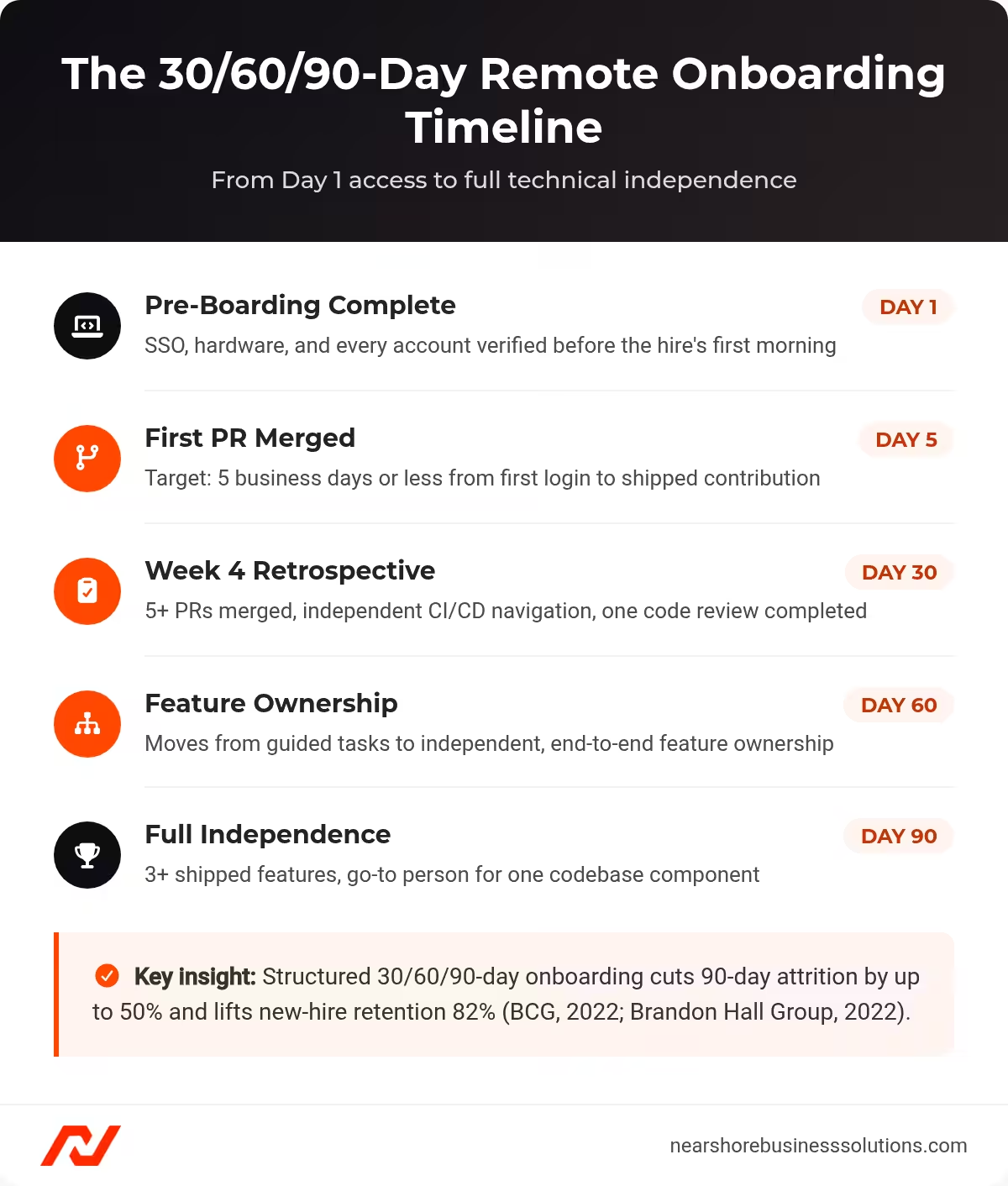
The 30/60/90-day remote onboarding milestone timeline from Day 1 to full independence.
What to Complete Before Day 1: The Pre-Boarding Foundation for Remote Hires
Seven pre-boarding tasks belong in the two weeks before a remote hire’s start date. Each one removes a trust-eroding blocker before Day 1. This assumes your hiring process is already solid. For sourcing and interviewing steps, see our guide to remote hiring best practices.
Complete the following before the engineer’s first morning:
- Finalize the EOR contract, payment currency, and schedule. 75% of companies hiring internationally without a local entity use an Employer of Record (G-P, 2023). Confirm payment currency and align pay dates with local banking norms.
- Ship hardware early enough to confirm delivery receipt. Use a logistics platform like FirstbaseHQ. Require delivery confirmation 72 hours before Day 1, and have a contingency plan ready if tracking shows a delay.
- Pre-load national holidays into the shared team calendar. Mexico mandates 7 public holidays; Colombia mandates 18. A sprint planned on a local holiday signals ignorance, not urgency.
- Provision SSO across the core stack through Okta or JumpCloud. Schedule activation for 9:00 AM in the hire’s local time zone on Day 1. A delayed rollout costs 4 to 6 hours of lost productivity per hire. Automated SSO cuts Day 1 access issues by over 90% (Gartner, 2023).
- Create every account (Email, Slack, GitHub, Jira, Notion) and have IT verify each login 24 hours before Day 1.
- Pre-populate the new hire’s Week 1 calendar. NBS recommends a 60% structured, 40% open split, so meetings do not swallow the week.
- Pair each tool with its own Notion runbook page and Loom walkthrough. Sequence access in layers: Day 1 opens communication tools, Day 2 adds development tools, Day 3 adds project and observability tools.
How Do You Assign the Right Onboarding Buddy?
You assign the right buddy by choosing someone with 6+ months of tenure. They also need 4+ hours of timezone overlap and strong async writing skills. New hires paired with a buddy reach 97% higher productivity by their 90-day mark. Within the first week, buddied hires build 8x more internal connections and report 36% higher satisfaction (Microsoft, 2022). Brief the buddy on four responsibilities:
- A daily async check-in for Weeks 1 to 2
- A daily 15-minute live sync
- Answering questions without redirecting them
- Cultural translation, especially for LATAM hires joining a US-headquartered team
What Goes in the Notion Runbook?
The Notion runbook needs nine required sections, built and shared before Day 1. Over 60% of tech companies already use Notion or Confluence as an internal wiki (Atlassian, 2023). Required sections:
- Company mission and values
- Team org chart with photos, timezones, and preferred channels
- A role-specific 30/60/90-day plan with measurable goals
- Tech stack overview with embedded Loom walkthroughs
- Local dev environment setup guide
- A “first PR” checklist
- Communication norms with response-time expectations
- A “who to ask for what” directory
- An FAQ built from past new hires’ questions
For LATAM hires, add a section using Erin Meyer’s Culture Map framework to explain the team’s direct-feedback norms. Email the runbook link, Day 1 schedule, and manager and buddy introductions five business days before the start date.
How Do You Run the 30-Day Remote Onboarding Checklist From First Login to First Impact?
The 30-day checklist runs from first login to a first shipped contribution. The target for engineers is 5 business days or less. Non-engineering roles get an equally concrete milestone: a first stakeholder presentation, design review, or shipped dashboard. For contractor hires specifically, see our detailed staff augmentation onboarding plan, which covers access provisioning and first-commit logistics.
What Happens During Week 1’s Structured Immersion?
Week 1 caps live meetings at 3 hours per day. Daily 15-minute manager check-ins in the first week produce 23% higher onboarding completion rates than weekly-only touchpoints (Lattice, 2024).
Day 1 schedule, in the hire’s local time zone:
- 9:00 to 9:45 AM. Welcome call with the manager: priorities, role connection, and the 30/60/90-day plan.
- 10:00 to 10:30 AM. IT access verification: log into every account under observation.
- 10:45 to 11:15 AM. First buddy sync, focused on communication norms, no codebase discussion.
- 11:30 AM to 12:30 PM. Notion runbook self-study.
- 1:30 to 3:00 PM. Local dev environment setup, guided by the Notion runbook and Loom walkthroughs.
- 3:00 to 3:30 PM. Virtual coffee with someone outside the immediate team.
- 3:30 to 4:00 PM. End-of-day async check-in on Slack.
Week 1 targets:
- Merge a first PR by Day 5 (a documentation fix, typo, or minor bug that travels the full pipeline)
- Complete 3 to 4 virtual coffees
- Finish every Notion runbook module
- Attend one standup and one sprint ceremony as an observer
What Happens in Weeks 2 and 3: The First Contribution?
The engineering manager curates 5 to 8 starter issues before the hire’s start date. Each needs a well-defined scope, low blast radius, and real production value, plus exposure across two stack layers. For Days 8 to 12, pair the new hire with a senior engineer for one 45-minute session. The senior narrates architectural decisions instead of writing code.
Day 15 milestone: 3 to 5 merged PRs of increasing scope, independent CI/CD pipeline navigation, and one code review for a teammate’s PR. Manager check-ins shift to 2 to 3 weekly 30-minute 1:1s focused on architectural understanding.
What Should the Week 4 Retrospective Cover?
The Week 4 retrospective covers six measurable checkpoints in a dedicated 45-minute 1:1, not a regular check-in. Structured programs with a formal Day 30 check-in raise new hire eNPS by 20 to 30 points (Gartner, 2023).
| Metric | Target | How to Measure |
|---|---|---|
| Time-to-first-PR | ≤ 5 business days | GitHub merge timestamp minus Day 1 |
| Total PRs merged | ≥ 5 (increasing scope) | GitHub merge history |
| Sprint ticket completion | 2 to 3 tickets independently completed | Jira ticket data |
| Tool confidence self-rating | ≥ 7/10 per core tool | Async survey |
| Buddy check-ins completed | ≥ 10 sessions | Buddy log |
| Overall onboarding rating | ≥ 7/10 | Async survey |
Ask three open-ended questions:
- “What’s still unclear?”
- “Where did you feel stuck and not ask for help?”
- “What would have made your first 30 days better?”
A tool score below 7 triggers a remediation session within 48 hours. A time-to-first-PR past 8 days demands root cause analysis: environmental, informational, or interpersonal.
How Does a 90-Day Remote Employee Onboarding Checklist Prevent Early Attrition?
A structured 90-day program improves new hire retention by 82% and productivity by over 70% (Brandon Hall Group, 2022). It also cuts 90-day attrition by up to 50% (BCG, 2022). Nearshore LATAM developers show 15% to 20% lower first-year attrition than offshore developers (per 2023 nearshore industry data), driven by timezone alignment and cultural integration.
What Happens at the 60-Day Checkpoint?
By Day 60, the hire moves from guided tasks to independent, end-to-end feature ownership, or becomes primary reviewer for a teammate’s code. Schedule 3 to 5 cross-team coffee chats with stakeholders from months 3 to 6, which prevents the remote-specific trap of only knowing your immediate team. Manager cadence shifts to weekly coaching 1:1s plus one skip-level with the manager’s manager. The 60-day review runs both directions: the manager gives performance feedback, and the hire critiques the onboarding process itself.
What Are the Day 90 Success Criteria?
By Day 90, a fully onboarded hire meets six concrete criteria, not a vague feeling of “settled in.”
| Dimension | Success Criteria | Evidence |
|---|---|---|
| Technical Independence | Operates independently; go-to person for one codebase component | Manager assessment plus sprint data |
| Meaningful Contributions | 3+ shipped features, fixes, or equivalent deliverables | GitHub/project tool history |
| Cross-Team Network | Relationships with 5+ people outside the immediate team | Self-report plus calendar data |
| Strategic Alignment | Can articulate team goals and how their role contributes | 90-day review conversation |
| Sprint Participation | Contributes actively to planning and design discussions | Manager observation |
| Development Plan | Documented growth plan for months 4 to 12 | Written plan co-created with manager |
The development plan row matters most. Without it, post-90-day drift replaces pre-boarding neglect as the retention risk. A $5,000 structured onboarding program that prevents just one early departure returns roughly 1,500% on that investment (SHRM, 2022). For the full framework connecting hiring, onboarding, and long-term retention, see our guide to hiring, onboarding, and retaining remote talent.
Frequently Asked Questions About Remote Onboarding
These are the questions HR leads and engineering managers ask most often.
How Long Does It Take to Onboard a Remote Developer?
Plan for 90 days to reach independent ownership, with the first shipped contribution by Day 5. Nearshore LATAM hires typically reach their first major contribution in 4 to 6 weeks, faster than the 8 to 12 weeks common for offshore hires (per published nearshore platform data, 2023).
What If a New Hire Doesn’t Ramp Up on Schedule?
A score under 7/10 on any tool triggers a 48-hour remediation session, not a performance flag. A time-to-first-PR past 8 days triggers a root cause review of the blocker: environment, documentation, or team support.
Do I Need to Provide Equipment for a Remote Hire?
Yes. Ship a laptop and peripherals through a logistics platform like FirstbaseHQ, and require delivery confirmation 72 hours before Day 1. A late laptop tells a new hire their start date was an afterthought.
What’s the Difference Between Onboarding a Nearshore Hire and a Domestic Hire?
The core 30/60/90 framework stays the same. Nearshore onboarding adds EOR contracting, local holiday calendars, and payment currency setup, though time zone overlap keeps live collaboration close to a domestic hire’s experience.
Do I Need a Local Entity to Hire in Latin America?
No. 75% of companies hiring internationally without a local entity use an Employer of Record instead (G-P, 2023). An EOR partner handles compliance, payroll, and benefits, so you can onboard within weeks instead of standing up a foreign entity.
What Does a Failed Remote Onboarding Actually Cost?
For a senior engineer earning $120,000, a 90-day quit costs $74,000 to $86,000 once you add recruiting, training, lost productivity, and team disruption (SHRM, 2022; Josh Bersin, 2023). A structured onboarding program is cheap insurance against that loss.
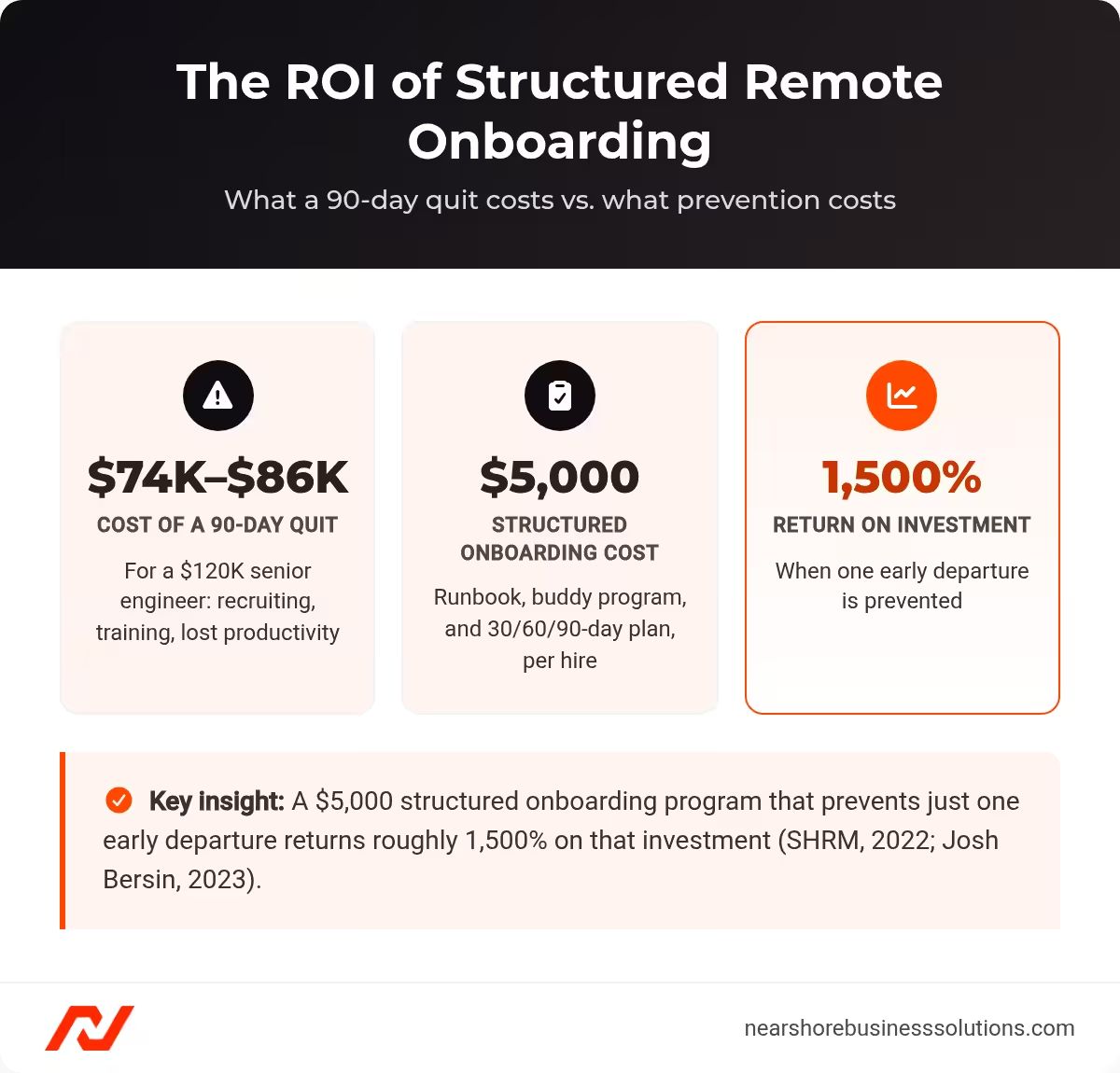
Cost of a failed 90-day onboarding versus the ROI of a structured program.
Ready to Build Your Remote Onboarding Process?
Building a remote onboarding process is faster with a vetted partner. Nearshore Business Solutions sources and vets developers, then helps you get them productive fast. Placements come with a 90-day replacement guarantee and your first pre-vetted candidates within 3 business days.
Get a free consultation to discuss your onboarding needs.