
The global staffing industry hit $638.2 billion in 2023 (Staffing Industry Analysts), and 77% of US tech companies already hire internationally (Remote.com), yet most still pick a vendor by brand name instead of by the model, contingency, retained, RPO, or nearshore, that fits their hiring stage.
This guide compares all four models on fee structure, time-to-fill, and fill rate. It benchmarks true cost-per-hire, including the fees that don’t show up in the pitch deck, and lays out the due-diligence questions that separate a reliable partner from a resume mill. It also covers when a Recruitment as a Service model changes the math entirely.
What Do International Recruitment Agencies Actually Do (And What Don’t They Do)?
International recruitment agencies run a five-step value chain: sourcing, screening, shortlisting, offer management, and, sometimes, compliance and payroll. Demand for that chain is climbing fast: 91% of tech companies planned to hire internationally in 2024 (Terminal.io, State of Global Hiring Report 2024). That “sometimes” matters more than most buyers realize.
A pure-play agency finds and vets candidates, then hands them off. It does not employ them, pay them, file local taxes, or manage benefits. Those responsibilities fall to you, either through your own foreign entity or through an Employer of Record (EOR) provider like Deel, Remote, or Oyster.
EOR platforms have blurred this boundary. Deel Hire, Remote Talent, and Oyster for Hirers now bundle recruitment services on top of their core compliance and payroll infrastructure. Their recruitment fees typically land at a one-time flat rate of $5,000 to $10,000 or 10% to 15% of annual salary. On top of that sits a recurring $599 to $799 per month per employee for ongoing employment management (Deel, Remote, and Oyster pricing pages, 2024). That bundled model eliminates the handoff gap between “we found your candidate” and “your candidate is legally employed and paid on time.”
Understanding where agency scope ends and employer responsibility begins is the single most important filter for choosing between vendor types. Whether you ultimately engage a traditional agency or explore a Recruitment as a Service model, the distinction shapes every downstream decision.
When Don’t You Need an International Recruitment Agency?
You don’t need an agency if you already have strong employer brand in your target market, an internal recruiter with local language skills, and a compliant hiring entity. Zapier demonstrates this path. With over $140 million in ARR and a globally recognized remote-work brand, it built its own international remote talent acquisition function and paired it with Deel for EOR compliance. It scaled dozens of engineering hires across LATAM, with estimated savings of 40% to 50% per hire compared to Bay Area equivalents (Zapier public remote-work disclosures, 2023).
Most companies between $5M and $50M ARR lack that gravitational pull. If your LinkedIn job posts in Bogota or Sao Paulo generate single-digit qualified applicants, you have a sourcing gap that an agency fills immediately. But if you do need one, the model you choose matters more than the brand name.
Which Recruitment Model Fits Your Hiring Stage?
Four models, contingency, retained search, RPO, and nearshore, cover most international hiring needs. Fees range from 10% to 35% of first-year pay depending on which one you pick, and the wrong choice doesn’t just waste budget. It delays roadmap-critical roles by weeks or months.
What Is Contingency Recruitment, and Where Does It Fall Short?
Contingency recruitment charges 20% to 30% of the placed candidate’s first-year salary (Forbes, 2023), averaging 23.5% for international tech roles (Bowdoin Group, 2024 Tech Recruiting Fee Analysis). The agency collects nothing until someone signs and starts. No hire, no fee.
The tradeoff hides in the incentive structure. Contingency recruiters juggle multiple requisitions across multiple clients at once, so fill rates land between 15% and 25% (Hunt Club, 2023). Firms like Michael Page, Robert Half Technology, and Hays Technology operate this model at scale. Average time-to-fill runs 45 to 90 days (SHRM, Time-to-Fill Benchmarks, 2023).
Best for: Backfill and lateral hires in the $80K to $200K salary band where you have internal capacity to screen heavily.
What Is Retained Search, and When Does the Upfront Investment Pay Off?
Retained search flips the payment structure into three installments: one-third at engagement, one-third at shortlist delivery, one-third at placement. The model commands 30% to 35% of first-year total cash compensation (N2Growth, Executive Search Fees Guide, 2024). A VP of Engineering search at $300K total comp generates a $90,000 to $105,000 fee.
That upfront commitment buys exclusivity and depth. Fill rates exceed 90% (N2Growth, 2024), even though time-to-fill deliberately stretches to 90 to 180 days (AESC, State of the Executive Search Industry, 2023). Firms like Korn Ferry, Spencer Stuart, and Heidrick & Struggles run structured assessment processes built for C-suite and hyper-specialized technical roles.
Best for: Leadership hires where a mis-hire costs six figures in lost productivity.
What Is RPO, and How Does Recruitment as a Service Extend It?
Recruitment Process Outsourcing (RPO) replaces per-role purchasing with a metrics-driven partnership. An RPO provider embeds dedicated sourcers and coordinators inside your talent acquisition workflow. Pricing typically runs a monthly management fee of $5,000 to $25,000 or more, plus a cost-per-hire of $5,000 to $15,000 per tech placement, or a blended 10% to 18% per hire (RPO Association, RPO Pricing Models, 2023).
RPO clients report 30 to 60 day average time-to-fill with fill rates above 95% (RPO Association, 2023). The model is growing at a 14.2% CAGR through 2030 (Grand View Research, 2024), the fastest of any recruitment model tracked. Recruitment as a Service (RaaS) productizes this further: a predictable monthly cost and dedicated sourcing capacity without the enterprise-scale minimums traditional RPOs require.
Best for: Companies planning 20+ hires per year who need process consistency and cost predictability.
What Time-Zone and Cost Advantages Does Nearshore Recruitment Offer?
Nearshore recruitment, sourcing talent from Latin America for US teams, grew 160% between H2 2022 and H2 2023 (Deel, Global Hiring Report 2023), making nearshore recruitment the fastest-expanding segment in international hiring. An estimated 42% of US tech companies hiring internationally now actively source in Latin America (Deel, 2023). The region’s IT outsourcing market, valued at $12.7 billion in 2023, is projected to reach $20.5 billion by 2028 (MarketsandMarkets, 2023).
The structural advantages are concrete. Mexico, Colombia, and Costa Rica deliver 7 to 8 hours of full-day overlap with US Eastern and Central time zones. Teams with four or more hours of overlap complete complex, collaborative work 32% faster than teams with little to no overlap (Harvard Business School, “The Power of Proximity,” 2022). That’s why real-time collaboration is the model’s core selling point.
Nearshore specialist agencies, including BairesDev, Terminal, Blue Coding, and Turing, maintain pre-vetted regional talent pools that compress average time-to-fill to 21 to 42 days with fill rates above 85% (Terminal.io, 2024). Fees typically run 18% to 22% of first-year salary or a flat $12,000 to $18,000 for a senior engineer placement.
Best for: Engineering teams that need daily synchronous collaboration at lower cost than domestic hiring.
How Do the Five Models Compare Side by Side?
Contingency is the cheapest to start and the slowest to guarantee a result, while retained search costs the most but fills over 90% of the time. The table below lines up fee range, timeline, and risk across all five structures, including the EOR-bundled option, so you can match a model to a role before you call a single vendor.
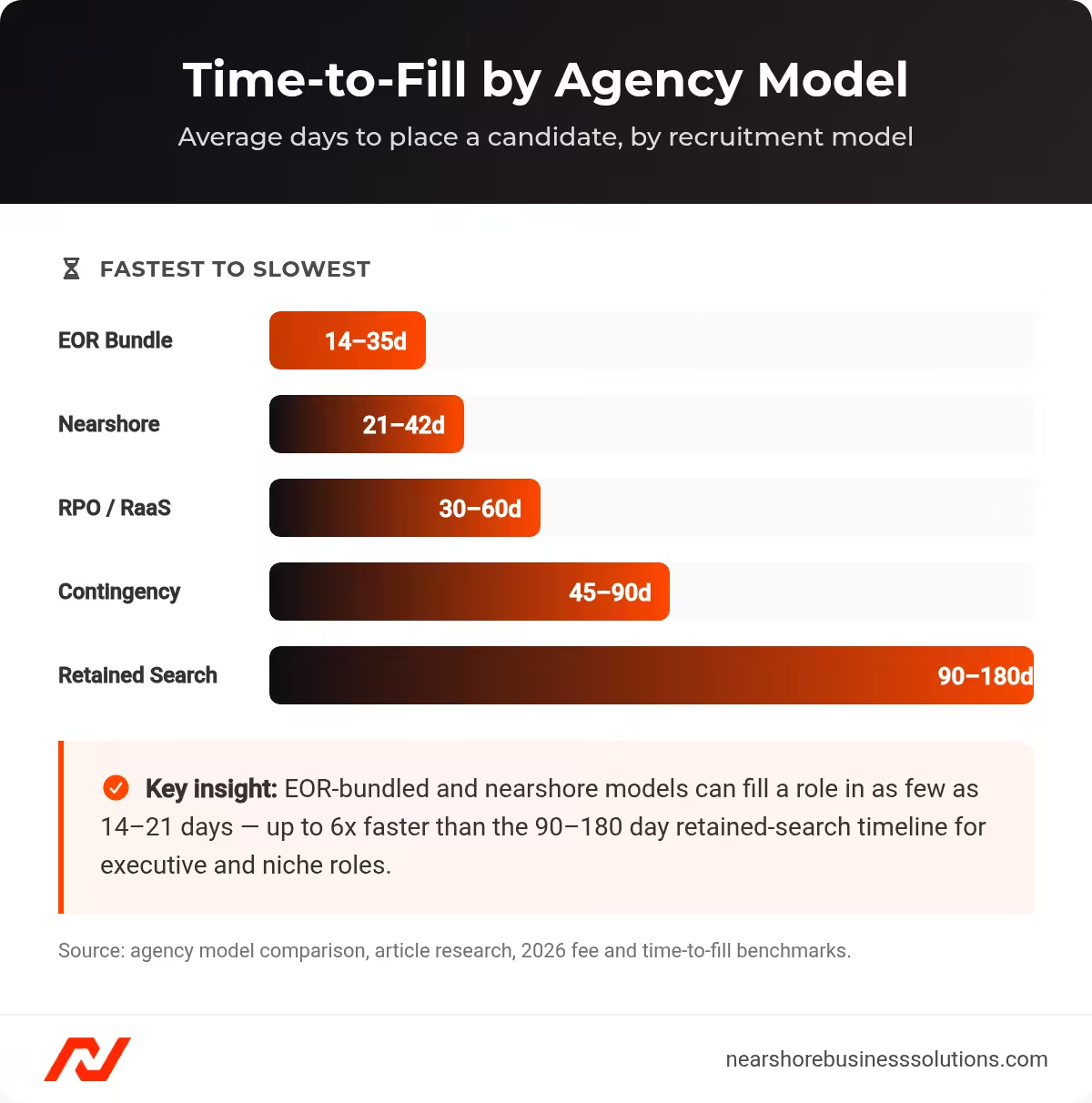
Average time-to-fill in days across five international recruitment agency models, 2026.
| Attribute | Contingency | Retained Search | RPO / RaaS | Nearshore Specialist | EOR + Recruitment |
|---|---|---|---|---|---|
| Typical Fee Range | 20%-30% of salary | 30%-35% of TC | 10%-18% or $5K-$25K/mo + per-hire | 18%-22% or $12K-$18K flat | 10%-15% + $599-$799/mo |
| Best For | Mid-level, non-urgent roles | Executive / niche leadership | High-volume scalable hiring (20+/yr) | Augmenting teams with LATAM talent | All-in-one compliant hiring |
| Avg. Time-to-Fill | 45-90 days | 90-180 days | 30-60 days | 21-42 days | 14-35 days |
| Fill Rate | 15%-25% | 90%+ | 95%+ | 85%+ | N/A |
| Guarantee Period | 60-90 days | 12 months | 90-180 days | 90 days | Varies |
How Much Do International Staffing Agencies Charge in 2026?
International staffing agencies charge anywhere from 10% to 35% of first-year salary, or flat fees between $5,000 and $18,000 per placement, depending on the model and role level. Contingency and nearshore agencies run cheapest per hire. Retained search runs highest because it buys exclusivity.
How Do Percentage, Flat-Fee, and Retainer Pricing Compare?
Percentage-of-salary, flat-fee, and monthly-retainer are the three pricing mechanics international agencies use, and each favors a different hiring volume. Below 5 roles a year, percentage-based pricing is simplest to compare across quotes. At volume, a retainer wins on unit economics.
| Pricing Mechanic | Favors Buyer When | Example Calculation |
|---|---|---|
| Percentage of salary | Hiring fewer than 5 roles/year with zero upfront exposure | Senior Backend Engineer in Mexico at $70K x 20% = $14,000 |
| Flat fee per placement | Salaries exceed the break-even vs. percentage models | EOR-bundled: $8,000 flat + $700/mo = $16,400 year-one total |
| Monthly retainer + per-hire | Volume exceeds 15 hires/year | $10K/mo + $4K/hire x 25 engineers = $8,800 effective CPH |
The percentage model penalizes you for hiring well. When salary rises from $70,000 to $100,000, a 20% fee jumps from $14,000 to $20,000 based on candidate market value, not agency effort. Flat-fee and retainer models decouple recruitment cost from salary inflation, which matters most in markets like Argentina, where currency swings drive frequent USD-denominated salary adjustments.
What Hidden Costs Inflate Your Total Agency Spend?
Headline fees rarely cover your full recruitment spend. The gap hides in line items that surface after contract signature:
- Replacement-guarantee gaps. LATAM tech talent turns over at 18% to 22% annually, versus 15.5% in the US (Mercer, Global Talent Trends 2024). A contingency agency’s 60 to 90 day guarantee covers barely a quarter of that first-year risk. Negotiate guarantees to 180 days minimum with prorated fee refunds.
- Sourcing-tool pass-through fees. Some agencies bill separately for LinkedIn Recruiter seats, assessment-platform licenses, and regional job-board postings like Getonboard or Computrabajo. Ask for an all-in quote before signing.
- Background-check surcharges. Multi-country criminal-record searches and education verification across different accreditation systems often bill per candidate, outside the headline fee. Confirm whether these are included or itemized separately.
- Currency-exchange markups. Cross-border fee transfers and payroll can carry an exchange-rate spread that eats into your salary savings. Ask your agency or EOR partner to disclose that spread in writing before you sign.
- Argentina-specific inflation repricing. EOR providers commonly reprice Argentina payroll fees on a rolling basis because of currency volatility (Deel, Remote, and Oyster pricing pages, 2024). Build a contingency buffer into any multi-year Argentina hiring budget.
How Do You Benchmark Agency Fees Against Your Cost-per-Hire Target?
You benchmark agency fees by dividing total agency spend by hires made, then comparing that blended cost-per-hire against the SHRM domestic average of $4,700. International hiring adds compliance and time-zone coordination costs, but LATAM salary savings of 55% to 68% typically outweigh them (Deel, Terminal.io, and Levels.fyi salary data, 2024).
| Role | US (Onshore) | Mexico | Colombia | Argentina | Brazil |
|---|---|---|---|---|---|
| Senior Full-Stack Engineer | $165,000 | $65,000 | $60,000 | $55,000 | $70,000 |
| DevOps/SRE Engineer | $175,000 | $75,000 | $68,000 | $60,000 | $78,000 |
| Engineering Manager | $220,000 | $90,000 | $85,000 | $75,000 | $95,000 |
Worked benchmark: Senior Full-Stack Engineer, Colombia vs. US. Colombia total (salary $60,000 plus a 20% agency fee of $12,000 plus an EOR fee of $8,400 at $700 per month) equals $80,400. US total ($165,000 salary plus the $4,700 SHRM cost-per-hire) equals $169,700. Net savings: $89,300 per hire.
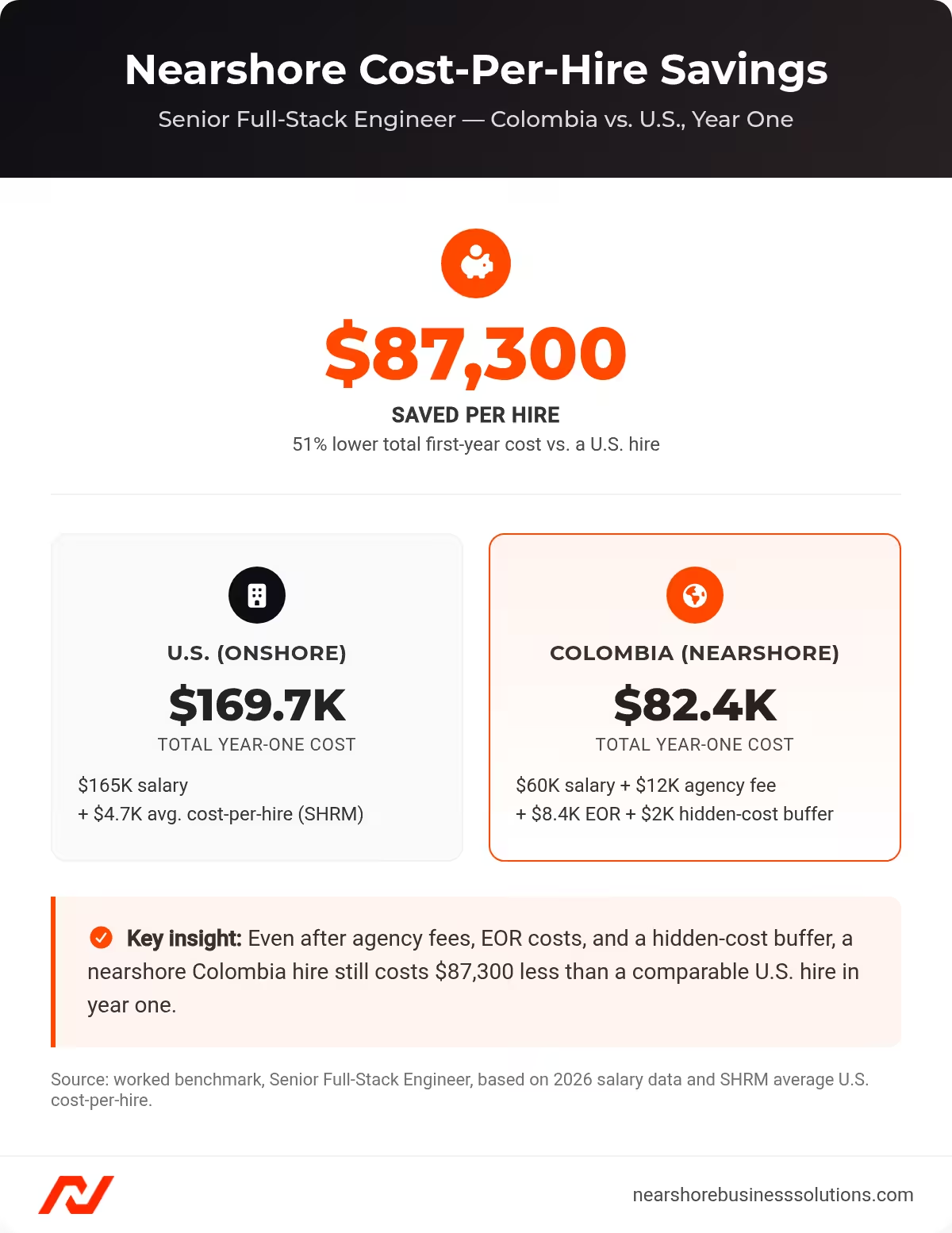
Total year-one hiring cost for a senior engineer, Colombia vs. U.S., including all fees.
The table below is a starting point, not a rule, for matching hiring volume to model:
| Annual Hires | Recommended Starting Point | Target Blended CPH | Target Savings vs. US |
|---|---|---|---|
| 1-4 | Contingency or nearshore flat-fee | $12,000-$18,000 | 45%-55% per role |
| 5-14 | Nearshore flat-fee or hybrid | $10,000-$15,000 | 50%-60% per role |
| 15-30 | RPO/RaaS retainer | $7,500-$10,000 | 55%-65% per role |
| 30+ | Embedded RPO with dedicated LATAM pod | $5,500-$8,800 | 60%-68% per role |
How Do You Choose the Right International Recruitment Agency for Your Team?
Choose an international recruitment agency by testing candidate quality first, the criterion 45% of mid-market HR leaders rank highest (Aptitude Research, 2023), then time-to-fill (28%) and cost-effectiveness (15%), with specialization (12%) close behind. That hierarchy should govern your evaluation, though most vendor comparisons start with price instead, which is how companies end up with a cheap agency that delivers unscreenable resumes eight weeks late.
What Five Due-Diligence Questions Should You Ask Before Signing?
Ask these five questions before you sign any contract, and score every answer against the green-flag and red-flag patterns below.
| # | Question | Green-Flag Answer | Red-Flag Answer |
|---|---|---|---|
| 1 | “What is your average time-to-fill for [role] in [country]?” | Specific median figure within a 30-day range, backed by placement data | “It depends” without supporting metrics |
| 2 | “Do you provide EOR services, partner with one, or leave compliance to us?” | Names their EOR partner with bundled pricing | “We don’t handle that” with no guidance |
| 3 | “What is your replacement guarantee window and refund policy?” | 180+ days with prorated refund formula | 60-day guarantee, replacement-search-only terms |
| 4 | “Can you share anonymized pipeline metrics for comparable searches?” | 200+ sourced, 30-40 screened, 8-12 submitted, 1-2 offers | No tracked metrics or vague database claims |
| 5 | “How do you handle salary benchmarking, and what data sources?” | References Deel, Terminal.io, Levels.fyi with country-level granularity | Single global database without local adjustment |
Agencies that specialize, whether in IT recruitment or a single LATAM market, consistently score higher on questions 1 and 4 than generalist firms working every industry at once.
Disqualification criteria: Any agency that cannot answer questions 1, 3, and 4 with specific data, not anecdotes, lacks the operational rigor to protect your investment. Walk away and evaluate the next vendor.
Frequently Asked Questions About International Recruitment Agencies
These are the questions HR leads ask most before signing with an international recruitment agency.
How Long Does It Take an Agency to Fill an International Role?
It ranges from 14 to 180 days depending on the model. EOR-bundled marketplaces fill in 14 to 35 days, and nearshore specialists fill in 21 to 42 days. Contingency firms take 45 to 90 days, and retained search deliberately takes 90 to 180 days to protect fill quality on senior roles.
What Happens If a Placed Candidate Doesn’t Work Out?
Your recourse depends on the guarantee window you negotiated. Most contingency agencies offer 60 to 90 days, which covers only a fraction of the 18% to 22% annual turnover rate in LATAM tech talent (Mercer, 2024). Push every contract to 180 days minimum with a prorated refund clause.
Do I Need a Local Entity to Hire Internationally?
No, not if you pair an agency with an Employer of Record. An EOR becomes the legal employer in-country, handling payroll, taxes, and compliance for a recurring fee of $599 to $799 per month per employee, so you can hire without ever incorporating abroad.
How Is Nearshore Recruitment Different From Offshore Recruitment?
Nearshore recruitment sources from Latin America, giving US teams 6 to 8 hours of same-day overlap and 32% faster task completion on collaborative work (Harvard Business School, 2022). Offshore recruitment typically sources from regions with far larger time gaps, trading real-time collaboration for a different cost profile.
How Do I Pay the Agency and the Employee Once Hired?
You pay the agency its placement or retainer fee directly, on the schedule set in your contract. You pay the employee through your own foreign entity or, more commonly, through an EOR partner that runs local payroll and tax withholding on your behalf.
What’s the Difference Between Contingency and Retained Search?
Contingency is pay-on-success, with fees of 20% to 30% and no upfront cost, but fill rates of only 15% to 25%. Retained search is paid in three installments up front, costs 30% to 35% of total comp, and closes over 90% of searches because the engagement is exclusive.
Is RPO Worth It If I’m Only Hiring a Few Roles This Year?
Usually not. RPO’s monthly management fee of $5,000 to $25,000 only pencils out against 20 or more hires a year. Below that volume, a contingency or nearshore flat-fee model delivers a lower blended cost-per-hire without the 12-month commitment RPO typically requires.
Ready to Skip the Guesswork on Your Next International Hire?
Nearshore Business Solutions runs a Recruitment as a Service model built for HR leads who need a predictable cost per hire, not a placement-fee gamble. We source and vet nearshore engineering talent, screen for technical skill, English fluency, and US work-style fit, and back every placement with a 90-day replacement guarantee.
Talk to our team about Recruitment as a Service to see a predictable monthly cost model instead of a placement-fee surprise.