
Grand View Research values the global IT outsourcing market at $586.6 billion, and Gartner finds 72% of US tech companies now run distributed engineering teams. The US Bureau of Labor Statistics projects demand for 1.2 million new developers against just 65,000 annual computer science graduates, a gap only distributed teams can close.
Google’s State of DevOps research found zero correlation between team location and engineering performance. This playbook gives CTOs the operating model, sprint rituals, tooling stack, and DORA framework to run offshore teams as true engineering extensions, not vendor relationships.
You’ll find a RACI matrix, a three-tier communication protocol, and DORA benchmarks from Eventbrite’s 100-engineer Mendoza, Argentina office and a FinTech company that moved from Medium to High DORA performance in nine months. The plan closes with a 90-day launch sequence for your first offshore pod.
Why Most CTOs Fail at Managing Offshore Development Teams Before They Even Start
Two mental models drive offshore outcomes: vendor management, optimized for deliverables and SLAs, and distributed engineering leadership, optimized for shared context and collective code ownership. Fix the mental model first.
Vendor Mindset vs. Integrated-Team Mindset
Vendor management measures deliverables. Integrated management measures shared outcomes, and only one scales past a handful of engineers. Google’s State of DevOps research found zero correlation between team location and performance: the real predictors are practices, not geography, like CI/CD maturity, trunk-based development, loosely coupled architecture, and psychological safety.
Eventbrite proved the integrated model scales. The company grew its Mendoza, Argentina office to over 100 engineers with full ownership of major product lines. That structure cut per-engineer costs an estimated 50-60% and time-to-hire from 90-plus days in San Francisco to roughly 45 days in Argentina, according to Eventbrite’s Engineering Blog. See our nearshore team implementation guide for a step-by-step framework.
| Dimension | Vendor Mindset | Integrated-Team Mindset |
|---|---|---|
| Backlog Ownership | Onshore defines, offshore executes | Shared backlog; all engineers pull from one queue |
| Code Review Model | Post-handoff review; delayed by timezone gaps | Cross-pod PR reviews in real time |
| Deployment Access | Restricted to onshore | Unified pipeline; any qualified engineer deploys |
| Definition of Done | Ambiguous across locations | Explicit: code merged, tests green, monitoring confirmed |
| Escalation Path | Through account managers; context lost | Direct engineer-to-engineer, like any co-located team |
If your current offshore engagement matches three or more items in the vendor column, restructure before adding headcount.
The Hidden Cost of Ambiguous Ownership: Why You Need RACI Before You Need Jira
Ambiguous ownership between onshore architects and offshore developers causes the costliest failure mode in distributed teams: rework from unstated assumptions. RACI forces explicit answers before any code ships.
| Task / Deliverable | US Product Manager | US Eng Lead / Architect | Nearshore Tech Lead | Nearshore Engineers |
|---|---|---|---|---|
| Define User Story & Acceptance Criteria | Responsible | Accountable | Consulted | Informed |
| Technical Design / Architecture | Consulted | Accountable | Responsible | Consulted |
| Code Implementation & Unit Tests | Informed | Informed | Accountable | Responsible |
| Code Review (PR Approval) | Informed | Responsible | Responsible | Consulted |
| Deployment to Production | Informed | Accountable | Responsible | Informed |
Build your RACI during the first week of engagement, not after the first failed sprint. For broader fundamentals on leading distributed staff, see our guide to managing a remote team.
Overlap Hours Are Non-Negotiable
UC Irvine and Microsoft Research put 4 hours of synchronous overlap as the minimum for complex software development; 5-6 hours produces the highest productivity and satisfaction scores.
| US Time Zone | Mexico City (CST) | Bogotá (COT) | Buenos Aires (ART) | São Paulo (BRT) |
|---|---|---|---|---|
| Eastern (ET) | 1 hr behind | Same time | 2 hrs ahead | 2 hrs ahead |
| Central (CT) | Same time | 1 hr ahead | 3 hrs ahead | 3 hrs ahead |
| Pacific (PT) | 2 hrs ahead | 3 hrs ahead | 5 hrs ahead | 5 hrs ahead |
Latin America delivers 5-8 hours of natural overlap with US business hours, versus 0-1.5 hours for India and 0 for the Philippines. At that low end, a feature needing three review iterations loses a full week to timezone lag.
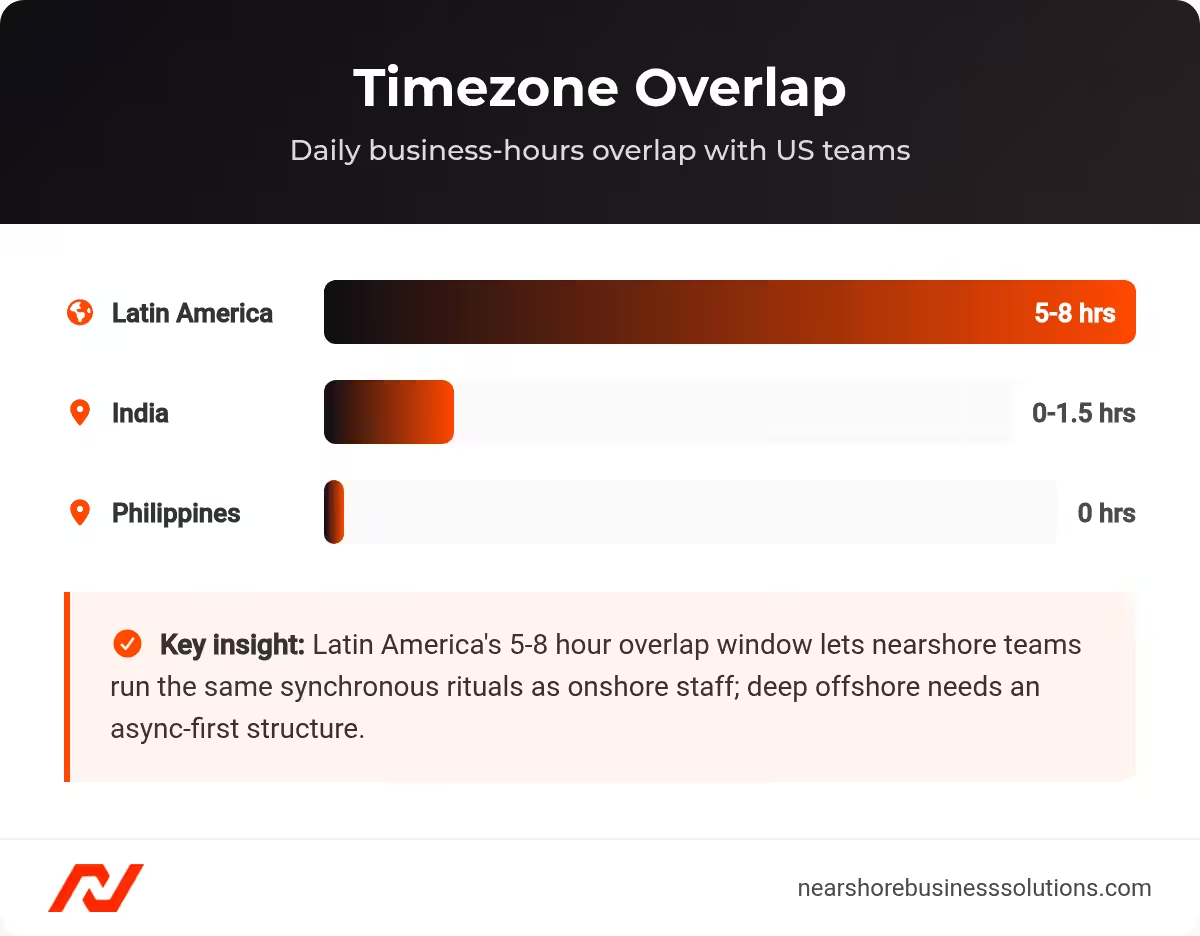
Daily overlap hours with US business time: Latin America versus India and the Philippines.
How Do You Structure Sprint Rituals for a Distributed Development Team?
61% of Agile teams run two-week sprints (Source: Atlassian, 2023 State of Agile Report), a cadence that holds whether a team sits in one office or spans three countries. Ritual design is what breaks distributed teams: context that travels by osmosis in an office must be engineered explicitly. See our guide to agile team structure for the roles behind these ceremonies.
Async-First Standups That Actually Surface Blockers
Replace the daily standup with structured written updates posted before the overlap window opens, paired with a blocker-buster call 2-3 times per week.
| Field | Description | Example Entry |
|---|---|---|
| Yesterday (Completed) | Tasks finished, with PR links | Completed auth token refresh; PR #482 submitted |
| Today (Planned) | Concrete deliverables | Implement rate limiting on /api/v2/users (PLAT-1147) |
| Blocked | Blocker + who can unblock | PR #471 in review 26 hours, need @david.chen |
| Confidence Score | 1–5 likelihood of hitting commitment | 2: blocked PR is on critical path for two stories |
The Confidence Score is the most diagnostic field: a team averaging 4.2 on Monday that drops to 2.8 by Wednesday has a sprint commitment problem. Schedule the blocker-buster at 11:00 AM ET, giving Latin American engineers 1-2 hours to review overnight PRs first.
Sprint Planning: The “Pre-Read + Live Refine” Model
A 2023 Loom report found that recorded walkthroughs cut meeting time by 25%. Applied to sprint planning, the savings run larger.
Phase 1 (Async): The Product Manager records a 15-20 minute backlog walkthrough 24 hours out. Engineers comment on tickets, and the nearshore tech lead consolidates a pre-read summary.
Phase 2 (Live, 60 minutes): Schedule mid-overlap at 1:00 PM ET. Batch-estimate aligned stories in 15 minutes, discuss design-heavy stories for 30, then resolve dependencies in the final 15.
Sprint planning drops from 3+ synchronous hours to 60 focused minutes. The nearshore team shapes the work instead of just receiving it.
Retrospectives Anchored to DORA Metrics
Anchor retrospectives to DORA trends. The retro question changes from “what didn’t go well?” to “lead time increased from 2.1 to 4.8 days: what systemic bottleneck caused it?”
Every action item needs an owner, a deadline, and a success criterion: “improve communication” becomes “cut PR review latency from 36 to under 8 hours.” Rotate the facilitator between onshore and nearshore engineers each sprint, a practice GitLab’s handbook documents explicitly.
What Tooling Stack Makes or Breaks Offshore Team Management?
Three tools decide whether your offshore stack scales: Jira for a shared backlog, Slack for tiered communication, and one CI/CD pipeline with no location-based gates. Misconfigure any one, and you’ve encoded the vendor mindset into your infrastructure.
Jira Configuration for Multi-Pod Visibility
Jira holds an estimated 65% market share among mid-to-large tech companies (Source: G2 Grid, Q1 2024). LinearB’s Engineering Benchmarks Report finds simple, well-defined workflows produce the lowest cycle times. Elaborate workflows (10+ statuses, approval gates at every step) produce the highest cycle times and lowest satisfaction.
Use a single board with swimlanes by assignee or team label. Five workflow columns handle every distributed team’s needs:
| Workflow State | Handoff Trigger | Automation |
|---|---|---|
| To Do | Sprint planning assigns engineer | Auto-assign based on sprint start |
| In Progress | Engineer pulls ticket | Slack notification to pod channel |
| In Review | PR opened and linked to ticket | Auto-transition via GitHub integration |
| In QA | PR approved and merged to staging | Auto-assign to QA rotation |
| Done | Deployment confirmed | Auto-transition via CI/CD webhook |
Enforce four required fields at ticket creation: Story Points, Epic Link, Assignee, and Acceptance Criteria. Avoid states like “Ready for Offshore Dev” or “Waiting for Onshore Approval”: they encode a location hierarchy.
Unifying Your CI/CD Pipeline So Location Becomes Invisible
The strongest signal of true integration: a nearshore engineer pushes code, passes automated checks, deploys to staging, and promotes to production without asking anyone onshore. Sleuth reports up to 3x deployment frequency gains from eliminating manual gates.
Five requirements make a pipeline location-invisible:
- Shared repository access with identical permissions
- Environment parity across dev, staging, and production
- Automated quality gates that replace human gatekeeping
- Self-service staging deployment, with feature flags decoupling release
- Unified observability, with equal monitoring access from day one
Meet all five, and location becomes invisible to the codebase.
Communication Protocols: A Three-Tier Framework
85% of tech companies use Slack (Source: Okta, Businesses at Work 2024), but channel discipline, not availability, is the real problem. Structure communication into three explicit tiers:
| Tier | Type | SLA | Use Cases |
|---|---|---|---|
| Tier 1 | Async | <4 hours | Non-blocking questions, status updates, FYI via Slack threads and Jira comments |
| Tier 2 | Scheduled Sync | Daily during overlap | Blocker-buster calls, sprint ceremonies, design reviews via Zoom |
| Tier 3 | Escalation | <1 hour | Production incidents, security issues, customer outages via PagerDuty and Slack DM |
Document these tiers in a shared wiki so both teams share identical expectations. Notion or Confluence should be the source of truth for architecture decisions. See our guide to nearshore team communication protocols for a deeper framework.
What DORA Metrics Should You Track for Distributed Team Management?
The four DORA metrics to track are deployment frequency, lead time for changes, change failure rate, and mean time to recovery. Google’s State of DevOps research validated these as the strongest predictors of engineering performance, with no adjustment for distributed teams.
The Four DORA Metrics for Offshore Pod Performance
| Metric | Elite | High | Medium | Low |
|---|---|---|---|---|
| Deployment Frequency | Multiple deploys/day | Daily to weekly | Weekly to monthly | Less than monthly |
| Lead Time for Changes | Less than one day | One day to one week | One week to one month | One to six months |
| Change Failure Rate | 0–15% | 16–30% | 16–30% | 46–60% |
| Mean Time to Recovery | Less than one hour | Less than one day | One day to one week | More than one week |
A US FinTech company built a nearshore DevOps team in Colombia and within 9 months moved from Medium to High DORA performance. Deployment frequency rose from biweekly to 3-4 times a week, and lead time dropped to under 2 days.
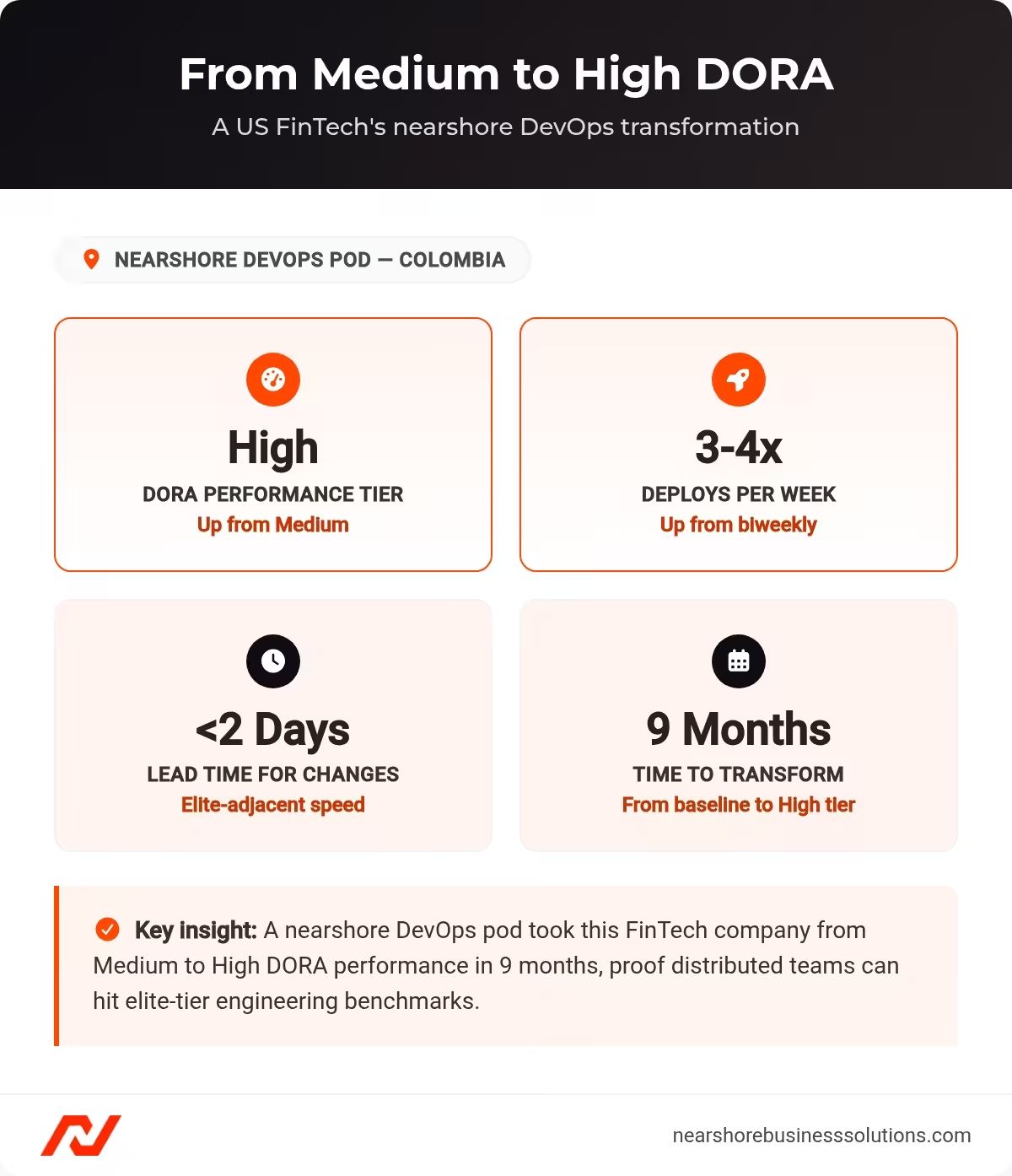
FinTech case study: DORA performance jump from Medium to High in 9 months.
Beyond DORA: Complementary Health Indicators
| KPI | Elite Benchmark | What It Reveals in a Distributed Context |
|---|---|---|
| PR Review Turnaround | Under 4 hours | Strongest indicator of cross-pod collaboration; timezone lag drives most delays |
| Sprint Predictability (Say-Do Ratio) | 80–90% | Low ratio signals estimation issues common in a new pod’s sprints |
| Cycle Time (Coding → Production) | Varies by phase | PR pickup and review time inflate with timezone gaps |
| Developer Satisfaction (DX Score) | Tracked as trend | Early warning for disengagement before it hits velocity |
LinearB case studies report a 45% average Cycle Time reduction and 60% PR merge speed increase within 6 months, from fixing review bottlenecks. Velocity drops 15-20% for two sprints when a developer leaves (Source: Code Climate, 2023), making retention a major driver of predictable output.
Share dashboards bidirectionally, and let the offshore team set its own improvement targets per sprint. Metrics used for coaching build trust; metrics used for surveillance destroy it.
How Do You Build a 90-Day Launch Plan for Your Offshore Team?
A 90-day launch plan runs three 30-day phases: integrate before expecting output, calibrate rituals and metrics against baselines, then transfer ownership and build the ROI case.
Days 1–30: Integrate Before You Build
- Define RACI for the first project
- Configure a single Jira board with shared workflow
- Grant full CI/CD access: staging deployments start Day 1
- Establish the three-tier communication protocol in a shared wiki
- Set up async standup tooling
- Instrument DORA metric collection and run baselines
- Schedule overlap-hour blocker-buster calls 3x/week
- Assign a well-scoped, non-critical onboarding feature
- Run a “ways of working” kickoff on feedback norms and escalation paths
Onboarding a new developer takes 3-6 months to reach full productivity. The first month is about integration, not output.
Days 31–60: Calibrate and Read Signals
- Run the first sprint using Pre-Read + Live Refine planning
- Review async standup entries for real blockers, not status theater
- Run the first retrospective anchored to Day 30 DORA baselines
- Compare velocity to baseline: expect 40-60% of steady-state (Source: Pluralsight/GitPrime engineering-workforce analysis)
- Audit PR review turnaround; adjust review pairing if over 8 hours
- Watch for shadow backlog: work the onshore team routes around the pod
- Hold first 1:1s between onshore and offshore tech leads on calibration, not performance
Days 61–90: Transfer Ownership and Build the ROI Case
- Assign end-to-end ownership of at least one service or feature area to the offshore pod
- Include nearshore tech leads in PagerDuty on-call rotations
- Package DORA improvements and velocity trends into a board narrative
- Compare fully loaded costs: $247,000-$285,000 for a $190K US senior engineer (1.3-1.5x fully loaded) versus $90,000-$101,250 for a $75K LATAM senior engineer (1.2-1.35x fully loaded), per Remote.com’s 2024 Employee Cost Calculator
- Plan the first quarterly in-person meetup, feasible for nearshore teams and a proven trust accelerator
- Set 6-month targets using the FinTech trajectory: Medium to High DORA within 9 months
The talent gap isn’t closing. The teams that win in 2026 will be the ones who built distributed engineering organizations that perform identically regardless of where each engineer sits. If you need a distributed engineering partner that operates inside your sprint from Day 1, that’s the team to build next.
Frequently Asked Questions About Managing Offshore Development Teams
CTOs ask these questions most often about offshore team management.
How long does it take to stand up an offshore development pod?
You’ll have your first vetted candidates within 3 business days. Add the 30-day integration phase above, and a pod reaches full productivity in 3-6 months.
What happens if an offshore developer doesn’t work out?
A structured RACI and 90-day plan surface issues within 30-60 days. Most staffing partners include a replacement guarantee, so you can swap the developer without restarting sourcing.
Do offshore engineers need the same tools and access as onshore engineers?
Yes. Identical CI/CD permissions, the same Jira board, and equal monitoring access from Day 1. Restricting access by location is the clearest vendor-mindset signal.
How do you handle payroll, contracts, and legal entities for offshore developers?
Most US companies use a staffing or employer-of-record partner instead of opening a foreign entity. Engineers stay on local, compliant contracts while you manage their work inside your own Jira board.
What’s the difference between managing a nearshore team and an offshore team?
Nearshore teams in Latin America offer 5-8 hours of daily overlap with US time zones, versus 0-1.5 hours with India or the Philippines. That overlap lets nearshore teams run the same synchronous rituals as onshore staff; deep offshore needs an async-first structure.
Ready to Build Your Offshore Engineering Team?
Nearshore Business Solutions sources and vets developers across Latin America, screening for technical skills, English fluency, and US work style fit.
Every placement includes a 90-day replacement guarantee. You receive the first pre-vetted candidates within 3 business days.
Talk to our staff augmentation team to discuss your engineering capacity needs.