
Structured nearshore communication protocols reduce project risk by 70%, recover $94,500 per $1M in spend, and cut feature cycle times by 32%, according to PMI and nearshore industry research.
Teams in Mexico City, Bogota, and Medellin share 6-8 hours of overlap with US offices. That window is the core nearshore advantage. Without a formal protocol stack, that overlap disappears into status meetings and unblocked Slack threads. With one, it becomes your highest-output engineering hours.
This playbook covers the DACI decision framework, overlap window design, async update formats, weekly cadences, and escalation tiers. It’s built for VP Engineering and CTO-level leaders scaling teams across Mexico and Colombia.
Why Do Remote Team Communication Frameworks Fail at Scale?
Most distributed team protocols fail nearshore teams because they borrow from fully-remote playbooks built for 12-hour timezone gaps. Teams in Mexico City or Bogota share 6-8 hours of working overlap with US East Coast offices. Applying async-only protocols to those teams wastes that overlap window.
PMI’s 2023 Pulse of the Profession found that $135,000 of every $1M in project spend is at risk due to ineffective communication. Implementing formal protocols cuts that risk by 70%, recovering $94,500 per million. Grammarly’s 2024 State of Business Communication report estimates $1.2 trillion in annual losses to poor US workplace communication. The failure is structural, not cultural.
What Is the “Copy-Paste Remote” Anti-Pattern?
The copy-paste remote anti-pattern applies 100%-async protocols to nearshore teams that share a substantial timezone overlap. Teams with 4-6 hours of overlap resolve bugs 21% faster than teams with 1-2 hours, per Microsoft Research (Bird et al., 2022). A Mexico City team paired with Austin loses that advantage when engineers default to async PR queues instead of a 20-minute sync session.
Research in the Journal of Software: Evolution and Process (Feb 2023) found that high-overlap teams posted 15% higher weekly commit frequency and 12% lower code integration conflict rates compared to low-overlap teams using async handoffs. DORA’s 2023 State of DevOps Report found that teams able to resolve blockers in real time were 2.5x more likely to qualify as “high performers” on deployment frequency.
The fix is a hybrid-sync architecture: async for context, sync for decisions.
| Attribute | Fully Remote Protocol (12+ hr gap) | Nearshore-Adapted Protocol (1-4 hr gap) |
|---|---|---|
| Default communication mode | Async-first: written docs, recorded video | Hybrid-sync: async for context, sync for decisions |
| Decision-making speed | 2-5 day async RFC cycle | Same-day decision via sync meeting plus async ratification doc |
| Meeting format | Recorded standup video | Live 15-min standup in overlap window |
| Blocker resolution | Queued in Slack, next-day review | Real-time pair session during core band |
How Does Communication Debt Compound Sprint Over Sprint?
Communication debt costs 45% of project delays in distributed teams, per PMI’s 2023 data. Every sprint that ships without resolving who owns a decision adds unresolved ambiguity. That ambiguity silently degrades cycle time and deployment frequency.
GitLab’s 2023 Remote Work Report found that 60% of distributed teams report an “us vs. them” divide. Teams with formal communication frameworks had a 28% lower rework rate and 35% faster ramp-up for new hires. The cure is protocol documentation, not team-building events.
For teams managing distributed team protocols across Mexico and Colombia, the compounding effect is especially acute. Hofstede data shows Mexico scores 82 and Colombia scores 80 on Uncertainty Avoidance, versus 46 for the US. Engineers from both countries have a measurably higher preference for clarity and defined requirements. Ambiguous specs generate more friction in Bogota than in Austin. These cultural gaps are exactly what strong international business communication practices are built to bridge.
How Do You Design Overlap Windows for LATAM Time Zones?
The right overlap window design protects 5+ hours of deep-work time while concentrating synchronous interaction into a 3-hour core band. A single interruption costs an average 23 minutes of recovery time, per Gloria Mark at UC Irvine (2023). Managers in distributed teams spend 8 or more hours per week more in meetings than co-located teams, per Microsoft Work Trend Index 2023. The overlap window, left undesigned, becomes the source of that surplus.
How Do You Map Effective Overlap for Mexico, Colombia, and U.S. Time Zones?
Identify a 3-hour core collaboration band positioned when both sides are warmed up and neither is winding down. Colombia’s UTC-5 offset gives full 8-hour overlap with US East Coast, making Bogota and Medellin the most overlap-rich nearshore corridors. For more on time zones across the region, see our guide to time zones in South America.
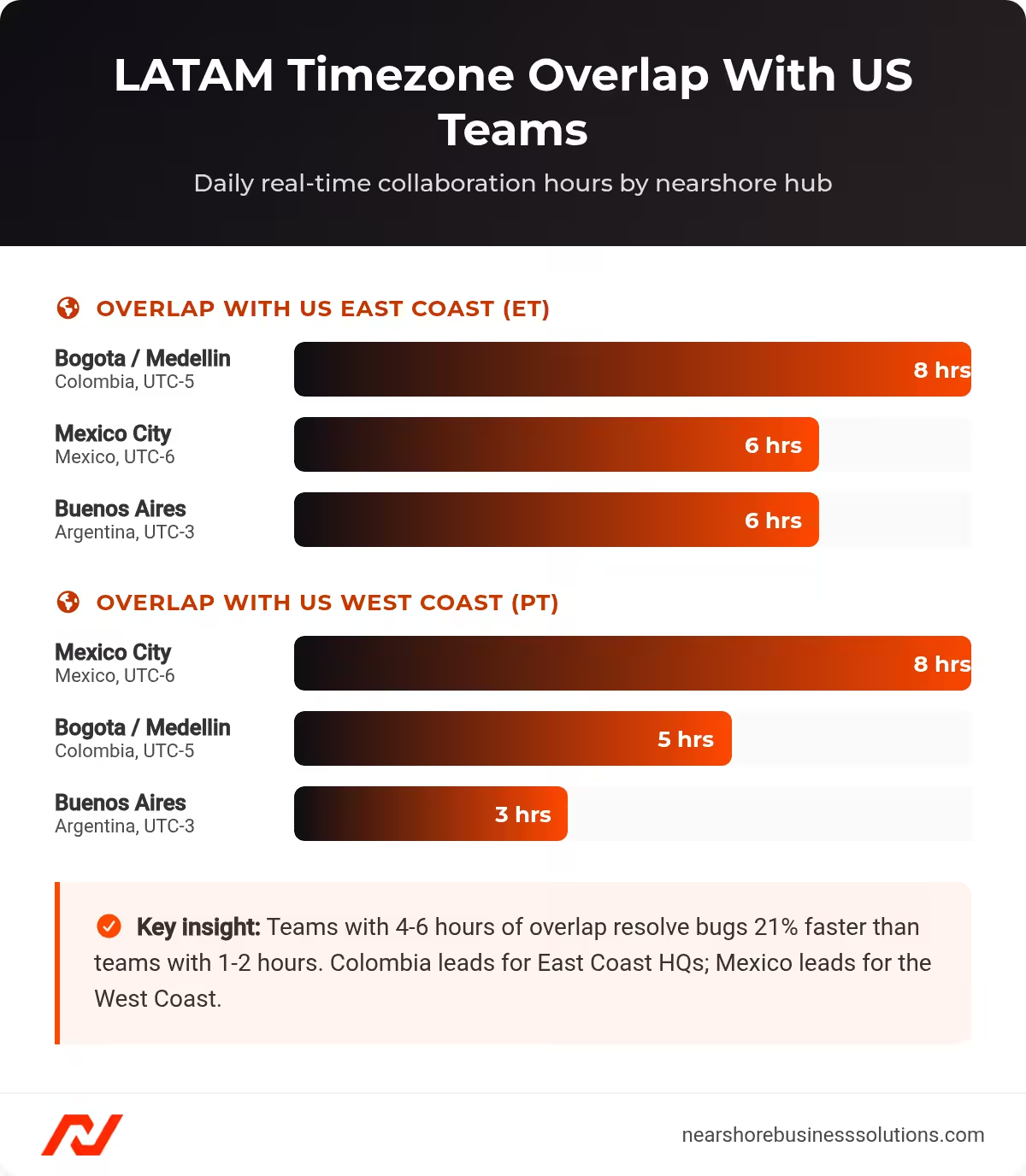
Daily real-time overlap hours between LATAM hubs and US East and West Coast teams.
| LATAM Tech Hub | UTC Offset | Overlap with US East (ET) | Overlap with US West (PT) | Recommended Core Band |
|---|---|---|---|---|
| Mexico City / Guadalajara | UTC-6 | 6 hours | 8 hours | 10 AM-1 PM CT |
| Bogota / Medellin | UTC-5 | 8 hours | 5 hours | 10 AM-1 PM ET |
| Buenos Aires / Sao Paulo | UTC-3 | 6 hours | 3 hours | 10 AM-1 PM ART/BRT |
Mexico corridors offer the widest scheduling flexibility. The risk is over-synchronization, not under. Colombia corridors hit the sweet spot for East Coast headquarters. Buenos Aires and Sao Paulo require the most discipline: only 3 hours of West Coast overlap.
How Should You Structure Sync Blocks and Async Blocks Each Day?
Structure each working day into two distinct modes. Sync blocks during the overlap window handle decisions, unblocking, and pairing. Async blocks outside overlap handle deep-work execution.
A sample day for a senior backend engineer in Bogota working with New York:
| Time (Bogota) | Time (New York) | Mode | Activity |
|---|---|---|---|
| 7:00-9:00 AM | — | Async | Deep work: feature implementation, PR reviews |
| 9:00-9:15 AM | 9:00-9:15 AM | Sync | Daily standup (15 min) |
| 10:00 AM-1:00 PM | 10:00 AM-1:00 PM | Core Band | Pair programming, design reviews, 1:1s |
| 1:00-2:00 PM | 1:00-2:00 PM | Open Corridor | Office hours for ad-hoc huddles |
| 2:00-5:00 PM | — | Async | Ship code, write ADRs, document decisions |
This delivers 5 hours of uninterrupted async execution and concentrates synchronous interaction into a window with 15 minutes of mandatory meetings.
No more than 40% of overlap hours should be formally scheduled. For a 3-hour core band, that is a ceiling of 72 minutes of calendar-blocked meetings per day. Atlassian reported a 30% reduction in meetings needed for project decisions after implementing DACI frameworks. Enforce this with three controls: audit recurring meetings monthly, require an agenda and goal type for every meeting, and time-box aggressively. Pairing those controls with a shared set of online meeting etiquette rules keeps the synchronous time that survives the audit focused and respectful across time zones.
How Do You Build Async Protocols That Eliminate Cross-Border Bottlenecks?
Documented async-first protocols with Colombian and Costa Rican nearshore engineers produced a 25% decrease in unplanned urgent Slack messages, per Gorilla Logic (2023). The reduction came from structural clarity. US teams implementing async communication LATAM protocols reduce the number of context-loss events that slow sprint delivery.
Teams with a well-maintained knowledge base onboard new engineers 33% faster, per GitLab’s 2023 Remote Work Report. The average knowledge worker spends 6 hours per week clarifying ambiguous communications, per HBR Analytic Services (May 2023). For a 20-person team, that is 6,240 hours of lost productivity per year.
What Is the 3-Part Async Update Framework?
The 3-part async update framework replaces rambling Slack messages and status-update meetings. Every async update follows this sequence: Context, Decision, Blocker.
- Context: What was accomplished, with specific deliverables and links to artifacts.
- Decision: What was decided or proposed, with reasoning and a named Approver if approval is needed.
- Blocker: What is stalled, who specifically can unblock it, and the deadline for sprint impact.
Apply the same format to PRs (include Loom walkthroughs and testing evidence), RFCs for architectural decisions (published 48-72 hours before synchronous review), and a single source of truth in Notion or Linear.
What Is the Right Tool for Each Communication Channel?
Each async channel serves a distinct purpose. Using the wrong tool for a task is itself a communication failure.
| Tool | Best For | Response SLA | Protocol Rule |
|---|---|---|---|
| Loom | Code walkthroughs, design rationale | N/A (async consumption) | Record instead of scheduling a meeting. Always include a written summary. |
| Slack | Time-sensitive coordination, daily async standups | 4 hrs (DMs), 24 hrs (channels) | No decisions in DMs. Enforce channel prefixes: #proj-, #feat-, #team-. |
| Notion / Confluence | Durable decisions, specs, RFCs, DACI logs | N/A (reference) | Single source of truth. If it is not in the doc, it did not happen. |
| Jira / Linear | Task tracking, sprint status | Auto-updated via commits | Zero manual status updates. The ticket is the record. |
Slack Connect is used by 80% of companies working with nearshore agencies, per Slack’s Future of Work Study 2023. It reduces email reliance by over 50% and creates a shared space that eliminates the agency/client communication gap.
How Does DACI Eliminate the “Who Decides?” Bottleneck?
DACI produces a 40% faster decision-making cycle in distributed teams, per Atlassian. Without explicit decision rights, async threads pile up. A Redis versus DynamoDB debate stalls when no one knows who holds final call.
DACI assigns four roles:
- Driver: The LATAM Tech Lead owns the process and drives it to resolution.
- Approver: One person, never a committee, holds final authority.
- Contributors: Provide input and options.
- Informed: Receive the outcome without involvement in the decision.
LATAM cultures have higher power distance: Mexico scores 81 and Colombia scores 67, versus 40 for the US. DACI works with this tendency by providing explicit structure. US leaders should proactively create psychological safety and solicit dissenting opinions from Contributors. For teams scaling headcount, see our guide on how to manage a remote team.
What Communication Protocols Should a Nearshore Team Follow Every Week?
Engineering teams with a written communication protocol had 18% higher employee retention and 22% higher team morale than those without, per Run The World (2023). The weekly cadence is the operational backbone of those protocols.
What Is the 5-Ritual Weekly Cadence for Nearshore Teams?
Five rituals cover the full communication surface of a nearshore engineering squad. Each serves a distinct function.
- Monday Kickoff Sync (15 min, synchronous): Align on sprint priorities. Surface weekend blockers. Run within the first 30 minutes of the shared overlap window.
- Daily Async Standup (written, Slack): Context, Decision, Blocker posted by the start of the overlap window each day. No live meeting required.
- Wednesday Technical Design Review (synchronous, during core band): Review RFCs and architectural decisions. Cover cross-team dependencies. Limit to 60 minutes.
- Friday Async Retrospective (threaded, Slack or Notion): What worked, what did not, what to change. LATAM engineers with higher collectivist scores (Colombia: 13 on Hofstede’s Individualism scale versus US: 91) thrive in structured retro formats that do not require open individual criticism.
- Friday Leadership Digest (async summary): Aggregated status for VP-level visibility with no meeting required.
Nextdoor integrated nearshore engineers from Mexico as full squad members using this model, maintaining sprint velocity consistent with US-based teams, per a published 2023 case study.
How Do You Escalate from Async to Emergency Sync in Under 10 Minutes?
Three escalation tiers cover every scenario from clarification to production incident. The tier structure ensures no one calls an emergency meeting for a Tier 1 issue.
| Tier | Channel | SLA | Example |
|---|---|---|---|
| Tier 1 – Standard | Async Slack thread | 4 hours | Clarification on ticket requirements |
| Tier 2 – Urgent | Slack huddle or video call | 30 minutes | Blocked dependency; failing CI pipeline |
| Tier 3 – Critical | Video call plus page DACI Approver | 10 minutes | Production incident; security vulnerability |
30% of critical production incidents have a delayed response due to confusion over who to contact, per PagerDuty. A documented on-call rotation that includes both US and LATAM team members eliminates that gap. Store the escalation policy in a team runbook alongside the DACI log.
How Do You Measure Whether Your Nearshore Communication Protocols Are Working?
An anonymized FinTech ($50M ARR, 20 engineers in Brazil via a nearshore provider) implementing strict async-first protocols reduced average feature cycle time from 28 days to 19 days, a 32% improvement, and decreased critical bug resolution time by 40%. Four leading indicators track protocol health before velocity drops.
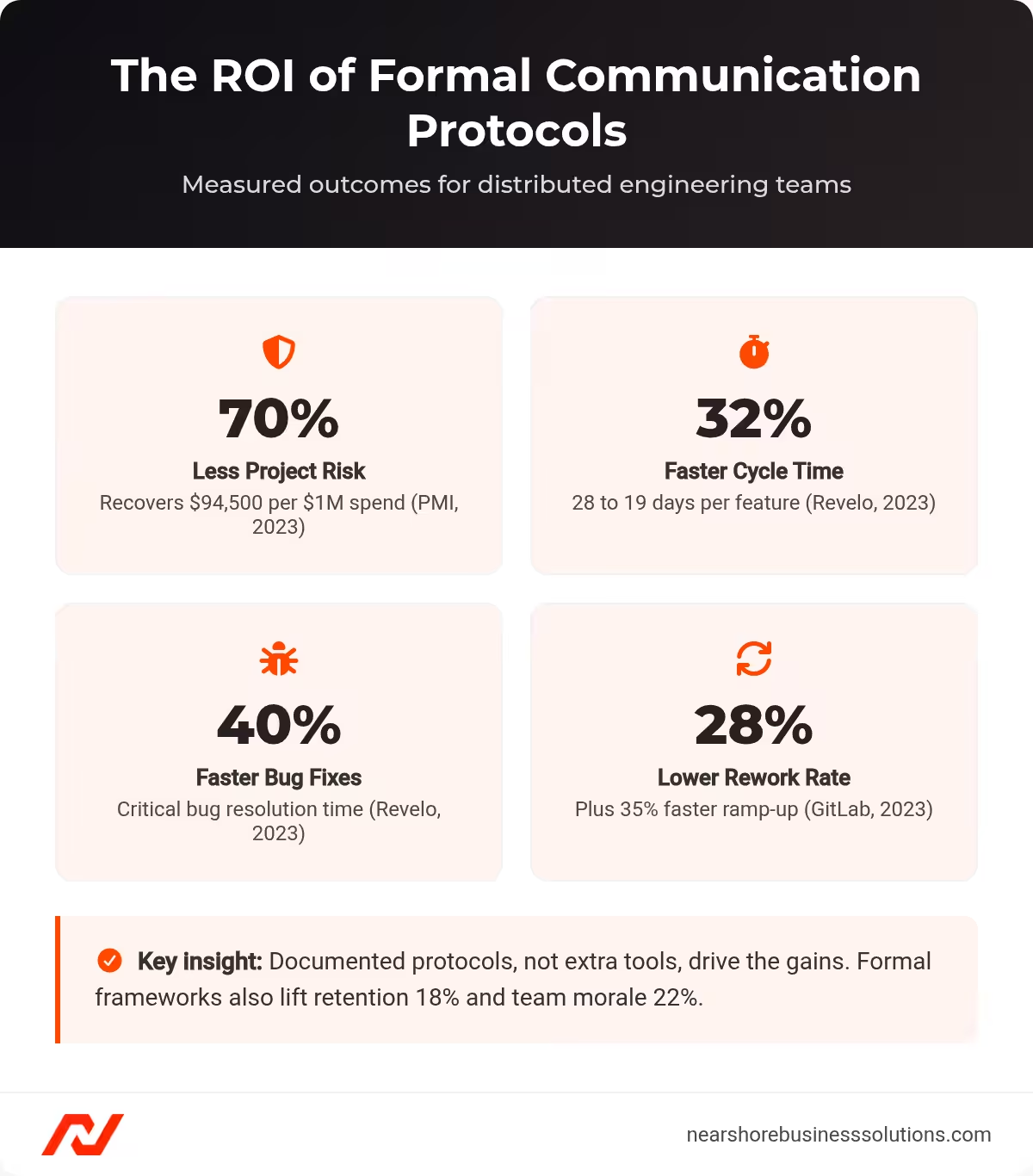
Measured ROI of formal communication protocols for distributed engineering teams.
| Indicator | What It Measures | Target | Red Flag |
|---|---|---|---|
| Async Response SLA Adherence | Updates arriving within agreed window | 90% or higher | Drops below 75% |
| Overlap Utilization Rate | Percent of sync time on decisions vs. status updates | 60% decision or unblocking | Majority consumed by status meetings |
| Decision Cycle Time | DACI log: proposal to approval | Under 48 hours | Stalling over 5 days |
| Escalation Frequency Trend | Tier 3 escalation direction | Declining or stable | Rising volume signals protocol gaps |
Run a 60-minute quarterly retrospective focused only on communication protocols. Three prompts: What protocol saved us time? What created friction? What is happening informally that should be formalized?
For teams in the onboarding phase, a structured 30-day communication integration plan pairs new LATAM engineers with a protocol buddy for their first two weeks. Teams with structured onboarding protocols ramp new nearshore engineers in 3-4 weeks versus 6-8 weeks for offshore engineers with large timezone gaps, per 2024 nearshore onboarding benchmarks. See our guide on staff augmentation onboarding for the full 30-day framework.
Frequently Asked Questions About Nearshore Team Communication Protocols
These are the most common questions VP Engineering and CTO leaders ask about building communication protocols for nearshore teams.
How Long Does It Take to Implement Nearshore Communication Protocols?
Implementing the core protocol stack takes 2-4 weeks. The DACI framework and async update format can be documented and enforced within the first sprint. Weekly cadence rituals take one full sprint cycle to normalize. The full protocol playbook typically reaches steady-state behavior after 4-6 weeks.
What If a Developer Does Not Follow the Protocol Norms?
Address protocol non-compliance the same way you address code style violations: with documentation, feedback, and consistent enforcement. Create a written “communication handbook” that defines expected behaviors, SLAs, and escalation paths. Engineers who receive clear written expectations show a 35% faster ramp-up rate, per GitLab (2023).
What Tools Do Most Nearshore Teams Use?
Slack adoption is above 95% across distributed tech teams. Loom is used by over 60% of remote-first companies for async code reviews. Notion or Confluence serves as the single source of truth for decisions and RFCs. Jira or Linear handles task tracking with automated ticket updates via commit messages.
How Is Nearshore Communication Different from Offshore Communication?
Nearshore teams in Mexico and Colombia share 6-8 hours of real-time overlap with US offices. Offshore teams in India share 0-2 hours. That overlap enables live standups, real-time pair programming, and same-day blocker resolution. Nearshore Americas (2024) found 78% of US engineering managers rate communication quality with LATAM teams as “good” or “excellent,” versus 45% for India.
Do I Need to Account for Cultural Differences in Communication Protocols?
Yes. Hofstede cultural dimensions show LATAM engineers score significantly higher on Uncertainty Avoidance (Mexico: 82, Colombia: 80 versus US: 46) and Power Distance (Mexico: 81, Colombia: 67 versus US: 40). Structure protocols to provide explicit clarity on requirements and decision rights. Over-communicate the “why” behind technical decisions. Proactively solicit feedback from LATAM Contributors in DACI processes, as high Power Distance cultures are less likely to surface dissent unprompted.
What Is the ROI of Implementing Formal Communication Protocols?
PMI data shows formal protocols reduce communication risk by 70%, saving $94,500 per $1M in project spend. Teams with documented frameworks have a 28% lower rework rate. KPMG estimates the 3-year ROI of a 50-person nearshore LATAM team at 150-220%, factoring in direct cost savings of 45-60% versus US hiring plus productivity gains from faster onboarding and overlap management.
How Do You Adapt Protocols When a Team Spans Multiple LATAM Countries?
When your team spans Mexico, Colombia, and Argentina, shared overlap shrinks. Reduce synchronous rituals to twice per week. Strengthen async documentation norms. Use the Friday Async Retrospective and Monday Kickoff Sync as the two anchor points. Assign a single DACI Driver per feature who is responsible for cross-timezone handoffs.
Ready to Staff a Team That Runs These Protocols?
Nearshore Business Solutions sources and vets engineers from Bogota, Medellin, Mexico City, and Guadalajara. Every candidate is screened for technical skills, English fluency, and US work style fit.
Every placement includes a 90-day replacement guarantee. You receive the first pre-vetted candidates within 3 business days.
See our staff augmentation service to discuss your team structure and receive a candidate shortlist.