
Lemon.io is a credible option for employers that want a curated shortlist of experienced remote developers and can manage the developer’s daily work. Its current offer covers contract talent and a separate direct-hire path called LemonHire. The public trial, replacement, and placement-fee terms differ across those paths, so the agreement must identify which product the buyer is purchasing.
This employer review was researched on August 27, 2026. Major platforms often mix developers, contractors, partners, and candidates. The evidence separates those audiences from verified clients and compares Lemon.io with direct hiring, staff augmentation, open marketplaces, and managed delivery.
Disclosure and methodology
Nearshore Business Solutions offers direct hire, Recruitment as a Service, and staff augmentation in Latin America, so it is one option discussed below. Lemon.io and the other providers did not review or pay for this comparison. We used provider pages and labeled independent review evidence by audience. Terms and review totals were checked on August 27, 2026.
The short answer for employers
Lemon.io’s contract marketplace fits buyers that want a screened developer and can manage delivery. Public terms put supervision and control with the client. LemonHire adds a paid working trial before a possible direct hire, with separate fee and guarantee terms. Buyers seeking permanent LATAM headcount with public placement pricing should compare NBS Remote Talent Acquisition.
What does Lemon.io actually sell?
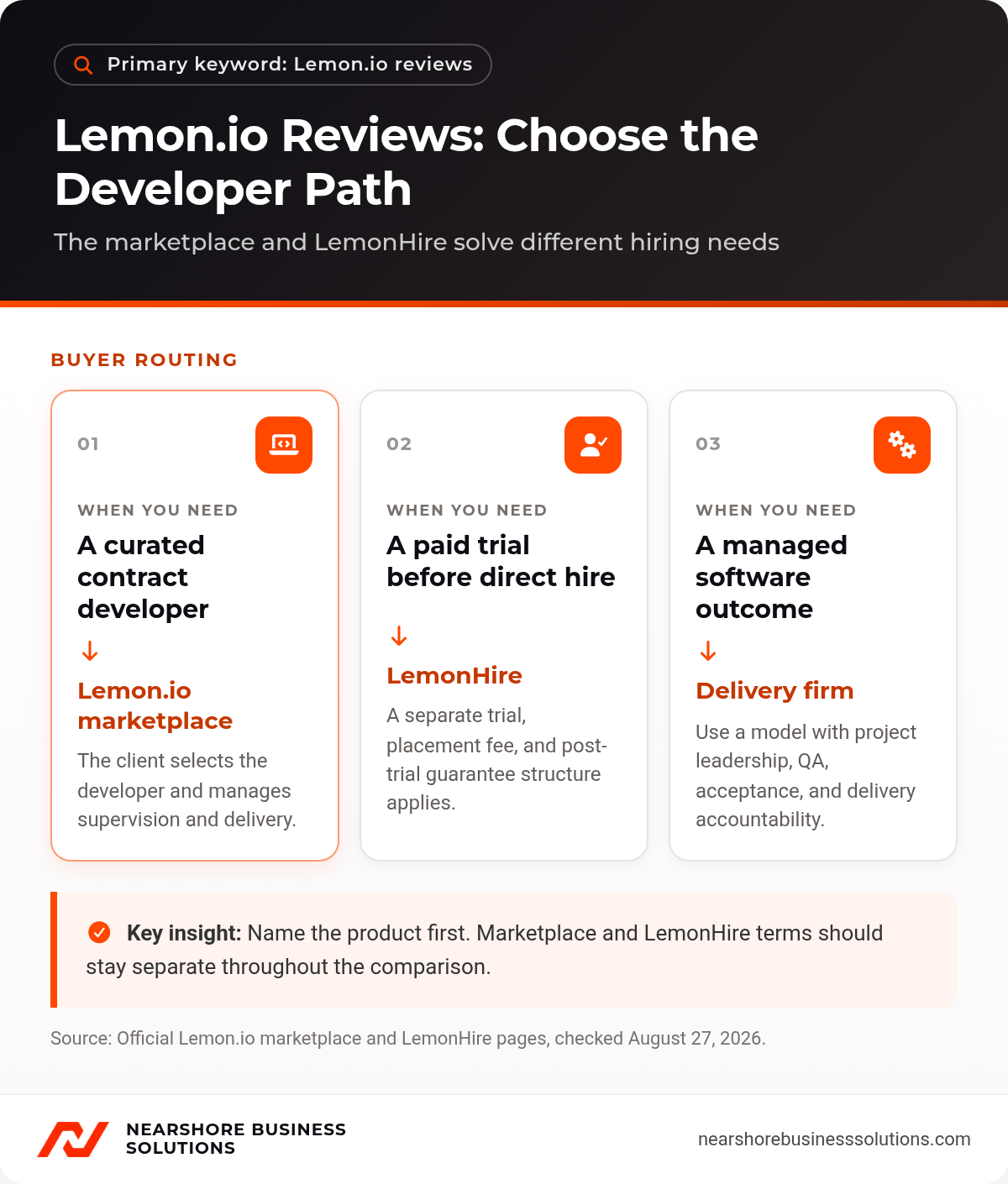
Lemon.io presents a contract marketplace and a LemonHire direct-hire path. Marketplace terms say the client and developer contract directly and exclude staffing-agency and employer-of-record status.
| Route | Working relationship | Who directs daily work? | Public commercial structure | Best initial use |
|---|---|---|---|---|
| Contract marketplace | Client engages a developer through the platform | Client | Prepaid subscription based on developer services | Part-time or full-time embedded technical capacity |
| LemonHire | Paid working trial can lead to a direct hire | Client during the trial; employer after hire | Hourly trial cost, management fee, then placement fee | Testing a potential permanent technical hire |
Lemon.io’s hire page lists developers across Europe, Latin America, the US, and Canada. Its homepage also describes sourcing across Asia. Buyers should confirm the country, work hours, relationship, and availability for every proposed person.
The published role coverage includes full-stack, front-end, back-end, mobile, game, DevOps, cloud, AI, data, blockchain, and automation QA. Lemon.io remains a technical-talent specialist. Companies hiring finance, sales, customer service, HR, or operations alongside developers will need a broader recruitment channel.
How do Lemon.io matching and vetting work?
The current process has three buyer-facing steps: describe the role, review Lemon.io’s matches, and interview the candidates before choosing. Lemon.io reports a roughly 24-hour average matching time on its hire page. That figure is a company-reported average. It does not create a public service level for every stack, location, or start date.
Lemon.io’s vetting process describes this funnel:
- The pre-screen checks the CV and LinkedIn profile, uses an AI-assisted screening call, and assigns a role-specific technical task.
- A recruiter interview can assess interpersonal skills, pressure handling, ambiguity, and client expectations. Lemon.io says this step can be skipped when earlier stages provide enough evidence.
- A senior engineer runs a live problem-solving interview that covers reasoning, tradeoffs, practical work, and AI use. The company says the result receives peer cross-review.
- Successful developers are organized in the network for matching against client requests.
Lemon.io publishes a 1.2% acceptance rate and describes the final result as roughly one accepted applicant per 100. It also reports more than 1,500 vetted developers and more than 2.3 million hours worked since 2015. These self-reported figures do not establish the quality of a specific match. The buyer still needs a structured technical and working-style interview.
Final selection remains the buyer’s strongest safeguard. Ask for the screening scorecard, interview notes, verified project history, and role-fit rationale.
How much does Lemon.io cost?
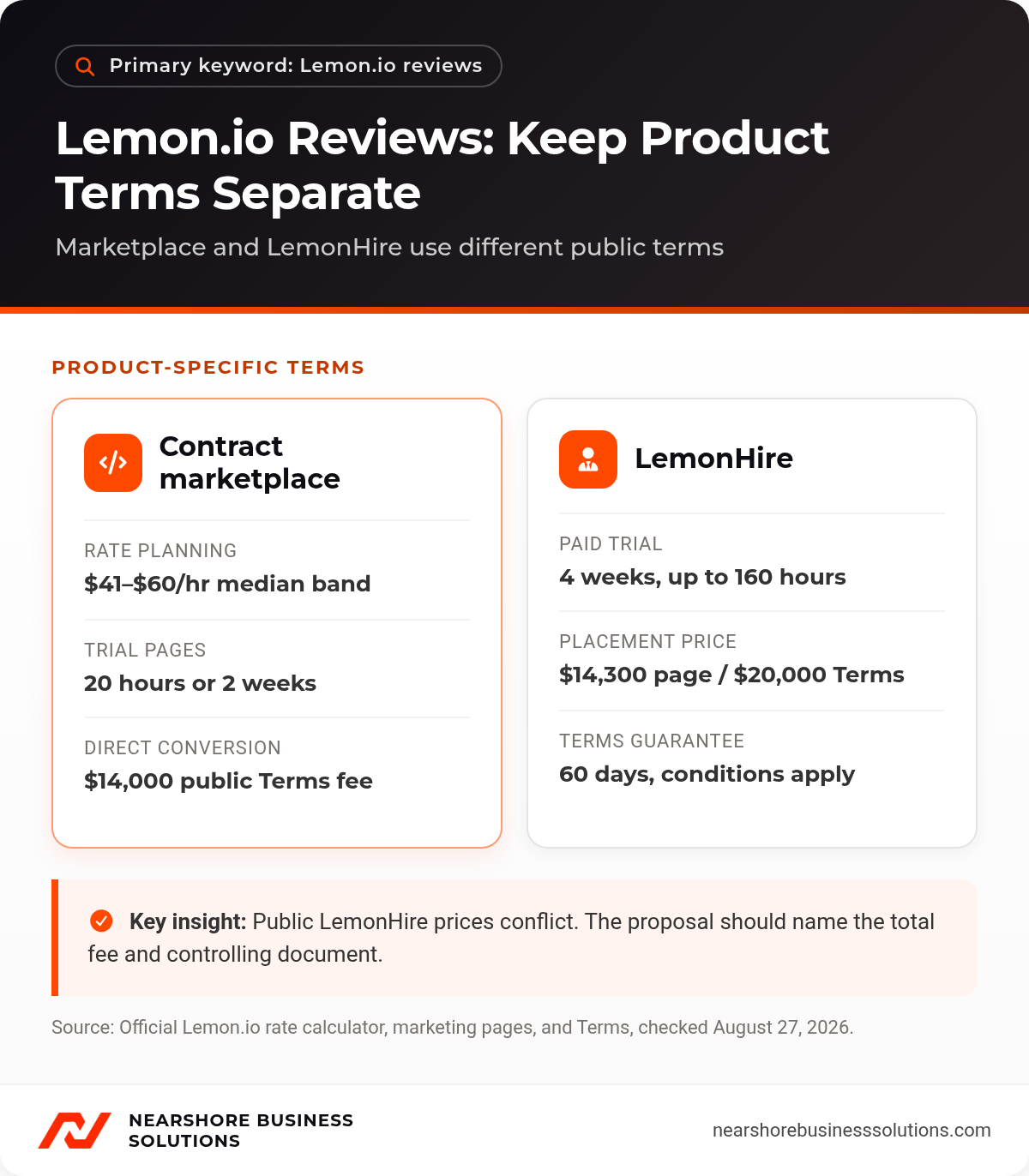
Lemon.io pricing depends on the product, developer, seniority, location, hours, and contract structure. The company publishes planning data, but a buyer still needs a named quote.
The current rate calculator displays a $41 to $60 per hour median band for senior developers and offers role and country views. Lemon.io says the data comes from active contracts involving more than 2,400 vetted developers. Use the calculator for budgeting and the proposal for the actual platform rate.
| Cost or term | Public evidence as of August 27, 2026 | What the buyer still needs |
|---|---|---|
| Named marketplace developer | Quote required; Lemon.io’s calculator displays a $41 to $60 hourly median band for senior developers | Named-person rate, weekly hours, platform margin, tax, expenses, and overtime |
| Subscription funding | Paid in advance; at least one week of balance for card billing or one month for invoiced, ACH, or wire billing | Billing cadence, unused balance, pause mechanics, and refund treatment |
| Marketplace trial | Current role pages describe a 20-hour paid trial; the rate calculator displays a two-week trial | Written product-specific trial terms |
| Marketplace direct conversion | Public terms list a $14,000 fee for direct hiring, direct contracting, or off-platform payment | Applicability, timing, exceptions, and the signed agreement |
| LemonHire trial | Four weeks and up to 160 hours, with the developer’s hourly rate plus a $2,000 management fee | Named rate, success criteria, and early-end process |
| LemonHire placement | Terms: $20,000 less the $2,000 trial management fee; marketing page: $14,300 | Total fee, included services, taxes, and controlling document |
| LemonHire guarantee | 60 days; the terms describe replacement and a placement-fee refund if no replacement arrives within 30 days, subject to conditions | Eligibility, evidence, exclusions, and claim process |
| Clutch directory snapshot | $25 to $49 per hour and a $1,000 minimum project on a profile with three reviews | Treat as directory context; obtain Lemon.io’s current quote |
The Terms of Use took effect on May 14, 2026. They allow a client to request a subscription pause through the account. The page leaves the effective date, refund mechanics, and signed-agreement notice requirement unclear.
Lemon.io’s LemonHire marketing page displays a $14,300 fee. The current Terms state a $20,000 LemonHire placement fee and credit the $2,000 trial management fee after a successful hire. The public pages do not reconcile those figures. The proposal should state the total fee, each included service, and the document that controls.
The public terms give clients ownership of paid work product after full payment. Section 26 requires recipients, including Lemon.io and developers, to keep defined confidential information in strict confidence. The Terms also say they control conflicts with other agreements and generally cap Lemon.io’s aggregate liability at $500, with stated exceptions. Counsel should reconcile IP, confidentiality, security, and liability provisions across the proposal and statement of work.
Why the trial language needs written confirmation
Lemon.io’s public pages describe three trial structures:
- Several current role pages publish a 20-hour paid marketplace trial with a replacement path.
- The rate calculator displays a two-week trial period and money-back guarantee.
- The legal terms define a four-week, 160-hour maximum trial for LemonHire, followed by a possible direct placement.
- The LemonHire marketing page describes testing through a marketplace contract and a replacement during a 30-day probation period. The Terms describe a separate 60-day post-trial guarantee.
These descriptions may apply to different products. The proposal should name the product, trial length, billable hours, refund conditions, replacement clock, and governing document.
What do Lemon.io reviews tell employers?
The independent evidence is positive, but buyer-only evidence is limited. Review count alone can mislead because each platform measures a different relationship.
| Source | Snapshot on August 27, 2026 | Audience | Proper use |
|---|---|---|---|
| Clutch | 4.8/5 from 3 reviews | Verified clients | Buyer experience, with a small and dated sample |
| G2 | 4.7/5 from 59 reviews | Clients, developers, and partners | Broad platform sentiment |
| Trustpilot | 4.8/5 from 354 reviews | Mixed, with recent reviews dominated by developers and contractors | Talent support, matching, and payment sentiment; limited client inference |
| Glassdoor | 4.8/5 from 70 reviews | Employees, contractors, and candidates | Workplace and screening research |
Clutch provides the clearest client evidence. Its three clients report strong developer caliber, collaboration, responsiveness, communication, and value. The reviewed engagements began from 2017 through 2019, and the sample cannot support a broad satisfaction claim.
G2 has a larger mixed-audience total. One visible buyer praises the developer, screening, payment handling, and team interactions while asking for a clearer post-hire process. Other visible reviews come from developers and a talent-supply partner.
Trustpilot’s recent visible reviews focus heavily on developer onboarding, matching, support, and payment. They provide limited evidence about buyer delivery, contract administration, or total cost.
Glassdoor covers workplace and interview experience. Developers and candidates can use it to research screening and project availability. Employers should not use its rating as a measure of client delivery.
Where does Lemon.io fit?
Lemon.io reduces sourcing volume by presenting screened technical matches, while the client keeps final selection and daily control. LemonHire adds a path from paid trial work to employment. A direct recruiter fits permanent LATAM headcount; staff augmentation adds employment administration; an open marketplace gives the buyer a broader pool; and a delivery firm owns a defined software outcome. The alternatives below separate those models.
What are the best Lemon.io alternatives by use case?
The strongest alternative depends on the relationship the buyer wants. These providers sell different combinations of sourcing, screening, contracting, employment, and delivery.
| Provider | Published model | Best initial use case | Buyer control | Main diligence question |
|---|---|---|---|---|
| NBS | Direct hire, RaaS, and staff augmentation across Latin America | Long-term LATAM employees or dedicated nearshore staff | Buyer interviews and manages the hire | Which employment route and first-year cost fit the role? |
| Toptal | Curated global freelance talent, teams, and services | Screened global specialist with flexible commitment | Buyer approves and integrates talent; accountability varies by model | What are the talent rate, platform fee, trial, and conversion terms? |
| Arc | Pre-vetted global freelance, part-time, full-time, and contract-to-hire talent | Buyer comparing contract and permanent remote paths | Buyer interviews and selects | Which vetting path and fee apply to the chosen engagement? |
| Gun.io | Curated freelance developers with retainer, prepaid-hour, and contract-to-hire options | Contract developer with a managed shortlist | Buyer interviews and directs the developer | What commitment, rate, conversion, and replacement terms apply? |
| Upwork | Open freelance marketplace with job posts and bids | Broad selection and buyer-led sourcing | High buyer control and screening workload | Who will validate technical depth and manage the engagement? |
| BairesDev | Staff augmentation, dedicated teams, and software outsourcing | Embedded capacity, a coordinated pod, or a managed outcome | Client control is highest in staff augmentation; vendor control rises in outsourcing | Who owns daily execution, acceptance criteria, and delivery risk? |
NBS overlaps when a US employer wants Latin American developers for its internal team. Remote Talent Acquisition uses a one-time fee equal to two times the candidate’s first monthly salary. NBS publishes a three-business-day first-shortlist target for standard searches and a 90-day replacement. Recruitment as a Service and staff augmentation support recurring hiring or employment administration.
Lemon.io versus direct LATAM hiring
Lemon.io can supply Latin American developers, but its network spans several regions. Direct LATAM recruitment starts with the regional hiring strategy and searches for a person who will join the employer or an agreed employment structure.
| Decision factor | Lemon.io marketplace | NBS direct LATAM hire |
|---|---|---|
| Worker relationship | Developer provides services through the platform | Candidate joins the client’s team through its entity or an agreed employment route |
| Geographic focus | Global network, including Latin America | Twelve owner-approved Latin American markets |
| Public price visibility | Rate benchmarks are public; named rate requires a quote | One-time placement fee equals two times first monthly salary; compensation varies by candidate |
| Published speed | Lemon.io reports roughly 24-hour average matching | NBS publishes first vetted candidates within three business days for standard searches |
| Daily management | Client | Client |
| Trial or replacement | Product-specific terms vary across marketplace pages; LemonHire has a separate structure | Free replacement within 90 days under the published direct-hire policy |
| Conversion | Public marketplace terms list a $14,000 direct-placement or off-platform fee | Direct employment is the intended outcome |
| Employment administration | Marketplace terms exclude staffing and EOR status | Client entity or employment coordinated through EOR partners |
| Continuity | Depends on contract length and any conversion decision | Designed for long-term internal headcount |
Compare costs with the same role, seniority, location, hours, benefits, platform fees, equipment, and management time. Direct employment can improve continuity. A marketplace can improve flexibility.
Model the regional route with the LATAM salary guide and developer hiring-channel guide. The Colombia, Mexico, and Argentina pages add local context.
What should buyers ask before signing?
Use these questions against the proposal, platform terms, and statement of work:
- Which Lemon.io product, legal entity, developer rate, commitment, and minimum term appear in the agreement?
- What must be prepaid, and what happens to unused funds after a pause or cancellation?
- Which trial applies, and what triggers replacement, reperformance, refund, or credit?
- What fee applies to direct hiring, direct contracting, or off-platform work?
- Who owns supervision, schedules, deliverables, defects, security, and access control?
- When does work-product ownership transfer, and how are background IP and open-source code handled?
- Which document controls when public pages and signed documents conflict?
The public refund policy adds two items for marketplace buyers. It gives clients ten business days after the month of disputed work to report a service dispute. It describes reperformance as the primary remedy and caps a refund at 40 paid hours where the work cannot be adequately redone. Legal counsel should assess the final limitation, indemnity, confidentiality, IP, and dispute terms for material engagements.
Final verdict
Lemon.io fits employers that want an experienced remote developer, curated matching, and direct control over the work. The company offers contract and direct-hire routes.
The commercial decision requires more care because the public site uses different trial descriptions and separate placement fees for the marketplace and LemonHire. A buyer should compare the named quote and signed terms before relying on a general rate benchmark or review score.
Choose a curated marketplace for screened contract capacity. Choose direct recruitment for permanent regional headcount. Choose staff augmentation for employment administration with client-led work. Choose a delivery firm when the vendor must own the software outcome.
Talk with NBS if you want to compare a current Lemon.io quote with direct LATAM hiring, RaaS, or staff augmentation. The comparison should use the same role, hours, start date, employment path, and first-year cost.
Frequently asked questions
Is Lemon.io legitimate?
Current terms identify Coding Ninjas Inc. as doing business as Lemon.io. Buyers should review the named developer, price, product, and agreement.
How much does Lemon.io cost?
Lemon.io publishes no universal client rate. Its calculator shows a $41 to $60 senior-developer median. Current terms list a $20,000 LemonHire placement fee with a $2,000 trial credit, while the marketing page shows $14,300.
How quickly can Lemon.io match a developer?
Lemon.io reports a roughly 24-hour average match. Role, availability, interviews, and contract review can extend the start date.
Is Lemon.io a staffing agency or employer of record?
Marketplace terms exclude staffing-agency and EOR status and put supervision with the client. Buyers needing employment administration should compare another model.
What is the Lemon.io trial?
Role pages describe a 20-hour marketplace trial, the calculator shows two weeks, and LemonHire terms define four weeks. The proposal should name the applicable trial.
Does Lemon.io offer replacements or refunds?
Marketplace replacement terms vary. LemonHire terms define a 60-day guarantee and a placement-fee refund if an eligible replacement is unavailable within 30 days. Confirm the applicable conditions.
Can a company hire a Lemon.io developer directly?
Marketplace terms list a $14,000 direct-conversion fee. LemonHire terms list $20,000 with a $2,000 trial credit, while its marketing page shows $14,300. Confirm the route and controlling document.
Are Lemon.io reviews from clients?
Clutch shows three verified client reviews. G2 and Trustpilot mix several audiences, and Glassdoor covers workplace and candidate experience.
What are the best Lemon.io alternatives?
NBS supports LATAM direct hire and staff augmentation. Toptal, Arc, and Gun.io offer curated remote talent; Upwork is an open marketplace; BairesDev adds software delivery.