
How to Hire in Argentina in 2026: The Complete Employer’s Guide
Argentina pairs Latin America’s strongest English proficiency with a deep pool of software, data, and creative talent, all on U.S.-aligned time and at 40-70% lower cost.
Get a Free ConsultationThis guide covers what U.S. companies need before hiring in Argentina: salary benchmarks, the three legal hiring models, labor law under the Ley de Contrato de Trabajo, payroll contributions, and total employer cost, whether you engage contractors, use an Employer of Record, or set up a local entity.
Why Hire in Argentina?
Argentina combines a strong educational foundation with a culture of technical innovation, giving companies in technology, professional services, and knowledge-based industries access to talent that is hard to match elsewhere in the region.
Skilled Talent Pool
Argentina graduates roughly 30,000 STEM professionals a year from institutions like the University of Buenos Aires (UBA), the National Technological University (UTN), and the Argentine Catholic University (UCA), with particular depth in software engineering, data science, and design.
Cost-Effective Salaries
Depending on role and seniority, salaries run 40-70% below comparable U.S. positions while maintaining high quality of work, freeing budget to build larger teams or invest in growth.
Time Zone Alignment
Argentina operates on ART (UTC-3) with no daylight saving time. That is a 1-3 hour difference from U.S. Eastern and Central time, giving teams a full overlapping workday for real-time collaboration.
Strongest English in the Region
Argentina consistently ranks first in Latin America on the EF English Proficiency Index (around 30th globally), so communication in tech, business, and customer-facing roles is direct and reliable.
Cultural Compatibility
Argentine professionals work to Western business norms: direct but relationship-focused communication, deadline-driven delivery, and education built on curricula that align closely with North American and European expectations.
Government Support
The Knowledge Economy Law (Ley de Economía del Conocimiento) offers tax reductions for software, biotech, and professional-services firms, while Argentina Programa funds training toward a target of 70,000+ new tech workers by 2030.
Key Stats About Hiring in Argentina
Understanding Argentina’s labor force, currency, and digital infrastructure helps you evaluate it as a remote hiring destination.
The Most In-Demand Roles to Hire in Argentina
Argentina’s labor market runs deep in technology, digital services, and business operations. Buenos Aires, Córdoba, and Rosario anchor thriving tech ecosystems, while the country’s advertising and design heritage feeds a strong creative talent pool. For a market view, see our guide to recruiting talent in Argentina.
Software Development & Engineering
Argentina’s tech sector, shaped by homegrown giants and a strong startup culture, produces a steady stream of software engineers and developers fluent in agile delivery, cloud platforms, and modern frameworks.
- React
- Angular
- Vue.js
- TypeScript
- UI/UX
- Node.js
- Python
- Java
- Ruby
- .NET
- REST APIs
- MERN / MEAN
- Ruby on Rails
- PHP / Laravel
- Serverless
- iOS (Swift)
- Android (Kotlin)
- React Native
- Flutter
- AWS
- Azure
- GCP
- CI/CD
- Docker
- Kubernetes
- Terraform
- Manual QA
- Automation
- Selenium
- Cypress
- Playwright
AI, Data & Emerging Tech
A standout strength: Argentine engineers lead the region in AI and machine learning, and the country has a mature community of data and blockchain specialists.
- ML engineers
- NLP
- Computer vision
- LLMs
- MLOps
- Data engineers
- Data scientists
- BI
- Analytics
- SQL
- Solidity
- Smart contracts
- Web3
- DeFi
Sales & Marketing
A blend of creativity and analytical skill makes Argentine professionals a natural fit for digital marketing and content roles serving English and Spanish-speaking markets.
- SDRs
- Account executives
- Sales managers
- Salesforce
- HubSpot
- Performance marketing
- SEO
- SEM
- PPC
- Copywriting (EN/ES)
- Social media
- Video editing
- Graphic design
Finance & Professional Services
Detail-oriented finance and HR professionals well-versed in global business standards and cross-border team management.
- Accountants
- Bookkeepers
- QuickBooks
- Xero
- Tax
- Financial analysts
- FP&A
- Controllers
- Treasury
- Recruiters
- HR specialists
- Admin assistants
Customer Support & Operations
High English proficiency and cultural fit make Argentina a strong base for customer support and operations teams serving North American customers.
- Customer service
- Technical support
- Bilingual (EN/ES)
- Chat & email
- Virtual assistants
- Scheduling
- Data entry
- Research
- Ops coordinators
- Project managers
- BPO specialists
Design & Creative
Argentina’s advertising and design tradition produces creative talent recognized internationally for its craft and user-centered approach.
- UI/UX
- Product design
- Visual design
- Figma
- Design research
- Motion & video
- Advertising
- Brand design
- Illustration
Why These Roles Thrive in Argentina
The depth and quality of Argentine talent come from several structural factors.
Strong Educational Infrastructure
Universities such as UBA, UTN, and UCA produce around 30,000 STEM graduates a year, with specialized programs in software development, data science, and engineering.
Homegrown Tech Leaders
Regional champions like Mercado Libre and Globant were founded in Argentina and have trained a generation of world-class engineers, product managers, and designers who now anchor the wider talent pool.
Strongest English in the Region
Argentina ranks first in Latin America on the EF English Proficiency Index, so English is dependable across tech, business, and customer-facing teams, not just a select few.
Deep Freelance & Remote Culture
A large freelance economy, many contractors registered under the monotributo regime, means professionals are already experienced in international collaboration and remote delivery.
Cost-Effective Talent
Salaries typically run 40-70% below comparable U.S. positions while quality stays high, a gap widened by favorable exchange rates for dollar-based employers.
Monthly Salary Ranges in Argentina (USD)
These are average gross monthly salaries across entry, mid, and senior levels for common roles. Actual pay varies by city, experience, and language proficiency.
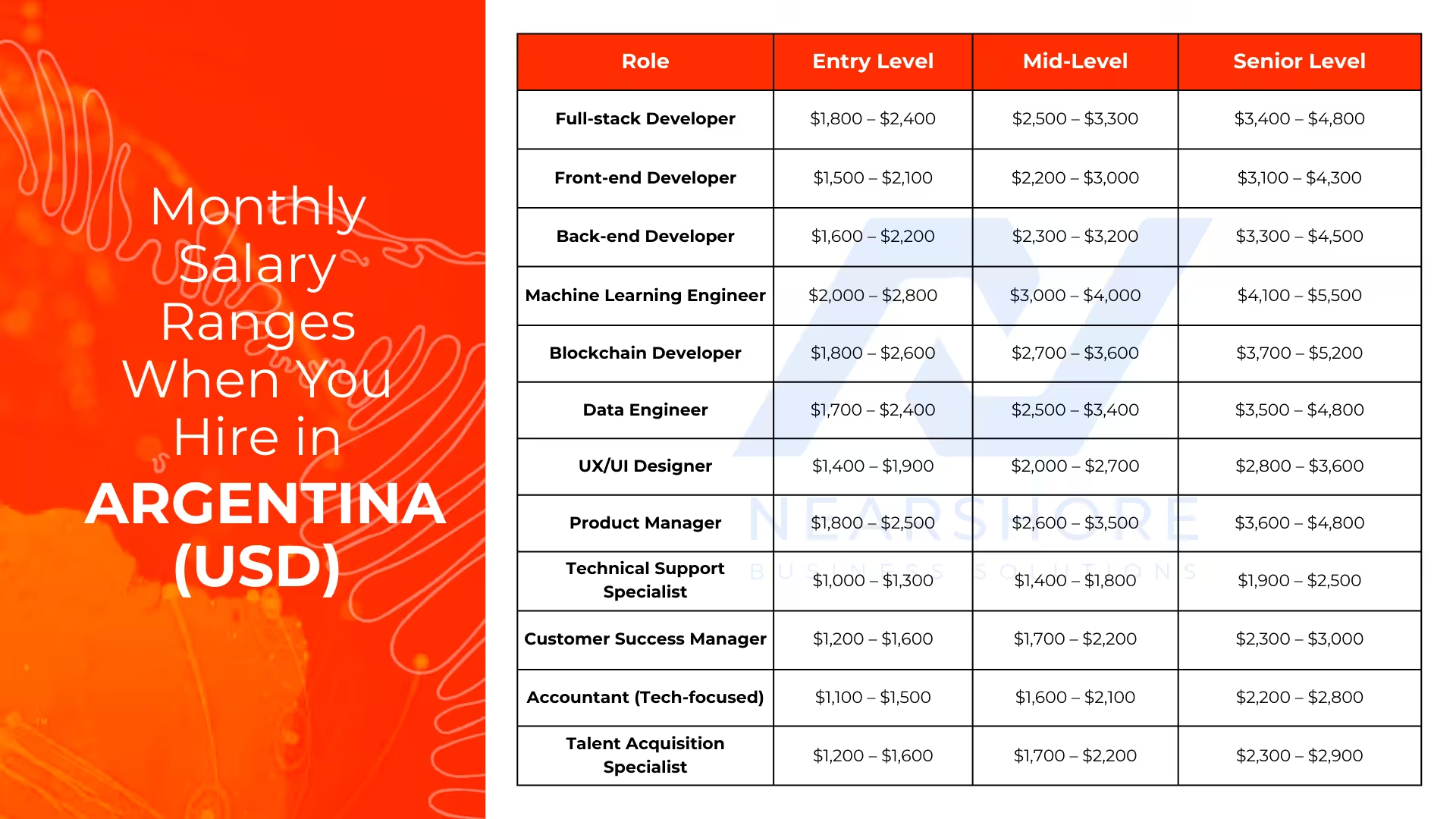
View the full salary table
| Role | Entry Level | Mid-Level | Senior Level |
|---|---|---|---|
| Full-stack Developer | $1,800-$2,400 | $2,500-$3,300 | $3,400-$4,800 |
| Front-end Developer | $1,500-$2,100 | $2,200-$3,000 | $3,100-$4,300 |
| Back-end Developer | $1,600-$2,200 | $2,300-$3,200 | $3,300-$4,500 |
| Machine Learning Engineer | $2,000-$2,800 | $3,000-$4,000 | $4,100-$5,500 |
| Blockchain Developer | $1,800-$2,600 | $2,700-$3,600 | $3,700-$5,200 |
| Data Engineer | $1,700-$2,400 | $2,500-$3,400 | $3,500-$4,800 |
| UX/UI Designer | $1,400-$1,900 | $2,000-$2,700 | $2,800-$3,600 |
| Product Manager | $1,800-$2,500 | $2,600-$3,500 | $3,600-$4,800 |
| Technical Support Specialist | $1,000-$1,300 | $1,400-$1,800 | $1,900-$2,500 |
| Customer Success Manager | $1,200-$1,600 | $1,700-$2,200 | $2,300-$3,000 |
| Accountant (Tech-focused) | $1,100-$1,500 | $1,600-$2,100 | $2,200-$2,800 |
| Talent Acquisition Specialist | $1,200-$1,600 | $1,700-$2,200 | $2,300-$2,900 |
These figures reflect gross monthly compensation and may vary based on city, skill set, and language proficiency. Hiring model (contractor, EOR, or direct) also affects final cost. For benchmarks across the region, see our LATAM developer salary guide.
Same business hours, 40-70% lower cost, and the strongest English in Latin America. That is why U.S. teams start their nearshore hiring in Argentina.
3 Legal Ways to Hire in Argentina
Companies have three primary pathways into the Argentine market: engaging contractors, using an Employer of Record (EOR), or establishing a local legal entity. Each offers a different balance of control, compliance, and setup effort.
Hiring Contractors
The fastest way to bring talent on board, especially for project-based or short-term work. Contractors are self-employed, and most register under the monotributo simplified tax regime, managing their own taxes and contributions.
- Fast onboarding with no local entity required
- Cost-effective, with no obligation to provide benefits
- Flexibility for fluctuating or specialized workloads
- Misclassification risk under Argentine labor law
- Less oversight than with employees
- May not attract talent seeking stability and benefits
Use a clear contract covering scope, payment, IP ownership, and confidentiality. If a contractor works exclusively for you on a fixed schedule, authorities may reclassify them as an employee.
Employer of Record (EOR)
An Employer of Record becomes the legal employer for your Argentine hires, so you can employ full-time staff without setting up an entity. The EOR runs payroll, taxes, benefits, and compliance on your behalf.
- Full compliance with the Ley de Contrato de Trabajo
- Fast market entry, typically within days
- Handles payroll, benefits, and AFIP registration
- Monthly service fee per employee
- Less direct control over HR policy, as the EOR is the legal employer
Ideal for testing the Argentine market or hiring a handful of employees without the expense of forming a company.
Local Entity
Forming a local entity lets you hire directly and run HR, payroll, and operations in-house. Best for companies planning a long-term, at-scale presence in Argentina.
- Full control over hiring, payroll, and terms
- Stronger local brand and market presence
- Supports long-term growth and larger teams
- Setup takes weeks to a few months
- Higher registration, legal, and compliance costs
- Requires navigating local tax and labor regulation
Makes sense when you are committed to a substantial team and want complete operational control, but budget for the upfront time and money.
Employment Compliance When You Hire in Argentina
Argentine labor law is protective of workers and highly regulated. Understanding contract types, statutory benefits, and payroll obligations is essential to staying compliant and avoiding costly penalties.
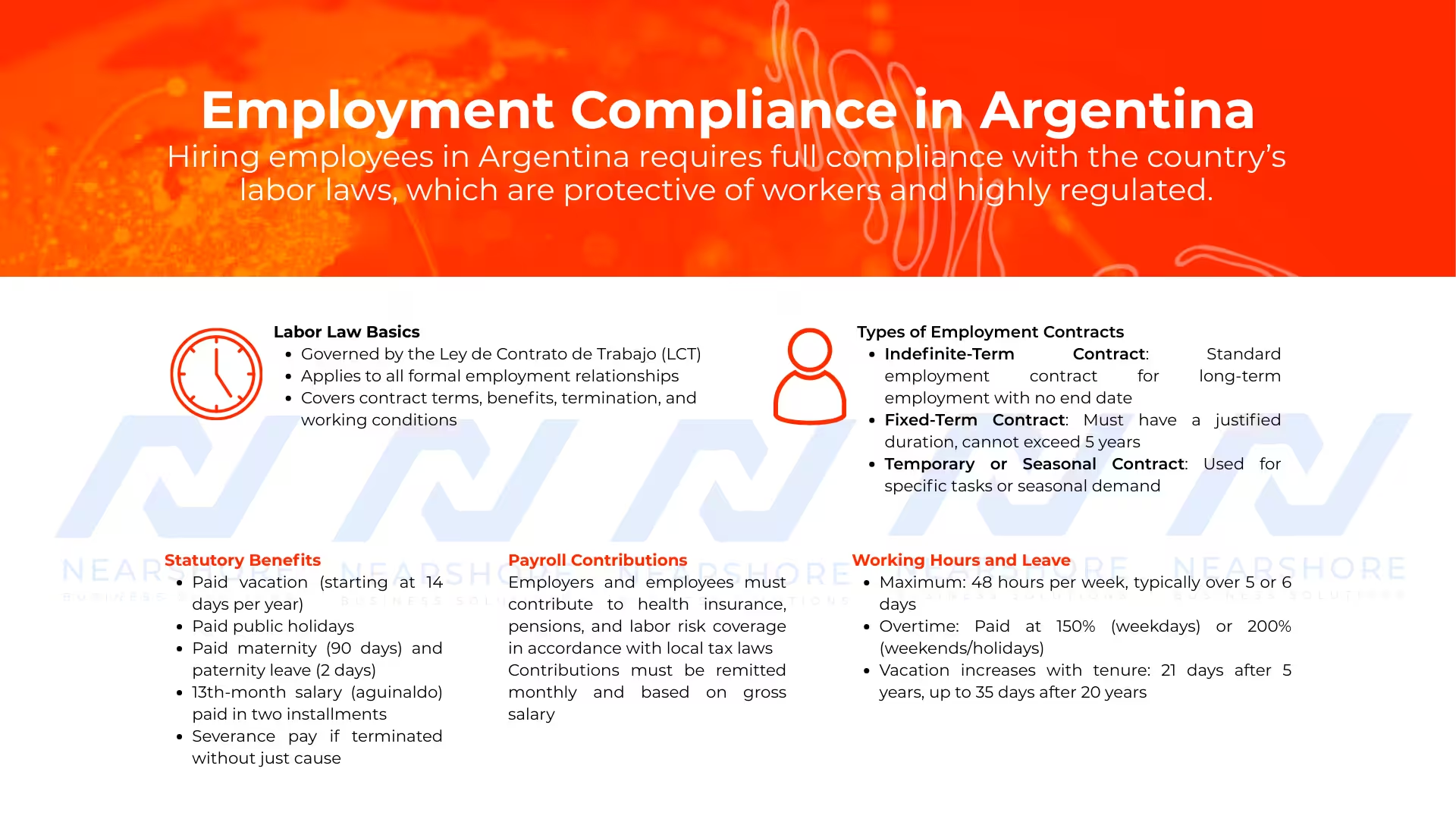
Understanding Argentine Labor Law
Employment relationships are governed by the Labor Contract Law (Ley de Contrato de Trabajo, or LCT), which sets the rules for contract terms, statutory benefits, working conditions, and termination. Employers must register with AFIP, obtain a tax ID (CUIT), and enroll each employee in the social-security system before work begins.
Indefinite-Term Contracts
The standard employment contract, with no end date. Preferred for long-term roles and the default assumption under the LCT.
Fixed-Term Contracts
Must have a justified reason and a defined duration, and cannot exceed five years. Ending one early can trigger severance obligations.
Temporary or Seasonal Contracts
Used for specific tasks or seasonal demand. The scope and expected duration must be clearly defined in writing.
Statutory Benefits & Leave Requirements in Argentina
Employers must provide these minimum benefits to all full-time employees under the LCT.
| Benefit / Leave | Statutory minimum |
|---|---|
| Working hours | 48 hours per week (8 per day), typically over 5-6 days; overtime paid at premium rates |
| Overtime | 50% surcharge on weekdays and Saturday before 1 PM; 100% on Sundays, holidays, and rest periods |
| Probation period | Up to 3 months; may end with 15 days’ notice and no severance |
| Annual leave | 14 days (under 5 years of service), 21 days (5-10 years), 28 days (10-20 years), 35 days (over 20 years) |
| Public holidays | Paid national holidays observed each year |
| Aguinaldo (SAC) | 13th-month salary, paid in two installments (June and December) |
| Sick leave | Paid: up to 3 months per year (under 5 years of service), up to 6 months (over 5 years); doubled with dependents |
| Maternity leave | 90 days paid (45 before and 45 after birth) |
| Paternity leave | 2 days paid |
| Severance (without just cause) | One month’s salary per year of service, or fraction over 3 months (Art. 245, LCT) |
Mandatory Contributions & Payroll Deductions in Argentina
Employers and employees both contribute to national social-security programs, calculated on each employee’s gross monthly salary and remitted monthly to AFIP.
| Contribution | Employer share | Employee share |
|---|---|---|
| Pension fund (SIPA) | 10.77%-12.35% | 11% |
| Healthcare (Obra Social) | 6% | 3% |
| Retiree healthcare (PAMI / INSSJP) | Included above | 3% |
| Family allowances (ANSES) | 4.44%-5.56% | 0% |
| National Employment Fund | 0.89%-1.11% | 0% |
| Labor-risk insurance (ART) | 1%-3% (risk-based) | 0% |
Total employer contributions run roughly 24-26.4% of gross salary depending on company size, plus ART. Employees have 17% withheld. Employers are exempt on the first ARS 7,003.68 of each monthly salary. New for 2026: a Labor Assistance Fund (Fondo de Cese) takes effect in November, adding a 1% employer contribution for large companies and 2.5% for small and medium-sized enterprises.
How to Set Up a Business to Hire in Argentina
For companies planning a long-term presence with direct hiring, establishing a legal entity is necessary. An EOR is faster to launch, while an entity can be more cost-effective and tailored for teams that plan to scale.
Simplified Stock Company (S.A.S.)
The most common structure for foreign businesses. Can be formed by a single shareholder, with a streamlined incorporation process suited to startups and small teams.
Limited Liability Company (S.R.L.)
Requires two or more partners, with liability limited to capital contributions. A straightforward fit for small to medium operations.
Corporation (S.A.)
Requires at least two shareholders and a more formal governance structure, typically used for larger operations and significant investment.
Registration Steps
- Reserve a company name — confirm the name is unique and complies with local rules.
- Draft and notarize bylaws — outline governance, management, and operating rules.
- Register with the Public Registry of Commerce — formally establish the company as a legal entity.
- Obtain a CUIT from AFIP — the tax ID required before operations begin.
- Enroll in social security and tax systems — required to run compliant payroll.
- Open a corporate bank account — needed for payroll, tax payments, and local operations (major banks include Banco Nación, Santander, and BBVA).
Registration typically takes a few weeks to a couple of months. Working with local legal or accounting advisors helps navigate the process and stay compliant.
Ongoing Compliance Requirements
Once your entity is operational, maintaining compliance with Argentine authorities is essential.
Annual Tax & Reporting Obligations
- Corporate income tax — file annual returns with AFIP.
- VAT and gross-income tax — filed monthly or quarterly.
- Financial statements — submitted annually under IFRS.
- Income sourcing — residents report worldwide income; non-residents are taxed on Argentine-source income only.
Payroll & Risk Mitigation
- Monthly contributions — remit health, pension, and labor-risk payments on time.
- Accurate payroll — proper deductions and payslips for every employee.
- Worker classification — keep contracts and HR policies compliant to avoid misclassification fines.
- Regular audits — review filings periodically to reduce the risk of penalties or disputes.
How to Legally Terminate Employees in Argentina
Termination must follow strict legal procedures under the LCT. Dismissals require just cause, mutual agreement, or full severance compensation, and all terminations should be clearly documented to avoid reinstatement orders or fines.
Grounds for Termination
Just cause (misconduct, repeated absenteeism, breach of contract) must be supported by documentation. Dismissal without cause is permitted but requires full severance. During the up-to-3-month probation period, termination is allowed with 15 days’ notice and no severance.
Severance Pay
For dismissal without just cause, the core indemnity under Art. 245 of the LCT is one month’s salary per year of service (counting any fraction over 3 months), based on the highest normal monthly compensation.
Notice Periods
Provide 15 days’ notice for employees with under 5 years of service and 30 days for those with more. Notice given in the probation period is 15 days. Pay in lieu of notice applies when notice is not worked.
Final Payments & Mutual Exit
Settle all accrued entitlements: unused vacation, proportional aguinaldo, and outstanding salary. Mutual terminations require a written agreement, ideally signed before a labor authority for legal protection.
Frequently Asked Questions About Hiring in Argentina
What is the minimum wage in Argentina in 2026?
As of July 2026, the minimum wage (Salario Mínimo, Vital y Móvil) is ARS 372,400 per month, roughly $250 USD at current exchange rates. The government set a staggered 2026 schedule that rises to ARS 376,600 by August 2026. Because the peso continues to move against the dollar, the USD equivalent fluctuates, so employers should confirm the current rate when budgeting.
What is the average salary in Argentina?
It varies widely by role and seniority. For in-demand tech and professional roles, entry-level salaries typically run $1,000-$2,000 USD per month, mid-level $1,600-$3,500, and senior $2,200-$5,500. A senior machine-learning engineer sits at the top of that range, while support and accounting roles sit lower. See the salary table above for role-by-role monthly ranges in USD.
How much does it cost to hire an employee in Argentina?
Beyond gross salary, budget for employer social-security contributions of roughly 24-26.4% depending on company size, plus labor-risk insurance (ART) of about 1-3%. Add statutory benefits such as the aguinaldo (an extra month’s salary paid in two installments) and paid leave. Even with these on-costs, total employment cost typically remains 40-70% below a comparable U.S. hire.
Can I hire employees in Argentina without a local entity?
Yes. An Employer of Record (EOR) acts as the legal employer for your Argentine staff, handling payroll, AFIP registration, tax withholding, benefits, and compliance with the Ley de Contrato de Trabajo, while you direct the day-to-day work. This lets you hire and pay full-time remote employees compliantly within days, without forming a company. Independent contractors are the other no-entity option.
How do I hire contractors in Argentina?
Draft a clear independent-contractor agreement specifying scope, deliverables, payment terms, IP ownership, and duration. Most Argentine contractors invoice under the monotributo simplified tax regime and handle their own taxes and contributions. The main risk is misclassification: if a contractor works exclusively for you on a fixed schedule and is integrated like an employee, authorities can reclassify the relationship and impose back payments and penalties.
Why do US companies hire workers from Argentina?
Cost, talent depth, English, and time zone. Salaries run 40-70% below comparable U.S. roles; the country graduates around 30,000 STEM professionals a year with particular strength in software, AI, and data; it ranks first in Latin America for English proficiency; and it operates on UTC-3 with no daylight saving, overlapping the U.S. business day year-round. Homegrown leaders like Mercado Libre and Globant have deepened the engineering talent pool.
What employer contributions and payroll taxes apply in Argentina?
Employers contribute roughly 24-26.4% of gross salary to social security (pension, healthcare, family allowances, and the national employment fund), plus 1-3% for labor-risk insurance (ART). Employees have 17% withheld: 11% pension, 3% healthcare, and 3% for retiree healthcare (PAMI). Employers are exempt on the first ARS 7,003.68 of each monthly salary. A new Labor Assistance Fund adds 1-2.5% for employers starting November 2026.
How is severance calculated in Argentina?
For termination without just cause, the core indemnity under Article 245 of the Ley de Contrato de Trabajo is one month’s salary for each year of service (including any fraction greater than three months), based on the employee’s highest normal monthly pay. On top of that, employers settle accrued entitlements such as unused vacation, proportional aguinaldo, and any pay in lieu of notice.
Should I use an EOR or set up a local entity in Argentina?
For a first hire or a small team, an EOR is faster and cheaper: it becomes the legal employer, runs compliant payroll and benefits, and gets someone working in days for a monthly per-employee fee, with no incorporation. Setting up a local entity (usually an S.A.S.) takes weeks to a couple of months and carries legal, accounting, and ongoing filing costs, but gives full control and can be more economical at scale. Many companies start with an EOR while planning entity formation. To employ a full-time software engineer, for example, the EOR route means a signed contract and payroll in days, versus registering with the Public Registry, obtaining a CUIT from AFIP, and opening a corporate bank account for an entity.
Can an EOR act as the legal employer for a whole engineering or QA team?
Yes. An EOR can serve as the legal employer for a full team, for example a 10-person QA or development group, handling contracts, payroll, benefits, and compliance for every member while your managers direct the work. This is a common route for U.S. companies that want to stand up a nearshore team quickly without a local entity, and it keeps all statutory obligations under the LCT with the EOR rather than your company.
Is English widely spoken in Argentina’s workforce?
Yes, more so than anywhere else in Latin America. Argentina ranks first in the region on the EF English Proficiency Index (around 30th globally), and English is especially strong in tech, business, and customer-facing roles in Buenos Aires, Córdoba, and Rosario. Many professionals have developed their English through education and international work.
What is the standard workweek and overtime in Argentina?
The legal maximum is 48 hours per week (8 hours per day), typically spread over 5-6 days, though many professional employers use a 40-hour week. Overtime cannot exceed 3 hours per day, 30 per month, or 200 per year, and is paid at a 50% surcharge on weekdays and Saturday before 1 PM, rising to 100% on Sundays, holidays, and rest periods.
How long does it take to hire in Argentina?
Using an EOR: a few days to a couple of weeks after selecting a candidate. Hiring contractors: as little as a few days once the agreement is signed. Establishing a local entity: a few weeks to a couple of months, with the S.A.S. structure usually the fastest, after which individual hiring takes 1-2 weeks.
What are the risks of misclassifying employees as contractors in Argentina?
Argentine authorities look at the real nature of the relationship, not the contract label. If a contractor works exclusively for you, on a set schedule, and integrated like staff, they can be reclassified as an employee. That exposes the company to retroactive statutory benefits (aguinaldo, vacation, severance), back social-security contributions, and fines. Clear scope, autonomy, and monotributo registration help keep contractor relationships defensible.
How does Argentina compare to other nearshore locations like Brazil or Uruguay?
Argentina leads the region on English proficiency and offers deep AI, data, and software talent at highly competitive dollar costs, on UTC-3. Neighboring Uruguay offers a smaller but very stable, business-friendly talent pool, while Brazil brings the largest developer market in Latin America (though primarily Portuguese-speaking). The best fit depends on team size, language needs, and your compliance appetite.
What are the best cities in Argentina to hire talent?
Buenos Aires offers the largest and deepest talent pool across tech, finance, and professional services. Córdoba is a fast-growing tech and university hub, Rosario adds strength in software and services, and Mendoza rounds out the map. Many companies hire across several cities to widen access to specialized skills.
Ready to Hire in Argentina?
Whether you are hiring your first role in Argentina or scaling an entire team, we support U.S. companies at every stage of the hiring journey. Tell us what roles you are hiring for, and we will help you understand market availability, salary ranges, and the best hiring model for your team.
Get a Free ConsultationEnd-to-end recruiting for remote hires in Argentina, including market benchmarking, vetting, and candidate selection.
Local, country-specific recruitment for companies building teams directly in Argentina.
An embedded recruiting model where our team operates as an extension of yours for ongoing hiring needs.
Dedicated nearshore talent that integrates into your workflows so you scale teams quickly and predictably.