
Hiring Java developers in Latin America saves 52%-70% vs. US rates while accessing 500,000+ Java professionals across Brazil, Mexico, Colombia, Argentina, Chile, and Costa Rica.
LATAM Java developers cost $60,000-$100,000 per year at the senior level, versus $180,000-$230,000 in the US. Brazil’s pool of 500,000 Java engineers (Evans Data Corporation, 2023) and Mexico’s 700,000+ software developers (Statista, 2023) give VP Engineering teams a deep, Spring Boot-fluent bench. Time zones align within 0-3 hours of US Eastern, enabling full-sprint collaboration.
We source Java developers from Sao Paulo, Guadalajara, Bogota, Buenos Aires, and Medellin, each vetted for Spring Boot 3.x production experience, English proficiency, and US team integration. Below you will find 2026 rates by country and seniority, a Spring Boot skill vetting framework, hidden cost breakdowns, and a senior hiring roadmap.
Why Do VP Engineering Teams Hire Java Developers in LATAM Instead of Competing for Scarce US Talent?
LATAM delivers timezone-aligned, JVM-fluent engineers at 52%-70% below US costs, backed by a talent pool trained at enterprise scale by companies like Nubank, Mercado Libre, and Globant.
The US market has seized up. Over 95,000 open “Java Developer” positions appear on LinkedIn, with more than 40,000 seeking senior-level expertise (LinkedIn Jobs, June 2024). The unemployment rate for US software developers sits at 2.3% (Bureau of Labor Statistics, Q1 2024), near-full employment that turns every senior Java hire into a bidding war. Java ranks #2 on the TIOBE Index as of June 2024 and powers an estimated 90% of Fortune 500 companies’ mission-critical applications (Oracle, 2023). The talent shortage is structural and will not resolve quickly.
Three structural advantages drive the LATAM shift. First, a 0-3 hour offset from US Eastern eliminates the async communication gap that erodes sprint velocity in offshore engagements. Second, major employers like Nubank, Mercado Libre, Globant, and TOTVS have produced engineers battle-tested on enterprise-grade JVM systems. Third, cultural and legal proximity reduces management overhead that drains engineering leadership bandwidth. For a broader view of nearshore backend talent strategy, read our hiring backend developers in LATAM guide.
Why Does Timezone Alignment Matter More Than Cost When Running Spring Boot Microservices?
Teams with at least 4-5 hours of overlapping work time resolve issues 50% faster and report 30% higher engagement and trust (Harvard Business Review, March 2021). LATAM delivers 7-9 hours of real-time overlap with US Eastern, functionally identical to a distributed US team.
| City | Offset from ET | Overlap with ET | Overlap with PT |
|---|---|---|---|
| Bogota, Colombia | 0 hours | 9 hours | 6 hours |
| Mexico City | -1 hour | 8 hours | 6 hours |
| Sao Paulo, Brazil | +2 hours | 7 hours | 4 hours |
| Buenos Aires, Argentina | +2 hours | 7 hours | 4 hours |
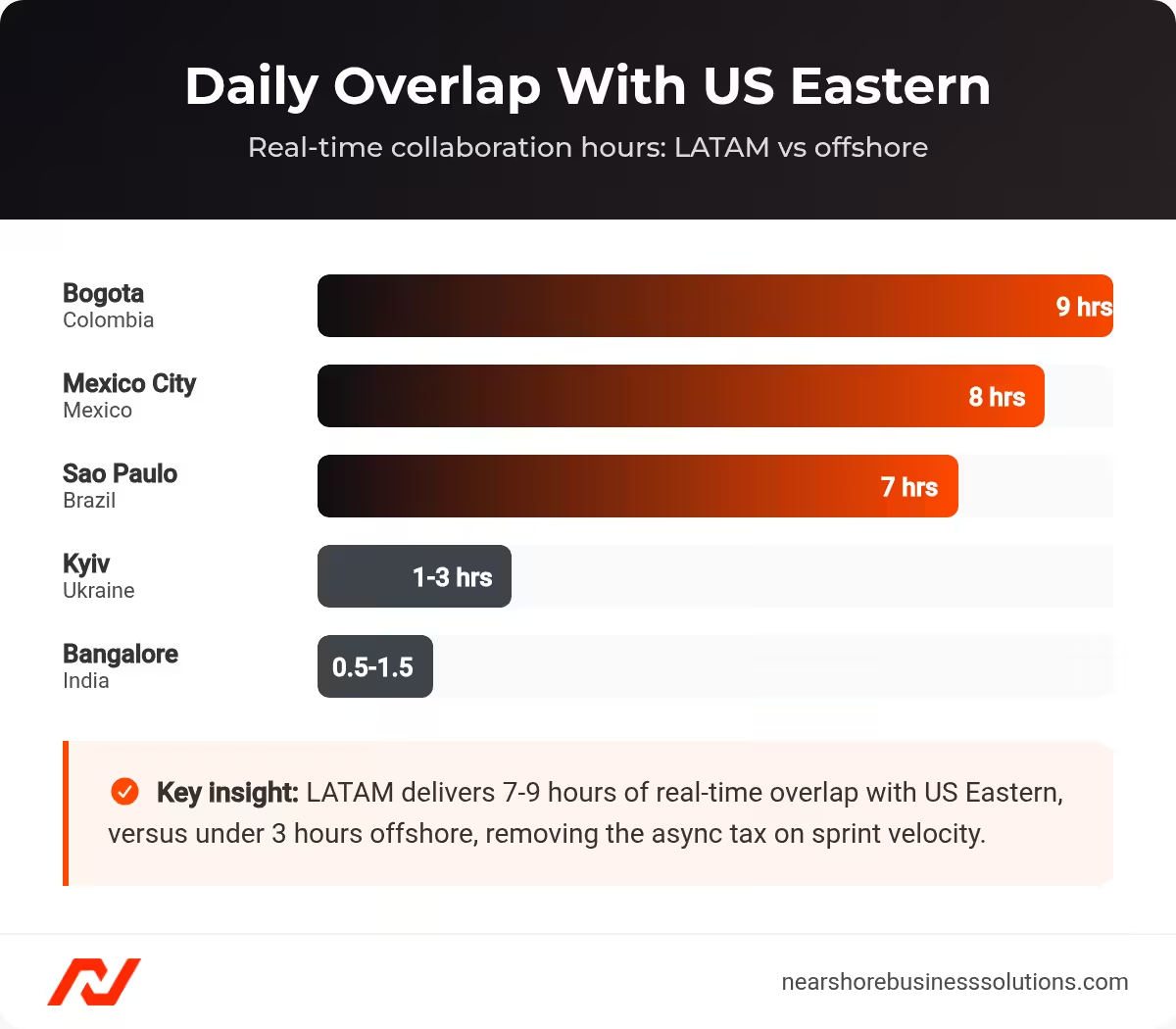
Daily collaboration overlap with US Eastern: LATAM cities versus offshore hubs.
Contrast that with Bangalore: 0.5-1.5 hours overlap with ET, zero with PT. Every pull request comment and every Slack question about a failing integration test waits 12-18 hours for a response. For a team running two-week sprints on a Spring Boot microservices platform, that gap compounds into meaningful lost velocity every sprint cycle. Kyiv offers 1-3 hours with ET and zero with PT. LATAM’s alignment is not a marginal improvement; it is a category difference.
How Does Cultural and Legal Proximity Reduce Management Overhead for US Engineering Orgs?
LATAM developers exhibit a direct and open communication style that makes it easier for US engineering leads to gauge project status and address blockers, compared to many Asian outsourcing markets (Forrester Research, Q2 2023). English proficiency in LATAM’s tech sector exceeds general population benchmarks significantly.
A 2023 Slang survey found that 79% of Brazilian developers hold at least intermediate English proficiency, with over 40% at advanced or fluent levels, despite Brazil ranking #70 on the general EF English Proficiency Index. Argentina ranks #28 globally at High proficiency. Developers in Bogota and Medellin’s Ruta N innovation district regularly work in English-only environments with US clients.
Legal proximity also matters. The USMCA covers intellectual property, patent enforcement, and digital IP protections for Mexican engagements. Brazil’s LGPD mirrors GDPR in data protection rigor. Colombian law enforces NDA and IP assignment agreements through established commercial courts. Geographic proximity enables quarterly in-person offsites with a 3-6 hour direct flight, a practical impossibility with Bangalore or Kyiv.
What Does It Cost to Hire Java Developers in Latin America in 2026?
Senior Java developers in LATAM cost $60,000-$100,000 per year, saving $80,000-$130,000 annually per hire versus equivalent US talent at $180,000-$230,000, according to Everest Group analysis.
US senior Java developer salaries resumed climbing at 3.5%-4.8% annually through 2025 (Robert Half, October 2023). LATAM rates have risen too, at 8%-12% annually for senior JVM roles, but the structural gap remains 52%-70% depending on country and seniority. The fully loaded cost of a single US senior Java developer in the US reaches $230,000-$290,000 per year (Robert Half Technology Salary Guide 2024). Even at that price, you will wait 45-60 days to fill the role, longer for specialized profiles like Java microservices architects (DevSkiller, 2024).
What Are the Mid-Level and Senior Java Developer Rates Across LATAM Countries?
LATAM senior Java developers cost $60,000-$100,000 per year depending on country, saving 52%-70% versus US equivalents at $180,000-$230,000.
| Country | Mid-Level (3-5 yrs) | Senior (5-8 yrs) | Architect/Lead (8+ yrs) | Senior Savings vs. US |
|---|---|---|---|---|
| Brazil | $45,000-$65,000 | $70,000-$95,000 | $90,000-$120,000+ | 55%-65% |
| Mexico | $50,000-$70,000 | $75,000-$100,000 | $95,000-$125,000+ | 52%-63% |
| Colombia | $40,000-$60,000 | $65,000-$85,000 | $80,000-$110,000+ | 58%-68% |
| Argentina | $40,000-$60,000 | $60,000-$80,000 | $75,000-$105,000+ | 60%-70% |
| Chile | $45,000-$65,000 | $70,000-$90,000 | $85,000-$115,000+ | 56%-66% |
| Costa Rica | $50,000-$70,000 | $70,000-$95,000 | $90,000-$120,000+ | 55%-65% |
| US Equivalent | $140,000-$175,000 | $180,000-$230,000 | $230,000-$300,000+ | N/A |
Sources: published 2024 global engineer salary reports, GeekHunter 2024 Tech Salary Report. US data from BuiltIn, Glassdoor, Robert Half 2024.
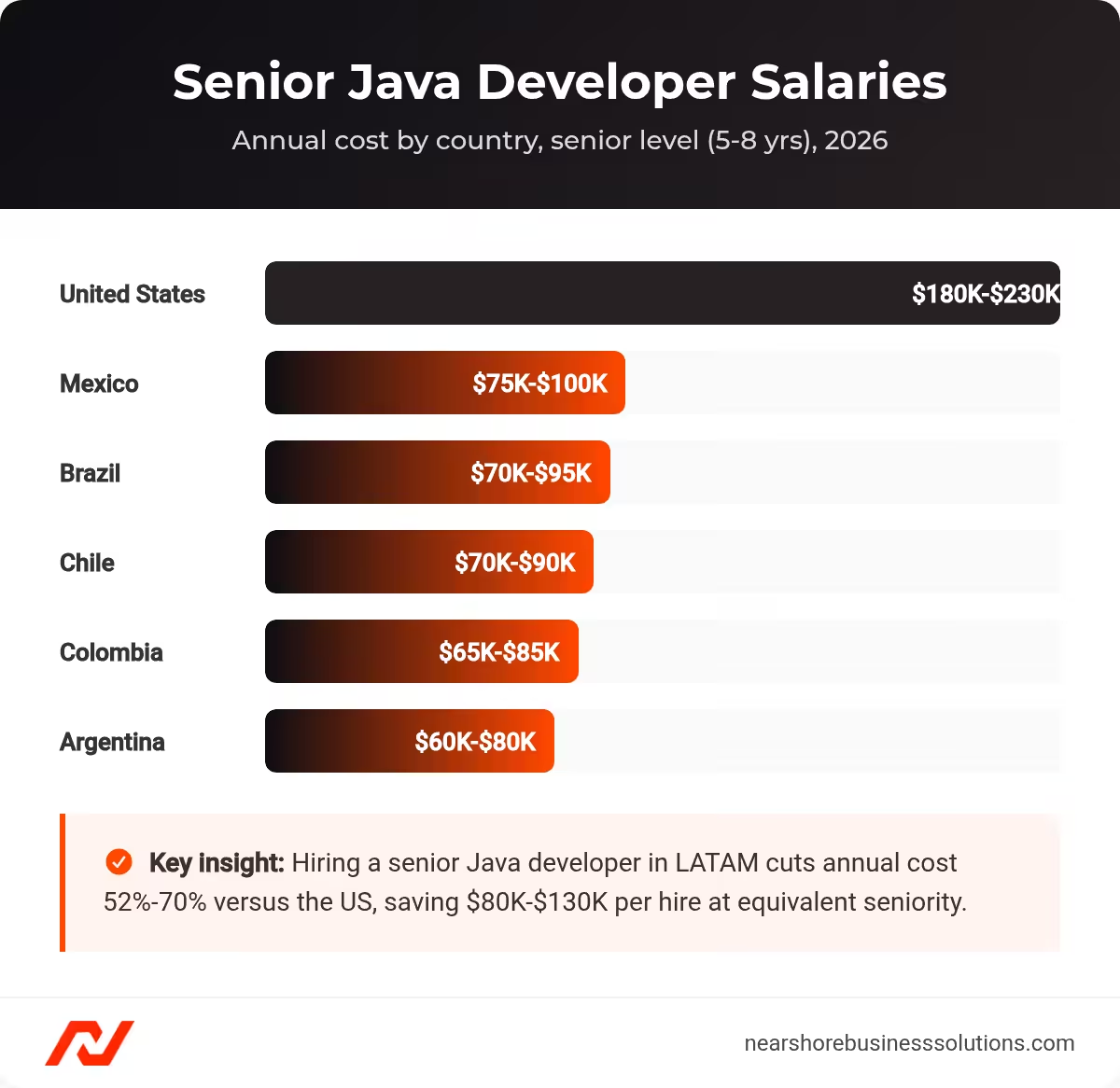
Senior Java developer annual salaries across the US and five LATAM countries, 2026.
For contractor engagements, senior hourly rates range from $29-$39 (Argentina) to $37-$49 (Mexico), versus $88-$113 for US equivalents. Argentina offers the widest savings band at 60%-70% but carries retention risk. Top Argentine developers may reprice 15%-20% annually due to macroeconomic factors. Colombia and Chile offer a balance of cost efficiency and rate stability. The right country choice depends on your priority: maximum savings in Argentina, deepest senior talent pool in Brazil, or optimal cost-stability balance in Colombia or Mexico.
Why Do Brazil and Mexico Command Premium LATAM Rates?
Brazil’s 500,000 Java developers constitute the largest JVM talent pool in Latin America (Evans Data Corporation, 2023), trained at enterprise scale by Nubank, TOTVS, and companies in Recife’s Porto Digital innovation district, which houses 350+ tech companies and 11,000+ workers.
Mexico follows with over 700,000 total software developers, 25%-30% of whom list Java as a primary or secondary proficiency (Statista, 2023). Together, Brazil and Mexico account for the majority of LATAM’s 350,000+ Java-proficient engineers.
Brazil’s enterprise Java ecosystem operates at global scale. Nubank, the world’s largest digital bank by customer count, runs one of the largest Java and Kotlin backend systems in production anywhere. Engineers who spend three to five years inside Nubank’s platform team arrive with production experience in distributed transaction processing and JVM performance tuning at scale. TOTVS maintains a Java footprint spanning ERP, CRM, and supply chain platforms across 70,000+ enterprise clients. Graduates from UFPE and CESAR in Recife and USP in Sao Paulo enter JVM-focused roles with strong competitive programming records. Brazilian developers consistently place in the top 20 globally in HackerRank coding challenges and top 10 in TopCoder’s competitive programming community.
Mexico’s tech corridor has matured beyond cost arbitrage. Guadalajara hosts R&D centers for Intel, Oracle, IBM, HP, and TCS. Monterrey, anchored by Tecnologico de Monterrey (top 3 LATAM engineering, QS), produces graduates with Spring Boot, Kubernetes, and CI/CD pipeline experience baked into their curricula. UNAM and IPN in Mexico City supply a second major pipeline of senior JVM engineers. Mexico City’s fintech ecosystem, including companies like Clip and Konfio, has generated senior Java engineers experienced with high-throughput payment processing.
Spring Boot adoption across the region reinforces depth: 82% of LATAM developers report Spring Boot as a primary framework (2023 nearshore industry data). Kotlin has seen a 35% increase in server-side adoption since 2022 (JetBrains, 2023), and LATAM’s deep Java bench positions the region as a natural source for JVM-interoperable language expertise.
What Are the Hidden Costs Beyond Base Salary When Hiring LATAM Java Developers?
Base salary typically captures 75%-85% of total engagement cost. The remaining 15%-25% breaks down across six line items.
- EOR and Payroll Provider Fees: 15%-20% of base salary annually. For a Brazilian senior at $85,000 base, this adds $12,750-$17,000. Providers like Deel and Remote.com may charge flat monthly fees of $599-$799 per employee instead.
- Statutory Benefits: Highly country-dependent. Brazil carries the heaviest load: 13th salary (8.33%), vacation loading (11.1%), FGTS employer deposits (8%), totaling 35%-40%. Mexico: aguinaldo plus PTU equals 8%-15%. Colombia: 25%-30%. Most EOR providers bundle these into quoted rates.
- Equipment and Workspace: $1,500-$3,000 one-time plus $100-$200 per month for internet stipends. Total first-year: $2,700-$5,400 per developer.
- Onboarding Investment: 2-4 weeks of reduced productivity, equivalent to $4,000-$8,000 in team time. This cost is identical whether hiring domestically or from LATAM.
- Retention: Budget $5,000-$8,000 per year for annual raises of 8%-12% plus $1,000-$2,000 for conferences and certifications.
- Travel: $4,000-$16,000 per developer annually depending on frequency. One in-person week generates 2-3 months of improved async collaboration, based on NBS placement experience.
Fully loaded Year 1 comparison: a US San Francisco senior Java developer at approximately $299,500 versus a LATAM Brazil senior at approximately $126,500, a 58% reduction with equivalent production capability.
How Do You Evaluate Spring Boot Developer Expertise in LATAM Beyond Resume Keywords?
86% of companies using the Spring Framework now use Spring Boot for new applications (Snyk, JVM Ecosystem Report 2023), which means every LATAM candidate lists Spring Boot. The challenge is distinguishing engineers who have architected and operated Spring Boot systems from those who deployed a tutorial app.
LATAM’s 82% Spring Boot adoption rate and 75% microservices architecture experience (2023 nearshore industry data) confirm the skill supply exists. The vetting challenge is signal quality, not supply. Our developer vetting process for nearshore hires covers the full framework; the Java-specific signals below focus on what separates production-ready Spring Boot engineers from candidates who have not shipped at scale.
Job postings mentioning “Spring Boot” increased 18% year-over-year through 2024 (Lightcast analysis). That demand means resume screening alone cannot reliably separate seniority tiers.
What Is the Spring Boot Skill Stack That Separates Production-Ready Engineers from Tutorial-Level Candidates?
Six non-negotiable skills separate production-ready LATAM Spring Boot engineers from tutorial-level candidates.
Must-have skills for any production Spring Boot role:
| Skill | Why It Matters | Senior-Level Signal |
|---|---|---|
| Spring Boot 3.x with Jakarta EE migration | The javax to jakarta migration broke every dependency and filter. Spring Boot 2.7 reached EOL November 2023. | Can they describe a specific production migration, including dependency conflicts resolved? |
| Spring Cloud (Config, Gateway, Circuit Breaker) | Microservices without centralized config, routing, and fault isolation are a distributed monolith. | Ask for a specific incident where a circuit breaker fired in production. |
| Spring Security with OAuth2 and OIDC | 68% of API security breaches stem from misconfigured auth layers (Salt Security, Q1 2024). | Can they explain the difference between @PreAuthorize and gateway-level token validation? |
| Spring Data JPA with Hibernate optimization | 85% of LATAM developers report Hibernate/JPA as primary (2023 nearshore industry data), but usage does not equal mastery. N+1 queries, lazy init exceptions, and batch operations all matter. | When do they bypass JPA entirely for native queries or JDBC templates? |
| JUnit 5 plus Testcontainers | @MockBean-heavy tests never catch schema mismatches or serialization failures. Docker and Kubernetes experience runs at 68% among LATAM devs (2023 nearshore industry data), supporting containerized testing. | Verify Testcontainers-based integration tests running in CI, not just locally. |
| Docker and Kubernetes deployment fluency | Must go beyond writing a Dockerfile. | Probe for health check endpoint configuration, graceful shutdown handling, and ConfigMap/Secret injection for Spring profiles. |
Nice-to-have skills that signal senior-to-staff depth:
| Skill | Why It Matters | Signal |
|---|---|---|
| Reactive programming with WebFlux and Project Reactor | Below 20% industry-wide adoption (JetBrains, 2023), reflecting genuine complexity. | Can they articulate when reactive I/O delivers measurable gains versus unnecessary overhead? |
| GraalVM native image compilation | Spring Boot 3.x first-class support reduces startup to under 100ms. Under 10% of production deployments (VMware Tanzu, 2024). | Have they shipped a native-compiled service to production? |
| Kotlin interop on Spring Boot | Nubank and Mercado Libre prove Java-Kotlin migration at scale. Spring has offered first-class Kotlin support since 5.0. | Can they migrate a Java module to Kotlin while maintaining interoperability? |
Frequently Asked Questions About Hiring Java Developers in LATAM
These are the most common questions VP Engineering leaders ask when evaluating LATAM Java hiring.
How Long Does It Take to Hire a Senior Java Developer in LATAM?
Expect 3-5 weeks from kickoff to signed offer with a nearshore staffing partner that maintains an active LATAM candidate pool. US hiring timelines for senior Java roles run 45-60 days (DevSkiller, 2024), and that assumes a candidate accepts. NBS delivers a pre-vetted shortlist in 3 business days and handles offer coordination.
What Happens If a Developer Does Not Work Out?
Structure your engagement with a 90-day replacement guarantee through your staffing or EOR partner. NBS includes this guarantee on every placement. If a developer exits within 90 days for performance reasons, we replace at no additional fee.
Do I Need to Set Up a Local Legal Entity in Brazil or Mexico?
No. An Employer of Record (EOR) handles local employment contracts, payroll, statutory benefits, and compliance on your behalf. EOR setup takes 3-7 days, versus 3-6 months for a local entity. Most US companies hiring 1-10 LATAM engineers use an EOR. Local entities make sense at 20+ headcount.
How Do I Pay LATAM Java Developers?
You pay the EOR provider in USD. The provider converts and disburses local currency, handles statutory deductions, and manages payroll compliance for each country. This eliminates currency exposure for the developer and administrative overhead for your team. Platforms like Deel and Remote.com automate this workflow.
What Is the Difference Between Nearshore and Offshore for Java Hiring?
Nearshore means LATAM, which gives you 0-3 hours offset from US Eastern and 7-9 hours of real-time collaboration daily. Offshore (India, Ukraine, Poland) typically delivers 0.5-5 hours of overlap with ET and zero overlap with PT. For agile teams running two-week sprints, nearshore alignment removes the async tax that offshore cannot.
How Do I Verify That a LATAM Java Developer Is Senior Level and Not Mid-Level?
Ask for a specific production incident they debugged: the symptom, the root cause, and the fix. Senior engineers can narrate these in detail. Mid-level candidates describe features they built. Also ask which version of Spring Boot they migrated away from, and why. Genuine senior developers have migrated production systems; tutorial-level candidates have not.
Is LATAM Safe for IP and Data Protection?
Yes, with proper legal structure. Mexico’s USMCA IP provisions, Brazil’s LGPD (equivalent to GDPR), and Colombia’s Law 1581 (data protection) all provide enforceable IP assignment and NDA frameworks. Use a local IP assignment addendum in your EOR agreement. This is standard practice and adds no timeline.
How Do You Scale a Java Engineering Team in LATAM? A Senior Hiring Roadmap for 2026
Scaling a LATAM Java team takes three parallel workstreams: sourcing through a partner with a pre-vetted LATAM pool, structuring through an EOR for compliance protection, and planning one in-person onboarding week to accelerate the async collaboration that follows.
The cost case is decisive. Senior LATAM Java engineers cost $60,000-$100,000 fully loaded, versus $230,000-$299,500 in the US, a 52%-70% reduction with equivalent production capability across Brazil, Mexico, Colombia, Argentina, Chile, and Costa Rica. Scale that savings across a five-person senior Java team and the annual delta reaches $650,000-$900,000.
Timezone alignment is not a soft benefit. It is a structural velocity multiplier that offshore regions cannot replicate. LATAM delivers 7-9 hours of real-time collaboration versus Bangalore’s zero-to-one. Every sprint ceremony, every production incident, every PR review cycle runs in real time.
The talent depth is real. Brazil alone has 500,000 Java developers trained at enterprise scale by companies processing billions of transactions on JVM platforms. The region’s 82% Spring Boot adoption rate means candidates arrive with production framework experience, not tutorial keywords. Brazilian developers consistently rank in the top 20 globally on HackerRank, and Tecnologico de Monterrey, UNAM, UFPE, and Universidad de los Andes supply a pipeline of CS graduates with competitive programming backgrounds.
Start your search with a structured vetting process. Use the Spring Boot skill matrix above to separate production-ready engineers from resume-keyword candidates. Verify Testcontainers-based CI test suites, ask for Spring Boot migration war stories, and probe for real circuit-breaker production incidents. A developer who can narrate a Hibernate N+1 fix under load is senior. One who cannot is not.
Country selection matters at scale. Brazil offers the deepest senior talent pool and the strongest enterprise Java pedigree, making it the right primary market for specialist roles like distributed transaction architects and JVM performance engineers. Colombia and Mexico offer a better cost-stability balance for mid-level and senior generalist roles. Argentina delivers the widest savings but requires proactive retention planning, including annual raises of 8%-12% and a clear equity or growth path. Costa Rica and Chile offer US timezone alignment at slightly higher rate floors, making them strong secondary markets for roles that require maximum overlap with West Coast teams.
For a full view of LATAM staff augmentation models and engagement structures, see our staff augmentation guide.
Ready to Hire Senior Java Developers in LATAM?
Nearshore Business Solutions sources and vets Java developers from Sao Paulo, Guadalajara, Bogota, Buenos Aires, and Medellin. We screen for Spring Boot 3.x production depth, English fluency, and US work style fit.
Every placement includes a 90-day replacement guarantee. You receive pre-vetted candidates in 3 business days.
Get a free consultation to discuss your Java hiring needs and receive a custom candidate quote.