
An Employer of Record in Colombia lets US companies hire engineers in 24 hours to 5 business days, without opening a local entity. Colombia’s total employer burden runs 50% to 55% above base salary, yet senior engineers still cost 60% to 64% less than US equivalents.
Bogotá, Medellín, and Barranquilla host 100,000 to 150,000 developers who work under the Código Sustantivo del Trabajo (CST), Colombia’s labor code (Invest in Bogotá, 2023). Mandatory benefits like prima de servicios and cesantías add close to two extra months of salary a year, on top of EPS health and ARL risk contributions.
This guide breaks down Colombia’s mandatory contribution rates, EOR provider fees, misclassification penalties under UGPP enforcement, and the statutory benefits your Colombian hires expect in 2026.
How Does an Employer of Record Work in Colombia?
An Employer of Record signs the employment contract, runs payroll, and carries every statutory obligation for your Colombian hires under Colombian law. The EOR’s local Colombian entity places the worker on its payroll and handles taxes, EPS and ARL contributions, benefits administration, and labor law compliance. Your company keeps full operational control: you assign the work, manage performance, and run the employee inside your engineering team. You never need a Colombian legal entity.
Three distinctions matter before you sign with a provider:
- EOR vs. PEO. A Professional Employer Organization co-employs workers alongside your company, which means you must already hold a legal entity in Colombia. An EOR removes that requirement. The EOR functions as the entity.
- EOR vs. staffing agency. A staffing agency finds candidates. An EOR’s core function is legal employment, payroll, and compliance, not recruitment.
- EOR vs. independent contractor. An EOR creates a formal employment relationship, typically a contrato a término indefinido (indefinite-term contract). A contractor arrangement (contrato de prestación de servicios) classifies the worker as self-employed. Colombia’s Ministry of Labor and its courts reclassify contractor relationships that show markers of employment: fixed schedules, exclusive dedication, company-provided tools, and subordination. Misclassification triggers back-payment of benefits and social security, plus penalties (covered in detail below). For any full-time, integrated engineering role, the contractor model carries real legal risk.
What Legal Structure Governs EOR Services in Colombia?
The Código Sustantivo del Trabajo governs every employment relationship in Colombia, and it sets four requirements that matter most to foreign employers: contract type, probation length, working hours, and mandatory benefits.
Colombian EORs use two contract types. Término indefinido (indefinite-term) contracts carry no end date, offer maximum employee protection, and are the standard choice for full-time engineering roles because top candidates expect them. Término fijo (fixed-term) contracts cap out at three years and see limited use outside short, defined projects.
Probation runs two months maximum for indefinite-term contracts, regardless of seniority, and the clause must appear in writing (CST, Articles 76 to 80). Colombia’s standard legal workweek is 42 hours as of 2026, the final step down from 47 hours under the phase-in schedule set by Ley 2101 de 2021. Night work between 9:00 PM and 6:00 AM carries a 35% surcharge. Sunday and holiday work carries a 75% surcharge, and overtime caps at two additional hours a day, paid at 125% to 175% of the hourly rate depending on timing.
The CST also mandates four benefits on top of salary: prima de servicios, cesantías, interest on cesantías, and paid vacation. Together, prima de servicios and cesantías function as Colombia’s version of 13th-month pay, spread across two separate payments rather than a single lump sum. The full rates and payment schedule appear in the cost breakdown below.
What Do You Control, and What Does Your Colombia EOR Provider Manage?
You keep sourcing, task assignment, and performance management. Your EOR owns every legal and payroll obligation tied to Colombian labor law.
| EOR Provider Manages | Client Company Manages |
|---|---|
| Drafting and signing compliant employment contracts | Sourcing and interviewing candidates |
| Employee onboarding and offboarding, including registrations with EPS, AFP or Colpensiones, ARL, and caja de compensación | Day-to-day task assignment and project management |
| Calculating and processing monthly payroll, including prima de servicios and cesantías | Performance reviews and professional development |
| Withholding and remitting all taxes and social security contributions | Integrating the employee into company culture and teams |
| Ensuring ongoing compliance with evolving Colombian labor law | Providing equipment and software or tool access |
| Managing terminations and calculating severance | Defining the role, responsibilities, and KPIs |
Your Colombian engineer reports to your engineering manager, joins your standups, and ships code to your repositories. The EOR ensures every peso of payroll and every social security filing stays compliant behind the scenes.
How Long Does EOR Onboarding Take Compared to Setting Up Your Own Entity?
EOR onboarding takes 24 hours to 5 business days after a candidate accepts an offer. Setting up your own Colombian entity takes 4 to 12 weeks minimum, plus $5,000 to $15,000 in legal, registration, and accounting fees.
| Factor | EOR Hiring | Own Entity Setup (SAS) |
|---|---|---|
| Timeline to first hire | 24 hours to 5 business days | 4 to 12 weeks minimum |
| Upfront cost | Minimal beyond the monthly EOR fee ($199 to $699/month) | $5,000 to $15,000 in legal, registration, and accounting fees |
| Ongoing compliance burden | Zero for the client | Full burden: local HR, legal, and accounting required, at $1,500 to $3,000/month |
| Best for | 1 to 15 employees | 15+ employees with a long-term commitment |
A 12-week entity setup delays your first hire by roughly a quarter. An EOR compresses that gap to days, letting you deploy a Colombian developer into your sprint cycle within the same week they accept an offer.
What Does an Employer of Record in Colombia Cost in 2026?
Colombia’s total employer burden adds 50% to 55% on top of every peso of base salary, one of the highest rates in Latin America (Código Sustantivo del Trabajo and UGPP contribution tables, January 2025). Base salaries still run 50% to 70% below US equivalents for senior engineers in Bogotá, Medellín, and Barranquilla. Your fully loaded Total Cost to Employer lands at roughly one-third of the same hire in the US.
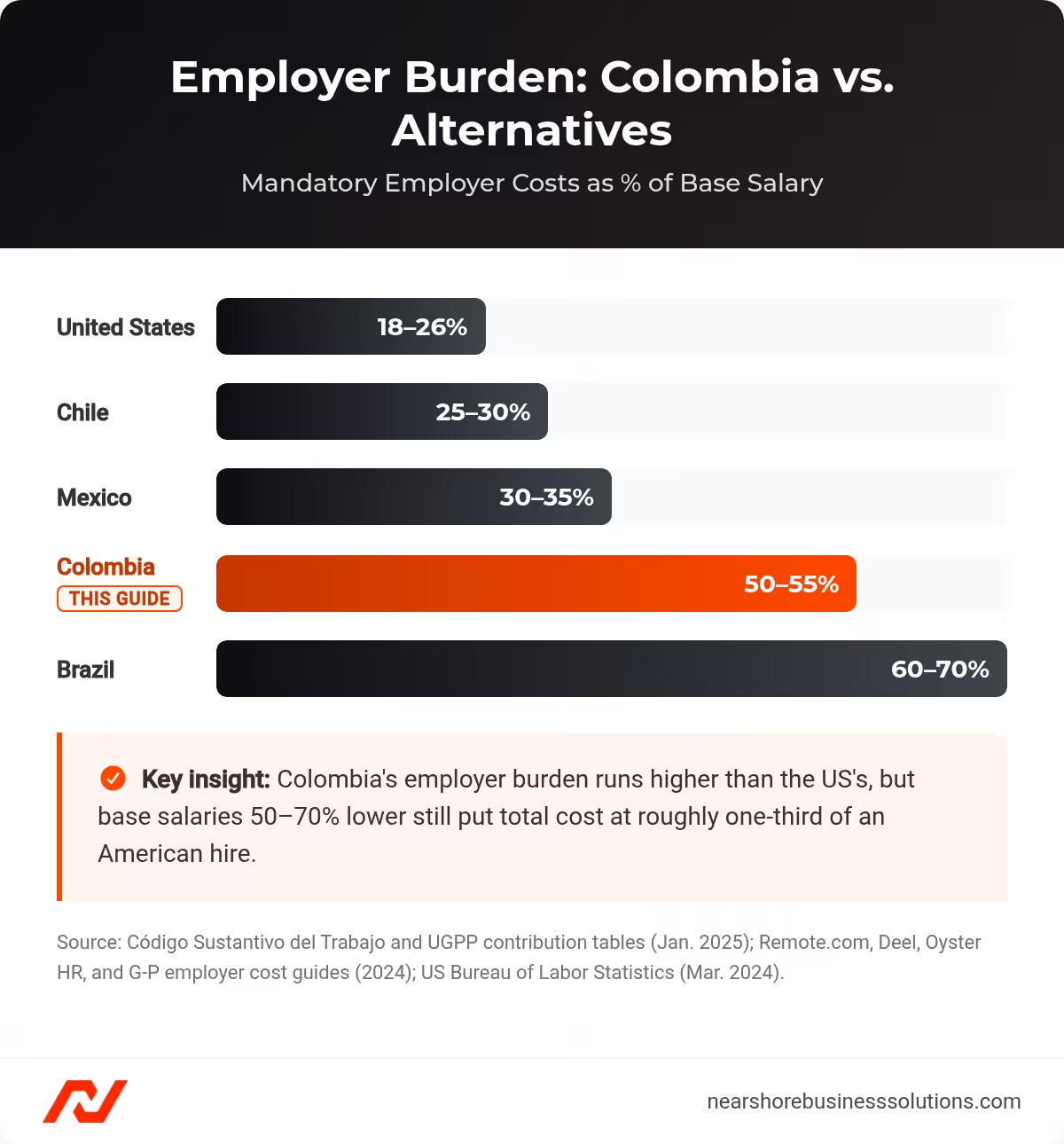
Colombia’s 50-55% employer burden compared to the US and four nearshore alternatives.
What Are Colombia’s Mandatory Employer Contributions and Benefits?
Colombian employers pay two categories of mandatory cost on top of base salary: social security and parafiscal contributions, and mandatory benefit provisions. Both are set by the CST and enforced by the UGPP.
Social Security and Parafiscal Contributions
| Item | Employer Rate | Notes |
|---|---|---|
| EPS (Health Insurance) | 8.5% | Employee also pays 4%. Covers public health system access. |
| Pension (AFP or Colpensiones) | 12.0% | Employee also pays 4% into the employee’s chosen fund. |
| ARL (Workplace Risk) | 0.522% | Class I rate for office and remote tech roles, the lowest risk tier. |
| Caja de Compensación | 4.0% | No employee counterpart. Funds family recreation and housing subsidies. |
| ICBF | 3.0% | Exempt below 10 SMMLV (about COP $15,650,000/month in 2025, per Ley 1819 de 2016). |
| SENA | 2.0% | Same exemption threshold as ICBF. |
Subtotal below 10 SMMLV: approximately 25.0%. Above 10 SMMLV: approximately 30.0%.
The 10-SMMLV threshold creates a real cost cliff. A senior engineer earning COP $15,000,000/month costs 25.0% in contributions. At COP $16,000,000/month, crossing the threshold, contributions jump to 30.0%. Five percentage points on a $5,000/month salary adds roughly $3,000/year per engineer.
Mandatory Benefit Provisions
| Item | Rate/Accrual | Schedule |
|---|---|---|
| Prima de Servicios | 8.33% | Two installments: June 30 and December 20 |
| Cesantías | 8.33% | Deposited into a regulated fund by February 14 |
| Intereses sobre Cesantías | 1.0% effective | Paid to the employee by January 31 |
| Vacaciones | 4.17% | 15 working days a year |
Subtotal: approximately 21.83% of base salary.
Budget for 14.17 months of salary equivalent per calendar year, not 12. Prima de servicios and cesantías together create two additional months of salary, plus interest on cesantías, the closest Colombian equivalent to the 13th-month pay common elsewhere in Latin America.
What Do Colombia EOR Providers Charge, and What Hidden Costs Should You Watch For?
Colombia EOR providers charge a flat monthly fee or a percentage of payroll, and the difference compounds fast at scale.
| Pricing Model | Range (2025 to 2026) | Best For |
|---|---|---|
| Flat Monthly Fee | $599 to $799/employee/month | Senior hires, where the fee becomes a smaller share of salary |
| Percentage of Payroll | 10% to 18% of total payroll | Junior hires, where the lower absolute cost wins |
Watch for six cost traps that inflate your real EOR spend beyond the quoted fee:
- FX markups of 1.5% to 3.0% on currency conversion, adding roughly $2,280/year per senior employee
- Deposit requirements that lock up $50,000 to $76,000 for a five-person team
- Offboarding fees of $500 to $2,000 per termination
- Benefit administration surcharges of $25 to $75/month per supplemental benefit per employee
- Contract minimums with 12-month lock-in periods and early-exit penalties
- Compliance adjustment fees some providers charge each time Colombia’s annual minimum wage change (a 9.54% increase in January 2025, per Decreto 2613 de 2024) forces a contract update
EOR pricing compresses at scale. Providers routinely discount fees 15% to 25% for teams of 5 or more employees, and 25% to 40% for teams of 10 or more. Negotiate volume pricing in writing before you sign, with specific headcount tiers.
How Does EOR Cost Compare to Your Own Entity or a Contractor in Colombia?
An EOR costs $599 to $799 per employee per month on top of the roughly 52% employer burden. A contractor arrangement looks cheaper on paper but carries misclassification exposure of $7,500 to $36,000 or more per employee (detailed in the next section). Your own entity costs $5,000 to $15,000 to set up, then $1,500 to $3,000 a month regardless of headcount.
Colombia’s employer burden sits mid-pack among nearshore destinations, but its base salaries run lower than most regional peers, which keeps total cost competitive.
| Country | Typical Employer Burden | Source |
|---|---|---|
| Chile | 25% to 30% | Published EOR employer-cost guide, 2024 |
| Mexico | 30% to 35% | Published EOR employer-cost calculator, 2024 |
| Colombia | 50% to 55% | CST and UGPP published rates, January 2025 |
| Argentina | 55% to 65% | Published EOR global employment-cost guide, 2024 |
| Brazil | 60% to 70% | G-P Global Payroll Calculator, 2024 |
| United States | 18% to 26% | US Bureau of Labor Statistics, March 2024 |
If your hiring plan spans more than one LATAM market, our EOR Chile guide covers the lowest-burden option in the region for comparison.
Despite the higher percentage burden, Colombia’s total cost to employer still undercuts most of the region in absolute dollars. Base salaries run 15% to 25% lower than Mexico’s and 20% to 30% lower than Brazil’s for equivalent seniority (per published 2024 LATAM salary data).
| Role | Seniority | Colombia TCE (Annual USD) | USA TCE (Annual USD) | Savings |
|---|---|---|---|---|
| Software Engineer | Mid-Level (3 to 5 yrs) | $50k to $75k | $160k to $220k | 66% to 69% |
| Software Engineer | Senior (6 to 10 yrs) | $80k to $110k | $220k to $300k | 60% to 64% |
| Staff/Principal Engineer | 10+ yrs | $110k to $150k | $300k to $450k+ | 63% to 67% |
| DevOps/SRE Engineer | Mid-Senior | $70k to $100k | $180k to $260k | 61% to 65% |
| Data Engineer | Mid-Senior | $75k to $105k | $190k to $270k | 61% to 63% |
(Sources: published 2024 global hiring and tech-salary reports, cross-referenced with Levels.fyi, 2024.)
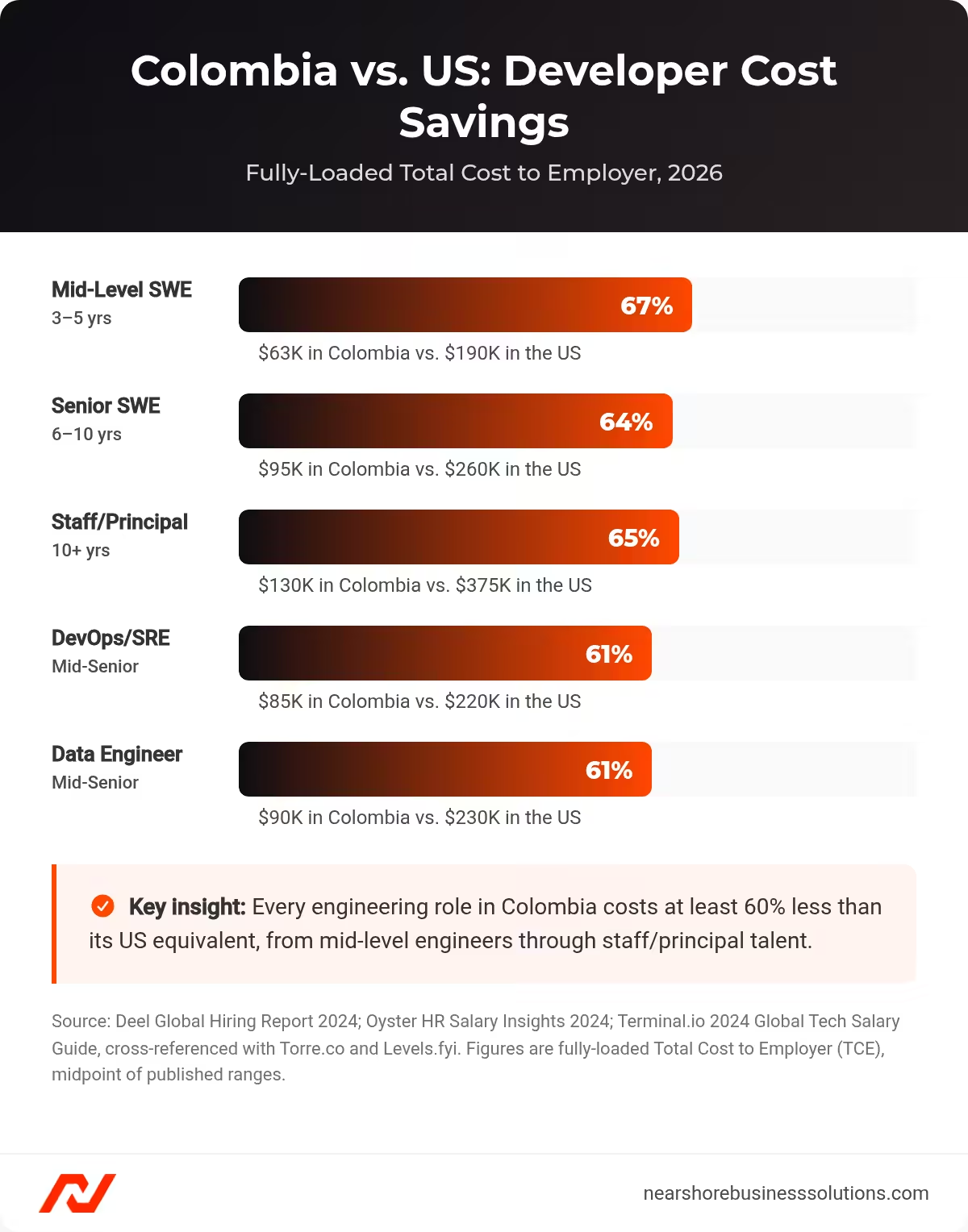
Colombia EOR hires cost 60-67% less than US-based engineers across five seniority levels.
What Compliance Risks Do EOR Services in Colombia Eliminate for Foreign Companies?
An EOR eliminates worker misclassification exposure, the single most expensive compliance mistake foreign companies make when hiring in Colombia. The risk clusters around one government agency: the UGPP.
What Penalties Does Worker Misclassification Trigger Under UGPP Enforcement?
Misclassifying a Colombian engineer as a contractor can cost a company $15,000 to $36,000 or more in UGPP sanctions per employee, on top of unpaid contributions and benefits. Colombian labor law presumes employment the moment personal service is proven, which flips the burden of proof onto the employer.
CST Article 23 finds employment exists when three elements appear together:
- Personal service. The individual performs the work themselves.
- Continued subordination. The employer directs how, when, or how much work gets done.
- Remuneration. The worker receives regular payment.
A senior engineer embedded in your sprint cycles, attending retrospectives, and shipping code through your CI/CD pipeline satisfies every marker.
CST Article 24 makes this consequential: once personal service is proven, an employment relationship is presumed. The company must prove genuine independence, which is close to impossible for any full-time, integrated engineering role.
The Unidad de Gestión Pensional y Parafiscales (UGPP) is Colombia’s social security audit agency. It collected COP $1.37 trillion (approximately USD $342 million) in sanctions and recovered contributions during fiscal year 2023, a 28% increase over 2022. The agency processed over 8,200 audit actions that year (UGPP, Informe de Gestión 2023, published March 2024).
Its enforcement mechanism cross-references PILA social security filings against income reported to DIAN, Colombia’s tax authority. A remote engineer earning $3,000 to $8,000/month from a single US client creates an obvious data signature for auditors when no employer social security contributions exist for that income.
Financial exposure per misclassified employee, per year of misclassification, breaks down into four categories:
- Unpaid social security: $7,500 to $18,000
- Unpaid mandatory benefits: $6,500 to $13,000
- UGPP sanctions: up to 200% of unpaid contributions, or $15,000 to $36,000 (Ley 1607 de 2012, Article 179)
- Interest, severance, and legal fees: added on top of the above
The UGPP can audit and sanction the previous five years retroactively (Ley 1607 de 2012, Article 178). A multi-year contractor relationship can generate six-figure exposure for a single employee.
An EOR removes this risk from day one. The worker appears on the EOR’s PILA filings as a formal employee, every contribution and benefit is calculated and remitted on schedule, and there is no contractor relationship left to reclassify. For a broader look at how contractor and employee structures compare across the region, and where the line between the two sits in each country, see our contractor vs. employee guide for Latin America.
What Benefits Must You Provide Through a Colombia Employer of Record?
Every statutory benefit detailed above is non-negotiable. Beyond the cost mechanics, employees exercise real choices and rights over how these benefits function day to day.
Employees choose their own EPS health provider from roughly 30 regulated entities. They also choose their own pension fund, deciding between Colpensiones (the public, defined-benefit system) and a private AFP such as Porvenir or Protección (a defined-contribution system). That choice carries long-term financial consequences the employee alone controls. Colpensiones requires around 1,300 weeks of contributions for a lifetime pension. A private AFP depends on accumulated capital and investment returns, with no minimum-weeks requirement.
Cesantías function as a savings and severance fund. Employees can withdraw early for education or housing, without employer approval, once they provide supporting documentation. Prima de servicios payments in June and December are culturally significant. Employees budget around them months in advance, so avoid scheduling role changes or compensation conversations near those payment dates. ARL coverage extends to the home office for remote workers under Ley 2121 de 2021, Colombia’s remote work law. The same law requires employers to cover a reasonable share of connectivity costs.
Colombia’s tech workforce context makes competitive benefits a real differentiator, not just a compliance checkbox. The IT and BPO sector generated over USD $9.5 billion in revenue in 2023 and was projected to exceed USD $11 billion by 2025 (ProColombia, BPO & IT Sector Investment Report, 2024). That sector draws on 100,000 to 150,000 developers concentrated in Bogotá, Medellín, and Cali (Invest in Bogotá, 2023).
Colombian universities graduate roughly 60,000 engineering and technology students a year (SNIES Database, 2023). Top programs include Universidad de los Andes, Universidad Nacional de Colombia, Pontificia Universidad Javeriana, and EAFIT (QS World University Rankings by Subject, 2024). The most in-demand stacks are React, Node.js, Python, Java, and DevOps tooling. Over 80% of tech roles in Colombia are offered fully remote or hybrid, a trend backed by Ley 2121 de 2021 (El Empleo, Tech Hiring Trends Report, 2024).
For the full picture of Colombia’s hiring process outside the EOR model, including recruiting timelines and role-specific benchmarks, see our complete guide to hiring in Colombia.
Supplementary benefits separate a competitive offer from a merely compliant one. Medicina prepagada (prepaid private healthcare) ranks as the top differentiator among Colombian tech professionals. EPS specialist appointments can take 20 to 45 days to schedule, while prepaid plans cut that to 24 to 72 hours. Education stipends and home office allowances round out the packages that win offers against the dozens of other US companies recruiting from the same Bogotá and Medellín talent pools.
Is an Employer of Record the Right Model for Scaling Your Team in Colombia?
An EOR is the right model for 1 to 15 Colombian employees. Above that range, the math shifts toward opening your own entity, depending on headcount stability and how long you plan to stay.
With EOR fees of $599 to $799/month per employee, annual EOR cost for a 10-person team reaches $71,880 to $95,880. Compare that against entity setup ($5,000 to $15,000) plus ongoing maintenance ($1,500 to $3,000/month, or $18,000 to $36,000/year). Run the simple math and the entity looks cheaper almost immediately. That comparison undercounts real costs, though. It skips the executive time spent managing Colombian compliance. It also skips the risk of a missed cesantías deadline, which penalizes the employer one day of salary per day late, and the legal cost of handling terminations without an EOR’s built-in process. Weight those factors in and the breakeven point typically falls between 12 and 20 employees. Below that threshold, an EOR delivers faster time-to-hire, zero compliance burden, and full flexibility to scale up or down without carrying fixed overhead.
For EOR-to-entity transitions, the EOR terminates the existing employment contract and the employee simultaneously signs with your new local entity. Colombian law treats this as substitución patronal (employer substitution): the employee’s tenure, accrued cesantías, and benefits carry over without interruption, which avoids triggering a constructive dismissal claim. Handle the transition carefully. Any gap in coverage, or any reduction in salary or benefits during the switch, exposes you to that claim.
How Do You Make Your First EOR Hire in Colombia Within 30 Days?
You can have a compliant Colombian engineer on payroll within 30 days by moving through four phases without dead time between handoffs.
- Week 1: Select and contract with an EOR provider. Evaluate providers on whether they hold a direct Colombian legal entity versus a local partner. Sign the master services agreement and complete platform onboarding.
- Weeks 2 to 3: Source, interview, and extend an offer. Coordinate with your EOR on a compliant compensation structure first. Salary must be denominated in Colombian pesos under CST requirements.
- Weeks 3 to 4: The EOR onboards the employee. The provider generates the employment contract and collects documentation (cédula de ciudadanía, social security affiliations, bank details). It processes digital signatures and completes EPS, pension, ARL, and caja de compensación enrollments. This step typically finishes in 2 to 3 business days.
- Weeks 4 to 5: The employee starts work. The first payroll cycle processes. The EOR handles the initial PILA filing and every statutory withholding.
Colombia’s position on the map does the rest of the work. It sits at GMT-5, the same time zone as US Eastern, and its IT sector is growing at 8% to 10% CAGR (Colombia IT, Sector Report 2023). MinTIC has set a goal to train over 1 million Colombians in digital skills by 2026 (MinTIC, Sociedad Digital 2022-2026). Combined with a $9.5 billion IT and BPO sector, that makes Colombia one of the strongest nearshore EOR markets for US tech companies scaling engineering capacity in 2026.
If your growth plan extends beyond one country, our Employer of Record in Latin America guide covers how the model works across the region’s other major nearshore markets.
Frequently Asked Questions About Using an EOR in Colombia
These are the questions US tech leaders and finance leads ask most often about hiring in Colombia through an EOR.
How Long Does It Take to Hire Someone in Colombia Through an EOR?
Onboarding takes 24 hours to 5 business days once a candidate accepts an offer, with most providers completing the process in 2 to 3 business days. That compares to 4 to 12 weeks to set up your own Colombian entity.
What Happens If I Need to Terminate a Colombian Employee?
Termination without just cause requires mandatory severance (indemnización) under CST Article 64, calculated by tenure and salary level. Your EOR manages the calculation and the offboarding process, and some providers charge a separate administrative fee of $500 to $2,000 per termination on top of the statutory amount.
Do I Need to Provide Equipment to My Colombian Employee?
Most companies do, either by shipping hardware or providing a stipend of $1,000 to $2,500 for the employee to purchase their own. Remote work equipment and connectivity cost-sharing are addressed under Ley 2121 de 2021.
Can I Convert an EOR Employee to My Own Entity Later?
Yes. This is a standard process called an EOR-to-entity flip. The EOR and your new entity coordinate a same-day transition so the employee’s tenure and accrued benefits carry over without a gap in employment.
What Is the Difference Between an EOR and a PEO in Colombia?
A PEO co-employs workers and requires you to already hold a Colombian legal entity. An EOR removes that requirement entirely, since the EOR itself is the legal employer.
How Do I Pay Colombian Employees Hired Through an EOR?
You pay one consolidated invoice to the EOR in USD. The EOR converts and disburses salary in Colombian pesos, since Colombian law requires compensation in local currency. Confirm your provider’s FX markup upfront. Undisclosed spreads of 1.5% to 3.0% are common industry practice.
Ready to Build Your Colombia Engineering Team?
Nearshore Business Solutions sources and vets developers from Bogotá, Medellín, and Barranquilla. We screen for technical skills, English fluency, and US work style fit.
Every placement includes a 90-day replacement guarantee. You receive the first pre-vetted candidates within 3 business days.
See our full guide to employer of record services in Latin America, or get a free consultation to discuss your hiring needs and receive a custom quote.