
Outsourcing IT to Latin America delivers 40-60% total-cost-of-ownership savings versus US equivalents. The LATAM market reached $28.9 billion in 2023 and is growing at a 7.5-8.5% CAGR (Statista, 2024).
Latin America now captures over 25% of the U.S. outsourcing market share, up from 15% in 2020, with approximately 1.2 million developers across primary markets (Clutch, 2024). About 38% of U.S. companies with distributed engineering teams include at least one LATAM country in their talent footprint. Companies that treat outsourcing as five structured decisions consistently capture those savings. Companies that chase the lowest hourly rate on a spreadsheet consistently do not.
Below you will find five decisions: engagement model, country, compliance, true cost, and vendor qualification. Each decision includes a framework you can apply before signing a contract.
Which IT Outsourcing LATAM Model Fits Your Stage?
65% of mid-market firms default to staff augmentation or managed teams for their first nearshore engagement, according to HFS Research (2023). The problem: most CTOs never evaluate whether that default matches their stage, team structure, and compliance tolerance.
Three models cover most LATAM IT outsourcing engagements: staff augmentation, managed services, and employer of record (EOR). Each fits a different stage and risk profile.
How Do Staff Augmentation, Managed Services, and EOR Compare?
Staff augmentation, managed services, and EOR serve different control and scale needs. Here is how they compare across eight dimensions:
| Dimension | Staff Augmentation | Managed Services | EOR |
|---|---|---|---|
| How it works | Vendor supplies individual engineers who embed in your scrum teams. You manage daily work; vendor handles payroll and HR. | Vendor delivers a self-managed pod (PM + devs + QA). You define product requirements; they own execution. | You recruit the talent yourself. A third-party EOR legally employs them in-country, handling compliance, payroll, taxes, and benefits. |
| Ideal for | Filling specific skill gaps fast (e.g., adding 2-3 backend engineers to an existing team) | Building a new product from scratch, offloading a non-core function, or teams lacking management bandwidth | Hiring specific high-value individuals you have already sourced; building a long-term strategic team without a foreign entity |
| Control level | High: direct management of individual contributors | Moderate: you set requirements and review deliverables; vendor manages execution | High: direct relationship with talent, full day-to-day management |
| IP ownership default | Assigned via vendor contract (verify carefully) | Assigned via vendor contract with work-for-hire clauses | Typically assigned directly to you (the client company). Verify the assignment chain runs engineer to EOR to client with no gaps. |
| Time to hire / ramp | Under 30 days | 4-8 weeks (team assembly and kickoff) | 1-4 weeks (once candidate identified; recruiting time is on you) |
| Optimal team size | 1-10 engineers | 5-20+ engineers | 1-50+ (scales with your recruiting capacity) |
| Cost structure | Hourly. Mid-level: $45-$60/hr. Senior: $60-$85/hr. Lead/Architect: $85-$110+/hr | Monthly retainer. Senior engineer: $9,000-$12,000/mo. Often SLA-driven contracts. | $599/mo per employee flat fee or 5-10% of salary. Providers: Deel, Remote, Papaya Global, Oyster, Atlas, G-P. |
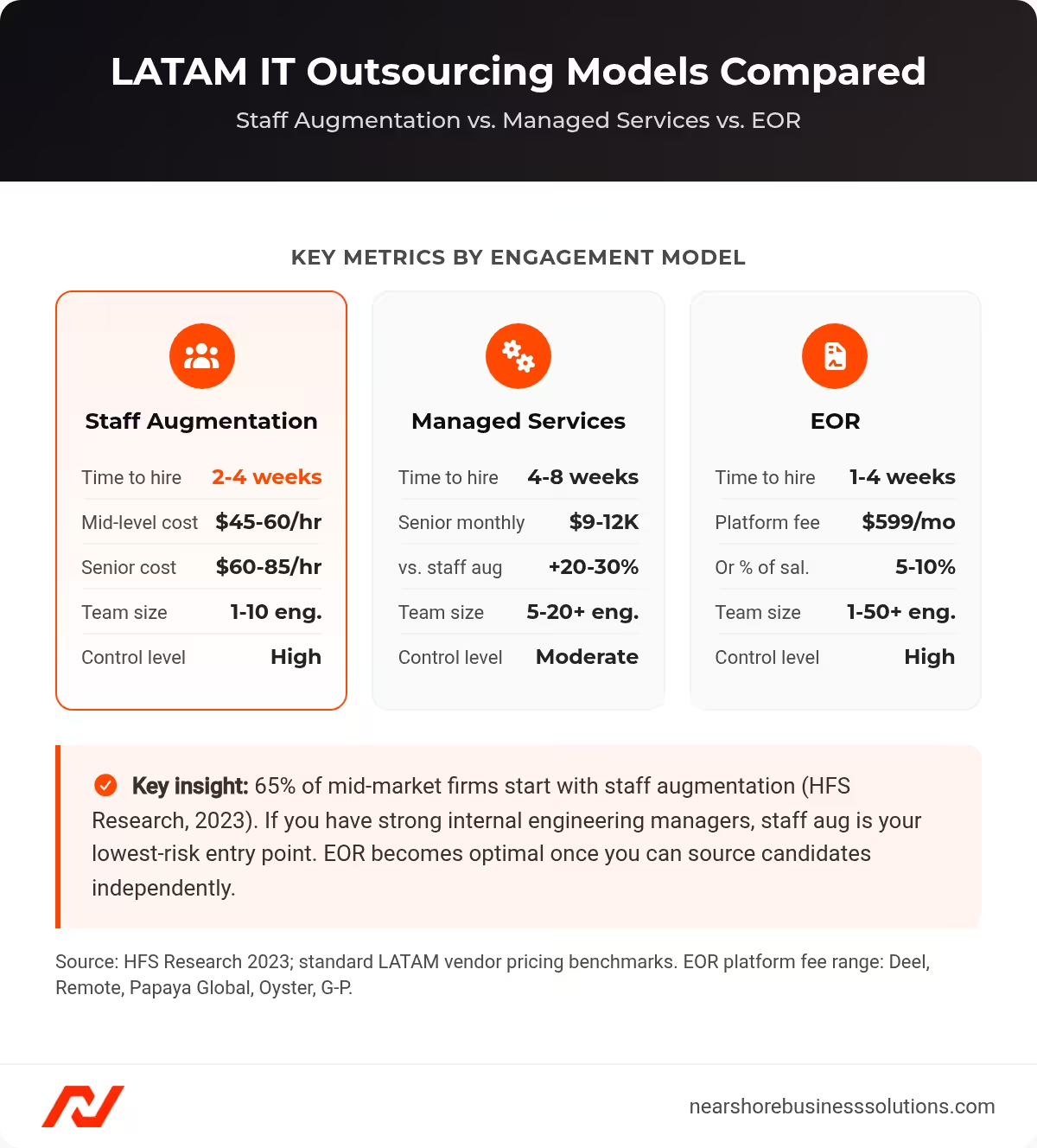
Staff augmentation, managed services, and EOR differ in time-to-hire, cost structure, and control level.
Staff augmentation works best as your entry point when you have strong engineering managers who can absorb 2-5 additional direct reports without degrading sprint velocity. Most Series B-C companies start here. Graduate to managed services once your nearshore headcount exceeds what your existing managers can effectively oversee, typically around 8-10 augmented engineers.
Managed services trade direct control for delivery accountability. The SLA-driven contract structure means the vendor absorbs attrition risk and delivery variance. That accountability justifies a 20-30% cost premium over equivalent staff augmentation rates, per standard LATAM vendor pricing benchmarks.
EOR is the fastest-growing model for companies with strong internal recruiting engines. If your talent team can source and close candidates independently, EOR eliminates the vendor margin entirely. You pay only the engineer’s local salary plus a flat platform fee. See our full breakdown of employer of record services in Latin America.
How Do You Choose the Right Country When Outsourcing IT to Latin America?
Four variables separate a high-performing nearshore engagement from one that stalls within six months: talent depth in your specific stack, labor cost trajectory, legal and IP protections, and real-time working-hour overlap with your U.S. engineering team.
For a broader view of engagement models and regional fit, see our guide to nearshore IT solutions.
What Are the Talent Density, Cost, and Stability Differences by Country?
The four primary LATAM markets differ significantly across developer population, specializations, English proficiency, and cost savings. Below are 2024 benchmarks:
| Dimension | Mexico | Colombia | Argentina | Brazil |
|---|---|---|---|---|
| Developer population | ~225,000 | ~150,000 | ~135,000 | ~500,000+ (largest in LATAM) |
| Top tech hubs | Guadalajara, Mexico City, Monterrey | Bogota, Medellin, Barranquilla | Buenos Aires, Cordoba, Rosario | Sao Paulo, Florianopolis, Belo Horizonte |
| Key specializations | Enterprise software (Java, .NET), fintech, embedded systems | Fintech, e-commerce, mobile, SaaS | AI/ML, data science, fintech, gaming | Fintech (Nubank), e-commerce, AI, deep tech |
| English proficiency (EF EPI 2023) | 43rd globally | 40th globally | 30th globally: #1 in Latin America | 70th globally; English talent commands 15-20% premium |
| Government incentives | IMMEX program; strong IP under USMCA | ProColombia; tax incentives in Zonas Francas | Knowledge Economy Law tax breaks; capital controls complicate payments | LGPD aligned with GDPR; complex regulatory framework |
| Senior Full-Stack Dev salary | $65,000 | $60,000 | $55,000 | $62,000 |
| DevOps / SRE salary | $75,000 | $70,000 | $68,000 | $72,000 |
| AI/ML Engineer salary | $80,000 | $75,000 | $72,000 | $78,000 |
| Savings vs. U.S. equivalent | 50-55% | 55-60% | 58-65% | 53-57% |
Salary data: Q1 2024 aggregated benchmarks from published global hiring and developer-marketplace sources, Glassdoor, and Payscale. U.S. comparison: Senior Full-Stack $145K, DevOps/SRE $160K, AI/ML $170K.
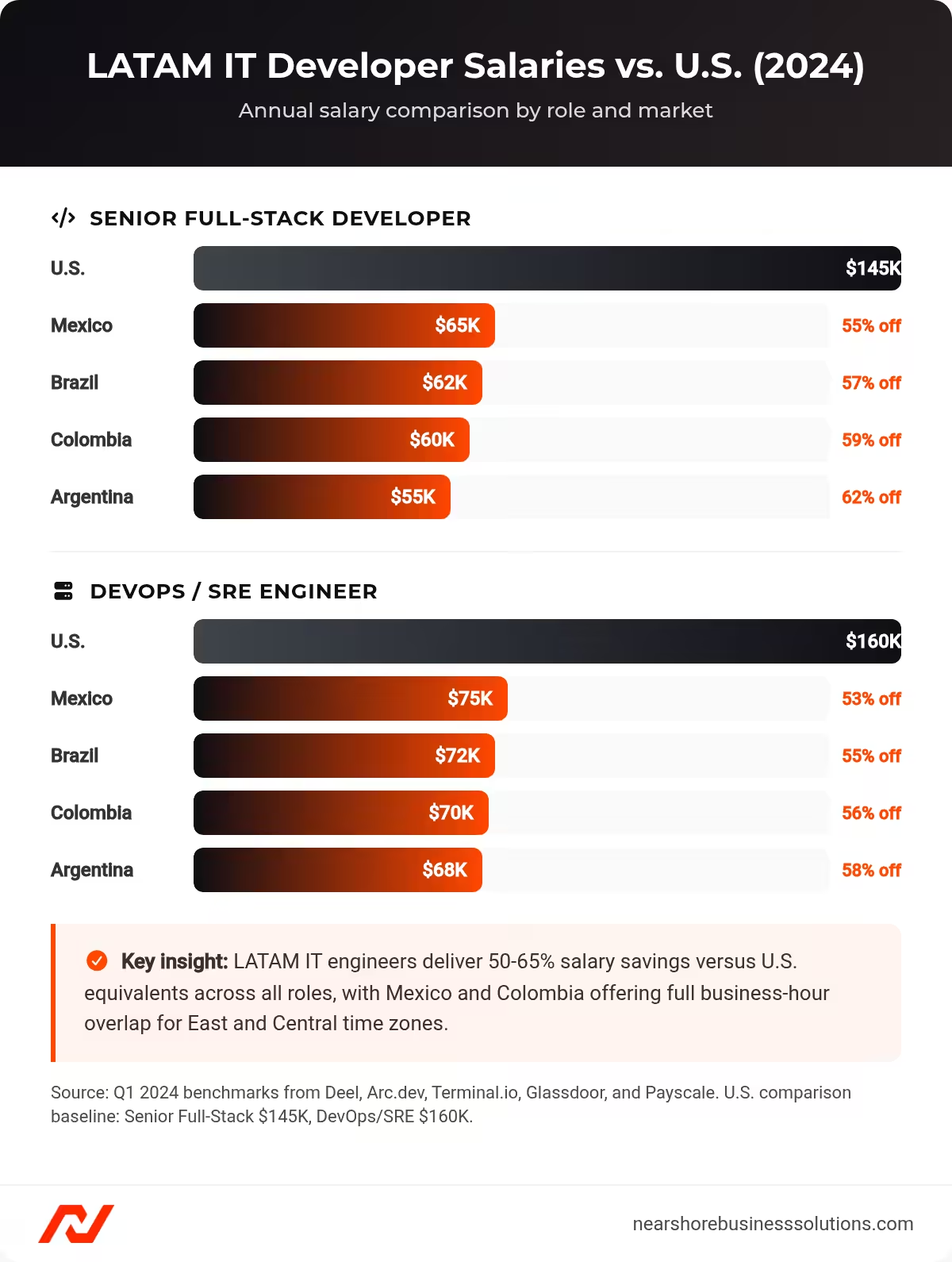
Senior IT developer salaries in Latin America run 50-65% below U.S. equivalents across all primary markets.
Stack alignment matters more than country rankings. The dominant LATAM tech ecosystem clusters around JavaScript/TypeScript (React, Angular, Vue.js) on the frontend; Node.js, Python, Java, and .NET on the backend; React Native and Flutter for mobile; and AWS as the leading cloud platform. If your stack sits within these corridors, all four primary markets can deliver. If you need niche AI/ML talent, Argentina ranks #1 in LATAM for technology skills (Coursera Global Skills Report, 2023), making it the strongest match despite its macroeconomic risk.
Secondary markets deserve consideration for specific use cases. Uruguay offers a boutique talent pool: small but exceptionally high in English proficiency and stability, ideal for 2-5 senior engineers in high-trust roles. Costa Rica draws from a mature ecosystem built by Intel and Microsoft investments. That Intel-and-Microsoft lineage is exactly why the country is such a strong outsourcing base, as we explain in our guide on why Costa Rica works for tech outsourcing. Chile’s stable economy and Start-Up Chile ecosystem make Santiago viable for product-oriented teams.
Which Startups Prove the Depth of Each LATAM Market?
The strongest signal of a market’s engineering depth is the venture-backed companies that scaled out of it. These startups built and retained senior teams locally, which tells you the talent corridor you would be recruiting into is real, not aspirational:
- Mexico anchors LATAM fintech. Kueski (consumer lending), Clip (payments infrastructure), and Credijusto (SMB credit) all scaled their engineering organizations out of the Guadalajara, Mexico City, and Monterrey hubs, validating the country’s strength in enterprise and financial software.
- Argentina produces deep-tech and crypto talent. Ripio, a leading regional cryptocurrency platform, and Auth0, the identity platform later acquired by Okta, both grew core engineering teams in the country, consistent with its #1 LATAM ranking for technology skills.
- Chile backs product-led companies. NotCo (AI-driven food tech) and Cornershop (grocery delivery, later acquired by Uber) emerged from Santiago’s ecosystem, reinforcing its fit for product-oriented teams.
- Uruguay punches above its size. CodigoDelSur and Kentech are established players that turned the country’s small but high-trust talent pool into export-grade software work.
Why Does Time Zone Overlap With U.S. Teams Compound Into Measurable Sprint Velocity Gains?
Teams with fewer than 4 hours of workday overlap experience significant drops in both velocity and code quality, per a 2021 Microsoft Research study. GitLab’s Remote Work Report (2023) corroborates this: communication latency in async-heavy environments adds 15-25% to project timelines versus teams with substantial synchronous overlap.
| City | Overlap with U.S. Pacific | Overlap with U.S. Central | Overlap with U.S. Eastern |
|---|---|---|---|
| Mexico City (UTC-6) | 6 hours | Full overlap | 7 hours |
| Bogota (UTC-5) | 5 hours | 7 hours | Full overlap |
| Buenos Aires (UTC-3) | 3 hours | 5 hours | 6 hours |
Mexico City and Bogota teams participate in every standup, sprint planning, and retrospective during normal business hours. Contrast this with India’s 10.5-hour gap from U.S. Eastern: despite holding approximately 55% of the U.S. outsourcing market share, Indian teams cannot participate in real-time ceremonies without one side working outside business hours.
The matching rule: if your engineering leadership sits in Pacific time, Mexico is your default. Eastern time means Colombia delivers full alignment at the lowest friction. Teams weighing those two defaults against each other can compare cost, talent, and timezones in our Colombia vs Mexico nearshore comparison.
What Compliance and IP Protections Does Latin America IT Outsourcing Actually Require?
Compliance in LATAM nearshoring breaks into three exercises: security certification validation, IP assignment enforceability, and data privacy law alignment. Each is shaped more by your industry vertical than by the vendor’s country. Healthcare is the sharpest example, where our guide to building HIPAA-compliant healthcare teams maps each safeguard to the countries whose privacy laws align with HIPAA.
How Do You Vet a LATAM Partner’s SOC 2 and ISO 27001 Security Posture Before the First Sprint?
SOC 2 Type II confirms that a service organization’s controls operated effectively over a 6-12 month observation period. ISO 27001 confirms an Information Security Management System exists and is documented. It does not independently verify continuous operational effectiveness the way a Type II audit does.
Most mid-market LATAM vendors hold only a Type I or are “in process” toward Type II. If your customer’s security questionnaire asks whether your subprocessors hold SOC 2 Type II, a Type I from your nearshore vendor is a factual “no.” That “no” can stall enterprise deals.
Five questions to ask before the first sprint:
- “Provide your most recent SOC 2 Type II report, including the observation period end date.” Request the full report. Section IV reveals whether the auditor noted control exceptions.
- “Which independent CPA firm conducted your SOC 2 audit, and are they AICPA peer-reviewed?”
- “Does your ISO 27001 certification cover the specific business unit and locations that will service our engagement?” Request the Statement of Applicability and verify coverage.
- “Describe your vulnerability management cadence: scanning frequency, mean time to remediate critical CVEs, and whether you use an external penetration testing firm annually.”
- “Walk me through your incident response plan and the last time you executed a tabletop exercise.”
For a deeper analysis of what your MSA must include, see our guide on SOC 2 and ISO 27001 compliance for nearshore partners.
How Does IP Assignment Work Across LATAM Jurisdictions?
The “work for hire” doctrine does not translate uniformly across LATAM jurisdictions. All four primary markets are Berne Convention signatories, but ownership rules for works created under employment remain domestic:
| Country | Default IP Ownership Rule | Key Risk | Recommended Mitigation |
|---|---|---|---|
| Mexico | Economic rights belong to the commissioning party unless the contract states otherwise. Strongest “work-for-hire” alignment in LATAM. Reinforced by USMCA. | Low | Explicit assignment language; use USMCA dispute mechanisms |
| Colombia | Economic rights in software belong to the employer, only if the contract explicitly states this. Without explicit assignment, ownership defaults to the developer. | Medium: verbal agreements unenforceable | Every agreement must contain explicit, written IP assignment |
| Argentina | Software protected as a literary work; economic rights transferable by contract. Moral rights are inalienable. | Medium: moral rights can complicate white-label arrangements | Include clause where developer agrees not to exercise moral rights |
| Brazil | Software developed under employment belongs to employer, only when directly related to the employee’s functions and developed using employer’s resources. Moral rights are perpetual and inalienable. | High: vague scope definitions can shift ownership to the developer | Define scope with granular specificity; explicitly assign all economic rights |
Every LATAM nearshore contract should include five elements: (1) explicit IP assignment language (do not rely on “work for hire” phrasing); (2) a moral rights non-exercise clause; (3) source code escrow for managed services engagements; (4) a pre-existing IP carve-out requiring disclosure of all open-source components; and (5) U.S. governing law with arbitration under ICC or AAA rules, enforceable across all four markets under the New York Convention.
What Data Privacy Regulations Must Your MSA Address?
Data privacy requirements differ by country and by where your data is hosted. Your MSA must address cross-border transfer rules specific to each market:
| Dimension | Brazil (LGPD) | Colombia (Law 1581) | Mexico (LFPDPPP) | Argentina (PDPA) |
|---|---|---|---|---|
| Cross-border transfer | SCCs validated by ANPD in 2024, or specific consent | Receiving country must provide “adequate protection.” U.S. is not on the SIC list. Requires explicit consent or contractual guarantees. | Permitted within corporate groups under binding policies, or with consent | Permitted to countries with adequate protection; EU adequacy status simplifies flows |
| Key MSA requirement | Appoint DPO for processing at scale; include SCCs for U.S.-hosted databases | DPA addendum binding your company to Colombian-equivalent protections | Include Aviso de Privacidad compliance; specify legal basis for transfers | Use EU adequacy status for multi-jurisdiction data flows |
How Do You Calculate the True Cost to Outsource IT in Latin America?
The cheapest hourly rate often produces the highest TCO. Proper cost modeling accounts for blended rate, management overhead, ramp time, attrition replacement cost, compliance fees, and tooling.
How Do You Build a Total Cost of Ownership Model for LATAM Engineers?
A proper TCO model shows that a LATAM-based engineer at $70,000 in base salary delivers a Year 1 total cost of approximately $96,500, versus approximately $225,500 for a U.S.-based engineer at $150,000:
| Cost Component | US-Based Engineer ($150k Salary) | LATAM-Based Engineer ($70k Salary) |
|---|---|---|
| Base Salary | $150,000 | $70,000 |
| Benefits/Burden Rate | 25-30% ($37,500-$45,000) | 30-45% ($21,000-$31,500): higher % due to mandatory social contributions |
| Recruiting Costs | 20-25% of salary ($30,000-$37,500) | Bundled into partner’s rate or lower one-time fee |
| Onboarding/Training | $5,000 | $2,500 (often handled by partner) |
| Tooling/Infrastructure | $3,000 | $3,000 (equivalent) |
| Attrition Cost | ~50% of salary ($75,000) | Lower absolute cost; partner often provides replacement guarantee |
| Total Year 1 Cost | ~$225,500 | ~$96,500 (via partner, excluding margin) |
Average annual developer attrition in Latin America runs 15-20%, significantly lower than the 25-30% seen in hyper-competitive markets like India (Mercer, 2023). Each attrition event carries knowledge transfer disruption beyond its dollar cost. Budget two weeks of ramp per replacement.
Costs rarely included in vendor proposals: LATAM benefits burden (30-45% of base) that vendors may not make transparent; tooling costs (~$3,000/engineer) that do not decrease with offshoring; and with EOR models, you bear the full recruiting burden internally.
Pricing model fit matters. Time-and-materials ($45-$90+/hr) suits evolving scope and discovery-phase work. Monthly retainers ($9,000-$12,000/engineer) provide budget predictability for ongoing product development. Fixed-price contracts are risky for iterative product development. Reserve them for well-defined deliverables with minimal scope change.
How Do You Evaluate and Select a LATAM IT Outsourcing Partner?
The right vendor selection process eliminates gut-feel decisions and makes tradeoffs explicit. Companies that run a structured pilot before a 12-month commitment reduce early termination rates significantly versus those that skip to a full engagement. Explore our guide on outsourcing risk management for a deeper framework.
What 7-Criteria Scorecard Should You Use to Evaluate LATAM IT Vendors?
Score each vendor on a weighted scale before shortlisting. Weight toward technical depth and security certifications: those two criteria together represent 45% of your total score.
| Criterion | Weight | What to Evaluate | Red Flag |
|---|---|---|---|
| Technical depth in your stack | 25% | Live coding assessment in your primary language/framework; portfolio of shipped products in your domain | Generic “we do everything” positioning with no stack-specific case studies |
| Security certifications | 20% | SOC 2 Type II (current), ISO 27001 scoped to your engagement | Type I only, or “in process” with no target date |
| Client retention rate | 15% | % of clients retained beyond 24 months; named references willing to speak | Won’t share retention data or only offers references from the last 6 months |
| Cultural and communication fit | 15% | Trial pairing sessions; English proficiency in technical discussions; willingness to challenge assumptions | Engineers defer to authority without pushback in group settings: a known LATAM cultural tendency that effective vendors actively coach against |
| Financial stability | 10% | Revenue trajectory, funding status, client concentration | >50% revenue from a single client; recent layoffs exceeding 15% |
| Contractual flexibility | 10% | Willingness to negotiate IP, non-solicitation, and replacement SLAs | Rigid non-solicitation clauses blocking direct hires; no replacement guarantees |
| Reference quality | 5% | References from companies at your stage and in your vertical | Only references from enterprise clients when you’re mid-market, or vice versa |
Cultural fit deserves context beyond a table row. Hofstede’s Cultural Dimensions analysis shows LATAM scores higher on power distance and collectivism versus U.S. individualism. The tech subculture is heavily influenced by U.S. agile practices and runs significantly flatter. The GLOBE study highlights a relationship-oriented business style: building personal rapport (“confianza”) is key. Nearly universal agile adoption across LATAM outsourcing, with shared toolchains (Jira, Slack, GitHub), provides a powerful cultural bridge.
How Do You Run an Effective Pilot?
Run a 6-10 week pilot with 2-4 engineers on a non-critical but representative workstream. Given the 2-4 week ramp-up period for staff augmentation, pilots shorter than 4 weeks never get past onboarding. Define success metrics before kickoff: velocity benchmarks against your domestic team’s baseline, code review pass rates, communication quality scores, and a zero-security-incident threshold.
What Red Flags Surface After Signing?
Five post-signing risks are common enough to warrant contractual countermeasures before you sign:
- Bait-and-switch rosters: senior engineers from the pilot replaced by juniors in month two. Countermeasure: contractual roster lock requiring written approval for any personnel change.
- Bench billing: invoicing for engineers not yet assigned or between projects. Countermeasure: pay only for named, active engineers with weekly time reporting.
- Restrictive non-solicitation clauses: blocking you from hiring engineers directly after the engagement ends. Countermeasure: cap non-solicitation at 6 months with a reasonable buyout fee.
- Opaque attrition rates: vendor will not share turnover data. Countermeasure: require quarterly attrition reporting as a contract term.
- No replacement guarantees: no commitment to backfill within a defined SLA. Countermeasure: require replacement within 2 weeks with equivalent seniority, at no additional cost during the transition.
What Should a CTO Ask Before Outsourcing IT to Latin America?
A 12-point pre-engagement checklist helps you validate each of the five decisions above before committing. Group the questions by domain:
Strategic Alignment
- Does this engagement support a specific product milestone, cost restructuring, or capability buildout? Outsourcing without a defined objective produces diffuse results.
- Is outsourcing solving the right problem, or just filling seats? If your bottleneck is architectural decision-making, adding engineers will not help.
- Do the required capabilities (AI/ML, cloud/DevOps, data engineering) align with LATAM talent depth? Match your stack to the country-level specialization data above.
- What is the 18-month product roadmap dependency on this team? If the nearshore team owns a critical path, invest in managed services or EOR, not transactional staff augmentation.
Operational Readiness
- Do your engineering managers have capacity to absorb additional direct reports? If not, managed services is your model.
- Is your codebase documented well enough for external engineers to onboard in under two weeks? Poor documentation doubles ramp time regardless of talent quality.
- Do you have async tooling (Loom, Linear, documented PRs) in place for the 3-hour overlap gap with Southern Cone teams?
- Who internally owns the vendor relationship day-to-day? Engagements without a dedicated internal point of contact fail at twice the rate, per NBS operational data across our placements.
Vendor and Commercial
- Have you modeled TCO, not just hourly rate, across a 12-month horizon? Use the cost framework above.
- Does your MSA include explicit IP assignment, moral rights non-exercise, and U.S. governing law with arbitration?
- Have you verified SOC 2 Type II coverage scoped to the specific business unit servicing your contract?
- Have you planned a 6-10 week pilot with defined success metrics before committing to a 12-month contract? The pilot is your cheapest insurance against a misaligned partnership.
Frequently Asked Questions About Outsourcing IT to Latin America
These are the most common questions CTOs ask before committing to a LATAM IT outsourcing engagement.
How Long Does It Take to Hire Engineers in Latin America?
Staff augmentation takes under 30 days from contract signature to engineer onboarding, with first vetted candidates within 3 business days. Managed services teams take 4-8 weeks due to team assembly and kickoff. EOR timelines depend on your internal recruiting speed: once you identify a candidate, the legal employment structure can be set up in 1-4 weeks.
What If an Engineer Does Not Work Out?
Reputable staff augmentation vendors include a replacement SLA in the contract: typically 2 weeks with equivalent seniority at no additional cost during the transition. Require this in writing before signing. EOR models put replacement risk on your internal recruiting team, so factor that into your model selection.
Do I Need a Local Legal Entity to Hire LATAM Engineers?
No. Staff augmentation and managed services vendors handle the legal employment relationship in-country. EOR providers like Deel, Remote, and G-P serve as the legal employer in each country, eliminating the need for a foreign subsidiary. You only need a local entity if you plan to build a permanent captive center with 20+ direct employees.
How Do You Pay LATAM Developers?
In staff augmentation and managed services, you pay the vendor in USD via wire transfer or ACH. The vendor handles in-country payroll in local currency. In EOR arrangements, you pay the EOR platform a monthly amount covering the engineer’s salary, employer social contributions, and the platform fee. The EOR pays the engineer in local currency.
What Is the Difference Between Nearshore and Offshore Outsourcing?
Nearshore refers to hiring in adjacent or nearby countries with overlapping time zones, typically Latin America for U.S.-based companies. Offshore refers to hiring in distant regions (India, Philippines, Eastern Europe) with 8-12 hour time zone gaps. The core operational difference is synchronous collaboration: nearshore teams participate in real-time sprints; offshore teams require asynchronous handoffs that add 15-25% to project timelines, per GitLab’s Remote Work Report (2023).
What Does a Reputable LATAM IT Outsourcing Vendor Look Like?
Look for vendors who can provide their SOC 2 Type II report (not just Type I), share client retention rates beyond 24 months, and connect you with references from companies at your stage and in your vertical. Vendors who cannot share their own retention data are telling you something. Acceptance rates below 30% and 90-day replacement guarantees are strong baseline signals.
Ready to Build Your Latin America Engineering Team?
Nearshore Business Solutions sources and vets engineers from tech hubs across Mexico, Colombia, Argentina, and Brazil. We screen for technical skills, English fluency, and U.S. work style fit.
Every placement includes a 90-day replacement guarantee. You receive the first pre-vetted candidates within 3 business days.
Get a free consultation to discuss your engineering needs and receive a custom LATAM outsourcing plan.