Tech skills hiring in Latin America requires screening for seven cross-cutting competencies that predict remote success, not just stack familiarity. Latin America’s developer population exceeds 1.2 million and grows faster than the US pool, yet most US hiring managers still use frameworks built for domestic or offshore talent.
A failed senior technical hire costs upward of $150,000 once you add recruiting spend, onboarding, lost sprint velocity, and backfill cycles. The talent depth is already proven. MercadoLibre runs over 10,000 engineers across Argentina, Brazil, and Mexico on a proprietary Kubernetes-based PaaS called Fury. Nubank’s roughly 5,000-person engineering org builds on a Clojure, Kotlin, and Flutter stack. Globant has trained 27,000+ engineers in multi-cloud delivery at scale.
The demand side makes the case necessary, not just attractive. The US Bureau of Labor Statistics projects 277,300 average annual software developer openings through 2032 (BLS, “Occupational Outlook Handbook,” September 2023). Korn Ferry estimated an 85.2 million global talent shortage by 2030 (Korn Ferry, “The Global Talent Crunch,” 2018). Below you will find the seven skills to screen for, scenario-based interview questions, country-level skill data, and a screening funnel that isolates the top 1-3% of candidates.
Why Does Timezone Overlap Give LATAM Candidates a Screening Advantage Over Other Regions?
LATAM’s 0-3 hour timezone offset from US business hours creates a structural screening advantage no other region matches. Real-time collaborative screening (live pair programming, synchronous system design, interactive debugging) outperforms async take-home tests at predicting remote team success.
| Country | Timezone (UTC) | US Timezone Alignment | Daily Overlap with US East Coast |
|---|---|---|---|
| Colombia | UTC-5 | US Eastern | 8 hours (full overlap year-round) |
| Mexico | UTC-6 | US Central | 7-8 hours |
| Argentina | UTC-3 | 2 hours ahead of Eastern | 6-7 hours |
| Brazil | UTC-3 | 2 hours ahead of Eastern | 6-7 hours |
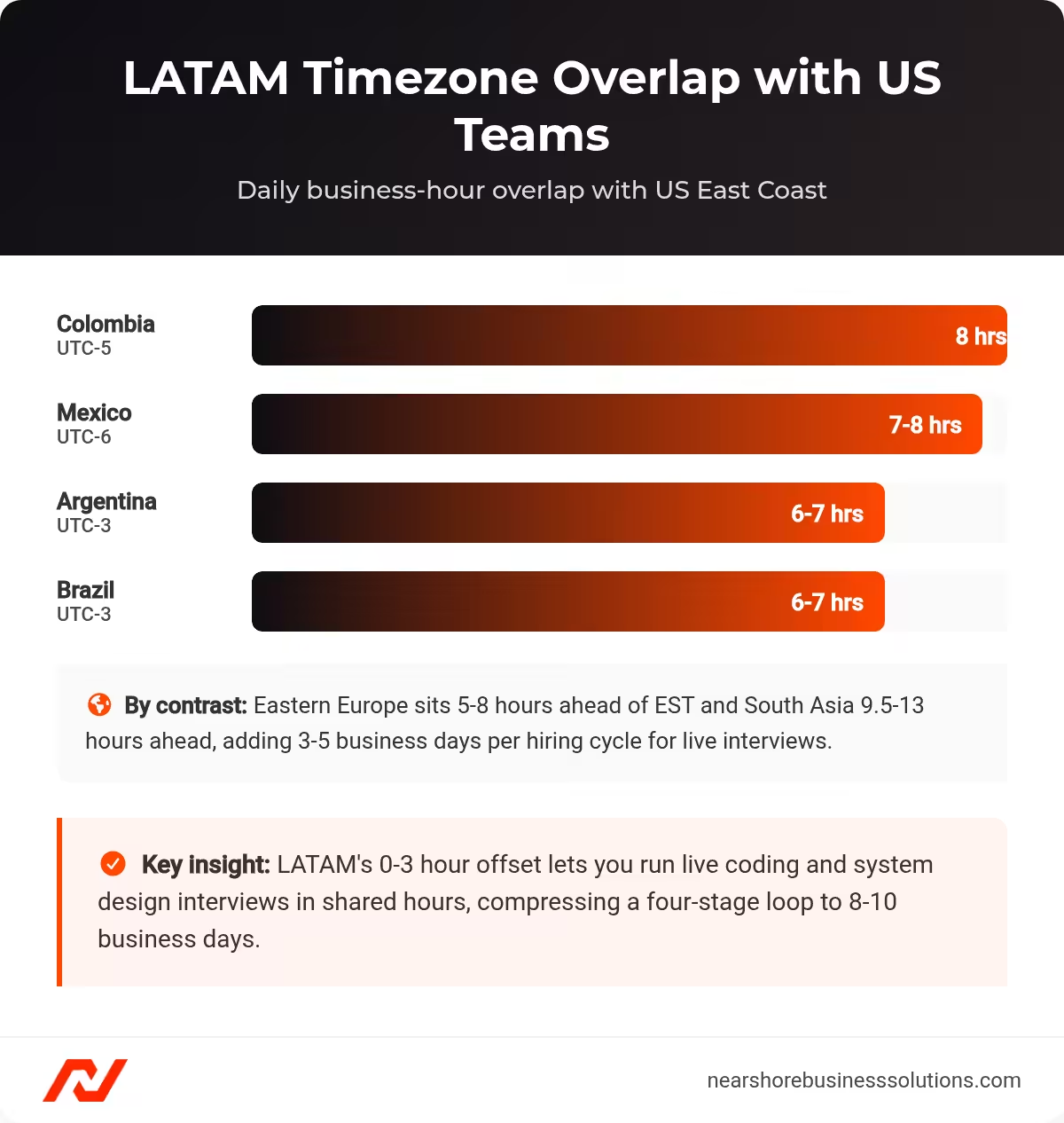
Daily US East Coast overlap by LATAM country, versus Eastern Europe and South Asia.
Eastern European candidates sit 5-8 hours ahead of EST. South Asian candidates sit 9.5-13 hours ahead. Scheduling live interviews with either forces one party to work after hours, adding 3-5 business days to each cycle. With LATAM candidates, you compress a four-stage loop into 8-10 business days. That speed lets you close candidates before competing offers land. Firms that build staff augmentation pipelines around this overlap get higher-fidelity candidate signal in less elapsed time than any async-only workflow.
What Are the 7 Essential Developer Skills to Screen for in 2026?
Seven skills predict whether a LATAM hire ships reliably inside a US team. Most screening frameworks fail because they test language proficiency without evaluating these cross-cutting competencies. The LATAM tech stack already mirrors US standards: JavaScript and TypeScript dominate, React and Node.js form the default full-stack pair, Python powers AI/ML and backend work, Java anchors fintech, and Go is surging for microservices (Stack Overflow, “2023 Developer Survey,” June 2023). Stack familiarity is table stakes.
The seven skills split into two layers. Skills 1-3 are infrastructure competencies that determine whether a developer can build cloud-native systems without hand-holding. Skills 4-7 are operational and collaborative competencies that determine whether that developer can function autonomously in a distributed team.
- Cloud-Native Architecture. The candidate designs, deploys, and troubleshoots production workloads on AWS, Azure, or GCP using managed services, IaC tooling, and cost-aware scaling.
- Docker and Kubernetes Fluency. The candidate containerizes apps, writes production-grade Dockerfiles, orchestrates multi-service deployments, and debugs pod failures without escalating to your platform team.
- API Design Mastery. The candidate builds RESTful or GraphQL APIs with clean versioning, error handling, pagination, and auth your frontend team can consume without back-and-forth.
- Async Communication Rigor. The candidate documents decisions in writing, writes context-rich PR descriptions, and raises blockers early. This is the single strongest predictor of remote success.
- System Design Thinking. The candidate reasons about trade-offs across scalability, latency, data consistency, and fault tolerance, and can whiteboard an end-to-end architecture.
- CI/CD Pipeline Ownership. The candidate builds and improves automated build-test-deploy pipelines and treats broken builds as P0 incidents.
- Security-First Development. The candidate applies OWASP principles, manages secrets properly, and flags risks during code review instead of deferring to a separate audit.
The regional data confirms the depth exists. Per the Stack Overflow 2023 Developer Survey, 61% of Brazilian developers and 58% of Argentinian developers use AWS professionally, above the 55% global average. Docker runs at 60% in Brazil and 59% in Argentina, above the 57% global baseline. A 2023 survey of tech leaders in Brazil and Mexico found 85% of companies have implemented CI/CD using Jenkins, GitLab CI, and GitHub Actions. Your screening needs to verify depth, not just exposure.
How Do You Screen LATAM Developers for Cloud, Docker, and Kubernetes Proficiency Beyond Certifications?
You screen for production judgment with scenario-based questions, because certifications and skill rankings prove the pool exists but say nothing about a specific candidate. Brazil scores 90% proficiency in Cloud Computing and Argentina hits 91% in Computer Programming on Coursera’s Global Skills Report 2023. Those numbers confirm the talent base. They do not tell you whether a candidate can architect a multi-AZ failover under production pressure.
Which Scenario-Based Questions Expose Real Cloud Experience vs. Tutorial Knowledge?
Scenario questions outperform certification checks because they force sequential decisions under constraints. MercadoLibre’s pipeline uses automated coding challenges, live coding, and system design interviews for senior roles, all inside a builder culture that expects engineers to own services end to end. Rappi runs a parallel approach: live coding paired with system design probing real-world scale. When a resume shows 3+ years at either company, weight that production experience above any certification line item.
| Question / Scenario | Primary Skill Tested | What Good Looks Like | Red Flags |
|---|---|---|---|
| “You have a monolithic app handling 10K RPM to migrate to AWS. Walk me through your plan, key services, and the three biggest risks.” | Cloud-native migration, service selection | Names a strangler-fig decomposition. Picks services tied to workload (ECS/Fargate, RDS Multi-AZ, ElastiCache). Calls out data-migration risk and traffic-splitting. Mentions rollback criteria. | Jumps to “put it in Lambda” with no analysis. Proposes a full rewrite. Cannot name specific risks. Ignores the data layer. |
| “Design a highly available image-upload service on GCP handling 50K uploads/hour at peak with P99 latency of 800ms.” | Multi-service architecture, cost-performance trade-offs | Separates upload acknowledgment from processing. Uses Cloud Storage, Pub/Sub, Cloud Run, Cloud CDN. Addresses cost with preemptible instances and lifecycle policies. Designs for failure with dead-letter queues and idempotent uploads. | Designs a synchronous pipeline. Ignores cost. No failure handling. |
| “A deploy caused 0.3% of payment transactions to double-charge across three AZs. Walk me through detection, mitigation, and prevention.” | Incident response, CI/CD, observability | Detects via anomaly alerting and reconciliation jobs. Mitigates with blue/green rollback and idempotency keys. Prevents with canary deploys and metric-based gates. Mentions customer communication. | First instinct is to read logs by hand. No automated rollback. Ignores idempotency. Treats it as a one-time fix. |
How Do You Separate Senior from Mid-Level LATAM Hires on Docker and Kubernetes?
Container fluency correlates directly with production ownership. Per the Stack Overflow 2023 Developer Survey, Kubernetes usage runs at 25% in Brazil and 23% in Argentina, mirroring the 25% global average, so senior container skill is a genuine differentiator rather than a baseline.
What good looks like for Docker: Writes multi-stage Dockerfiles producing slim images under 150MB. Orders layers to maximize cache hits. Uses non-root users. Diagnoses container networking, DNS resolution, and port conflicts without guesswork.
Red flags for Docker: A single-stage Dockerfile producing a 1.2GB image. Runs containers as root. Cannot explain layer caching.
What good looks like for Kubernetes: Describes pod lifecycle states and maps each to a debugging strategy. Sets resource requests and limits from load-test data. Writes liveness and readiness probes that test real application health. Uses Helm or Kustomize for environment-specific config.
Scenario question: “A pod is crash-looping in production. It worked in staging. What are the first five kubectl commands you run?” A strong answer walks through kubectl get pods, kubectl describe pod, kubectl logs --previous, kubectl get events, and inspecting configmap and secret mounts. That sequence rules out scheduling failures, OOMKilled signals, application errors, cluster events, and config drift. A candidate who says “I would delete the pod and redeploy” has told you everything about their production readiness.
How Do You Screen LATAM Developers for the Soft Skills That Predict Remote Team Success?
You score async communication, written documentation, and constrained system design, because technical screening alone only eliminates candidates who cannot build. It does not catch candidates who stall sprint velocity through unclear pull requests, undocumented decisions, or deferred security gaps. A remote engineer with weak documentation habits creates a 24-hour feedback loop: they push ambiguous code, your US reviewer requests changes in their morning, the LATAM engineer sees it after lunch, and a two-line fix consumes a full business day.
How Do You Test Async Communication and Documentation Quality During Interviews?
You test it with timed writing exercises and a deliberate idiom check, scored on a 1-4 rubric. Hire-ready engineers for US teams typically hold B2 or C1 English on the CEFR scale. Argentina yields the highest share of B2+ candidates at 45-55%, making it the most efficient market for heavy written-communication roles. Brazil has the largest pool at roughly 50,000 CS graduates a year, but a 15-25% English filter means you screen four to six candidates to find one who clears the bar. Colombia sits at 30-40% B2+, with a fast-growing pool driven by government bilingualism programs. These ranges reflect nearshore hiring-platform benchmarks rather than a single published survey.
Screen for colloquial gaps with an informal conversational stage. Use idiomatic phrases on purpose (“let’s circle back,” “that’s a non-starter,” “punt it to next sprint”) to test real comprehension.
| Screening Method | Format | What It Tests | Pass Criteria |
|---|---|---|---|
| PR description review | Async, 30 min. Provide a diff, ask for the PR description. | Clarity, completeness, audience awareness. | Includes the why, links context, lists testing steps, flags uncertainty. |
| RFC-style proposal | Async, 60-90 min. Give a requirement, ask for a one-page proposal. | Structured thinking, trade-off articulation, written persuasion. | Clear recommendation, two alternatives with rejection rationale, explicit trade-offs, open questions. |
| Loom-style walkthrough | Async, 10 min max. Record a screen-share explaining a past project. | Verbal clarity, ability to explain to a mixed audience. | Logical structure, stays in time, shows self-awareness about past trade-offs. |
| Live decision document | Sync, 25 min. Write a decision doc in a shared Google Doc while observed. | Writing speed, structure under pressure, reasoning. | Recommendation, evaluation criteria, evidence, and a stated trade-off. |
Score each method 1-4. Require a minimum average of 3.0 for any candidate joining a distributed US team. A candidate who scores 4 on live coding but 1.5 on async communication will cost you more in coordination overhead than they save in raw output. Build these scoring rubrics into your developer vetting process before the first interview, not after.
Why Do Standard FAANG System Design Interviews Fail for LATAM Remote Hires?
FAANG prompts fail because they test planet-scale reasoning your mid-market team will never use. Prompts like “Design Twitter” or “Design Google Maps” reward scale without cost constraints, reward pattern-matching over adaptive trade-off reasoning, and over-index on algorithmic puzzles versus practical wiring. HackerRank’s country rankings placed Argentina #21 globally in algorithmic skill and Brazil #38 (HackerRank, “Which Country Has the Best Developers?” 2020). Foundational ability is strong, but algorithms alone do not predict production success.
Replace unbounded prompts with constrained scenarios: “Design a notification system for a delivery app with 500K daily active users across three countries. You have a $3,000/month AWS budget. What is your architecture, and what do you cut first if the budget drops to $1,500?” That surfaces cost-awareness, trade-off articulation, and adaptability under shifting constraints far better than asking someone to design the next Twitter.
For CI/CD and security, probe for a production-ownership mindset: “Design a CI/CD pipeline for a microservices app. What are the key stages, and how do you handle automated testing, security scanning, and deployment to staging versus production?” Engineers from Nubank’s compliance-heavy fintech or Rappi’s multi-country delivery infrastructure carry disproportionate signal here. They have worked where broken pipelines and security gaps have immediate, measurable business consequences.
What Does a Best-Practice Screening Funnel for LATAM Engineers Look Like?
A well-tuned funnel yields a 1-3% application-to-hire rate across six stages, and that selectivity is the point. The benchmarks below come from Karat (“The Interviewing Cloud”) and internal data from nearshore hiring platforms.
| Stage | Purpose | Typical Pass Rate |
|---|---|---|
| 1. Sourcing and resume screen | Filter for stack, experience, English level. | 30-40% |
| 2. Automated coding assessment | Test CS fundamentals and problem-solving. | 25-35% |
| 3. Live coding interview | Evaluate communication and real-time problem-solving. | 40-50% |
| 4. System design interview | Assess architecture and scalability thinking. | 30-40% |
| 5. Behavioral and cultural fit | Assess values, communication style, motivation. | 60-70% |
| 6. Final and offer stage | Leadership sign-off. | 80-90% |
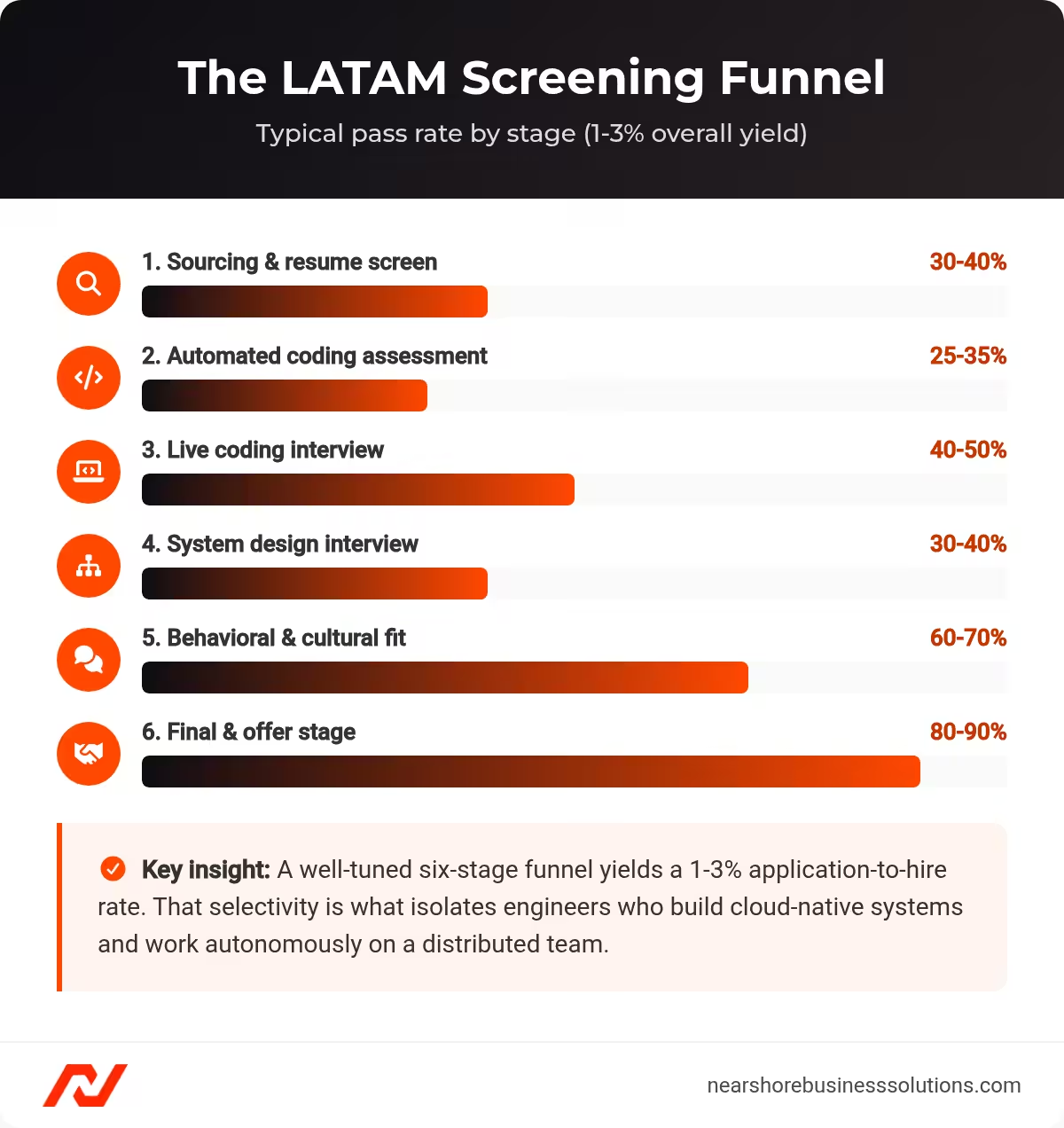
Typical pass rate at each of the six screening stages, yielding a 1-3% hire rate.
The seven skills (cloud-native architecture, Docker and Kubernetes fluency, API design mastery, async communication rigor, system design thinking, CI/CD pipeline ownership, and security-first development) reframe LATAM hiring from a cost-arbitrage play into a strategic talent advantage. That only holds if your screening process is rigorous enough to capture it. For teams without the internal bandwidth to run all six stages, a recruitment-as-a-service partner can run the funnel end to end.
Frequently Asked Questions About Tech Skills Hiring in Latin America
These are the most common questions US engineering leaders ask about screening LATAM developers.
How Long Does It Take to Screen and Hire a LATAM Developer?
It takes 8-10 business days to run a four-stage evaluation loop, thanks to the 0-3 hour timezone overlap. Live coding and system design interviews can be scheduled inside shared business hours, which removes the 3-5 day lag common with Eastern European or South Asian candidates.
What English Proficiency Should You Require for US Engineering Teams?
You should require B2 or C1 on the CEFR scale for roles with heavy written communication. Argentina yields the highest B2+ share at 45-55%, Colombia sits at 30-40%, and Brazil’s larger pool carries a tighter 15-25% English filter.
What Are the Biggest Red Flags When Screening LATAM Developers?
The biggest red flags are over-indexing on algorithmic puzzles, single-stage Dockerfiles producing bloated images, and “delete the pod and redeploy” answers to crash-loop debugging. Weak async communication is the costliest, because it stalls sprint velocity even when raw coding skill is high.
Should You Weight Experience at Companies Like MercadoLibre, Nubank, or Rappi?
You should weight it heavily. Three or more years at MercadoLibre, Nubank, or Rappi signals production ownership in high-scale, compliance-heavy environments, and that experience predicts on-the-job performance better than any certification.
What Is a Realistic Application-to-Hire Rate for LATAM Engineering Roles?
A realistic rate is 1-3% across a six-stage funnel. That selectivity is intentional. It is what isolates engineers who can both build cloud-native systems and operate autonomously inside a distributed US team.
Ready to Build Your LATAM Engineering Team?
Nearshore Business Solutions sources and vets developers across Latin America. We screen for cloud-native architecture, container fluency, async communication, and US work-style fit, then deliver pre-vetted candidates with a 90-day replacement guarantee.
Get a free consultation to discuss your screening criteria and receive a shortlist of vetted engineers.