
Colombia and Mexico deliver 44-59% savings versus US developer rates while providing same-timezone collaboration with US engineering teams.
Colombian developers cost $36,500-$95,000 per year base salary. Mexican developers cost $42,500-$115,000. Both countries deliver substantial savings versus US equivalents at $110,000-$240,000. Medellín and Bogotá supply exceptional React and Node.js talent. Guadalajara and Monterrey offer deeper Java and enterprise .NET pipelines.
We connect US engineering teams with vetted developers from both markets. Below, you’ll find salary benchmarks by role, talent pool comparisons, English proficiency data from EF EPI 2023, and a scenario-based decision framework for VPs of Engineering choosing between Colombia and Mexico.
Why Does the Colombia vs Mexico Nearshore Development Decision Matter in 2026?
LATAM nearshore hiring is growing 2-3x faster than traditional offshore in India and Eastern Europe. Gartner’s 2023 sourcing guidance identified improved team integration and higher sustained productivity as the primary value drivers beyond cost. McKinsey research confirmed that time-zone misalignment is a top source of operational drag, inflating meeting overhead and accelerating burnout among US staff absorbing early-morning or late-night sync calls.
Two cost pressures make 2026 the inflection point. Senior English-speaking developers in Colombia have seen 12-18% annual compensation increases since 2022. Mexico’s equivalent roles have risen 10-15% annually. A decision delayed 12 months could erase $15,000-$25,000 per engineer in annual savings. US H-1B policy uncertainty is pushing domestic hiring costs higher, pushing nearshore from a contingency to a primary capacity channel.
What Are the Five Axes Every VP of Engineering Should Evaluate?
Five factors determine whether Colombia or Mexico fits your engineering organization:
- Cost: Colombia delivers 40-60% fully loaded savings versus US equivalents. Mexico delivers 50-55%. The gap narrows based on seniority and metro area.
- Talent depth: Mexico’s developer pool is roughly 2x Colombia’s (225,000-280,000 vs. 120,000-150,000), directly affecting how fast you can scale a 20-person team.
- English proficiency: Colombia scores 480 on the EF English Proficiency Index versus Mexico’s 451 (EF EPI 2023). Both fall in the Low Proficiency band nationally, but tech-sector fluency runs substantially higher.
- Time-zone overlap: Colombia operates on UTC-5 year-round. Mexico spans four time zones (UTC-5 to UTC-8), offering East Coast alignment or full West Coast coverage depending on city.
- Legal and IP protection: Mexico benefits from USMCA’s integrated IP enforcement framework. Colombia operates under the US-Colombia Trade Promotion Agreement, which provides strong but structurally different protections.
What Do Colombia vs Mexico Developers Actually Cost Fully Loaded in 2026?
Colombia and Mexico converge to within 3-5% on fully loaded costs for most mid-senior roles, despite Colombia’s lower base salaries. Colombia mandates employer contributions totaling 45-55% of base salary. Mexico’s mandatory stack adds 30-40%. Colombia’s higher statutory burden compresses what looks like a 12-15% base-salary advantage into a 3-5% loaded-cost advantage.
What Is the Side-by-Side Salary Comparison for Senior Engineers, DevOps, and React Specialists?
Colombian developers cost 44-59% less than US equivalents on a fully loaded basis, per a January 2024 global hiring report, 2024 developer-marketplace salary data, Glassdoor/Payscale (Q1 2024), and Robert Half 2024 US Salary Guide.
| Role | Colombia Base (USD/yr) | Colombia Loaded (USD/yr) | Mexico Base (USD/yr) | Mexico Loaded (USD/yr) | US Base (USD/yr) | Colombia Savings vs. US | Mexico Savings vs. US |
|---|---|---|---|---|---|---|---|
| Software Engineer, Junior | $36,500 | $60,200 | $42,500 | $63,800 | $110,000 | 59% | 57% |
| Software Engineer, Senior (5+ yrs) | $77,500 | $127,900 | $90,000 | $135,000 | $195,000 | 49% | 47% |
| Frontend (React/Angular) | $65,000 | $107,300 | $75,000 | $112,500 | $160,000 | 50% | 48% |
| Backend (Node/Python/Java) | $70,000 | $115,500 | $80,000 | $120,000 | $175,000 | 50% | 49% |
| DevOps / SRE Engineer | $75,000 | $123,800 | $88,000 | $132,000 | $180,000 | 48% | 45% |
| AI/ML Engineer | $80,000 | $132,000 | $95,000 | $142,500 | $190,000 | 48% | 44% |
| Engineering Manager | $95,000 | $156,800 | $115,000 | $172,500 | $240,000 | 51% | 47% |
Colombia loaded = base x 1.65 (50% statutory + 15% recruitment/overhead). Mexico loaded = base x 1.50 (35% statutory + 15% recruitment/overhead). US loaded = base x 1.35. Exchange rates: COP 4,100/USD, MXN 17.5/USD.
Encora reports client-level cost savings of 40-50% on blended teams, consistent with per-role figures above. The Colombia vs Mexico cost decision rarely hinges on cost alone. It hinges on which market delivers the right engineers faster.
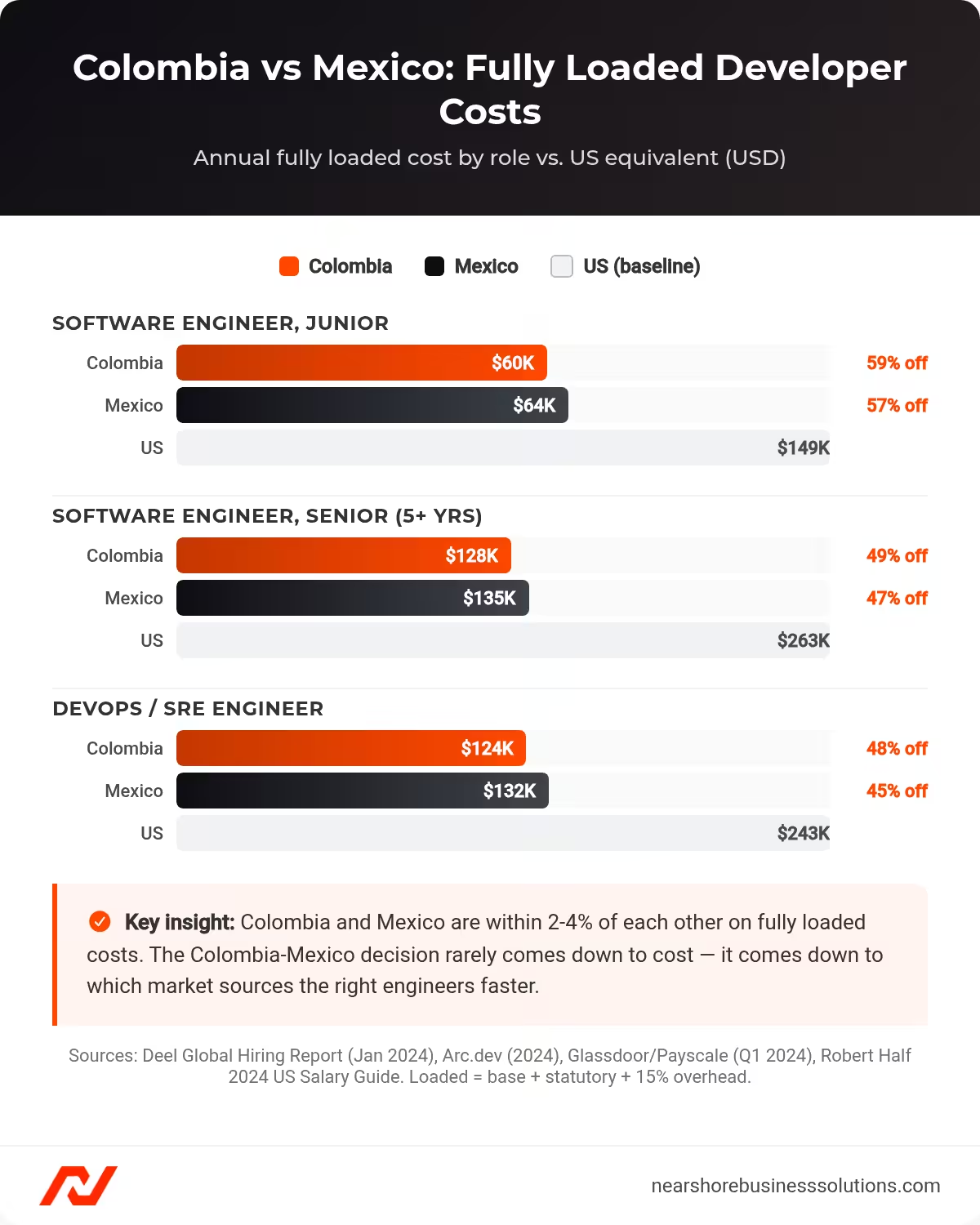
Fully loaded developer costs in Colombia and Mexico run 44-59% below US equivalents across all seniority levels.
How Does Engagement Model Shift the Cost Equation?
Your legal structure adds 15-40% in hidden costs beyond base salary. Three models dominate the market for US companies hiring in Colombia or Mexico:
| Model | Added Cost | Compliance Risk | Best For |
|---|---|---|---|
| Independent Contractor | Lowest on paper | High. Both countries enforce reclassification aggressively. Mexico’s 2021 outsourcing reform imposed criminal penalties. | 1-2 consultants on defined-scope engagements only |
| Employer of Record (EOR) | $500-$700/employee/month | Low. EOR absorbs payroll, statutory benefits, and termination liability. | Under 15 engineers; uncertain growth trajectory |
| Owned Legal Entity | Fixed overhead; cost-efficient once amortized across 15-20+ engineers | Low once operational, but dissolution triggers significant severance obligations in both countries | 15+ engineers with 2-year+ commitment |
For companies hiring their first 5-10 LATAM engineers, EOR is the lowest-risk path. See our guide to hiring in Colombia and guide to hiring in Mexico for country-specific compliance details.
What Are the Talent Depth and Technical Skill Differences Between Colombia and Mexico?
Mexico fields 225,000-280,000 software developers versus Colombia’s 120,000-150,000 (Statista 2023; Evans Data Corp 2022). GitHub’s 2023 State of the Octoverse shows the same roughly 2x ratio: 510,000 active users in Mexico versus 280,000 in Colombia. On raw volume, Mexico wins. Colombia’s smaller pool concentrates skill density and modern-stack specialization in ways that reverse the advantage for specific hiring profiles.
How Do HackerRank Scores Compare Between Colombian and Mexican Developers?
Colombia outranks Mexico globally in 5 of 6 technical domains, achieving higher placement with roughly half the eligible talent base. The HackerRank 2020 Developer Skills Report placed Colombia two positions ahead of Mexico overall.
| Domain | Colombia Rank | Mexico Rank | Implication |
|---|---|---|---|
| Overall | #33 | #35 | Colombia outranks with 55% fewer developers |
| Algorithms | #26 | #29 | Critical for backend and infrastructure roles |
| Python | #21 | #24 | Aligns with Colombia’s data-science adoption |
| Java | #25 | #22 | Mexico’s strongest domain; decades of enterprise Java work |
| JavaScript | #28 | #31 | Maps to React/Node.js ecosystem in Medellín and Bogotá |
| Data Structures | #34 | #39 | Widest gap; suggests stronger CS theory at Colombian universities |
Colombian developers trained at Universidad de los Andes (ranked 1st in Colombia) and Universidad EAFIT in Medellín consistently perform above global median in algorithm and data-structure assessments. Pontificia Universidad Javeriana and Universidad Nacional de Colombia (UNAL) contribute additional CS and engineering graduates annually.
Mexican developers benefit from Tecnológico de Monterrey (ITESM), ranked among the top 3 universities in Latin America for engineering, and Universidad Nacional Autónoma de México (UNAM), Latin America’s largest university with 350,000+ students. Instituto Politécnico Nacional (IPN) and Universidad de Guadalajara add volume to the pipeline.
What Are the Tech Hub Specialties Across Both Countries?
Colombia concentrates its talent in two primary hubs. Mexico distributes talent across three distinct cities with different specializations.
Colombia Hubs:
- Bogotá: FinTech, SaaS, e-commerce. Key companies include Rappi, Globant, and Mercado Libre. StartupBlink 2023: 61st globally, 3rd in LATAM.
- Medellín: AI/ML, HealthTech, software services. Government-backed Ruta N innovation district provides tax benefits and R&D grants. Cost of living runs 20-30% below Bogotá’s. Parque del Emprendimiento and INNpulsa Colombia support the startup pipeline. StartupBlink: 158th globally.
- Cali: Software development services. Lower saturation means faster offer-acceptance cycles.
Mexico Hubs:
- Mexico City: FinTech, e-commerce, AI, corporate headquarters. Largest VC funding pool in LATAM. Key companies include Google, Microsoft, Amazon, Kavak, and Bitso. StartupBlink: 45th globally, 1st in LATAM.
- Guadalajara: Embedded systems, enterprise SaaS, hardware-software integration. The Guadalajara Creative Digital City (Ciudad Creativa Digital) hosts Intel, HP, and Oracle. This government-backed technology district has created deep benches of engineers with low-level systems knowledge uncommon in most nearshore markets. StartupBlink: 138th globally.
- Monterrey: Enterprise software, IT services at scale. Softtek headquarters (15,000+ employees). Deep benches of engineers experienced in SOC 2 compliance and large-program governance.
Mexico has deeper, more mature talent for Java/Spring Boot, .NET, and enterprise SQL. Colombia shows exceptional depth in React, Node.js, Python, and mobile (React Native/Flutter). Training pipelines reinforce both: Colombia’s Platzi and Holberton School feed modern-stack talent, while Mexico’s larger bootcamp landscape (Digital House, Ironhack, Le Wagon, Bedu) produces more annual entrants in absolute terms.
How Does Seniority Distribution Compare Between the Two Markets?
Mexico’s addressable senior pool is 2x larger than Colombia’s, supporting faster absolute scaling. Colombia’s smaller senior pool concentrates competitive-programming caliber talent in identifiable clusters.
| Metric | Colombia | Mexico | Source |
|---|---|---|---|
| Total developer pool | 120,000-150,000 | 225,000-280,000 | Statista 2023 |
| % with 5+ years experience | ~35% | ~42% | Stack Overflow 2023 (extrapolated) |
| Senior-eligible developers | 42,000-52,500 | 94,500-117,600 | Derived |
| Annual CS and engineering graduates | ~25,000 | ~45,000 | National Education Ministry estimates |
| Annual attrition (nearshore teams) | 8-15% | 8-15% | Published nearshore attrition data |
Mexico’s seniority advantage compounds through its graduate pipeline: over a three-year horizon, Mexico generates roughly 60,000 more STEM graduates cumulatively. Nearshore attrition of 8-15% in both countries runs materially below the 15-25% US tech-hub average. Wizeline published attrition below 10% across its 1,000+ Mexico engineers. Both countries offer retention rates that support long-term team building.
How Do Colombia and Mexico Compare on English Proficiency for Slack-First Teams?
EF EPI national scores place both countries in the Low Proficiency band, but national scores measure the general population, not the export-oriented tech sector where English fluency functions as an economic filter. Tech hiring with rigorous English screening produces teams that operate well above national averages.
What Do the EF EPI Rankings Show for Colombia vs Mexico Trajectory?
Colombia shows a more resilient English proficiency trajectory than Mexico over the last five years, per EF EPI data.
| Year | Colombia Score | Mexico Score | Notes |
|---|---|---|---|
| 2019 | 488 | 487 | Virtual parity |
| 2020 | 486 | 469 | Mexico drops 18 points |
| 2021 | 465 | 436 | Pandemic-era disruptions |
| 2022 | 477 | 447 | Colombia rebounds faster |
| 2023 | 480 | 451 | Colombia 8 pts below 2019; Mexico 36 pts below |
Mexico’s 36-point decline since 2019 represents the steepest sustained drop among major LATAM nearshore destinations. Colombia’s resilience reflects sustained bilingual-education investment. The Colombia Bilingüe program has embedded English instruction from primary school since 2004.
At the hub level, Bogotá and Medellín produce meaningfully higher B2+ proficiency than national averages. Mexico City, Monterrey, and Guadalajara bilingual professional pools are strong due to deep economic ties with the US.
For comparison: Argentina scores 562 (High Proficiency), Costa Rica 534 (Moderate), India 504 (Moderate), and Poland 600 (Very High) on EF EPI 2023. Both Colombia and Mexico trail these benchmarks nationally. Individual English screening matters more than country averages. Use async video, written RFC exercises, and live system-design interviews conducted in English.
How Does Time-Zone Overlap Differ Between Colombia and Mexico for US Engineering Teams?
Colombia’s fixed UTC-5 alignment gives East Coast and Central US teams 7-8 synchronous hours. Mexico’s four time zones extend to full West Coast coverage via Tijuana’s UTC-8.
What Is the Overlap Hours Comparison Between Colombia and Mexico?
Colombia’s fixed time zone simplifies scheduling for East Coast teams. Mexico’s multi-zone spread creates more flexibility but requires intentional hub selection.
| US HQ City | Colombia (UTC-5, no DST) | Mexico City/GDL/MTY (CST) | Tijuana (PST) |
|---|---|---|---|
| New York (EST) | 8 hours | 9 hours | 5 hours |
| Chicago (CST) | 7 hours | 9 hours | 6 hours |
| San Francisco (PST) | 5 hours | 6 hours | 9 hours |
| Miami (EST) | 8 hours | 9 hours | 5 hours |
Overlap hours assume 9 AM-6 PM local business hours. Figures may shift plus or minus 1 hour during US DST transitions.
Colombia’s fixed UTC-5 aligns with US Eastern Time during EST months (November-March). During the eight months of EDT, Colombia falls one hour behind. Mexico’s multi-zone spread provides flexibility: Mexico City teams give East Coast and Central teams 9 synchronous hours. Tijuana teams give San Francisco a full 9-hour overlap, which Colombia cannot match for West Coast companies.
Teams in both countries can resolve blockers within the same business day, complete code reviews faster, and maintain higher sprint velocity compared to teams with 8+ hours of time difference. A blended approach combining Colombia (UTC-5) with Mexico Central (UTC-6) and Tijuana (UTC-8) spans three hours of offset, enabling extended coverage windows for distributed US operations.
Mexico offers superior time-zone flexibility for West Coast companies via Tijuana. Colombia excels for East Coast and Central teams. View the LATAM developer salary guide for full compensation benchmarks across all LATAM time zones.
Is Colombia or Mexico Better for Nearshore Development?
Colombia and Mexico each win on different evaluation axes. No single country dominates for every hiring scenario.
| Evaluation Axis | Colombia Advantage | Mexico Advantage | Edge |
|---|---|---|---|
| Cost (Loaded) | ~$3,750/yr cheaper per senior engineer | Closer to parity than base salary suggests | Colombia (slight) |
| Talent Pool Size | – | 2x larger developer pool | Mexico |
| Senior Talent Density | Higher competitive-programming density per capita | Larger absolute pool of 5+ yr engineers | Depends on role |
| English Proficiency | EF EPI 480 vs. 451; stronger trajectory | Strong bilingual pools in major hubs | Colombia (slight) |
| Time-Zone (East/Central US) | 7-8 hrs overlap | 9 hrs overlap | Mexico (slight) |
| Time-Zone (West Coast US) | 5 hrs overlap | 9 hrs (Tijuana) | Mexico (decisive) |
| Legal/IP Framework | US-Colombia TPA | USMCA integrated framework | Mexico (slight) |
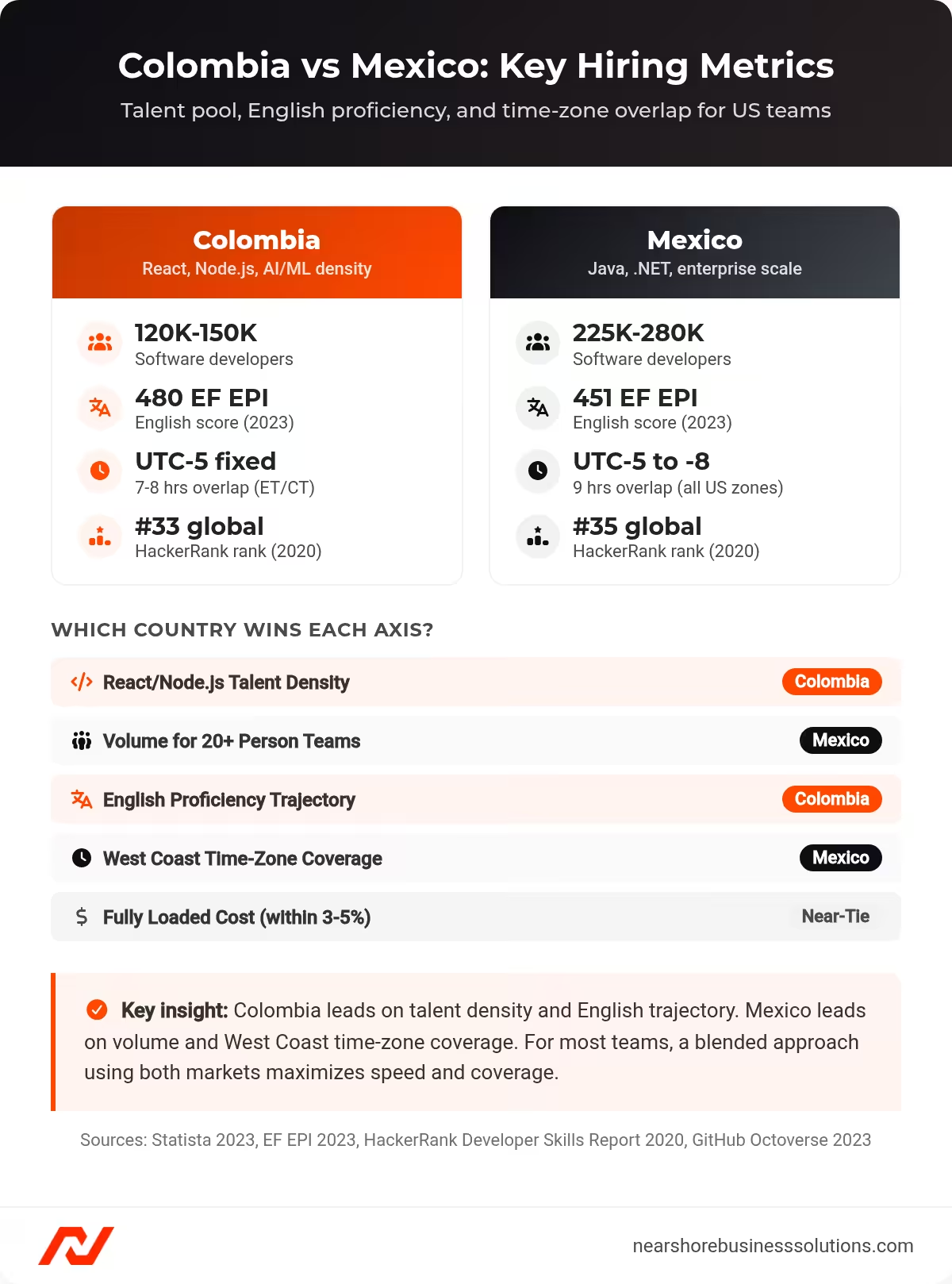
Colombia leads on talent density and English trajectory; Mexico leads on volume and West Coast time-zone coverage.
Which Country Is Better for Hiring Three Senior React Engineers Within 60 Days?
Colombia is better for fast, stack-specific sourcing of senior React engineers. Bogotá and Medellín concentrations shorten sourcing timelines compared to Mexico’s broader, more distributed market.
Colombia’s startup ecosystem has cultivated exceptional depth in React and Node.js. Houm, a US/Chilean PropTech company, built a team of 40+ engineers in Bogotá and reduced time-to-hire by 50% compared to Chile. For a narrow, stack-specific search where you need high-caliber candidates fast, Colombia’s concentrated talent density in Medellín and Bogotá shortens sourcing timelines. The loaded-cost savings of roughly $3,750 per engineer per year multiply across three hires. More importantly, you are finding competition-grade React specialists in a market where fewer recruiters compete for the same profiles.
Which Country Is Better for Scaling a 20-Person Cross-Functional Team Over Six Months?
Mexico is better for scaling cross-functional teams. Mexico’s 2x larger developer pool and higher percentage of senior engineers reduce bottleneck risk across multiple simultaneous roles.
Mexico’s 225,000-280,000 developer pool and 42% rate of 5+ year engineers (versus Colombia’s 35%) reduce bottleneck risk when filling frontend, backend, QA, and DevOps roles simultaneously. For a San Francisco-headquartered company, Tijuana’s full PST overlap eliminates async friction that a Colombia-only team would introduce. Mexico’s USMCA-backed IP framework also simplifies legal review for companies already operating cross-border with Mexico. The IMMEX program can reduce operational hardware and equipment costs for companies establishing a Mexico City or Guadalajara delivery center.
What Is the Blended Colombia-Mexico Approach?
Source staff-level architects from Colombia’s high-density pool. Backfill the broader IC band from Mexico’s larger pipeline. Maintain delivery centers in both countries to preserve time-zone flexibility and talent-supply optionality. This blended approach gives you the depth concentration of Colombia’s senior talent with the volume throughput of Mexico’s larger market.
Frequently Asked Questions About Colombia vs Mexico Nearshore Development
These are the most common questions US VPs of Engineering ask when comparing Colombia and Mexico for nearshore hiring.
How long does it take to hire developers in Colombia or Mexico?
Through a nearshore staffing partner, you receive your first pre-vetted candidates within 3 business days. Direct sourcing via local recruiters typically takes 6-12 weeks. Mexico’s larger pool slightly shortens sourcing timelines for volume hiring (10+ roles), while Colombia’s concentrated talent density can speed time-to-fill for specific senior roles like staff engineers.
What if a developer doesn’t work out?
NBS provides a 90-day replacement guarantee on all placements. Both Colombia and Mexico have specific termination procedures under local labor law. EOR providers handle termination obligations, severance, and statutory payments on your behalf, eliminating direct legal exposure.
Do I need to provide equipment to nearshore developers?
It depends on the engagement model. EOR and staff augmentation models typically require you to provide equipment or a clear equipment allowance. Contractors often use their own equipment, which introduces security risks. For SOC 2-compliant teams, company-provided hardware with MDM enrollment is standard practice in both countries.
How do I pay nearshore developers in Colombia or Mexico?
EOR providers handle payroll in local currency (COP or MXN), including statutory deductions, benefits, and tax filings. You pay the EOR a single consolidated invoice in USD. Direct contractor payments require international wire transfer or platforms like Deel or Wise, with currency and tax compliance managed separately.
What is the difference between nearshore and offshore for LATAM development?
Nearshore refers to hiring in countries with 0-3 hours of time-zone difference from your headquarters. Colombia (UTC-5) and Mexico (UTC-5 to UTC-8) qualify as nearshore for US companies. Offshore refers to India (UTC+5:30) or Eastern Europe (UTC+2 to UTC+3), which create 9-13 hour gaps with US business hours. Nearshore enables same-day collaboration, faster code reviews, and lower meeting overhead.
Do I need a local entity to hire in Colombia or Mexico?
No. You can hire legally through an EOR without establishing a local entity. An owned entity becomes cost-efficient only at 15-20+ engineers with a multi-year commitment. Both Colombia and Mexico have active EOR providers (Deel, Remote, Papaya Global) with established payroll infrastructure in both countries.
Which country has better IP protection for US companies?
Mexico’s USMCA framework provides IP protections structurally aligned with US law, including digital trade provisions and cross-border data flow rules. Colombia’s US-Colombia Trade Promotion Agreement provides comparable patent and copyright protections but with different enforcement mechanisms. Both countries enforce NDAs and IP assignment agreements, but USMCA gives Mexico a slight structural advantage for companies with proprietary software concerns.
Ready to Compare Colombia and Mexico Developers for Your Team?
Nearshore Business Solutions sources and vets engineers across Bogotá, Medellín, Cali, Mexico City, Guadalajara, and Monterrey. We screen for technical skills, English fluency, and US work-style fit. Every placement includes a 90-day replacement guarantee and your first pre-vetted candidates within 3 business days.
Get a free Colombia vs Mexico hiring consultation to compare talent options and receive a custom quote for your team.