Costa Rica’s $8.34 billion knowledge-services sector saves US engineering teams 55-65% on developer costs while delivering 7-hour US-Eastern timezone overlap and an EF English Proficiency score of 536 (High band, second in Latin America).
Costa Rica developers cost $45K-$65K/year at mid-level versus $130K-$180K in the US. The country has 45,000-60,000 active software developers, 8,000+ annual STEM graduates, and 25+ years of enterprise engineering culture shaped by Intel, Amazon, and IBM.
We place engineers from San Jose’s technology parks and Free Trade Zone campuses, each vetted for technical skills, English fluency, and US sprint-team compatibility. Below you’ll find salary benchmarks by role, fully loaded cost math, the talent pipeline depth, and a practical integration playbook for Costa Rica engineering teams.
Why Does Costa Rica Nearshore Outsourcing Outperform the Rest of LATAM?
Costa Rica’s knowledge-based services sector exported $8.34 billion in 2023, up 14.3% from $7.3 billion in 2022, contributing 13.4% of the country’s $85.8 billion GDP, according to CINDE (Costa Rican Investment Promotion Agency). That export concentration aligns government incentives, university curricula, and infrastructure investment around keeping the talent pipeline globally competitive.
Over 410 multinational companies operate in Costa Rica’s services sector, with more than 250 foreign firms specifically in ICT. CINDE attracted $3.96 billion in new and reinvested FDI in 2023, landing 59 new investment projects and facilitating 50 diversification expansions, per CINDE’s 2023 annual report. Costa Rica consistently ranks among the top three Latin American countries on the World Bank’s Worldwide Governance Indicators for political stability, rule of law, and control of corruption. The country has maintained 75 years of uninterrupted democratic governance since abolishing its military in 1948.
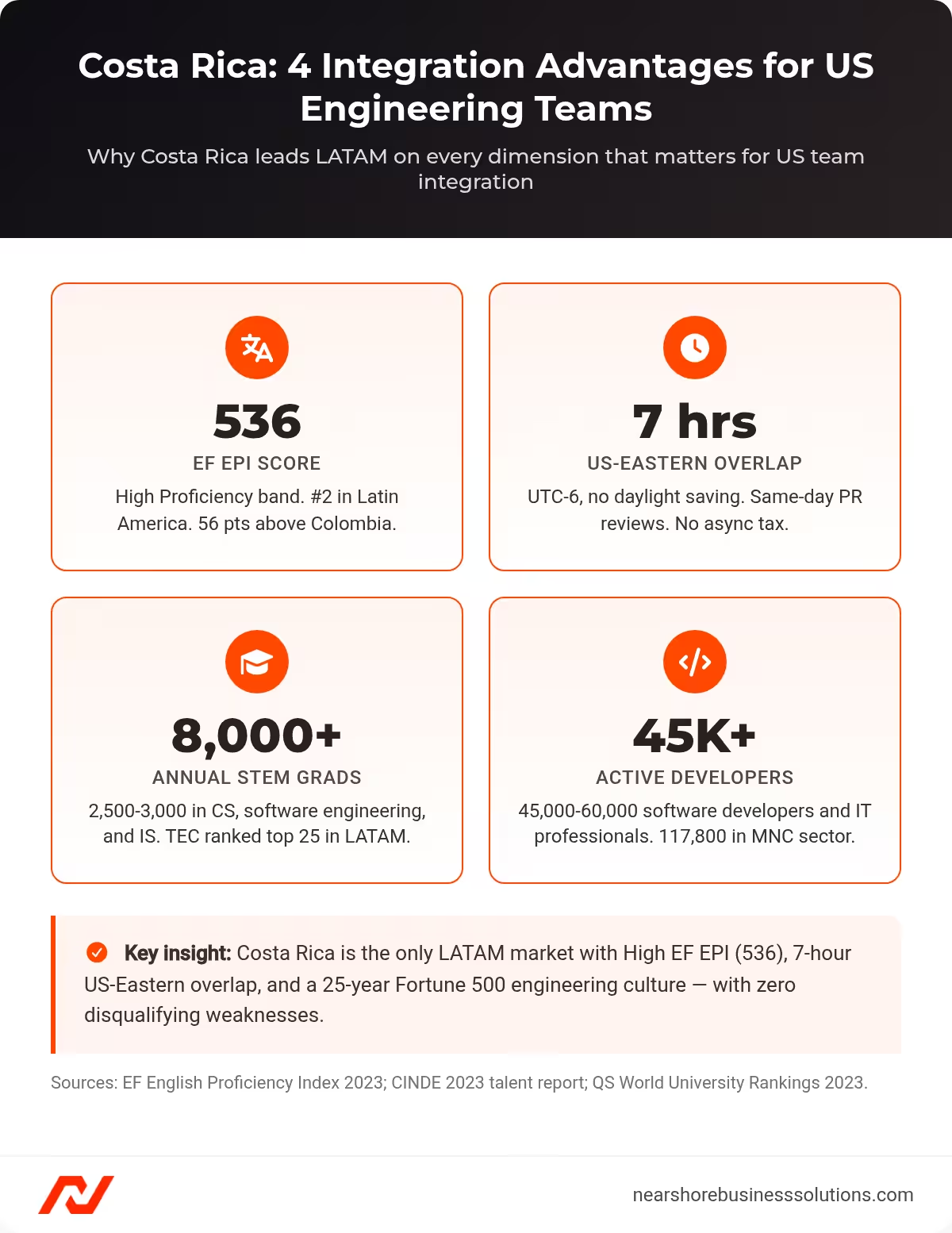
Costa Rica’s four integration advantages for US engineering teams: EF EPI score, timezone overlap, STEM graduates, and developer pool size.
How Did Intel, Amazon, and IBM Build Costa Rica’s Enterprise Engineering Culture?
Intel’s 1997 arrival rewired the country’s engineering trajectory. At peak operations, Intel employed over 3,500 people. When it shifted away from large-scale manufacturing in 2014, it pivoted to R&D, a Global Services Center, and specialized assembly. Today Intel operates with over 2,700 employees in Costa Rica. Intel alumni founded local tech startups, took leadership roles at other multinationals, and staffed nearshore delivery firms. They seeded the ecosystem with Six Sigma-trained, bilingual engineers who set an industry-wide standard for rigor.
Amazon now employs over 15,000 people in Costa Rica across customer service, AWS cloud support, software development, and data analysis. IBM operates a Global Business Services center with over 1,500 employees in cloud computing, cybersecurity, and consulting. Microsoft runs engineering teams of 1,000+ focused on cloud and AI solutions. Hewlett Packard Enterprise (1,200+), Accenture (1,500+), and Infosys add further enterprise depth.
The compounding effect matters for hiring decisions. When a US CTO hires a Costa Rican senior developer, that engineer likely spent years inside a Fortune 500 engineering org. That operational maturity, including comfort with CI/CD pipelines, agile ceremonies run in English, and stakeholder-facing demos, separates Costa Rica’s talent from lower-cost markets where developers may have equivalent technical skill but lack enterprise context.
What Do EF EPI Scores Reveal About Costa Rica’s English Fluency Advantage?
Costa Rica scores 536 on the EF English Proficiency Index (EF EPI 2023), placing it in the “High Proficiency” band and ranking second in Latin America, 56 points above Colombia (480, Low) and 89 points above Mexico (447, Very Low).
| Country | EF EPI Score | Proficiency Band |
|---|---|---|
| Argentina | 560 | High |
| Costa Rica | 536 | High |
| Brazil | 487 | Low |
| Colombia | 480 | Low |
| Mexico | 447 | Very Low |
Source: EF English Proficiency Index 2023.
“High Proficiency” means engineers participate fluently in standup calls, write precise async Slack messages, and present confidently in stakeholder demos without a bilingual PM acting as intermediary. “Low” and “Very Low” bands correlate with ambiguous ticket descriptions, misunderstood acceptance criteria, and rework that compounds across every sprint.
How Does the US-Eastern Timezone Overlap Work for Real-Time Collaboration?
Seven hours of overlapping business time between Costa Rica (UTC-6, no daylight saving) and US Eastern eliminates the async tax most offshore engagements pay. A 2017 study in the Journal of Software: Evolution and Process found that temporal distance was a significant predictor of communication delays and coordination failures. Zero-overlap teams experienced compounding delays: a blocking PR comment posted at 4 PM ET wouldn’t receive a response for 16+ hours. Costa Rica-based engineers resolve the same blocker within the same business day.
Sub-6-hour direct flights from Miami (3 hrs), Austin (4 hrs), and New York (5.5 hrs) make quarterly on-site visits a day trip. That travel accessibility enables the face-to-face cadence that converts a vendor relationship into an integrated engineering team.
How Does Costa Rica Compare to 7 LATAM Alternatives on Salary, English, and Timezone?
Costa Rica scores at or near the top across every dimension that matters for US team integration. It wins not by dominating any single variable, but by eliminating disqualifying weaknesses across all of them.
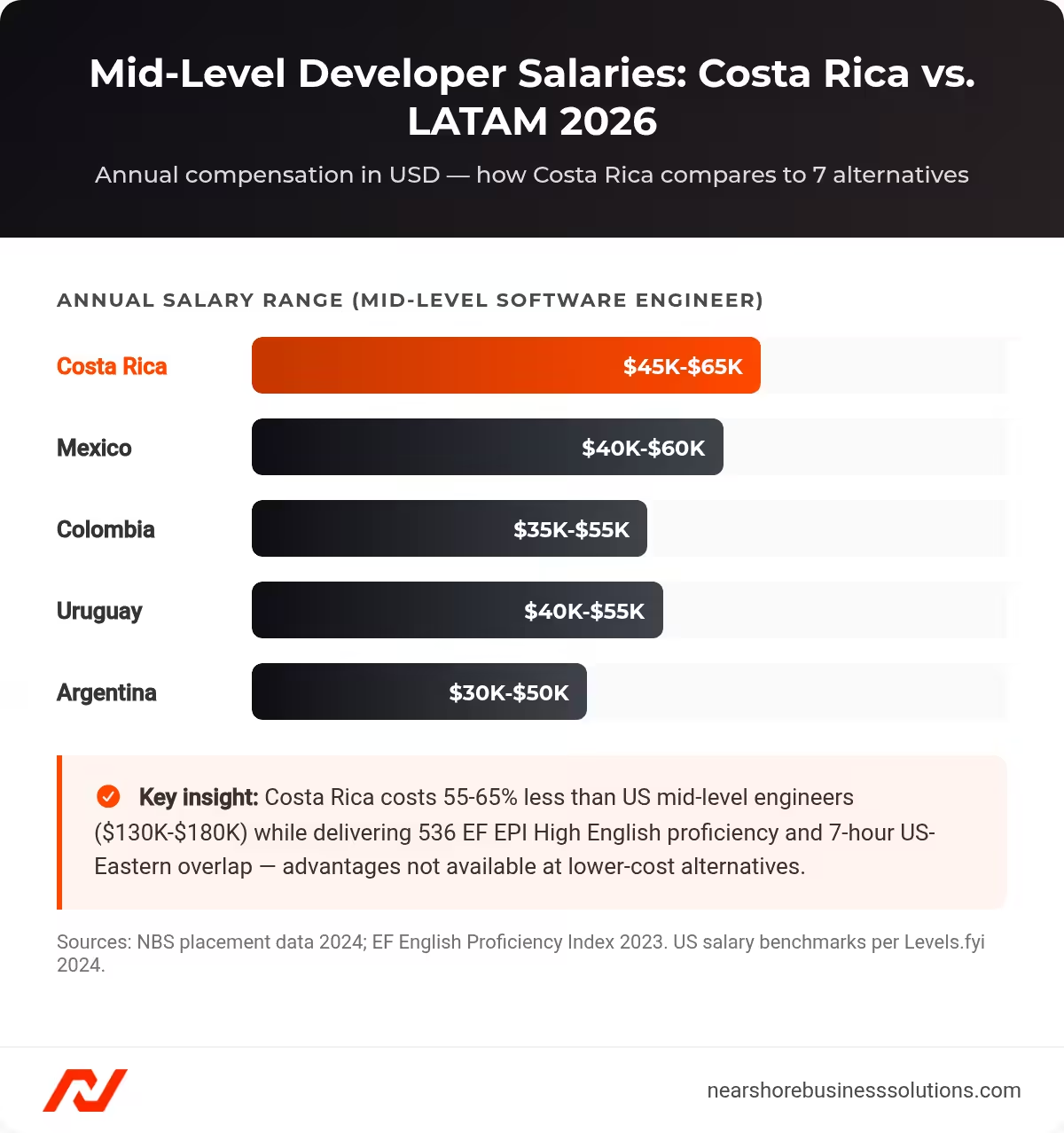
Mid-level developer salary comparison: Costa Rica versus 5 LATAM alternatives, annual USD 2026.
| Country | Mid-Level SWE Salary | EF EPI Score | Hours Overlap w/ US Eastern | Key Advantage | Key Risk |
|---|---|---|---|---|---|
| Costa Rica | $45K-$65K | 536 (High) | 7 hrs | No disqualifying weakness across any dimension | 8-12% annual salary inflation |
| Mexico | $40K-$60K | 447 (Very Low) | 7-8 hrs | Massive developer pool | Very Low English proficiency |
| Colombia | $35K-$55K | 480 (Low) | 8 hrs | Lowest salary floor | Low English proficiency |
| Argentina | $30K-$50K (volatile) | 560 (High) | 6-7 hrs | Strongest raw technical talent | Peso volatility, capital controls |
| Brazil | $40K-$60K | 487 (Low) | 6-7 hrs | 700,000+ developers | Portuguese-first, Low English |
| Uruguay | $40K-$55K | 513 (High) | 6-7 hrs | Political stability, strong rule of law | Small talent pool limits scale |
| Chile | $38K-$55K | 522 (High) | 5-7 hrs | Political stability | Small talent pool |
| Peru | $25K-$40K | 477 (Low) | 8 hrs | Lowest salary floor | Less mature tech ecosystem |
EF EPI scores per EF English Proficiency Index 2023. Salary ranges are approximate 2024 figures. For cross-market salary and talent benchmarks, see our LATAM Developer Salary Guide.
What Does It Actually Cost to Hire Developers in Costa Rica in 2026?
Costa Rica developers cost 55-65% less than US equivalents in fully loaded terms, with mid-level engineers running an estimated $45K-$65K/year versus $130K-$180K in the US, based on 2024 figures.
| Role | Costa Rica (USD/yr) | US (USD/yr) | Approx. Savings vs. US |
|---|---|---|---|
| Junior SWE | $30K-$45K | $90K-$130K | 65-70% |
| Mid-Level SWE | $45K-$65K | $130K-$180K | 60-65% |
| Senior SWE | $65K-$85K | $180K-$250K | 55-65% |
| Staff/Principal | $85K-$110K+ | $250K-$400K+ | 60-70% |
| DevOps/SRE | $60K-$90K | $150K-$220K | 55-60% |
| AI/ML Engineer | $70K-$105K | $180K-$280K | 55-65% |
Costa Rica runs 15-30% above Colombia and Brazil across every role. That premium buys English fluency that eliminates bilingual PM overhead ($80K-$100K saved) and enterprise operational maturity that compresses ramp time from 8-12 weeks to 2-4 weeks. AI/ML and Data Engineering command the highest premiums locally, reflecting scarcity. Companies hiring three or more ML engineers should expect 6-10 week fill times and consider blending Costa Rica with Argentina or Brazil.
What Are the Fully Loaded Costs and the Real Savings Math?
Costa Rican labor law mandates employer-side contributions adding 35-40% on top of base compensation, including CCSS social security (26.5%), aguinaldo/13th-month bonus (8.33%), severance accrual (5.5%), and minor levies (2-4%), per the Costa Rican Ministry of Labor’s mandatory employer contribution schedule.
Worked example: Senior Full-Stack Engineer
| Cost Component | Costa Rica | United States |
|---|---|---|
| Base salary | $70,000 | $200,000 |
| Employer burden (35-40% CR / 20-25% US) | $24,500-$28,000 | $40,000-$50,000 |
| Fully loaded annual cost | $94,500-$98,000 | $240,000-$250,000 |
Even after the higher statutory burden, the fully loaded savings hold at 60%.
Staff augmentation ($35-$65/hr, mid-to-senior) works best for engagements under 12 months or teams of 1-3 engineers. Dedicated teams (monthly retainers of $5,500-$9,500 per seat) suit 12+ month engagements where nearshore engineers own a product surface area. Dedicated teams justify the higher per-seat cost through markedly lower attrition than staff-aug arrangements and deeper product context accumulation.
The quality-adjusted cost model matters more than raw salary. Eliminating one bilingual PM adds 13-17% to effective savings on a 6-person team. Compressed ramp time saves $8K-$11K per engineer. Each avoided attrition replacement saves an estimated $15K-$30K in recruiting and lost productivity. Costa Rica’s tech sector attrition averages 12-15% annually, lower than Colombia’s 18-22% and Mexico’s 16-20%.
What Is the Depth of the Costa Rica Talent Pipeline?
Costa Rica produces approximately 8,000 STEM graduates annually, with 2,500 to 3,000 completing degrees directly tied to computer science, software engineering, and information systems, per CINDE’s 2023 talent report. Between 45,000 and 60,000 software developers and IT professionals operate in Costa Rica today. The knowledge-intensive services sector within CINDE-supported multinationals grew 52% from 2019 (77,500 employees) to 2023 (117,800 employees), with projections exceeding 135,000 by 2025, according to CINDE.
A 20-person engineering team requires recruiting from roughly 200-400 qualified candidates. In a market of 45,000-60,000 developers, that draw represents less than 1% of the available pool. Scale constraints emerge only for highly specialized niches or when hiring 50+ engineers simultaneously.
Tecnologico de Costa Rica (TEC), ranked among the top 25 universities in Latin America per QS World University Rankings 2023, graduates 500-600 students annually from Computer Engineering and Computer Science. TEC emphasizes applied engineering: systems-level thinking, version-controlled team projects, and a mandatory capstone mirroring sprint demo cycles. Intel research partnerships shape curriculum around performance optimization and testing methodologies.
Universidad de Costa Rica (UCR) graduates 400-500 students annually with stronger theoretical foundations, including algorithm design, computational complexity, formal methods, and mathematical modeling. Private universities like Universidad Cenfotec and ULACIT add specialized, industry-aligned programs, while coding bootcamps like Codenation contribute junior talent trained in modern web stacks.
The mid-career layer matters most for team architecture. Staff/Principal Engineer salaries of $85K-$110K+ and Engineering Manager salaries of $90K-$130K+ confirm a deep senior-engineer pool (45,000+ active developers). Prevalent stacks include JavaScript/TypeScript (React, Node.js), Java (Spring), Python, and .NET, with strong and growing availability in AWS cloud engineering, DevOps/SRE (Docker, Kubernetes), and mobile development. Data Engineering (Spark, Kafka) and AI/ML (TensorFlow, PyTorch) talent exists but faces high MNC competition.
How Do You Outsource to Costa Rica Without Wrecking Your Engineering Culture?
Integration quality determines outcomes. Costa Rica’s 7-hour US-Eastern overlap means the difference between a vendor relationship and a genuine engineering team is process design, not geography.
Should You Choose Embedded Squads or Project-Based Engagements?
For product engineering, embedded squads outperform project-based handoffs in the large majority of engagements. Embedded developers join your existing scrum teams, sharing the same Jira board and attending all ceremonies. Project-based handoffs create a two-tier culture where nearshore engineers become ticket-takers rather than product owners. That dynamic drives attrition and reduces code ownership.
What Onboarding Rituals Close the 1,500-Mile Gap in the First Two Weeks?
Structured onboarding in the first 14 days determines whether a nearshore engineer integrates or drifts. The following sequence works across our Costa Rica placements:
- Days 1-2: In-person kickoff or high-fidelity virtual intensive. Cover product vision, architecture walkthrough, and team norms. First impressions set collaboration tone.
- Days 2-3: Shared-context documentation sprint. Ensure nearshore engineers review architecture decision records, runbooks, and the current sprint board, not just repo access.
- Days 3-5: Buddy-pairing with US-side engineers. Pair on real tickets, not toy projects. Accelerates codebase familiarity and relationship-building.
- Week 1 close: First PR submitted and reviewed. Every new nearshore engineer submits at least one pull request by end of week 1. Establishes quality norms immediately.
- Week 2: Cross-cultural retro. Run a retrospective that asks specifically about communication gaps, timezone friction, and tooling misalignment.
- Ongoing: Bi-weekly integration health checks. Brief async surveys where both sides flag emerging friction before it compounds.
Which KPIs Replace Story-Point Theater for Nearshore Teams?
DORA metrics reveal actual engineering throughput better than story points for distributed teams. Measure cycle time (commit to deploy), deployment frequency, escaped-defect rate, and time-to-first-PR-review. Set explicit targets: same-day PR review turnaround and sub-24-hour cycle time for standard changes. Track identically for onshore and nearshore engineers. Teams that apply DORA metrics to nearshore squads report meaningful improvement in cycle time within the first quarter.
What Is Shaping the Costa Rica Nearshore Talent Market in 2026?
Tech salaries in Costa Rica have inflated 8-12% annually from 2021-2024, driven by MNC competition and US companies hiring remotely, per CINDE labor market reports. That compression erodes the raw cost gap over time but signals a market producing talent valuable enough to command rising rates. Free Trade Zone incentives, including 100% exemption on import/export duties and corporate income tax rates reduced to 0-15% versus the standard 30%, continue attracting investment. Prime technology park occupancy in San Jose’s technology corridor consistently exceeds 95%, per CINDE.
The window for hiring top-tier Costa Rica talent at current rates is narrowing. CTOs should model value on quality-adjusted cost, factoring English fluency, timezone alignment, ramp time, and attrition, rather than raw salary arbitrage. For engineering organizations building durable nearshore capacity, Costa Rica remains the highest-integration option in Latin America. See our Costa Rica hiring guide for placement timelines and vetting standards.
Frequently Asked Questions About Costa Rica Tech Outsourcing
How long does it take to hire developers in Costa Rica?
Hiring takes under 2 weeks through a nearshore partner with an established candidate pool, with NBS delivering pre-vetted Costa Rica candidates within 3 business days of a role briefing. Direct hiring without a partner takes 8-16 weeks, including sourcing, vetting, and onboarding.
What if a Costa Rica developer doesn’t work out?
NBS includes a 90-day replacement guarantee on every Costa Rica placement. If a developer isn’t the right fit within the first 90 days, we source and place a replacement at no additional cost.
Do I need a local entity to hire in Costa Rica?
No. US companies hire Costa Rica developers through an Employer of Record (EOR) arrangement. The EOR handles CCSS registration, payroll, statutory benefits, and labor law compliance. You manage the engineer’s work. This eliminates the 6-12 month timeline and $30K-$80K cost of establishing a local entity.
How do I pay Costa Rica developers?
Through an EOR or nearshore partner, you pay a monthly invoice in USD. The EOR handles all local payroll in Costa Rican colones, including CCSS contributions (26.5% employer side), aguinaldo (8.33%), and severance accrual (5.5%).
What stacks are most available in Costa Rica?
JavaScript/TypeScript (React, Node.js), Java (Spring), Python, and .NET have the deepest talent pools. AWS cloud engineering, DevOps/SRE (Docker, Kubernetes), and mobile development (iOS/Android) have strong and growing availability. AI/ML (TensorFlow, PyTorch) and Data Engineering (Spark, Kafka) exist but fill 6-10 weeks due to MNC competition.
What is nearshore vs. offshore outsourcing?
Nearshore means hiring in a neighboring region with overlapping time zones (Latin America for US teams). Offshore means hiring in a distant region with minimal overlap (India, Eastern Europe for US teams). Costa Rica’s 7-hour US-Eastern overlap makes it nearshore. India’s 9.5-10.5 hour offset makes it offshore, with the async tax compounding across every sprint.
Do I need to provide equipment to Costa Rica developers?
Depends on the engagement model. Staff augmentation through NBS includes equipment provisioning as an optional add-on. Most Costa Rica developers working for US tech companies already have professional-grade setups. Enterprise clients often ship a Mac or ThinkPad on day 1 to standardize tooling.
Ready to Build Your Costa Rica Engineering Team?
Nearshore Business Solutions sources and vets developers from San Jose’s enterprise technology corridor, including Intel, Amazon, and IBM alumni. We screen for technical skills, English fluency, and US sprint-team fit.
Every placement includes a 90-day replacement guarantee. You receive pre-vetted candidates within 3 business days.
Start hiring Costa Rica developers and get a custom salary benchmark for your open roles.