
Hiring Python developers in LATAM saves 50-65% versus US rates while accessing 350,000-400,000 Python developers across Argentina, Brazil, Colombia, and Mexico.
LATAM Python developers cost $30,000-$95,000 annually versus $95,000-$210,000 in the US. You get same-timezone collaboration, strong English proficiency, and production-grade skills in Django, FastAPI, and data engineering. NBS delivers a vetted shortlist in 3-5 business days.
We source Python developers from tech hubs in Buenos Aires, Sao Paulo, Bogota, and Mexico City. Each candidate is screened for technical skills, English fluency, and US work style fit. Below you will find 2026 salary benchmarks, framework skill data, hub profiles, and a step-by-step hiring guide.
Why Are Engineering Leaders Choosing LATAM Python Developers Over Traditional Outsourcing Markets?
Engineering leaders choose LATAM Python developers to protect engineering velocity while scaling teams domestically unavailable. 82% of US engineering VPs rank time zone alignment as critical or very important when selecting a global talent location, citing improved Agile velocity and stronger team cohesion as primary drivers (2023 Global Engineering Management Survey, Accelerate Strategies, Inc.).
The domestic hiring math has broken down. US-based senior Python developers command $160,000-$210,000 in total compensation. The average time-to-fill exceeds 60 days. Over 150,000 active Python job postings sit open in the US as of Q1 2024 (LinkedIn Talent Insights and Indeed Hiring Lab). Meanwhile, LATAM produces over 150,000 new STEM graduates annually across Brazil, Mexico, Argentina, and Colombia. The region holds an estimated 350,000-400,000 Python developers.
Traditional offshore markets carry compounding risks that LATAM avoids. Eastern Europe operates under geopolitical instability that creates retention volatility. India offers scale but delivers near-zero synchronous overlap with US teams, forcing async-only workflows that slow sprint cycles. LATAM eliminates both failure modes: stable operating environments, real-time collaboration windows, and cultural proximity that compounds over every quarter of engagement.
For a broader view of LATAM engineering talent, see our guide to hiring software developers in Latin America.
What Time Zone and Collaboration Advantages Do LATAM Python Developers Offer?
US East Coast teams share 6-8 overlapping business hours with every major LATAM engineering hub. US West Coast teams get 3-6 hours. That covers morning stand-ups, pair programming sessions, and afternoon blocker resolution.
| US Time Zone | Buenos Aires (UTC-3) | Sao Paulo (UTC-3) | Bogota (UTC-5) | Mexico City (UTC-6) |
|---|---|---|---|---|
| Eastern (UTC-5) | 2 hrs ahead | 2 hrs ahead | Same time | 1 hr behind |
| Central (UTC-6) | 3 hrs ahead | 3 hrs ahead | 1 hr ahead | Same time |
| Pacific (UTC-8) | 5 hrs ahead | 5 hrs ahead | 3 hrs ahead | 2 hrs ahead |
MIT’s Human Dynamics Laboratory research confirms the mechanism: teams with more synchronous communication opportunities consistently outperform on efficiency and innovation metrics (Pentland, Social Physics, 2014). Blockers that take 24 hours to resolve asynchronously across a 10-hour time gap resolve in minutes during a shared working window.
What Is English Proficiency Like Among LATAM Python Developers?
Argentina ranks #1 in Latin America on the EF English Proficiency Index (2023) with a score of 560, placing it in the High Proficiency band. National averages for Brazil, Colombia, and Mexico score lower. But proficiency within the tech sector runs significantly higher. LATAM developers read English documentation, contribute to English-language open source, and increasingly work for US-headquartered companies from their first role.
Hofstede’s Cultural Dimensions data shows LATAM’s collectivist orientation fosters strong team loyalty and a collaborative default. Higher uncertainty avoidance scores correlate with a preference for well-defined processes and structured workflows. Engineering managers report less time explaining how to work in Agile and more time focused on what to build.
What Retention Rates Can You Expect From LATAM Python Developers?
Quality nearshore partners deliver 5-10% annual turnover for LATAM Python developers. That compares to 13-18% for US-based tech teams (Forrester 2023; Radford 2023). Three structural factors drive this: purchasing-power uplift from USD-denominated compensation, resume-building access to US-scale products, and sustainable schedules that eliminate the night shifts burning out developers in offshore markets.
With over 150,000 STEM graduates entering the workforce annually and a maturing ecosystem of Python-heavy startups, fintechs, and AI labs, LATAM offers both depth and replacement capacity. A quality nearshore partner can backfill from a pre-vetted pipeline in days, not months.
How Much Does It Cost to Hire Python Developers in Latin America? 2026 Salary Benchmarks
LATAM Python developers cost $30,000-$95,000 annually versus $95,000-$250,000 in the US. That represents a 50-65% savings at the senior level.
US vs. LATAM salary ranges by seniority level (2026 projections):
| Seniority Level | US Annual Salary (USD) | LATAM Annual Salary (USD) | Cost Savings |
|---|---|---|---|
| Junior (1-3 yrs) | $95,000-$120,000 | $30,000-$45,000 | ~65% |
| Mid-Level (3-5 yrs) | $125,000-$150,000 | $50,000-$70,000 | ~58% |
| Senior (5-8 yrs) | $155,000-$190,000 | $75,000-$95,000 | ~52% |
| Staff/Lead (8+ yrs) | $195,000-$250,000 | $95,000-$120,000 | ~51% |
(Sources: Robert Half 2024; Hired.com 2023; Glassdoor Q2 2024; published 2024 developer-marketplace data)
The savings percentage compresses at higher seniority levels. Engineering leaders planning 2026 headcount should model at the 52% tier for senior hires, not the 65% junior figure.
How Do LATAM Python Rates Compare to Western Europe and Asia?
The LATAM advantage holds against the broader global market, not just the US. Mid-level Python developers earn roughly $70,300 annually in Western Europe and up to $120,650 in North America, while entry-level developers in India start at $3,530-$6,315. Viewed worldwide, a 2025 compensation survey put the average Python developer salary between $72,857 and $125,000, with the top 10% earning $142,320 or more and the bottom 10% around $64,285. LATAM senior rates of $75,000-$95,000 sit below North American and most Western European mid-to-senior bands while delivering the same-timezone, English-fluent collaboration that lower-cost Asian markets cannot match.
| Region | Entry Level | Mid Level | Senior Level | Market Factors |
|---|---|---|---|---|
| North America | $60,000-$80,000 | $100,000-$140,000 | $140,000-$200,000+ | High demand, established tech industry |
| Western Europe | $40,000-$60,000 | $60,000-$90,000 | $90,000-$140,000+ | Growing tech sector, competitive salaries |
| Latin America | $30,000-$45,000 | $50,000-$70,000 | $75,000-$95,000 | Same-timezone collaboration, strong English, 50-65% US savings |
| India | $3,500-$7,000 | $10,000-$20,000 | $20,000-$40,000+ | Large talent pool, low cost, async-only US overlap |
(Sources: bluelight.co Python Developer Salary Guide; aijobs.net 2025 Python Developer Salary Survey)
What Do Python Developer Rates Look Like Across Six LATAM Countries?
Country selection drives a 25-40% variance in compensation within LATAM itself. Colombia and Mexico offer the most predictable cost modeling with stable currencies and 3-5% quarterly rate variance.
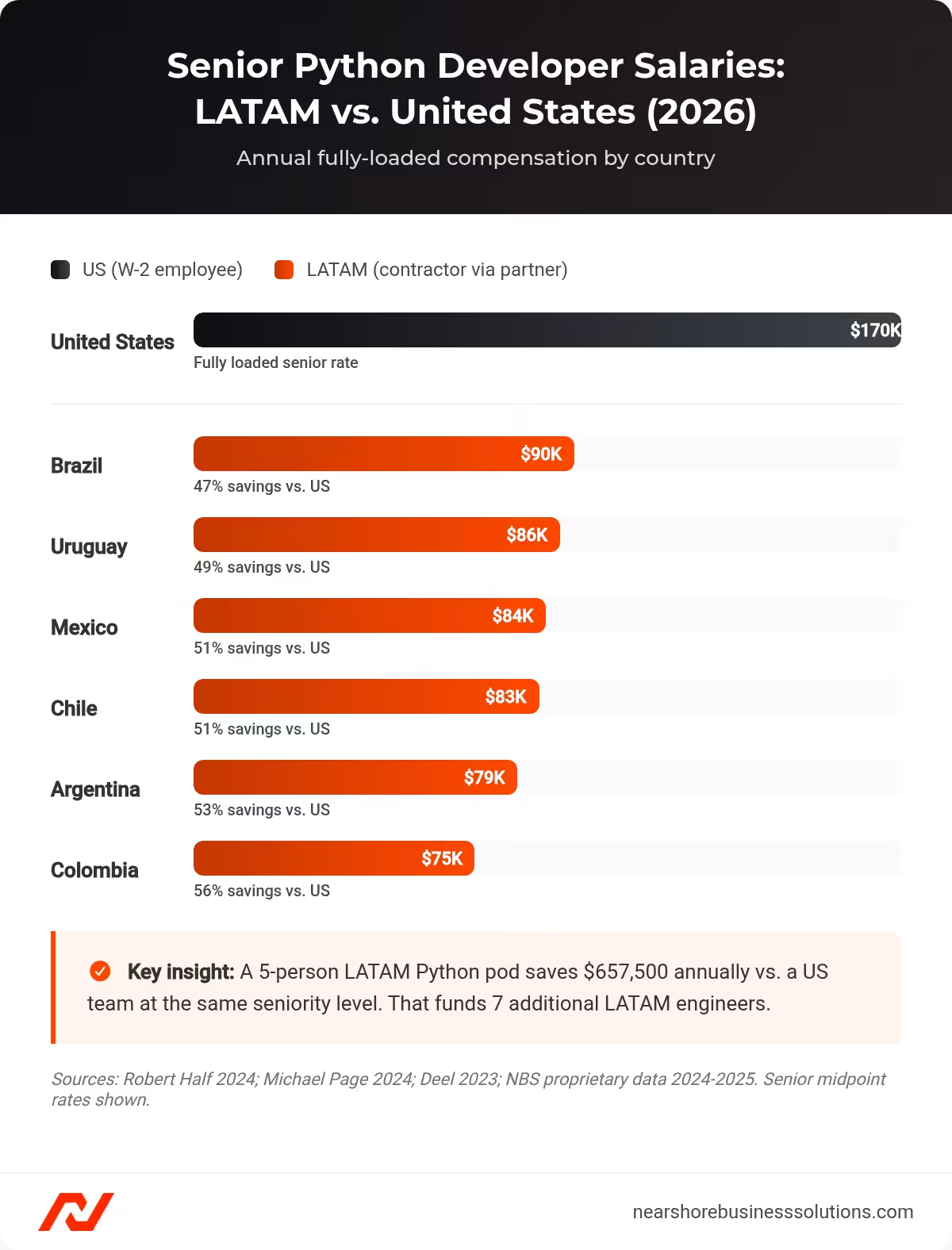
Senior Python developer salary comparison across six LATAM countries versus the US (2026).
Monthly salary ranges by country and seniority (USD, 2026 projections):
| Country | Mid-Level Monthly | Senior Monthly | Staff/Lead Monthly |
|---|---|---|---|
| Argentina | $3,750-$5,400 | $5,800-$7,500 | $7,500-$9,200 |
| Brazil | $4,600-$6,250 | $6,700-$8,300 | $8,300-$10,400 |
| Colombia | $3,750-$5,000 | $5,400-$7,100 | $7,100-$8,750 |
| Mexico | $4,200-$5,800 | $6,250-$7,900 | $7,900-$10,000 |
| Uruguay | $4,400-$6,000 | $6,500-$8,100 | $8,100-$10,200 |
| Chile | $4,000-$5,600 | $6,000-$7,700 | $7,700-$9,800 |
(Sources: Michael Page 2024; published 2023-24 LATAM salary benchmarks)
Argentina delivers the deepest senior talent pool at the most aggressive rates but requires hedging against currency-driven rate renegotiation. Brazil demands careful engagement structuring. Its direct employment labor law multiplier can reach 1.8x base salary, but contractor or EOR models compress that to 1.2-1.35x. Uruguay and Chile deliver premium talent with exceptionally low attrition but limited volume.
What Is the Full Cost of Hiring a LATAM Python Developer vs. a US Engineer?
Five senior Python developers cost $1,125,000 annually for a US team versus $467,500 for a LATAM nearshore pod. The $657,500 in annual savings funds seven additional senior LATAM developers at the same quality tier.
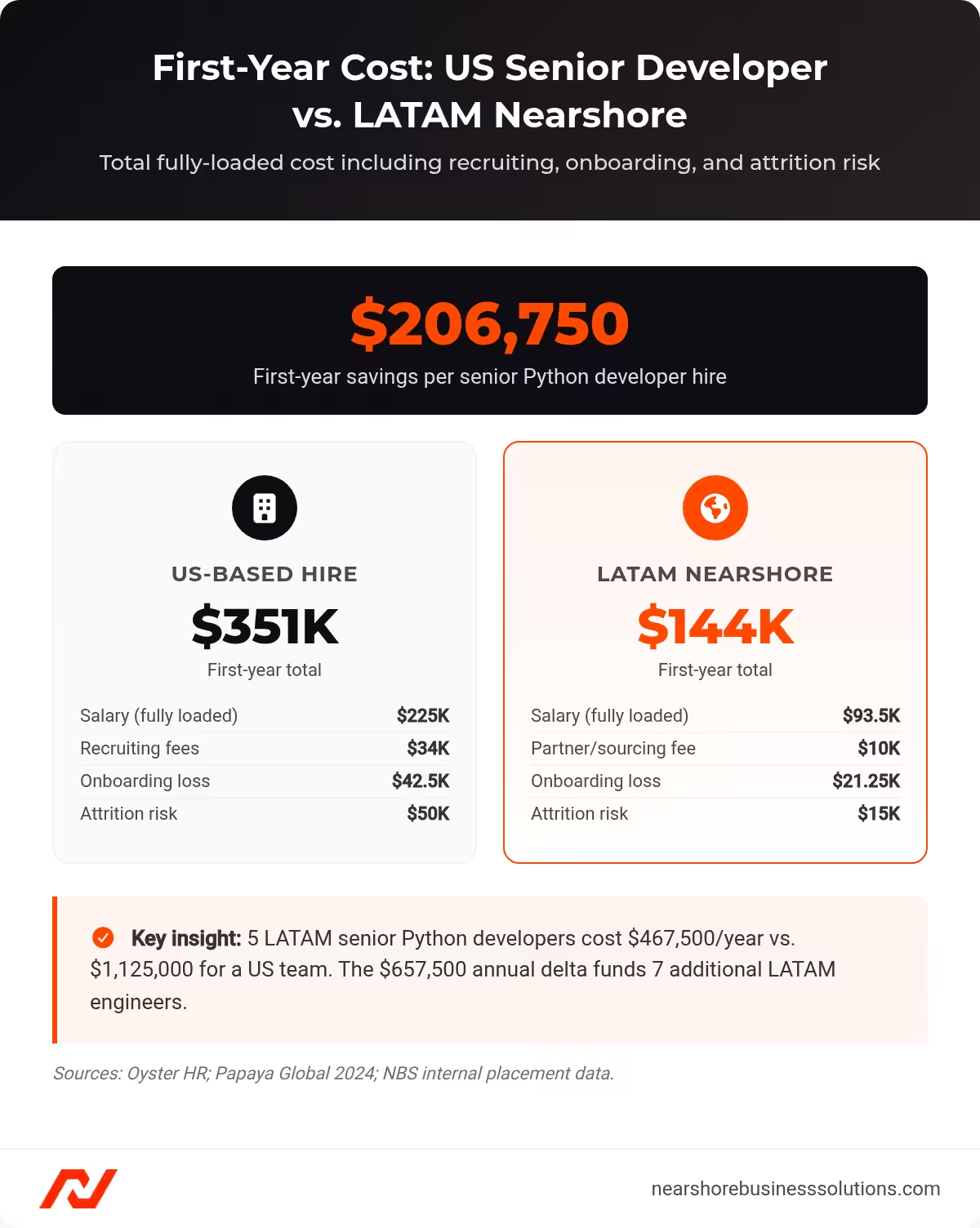
First-year total cost comparison: US senior Python developer vs. LATAM nearshore hire.
| Engagement Model | Base Salary (Senior) | Multiplier | Fully Loaded Annual Cost |
|---|---|---|---|
| US W-2 Employee | $170,000 | 1.25x-1.40x | $212,500-$238,000 |
| LATAM Contractor (via partner) | $85,000 | 1.05x-1.15x | $89,250-$97,750 |
| LATAM Employee (via EOR) | $85,000 | 1.20x-1.35x | $102,000-$114,750 |
(Sources: Papaya Global 2024; published EOR platform cost data)
First-year total cost comparison:
| Cost Component | US-Based Senior Developer | LATAM Nearshore Senior Developer |
|---|---|---|
| Recruiting/sourcing fees | $34,000 (20% of salary) | $5,000-$15,000 (partner fee) |
| Onboarding productivity loss | $42,500 (3 months reduced output) | $21,250 (faster ramp via partner) |
| First-year fully loaded salary | $225,000 | $93,500 |
| Attrition risk (amortized) | $50,000 (15% turnover) | $15,000 (8% turnover) |
| First-Year Total | ~$351,500 | ~$144,750 |
What Python Frameworks and Tools Should You Expect LATAM Developers to Know?
65-70% of LATAM Python developers demonstrate proficiency in at least one major web framework, according to regional developer surveys. Python holds the #1 position on the TIOBE Index (May 2024) and ranks as the most desired language on Stack Overflow for the seventh consecutive year. LATAM’s developer population mirrors that expansion across web backends, data engineering, ML infrastructure, and cloud-native automation. Backend teams that run JavaScript alongside Python can also review our guide to hiring Node.js developers in LATAM for runtime-specific vetting.
What Django and Flask Proficiency Can You Expect from LATAM Python Developers?
35% of LATAM Python developers carry production-grade Django proficiency, concentrated in Brazil and Argentina (Stack Overflow Developer Survey 2024). Bootcamps across the region anchor backend curricula on Django: Trybe and Digital House in Brazil, Soy Henry and Coderhouse in Argentina, Platzi and Holberton in Colombia. Flask claims an estimated 25% proficiency, concentrated among developers working on microservices architectures.
Django commands a modest 10% premium over generalist Python rates. A LATAM senior Django developer earns $85,000 annually versus $170,000 for a comparable US hire. Production Django proficiency implies competence in PostgreSQL optimization, DRF API design, Celery task queuing, and Redis caching. Flask developers price at generalist parity ($82,000 annually) because the premium attaches to complementary skills like container orchestration and API gateway design.
How Widespread Is FastAPI Adoption Among LATAM Python Developers?
15% of LATAM Python developers report FastAPI proficiency today. That figure understates the framework’s trajectory. By most accounts, it is tracking 18-24 months behind US adoption. Argentina and Brazil lead with 2-3 years of production async experience, fed by university pipelines at UBA and USP. Colombia and Mexico show the fastest adoption growth rates, driven by US nearshore engagements and accelerator ecosystems like Ruta N and Wizeline Academy.
FastAPI developers command a 15% premium over generalist rates. A LATAM senior FastAPI developer earns $90,000 annually versus $175,000 for a US hire. The premium compensates for async/await fluency under production concurrency, Pydantic model design, and OpenAPI auto-documentation. Expect this premium to compress toward 8-10% by late 2026 as adoption normalizes.
What Data Engineering and ML Skills Do LATAM Python Developers Bring?
LinkedIn Talent Insights and Indeed Hiring Lab data attribute the majority of Python demand growth to AI/ML, data engineering, and automation, not backend web. Coursera’s Global Skills Report (2023) documents that 60-70% of STEM graduates across LATAM enter the workforce with Python proficiency, with curricula increasingly embedding data science and ML fundamentals.
The key tools prevalent across LATAM’s senior Python talent:
- pandas and NumPy for production-volume data manipulation in fintech and e-commerce
- Apache Airflow for pipeline orchestration, with deep adoption led by Brazil’s data engineering community at Nubank and iFood
- scikit-learn through PyTorch/TensorFlow for ML model development
- SageMaker, Vertex AI, and MLflow for cloud-native ML operations
Top 10 Python Skills to Screen For (2026):
- FastAPI and async/await patterns for production concurrency
- Django REST Framework for API versioning, serializer optimization, custom auth
- pandas and SQL query optimization for dual application/data layer proficiency
- Apache Airflow DAG design for dependency management, idempotent tasks, failure recovery
- Docker and Kubernetes deployment for containerized Python services
- CI/CD pipeline construction with GitHub Actions, linting, type checking, pytest
- PostgreSQL advanced operations including EXPLAIN ANALYZE, index strategy, PgBouncer
- scikit-learn and ML model evaluation for cross-validation, feature engineering
- Terraform or Pulumi IaC for Python engineers who provision their own cloud resources
- Pydantic data validation and type hints for runtime validation, schema evolution
A senior LATAM Python engineer with FastAPI, Airflow, PostgreSQL, and Docker proficiency at $90,000 annually replaces what would require a $175,000 US hire or two separate domestic hires. That skill-stacking pattern defines the LATAM talent profile delivering the highest ROI through 2026. Turning that profile into a confident hire comes down to the interview itself, and our guide to interview techniques for top Python developers lays out the questions and assessments that surface real production skill.
Our Python developer vetting guide covers the exact screening process we use for framework proficiency and production-grade skill verification.
Where Are the Strongest Python Developer Hubs in Latin America?
Six cities account for over 60% of LATAM’s hireable senior Python talent. Each hub carries a distinct profile shaped by university pipelines, industry concentration, and macroeconomic conditions.
What Makes Buenos Aires and Argentina the Top Choice for Senior Python Talent?
65,000 Python developers operate across Argentina. Approximately 15,000 STEM graduates enter the workforce annually, with an estimated 70% carrying Python proficiency. That is the highest percentage among LATAM’s major markets. UBA (Universidad de Buenos Aires) and UTN anchor the institutional pipeline, while Digital House and Soy Henry layer applied training. Argentina’s tech sector matured earlier than its neighbors. MercadoLibre launched in Buenos Aires in 1999, creating a generation of engineers with 8-15 years of experience. Eventbrite integrated a Mendoza-based team of roughly 30 Python and Django developers. Vercel used Argentine and Brazilian talent for backend infrastructure teams.
Argentina’s Knowledge Economy Law provides a 15% reduced income tax benefit for tech workers through 2029. That makes USD-denominated compensation even more attractive in purchasing-power terms, driving retention rates below 8% annually for senior developers.
Why Is Brazil the Highest-Volume Python Talent Market in LATAM?
Brazil holds the largest pool in LATAM: approximately 150,000 Python developers, fed by 50,000 STEM graduates annually with 60% Python skills. USP (Universidade de Sao Paulo) and Unicamp anchor the academic pipeline. Sao Paulo serves enterprise-grade teams. Florianopolis, the “Island of Innovation,” delivers startup-caliber talent. Brazil is experiencing among the highest salary inflation rates in LATAM, and its direct employment multiplier demands contractor or EOR structuring to preserve cost advantages. English screening is critical in this Portuguese-first market.
What Python Talent Can You Find in Colombia and Mexico?
Colombia fields approximately 50,000 Python developers with 25,000 STEM graduates annually. 65% carry Python skills, driven by government tech initiatives through INNpulsa Colombia and ProColombia. Bogota operates in the same time zone as US Eastern, which maximizes collaboration overlap. Senior rates of $65,000-$85,000 annually are the lowest among major markets. Universidad de los Andes and EAFIT in Medellin produce a strong pipeline. Medellin’s Ruta N innovation district has added 200+ tech companies since 2010. Zapier built a distributed team of 50+ across Colombia, Brazil, and Argentina with high retention.
Mexico holds the second-largest pool at roughly 90,000 Python developers, fed by 65,000 STEM graduates annually from Tecnologico de Monterrey (ITESM) and UNAM. Mexico City sits one hour behind US Eastern. Guadalajara, often called Mexico’s Silicon Valley, adds a second major hub for backend engineering talent. Gusto opened a dedicated Mexico City office to scale product teams without competing in hyper-competitive San Francisco. Nextdoor established nearshore hubs across Brazil and Mexico with 100+ hires, reporting 50% reduction in talent acquisition costs and 25% increase in product velocity.
Colombia and Mexico deliver rates 15-20% below Argentina and Brazil. Colombia’s senior midpoint of $75,000 runs 17% below Brazil’s $90,000. Talent depth in both markets catches up rapidly through accelerator ecosystems and government-backed education initiatives.
For a complete breakdown of engagement models and hiring mechanics, see our backend developer hiring guide.
Frequently Asked Questions About Hiring Python Developers in LATAM
These are the most common questions US engineering leaders ask about hiring Python developers from Latin America.
How Long Does It Take to Hire a Python Developer in LATAM?
NBS delivers a pre-vetted shortlist of 3-5 Python developers within 3-5 business days of a confirmed role brief. Full onboarding, including contract execution and access setup, typically completes in 2-4 weeks. That compares to 45-90 days for a US-based hire at the same seniority level.
What If a Developer Does Not Work Out?
Every NBS placement includes a 90-day replacement guarantee. If a developer is not the right fit within the first 90 days, we replace them at no additional cost.
What Python Interview Format Works Best for LATAM Candidates?
Use a two-stage technical process: a 60-minute async coding challenge followed by a 90-minute live session covering architecture decisions, production debugging, and API design. Avoid timed puzzle challenges. LATAM developers, like US developers, perform better on realistic production scenarios. NBS can provide benchmark technical assessments calibrated to LATAM senior-level expectations.
How Do You Pay Python Developers in LATAM?
Through NBS, billing is in USD via invoice. We handle local payroll, currency conversion, benefits compliance, and tax withholding in each country. You pay one monthly invoice. No EOR complexity, no local entity required.
What Is the Difference Between Nearshore and Offshore Python Development?
Nearshore means LATAM: same or adjacent time zones (UTC-3 to UTC-6), strong English proficiency, cultural alignment with US work styles. Offshore typically means India or Eastern Europe: 8-12 hour time differences, async-first workflows, and higher communication overhead. For teams running Agile sprints, nearshore collaboration velocity is significantly higher.
Do I Need a Local Entity to Hire Python Developers in LATAM?
No. NBS operates as employer of record across Argentina, Brazil, Colombia, and Mexico. You get access to local talent without forming a local entity. The entire engagement is governed by a single US-law service agreement.
What Python Seniority Level Is Most Available in LATAM?
Mid-level and senior developers (3-8 years of experience) are the most available tier in LATAM, with the strongest depth in Argentina and Brazil. Junior developers are abundant across all markets. Staff and principal engineers are available but require longer sourcing timelines in smaller markets like Uruguay and Chile.
Ready to Build Your LATAM Python Engineering Team?
Nearshore Business Solutions sources and vets Python developers across Argentina, Brazil, Colombia, and Mexico. We screen for technical skills, English fluency, and US work style fit.
Every placement includes a 90-day replacement guarantee. You receive pre-vetted candidates in 3-5 business days.
Get a free consultation to discuss your Python hiring needs and receive a custom quote.