
LATAM produces an estimated 40,000-60,000 active Salesforce professionals across six major hubs, a figure triangulated from LinkedIn Talent Insights and Salesforce community data since Salesforce publishes no country-level counts. Senior Apex specialists in Bogota cost 50-56% less than US equivalents while working the same business hours (2023 Salesforce careers and hiring guides).
US engineering leaders face 48-day average time-to-fill for senior Salesforce developers (SHRM, 2023). Latin America solves this through deep certification pipelines, 3-8 hours of daily timezone overlap with US teams, and fully-loaded senior rates between $78,000 and $165,000 per year. IDC projects 11.6 million new Salesforce-related jobs globally by 2028, amplifying global demand further.
This guide covers salary benchmarks by country and seniority level, technical skills that separate architects from coders, a four-stage vetting framework, and a 30-day roadmap for your first LATAM Salesforce hire.
Why Latin America Has Become the Top Nearshore Hub for Salesforce Developers
LATAM’s structural advantages for Salesforce hiring stack across every dimension that matters to US engineering leaders: 3-8 hours of daily timezone overlap versus 0-1 hours for India (based on UTC offsets of -3 to -6 for LATAM vs. UTC+5.5 for India), voluntary tech turnover of 12-15% versus 18-22% in the US and 20-25%+ in India (Aon Hewitt and Mercer, 2023), and a rapidly deepening ecosystem that Salesforce itself actively feeds. Four of the five largest Salesforce systems integrators now operate dedicated LATAM delivery centers.
Why Does Timezone Alignment Matter for Salesforce Projects?
Six to eight overlapping business hours between Mexico City and any US timezone reshapes how Salesforce teams ship work. Bogota delivers 5-8 hours of overlap, Sao Paulo 4-7, and Buenos Aires 3-6. Compare that to India’s 0-1 hours of overlap with US business hours, or Poland’s 2-3 hours with the East Coast and zero with the West Coast.
Salesforce projects amplify the cost of timezone gaps because they demand constant interaction with non-technical stakeholders. A developer in Bogota can join a 15-minute call with a Sales Ops manager in Chicago to clarify a validation rule requirement, resolve it, and push code, all before lunch. That same question, routed to Hyderabad, sits in a Slack thread for 10-14 hours. A Qatalog and Cornell University study (2022) found that asynchronous work, when poorly managed, drives a 20% decrease in perceived team performance due to communication delays.
How Deep Is the Salesforce Ecosystem in Sao Paulo, Buenos Aires, Medellin, and Mexico City?
Brazil’s estimated 15,000-20,000 active Salesforce professionals make it the largest talent pool in the region. Mexico follows with 10,000-15,000 professionals concentrated in Guadalajara, Mexico City, and Monterrey. Argentina contributes 8,000-12,000, Colombia 6,000-9,000 (the fastest-growing ecosystem), Chile 3,000-5,000, and Costa Rica 2,000-4,000.
| Country | Key Tech Hubs | Est. Active Salesforce Professionals | EF English Proficiency Score | UTC Offset |
|---|---|---|---|---|
| Mexico | Guadalajara, Mexico City, Monterrey | 10,000-15,000 | 447 / Very Low nationally (bilingual concentration in Guadalajara and Monterrey) | UTC-6 |
| Colombia | Medellin, Bogota | 6,000-9,000 | 480 / Low nationally (tech sectors invest heavily in English) | UTC-5 |
| Argentina | Buenos Aires, Cordoba | 8,000-12,000 | 560 / High | UTC-3 |
| Brazil | Sao Paulo, Florianopolis | 15,000-20,000 | 487 / Low nationally (tech talent far above average) | UTC-3 |
| Costa Rica | San Jose | 2,000-4,000 | 536 / Moderate | UTC-6 |
| Chile | Santiago | 3,000-5,000 | 510 / Moderate | UTC-3 |
National EF scores understate the reality for tech hiring. Argentina scores 560 (High band, 28th globally per Education First’s 2023 EF EPI). Mexico scores 447 nationally, but Guadalajara and Monterrey, where proximity to US companies has created dense bilingual talent pools, operate well above that baseline.
LATAM-based teams already ship production-grade Salesforce IP to global markets. Zimperium in Argentina delivers a mobile security AppExchange application. OSF Digital runs a large Brazil-based operation producing numerous AppExchange solutions. Cloud Co-Op in Mexico publishes both free and paid apps on the AppExchange. These are product teams shipping packaged software on Salesforce’s platform, not staff-augmentation shops.
What Does It Cost to Hire Salesforce Developers in LATAM in 2026?
Salesforce reported $34.9 billion in FY2024 revenue, up 11% year-over-year, signaling an enterprise platform still expanding (Salesforce Q4 FY2024 Earnings Release). Over 7,000 apps on the AppExchange require ongoing development and integration work. That demand drives US senior Salesforce developer salaries past $200,000 before benefits, pushing engineering leaders toward markets where the same certifications, Apex fluency, and Lightning expertise cost 40-60% less.
What Are Salesforce Developer Salary Ranges in LATAM Compared to the US?
Total Cost of Employment layers in statutory benefits, payroll taxes, mandatory bonuses, health contributions, and severance. This multiplier varies dramatically by jurisdiction. Brazil’s CLT labor framework pushes TCE to 1.50x-1.65x base salary. Argentina’s monotributo-eligible contractors stay leaner at 1.30x-1.40x.
| Region | Junior (1-3 Yrs) | Mid (3-6 Yrs) | Senior (6+ Yrs) | TCE Multiplier | Senior Fully-Loaded | Savings vs. US |
|---|---|---|---|---|---|---|
| United States | $110K-$135K | $135K-$165K | $165K-$210K | 1.25x-1.30x | $206K-$273K | – |
| Mexico | $35K-$50K | $50K-$70K | $70K-$95K | 1.35x-1.45x | $95K-$138K | 47-54% |
| Colombia | $30K-$45K | $45K-$65K | $65K-$85K | 1.40x-1.52x | $91K-$129K | 50-56% |
| Argentina | $25K-$40K | $40K-$60K | $60K-$80K | 1.30x-1.40x | $78K-$112K | 54-62% |
| Brazil | $35K-$50K | $50K-$75K | $75K-$100K | 1.50x-1.65x | $113K-$165K | 40-54% |
| India | $20K-$35K | $35K-$55K | $55K-$75K | 1.20x-1.25x | $66K-$94K | 60-68% |
Sources: published 2023-24 Salesforce salary surveys and hiring guides; Glassdoor and LinkedIn Salary (US benchmarks); statutory benefit requirements per jurisdiction.
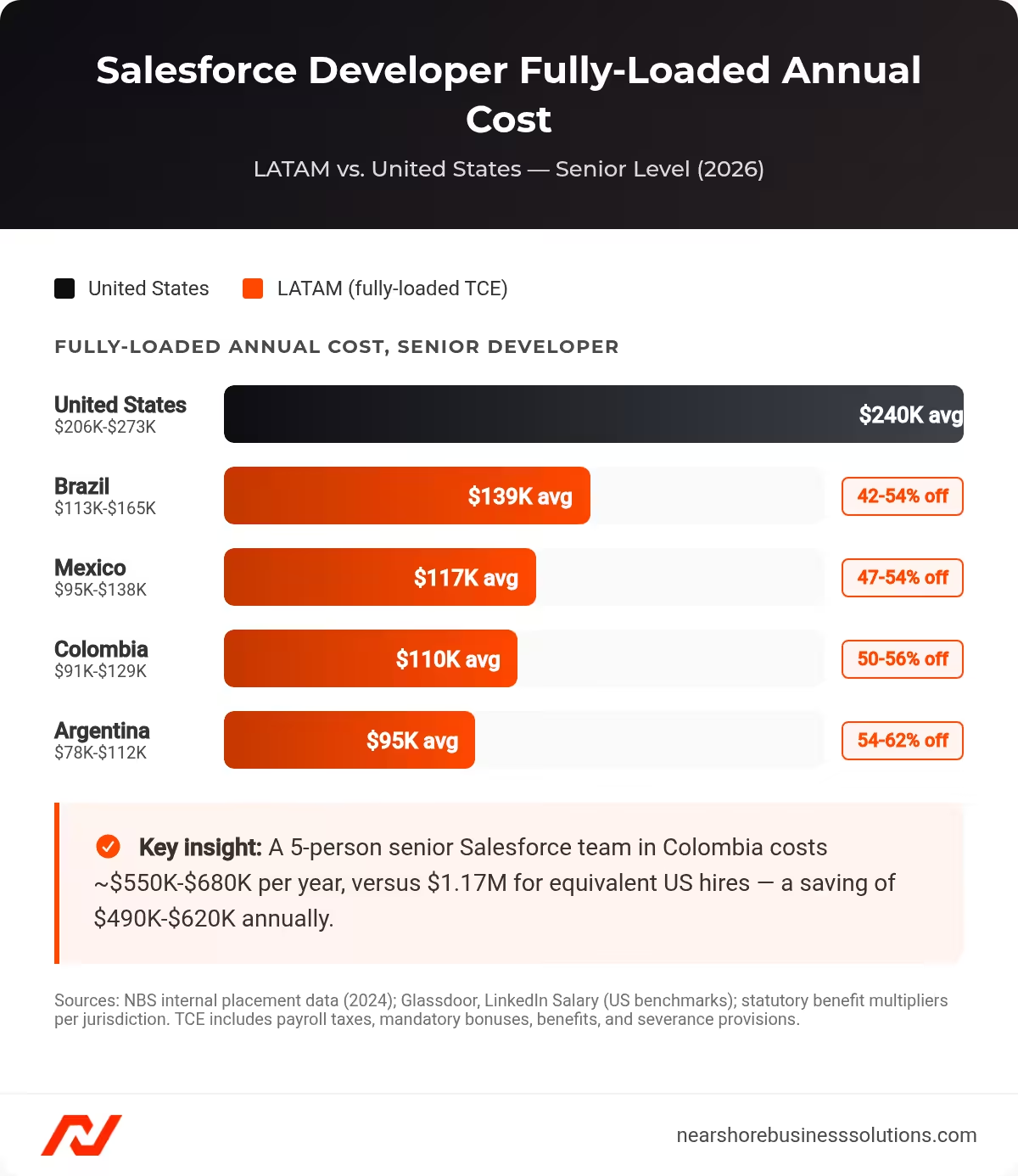
Fully-loaded senior Salesforce developer annual costs in LATAM versus the United States, 2026.
Argentina delivers the deepest discount at the senior level, running 54-62% below a US equivalent, calculated from 2023-24 Salesforce salary surveys and hiring guides. Brazil’s high TCE multiplier narrows the gap, but its estimated 15,000-20,000 professionals constitute the region’s deepest talent pool, meaning hiring speed often justifies the premium. India’s on-paper savings erode under coordination overhead. A Stanford Digital Economy Lab analysis (2023) found that 24-hour feedback loops add 15-25% to effective project costs for fully offshore teams, pushing India’s real cost within single-digit percentages of LATAM while retaining every collaboration disadvantage.
For deeper market context on how these rates compare across tech roles, see our software developers LATAM hiring guide.
How Do Apex, Lightning, and AppExchange Specializations Affect Developer Rates?
A developer who configures flows and writes basic triggers occupies a fundamentally different market than one who architects scalable Apex frameworks or shepherds an AppExchange app through security review. Argentina commands a meaningful specialty premium, the steepest in the region, reflecting a supply-demand imbalance. Argentine developers disproportionately concentrate in React and Node.js ecosystems, making Salesforce-certified Apex specialists scarce. Brazil’s premium runs lower because Salesforce’s heavy domestic presence generates a larger certified pool relative to demand.
CPQ and Billing occupies the highest-premium niche in practice. Senior Apex specialists in Colombia run $65,000-$85,000 base per 2023-24 salary surveys, and CPQ commands a premium above that band because the skill requires simultaneous fluency in Apex, product catalog architecture, pricing logic, and billing-system integration.
How Do Full-Time Hires, Staff Augmentation, and Dedicated Teams Compare on Total Cost?
| Attribute | Direct Full-Time Hire | Staff Augmentation | Dedicated Team |
|---|---|---|---|
| Senior Dev Annual All-In (LATAM) | $78K-$165K | $128K-$160K (1.6-2.0x base) | $110K-$136K per dev |
| Savings vs. US (~$234K) | 30-67% | ~38% | 42-53% |
| Time to Onboard | 4-8 weeks | 1-3 weeks | 4-8 weeks |
| Risk / Flexibility | Highest commitment; local labor law applies | Low; 30-day termination, replacement guarantees | Medium; 60-90 day ramp-down |
Start with 1-2 staff-augmented developers for months 1-3 to validate quality. Expand to a 3-4 person pod with a LATAM tech lead in months 4-9. Graduate to a dedicated team of 5+ engineers at month 10. A five-person dedicated team in Colombia runs approximately $550,000-$680,000 annually, versus $1,170,000 for five equivalent US direct hires, modeled from published 2023-24 salary benchmarks.
Which Technical Skills and Certifications Predict Salesforce Developer Performance?
Certification counts do not predict delivery speed. Stack depth does. A developer holding six credentials but no production experience with asynchronous Apex patterns will bottleneck a complex implementation faster than an uncertified engineer who has shipped three managed packages.
What Are the Core Technical Skills Every Salesforce Developer Must Have?
Apex executes on a multi-tenant runtime where every transaction faces hard governor limits: 100 SOQL queries, 150 DML statements, 6 MB of heap, and a 10-second synchronous CPU ceiling. The first technical gate for any hire is whether the candidate can articulate and apply bulkification patterns without prompting. Senior LATAM developers in established consultancies typically demonstrate fluency across trigger handler frameworks, asynchronous processing selection (Batch, Queueable, Schedulable, @future), and SOQL optimization using indexed fields.
Lightning Web Components have replaced Aura as the mandatory frontend skill. LWC adoption is strong among LATAM developers because the framework builds on W3C web standards, specifically standard HTML templates and native JavaScript ES modules, rather than Aura’s proprietary model. Developers trained in React or Vue transition to LWC with minimal friction. Practical evaluation should probe wire service versus imperative Apex calls, Lightning Message Service for cross-component communication, and SLDS compliance for accessibility.
Visualforce matters only as a migration skill. Any org older than 2019 carries Visualforce technical debt. The hiring signal is whether a developer can systematically replace Visualforce with LWC equivalents while preserving business behavior. See our backend developer vetting guide for the technical assessment framework we use across all role types.
How Does Salesforce Flow Separate Architects from Coders?
Salesforce’s investment in Flow Builder has made declarative automation the first-choice tool for business logic that does not require code. A developer who writes Apex for work that a Flow handles more maintainably is not demonstrating technical depth, they are demonstrating poor architectural judgment. That judgment, knowing when not to code, is the strongest signal of platform maturity a hiring manager can detect.
Which Salesforce Certifications Signal the Most Hiring Value?
- Platform Developer II (PD2): Strong differentiator. Lowest pass rate on the developer track. Validates advanced Apex, integration architecture, and performance optimization. Weight heavily for senior roles.
- Application Architect / System Architect: Strong for lead roles. Validates cross-cloud design and large-data-volume strategies. Pair with PD2 for full coverage.
- JavaScript Developer I: Validates LWC-readiness. Increasingly important as Salesforce mandates LWC for all new frontend development.
- Platform Developer I (PD1): Table stakes. Confirms Apex syntax, SOQL basics, and trigger fundamentals. Necessary but not sufficient for mid-level or senior roles.
- Platform App Builder: Validates declarative skills. Useful signal for developers who understand the build-versus-configure boundary, but insufficient alone for developer roles.
- Administrator: Weak signal for developer hiring. Over-indexing on Admin certs for developer roles is the most common screening mistake. The exam tests configuration knowledge, not code-level problem solving.
How Do You Vet Salesforce Developers in Latin America to Avoid Costly Mis-Hires?
US companies consistently report that LATAM developers perform on par with or exceed expectations during technical assessments focused on problem-solving and system design. The key is using a structured vetting process rather than relying on certifications alone.
What Does a Reliable 4-Stage Vetting Framework Look Like?
- Resume and Certification Audit: Verify certifications against Salesforce’s Trailhead verification tool. Screen for production project history, not just credential count. Pass: PD1 minimum plus demonstrable project work. Fail: certifications only, no project portfolio.
- Technical Assessment: Live Apex coding challenge covering bulkification, governor-limit handling, and async pattern selection. Recommended: 60-90 minute timed exercise in a scratch org. Pass: clean, bulkified code with test coverage above 85%. Fail: nested SOQL in loops, row-level DML, or inability to explain governor limits.
- Architecture Interview: Present an org-design scenario, such as a multi-object data model with integration requirements. Evaluate whether the candidate distinguishes between declarative and coded solutions. Pass: coherent data model, appropriate use of Flow versus Apex, integration pattern selection. Fail: defaulting to code for every requirement or inability to discuss tradeoffs.
- Trial Sprint: Paid 1-2 week engagement with defined KPIs: story points completed, code-review pass rate, and defect count. This converts hiring risk into measurable data before full commitment.
What Are the Green Flags and Red Flags in a Salesforce Developer’s Portfolio?
Green Flags: Published AppExchange apps, completed Trailhead Superbadges (especially Apex Specialist and Data Integration Specialist), PD2 certification, GitHub profile with Salesforce projects, multi-cloud project experience, demonstrated governor-limit optimization in code samples.
Red Flags: Only Admin or App Builder certs for a developer role, no code samples or GitHub profile, over-reliance on declarative tools for complex logic, inability to discuss async Apex patterns, no integration project experience, certification count without corresponding project depth.
Why Does a Specialized LATAM Staffing Partner Outperform Generalist Recruiters?
Over 30,000 open Salesforce roles were listed on LinkedIn at any given time in Q1 2024 (LinkedIn Talent Insights, Q1 2024). Generalist recruiters lack the pre-built technical screening infrastructure needed for Salesforce hires. A specialized partner maintains pre-vetted talent pools with Salesforce-specific coding challenges already completed, reference networks within the Salesforce consulting ecosystem, replacement guarantees (typically within 10 business days), and cultural-fit screening calibrated to US engineering team norms.
How Do You Hire Salesforce Developers in LATAM Within 30 Days?
This roadmap applies whether you are hiring staff-augmented contractors, building a dedicated pod, or making your first direct full-time hire in the region.
What Are the Week-by-Week Milestones From Role Definition to First Deployed Sprint?
- Week 1: Define role spec and rate budget. Identify required specialization (Apex, LWC, CPQ, integrations), seniority level, and engagement model. Set budget using the benchmarks above.
- Week 2: Source and shortlist. Specialized LATAM partners present 3-5 qualified, pre-vetted candidates within 10-15 business days. Conduct resume audits and schedule technical assessments.
- Week 3: Technical vetting and interviews. Run the coding challenge, architecture interview, and reference checks. Select finalist(s) and extend offer.
- Week 4: Onboard and launch first sprint. Provision sandbox access, integrate into Scrum ceremonies, assign first sprint stories. Total time-to-hire: under 30 days versus 48-60+ days for US direct hire.
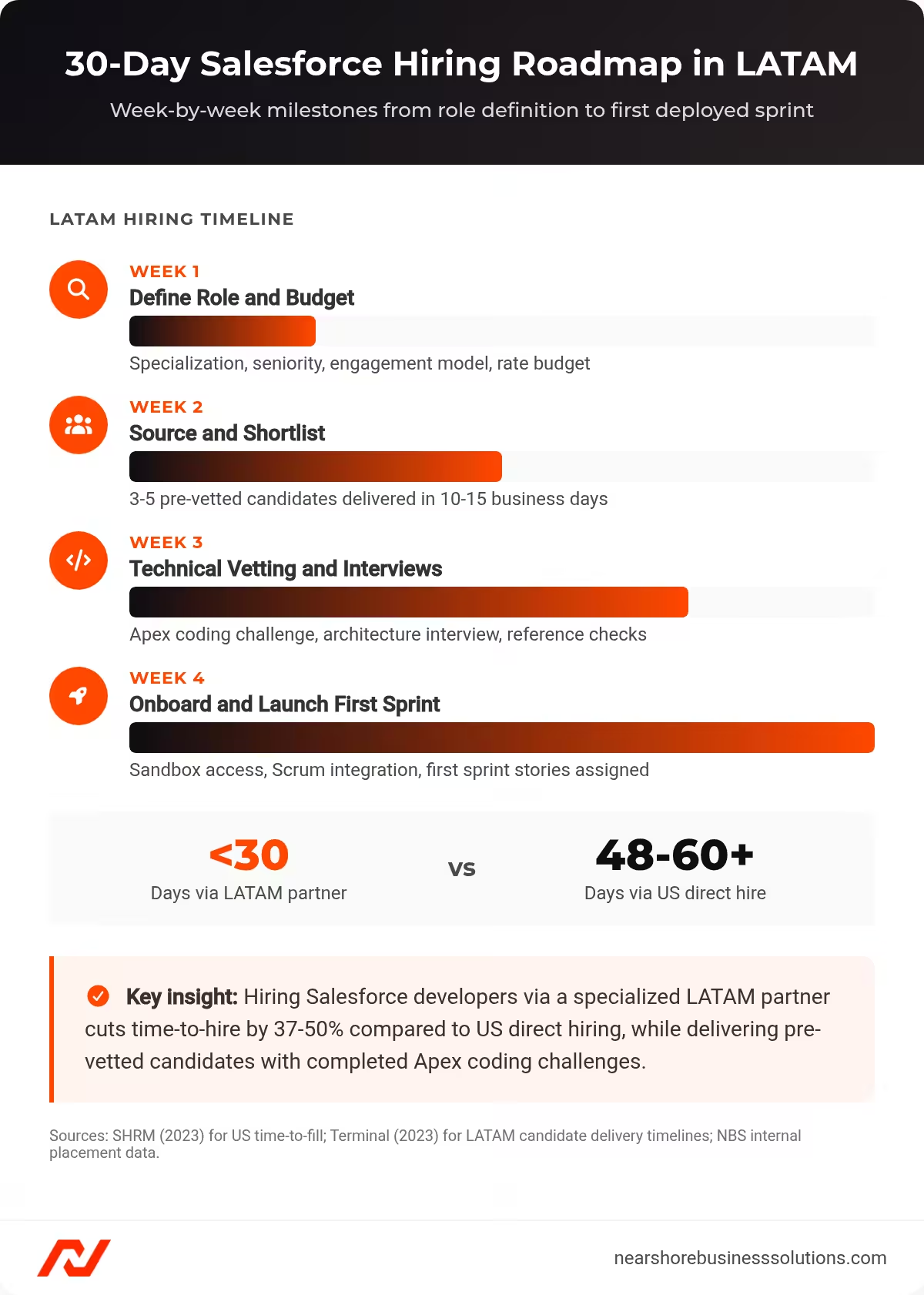
Week-by-week Salesforce hiring roadmap in LATAM: under 30 days versus 48-60+ days for US direct hire.
What Other Backend Roles Can You Hire in LATAM Alongside Salesforce Developers?
If you are building a broader engineering org, LATAM’s talent market covers the full backend stack. Our backend developers LATAM guide covers Node.js, Python, Java, and Go specialists available in the same talent hubs as your Salesforce team.
What Are Common Questions About Hiring Salesforce Developers in LATAM?
How Long Does It Take to Hire a Salesforce Developer in LATAM?
Specialized LATAM partners deliver a shortlist of 3-5 pre-vetted candidates within 10-15 business days. Full time-to-hire, including assessments and offer acceptance, typically runs under 30 days, compared to 48-60+ days for US direct hiring.
What If a LATAM Salesforce Developer Does Not Work Out?
Reputable LATAM staffing partners include replacement guarantees, typically covering the first 90 days. If a placement does not meet expectations, the partner replaces the hire at no additional cost within 10 business days.
Do I Need a Local Entity to Hire Salesforce Developers in LATAM?
No. Most US companies use Employer of Record (EOR) services or staff augmentation structures to engage LATAM developers without establishing a local legal entity. EOR providers handle local payroll, tax compliance, and benefits in each jurisdiction.
How Do I Pay LATAM Salesforce Developers?
US companies typically pay LATAM contractors or EOR-employed staff in USD via wire transfer or global EOR and payroll platforms. For direct employees, local payroll processors handle currency conversion and statutory deductions.
What Is the Difference Between Nearshore and Offshore for Salesforce Teams?
Nearshore means hiring in countries with significant timezone overlap with your US team, specifically 3-8 hours daily. LATAM is nearshore for US companies. India is offshore (0-1 hours of overlap), which adds 10-14 hour turnaround delays to every question or code review cycle.
Ready to Build Your Salesforce Team in Latin America?
Nearshore Business Solutions sources and vets Salesforce developers across Colombia, Argentina, Mexico, and Brazil. We screen for Apex fluency, certification depth, and US work style fit.
Every Salesforce placement includes a 90-day replacement guarantee. You receive a shortlist of pre-vetted candidates matched to your Salesforce stack within 48 hours.
Get your Salesforce developer shortlist and hire your first LATAM developer in under 30 days.