Latin America’s 12 nearshoring markets mandate between 7 and 19 statutory holidays in 2026, and premium pay for holiday work reaches 3.0x the daily wage. Colombia carries the highest count at 19. Mexico carries the lowest at 7.
This guide compares statutory holiday counts, premium pay rules, and US-LATAM overlap dates across all 12 markets, so you can budget coverage before the calendar catches you short.
How Many Latin America Holidays Does Each Country Mandate in 2026?
Statutory holiday counts across Latin America’s 12 primary nearshoring markets range from 7 to 19 mandatory days off. The regional average sits at roughly 13 statutory holidays, two more than the 11 US federal holidays. A Colombian engineer has 12 fewer working days per year than a Mexican one on statutory holidays alone.
How Do the 12 Markets Rank From 7 to 19 Mandatory Days Off?
Colombia tops the region at 19 mandatory holidays, while Mexico sits at the bottom with just 7 in 2026.
| Rank | Country | 2026 Statutory Holiday Count | Primary Legal Source | Hiring Guide |
|---|---|---|---|---|
| 1 | Colombia | 19 | Código Sustantivo del Trabajo, Art. 177; Ley 51 de 1983; Ley 2578 de 2026 | Hire in Colombia |
| 2 | Argentina | 16-19 (varies with bridge holidays) | Ley de Contrato de Trabajo Nº 20.744; Ley 27.399 | Hire in Argentina |
| 3 | Chile | 16 | Ley Nº 2.977; D.F.L. Nº 178 de 1931; Ley Nº 20.299; Ley Nº 21.357 | Hire in Chile |
| 4 | Peru | 16 | D. Leg. Nº 713, Art. 6, plus later feriado laws; calendar published by gob.pe | Hire in Peru |
| 5 | Uruguay | 15 (5 paid + 10 non-paid observed) | Ley Nº 12.590, Art. 18 | Hire in Uruguay |
| 6 | Costa Rica | 12 | Código de Trabajo, Art. 148 | Hire in Costa Rica |
| 7 | Dominican Republic | 12 | Código de Trabajo, Art. 55; Ley 139-97 | – |
| 8 | Ecuador | 11 | Código del Trabajo, Art. 65 | Hire in Ecuador |
| 9 | Honduras | 11 | Código del Trabajo, Art. 339 | Hire in Honduras |
| 10 | Guatemala | 11 | Código de Trabajo, Art. 127 | – |
| 11 | Brazil | 9 (national; states and municipalities add more) | Lei 662/1949 as amended by Lei 10.607/2002; Lei 6.802/1980; Lei 14.759/2023 | Hire in Brazil |
| 12 | Mexico | 7 | Ley Federal del Trabajo, Art. 74 | Hire in Mexico |
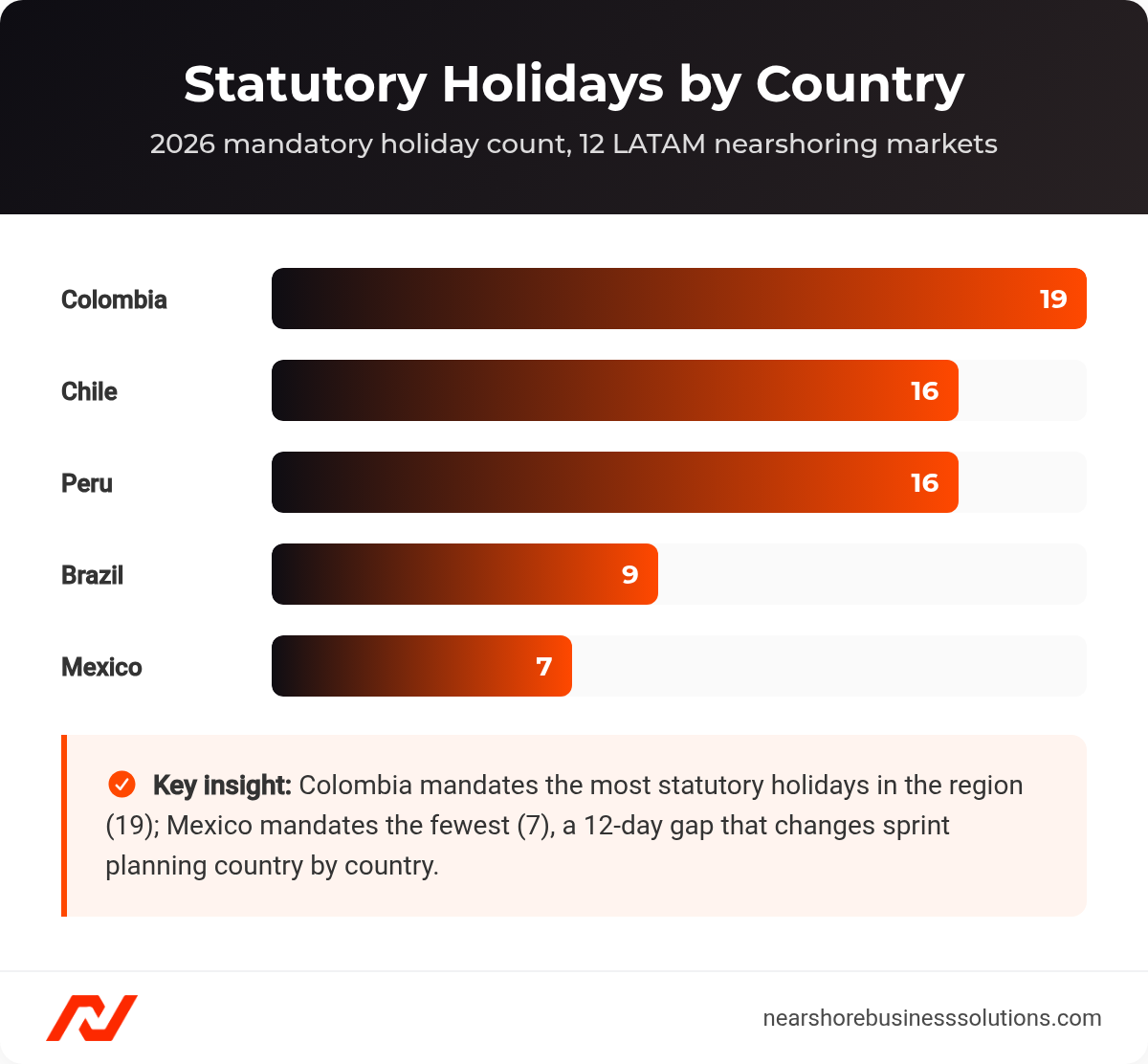
Statutory Holiday Count: Colombia mandates 19 holidays in 2026; Mexico mandates 7.
Mexico counts 7 in 2026. Art. 74 fracción VII of the Ley Federal del Trabajo adds October 1 as a mandatory rest day only in the years that carry the transmission of federal executive power, which last happened on October 1, 2024 and next happens on October 1, 2030. Fracción IX adds the jornada electoral day that federal or local electoral law sets in years with ordinary elections. No federal ordinary election falls in 2026, so 7 is the national figure and it rises only in a state that runs its own ordinary election. Brazil’s 9 national holidays are fixed by federal law (Lei 662/1949 as amended, Lei 6.802/1980 and Lei 14.759/2023). Lei 9.093/1995 requires every municipality to include Good Friday among its own local holidays, and most municipalities separately adopt Corpus Christi by their own ordinance, so the practical national-level count reaches 11 in nearly every city before any state or additional municipal holiday. That same law lets each state add its data magna and each municipality up to four religious days total, so your actual count depends on where your engineer is located.
What’s the Difference Between Paid and Observed Holidays?
Not every holiday on a country’s calendar triggers a premium pay obligation. The legal distinction between “paid statutory holiday” and “observed civic date” determines whether you owe 100-300% premium wages for work performed on that day.
Mexico distinguishes mandatory rest days (días de descanso obligatorio) from civic observances (e.g., May 5, Battle of Puebla). Only the 7 Art. 74 days trigger triple-pay obligations. Civic observances carry zero premium unless a CBA specifies otherwise. Colombia makes no such distinction: all 19 holidays carry identical premium pay obligations (190% of daily wage under the transitional rate in effect from July 1, 2026). Argentina uses three categories: non-transferable holidays, transferable holidays, and bridge holidays decreed annually (up to 3 per year). All three trigger premium pay, but bridge holidays remain unpredictable until the government issues its annual decree.
Uruguay presents the most misleading headline count: only 5 of its 15 holidays are legally paid (Jan 1, May 1, Jul 18, Aug 25, Dec 25), cutting actual payroll exposure to a third of the headline count. Brazil’s pontos facultativos (e.g., Carnival Monday) are not legally mandatory nationwide, though most employers observe them by convention. Rio de Janeiro state is the exception: Lei Estadual nº 5.243/2008 makes Carnival Tuesday a mandatory paid state holiday there.
Two structural points affect every market. Colombia’s “Ley Emiliani” moves most non-fixed holidays to the following Monday, shifting your payroll obligation date. And across the entire region, independent contractors are not covered by holiday pay premiums, a factor that matters if you’re evaluating contractor-based nearshoring models versus direct employment through an Employer of Record in Latin America.
Why Does the Religious-vs-Civic Mix Change Where Your Coverage Gaps Land?
Holiday composition, religious versus civic, drives clustering patterns that determine when your nearshore capacity drops.
Colombia’s 19 holidays are heavily weighted toward Catholic religious observances: 13 religious versus 6 civic, with movable feasts (Ascension, Corpus Christi, Sacred Heart) creating unpredictable mid-year gaps. Mexico is the inverse: predominantly civic and historical, with only Christmas as a religious holiday, making it the most predictable calendar in the region. Argentina mixes civic dates (Malvinas Day, May Revolution Day, multiple national hero commemorations) with religious observances (Carnival, Good Friday, Immaculate Conception).
The Andean cluster pattern across Colombia, Chile, and Peru deserves specific attention: all three observe Saints Peter and Paul Day, Immaculate Conception, Good Friday, and Labor Day. A team distributed across these three countries faces synchronized downtime on at least four dates.
Honduras’s Semana Morazánica stands alone as the region’s most disruptive single-holiday block. The Wednesday-through-Saturday closure effectively removes an entire working week when combined with the weekend, requiring sprint planning to account for a full-week gap in early October.
What Do Latin American Holidays Cost When Your Team Works on Statutory Dates?
Working a statutory holiday costs up to 3.0x the daily wage in base premium, plus employer-side social contributions that add at least another 21-28% depending on the country. The multiplier alone understates your real exposure.
What Are the 2026 Premium Pay Multipliers by Country?
Cash premiums for holiday work run from 1.90x in Colombia to 3.0x in Mexico and Peru, and Chile resolves most of the obligation with a compensatory rest day. The multiplier alone does not predict your total annual cost.
| Rank | Country | Effective Multiplier | Breakdown | Legal Source |
|---|---|---|---|---|
| 1 | Mexico | 3.0x | 100% base + 200% premium | LFT, Art. 75 |
| 2 | Peru | 3.0x | 100% base + 100% premium + 100% surcharge | D. Leg. Nº 713, Art. 8-9 |
| 3-9 | Argentina, Brazil, Uruguay, Ecuador, Dominican Republic, Guatemala, Honduras | 2.0x | 100% base + 100% premium | Various (see statutory sources above); Honduras: Código del Trabajo, Art. 340 |
| 10 | Colombia | 1.90x | 100% base + 90% premium (transitional rate: 90% from July 1, 2026, rising to 100% on July 1, 2027) | CST, Art. 179, as amended by Ley 2466 de 2025 |
| 11 | Costa Rica | 2.0x | 100% base + 100% premium | Código de Trabajo, Art. 152 |
| 12 | Chile | 1.0x plus a compensatory rest day | Ordinary pay for the day, a 50% surcharge only on hours above the ordinary weekly schedule, and one compensatory rest day for each holiday worked | Código del Trabajo, Arts. 32, 35 and 38 |
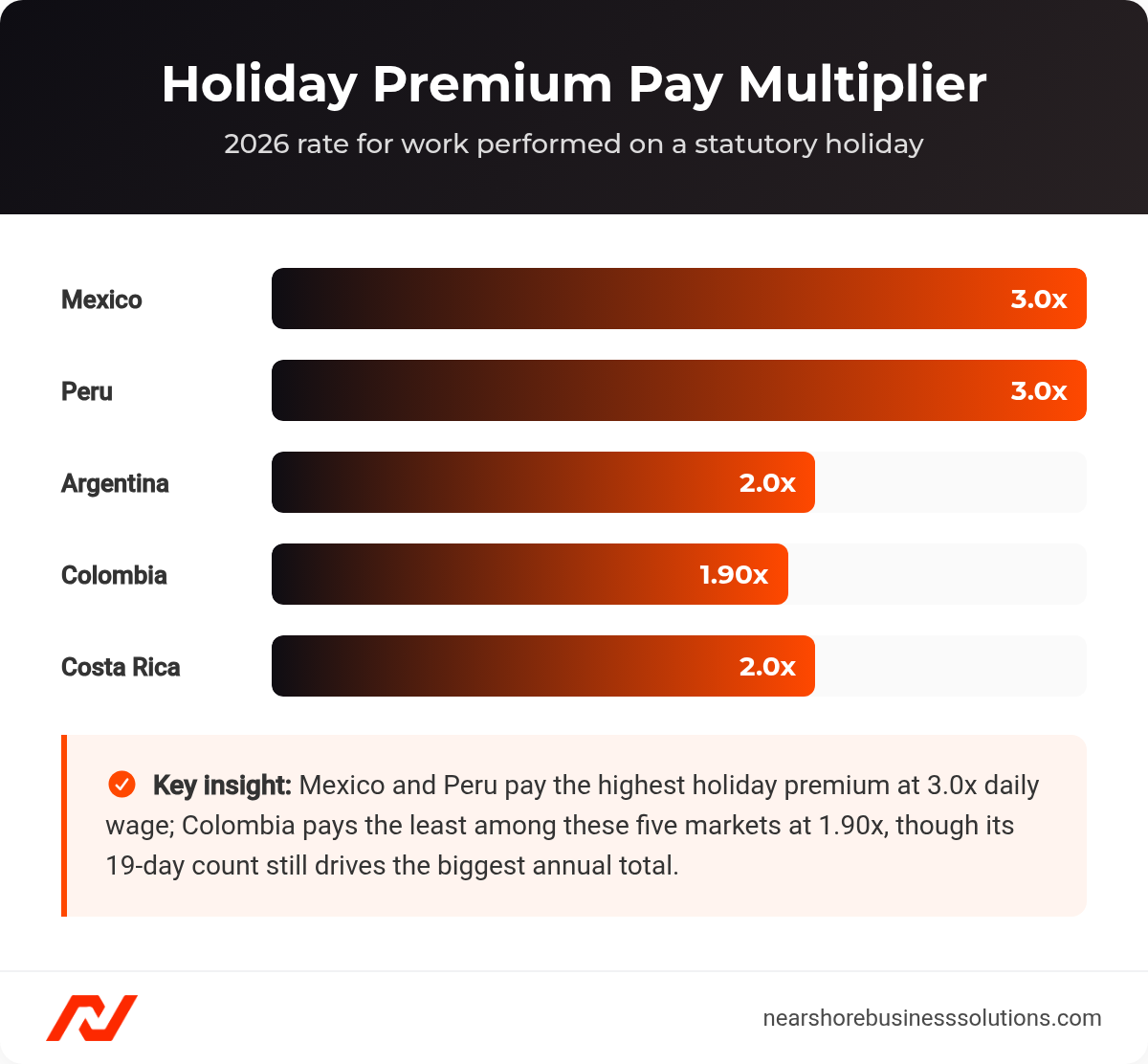
Holiday Premium Pay Multiplier: rates range from 1.90x in Colombia to 3.0x in Mexico and Peru.
Mexico’s 3.0x multiplier applies to the fewest statutory days (7), while Colombia’s lower 1.90x applies across 19 holidays. The per-day rate and the number of days it applies to produce very different annual totals.
What Does Holiday Coverage Really Cost Beyond the Multiplier?
Compensatory time-off obligations create a second cost layer beyond premium multipliers, and it can outweigh the multiplier itself. Chile, Peru, Uruguay, and Guatemala impose cumulative obligations: the employer pays the premium and provides compensatory rest. Colombia and Brazil treat them as alternatives. Mexico, Argentina, Ecuador, Costa Rica, and the Dominican Republic resolve the obligation entirely through cash.
Modeling the annual cost differential for a 10-person team earning $200 USD/day, working all statutory holidays:
| Country | Holidays Worked | Premium Per Engineer/Holiday | Annual Premium (10 Engineers) |
|---|---|---|---|
| Colombia | 19 | $180 | $34,200 |
| Argentina | 17 (mid-estimate) | $200 | $34,000 |
| Mexico | 7 | $400 | $28,000 |
| Brazil | 9 | $200 | $18,000 |
Colombia’s 19-day count and its 90% transitional surcharge push its annual total above every other market modeled here, and Argentina’s high holiday count separately pushes its total above Mexico’s despite a lower per-day multiplier. In Colombia, if half the team elects compensatory rest, cash cost drops to roughly $17,100, but removing 95 person-days of future capacity is worth $19,000 in lost output, making the real economic cost $36,100.
These figures exclude employer-side social contributions, which is where the real budget risk hides. In Brazil the employer’s INSS contribution runs at 20% of payroll and FGTS adds 8%, so a $200 premium costs at least $256 before the work-accident (RAT) and third-party contributions are counted. Argentina’s employer contributions add 24% to 26.4% of payroll. In Colombia the employer carries roughly 20.5% of monthly salary in pension and health, the ARL occupational-risk contribution runs from 0.522% to 6.96%, and a 9% payroll tax applies to employees earning above ten monthly minimum wages. Those rates come from PwC’s Worldwide Tax Summaries country pages for Brazil, Argentina and Colombia, each reviewed in 2026. If most of your nearshore team sits in Brazil, budget the loaded figure.
Which Holidays Are Non-Waivable, and How Much Flexibility Does That Cost You?
Mexico, Ecuador, Honduras, the Dominican Republic, and Guatemala give employers the most scheduling flexibility: premium pay resolves the obligation with no consent requirement. Colombia requires explicit written consent for non-essential roles, since software engineering does not automatically qualify as “essential” under Art. 175 CST. Colombia’s Ministerio del Trabajo can fine an employer up to 5,000 monthly minimum wages. Decreto 1469 de 2025 set the 2026 minimum wage at COP 1,750,905, which puts that ceiling at COP 8,754,525,000, or about $2.88M USD at the 3,042 COP/USD rate of August 25, 2026. Chile’s “irrenunciable” holidays (Jan 1, May 1, Sep 18, Sep 19, Dec 25) bind a narrower group than the label suggests. Art. 2 of Ley Nº 19.973, as amended by Ley Nº 20.215 of September 14, 2007 and Ley Nº 20.629 of September 14, 2012, makes those five dates non-waivable for dependientes del comercio, and it fines a breach at 5 UTM per affected worker, 10 UTM if the employer has 50 or more workers, and 20 UTM at 200 or more. Software engineers fall outside that class. For everyone else Art. 37 of the Código del Trabajo bars an employer not exempted from Sunday rest from scheduling holiday work except in force majeure, and the Dirección del Trabajo can order those hours paid as overtime and impose a fine under Art. 506. Brazil requires CBA authorization or individual consent for holiday work in the tech sector.
When Do South America Holidays and US Federal Holidays Overlap in 2026?
Only 2 dates close down every Latin American market and the US at once. The rest of the calendar splits into gaps that run in both directions, days where your LATAM team is dark and the US is working, and days where the reverse is true.
Which Dates Shut Down Both Your US and LATAM Teams at Once?
Only two dates shut down both your US headquarters and every Latin American market simultaneously: January 1 and December 25.
Two near-universal LATAM-only shutdowns, Good Friday (April 3, statutory in 11 of the 12 markets, since Mexico’s Art. 74 list omits it) and May Day (May 1, all 12 markets), hit while US operations run at full capacity, creating the year’s most acute coverage gaps. Maundy Thursday (April 2) adds a third closure in exactly 7 of the 12 markets: Argentina, Colombia, Costa Rica, Guatemala, Honduras, Peru, and Uruguay observe it as a statutory rest day, while Brazil, Chile, the Dominican Republic, Ecuador, and Mexico do not.
South American holidays lean toward civic hero commemorations like Argentina’s Malvinas Day, while Central America holidays cluster around Holy Week: Costa Rica, Guatemala, and Honduras all close from Maundy Thursday through Good Friday.
Conversely, eight US federal holidays (MLK Day, Presidents’ Day, Memorial Day, Juneteenth, Independence Day, Labor Day, Veterans Day, Thanksgiving) trigger zero LATAM closures, delivering eight full workdays of uninterrupted nearshore productivity while your US team is offline.
Which LATAM Holidays Leave US Teams Without Nearshore Coverage?
| Country | LATAM-Only Holiday Days (2026) | Highest-Risk Dates |
|---|---|---|
| Colombia | 17 | Holy Week, Corpus Christi, Sacred Heart, Ley Emiliani Monday shifts |
| Argentina | 14-17 | Carnival (Feb 16-17), Malvinas Day (Apr 2), unpredictable bridge holidays |
| Chile | 14 | Fiestas Patrias week (Sep 18-19 + bridges), Reformation Day (Oct 31) |
| Peru | 14 | Independence Days (Jul 28-29), August cluster |
| Brazil | 7 | Carnival week (de facto full-week shutdown, not statutory), Tiradentes (Apr 21) |
| Mexico | 5 | Constitution Day (Feb 2), Benito Juárez Birthday (Mar 16), Revolution Day (Nov 16) |
Mexico exposes US teams to the fewest coverage gaps (5 LATAM-only holidays), while Colombia creates the most (17). Good Friday (April 3) and May Day (May 1) represent the highest-risk concentration: both shut down 11 to 12 markets simultaneously while US operations run at full capacity. Maundy Thursday, April 2, adds a third closure but only in 7 of the 12 markets.
Net effective working days tell the fuller story: 2026 carries 261 weekdays, so a US team has approximately 250 effective days (261 minus 11 federal holidays), while the average LATAM team has approximately 248 (261 minus 13 holidays), a difference of just 2 days. But the 8 US-only holidays where LATAM teams provide full coverage create a significant operational advantage, particularly during Thanksgiving week when the entire LATAM workforce is operational while the US is largely unavailable from Wednesday afternoon through Friday.
Multi-country diversification shrinks total regional shutdown risk to a handful of dates. A Mexico, Colombia and Argentina team shares three statutory closure dates in 2026: January 1, May 1 and December 25. Mexico’s Art. 74 list carries no Good Friday, so April 3 closes Colombia and Argentina while Mexico works. Outside those three dates at least one of the three markets stays operational, which turns the LATAM holiday calendar into a scheduling advantage.
Frequently Asked Questions About Latin America’s 2026 Holiday Calendar
How many paid holidays does the average Latin American country observe in 2026?
The regional average is roughly 13 statutory holidays, two more than the 11 US federal holidays. The range runs from 7 in Mexico to 19 in Colombia, so the “average” hides a wide spread across the 12 markets.
What happens if my nearshore team works a holiday without paying the premium?
Enforcement varies by country. Colombia’s Ministerio del Trabajo can fine an employer up to 5,000 monthly minimum wages for scheduling non-essential roles without consent, which is COP 8,754,525,000 in 2026, or about $2.88M USD. Most employers avoid the risk entirely by obtaining written consent and paying the statutory multiplier.
Which Latin America holidays should I plan sprint capacity around first?
Good Friday and May Day close 11 to 12 of the 12 markets simultaneously and both fall while US operations run at full capacity. Honduras’s Semana Morazánica in early October removes a full working week in that market alone.
Do independent contractors in Latin America get paid holidays?
No. Holiday pay premiums apply to employees under each country’s labor code, not to independent contractors. That distinction is a factor when you’re comparing contractor-based nearshoring against direct employment through an employer of record.
How can I avoid losing an entire week of nearshore coverage to one country’s holiday calendar?
Distribute your team across 3 or more countries with different holiday calendars. A Mexico, Colombia and Argentina team shares three statutory closure dates in 2026: January 1, May 1 and December 25. Each of those countries carries between 7 and 19 statutory holidays on its own.
Is Thanksgiving week a good time to route work through LATAM teams?
Yes. Thanksgiving is not a statutory holiday anywhere in Latin America, so your nearshore team stays fully operational while the US is largely unavailable from Wednesday afternoon through Friday.
Do these holiday counts stay the same every year?
No. Mexico counts 7 in 2026 because Art. 74 fracción VII adds October 1 only in the years that carry the transmission of federal executive power. That last happened on October 1, 2024 and returns on October 1, 2030. Argentina’s government decrees up to 3 bridge holidays annually, so its count can shift from year to year.
Ready to Plan Nearshore Coverage Around Latin America’s Holiday Calendar?
Nearshore Business Solutions places vetted engineers across all 12 of these markets and screens for technical skill, English fluency, and US work-style fit before you ever see a resume. Client retention runs at 94%, the replacement rate stays under 2%, and you see first vetted candidates within 3 business days, so a holiday-calendar surprise never has to become a coverage crisis.
Country-specific holiday calendars are also available for El Salvador and Nicaragua, and both markets have their own hiring guides: Hire in El Salvador and Hire in Nicaragua.
Get a free consultation to build a multi-country nearshore team that stays covered through Latin America’s 2026 holiday calendar.