Nearshoring track and trace specialists to LATAM cuts hiring costs by 61% while accessing 220,000+ logistics-ready graduates annually from Mexico and Colombia.
A five-person US senior specialist team costs $415,000 annually. The same team in Colombia or Mexico costs $85,000 to $110,000. LATAM nearshored roles show 2% resignation rates versus 17.3% in the US, with time zone alignment enabling real-time collaboration.
We source and vet specialists from tech hubs in Guadalajara, Monterrey, Bogotá, and Medellín. Each candidate is screened for platform certifications, English fluency, and US work style fit. Below, you’ll find 2026 salary benchmarks, compliance requirements, shift patterns, and a step-by-step hiring process.
What Are Track and Trace Specialists and Why Do You Need Them?
Track and trace specialists are the human intelligence layer between your platform data and your operational decisions. The China+1 sourcing shift has multiplied monitoring requirements. GNSS jamming incidents increased 175% from 2023 to 2024, and automated systems alone cannot catch every anomaly.
What Do Track and Trace Specialists Actually Do?
Track and trace specialists monitor shipments in real-time and convert platform data into operational decisions. They map supply chain partners, assign risk levels, and report security incidents within 24 to 48 hours for critical issues.
They enforce 100% air cargo screening and maintain chain of custody through tamper-evident seals and verified driver credentials. A four-hour slip can break air-freight cutoffs or cold chain requirements for HealthTech shipments, costing customer relationships and penalty fees.
Their core value is data actionability: turning raw telemetry from platforms like project44 and FourKites into business decisions that prevent delays and cost overruns.
What Skills Do Track and Trace Specialists Need?
The 2026 market requires blended talent. Specialists need cross-border freight expertise (customs documentation, bonded warehouses) combined with API integration and automation skills.
Platform proficiency is mandatory. Specialists need working fluency in at least two of the three essential platforms:
- project44 Movement: The world’s largest transportation dataset, used by Ford and Landstar for AI-driven disruption navigation
- Descartes MacroPoint: Powers 80% of brokered loads at firms like Landstar; the carrier trust standard
- FourKites: Network collaboration leader with a 20% increase in Mexico-US shipment volumes
Mexico produces 130,000 engineering and technology graduates annually. Colombia adds 90,000 more. Graduates from institutions like Tecnologico de Monterrey (ITESM), UNAM, Universidad de los Andes, and Universidad EAFIT bring strong written communication and platform navigation skills. These are the primary requirements for asynchronous, tool-driven operations.
Why Has Track and Trace Become Mission-Critical?
Track and trace shifted from back-office to mission-critical because supply chain complexity and threats have increased sharply. GNSS jamming incidents rose 175% from 2023 to 2024. The China+1 strategy diversified supply chains but multiplied monitoring requirements.
Specialists prevent landed cost inflation by catching delays before they cascade. For HealthTech companies managing temperature-sensitive diagnostic tools, or SaaS providers tracking data center hardware, a missed alert means direct revenue loss and damaged customer relationships.
What Does It Mean to Outsource Track and Trace Operations?
Outsourcing moves shipment monitoring to an external team rather than internal US staff. 74% of regional logistics data will be standardized by 2025, enabling seamless API integration for outsourced operations. The result is lower turnover, standardized workflows, and significantly reduced total cost.
How Much Does Nearshore Outsourcing Cut Costs?
Nearshoring cuts total hiring costs by up to 61% versus US domestic hiring. US tech firms trim $30,000 to $50,000 from annual expenditure for a single mid-senior hire.
A five-person US-based senior specialist team costs $415,000 annually. The same team in Colombia or Mexico costs $85,000 to $110,000. This frees $300,000+ to triple monitoring capacity or redeploy toward R&D.
Working for US tech companies carries high prestige in Colombia, Mexico, and Argentina. This reduces attrition and improves talent quality across the board.
What Turnover Advantage Does Nearshoring Provide?
Nearshored LATAM roles show 2% resignation rates in late 2024, down from 3% in early 2023. US Manufacturing and Logistics turnover runs 28.6% to 32.9%, which is 14x higher. US tech sector turnover reaches approximately 60%. Each US resignation triggers recruitment, training, and ramp-up costs. Nearshore teams in Colombia, Mexico, and Argentina avoid this churn cycle.
What Ongoing Costs Should You Budget For?
Budget for 8 to 12% annual cost-of-living adjustments (COLA) as standard in Mexico, Colombia, and Brazil. Argentina may require quarterly reviews due to inflation volatility.
Employer contribution rates vary by country:
- Mexico: 24.9% to 33.6% social security contributions on top of base pay
- Colombia: 19% to 41% income-dependent tax
- Wage growth: 6% in Colombia, 5.4% in Mexico versus 3.7% projected in the US
Currency pegging to USD simplifies cross-border payroll and protects talent from local volatility. Dollar-pegged payments increased 7% in Argentina and 6% in Colombia and Mexico during 2024.
What Is Nearshoring for Shipment Tracking Teams?
Nearshoring places your shipment monitoring team in a geographically proximate region rather than a distant offshore location. For US tech companies, this means Latin America, which delivers nearly 1:1 time zone alignment, cultural proximity, and rapidly maturing digital infrastructure.
Why Does Time Zone Alignment Matter for Shipment Monitoring?
Time zone alignment eliminates the “midnight meeting” problem that offshore models create. A four-hour delay in response time can cause a shipment to miss a critical air-freight window or fail a cold chain requirement. That is direct revenue impact.
Mexico City is one hour behind US Eastern. Bogota matches Eastern (or one hour behind). Sao Paulo and Buenos Aires run two hours ahead of Eastern, enabling follow-the-sun coverage within the Americas.
For teams managing HealthTech temperature-sensitive equipment or mission-critical SaaS spare parts, this alignment is not optional. It is the foundation of 24/7/365 monitoring.
What Is Digital Velocity and Why Does It Matter?
Digital velocity is the speed required to innovate and respond to disruptions in modern tech environments. The regional focus is shifting from mere visibility to decision intelligence. AI-driven insights now anticipate disruptions before they cascade. LATAM professionals align closely with US business culture, reducing communication friction. Specialists in Guadalajara’s tech clusters and Bogota’s enterprise sector are trained for this environment.
How Do You Hire Track and Trace Specialists Through Nearshore Outsourcing?
Hiring nearshore track and trace specialists takes 2 to 4 weeks when working with a vetted nearshore partner. The process involves six steps from needs assessment to compensation design.
Step 1: Should You Assess for 24/7 Monitoring and High-Value Shipment Coverage?
Yes. Evaluate your uninterrupted monitoring requirements before defining the role. HealthTech companies managing temperature-sensitive products and SaaS firms handling mission-critical spare parts need 24/7/365 coverage. 75% of preventable US voluntary resignations stem from unrealistic workloads and poor communication. Nearshore teams can resolve this through better staffing ratios.
Step 2: How Do You Define Platform Certifications and Sector Requirements?
Define required platform certifications based on your freight lanes. Different sectors have different platform priorities:
Platform certifications by use case:
- project44: AI-driven disruption navigation; essential for Ford, Landstar-style operations
- FourKites: Network collaboration; 20% increase in Mexico-US shipment volumes
- Descartes MacroPoint: Carrier trust standard; ease of setup; mandatory for brokered loads
Sector-specific requirements:
- HealthTech: Temperature tracking capabilities and cold chain routing
- FinTech/SaaS: Real-time Tax Oversight compliance with Mexico’s SAT
- EdTech: Last-mile tracking precision for hardware deliveries in the Americas
Step 3: What Are the 2026 Salary Benchmarks Across Nearshore Locations?
LATAM specialists cost 60 to 75% less than US equivalents at every seniority level. The table below shows 2026 annual base salaries in USD.
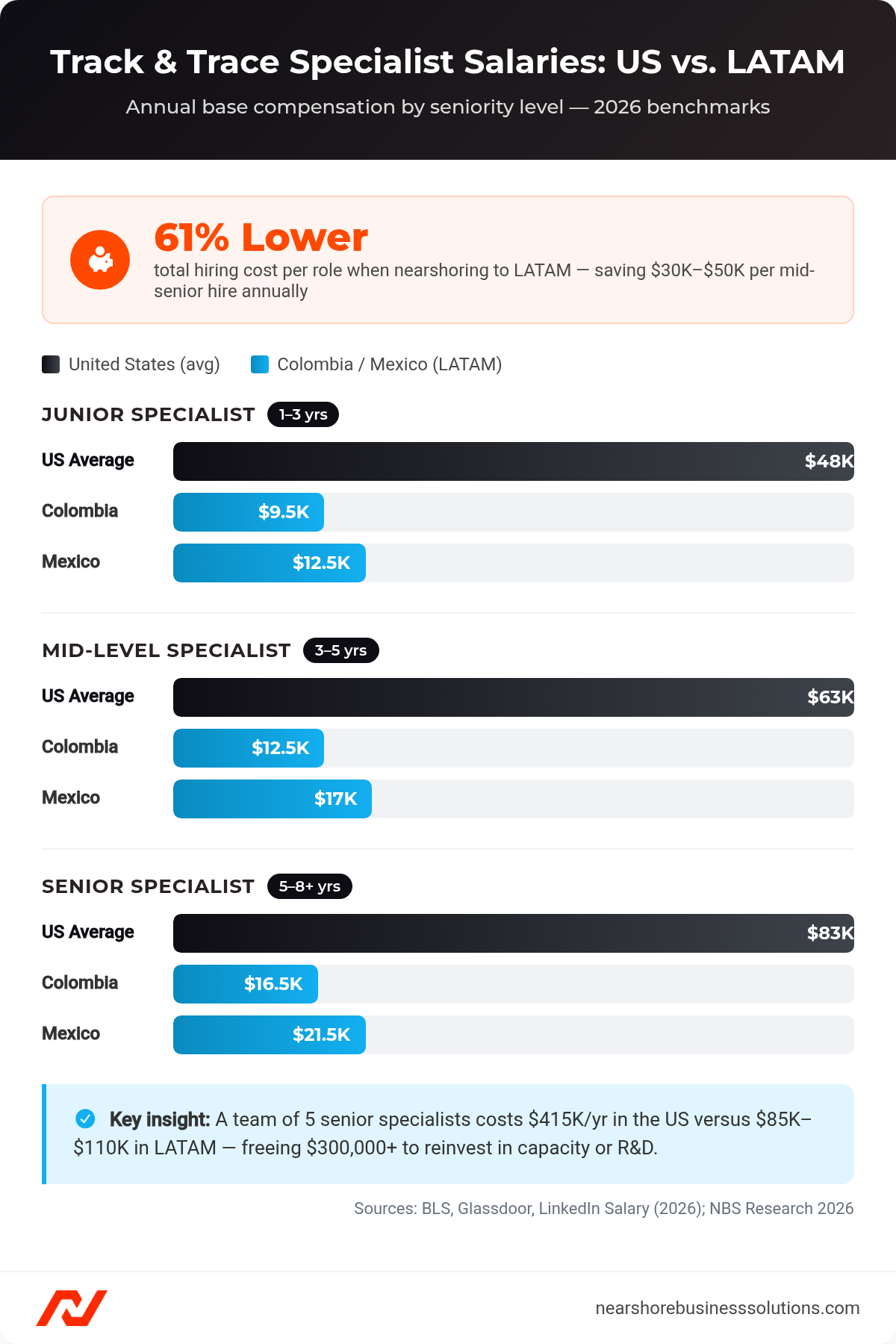
Track and trace specialist salaries across seniority levels — US domestic rates compared to Colombia and Mexico LATAM benchmarks for 2026.
| Role | US | Mexico | Colombia | Brazil | Argentina |
|---|---|---|---|---|---|
| Junior Specialist (1-3 yrs) | $45,713-$51,635 | $11,500-$14,000 | $8,800-$10,500 | $11,800-$13,500 | $12,500-$14,500 |
| Mid-Level (3-5 yrs) | $61,840-$64,137 | $15,500-$19,000 | $11,500-$14,000 | $14,500-$18,000 | $17,000-$20,000 |
| Senior Specialist (5-8+ yrs) | $79,285-$86,257 | $19,500-$24,000 | $14,500-$18,500 | $19,000-$23,500 | $21,000-$26,000 |
| Logistics Manager | $108,000 | $28,000-$35,000 | $22,000-$28,000 | $28,500-$36,000 | $25,000-$32,000 |
Digital infrastructure quality directly affects operational reliability. Here is how the primary LATAM hubs compare:
| Country | Digital Maturity (out of 5.0) | Active Cloud Regions | Key Infrastructure |
|---|---|---|---|
| Brazil | 3.8 | 9 (Sao Paulo, Rio de Janeiro) | Highest data center capacity, 9.33% warehouse vacancy |
| Mexico | 3.6 | 6 (Mexico City, Monterrey, Guadalajara) | Primary tech-logistics nexus with redundant fiber |
| Colombia | 3.3 | 2 (Bogota, Medellin, Cali) | Growing BPO and operations hub |
| Argentina | 3.2 | 1 (Buenos Aires, Cordoba) | 58% Internet Resilience Index, 67 data centers |
English proficiency varies by country but is strongest for writing and reading, the primary skills for platform management. Argentina scores highest (575 EF EPI). Brazil IT specialists score 551 despite a low national average (482). Tech clusters in Guadalajara’s Ciudad Creativa Digital, Mexico City, and Bogota exceed national averages in IT roles. Guadalajara’s Creative Digital City hosts Intel, IBM, Oracle, and HP, producing a concentration of English-proficient tech professionals.
Step 4: How Do You Verify Partner Compliance With CTPAT and TSA Requirements?
Verify CTPAT certification before engaging any nearshore partner. CTPAT-certified companies report 75% fewer security incidents and 60% faster processing at Los Angeles and Long Beach ports.
Key compliance checkpoints:
- CTPAT certification: 24-hour to 30-day security incident reporting by severity level
- TSA IAC Program: Facilities must meet 100% air cargo screening standards
- Chain of Custody: Tamper-evident seals and verified driver credentials required
Step 5: How Do You Identify Candidates With the Right Platform Experience?
Assess certifications in project44, FourKites, and Descartes MacroPoint based on your freight lanes. Talent with project44 and FourKites experience concentrates in Mexico and Brazil due to deep US-bound freight lane integration.
Target Gen Z candidates. Demand for young tech talent surged 97% globally, with higher rates in Chile and Mexico. Gen Z brings AI familiarity and a strong learning orientation, which maps directly to the decision intelligence requirements of 2026 track and trace operations.
Graduates from ITESM and UNAM in Mexico, and from Universidad de los Andes and EAFIT in Medellin, increasingly hold platform certifications alongside logistics credentials. Ruta N, Medellin’s government-backed technology district, has created a dense pool of specialists familiar with US client requirements.
Step 6: How Do You Achieve 95% Retention Through Compensation Design?
Use AI-led mobile solutions and engagement platforms. Rowleys Wholesale and DHL Supply Chain achieved 95% retention with these tools.
Offer dollar-pegged compensation. Dollar payments increased across the region in 2024: 7% in Argentina, 6% in Colombia and Mexico. This protects talent from local currency volatility and is especially critical in Argentina.
For specialist roles in Colombia and Mexico, the “prestigious US employer” effect drives quality applications. Working for a US tech company is a high-status position in Bogota, Medellin, Mexico City, Guadalajara, and Monterrey.
What Technology and Systems Should Your Shipment Tracking Team Use?
Three platform categories define the 2026 track and trace tech stack: supply chain visibility platforms, ERP/TMS integrations, and compliance infrastructure. Regional leaders average 3.72 out of 5.0 digital maturity scores, driven by AI-powered predictive analytics.
What ERP and TMS Integration Skills Do Specialists Need?
Specialists must integrate tracking platforms with core ERP and TMS systems. This integration skill is now mandatory, not optional.
Mexico’s 2026 Customs Reform mandates “Anexo 24” systems interoperable with Mexico’s official foreign trade platform. Specialists without ERP integration skills cannot support Mexico-routed freight without non-compliance risk.
API-first architectures enable real-time data integration across platforms and compliance systems. Specialists trained in Guadalajara and Monterrey’s tech clusters increasingly hold API integration certifications alongside logistics credentials.
Which Platforms Are Essential for 2026 Operations?
Three platforms dominate the US-bound freight monitoring landscape. Each serves different freight types and client profiles:
- project44 Movement: AI-driven disruption navigation for enterprise clients like Ford and Landstar; requires specialists who can manage API-first architectures
- FourKites: Strong in automotive and food/beverage; 20% increase in Mexico-US shipment volumes makes it a priority for Mexico-based teams
- Descartes MacroPoint: Ease of setup and carrier trust make it the standard for 80% of brokered loads
Specialists concentrating in Mexico City, Guadalajara, and Bogota have the deepest US-platform certification rates due to direct freight lane integration with US operations.
How Does Infrastructure Support Low-Latency Operations?
Latin America’s Firmina and TAM-1 submarine cable projects improved latency and resilience across the region. Video monitoring is mandatory in Mexico for real-time SAT access. Remote infrastructure supports continuous data ingestion in Mexico City, Monterrey, and Guadalajara.
Buenos Aires maintains a 58% Internet Resilience Index with 67 data centers. Sao Paulo hosts the region’s highest concentration of data center capacity.
How Do You Manage Nearshore Track and Trace Specialists Effectively?
Effective management of nearshore specialists requires clear KPI frameworks, compliant shift patterns, and structured time zone overlap policies. Teams managed with these three components deliver measurable operational improvements.
What KPIs Should You Track for Shipment Monitoring Teams?
Track gross margin gains (up to 30%), landed cost reduction (up to 25%), and OTIF improvement (26%) as primary specialist performance metrics. These KPIs directly measure the operational value of your monitoring team.
| Metric | Improvement | Source |
|---|---|---|
| Gross margin gains | Up to 30% | Bain and Company |
| Landed cost reduction | Up to 25% | Boston Consulting Group |
| On-Time In-Full (OTIF) | 26% improvement | project44 data |
| Safety stock reduction | 13% | SaaS inventory optimization |
| Delivery error reduction | Up to 40% | Forbes LATAM tech teams |
| Cost avoidance (disruptions) | $16 million | Baltimore Bridge collapse case |
Which Shift Patterns Work Best for 24/7 Monitoring?
Three rotating shift patterns provide 24/7 coverage while complying with LATAM regional labor laws:
- Panama Schedule (2-2-3): A 14-day cycle; standard for IT and data center monitoring. Works with 12-hour shifts.
- Dupont Shift Pattern: A 28-day cycle with four teams and a mandatory 7-day break. Best for larger teams.
- Continental Shift Pattern: Fast-forward rotating schedule with flat staffing structure.
AI-led mobile solutions adapt schedules in real-time based on demand spikes or absences, delivering 95% new-hire retention.
How Do You Use Time Zone Overlap to Eliminate Communication Delays?
Mexico provides nearly 1:1 overlap with US Central and Eastern time zones. Brazil and Argentina run two hours ahead of Eastern, enabling follow-the-sun coverage. You can reach your Guadalajara, Monterrey, Bogota, or Medellin team during normal US business hours for every operational decision.
What Does It Cost to Hire Track and Trace Specialists Through Nearshoring?
Nearshoring delivers 61% cost savings versus US domestic hiring, with US track and trace specialists averaging $64,137 annually in early 2026.
How Does the US-to-LATAM Cost Comparison Break Down?
US track and trace specialists average $64,137 annually in early 2026. Senior roles reach $86,257. High-demand hubs (San Francisco, Santa Clara) see top earners at $98,000 to $105,000. LATAM nearshoring represents approximately 61% savings versus domestic hiring. See the salary table in Step 3 for country-by-country breakdowns.
What Is the ROI of a Five-Person Nearshore Specialist Team?
A five-person LATAM team saves $300,000+ annually versus a US-based team of equivalent seniority. This frees capital to triple monitoring capacity, fund R&D, or expand to new freight lanes. Factor in turnover: US tech sector runs approximately 60% turnover, while nearshored LATAM roles show 2% resignations in late 2024. Each US resignation triggers full replacement costs that compound across a team.
What Challenges Arise When You Hire Track and Trace Specialists Nearshore?
Three main challenges require proactive management: data security compliance, quality maintenance, and communication alignment. Each is manageable with the right frameworks.
How Do You Maintain Quality and Retention Over Time?
US employee turnover settled at 17.3% in 2024. Nearshored LATAM roles show 2% resignation rates through USD-pegged pay, career development, and the prestigious employer effect.
Firms achieve 95% retention through AI-led mobile solutions. Young graduates in Guadalajara, Monterrey, Bogota, and Medellin stay because working for a US tech company carries significant career status. ProColombia and INNpulsa Colombia actively develop this professional talent base.
What Data Security and Compliance Requirements Apply?
Mexico’s 2026 Customs Law Reform (effective January 1, 2026) creates mandatory compliance requirements for all operations involving Mexico-routed freight. Non-compliance risks are severe.
| Requirement | Operational Mandate | Non-Compliance Consequence |
|---|---|---|
| Real-time Video Monitoring | Authorized facilities provide live feeds to SAT | Video used as legal evidence for tax verification |
| Automated Inventory Control | “Anexo 24” systems interoperable with Mexico’s foreign trade platform | Immediate tax credits cancellation and IMMEX program revocation |
| Remote SAT Access | IT infrastructure allows SAT continuous access to operational/financial data | Service blocking and bonded facility license revocation |
| Electronic Customs File | Must include invoices, transport docs, payment proofs, contracts | Fines up to MXN $106,970 for incomplete COVE data |
Additional security requirements apply to all nearshore operations:
- CTPAT compliance with 24-hour to 30-day security incident reporting by severity
- TSA IAC Program with 100% air cargo screening and Chain of Custody maintenance
- Digital platforms (Amazon, Mercado Libre): real-time transaction data sharing to SAT
Colombia’s data protection framework under Law 1581 of 2012 provides GDPR-comparable personal data protections for operations based in Bogota and Medellin.
How Significant Are Communication Barriers With LATAM Teams?
Communication barriers are minimal for platform-driven operations. Writing and reading skills significantly exceed speaking proficiency across LATAM hubs. Brazil IT specialists score 551 on the EF EPI, sufficient for US tech integration. Tech clusters in Guadalajara, Bogota, and Medellin exceed national averages. Cultural alignment with US business practices further reduces friction.
How Does Nearshore Outsourcing Compare to Other Staffing Models?
Nearshoring outperforms both in-house US hiring and offshore models on turnover, cost, and response time. The comparison is most stark on retention and time zone alignment.
How Does In-House US Hiring Compare?
In-house US teams face approximately 60% tech sector turnover versus 2% for nearshored LATAM roles. “Unrealistic workloads” and “poor communication” drive 75% of preventable voluntary resignations in US domestic markets.
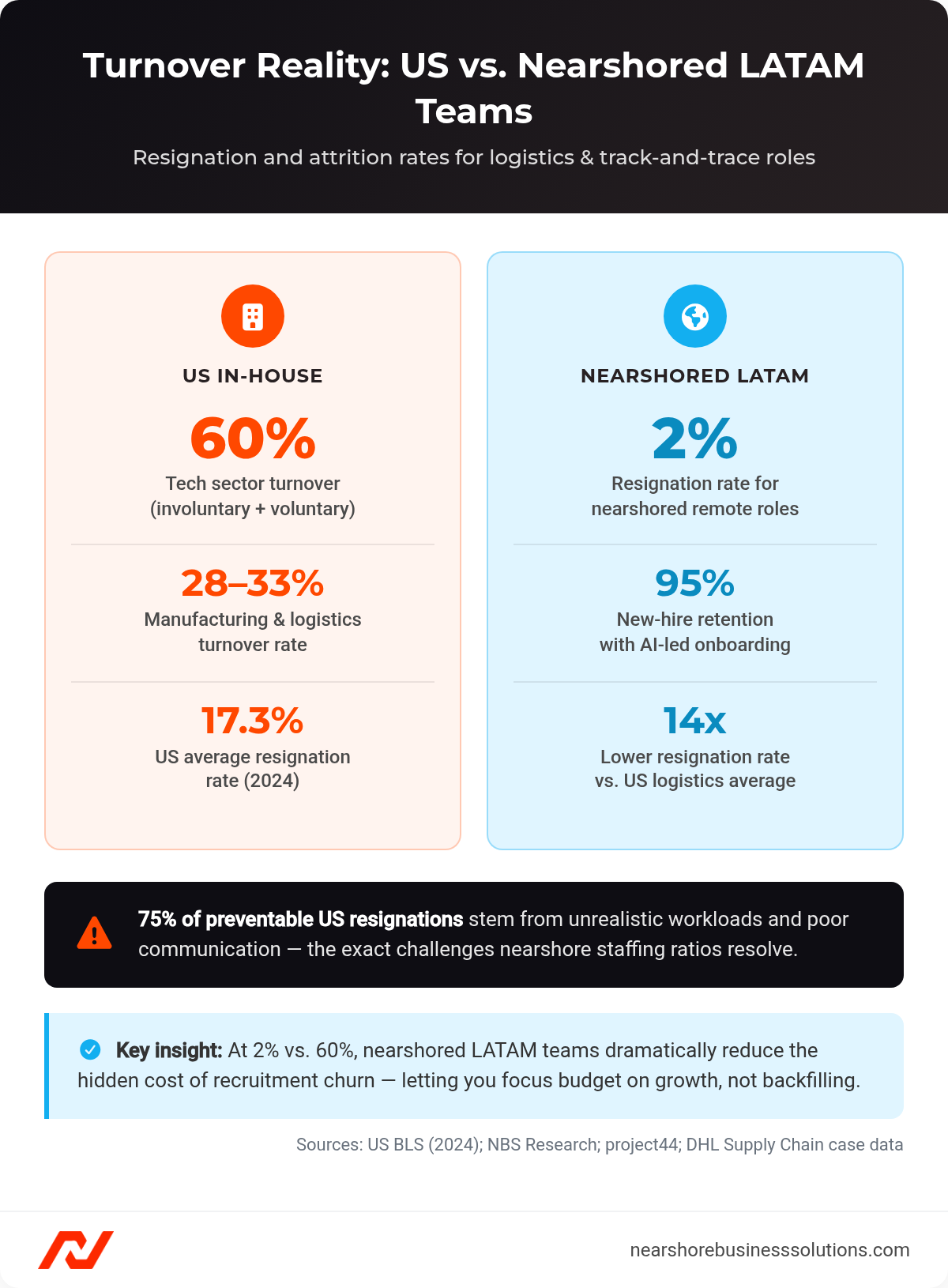
Turnover rates for US in-house logistics teams versus nearshored LATAM roles — resignation rates of 60% versus 2% highlight the stability advantage.
Manufacturing and Logistics teams face 28.6% to 32.9% turnover. Each departure triggers full replacement costs. Nearshore teams in Mexico and Colombia avoid this cycle through USD-pegged pay and the prestigious employer effect.
Learn more about building remote engineering teams across Latin America including detailed compliance guidance for Mexico’s 2026 Customs Reform requirements.
Why Does Nearshore Beat Offshore for Shipment Monitoring?
Nearshore provides nearly 1:1 time zone overlap versus offshore midnight meetings. Four-hour delays in offshore models cause missed air-freight windows or cold chain failures. That is direct revenue impact.
LATAM offers cultural proximity and alignment with US business practices. Offshore models in Asia cannot replicate this proximity. The result is faster decision cycles and fewer coordination errors.
Can Automation Replace Human Specialists?
No. The industry is shifting from mere visibility to decision intelligence. Human specialists manage AI-driven insights that automation cannot interpret alone. 74% of regional logistics data standardization by 2025 enables automation integration, but specialists remain essential to transform raw platform feeds into operational decisions.
What Are the Best Practices for Hiring Track and Trace Specialists Nearshore?
Three best practices drive successful nearshore specialist programs: retention-first compensation design, alignment with market growth, and proactive legal compliance.
How Do You Use Employer Status and USD Compensation for Retention?
Working for US-based tech companies carries high-status positioning in Colombia, Mexico, and Argentina. This drives quality applications and reduces attrition before it starts.
Implement USD-pegged compensation. Dollar payments increased 7% in Argentina and 6% in Colombia and Mexico during 2024. Target Gen Z talent: demand surged 97% globally, with higher rates in Chile and Mexico. Graduates from UNAM, ITESM, and Universidad de los Andes respond well to structured career development programs tied to platform certifications.
How Do You Scale Teams With LATAM Market Growth?
Scale hiring plans with LATAM logistics market projections. The region is growing faster than any comparable offshore destination.
| Market Segment | 2024/2025 | 2032/2034 | CAGR |
|---|---|---|---|
| LATAM E-commerce Logistics | $5.72B (2024) | $14.53B (2032) | 12.3% |
| LATAM Digital Transformation | $102.2B (2025) | $364.3B (2034) | 15.2% |
| Brazil Cloud Computing | $18.1B (2025) | $86.6B (2034) | 19.0% |
| LATAM Logistics (Total) | $366.1B (2025) | $580.1B (2034) | 5.25% |
Country-specific outlook for 2026 to 2027:
- Brazil: Regional tech leader focusing on AI and predictive analytics for cold chain and retail
- Mexico: “Interoperable Traceability” hub for 2026 Customs Reform compliance; high-tech customs brokers and e-commerce fulfillment
- Colombia: Highest growth rate in transportation spending through 2027; foodtech and transportation startup ecosystem anchored by Ruta N and INNpulsa Colombia
- Argentina: Industrial resurgence and qualified labor pool for high-margin tech monitoring projects despite inflation
How Do You Ensure Full Legal Compliance With 2026 Requirements?
Mexico 2026 Customs Reform is a board-level risk issue. Non-compliance leads to IMMEX program revocation and fines up to MXN $106,970.
Mandatory requirements:
- Real-time video monitoring with recordings available to SAT as legal evidence
- Electronic Customs File including invoices, transport docs, payment proofs, and contracts
- CTPAT certification (reduces security incidents 75% and processing time 60%)
- TSA IAC Program with 100% air cargo screening and Chain of Custody protocols
Frequently Asked Questions About Hiring Track and Trace Specialists Nearshore
These are the most common questions US tech leaders ask about nearshoring shipment monitoring operations.
How Long Does It Take to Hire a Track and Trace Specialist?
It takes 2 to 4 weeks to receive pre-vetted candidates through a nearshore partner. Full onboarding adds another 2 to 4 weeks. Total time to productivity is 4 to 8 weeks, versus 45 to 90 days for a US-based hire.
What Happens If a Specialist Does Not Work Out?
Most nearshore partners offer a 90-day replacement guarantee. If a specialist does not meet performance standards within 90 days, the partner sources a replacement at no additional cost. Confirm this in writing before signing.
How Do I Pay Nearshore Track and Trace Specialists?
You pay through the nearshore partner or EOR provider in USD. The partner handles local payroll, social security, and tax compliance in Mexico, Colombia, Brazil, or Argentina. Dollar-pegged compensation protects specialists from local currency volatility.
What Is the Difference Between Nearshore and Offshore for Logistics Roles?
Nearshore means LATAM countries with 0 to 3 hour time zone difference from US operations. Offshore means Asia-Pacific with 10 to 14 hour differences. That gap causes missed air-freight cutoffs and cold chain failures. Nearshore enables real-time collaboration. Offshore does not.
Do I Need a Local Legal Entity to Hire in Mexico or Colombia?
No. You hire through a nearshore partner or Employer of Record (EOR). The EOR acts as the legal employer in Mexico, Colombia, Brazil, or Argentina. You direct the work. The EOR handles contracts, payroll, and compliance.
How Does Mexico’s 2026 Customs Reform Affect My Nearshore Operations?
Mexico’s 2026 Customs Law Reform (effective January 1, 2026) requires real-time video monitoring, Anexo 24 inventory systems, remote SAT access, and complete electronic customs files. Non-compliance triggers IMMEX revocation and fines up to MXN $106,970 per violation.
Ready to Build Your Nearshore Track and Trace Team?
Nearshore Business Solutions sources and vets specialists from tech hubs in Guadalajara, Monterrey, Mexico City, Bogota, and Medellin. We screen for platform certifications (project44, FourKites, Descartes MacroPoint), English fluency, and US work style fit. Our acceptance rate is 16%.
Every placement includes a 90-day replacement guarantee. You receive pre-vetted candidates in 2 to 4 weeks.
Get a free consultation to discuss your hiring needs and receive a custom quote.