
Remote work policy examples worth copying share three traits: async-first communication, output-based performance, and multi-country compliance language. By 2024, 29% of tech companies operated fully remote (Scoop’s Flex Index) and 65% had adopted a formal remote work policy (SHRM). This guide breaks down real policies from GitLab, Zapier, and Automattic, then gives you a template framework built for US-LATAM engineering teams. If you are also working through the operational side of managing a remote team, the policy framework here is the structural foundation that makes day-to-day management possible.
Why Most Work From Home Policies Fail Distributed Teams, and What to Replace Them With
Most remote work policies are useless for distributed teams. They were written between 2020 and 2022 as emergency accommodations: documents designed to let a San Francisco employee work from their kitchen table on Fridays, not to govern a 40-person engineering team spanning four countries and six time zones.
Three structural failures make legacy policies dangerous when applied to distributed or nearshore teams.
1. They assume same-timezone synchronous work. Every clause (core hours, meeting expectations, manager check-ins) presumes everyone operates on Pacific or Eastern time. Apply this to engineers in Bogotá, Buenos Aires, and Guadalajara and you get 7 AM standups, always-on Slack anxiety, and burnout that drives your best hires to competitors within 12 months.
2. They lack compliance language for multi-country hiring. Misclassification risk ranks as the top HR concern for international distributed teams, according to Gartner and Mercer research. Generic policies contain zero language on contractor-vs-employee classification, tax nexus boundaries, or jurisdiction-specific statutory benefits like Mexico’s aguinaldo or Brazil’s CLT requirements.
3. They treat remote as an exception rather than a default operating mode. Gartner’s 2023 research confirmed that RTO mandates had minimal impact on engagement or performance but significantly increased attrition risk. By 2025, Gartner projected employee retention would rank as a top-3 driver for companies formalizing flexible work policies. Policies that frame remote as an exception accelerate the exact turnover they claim to prevent.
The fix requires a philosophical upgrade. ROWE, the Results-Only Work Environment, gives employees complete control over when and where they work, with no schedules, no mandatory office time, and no judgment about how someone spends their day. Pure ROWE adoption remains niche, but its core principles underpin nearly every successful remote-first policy today. Async-first communication, best articulated by GitLab, operates on a simple default: “You are not expected to be online at all times. Communication is asynchronous by default.” Neither framework is a downloadable template. Both are operating philosophies that reshape what a policy needs to contain.
Critical Elements Missing From Generic Remote Work Policy Templates
A free remote work policy template from an HR library covers the basics: equipment expectations, data security reminders, a vague paragraph about “maintaining productivity.” Templates built for single-country, single-timezone teams actively create risk when applied to distributed engineering organizations. Seven critical gaps demand attention:
- Geofencing / Approved Work Locations. An engineer spending 60 days in an uncovered country can trigger corporate tax nexus or permanent establishment risk.
- Contractor vs. Employee Classification. The top HR concern for international distributed teams (Gartner, Mercer); omission means back-tax liability and forced reclassification.
- Multi-Country Expense Reimbursement. A flat $200/month stipend is generous in Medellín, inadequate in São Paulo; tax treatment differs by jurisdiction.
- Jurisdiction-Specific Statutory Benefits. Mexico’s aguinaldo, Brazil’s 13th-month salary, and Colombia’s prima de servicios are absent from US-centric templates.
- Async-First Communication Protocols. Without explicit async norms, LATAM engineers lose 2 to 3 hours of daily deep work to synchronous obligations designed around US HQ schedules.
- Core Hours / Time-Zone Overlap. Without explicit overlap policy, teams either mandate excessive synchronous availability (burnout) or operate with insufficient coordination.
- Right-to-Disconnect Compliance. Already law in Colombia (Law 2191, 2022), France, and Ontario; US-centric templates omit this entirely.
What Do the Best Remote Work Policy Examples Actually Include? A Section-by-Section Breakdown
The best remote work policy examples converge on 12 structural components, drawn from the public handbooks of GitLab (2,000+ employees, 65+ countries), Zapier (800+ employees, distributed since 2012), and Automattic (1,900+ employees, 95+ countries). Their approaches differ (GitLab codifies exhaustively, Zapier optimizes for autonomy, Automattic trusts cultural self-selection) but the skeleton is the same: eligibility and scope, work location and geofencing, work hours and availability, equipment and technology, expense reimbursement, data security, communication protocols, performance management, travel and meetups, dependent care, workers’ compensation, and termination procedures.
Eligibility, Equipment, and Expense Reimbursement Clauses That Protect Both Sides
Eligibility, equipment, and expense clauses define what the company owes a remote engineer on day one, and the gap between US and LATAM norms is wide enough to become a competitive advantage.
Eligibility: GitLab makes remote work the default for every role. Zapier defines eligibility at the role level. The clause your policy needs: “All roles designated as ‘distributed-eligible’ carry full remote work authorization from day one. No probationary period, no manager approval required.”
Equipment: For SOC 2 or ISO 27001 certified companies, company-issued and managed devices are non-negotiable. International shipping adds complexity: deploying a laptop to São Paulo adds import duty (which can reach roughly 60% of declared value for electronics in Brazil) and can extend delivery to 15 to 20 business days.
Expense Reimbursement: A one-time home-office stipend of $500 to $1,000 is the US industry standard, per published nearshore and global-hiring benchmark data, while a recurring $50 to $100 per month covers internet and electricity.
| Benefit Category | Zapier | US Industry Standard | LATAM Competitive Differentiator |
|---|---|---|---|
| Home Office Setup | $2,000 one-time | $500–$1,000 one-time | Purchasing power amplifies perceived value 2–3× in LATAM metros |
| Internet Stipend | Included in benefits | $50–$100/month | Critical: reliable high-speed internet often requires a premium plan ($40–$80/month locally) |
| Co-Working Access | Reimbursement available | Not standard | Top-3 most requested perk; $150–$300/month in LATAM metros |
| Health Insurance | Company-provided | Company-provided | Private health covering employee plus dependents is the single most valued benefit for LATAM engineers |
For teams hiring across borders, an employer of record in Latin America administers these stipends and statutory benefits in full compliance with each country’s labor code.
Performance Measurement and Accountability Without Micromanagement
Output-based performance is the defining clause of every credible remote policy, and the data backs it up: Best Buy’s ROWE experiment (2007–2013) saw productivity increase by 35% and voluntary turnover decrease by 52 to 90% in participating departments. The program was discontinued under new leadership, not because the data reversed, but because priorities shifted. The performance data was never refuted.
GitLab, Zapier, and Automattic each built performance frameworks on the same principle: measure output, not activity. The policy language converges on three commitments.
1. Exclude hours worked as a performance metric. “Performance is evaluated based on outcomes and deliverables. Hours logged, time online, and activity metrics are not factors in performance assessment.”
2. Use OKRs as the accountability mechanism. “All employees set quarterly objectives with measurable key results. Progress is reviewed via mid-quarter async written updates and end-of-quarter evaluations.”
3. Prohibit surveillance software by policy. Research in the Journal of Business and Psychology (2023) found invasive monitoring reduces intrinsic motivation and increases counterproductive work behaviors. “The Company does not use screen monitoring, keystroke logging, or activity-tracking software. Trust is a precondition of employment, not something earned through surveillance.”
For companies building talent management frameworks across US and LATAM teams, these three commitments form the minimum viable performance policy.
Communication Norms, Tool Standards, and Documentation Requirements
Documented communication norms recover real engineering hours: knowledge workers lose an average of 5.3 hours per week to unnecessary meetings, and async-first teams report holding 45% fewer meetings (Qatalog and Cornell University’s Future of Work Institute, 2023). For a 20-person engineering team, that difference translates to roughly 1,060 recovered engineering hours per quarter.
Companies that codify communication protocols for distributed teams recover those hours. GitLab’s framework rests on three principles: “Handbook First” means every process must be documented before it takes effect; “Low-Context Communication” means write explicitly and avoid idioms and undefined acronyms; and “No Surprise Meetings” means every meeting requires a written agenda shared 24 hours in advance. Zapier operationalizes a complementary rule: “Before calling a meeting, ask yourself: ‘Could this be resolved in a written thread?'”
Your policy should codify five rules: assign every tool a single purpose, establish default response windows (24 hours non-urgent, 2 hours for #urgent), record and summarize every synchronous meeting, default to public channels over DMs, and write documentation for the person who joins six months from now.
Data Security, VPN Requirements, and Acceptable Use for Remote Teams Across Borders
Data security for cross-border teams reduces to eight non-negotiable clauses, anchored by company-managed devices and mandatory VPN access.
- Company-managed devices only. MDM (Jamf, Kandji) enables remote wipe, enforced encryption, and patch compliance.
- Mandatory VPN. Select providers with LATAM points of presence to minimize latency.
- Public Wi-Fi prohibition for sensitive work. Pairs with the internet stipend policy.
- Full-disk encryption and automatic screen lock after 3 minutes of inactivity.
- Multi-factor authentication on all systems. Hardware security keys preferred; SMS-based MFA prohibited for production access.
- IP protection and confidentiality agreements. Jurisdiction-specific IP assignment language reviewed by local counsel, noting Brazil’s moral rights provisions.
- Choice-of-law specification. Security obligations governed by US state law; local labor law governs employment separately.
- Acceptable use with monitoring disclosure. Network-level metadata logging for security; no screen capture, keystroke logging, or content monitoring.
Brazil’s LGPD imposes restrictions on transferring personal data outside Brazil that parallel GDPR requirements. Colombia’s Law 1581 imposes similar requirements. Your data protection officer should review any cross-border data flows involving LATAM-based team members. Pair that review with our remote work security best practices to protect data across a distributed team.
How Do You Build a Remote Work Policy Template for Teams Spanning the U.S. and LATAM?
You build a US-LATAM policy on top of a mature, nearby talent pool: Latin America has an estimated 1.2 to 1.5 million software engineers as of 2024 (synthesized from Statista, IADB, and Evans Data Corporation estimates), growing 8 to 12% annually. Coursera’s 2023 Global Skills Report ranked Brazil and Argentina in its top “Cutting-Edge” technology-skills tier, outperforming the US and UK on several dimensions. This is not an emerging talent pool. It is a mature engineering workforce sitting one to three time zones from every US tech hub, and you can hire software developers in Latin America without opening a local entity.
Time-Zone Overlap as a Policy Advantage: Structuring Core Hours for Nearshore Teams
Time-zone proximity lets US-LATAM teams run a lighter core-hours requirement than US-APAC setups: every major LATAM tech hub shares at least 7 hours of daily overlap with US Eastern Time. Bogotá and Lima share a full 9-hour overlap, while São Paulo and Buenos Aires maintain 7 hours. The most effective sync window is typically 10:00 AM to 2:00 PM ET.
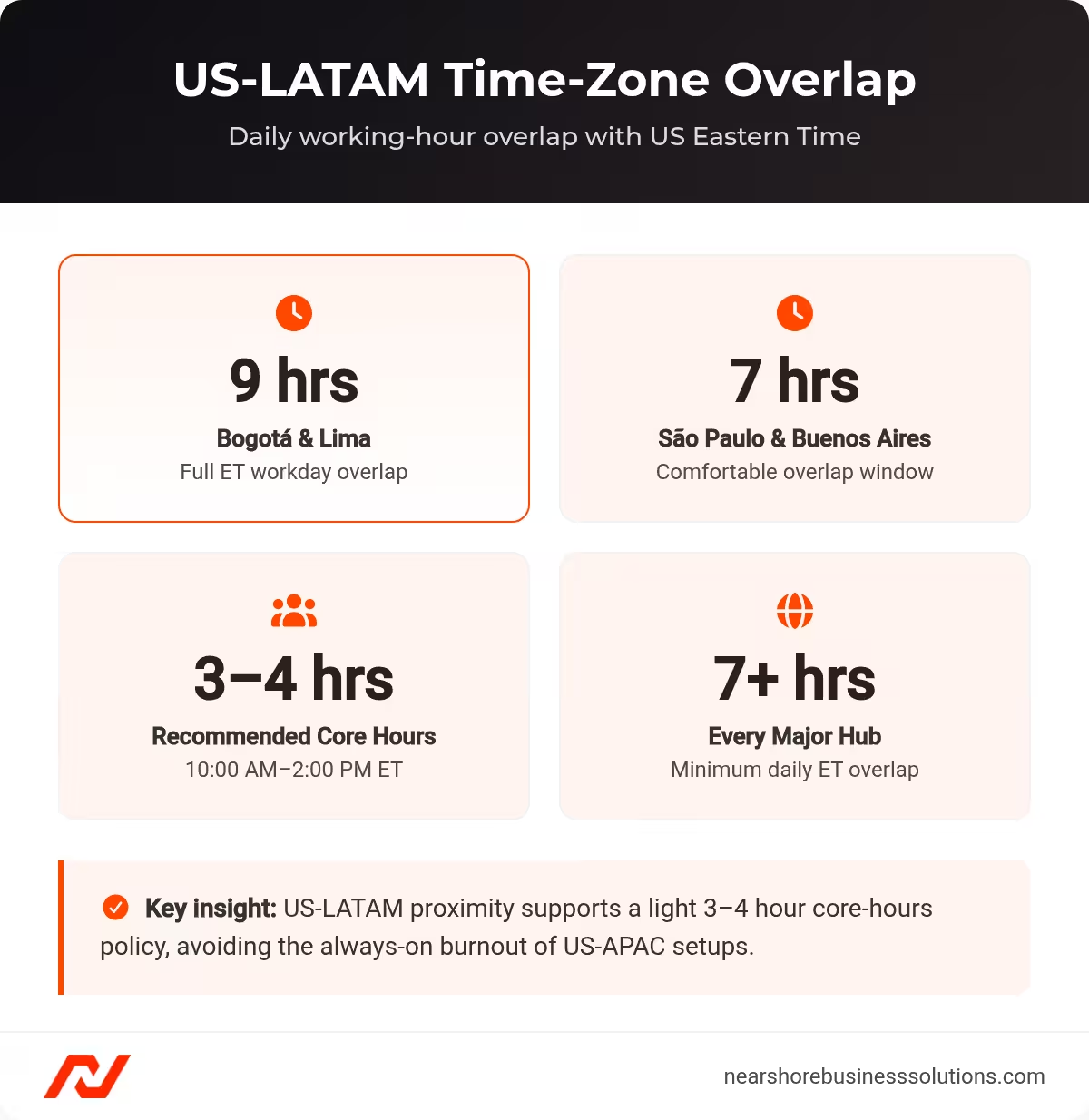
Daily working-hour overlap between US Eastern Time and major LATAM tech hubs.
| Model | Description | Best-Fit Team Type |
|---|---|---|
| Fully Async | No mandated overlap; 24-hour response window | Mature teams with strong documentation culture |
| Core Hours (3–4 hr overlap) | Designated daily sync window (e.g., 10am–2pm ET) | US + LATAM nearshore teams needing regular standups |
| Fixed Schedule | Traditional 9–5 in a single time zone | Single-timezone teams only |
Doist uses a “sync for strategy, async for execution” model. Toggl defines “collaboration hours” at the team level with no company-wide mandate. For US-LATAM teams, the 3 to 4 hour core-hours model provides the optimal balance.
Navigating Labor Law Compliance Across LATAM Jurisdictions
Labor-law compliance across LATAM requires jurisdiction-specific addenda, and your first decision is the employment structure: contractor, employer of record, or foreign subsidiary.
| Structure | Risk Level | Best Use Case |
|---|---|---|
| Independent Contractor | High: significant misclassification risk | Short-term project engagements only |
| Employer of Record (EOR), Recommended | Low: EOR manages local compliance | Teams under 20 in a single country |
| Foreign Subsidiary | Medium: significant upfront investment | 20+ employees in one country |
Key statutory requirements by country (salary data synthesized from a 2024 global engineer compensation report, developer-marketplace data, and GetonBoard):
| Country | Senior Engineer Salary (USD) | Key Statutory Requirements |
|---|---|---|
| Mexico | $55,000–$85,000 | Aguinaldo (13th-month salary); PTU (mandatory profit-sharing); IMSS |
| Colombia | $45,000–$75,000 | Right-to-disconnect (Law 2191); prima de servicios; 18 mandatory holidays |
| Brazil | $60,000–$95,000 | CLT labor code; 13th salary; FGTS severance fund; mandatory vacation bonus |
| Argentina | $40,000–$70,000 | Aguinaldo; currency controls complicate USD payments |
For comparison, US senior engineers command $150,000 to $220,000+. An EOR is the fastest compliant path for teams under 20 in a single country, since it manages aguinaldo, social security, and severance under local law on your behalf.
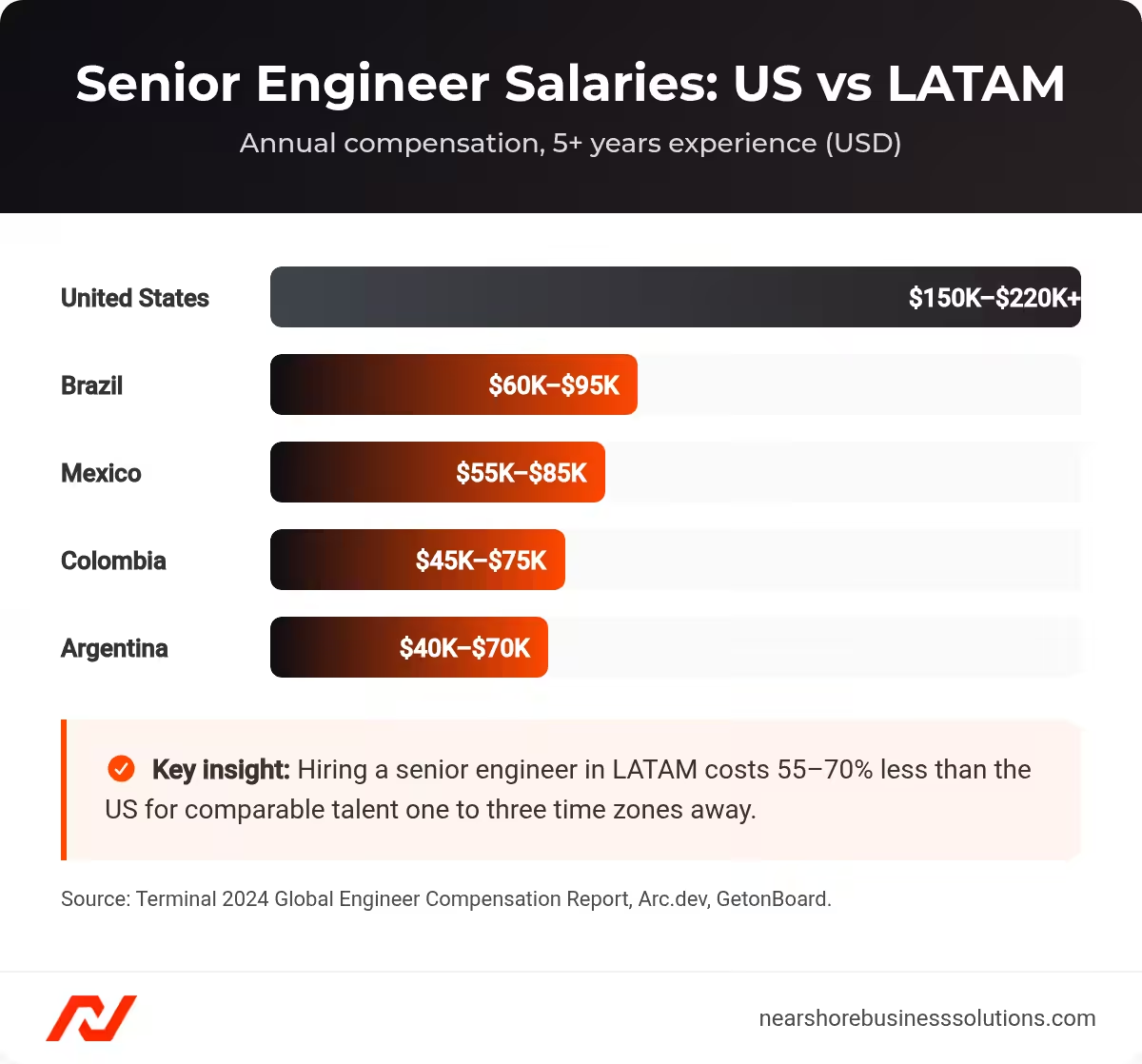
Senior engineer annual salaries: US versus four major LATAM markets.
Building Cultural Fluency Into Your Distributed Team Policy
Cultural fluency belongs in policy, not just onboarding, starting with a clear English proficiency standard: CEFR Level B2 (Upper-Intermediate) as the minimum for engineering hires, with C1 (Advanced) ideal for senior roles. EF’s 2023 English Proficiency Index rates Argentina as “High Proficiency” and Brazil, Colombia, and Mexico as “Low Proficiency,” but proficiency among university-educated software engineers runs well above national averages. Assess it via rigorous interviews, not country-level data.
Two concrete policy clauses make a measurable difference: sponsor English language classes ($100 to $200/month) as a retention multiplier, and mandate low-context written communication norms that eliminate the comprehension tax non-native speakers pay in every high-context interaction.
A Fill-in-the-Blank Remote Work Policy Template You Can Adapt
The structural components above tell you what a strong policy contains. This section assembles them into a copy-and-adapt skeleton. Drop your own values into the bracketed fields, delete the clauses that do not apply, and hand the draft to local counsel before you sign anyone. Treat it as a starting point, not a finished document: the value of a template is that it forces you to make a decision on every line rather than leave it implicit.
- 1. Scope and eligibility. “This policy applies to [roles / departments] designated as distributed-eligible. Remote authorization begins on [day one / after a defined period], requires [no approval / manager sign-off], and may be revised as business needs evolve.”
- 2. Approved work locations. “Employees may work from [list of approved countries / regions]. Working from an unlisted location for more than [number] days per year requires written approval to avoid tax-nexus and permanent-establishment exposure.”
- 3. Work hours and core overlap. “Core collaboration hours are [e.g. 10:00 AM–2:00 PM ET]. Outside that window, schedules are flexible. Default response times: [24 hours] for non-urgent messages and [2 hours] for items flagged urgent.”
- 4. Communication protocols. “Each tool has one job: [chat] for quick questions, [email / written threads] for decisions and detailed updates, for scheduled collaboration. Meetings require a written agenda shared in advance and are recorded and summarized.”
- 5. Performance and accountability. “Performance is measured by [OKRs / deliverables], reviewed through [async written updates] each cycle. Hours logged and online status are not performance factors, and the company does not use screen-monitoring or keystroke-logging software.”
- 6. Equipment and technology. “The company provides [company-managed laptop and peripherals] enrolled in [MDM tool]. Devices are for business use, must run [encryption / VPN], and are returned within [number] days of separation.”
- 7. Expense reimbursement. “A one-time home-office setup stipend of [amount] and a recurring [amount]/month covers internet and electricity. Co-working access is [reimbursed up to amount / not offered]. Stipends are administered in compliance with each employee’s local tax rules.”
- 8. Data security and acceptable use. “Mandatory: [VPN], multi-factor authentication, full-disk encryption, automatic screen lock, and no sensitive work on public Wi-Fi. Confidentiality and IP-assignment terms are governed by [jurisdiction] and reviewed by local counsel.”
- 9. Statutory benefits and compliance addenda. “Employment is structured through [contractor / employer of record / subsidiary]. Per-country addenda cover [statutory 13th-month pay, severance funds, mandatory holidays, right-to-disconnect law] where applicable.”
- 10. Travel, meetups, dependent care, and termination. “The company funds [number] in-person gatherings per year. Dependent-care expectations, workers’-compensation coverage, and the offboarding and equipment-return process are defined in [linked schedules].”
One caveat worth repeating: a template is a skeleton, not a substitute for jurisdiction-specific review. The brackets in clauses 9 and 10 are where US-centric documents quietly create liability, so resolve them with counsel in each country before the policy takes effect. Schedule a formal review of the whole document at least once a year, and sooner whenever you enter a new market, adopt a new collaboration tool, or receive new legal guidance.
Frequently Asked Questions About Remote Work Policies for Distributed Teams
What should a remote work policy include for a distributed team?
A distributed-team policy needs 12 core sections: eligibility, work location and geofencing, work hours and core overlap, equipment, expense reimbursement, data security, communication protocols, performance management, travel and meetups, dependent care, workers’ compensation, and termination. For multi-country teams, add jurisdiction-specific addenda for statutory benefits and right-to-disconnect law.
Is a remote work policy template enough for a US-LATAM team?
No. Generic templates assume single-country, single-timezone work and omit geofencing, contractor classification, multi-country reimbursement, and statutory benefits like Mexico’s aguinaldo or Colombia’s prima de servicios. Use a template as a starting skeleton, then layer in async core-hours rules and per-country compliance addenda.
How do you set core hours across US and LATAM time zones?
Every major LATAM hub shares at least 7 hours of overlap with US Eastern Time, so a 3 to 4 hour core-hours window (commonly 10:00 AM to 2:00 PM ET) covers standups and real-time collaboration while leaving most of the day async.
How should remote performance be measured without surveillance?
Measure output, not hours. Replace time-tracking with OKRs and async written updates, and prohibit screen-monitoring and keystroke-logging software by policy. Best Buy’s ROWE departments saw productivity rise 35% and turnover fall 52 to 90% using this approach.
What is the most compliant way to employ LATAM engineers?
An employer of record (EOR) is the lowest-risk option for teams under 20 in a single country. The EOR employs the engineer locally and manages aguinaldo, social security, severance, and tax withholding, eliminating misclassification risk without requiring a foreign subsidiary.
Ready to Build Your US-LATAM Distributed Team?
Nearshore Business Solutions sources and vets senior engineers across Mexico, Colombia, Brazil, and Argentina, then handles compliant employment through an employer of record so your remote work policy holds up in every jurisdiction. You get pre-vetted candidates who match US work style, time-zone overlap, and English fluency.
Book a consultation to structure a compliant US-LATAM remote work policy and get first pre-vetted candidates within 3 business days.