
LATAM developers deliver 30-50% savings versus US fully loaded costs (a 2024 global hiring report). India’s base rates are 21-30% lower, but India’s 20-28% annual attrition rate adds $40,000-$80,000 per unplanned departure, per NASSCOM 2024. The total cost picture often flips when you factor in attrition, time zone penalties, and IP risk.
LATAM engineers in Mexico City, Buenos Aires, Bogota, and Sao Paulo cost $44,000-$70,000 per year at mid-senior level versus $35,000-$58,000 in Bangalore. That 21-30% base gap shrinks to single digits once management overhead, rework, and attrition replacement load in. For product engineering teams that need daily sync with US architects, the math often favors LATAM.
Below you will find a role-by-role salary comparison, a time zone overlap analysis, an attrition cost model, and an IP risk breakdown. Use this data to choose between LATAM and India for your next engineering hire.
Why Are CTOs Abandoning the Default India Outsourcing Model in 2026?
India’s cost advantage is eroding. Annual salary increases of 12-15% in Bangalore, Hyderabad, and Pune since 2022 have compounded into a structural repricing of Indian senior engineering talent. Most CTO budget models anchor on rate cards from 2021 or 2022, underestimating actual India costs by 20-35%, per Aon’s India Salary Increase Survey 2023.
How Has India’s Salary Inflation Changed the Cost Equation?
India’s mid-senior developer salaries have risen 12-15% annually since 2022 in Bangalore and Hyderabad, per Aon’s India Salary Increase Survey 2023. At current trajectories, the base salary gap between India and LATAM for senior product engineers narrows to single digits by 2028. For a current breakdown of LATAM compensation by role and seniority, see our guide to hiring software developers in Latin America.
India still fields the world’s largest developer pool: 5.8 to 6.2 million engineers. LATAM has 1.2 to 1.5 million. Brazil alone accounts for 500,000 to 600,000 developers, according to Coursera’s 2024 Global Skills Report. Mexico adds 225,000 to 275,000. Argentina contributes 135,000 to 150,000. Colombia adds 100,000 to 120,000.
Pool size matters less than accessible, retainable, senior talent in your specific stacks. LATAM’s tech sector grows at 10-15% per year. India’s grows at 12-18%. The gap is narrower than most CTOs assume.
How Does LATAM Talent Quality Compare to India?
HackerRank’s 2023 rankings place Argentina (#39), Brazil (#40), and Mexico (#43) within single digits of India (#36) in algorithmic competency. Developer-level English fluency is higher than national averages suggest. A 2022 State of Nearshore Report found 82% of US engineering managers rated their LATAM teams as “highly integrated” with domestic teams. Only 55% said the same for offshore Asia teams. Communication ease and cultural similarity were the top two reasons cited. Those integration and communication wins rank among the broader advantages of hiring Latin American remote workers for lean teams.
Three forces drove LATAM’s developer pool to double since 2020. First: government-backed digital skills programs, including Colombia’s MinTIC initiatives and Argentina’s Plan 111 Mil. Second: university CS program expansion across Brazil and Mexico. Third: the remote-work migration post-2020 that kept senior engineers in-region earning US-competitive salaries.
How Do LATAM vs India Developer Costs Compare on a Fully Loaded Basis?
Rate cards lie. The sticker price favors India by 21-30% at the base-salary level for mid-senior product engineers. That gap shrinks to single digits once mandatory benefits, management overhead, rework cycles, and attrition replacement costs load in.
What Are the Base Salary Benchmarks for Key Engineering Roles?
Mid-senior developers (5-8 years of experience) in Bangalore and Hyderabad earn $35,000-$58,000 per year. LATAM engineers across Mexico City, Buenos Aires, Sao Paulo, and Bogota earn $44,000-$70,000 per year. The table below reflects annual base compensation.
| Role | India (Bangalore/Hyderabad) | LATAM (Blended) | LATAM Premium |
|---|---|---|---|
| React Developer (Mid-Senior) | $38,000-$52,000/yr | $48,000-$65,000/yr | +26-30% |
| Python/Django Developer | $36,000-$50,000/yr | $45,000-$62,000/yr | +25-28% |
| Node.js Developer | $35,000-$48,000/yr | $44,000-$60,000/yr | +25-29% |
| iOS/Swift Developer | $40,000-$55,000/yr | $50,000-$68,000/yr | +24-27% |
| DevOps Engineer | $42,000-$58,000/yr | $52,000-$70,000/yr | +21-25% |
Sources: published 2024 global hiring and developer-marketplace salary data; Glassdoor; Payscale. Ranges adjusted for 2025-2026 salary inflation.
Both LATAM and India deliver 30-60% savings versus the US. A comparable React engineer in the US commands $150,000-$220,000 base, with fully loaded costs reaching $195,000-$290,000.
What Are the Hidden Costs That Erase India’s Sticker-Price Advantage?
India’s mandatory employer contributions add 15-25% on top of base salary. LATAM’s employer burden runs heavier at 30-55%, with Brazil at the upper end. But the hidden line items cut against India. Model a five-person mid-senior product squad engaged for 18 months:
| Cost Category | India ($40K avg base) | LATAM ($55K avg base) |
|---|---|---|
| Base salary (18 months) | $300,000 | $412,500 |
| Loaded cost markup | $60,000 | $165,000 |
| Management overhead (async coordination) | $45,000-$54,000 | $0-$12,375 |
| Travel (annual, 3-person visit) | $12,000+ | $4,500 |
| Rework/QA cycle costs | $24,000-$60,000 | $4,800-$12,000 |
| Attrition replacement cost | $40,000-$80,000 | $0-$27,500 |
| 18-Month Total TCO | $481,000-$566,000 | $486,800-$633,875 |
India’s $112,500 base-salary advantage gets offset by $93,000-$181,500 in hidden costs. The variable that swings the model most: attrition. One departure on a five-person India team triggers $40,000-$80,000 in replacement costs, per SHRM and Josh Bersin benchmarks of 1.5-2.0x annual salary. Two departures push India’s total cost of ownership above LATAM’s in every scenario.
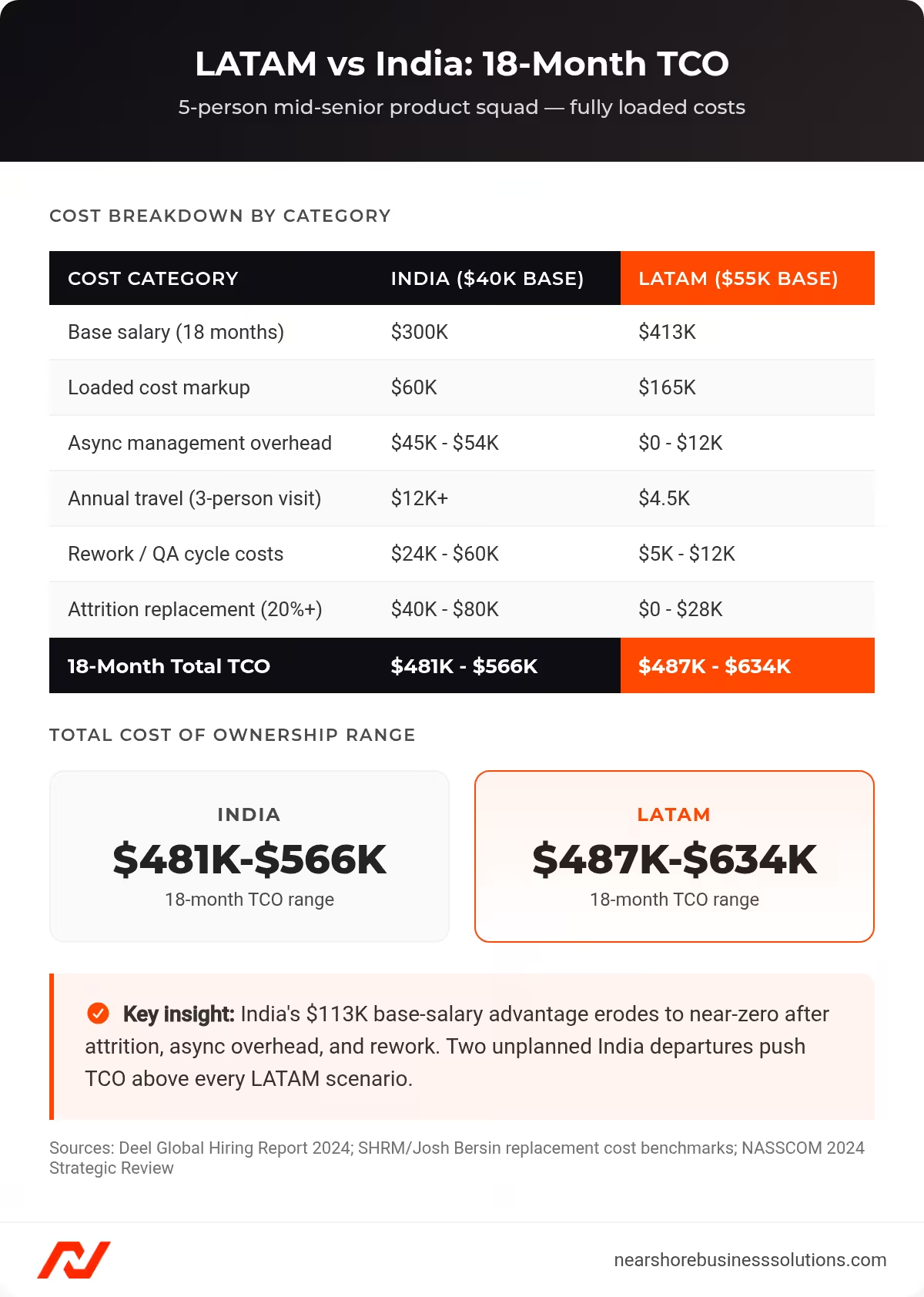
18-month TCO comparison for a 5-person squad — India’s base-salary advantage erodes after attrition and async overhead.
When Does India Still Deliver Better Unit Economics?
India remains superior for large-scale manual QA teams, L2/L3 production support in follow-the-sun rotations, and legacy Java/Spring Boot maintenance. India’s 2.6 million annual STEM graduates, per the National Science Foundation 2024 data, create a deeper bench for certified AWS/GCP/Azure professionals. The distinction is commodity execution versus product engineering. For product engineering that requires daily collaboration, the calculus shifts toward LATAM.
What Does Time Zone Overlap Actually Cost Your Sprint Velocity?
Zero overlapping business hours between Bangalore and a US Pacific team is not a scheduling inconvenience. It is a categorical shift in engineering practice. A 2018 study in the Journal of Software: Evolution and Process found that temporal distance degrades coordination effectiveness in direct proportion to the hours separating teams.
How Many Synchronous Hours Does Each Region Provide?
A US Pacific engineering lead shares zero overlapping business hours with Bangalore. The same lead gets seven hours with Mexico City. Mexico City, Bogota, Buenos Aires, and Sao Paulo all deliver four to nine hours of overlap depending on your US time zone.
| U.S. Time Zone | Mexico City | Bogota | Buenos Aires | Sao Paulo | Bangalore |
|---|---|---|---|---|---|
| Eastern (ET) | 8 hrs | 9 hrs | 7 hrs | 7 hrs | 1.5 hrs |
| Central (CT) | 9 hrs | 8 hrs | 6 hrs | 6 hrs | 0.5 hrs |
| Pacific (PT) | 7 hrs | 6 hrs | 4 hrs | 4 hrs | 0 hrs |
Four hours of overlap enables synchronous collaboration. Zero hours mandates asynchronous workflows. The engineering practices available to each model differ categorically.
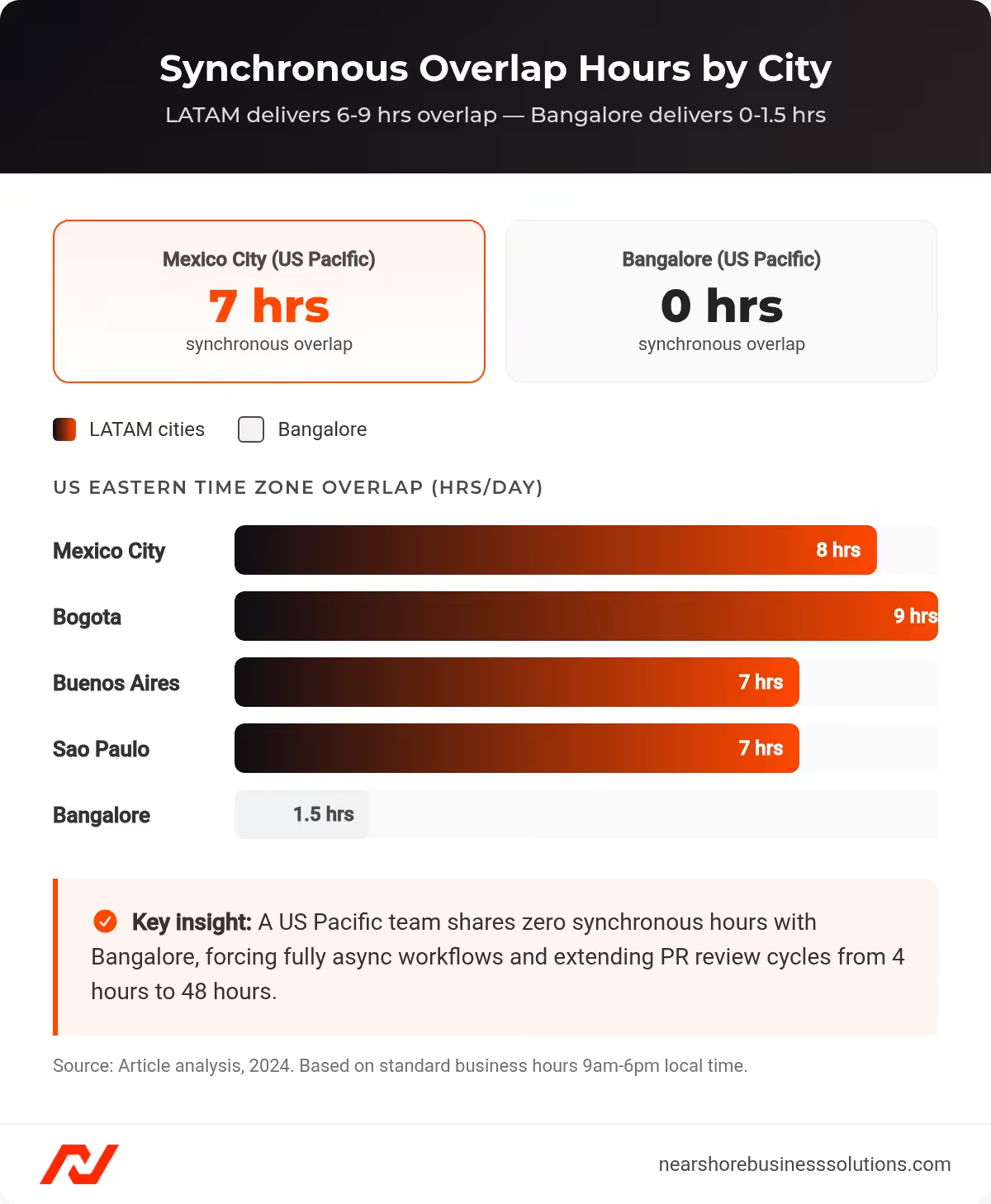
Synchronous overlap hours by city — LATAM delivers 7-9 hours with US Eastern, Bangalore delivers 0-1.5 hours.
How Do Async Handoffs Add to Feature Cycle Times?
A 2024 software-outsourcing industry guide measured nearshore LATAM teams delivering 25-40% higher productivity on complex collaborative tasks compared to offshore India teams. Time zone alignment was the primary causal factor.
| Engineering Workflow | LATAM Cycle Time | India Cycle Time |
|---|---|---|
| Single PR review cycle | 4 hours | 48 hours |
| Architecture decision | 90-minute meeting | 5-7 business days |
| Production incident swarming | 45 minutes | 12-16 hours |
GitHub’s 2024 Octoverse report documented that AI-assisted developers generate code 55% faster. But this shifts the bottleneck to review, validation, and architectural oversight. Stack Overflow’s 2024 Developer Survey found 76% of developers using AI tools spent more time on code review and architectural planning. AI copilots amplify the productivity of synchronous teams and widen the gap against async ones.
How Do Attrition, IP Risk, and Retention Differ Between LATAM and India?
Attrition is where the India cost model breaks down most visibly. A 20%+ annual attrition rate means you replace one in five engineers every year, absorbing onboarding costs that never appear in the original vendor rate card.
What Does India’s Attrition Rate Actually Cost Over Three Years?
NASSCOM’s February 2024 Strategic Review confirmed attrition across Indian IT services ran 20-28% annually through 2023-2024. Average Indian developer tenure at outsourcing firms: 18-24 months. LATAM developers working with US clients average 30-48 months. Eventbrite’s engineering hub in Mendoza, Argentina reported attrition below 10% annually.
Modeled on a 20-person team over three years: India’s attrition costs reach $346,500 annually (4.4 replacements times $52,500 times 1.5x replacement multiplier) versus LATAM’s $270,000 (2.4 replacements times $75,000 times 1.5x). Three-year total: India $1,039,500 versus LATAM $810,000. That is a $229,500 LATAM advantage on attrition alone, despite higher base salaries.
A 2024 state-of-global-hiring report flagged Argentina, Brazil, and Mexico among the fastest-growing hiring destinations for US companies, citing time-zone alignment as the primary driver. Our LATAM talent acquisition service places engineers with 94% retention at 90 days.
How Does IP Enforcement Compare Between LATAM and India?
Mexico’s USMCA Chapter 20 provides strong enforcement for trade secrets, digital copyrights, and patents with clear US recourse. India remains on the US Trade Representative’s Priority Watch List, citing concerns over patent issues and trade secret protection.
| Country | IP Index Rank (2024) | Key US Trade Agreement | US Special 301 Status |
|---|---|---|---|
| Mexico | #20 | USMCA (Chapter 20) | Not listed |
| Brazil | #31 | No comprehensive FTA | Watch List |
| Colombia | #36 | US-Colombia TPA | Not listed |
| India | #42 | WTO/TRIPS only | Priority Watch List |
How Does Communication Style Differ Between LATAM and India Teams?
Hofstede’s Power Distance scores place India at 77. This predicts a communication pattern where blockers get masked. A LATAM developer is more likely to say “That cannot ship by Friday” directly. An Indian developer might say “We will try our best,” which US managers frequently misinterpret as a commitment. The CTO of Hims and Hers described it directly: “The time zone alignment with LATAM allows for a much more collaborative environment than we have experienced with teams in other parts of the world.” If you are managing India teams through EOR structures, see our employer of record guide for Latin America for the compliance comparison.
Which Team Belongs in LATAM and Which Belongs in India?
The right answer is rarely all-or-nothing. Most growth-stage engineering orgs run a hybrid: LATAM for core product work and India for commodity execution.
What Does the 2026 Decision Matrix Look Like?
Choose LATAM for core product engineering, daily collaboration with US PMs, and stacks like React, Node.js, Python, and mobile. Choose India for large-scale QA, L2/L3 support, and legacy Java/Spring Boot maintenance. Consider a hybrid for teams with both product and commodity layers.
| Factor | Choose LATAM | Choose India | Consider Hybrid |
|---|---|---|---|
| Use case | Core product engineering | QA, support, maintenance at scale | Product plus commodity layers |
| Collaboration intensity | High (daily sync with US PMs) | Low (detailed specs, weekly check-ins) | Mixed |
| Key stacks | React, Node.js, Python, mobile | Java/Spring Boot, cloud ops, ML pipelines | Both |
| Team size sweet spot | 4-8 engineers | 15+ for process-driven work | 4-8 LATAM plus 2-4 India |
| Cost priority | TCO optimization | Unit cost minimization | Balanced |
Three steps to build a hybrid allocation:
- Map each role to a collaboration intensity score. Roles requiring daily sync with US PMs and architects go to LATAM. Roles operating from detailed specs with weekly check-ins go to India.
- Calculate total cost of ownership per role, not per region. Run the fully loaded cost model covering base salary, attrition replacement, management overhead, and rework rate for each specific position.
- Set a 90-day evaluation trigger. Measure sprint velocity, cycle time, attrition events, and escalation frequency per region to validate or adjust allocation.
How Do You Hire LATAM Developers and Deploy Your First Engineer in 30 Days?
Most CTOs making the switch from India to LATAM get the first 30 days wrong. Three mistakes account for most of the failure modes.
What Mistakes Do CTOs Make When Switching From India to LATAM?
The first mistake: applying the India vendor model to LATAM. LATAM’s best talent opts for direct-hire or EOR relationships, not agency staffing. The body-shop model yields lower-tier talent and higher attrition.
The second mistake: benchmarking LATAM against India instead of against the US. LATAM delivers 30-50% savings versus US fully loaded costs. The correct ROI comparison is LATAM versus US, not LATAM versus India.
The third mistake: underinvesting in onboarding because “they are in the same timezone.” Time zone alignment removes communication friction. It does not replace structured codebase ramp and architecture context.
What Does a 30-Day LATAM Hiring Roadmap Look Like?
Week 1: Define technical requirements and target compensation using country-level data. Mexico City runs at the higher end of LATAM ranges. Buenos Aires runs at the lower end.
Week 2: Source candidates through direct-hire channels or EOR partners. Vet English fluency individually. National averages are misleading; developer-level fluency is significantly higher.
Week 3: Run technical assessments calibrated to your stack. Conduct team-fit interviews with your US engineering lead. Screen for communication style and ability to flag blockers directly.
Week 4: Onboard your first LATAM engineer into your codebase, CI/CD pipeline, and daily standup. Ship their first PR before day 30.
For a step-by-step sourcing and placement process, see our staff augmentation service.
Frequently Asked Questions About LATAM vs India Developers
These are the most common questions CTOs ask when evaluating LATAM versus India for their engineering teams.
How Long Does It Take to Hire a LATAM Developer?
You can have a pre-vetted LATAM developer in your interview pipeline within 3-5 business days through a nearshore staffing partner, with specialist roles closing in under 2 weeks. Direct hiring without a partner takes 6-12 weeks on average.
What If a LATAM Developer Does Not Work Out?
Most nearshore partners offer a 90-day replacement guarantee. If a developer does not meet expectations within the first three months, the partner re-sources and places a replacement at no additional cost. NBS includes this guarantee on every placement.
How Do You Pay LATAM Developers?
You pay LATAM developers through an employer of record (EOR) or a nearshore staffing partner that handles local payroll, benefits, and compliance. You do not need a local entity in LATAM to hire. Payment is typically in USD via the EOR or staffing firm.
Do I Need a Local Entity in LATAM to Hire?
No. An employer of record handles local compliance, payroll, and benefits on your behalf. You sign a service agreement with the EOR. The developer signs a local employment contract. You manage the work; the EOR manages the legal employer relationship.
What Is the Difference Between Nearshore and Offshore?
Nearshore means hiring in a geographically and time-zone-adjacent region to your base of operations. For US companies, nearshore means LATAM: same or near-same time zones, 2-4 hour flight for in-person visits, and cultural alignment. Offshore means hiring in a distant region like India, Eastern Europe, or Southeast Asia, typically with 8-12+ hour time zone differences.
Is India Engineering Talent Higher Quality Than LATAM?
HackerRank’s 2023 rankings place India at #36 globally in algorithmic competency, with Argentina at #39, Brazil at #40, and Mexico at #43. The quality gap is narrow. The productivity difference comes from time zone alignment, communication style, and attrition, not raw engineering skill.
Can I Run a Hybrid LATAM/India Team?
Yes. A proven structure: 4-8 LATAM engineers handle core product work requiring daily collaboration. 2-4 India engineers handle QA, support, or legacy maintenance. Calculate total cost of ownership per role using the model in the cost section above. Hybrid teams require clear spec handoffs and explicit async protocols for the India layer.
Ready to Build Your LATAM Engineering Team?
Nearshore Business Solutions sources and vets developers from Mexico City, Buenos Aires, Bogota, Medellin, and Sao Paulo. We screen for technical skills, English fluency, and US work style fit.
Every placement includes a 90-day replacement guarantee. You receive pre-vetted candidates within 3-5 business days.
Book a free consultation to discuss your LATAM hiring needs and receive a custom candidate shortlist.