
Hiring offshore software developers costs $25 to $90 per hour depending on region, but the model matters more than the rate. LATAM nearshore hubs like Bogotá and Mexico City deliver 4 to 8 hours of US time-zone overlap and trade-agreement-backed IP protection (USMCA in Mexico, a 2012 trade agreement in Colombia) that India and Eastern Europe cannot match.
The global IT outsourcing market hit $587.6 billion in 2023 and is projected to reach $904.9 billion by 2029, growing at a 7.89% CAGR (Mordor Intelligence, 2024). This guide breaks down the three engagement models, real rate data by region, a five-step vetting process, and the true cost of offshore hiring once attrition and time-zone drag enter the calculation.
Why Do CTOs Still Hire Offshore Developers, and Where Does the Old Playbook Fail?
CTOs hire offshore developers for three reasons: access to talent pools that don’t exist domestically, 2 to 3 times the cost savings on equivalent output, and the ability to run parallel workstreams without competing for the same Series B through Series D candidates. The problem is execution, not strategy. The 2020-era offshore playbook, built on large bench teams and waterfall-style handoffs, looks efficient on a procurement spreadsheet and collapses on a velocity chart.
72% of US-based SMBs already outsource some business functions (Clutch.co, 2023), and 64% of IT leaders plan to increase their use of external talent (Skillsoft, “2024 IT Skills and Salary Report”). Hiring in Latin America by US companies grew 161% in the first half of 2022 alone (per a 2022 global hiring report), a trend that has continued through subsequent years. For a full breakdown of what these engagements cost beyond the rate card, see our guide to software development outsourcing costs.
How Big Is the US Engineering Talent Gap in 2026?
The US Bureau of Labor Statistics projects 277,300 new software developer, QA, and tester positions will open between 2022 and 2032, while US universities produce only about 65,000 computer science graduates per year (BLS, 2023; Evans Data Corporation, 2023). That gap, more than 4 to 1 on net-new roles alone, doesn’t close with better employer branding. Evans Data Corporation puts the current shortage at 1.2 million software engineers. US senior full-stack engineers command $120 to $180 or more per hour fully loaded, and average time-to-hire runs about 62 days (Hired.com), two full sprint cycles lost before a candidate even starts.
What Three Failure Modes Erode Offshore ROI Before Year One?
Three structural failure modes erode offshore ROI before the first year closes: communication overhead, silent attrition, and IP exposure.
| Failure Mode | Key Metric | Cost Impact | Mitigation Path |
|---|---|---|---|
| Communication overhead from 10+ hour time-zone gaps | 0 to 1.5 hours of overlap with US Pacific for India and Vietnam | Async tax compounds daily across every team member | Nearshore teams with 4 to 8 hours of direct overlap |
| Silent attrition on bench-model teams | 20 to 25% annual attrition in India IT services (industry reports) | Constant knowledge-transfer cycles and 2 to 4 month ramp costs per replacement | Dedicated teams with retention incentives and direct client relationships |
| IP protection gaps in weak-enforcement jurisdictions | India remains on the USTR “Priority Watch List” (2023 Special 301 Report) | Legal recourse is complex and slow; architectural IP exposure compounds | USMCA-covered jurisdictions (Mexico) or EU-aligned legal frameworks |
Time-zone overlap calculated from standard UTC offsets and a 9 AM to 6 PM local workday.
When Is Offshore Hiring the Wrong Call Entirely?
Offshore hiring is the wrong call when two or more of these four conditions apply. Hofstede’s Power Distance Index scores India at 77 versus 40 in the US, a gap that shapes the first two conditions below.
- You need a co-architect who challenges technical decisions in real time.
- You need a senior engineer embedded in product strategy and cross-functional standups.
- Your team touches regulated data under HIPAA or SOC 2.
- Your product demands multiple synchronous design decisions per day.
If two or more apply, the nearshore alternative below exists to solve these constraints.
Offshore vs Nearshore Developers: What Actually Changes When You Close the Time-Zone Gap?
Nearshore vs offshore is not a branding distinction. It is a structural variable that compounds across every sprint, reducing to five measurable dimensions: cost, time-zone overlap, communication quality, IP protection, and retention. On four of the five, nearshore outperforms traditional offshore for product-stage companies running continuous delivery cycles.
What Do Offshore Developer Rates Look Like by Region in 2025-2026?
Senior offshore developer rates range from $40/hr in India to $90/hr in Mexico and Brazil, with attrition running 8 to 25% depending on region.
| Region / Country | Mid-Level (3-5 yrs) | Senior (6-10 yrs) | Annual Attrition Rate | Rate Trend (2025-2026) |
|---|---|---|---|---|
| India | $25-$45/hr | $40-$65/hr | 20-25% | Rising 5-8% YoY; senior talent captured by GCCs |
| Philippines | $20-$35/hr | $35-$55/hr | 18-22% | Rising 6-9% YoY |
| Poland/Romania | $45-$70/hr | $65-$95/hr | 12-18% | Approaching Western European rates |
| Argentina | $30-$55/hr | $50-$80/hr | 8-15% | USD contracts create loyalty incentive |
| Colombia | $35-$60/hr | $55-$85/hr | 8-15% | Bogotá and Medellín emerging as primary hubs |
| Mexico | $40-$65/hr | $60-$90/hr | 8-15% | USMCA coverage adds legal premium |
| Brazil | $40-$65/hr | $60-$90/hr | 8-15% | Largest absolute talent pool in LATAM (500K+ developers) |
Sources: Nearshore Americas and Forbes, plus aggregated 2023-2024 nearshore vendor, developer-marketplace, and rate data.
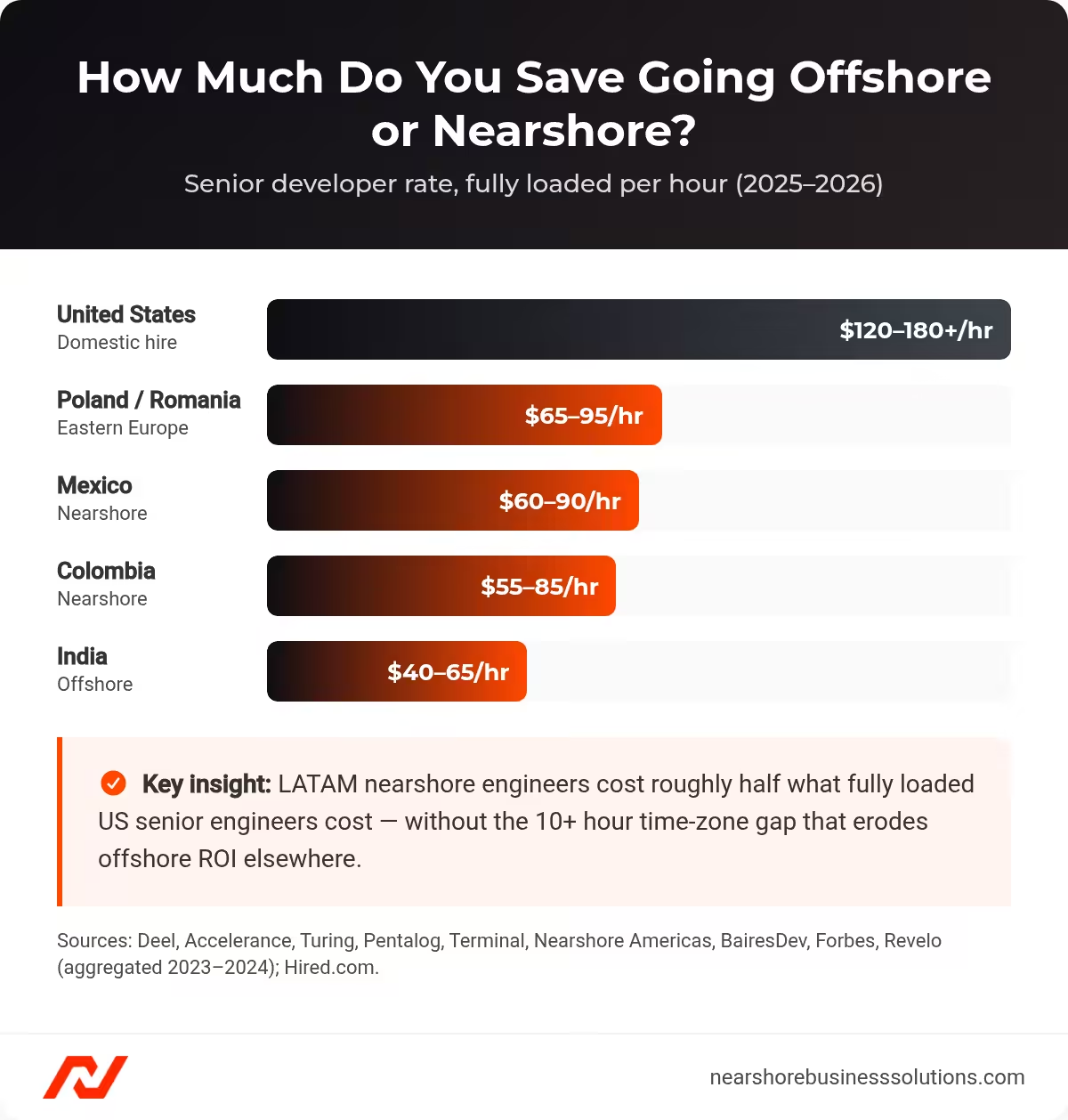
Senior developer hourly rates in the US versus Poland/Romania, Mexico, Colombia, and India.
The rate gap between India and LATAM averages 30 to 50% based on the ranges above, narrowing to 15 to 25% when comparing India to Argentina or Colombia specifically. That gap inverts once attrition replacement costs, async overhead, and PM translation layers enter the calculation, a total-cost model this guide walks through below.
Why Is Time-Zone Overlap a Compounding Advantage, Not a Nice-to-Have?
Time-zone overlap compounds because every hour below a four-hour threshold converts synchronous work into a 12 to 24 hour async round trip. A study in the Journal of Software: Evolution and Process found that teams with fewer than four hours of real-time overlap experienced measurably degraded coordination and lower output consistency.
| LATAM City | UTC Offset | Overlap with US Eastern | Overlap with US Central | Overlap with US Pacific |
|---|---|---|---|---|
| Mexico City | UTC-6 | 7 hours | Full overlap (8 hrs) | 7 hours |
| Bogotá, Colombia | UTC-5 | Full overlap (8 hrs) | 7 hours | 5 hours |
| Buenos Aires, Argentina | UTC-3 | 6 hours | 5 hours | 4 hours |
| São Paulo, Brazil | UTC-3 | 6 hours | 5 hours | 4 hours |
| San José, Costa Rica | UTC-6 | 7 hours | Full overlap (8 hrs) | 7 hours |
Overlap calculated from standard UTC offsets and a 9 AM to 6 PM local workday.
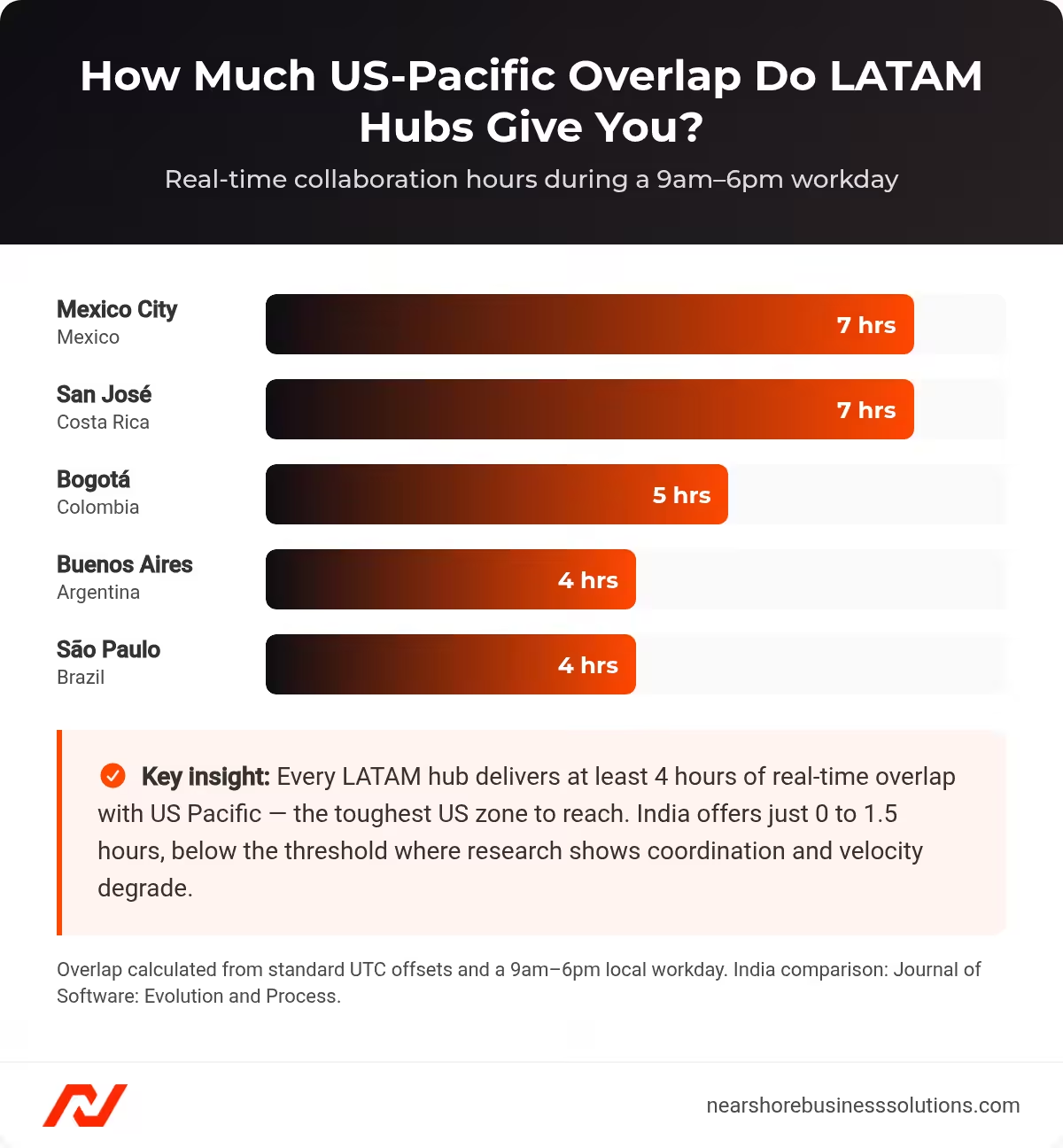
US-Pacific time-zone overlap hours across five LATAM tech hubs during a standard workday.
Every LATAM city delivers a minimum of four overlapping hours with every US time zone. India Standard Time (UTC+5:30) delivers 0 to 1.5 hours with US Pacific, consistently below the four-hour threshold.
How Do IP Protections Compare Across Offshore Jurisdictions?
India remains on the USTR “Priority Watch List” (2023 Special 301 Report), where enforcement timelines stretch for years, while Mexico operates under USMCA with IP provisions mirroring US law and binational dispute-resolution panels. Colombia’s 2012 Trade Promotion Agreement and recent trade-secret reforms add moderate to strong protections on top of that. For most US product-stage companies, the combination of USMCA protections, US-aligned data frameworks, and practical enforceability makes LATAM the lowest-risk offshore jurisdiction available.
What Are the Three Engagement Models for Building an Offshore Development Team?
Three engagement models cover nearly every offshore hiring scenario: staff augmentation, dedicated teams, and project-based outsourcing. Each maps to a different company stage and risk tolerance.
When Does Staff Augmentation Make Sense, and Where Does It Stop Scaling?
Staff augmentation places individual engineers directly onto your existing team, and it works best backfilling one to three roles mid-sprint. Chime used this model to scale engineering teams 50% faster than domestic hiring alone (published case study). Past three augmented engineers, management overhead grows nonlinearly. Each additional person requires onboarding context, PR review bandwidth, and 1:1 time drawn directly from architecture work.
What Is a Dedicated Offshore Team, and When Does BOT Make Sense?
A dedicated team stands up a self-contained pod, typically four to twelve engineers, with its own embedded technical lead and defined domain ownership. EY hired over 2,200 professionals in Argentina for complex financial products (EY Press Release, 2022). Pinterest opened an engineering hub in Mexico City, where CTO Jeremy King credited the decision to “world-class, bilingual talent” (Pinterest Newsroom, 2022).
The Build-Operate-Transfer (BOT) variant adds an exit ramp: the vendor builds and operates the team for 12 to 24 months, then transfers it to your direct employment. The offshore development center model is the natural endpoint of a successful BOT engagement, and it is where LATAM’s cost and overlap advantages compound most, as detailed in our guide to hiring software developers in Latin America.
When Does Project-Based Outsourcing Make Sense?
Project-based outsourcing works for spec-complete, non-core work: data migrations, internal reporting dashboards, and proof-of-concept apps, where the knowledge generated during development has no strategic value. It fails for iterative product development, because every build-measure-learn cycle that happens inside the vendor’s team is a cycle your organization never absorbs.
Which Engagement Model Fits Your Company Stage?
Company stage determines the right engagement model, ranging from a single augmented engineer at seed stage to a full dedicated pod at Series B and beyond.
| Company Stage | Recommended Model | Team Size | Key Rationale |
|---|---|---|---|
| Seed / Pre-Series A | Staff augmentation | 1-2 engineers | CTO needs hands-on control; speed to first hire matters most |
| Series A | Staff aug or small dedicated team | 2-5 engineers | Parallelizing workstreams without building foreign HR infrastructure |
| Series B+ | Dedicated team with BOT option | 4-12 person pod | Enough roadmap certainty to justify a second engineering pod |
| Any stage, bounded deliverable | Project-based outsourcing | Vendor-determined | Fixed scope, non-core work only |
How Do You Hire Offshore Software Developers Without Inheriting Technical Debt?
Technical debt from offshore teams originates in process gaps, not incompetence. An estimated 35 to 40% of senior developers in major LATAM tech hubs have worked directly with US-based companies (published nearshore-platform analyses, 2023-2024), which means the real screening challenge is finding engineers who communicate technical decisions asynchronously with the clarity your leads require. Instructure hired 40+ senior engineers in Latin America in under six months, accelerating their product roadmap by multiple quarters (per a published nearshore hiring platform case study).
What Does a Five-Step Vetting Process for Async-Ready Engineers Look Like?
A five-step vetting process filters for async-ready engineers before they ever touch your codebase.
- Async communication trial. The candidate records a Loom walkthrough of a recent pull request, explaining the problem, approach, trade-offs, and retrospective improvements. This filters for communication clarity and comfort with async artifacts.
- Live system-design session with ambiguous constraints. Present an underspecified problem and evaluate whether the candidate asks clarifying questions and proposes trade-offs rather than jumping to a single solution.
- Paired code review on your production codebase. Assess whether they identify substantive issues, explain why something is problematic, and write self-contained review comments. This skill sharply reduces async round-trips compared with terse or ambiguous feedback.
- Reference check focused on distributed-work behaviors. Ask specifically whether the engineer proactively surfaced blockers in writing, or whether issues emerged only in synchronous check-ins.
- Paid trial sprint of three to five days on a real but non-critical task. Evaluate commit cadence, PR description quality, communication patterns, and whether the engineer self-organizes or waits for direction. This is the single highest-signal vetting step.
Which Onboarding Rituals Cut Ramp Time from Eight Weeks to Three?
Five onboarding rituals cut ramp time from roughly eight weeks to three.
- Architecture walkthrough recordings. Pre-record Loom videos covering system architecture, key services, and the deployment pipeline so new hires self-serve context before day one.
- A “first PR in 48 hours” goal. Assign a small, well-scoped task that gets the engineer committing code and navigating review immediately.
- A buddy-pair system. Pair each offshore engineer with a US-based engineer for the first 30 days for ad-hoc questions and cultural context.
- Weekly 1:1 with the engineering lead for the first month. This builds trust, surfaces blockers early, and signals the hire is a first-class team member.
- A 30-day checkpoint review. Formally evaluate velocity, communication quality, and cultural fit against clear pass, adjust, or exit criteria.
What Architectural Guardrails Maintain Code Quality Across Distance?
CI/CD enforcement, automated code-quality gates like SonarQube and linting, trunk-based development, and mandatory PR reviews by onshore leads are not micromanagement. They are the infrastructure of trust. Nearshore teams enable faster PR review cycles: a stalled PR waiting for review from India blocks a feature for a full day, while a team in Colombia with full EST overlap reviews within an hour. For complex product development requiring high-bandwidth collaboration, the overlap-first model outperforms follow-the-sun, which works for 24/7 support roles but fails for core product engineering, where shared context and rapid iteration matter most.
What Do Offshore Software Developers Actually Cost?
Offshore developers can cost up to 63% more than their invoice rate once management overhead, rework, and attrition replacement enter the calculation, based on NBS’s total-cost-of-engagement model comparing India, Colombia, and Poland.
Why Does the Cheapest Offshore Rate Often Produce the Slowest Velocity?
The Qatalog and Cornell University study found that time spent waiting for information across time zones costs businesses up to $1,957 per employee per year in lost productivity, and cheap offshore rates rarely account for this hidden tax. Microsoft Research found it takes 23 minutes to resume a task after an async interruption. If five engineers each experience three timezone-driven interruptions daily, that is 5.75 hours of lost productive time across the team, by NBS’s calculation from the Microsoft Research figure.
Each attrition replacement cycle costs an estimated 50 to 150% of the departing engineer’s annual compensation in ramp time, recruiting, and lost productivity, per industry benchmarks. At India’s 20 to 25% annual attrition rate, a ten-person team replaces two to three engineers per year, each requiring two to four months to reach full productivity.
NextRoll switched from Eastern Europe to Latin America and reported a 30% increase in team productivity, attributed directly to improved communication and time zone overlap (published case study). 2023 developer-skill assessment data placed Argentine developers first globally in aggregate skill scores, while India ranked 31st on HackerRank, suggesting higher baseline code quality and less rework from LATAM hires.
Based on NBS’s total-cost-of-engagement model, factoring in rate, management overhead, rework, and attrition, a $50/hr India-based senior React engineer at 22% attrition produces a higher effective cost-per-merged-PR than a $70/hr Colombia-based engineer at 12% attrition with full time-zone overlap. The rate card tells one story. Delivered velocity tells another.
Frequently Asked Questions About Hiring Offshore Software Developers
These are the questions CTOs ask most before signing an offshore or nearshore contract.
How Long Does It Take to Hire an Offshore or Nearshore Developer?
Domestic hiring for a senior full-stack engineer averages 62 days (Hired.com). Staff augmentation and dedicated-team vendors typically deliver vetted your first candidates within 3 business days, with LATAM nearshore pipelines running fastest because interview hours overlap with US business hours.
What Happens If an Offshore Developer Doesn’t Work Out?
Reputable vendors include a replacement guarantee, typically 30 to 90 days. Run a paid trial sprint before committing to a longer engagement. This is the single highest-signal step in the five-step vetting process above.
Do I Need a Local Legal Entity to Hire Offshore Developers?
No. Staff augmentation and dedicated-team vendors employ engineers locally and handle payroll, benefits, and compliance. You contract with the vendor, not the individual engineer, which eliminates the need for a foreign entity.
Is Nearshore or Offshore Better for Regulated Data Like HIPAA or SOC 2?
Nearshore LATAM jurisdictions generally carry lower compliance risk. Mexico’s USMCA coverage and Colombia’s trade-secret reforms provide stronger legal recourse than jurisdictions on the USTR Priority Watch List. For a deeper comparison, see our guide to hiring software developers in Latin America.
Ready to Build Your Nearshore Engineering Team?
Nearshore Business Solutions sources and vets senior engineers from Bogotá, Medellín, Guadalajara, Monterrey, and Buenos Aires, LATAM hubs with 4 to 8 hours of US overlap and USMCA or trade-agreement IP protections. We screen for technical skills, English fluency, and US work style fit.
Every placement includes a 90-day replacement guarantee, and you receive vetted your first candidates within 3 business days. Explore how our remote talent acquisition process matches senior engineers to your engagement model, whether staff augmentation, a dedicated pod, or both.