
Hiring full-stack developers in Latin America saves 60-65% versus US rates while accessing 2 million tech professionals across 437 universities producing 220,000 STEM graduates annually.
LATAM senior full-stack developers cost $53,000-$80,000 per year. That compares to $210,000-$255,000 in total employer cost in the US. Time-to-hire runs 7-28 days versus 42-180 days domestically. Mexico City and Bogota offer 100% timezone overlap with US business hours.
Our network includes developers from tech hubs in Mexico City, Guadalajara, Bogota, Medellin, Sao Paulo, and Buenos Aires. Each is vetted for React, Node.js, and Python expertise, English fluency, and US work style fit. Below you will find salary benchmarks, hiring steps, legal compliance requirements, and platform comparisons.
What Does It Mean to Hire Full-Stack Developers in Latin America?
Latin America has become the primary nearshore destination for US tech companies scaling their engineering teams. The region’s 2 million tech professionals work in timezones that align with US business hours. That alignment enables real-time collaboration that offshore alternatives cannot match.
The typical full-stack developer in Latin America has 5-8 years of experience. They work across modern JavaScript frameworks, backend services, and cloud infrastructure. They understand agile methodologies, CI/CD pipelines, and the collaborative tools US companies use daily. Most importantly, they operate during the same hours as your US team.
The LATAM tech ecosystem has matured significantly over the past decade. Major tech hubs in Mexico City, Sao Paulo, Buenos Aires, Bogota, and Guadalajara now rival many US cities in technical talent density. Companies hire here not just for cost savings, but for genuine timezone alignment and access to senior talent that is difficult to source domestically.
Why Should You Hire Full-Stack Developers from Latin America?
Latin America delivers three advantages that other regions cannot match simultaneously: cost, timezone, and talent quality. For companies in the $5M-$100M revenue band, these three factors together create a compelling case for nearshore hiring.
What Are the Cost Savings When Hiring Full-Stack Developers in Latin America?
A senior full-stack developer in Latin America costs $53,000-$80,000 annually. The same profile in San Francisco costs $255,000 in total employer cost. That is a savings of $175,000-$202,000 per engineer per year. Five senior engineers save over $1 million annually versus domestic hiring.
| Advantage | Key Data | Impact |
|---|---|---|
| Cost Savings | $53,000-$80,000/year vs $210,000-$255,000 US total cost | Five senior engineers save $1M+ annually |
| Timezone Alignment | 1-3 hour offset vs 10-12 hour lag with Asia | Real-time standups, pair programming, incident response |
| English Proficiency | 50% salary premium for fluency creates self-selection | Minimal communication barriers for US-facing roles |
| Time-to-Hire | 7-28 days vs 42-180 days in the US | 4x faster team scaling |
| Offer Acceptance | 84-92% vs 75-85% in the US | Higher hiring predictability |
The cost advantage compounds at scale. A 10-person senior team in Latin America costs $650,000-$750,000 annually versus $2.4M-$2.55M in the US. The $1.7M-$1.8M annual savings funds 18 additional months of runway or an entire go-to-market budget for a Series A company.
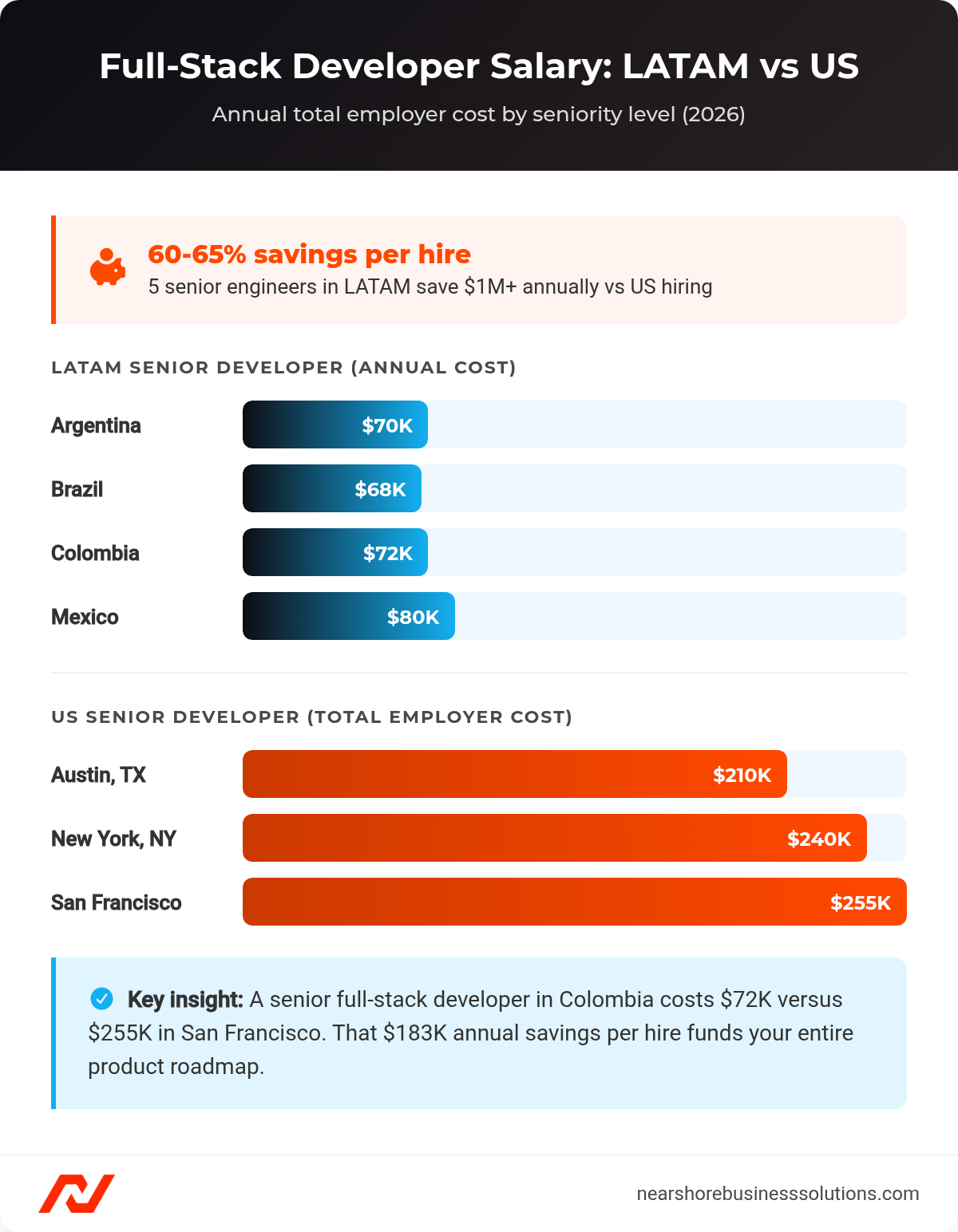
Annual developer salary comparison: LATAM senior engineers versus US total employer cost by city.
How Does Timezone Alignment Benefit Your Team?
Latin American developers work within a 1-3 hour offset from US time zones. That compares to a 10-12 hour lag with India or Southeast Asia. Mexico City and Bogota offer 100% overlap with US Eastern and Central hours. Sao Paulo and Buenos Aires offer 75-90% overlap depending on your coast.
| US City | Mexico City (0h) | Bogota (0h) | Sao Paulo (+2h) | Buenos Aires (+2h) |
|---|---|---|---|---|
| San Francisco (PST) | 100% Sync | 100% Sync | 75% Sync | 75% Sync |
| New York (EST) | 100% Sync | 100% Sync | 90% Sync | 90% Sync |
| Austin (CST) | 100% Sync | 100% Sync | 85% Sync | 85% Sync |
This timezone alignment eliminates the async bottlenecks that plague offshore development. A developer in Buenos Aires can join your 10am standup. A developer in Bangalore cannot.
For more on the LATAM hiring landscape, see our complete guide to hiring software developers in Latin America.
Which Latin American Countries Have the Strongest Full-Stack Developer Talent?
Latin America’s top four markets each offer distinct talent profiles. Mexico leads in total pool size at 800,000+ developers. Brazil offers the deepest pool for AI and data science. Colombia ranks in the top 50 globally for problem-solving on HackerRank. Argentina produces senior specialists with strong product strategy backgrounds.
| Country | Developer Pool | Specializations | Senior Range | AI/ML Range | Key Notes |
|---|---|---|---|---|---|
| Argentina | 150,000+ (Buenos Aires, Mendoza) | Product strategy, blockchain | $55,000-$70,000 | $66,000-$85,000 | Dollar-indexed contracts offset inflation. Highest senior cost in region. |
| Brazil | 540,000+ (Sao Paulo, Campinas) | AI, data science, Java | $53,000-$68,000 | $65,000-$80,000 | Deepest talent pool. 4th globally in 5G at 430.83 Mbps median speed. |
| Mexico | 800,000+ (Mexico City, Guadalajara, Monterrey) | Mobile, enterprise, FinTech | $55,000-$80,000 | $70,000-$95,000 | Largest pool. Strongest for mobile and enterprise. US proximity drives premium. |
| Colombia | 165,000+ (Bogota, Medellin) | SaaS, backend, DevOps | $51,000-$72,000 | $62,000-$78,000 | Top 50 globally in problem-solving. 207.32 Mbps 5G. |
| Chile | Emerging market | Infrastructure specialists | N/A | N/A | Best connectivity: 357.25 Mbps fixed broadband, 289.77 Mbps 5G. |
What Makes Each Country Distinct for Full-Stack Hiring?
Argentina produces senior engineers with startup experience at $55,000-$70,000 annually. Buenos Aires and Mendoza specialize in product strategy and blockchain. Universidad de Buenos Aires (UBA) and ITBA produce strong computer science graduates. Contracts are dollar-indexed to protect against inflation.
Colombia offers the best cost-quality ratio. Bogota and Medellin developers rank in the top 50 globally for problem-solving on HackerRank. Medellin’s Ruta N innovation district and universities like Universidad de los Andes and EAFIT produce consistent engineering talent.
Mexico’s 800,000+ developer pool is the largest in the region. Mexico City leads in mobile development. Guadalajara, often called “Mexico’s Silicon Valley,” leads in enterprise systems. Monterrey leads in FinTech. Engineers from Tecnologico de Monterrey (ITESM) and UNAM staff these hubs.
What Technical Skills Do Full-Stack Developers in Latin America Have?
Latin American full-stack developers have strong fluency in React, Node.js, Python, and TypeScript. TypeScript has become the most-used language by GitHub contributor count, growing 66.6% year-over-year to 46.2% adoption. Python leads in overall usage at 57.9%, driven by AI and data infrastructure demand.
| Technology | Adoption Rate | YoY Growth | Primary Use Cases |
|---|---|---|---|
| React | 44.7% | +28.4% | Frontend development. Next.js (20.8% adoption, +35% growth) replacing Create React App as production standard. |
| Node.js | 40.7% | +22.1% | Backend services, API development, microservices. Enables full-stack JavaScript teams. |
| Python | 57.9% (highest) | +48.7% (fastest) | Data pipelines, ML infrastructure, backend services. Required for AI roadmaps in 2026. |
| TypeScript | 46.2% | +66.6% | Type contracts that validate AI-generated code. Default for new projects. |
How Has AI Changed the Skills Full-Stack Developers Need?
AI tools have shifted the highest-value developer skills from algorithm memorization to prompt engineering, code validation, and architectural thinking. Stack Overflow question volume dropped 80% as developers shifted to LLM assistants like Cursor and GitHub Copilot. Only 35% of developers regularly consult Stack Overflow. They now use it primarily to debug AI hallucinations.
TypeScript’s dominance reflects this shift. AI teams prefer TypeScript because its type system catches errors in LLM-generated code before reaching production. Python’s 48.7% growth rate reflects the AI infrastructure buildout across SaaS companies. Every company building AI features needs data pipelines, ML infrastructure, and backend services. Python dominates all three layers.
How Do You Hire Full-Stack Developers in Latin America Step by Step?
92% of Latin American tech professionals are open to international offers. Unlike the US market where passive candidates require extensive outreach, LATAM developers actively seek US company opportunities. You choose from engaged candidates rather than convincing reluctant engineers.
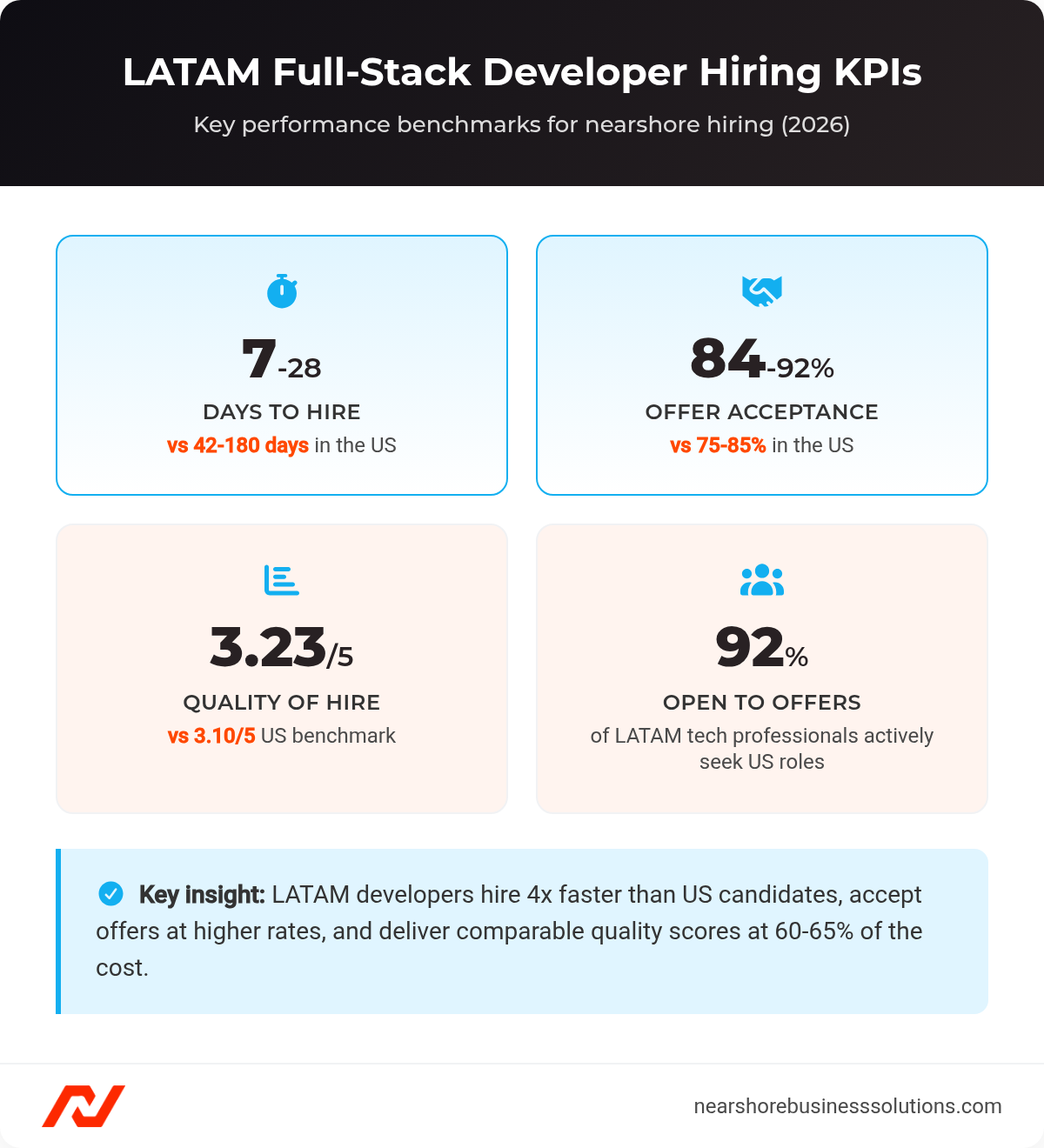
Key LATAM hiring benchmarks versus US equivalents for senior full-stack developers in 2026.
How Do You Choose a Hiring Platform for LATAM Developers?
Five platforms dominate the LATAM hiring market. Each offers a different model suited to different company stages. Managed models like BairesDev and Terminal.io work best for companies without local entities. Direct marketplaces like Arc.dev work best for companies with existing HR infrastructure.
| Platform | Model | Pass Rate | Best For |
|---|---|---|---|
| BairesDev | Staff augmentation | 1% | High-volume hiring. 9.1/10 CSAT. Five-stage vetting. 1.5M annual applications. |
| Terminal.io | Managed marketplace/EOR | 7% | Companies without a local entity. 30% lower turnover. Full lifecycle management. |
| Arc.dev | Direct hire marketplace | 2.3% | Fast direct hiring. 15% of annual salary fee. 4x faster than traditional recruiting. |
| Teilur Talent | Recruitment/payroll | N/A | Senior talent at transparent cost. 20% capped markup. $6k/month average. |
| Toptal | High-end freelance | 3% | Premium specialists for short-term projects. $60-$200+/hour. Top 3% vetting. |
For companies making their first 1-5 hires, managed platforms reduce compliance risk. They handle employment structure, payroll, benefits, and hardware provisioning. Direct recruitment makes sense once you have hired 10-20 LATAM developers and understand regional compliance requirements. See our guide to hiring developers in Colombia for a country-specific example.
How Should You Screen Full-Stack Developers Technically?
LATAM roles receive 200+ applicants versus 50-80 in the US, giving you greater selection. CoderPad shows 96% candidate completion rates, significantly higher than algorithm-heavy platforms. Algorithm-heavy tests optimized for fresh graduates do not effectively evaluate senior full-stack developers. Focus on practical problem-solving instead.
Three assessment approaches work well for senior LATAM talent:
- Take-home projects (4-6 hours): Mirror actual work. “Build a REST API with authentication and rate limiting” evaluates relevant skills directly.
- System design discussions: Ask candidates to architect a feature or debug a production issue. Tests architectural thinking.
- Code review exercises: Candidates review a pull request, identify issues, suggest improvements, and discuss trade-offs.
What Should You Focus on During Interviews?
Quality of Hire scores for LATAM developers are 3.23/5.0 versus 3.10/5.0 in the US. Strong English fluency and senior experience level create a slightly higher quality bar than typical US hires. Focus interviews on technical depth, communication clarity, and practical experience rather than accent or speech speed.
Key interview focus areas:
- Technical depth: Can they explain architectural decisions and trade-offs across the full stack?
- Communication: Can they explain complex technical concepts clearly?
- Cultural fit: Do they ask clarifying questions? Are they comfortable challenging assumptions?
- Practical experience: Have they built and deployed production systems?
What Are the Salary Ranges for Full-Stack Developers in Latin America?
LATAM full-stack developers cost $18,000-$105,000 annually depending on seniority and country. Senior engineers ($55,000-$80,000) deliver the highest ROI. They require only 5% management overhead versus 40% for juniors. Mid-level engineers ($35,000-$50,000) offer the best value for growth-stage companies.
| Role | Argentina | Brazil | Colombia | Mexico |
|---|---|---|---|---|
| Junior Full-Stack | $18,000-$25,000 | $20,000-$28,000 | $20,000-$30,000 | $25,000-$35,000 |
| Mid-Level Full-Stack | $25,000-$35,000 | $28,000-$35,000 | $35,000-$50,000 | $35,000-$45,000 |
| Senior Full-Stack | $55,000-$70,000 | $53,000-$68,000 | $51,000-$72,000 | $55,000-$80,000 |
| Staff/Lead Engineer | $75,000-$95,000 | $70,000-$90,000 | $72,000-$85,000 | $80,000-$105,000 |
| AI/ML Specialist | $66,000-$85,000 | $65,000-$80,000 | $62,000-$78,000 | $70,000-$95,000 |
What Factors Increase Compensation Beyond Base Salary?
Three factors increase total employer cost beyond base salary. EOR markup adds 5-52% depending on country. AI/ML specialization commands an 18% premium in 2026. General full-stack roles project 10% salary increases as global firms compete for senior talent.
A $65,000 base salary in Colombia might total $75,000-$85,000 with EOR. That still compares favorably to $210,000-$255,000 in total employer cost in Austin or San Francisco. A $25,000 junior requires 40% management overhead. A $65,000 senior requires 5% and delivers autonomous value from week one.
What Are the Legal Requirements When Hiring Full-Stack Developers in Latin America?
The highest legal risk when hiring in Latin America is contractor misclassification. Tax authorities scrutinize contractor arrangements that mirror employment. Fixed monthly payments, required working hours, supervision, and core business function performance all signal employee status.
What Is the Contractor vs Employee Risk in Each Country?
| Classification | Best For | Risk Level | Context |
|---|---|---|---|
| Independent Contractor | Specialized, non-core, project-based work with clear deliverables | HIGH | 2025 audits in Argentina and Mexico increased, targeting “labor fraud.” Fines are severe. |
| Employee via EOR | Core team members, ongoing work, integrated into workflows | LOW | Requires proper employment structure but eliminates misclassification risk. |
Penalties include back payment of all employment taxes, fines from labor authorities, potential criminal liability for labor fraud, and forced employee conversion with retroactive benefits. EOR costs 5-52% more than contractor arrangements, but eliminates catastrophic downside risk.
What Mandatory Benefits Must You Provide in Each Country?
| Country | 13th Month | Vacation Bonus | Profit Sharing | Employer Social Tax | Key Notes |
|---|---|---|---|---|---|
| Brazil | Required | 33% of vacation pay | No | ~36.8% | Most complex labor law. “Pejotizacao” audits target contractor misclassification. |
| Mexico | Required (Aguinaldo) | No | Required (PTU) | ~25-30% | 2021 Outsourcing Reform increased misclassification risk. EOR strongly advised. |
| Argentina | Required (SAC) | No | No | ~28% | Dollar-indexed contracts protect against inflation. Monotributo categories tightened. |
| Colombia | Required (Prima de Navidad) | No | No | ~30.5-51.8% | Strict subordination tests determine employee status. High contractor risk. |
These benefits are non-negotiable. They are written into labor law. The 13th-month salary means you pay 13 months of compensation for 12 months of work. Factor this into your compensation model from day one.
When Should You Use an Employer of Record?
An Employer of Record is strongly advised for Mexico and Colombia, and mandatory for Brazil at 10+ hires. The EOR becomes the legal employer of your team members. They handle employment contracts, payroll processing, benefits administration, and termination procedures. You maintain day-to-day management. The EOR assumes all legal employer responsibilities.
| Country | EOR Recommendation | Primary Risk Factor |
|---|---|---|
| Mexico | Strongly advised | Extreme misclassification risk following 2021 Outsourcing Reform |
| Brazil | Mandatory for 10+ hires | “Pejotizacao” scrutiny targets companies using contractors at scale |
| Argentina | Preferred for stability | Economic volatility makes contractor models unstable |
| Colombia | Strongly advised | Strict subordination laws trigger employee status at any direction level |
By 2027, EOR will become the industry standard for LATAM hiring. Contractor-only models will be limited to short-term prototyping. Legal costs from misclassification lawsuits now exceed EOR administrative fees. For more on hiring structures, see our guide to hiring developers in Mexico.
What Challenges Exist When Hiring Full-Stack Developers in Latin America?
Four challenges affect LATAM hiring. Language barriers are minimal and declining. Cultural differences are smaller than expected. Remote team management requires deliberate process. Junior developer cost-cutting is a trap that negates savings.
How Significant Is the Language Barrier with LATAM Developers?
English fluency commands a 50% salary premium in the Latin American market, creating strong self-selection for US-facing roles. Developers pursuing US opportunities have already invested years in language skills. The EF English Proficiency Index scores tech professionals at significantly higher levels than the general population.
Assess communication directly during interviews. Can they explain a technical decision? Can they ask clarifying questions? Can they participate in architectural discussions? If yes, language will not be an operational barrier. Focus on clarity of technical thought, not native-like fluency or speech speed.
How Do You Manage a Distributed LATAM Engineering Team?
Remote LATAM teams at US firms show 88-95% annual retention when managed well. Departures primarily cite cultural isolation, not compensation. Four practices drive retention.
Four practices drive retention: async-first communication (document decisions in Notion or Confluence, maintain decision logs), hardware parity (identical MacBook Pro M3 and monitors for LATAM and US team members), buddy system onboarding (pair new LATAM hires with US technical leads for 30 days), and timezone-optimized meetings (schedule critical meetings during 10am-2pm ET overlap hours).
Voluntary turnover for LATAM developers at US firms runs 30% lower than US tech hubs when these practices are followed. A developer earning $65,000 at a US SaaS company cannot easily find an equivalent $65,000 role locally. Local companies pay $30,000-$40,000. This creates structural retention advantages.
Why Should You Avoid Hiring Junior Developers to Cut Costs?
A $20,000-$25,000 junior developer requires 40% management overhead. They need extensive code review, architectural guidance, and debugging help. For remote teams, this management burden eliminates cost savings. You save $30,000 on salary but add $40,000 in senior engineer time.
Mid-level developers at $45,000 require 20% management overhead. Senior developers at $65,000 require only 5%. For remote distributed teams, autonomous senior talent is the only model that scales.
How Does Latin America Compare to Other Nearshore Regions?
Latin America delivers 60-65% cost savings versus the US combined with 100% timezone overlap. Eastern Europe offers 40-50% savings but a 7-10 hour lag. Asia offers 70-80% savings but a 10-12 hour lag with zero timezone overlap.
| Region | Timezone Offset | Time-to-Hire (Senior) | Cost vs US | Key Advantage | Key Challenge |
|---|---|---|---|---|---|
| Latin America | 1-3 hours | 7-28 days | 60-65% savings | Real-time collaboration, cultural alignment | Smaller pool than Asia |
| Eastern Europe | 7-10 hours | Not available | 40-50% savings | Strong technical education | Significant timezone lag with US |
| Asia (India/SE Asia) | 10-12 hours lag | Not available | 70-80% savings | Massive talent pool, lowest cost | Zero timezone overlap, high turnover |
| United States | 0 hours | 42-180 days | Baseline | No timezone/cultural barriers | $210,000-$255,000 total cost |
The 10-12 hour lag with Asia creates structural problems regardless of process optimization. When production breaks at 2pm ET, your offshore team is asleep. Blocking questions wait 12+ hours. Pair programming is impossible.
LATAM pre-vetted platforms reduce time-to-hire to 7-28 days versus 42-180 days in the US. Offer acceptance rates are 84-92% in LATAM versus 75-85% domestically.
What Results Have Companies Achieved Hiring Full-Stack Developers in Latin America?
Senior React, Node.js, and Python teams in Colombia or Argentina deliver a 74% cost advantage with Quality of Hire scores of 3.23/5.0 versus 3.10/5.0 in the US. These are not outsourcing stories. They are strategic engineering expansions.
| Company | Country | Scale | Business Impact |
|---|---|---|---|
| Nubank | Brazil | Grew from $10M to $100M ARR using Sao Paulo talent | Built mobile-first banking platform. Became largest digital bank in Latin America. |
| Creditas | Brazil | Built proprietary lending technology platform in-region | Attracted $15B+ in venture capital by 2021. Regional IP became primary competitive moat. |
| Eventbrite | Argentina | Acquired Eventioz to gain Mendoza engineering team | Team built core payments infrastructure that saved millions in transaction processing costs. |
| Mexico | Established first LATAM engineering hub in Mexico City | Supports 475M global users. Engineers from UNAM collaborate on ML models in real time. | |
| Stripe | Mexico, Brazil, Argentina | Hired 100+ engineers across three countries starting 2019 | Built core financial infrastructure. Solved Silicon Valley talent shortage while expanding globally. |
These are not outsourcing stories. Nubank built their entire core platform in Brazil. Stripe built financial infrastructure that powers global payments. The model is senior engineers doing product-critical work, not support functions.
How Do You Retain Full-Stack Developers in Latin America Long-Term?
Retention rates for LATAM developers at US firms range from 85-95% annually when three practices are followed: competitive benefits beyond statutory minimums, inclusive company culture, and clear career development paths.
What Benefits Should You Offer Beyond Statutory Minimums?
Statutory benefits are legally required, not competitive advantages. To retain top performers, go beyond minimums with four additions: supplemental health insurance, $2,000-$5,000 annual professional development budgets, $100-$200 monthly remote work stipends, and latest MacBook Pro with quality monitors.
These benefits cost 10-15% of base salary. A developer choosing between $65,000 with benefits and a local company at $40,000 without them sees a quality-of-life difference that exceeds the salary delta.
How Do You Build a Culture That Retains LATAM Developers?
Retention data shows cultural isolation is the primary reason LATAM developers leave US firms. 88-95% annual retention in “Remote LATAM at US Firm” category. Departures cite feeling like outsourced labor rather than core team members.
Include LATAM developers in all-hands meetings, strategy discussions, and planning sessions. Promote based on merit. LATAM developers should reach senior, staff, and principal levels. Avoid “core team” versus “extended team” language that creates second-class status.
What Career Development Opportunities Do LATAM Developers Prioritize?
In 2026, developers prioritize companies offering upskilling pathways in AI and cloud architecture. Effective programs include AI/ML courses in PyTorch and LangChain, AWS or GCP certifications, conference attendance at React Summit or PyCon, and clear promotion pathways from mid-level to senior to staff to principal. Our backend developer guide covers role-specific skills development.
Frequently Asked Questions About Hiring Full-Stack Developers in Latin America
These are the most common questions US tech leaders ask about hiring full-stack developers in Latin America.
How Long Does It Take to Hire Full-Stack Developers in Latin America?
Pre-vetted platforms place senior engineers in 7-28 days. That compares to 42-180 days for US hiring. Managed platforms like BairesDev and Terminal.io process candidates continuously. You receive a shortlist of pre-screened candidates within days of signing. Direct marketplace platforms like Arc.dev report 4x faster hiring than traditional recruiting.
What Happens If a Developer Does Not Work Out?
Most managed platforms offer 30-90 day replacement guarantees. Nearshore Business Solutions includes a 90-day replacement guarantee with every placement. If a developer underperforms or leaves during the guarantee period, we source and place a replacement at no additional fee. This eliminates the primary risk concern for first-time LATAM hirers.
Do I Need to Provide Equipment to LATAM Developers?
Yes. Providing identical equipment to LATAM and US team members is a best practice that improves retention and productivity. Managed EOR platforms like Terminal.io handle hardware procurement and shipping. For direct hires, budget $3,000-$5,000 per developer for initial hardware and a $100-$200 monthly equipment stipend.
How Do I Pay Full-Stack Developers in Latin America?
EOR platforms handle payroll in local currency with proper tax withholding. For direct contractor arrangements, wire transfers and platforms like Wise or Deel are commonly used. EOR is the recommended approach for core team members. It eliminates the legal complexity of managing international payroll and ensures statutory benefit compliance.
What Is the Difference Between Nearshore and Offshore Development?
Nearshore means hiring in countries within 1-3 hours of your US time zone. Latin America is nearshore. Offshore means 10-12 hour differences, typically India or Southeast Asia. Nearshore enables real-time collaboration. Offshore requires async workflows and 24-hour response cycles. The marginally higher offshore cost savings are offset by collaboration friction.
Do I Need a Local Entity to Hire in Latin America?
No. Employer of Record services operate as the legal employer in each country without requiring a local entity. You maintain day-to-day management. The EOR handles employment contracts, payroll, and benefits. Local entity establishment only makes sense at 50+ employees in a single country.
How Do I Avoid Contractor Misclassification Risk?
Use an EOR for core team members. Misclassification risk is highest when contractors attend daily standups, work specific hours, follow your processes, and use your equipment. If your arrangement looks like employment, regulators treat it as employment. EOR services eliminate this risk.
Is Hiring Full-Stack Developers in Latin America Right for Your Company?
Hiring full-stack developers in Latin America makes strategic sense for US tech companies in the $5M-$100M revenue band. The 60-65% cost savings, 7-28 day time-to-hire, and real-time timezone overlap create a combination that no other region offers.
Companies that succeed share four approaches: hire mid-to-senior developers, use EOR structures for legal compliance, prioritize TypeScript and Python/FastAPI for AI alignment, and treat LATAM developers as first-class team members.
By 2027, 40% of top LATAM platforms will source from outside major metro areas. Mendoza, Argentina and Queretaro, Mexico offer lower salary competition and higher retention than saturated metros. Starlink and 5G expansion is decentralizing the LATAM tech workforce. Companies that build senior teams now will maintain a 3-5 year R&D efficiency advantage over domestic-only competitors.
Ready to Build Your Latin America Engineering Team?
Nearshore Business Solutions sources and vets full-stack developers from Mexico City, Guadalajara, Bogota, Medellin, Buenos Aires, and Sao Paulo. We screen for React, Node.js, and Python expertise, English fluency, and US work style fit. Our acceptance rate is 16%.
Every placement includes a 90-day replacement guarantee. You receive pre-vetted candidates in 2-4 weeks.
Get a free consultation to discuss your hiring needs and receive a custom quote.