
Hiring DevOps and cloud engineers in Latin America saves 52-79% versus US rates while accessing 2 million tech professionals trained in the same tools as Silicon Valley teams.
Latin American DevOps engineers cost $18,000-$90,000 annually. US equivalents run $85,000-$190,000+. Senior engineers in Mexico City, Buenos Aires, and Medellín hold AWS, Azure, and GCP Professional certifications with 15-25% salary premiums. Time-to-hire averages 8-21 days versus 30-60 days in the US.
Nearshore Business Solutions sources vetted DevOps and cloud engineers from hubs in Mexico City, Guadalajara, Buenos Aires, and Medellín. Each candidate is screened for technical skills, English fluency, and US work style. Below, you’ll find salary benchmarks by role and country, cloud certification requirements, a step-by-step hiring process, and compliance guidance for Mexico, Brazil, Colombia, and Argentina.
What Are DevOps Engineers and Why Are They Essential?
DevOps engineers automate deployment pipelines and maintain cloud infrastructure. They save companies 52-66% on senior engineering costs compared to US hires. Without them, your team spends hours on tasks that automation handles in minutes.
What Does a DevOps Engineer Do?
DevOps engineers build automated systems using Infrastructure as Code and CI/CD pipelines. Kubernetes appears in 59.8% of container-related job postings. Engineers use it to manage scaling, rolling updates, and resource allocation across clusters.
Latin American DevOps teams operate within Agile frameworks. Over 65% use Agile as their standard methodology. Many integrate AI coding assistants into daily workflows to speed infrastructure development.
What Skills Should DevOps Engineers Have?
Latin American DevOps engineers work with the same tools as US teams, based on analysis of 832 DevOps job postings in H2 2025.
| Technology | Market Mention Rate (H2 2025) | Primary Use |
|---|---|---|
| Kubernetes | 59.8% | Container orchestration |
| Terraform | 55.8% | Infrastructure as Code |
| Python | 40.4% | Automation and API scripting |
| AWS | 46.9% | Cloud infrastructure |
| GitHub Actions | 38.5% | CI/CD pipelines |
| Grafana | 35.1% | Monitoring and alerting |
Prioritize candidates with hands-on production experience in your specific cloud platform and automation stack.
What Are Cloud Engineers and How Do They Differ from DevOps Engineers?
Cloud engineers design and maintain infrastructure on AWS, Azure, or GCP. SRE and Platform Engineers earn $63,000-$95,000 annually in Latin America versus $175,000-$210,000+ in the United States.
What Is the Difference Between DevOps Engineers and Cloud Engineers?
DevOps engineers automate deployment pipelines and CI/CD workflows. Cloud engineers architect the underlying infrastructure those pipelines run on.
Platform engineers build self-healing infrastructure systems. DevOps engineers implement the automation and monitoring that makes those systems self-healing. The roles overlap but have different primary focuses.
Why Should Companies Hire DevOps Engineers in Latin America?
Latin American DevOps engineers deliver the same technical capabilities at 52-79% lower cost than US equivalents. The 0-3 hour timezone window enables real-time collaboration. Cultural alignment with Western business norms reduces friction.
How Much Can You Save by Hiring DevOps Engineers in Latin America?
Senior DevOps engineers cost $55,000-$90,000 annually in Latin America versus $160,000-$190,000+ in the US. A five-person DevOps team costs $325,000-$450,000 in Latin America versus $800,000-$1,000,000 in the US.
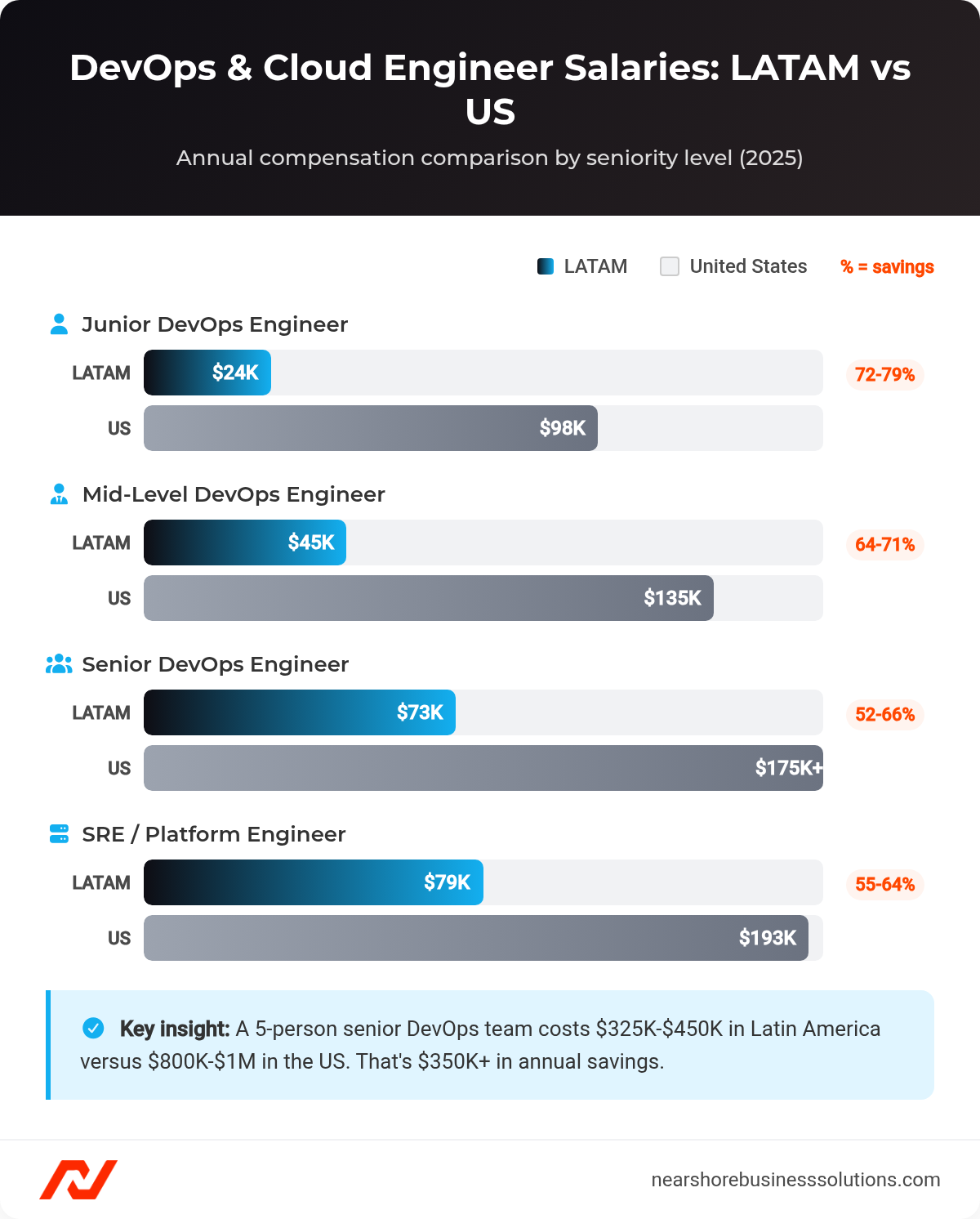
Annual DevOps and cloud engineer salaries in Latin America versus US equivalents, by seniority level (2025).
| Experience Level | LATAM Salary | US Salary | Savings |
|---|---|---|---|
| Junior DevOps | $18,000-$30,000 | $85,000-$110,000 | 72%-79% |
| Mid-Level DevOps | $35,000-$54,000 | $120,000-$150,000 | 64%-71% |
| Senior DevOps | $55,000-$90,000 | $160,000-$190,000+ | 52%-66% |
| SRE / Platform Engineers | $63,000-$95,000 | $175,000-$210,000+ | 55%-64% |
Total employer cost in Latin America runs $65,000-$90,000. The US equivalent is $160,000-$200,000. The average US company saves more than $30,000 per hire after all overhead and recruiting fees.
For a complete breakdown of LATAM hiring models, see our guide to hiring software developers in Latin America.
What Are the Time Zone Benefits of Hiring in Latin America?
Latin American time zones align within 0-3 hours of US business hours. India is 10-13 hours apart, causing late-night standups and average 21-day delays on complex projects.
| Country | Offset from EST | Best For |
|---|---|---|
| Mexico | 2 hours behind to aligned | West Coast and Central US |
| Colombia | 1 hour behind to aligned | New York and Miami |
| Argentina | 1 hour ahead | East Coast early-morning handoffs |
| Chile | 1 hour ahead | Synchronized US business hours |
| Brazil | 1-2 hours ahead | East Coast integration |
DevOps roles require real-time incident response. Latin American engineers join calls immediately when alerts fire.
Do Latin American DevOps Engineers Speak English?
Argentina ranks #26 globally for English proficiency. Uruguay ranks #34. Chile ranks #54. Most senior developers demonstrate B2 or C1 English levels. They explain complex architectures, write documentation, and debug issues in English. Latin American developers share Western business norms and direct communication styles.
Which Latin American Countries Have the Best DevOps and Cloud Engineering Talent?
Five countries provide the deepest DevOps and cloud talent pools in Latin America. Mexico and Brazil have the largest absolute numbers. Colombia grows fastest. Argentina offers the highest English proficiency.
| Country | Tech Professionals | Cloud Role Growth | Key Cities | Specializations | Hourly Rates |
|---|---|---|---|---|---|
| Mexico | 800,000+ (326K dev specialists) | 12%-15% YoY | Mexico City (553 startups), Guadalajara | AWS serverless, AI pipelines | $40-$70 |
| Colombia | 165,000 (62K dev specialists) | 14%-16% YoY | Medellín (100K+ engineers) | Cloud-native, distributed systems | $35-$60 |
| Argentina | 150,000 (115K dev specialists) | 11%-14% YoY | Buenos Aires (434 startups) | GCP, data engineering, ML | $35-$55 |
| Brazil | 540,000+ (500K dev specialists) | 10%-13% YoY | São Paulo (37.2% of regional data centers) | Azure, FinTech, compliance | $40-$65 |
| Chile | 100,000+ (61K-66K dev specialists) | 9%-12% YoY | Santiago | Multi-cloud, enterprise | $55-$90 |
Mexico: AWS dominates. Engineers focus on serverless architecture and AI-integrated pipelines using AWS Bedrock. Guadalajara is the “Silicon Valley of Mexico.” Tec de Monterrey and UNAM integrate cloud architecture into their computer science programs.
Colombia: Fastest-growing talent hub in South America. Amazon and Huawei operate R&D centers in Medellín. The AWS Skills to Jobs Tech Alliance actively builds certified specialists.
Argentina: Highest English proficiency (#26 globally). Specializes in GCP data engineering and machine learning. UBA produces AI and data engineering specialists. Buenos Aires hosts 434 startups.
Brazil: Largest talent pool. Strong Azure presence in regulated FinTech and government sectors. USP and UNICAMP lead in AI and distributed systems research. Note: CLT labor laws include a 40% severance penalty for termination without cause.
For country-specific hiring guides, see our guides to hiring in Mexico, hiring in Colombia, and hiring in Argentina.
What AWS Skills Should You Look for in Latin American DevOps Engineers?
AWS leads the cloud infrastructure market in Latin America with 31% share. Certifications command a 15%-25% salary premium. Latin American engineers rank among the most certified globally for their seniority tier.
Which AWS Certifications Are Most Valuable?
AWS Professional and Specialty certifications signal production-level competency. Look for AWS Certified Solutions Architect Professional or AWS Certified DevOps Engineer Professional. The AWS Skills to Jobs Tech Alliance in Brazil and Colombia trains specialists with hands-on production experience.
What AWS Services Should Engineers Be Proficient In?
- Serverless architecture: Mexican engineers excel here. Core services: Lambda, API Gateway, Step Functions, EventBridge.
- AWS Bedrock: Used for AI-integrated pipelines. Increasingly critical for companies building AI features.
- Kubernetes on EKS: Engineers manage clusters, auto-scaling, and service mesh architectures.
- Terraform: Appears in 55.8% of DevOps postings. Engineers provision AWS resources programmatically.
How Much Do Cloud Architects Earn in Latin America?
Cloud architect salaries are rising 12%-18% annually as specialized roles grow scarcer. Budget for higher retention costs as the market for AI and DevSecOps expertise tightens.
| Role Type | 2025 Salary | 2026 Projected | 2027 Projected |
|---|---|---|---|
| Cloud Architects (AWS/Azure) | $64,800-$94,800 | $72,000-$106,000 | $82,000-$122,000 |
| AI/ML Infrastructure Engineers | $69,600-$99,600 | $78,000-$110,000 | $92,000-$130,000 |
| DevSecOps Architects | $65,000-$95,000 | $74,000-$108,000 | $85,000-$125,000 |
What Azure Expertise Should Cloud Engineers in Latin America Have?
Azure holds 24% market share in Latin America. Brazil and Chile show the strongest Azure adoption among enterprise clients, particularly in regulated sectors like banking, healthcare, and government.
What Azure Certifications Demonstrate Competency?
Azure certifications command a 15%-25% salary premium. Look for Azure Solutions Architect Expert or Azure DevOps Engineer Expert certifications. Banks, government agencies, and healthcare organizations in São Paulo prefer Azure for compliance and Microsoft stack integration.
Which Azure Services Should Engineers Master?
- Hybrid cloud deployments: Engineers connect on-premise datacenters using ExpressRoute and Azure Arc. Critical for enterprises with existing infrastructure.
- Legacy Microsoft stack integration: Engineers modernize applications built on .NET, SQL Server, and Active Directory.
- Regulated sector compliance: Engineers configure Azure Policy, Security Center, and compliance reporting for HIPAA and Brazil’s LGPD.
What GCP Skills Are Important for Cloud Engineers in Latin America?
Google Cloud Platform holds 8-11% market share in Latin America. GCP grows fastest in Argentina and Uruguay. Engineers in Buenos Aires and Montevideo specialize in data engineering and machine learning workloads.
Which GCP Certifications Should You Prioritize?
GCP certifications command a 15%-25% salary premium. Look for Professional Cloud Architect or Professional Data Engineer certifications. UBA and Universidad de Chile both align data engineering and AI programs to GCP services.
What GCP Services Should Engineers Know?
- Data engineering: Engineers build pipelines using BigQuery, Dataflow, and Pub/Sub for petabyte-scale data processing.
- Machine learning: Engineers deploy models using Vertex AI and implement MLOps practices.
- AI-driven platforms: Argentine engineers excel at quantitative trading systems and risk analysis using GCP data and ML services.
What Are the Steps to Hiring DevOps Engineers in Latin America?
How Do You Define Your DevOps and Cloud Engineering Needs?
Start with your primary cloud platform. Analysis of 832 DevOps positions in H2 2025 shows Latin American technology stacks are consistent with Silicon Valley standards. Define whether you need AWS, Azure, or GCP specialization. Multi-cloud engineers command higher salaries but offer greater flexibility.
Should You Hire DevOps Engineers as Employees or Contractors?
The employment model affects total costs by 20-40%. Brazil provides a clear example of the difference.
| Employment Type | Base Salary | Statutory Benefits | Total Cost |
|---|---|---|---|
| PJ Contractor (1099 Equivalent) | $50,000 | $0 | $50,000-$60,000 |
| CLT Employee (W2 Equivalent) | $50,000 | ~$25,000 | $75,000+ |
The PJ model avoids the 13th-month salary, vacation bonuses, and FGTS. CLT includes these plus a 40% severance penalty for termination without cause. Choose contractors for short-term roles. Choose employees for core long-term team members.
Where Can You Find Qualified Latin American DevOps Engineers?
The regional talent pool exceeds 2 million tech professionals. Universities produce 220,000 STEM graduates annually across 437 institutions. The CVs-per-acceptance ratio is 8:1 versus 25:1 in the United States.
Source through regional job boards, tech communities, and specialized recruiting firms. LinkedIn has strong penetration in Mexico City, Buenos Aires, Medellín, Guadalajara, and São Paulo.
How Should You Screen and Assess DevOps Candidates?
- Verify AWS, Azure, or GCP certification credentials. Solutions Architect Professional or DevOps Engineer Professional certifications indicate production experience.
- Verify English proficiency at B2 or C1 level. Conduct the initial screening call in English.
- Review GitHub or GitLab profiles. Examine Infrastructure as Code repositories and CI/CD configurations. Code quality reveals practical expertise.
What Interview Questions Should You Ask DevOps Engineers?
- Conduct technical assessments on Kubernetes, Terraform, GitHub Actions, Grafana, and Python.
- Ask candidates to explain production architectures they have built.
- Present a production incident from your logs and ask how they would diagnose and resolve it.
- Request Infrastructure as Code examples. Evaluate code organization, documentation, and testing practices.
How Do You Structure Compensation for Latin American Engineers?
Senior DevOps engineers earn $55,000-$90,000 annually. Certification premiums add 15%-25% to base salary. Peg salaries to US dollars in volatile economies like Argentina to protect against devaluation. Total employer cost through an EOR runs $65,000-$90,000 including payroll taxes, benefits, and EOR service charges.
What Legal and Compliance Requirements Exist When Hiring in Latin America?
- The 2021 Mexican labor reform restricts outsourcing of core business functions. Comply with IMMEX and related regulations.
- Brazil’s CLT includes a 40% severance penalty for termination without cause. Factor this into workforce planning before hiring employees.
- Argentina requires mandatory benefit contributions of 25%-30% above base salary. The Knowledge Economy Law provides 15% reduced income tax for tech employers through 2029.
- An Employer of Record handles local tax, VAT, and mandatory benefits. This reduces compliance risk.
- High import taxes increase equipment costs by 50%-100% in Brazil and Argentina. Budget accordingly.
How Do You Onboard Remote DevOps Engineers Successfully?
Average ramp-up time is 2-4 weeks. Provide access to documentation, systems, and code repositories on day one. Annual retention runs 85%-98% in Latin America versus 60%-77% in the US. Average tenure is 2.5 years versus 1.8 years in the US.
- Include nearshore engineers in architecture decisions, on-call rotations, and team meetings.
- Assign a buddy for the first month to accelerate knowledge transfer.
- Schedule regular video calls during overlapping work hours.
Can You Hire Multi-Cloud Engineers Who Work Across AWS, Azure, and GCP?
Yes, multi-cloud engineers are available in Latin America. They concentrate among senior engineers in Mexico City, Buenos Aires, and São Paulo. These engineers manage workloads across all three major platforms.
What Are the Benefits of Hiring Multi-Cloud Specialists?
Multi-cloud specialists reduce vendor lock-in. They design portable architectures that shift workloads between clouds based on pricing or compliance requirements. Brazil holds 37.2% of Latin America’s data center market. Engineers managing hybrid architectures across multiple providers become more valuable as this footprint expands.
How Common Are Multi-Cloud Engineers in Latin America?
The rate of certification per capita among senior engineers surged between 2022 and 2025. Multi-cloud expertise concentrates among senior engineers. Junior and mid-level engineers typically specialize in one platform first. Source multi-cloud talent primarily from Mexico City, Buenos Aires, Guadalajara, and São Paulo.
How Do You Manage Remote DevOps Teams in Latin America?
What Tools Enable Effective Collaboration with Latin American Engineers?
Latin American DevOps teams use the same collaboration tools as US teams. No special adaptation is required.
- GitHub Actions: 38.5% adoption for CI/CD pipelines. Enables automated deployments and testing workflows.
- Grafana: 35.1% adoption for monitoring and observability. Teams share dashboards and alert configurations in real-time.
- AI tools like GitHub Copilot: Over 65% of teams integrate AI coding assistants into daily workflows. This accelerates infrastructure code development.
- Agile methodology: Over 65% adoption rate. Teams participate in sprints, standups, and retrospectives using tools like Jira and Linear.
How Do You Handle Time Zone Differences with LATAM Teams?
The 0-3 hour timezone window enables synchronous collaboration. Latin American engineers join incident calls immediately when alerts fire during normal US business hours. Use Slack threads and documentation for non-urgent topics.
What Are Best Practices for Remote Team Communication?
- Treat nearshore teams as core parts of your engineering organization. Include them in architectural decisions, not just implementation tasks.
- Document decisions and architectural patterns in writing. Written documentation keeps local and remote team members aligned.
- Establish clear on-call rotations. Distribute after-hours responsibilities fairly between US and Latin American team members.
What Are Common Challenges When Hiring DevOps Engineers in Latin America?
How Do You Overcome Potential Language Barriers?
Focus hiring in Argentina (#26 globally for English proficiency), Uruguay (#34), or Chile (#54). These countries have the strongest English education systems in the region.
Verify B2 or C1 English level during screening. Conduct initial calls in English. Most senior developers from Buenos Aires, Medellín, and Mexico City participate effectively in technical discussions and write clear documentation in English.
What Legal Complexities Should You Prepare For?
- The 2021 Mexican labor reform restricts outsourcing of core business functions. Comply with IMMEX and related regulations.
- Brazil’s CLT imposes a 40% severance penalty for termination without cause. Factor this into workforce planning before committing to employee contracts.
- Use an Employer of Record to manage local tax residency, VAT, and mandatory benefits. EORs handle payroll taxes and compliance reporting.
How Can You Ensure Quality Across Distributed Teams?
Latin American engineers train at top universities. USP leads in AI and distributed systems research. UNAM and Tec de Monterrey specialize in cloud architecture. UBA focuses on data engineering and AI. Google, Dell, HP, Uber, and Meta operate development centers in Latin America and hire local talent for production systems.
Annual turnover runs 2%-8% for well-managed teams versus 23% US average. Stable teams build deeper expertise in your specific infrastructure.
What Is the Hiring Timeline for DevOps Engineers in Latin America?
How Fast Can You Hire Through Recruitment Agencies?
Average time-to-hire is 8-21 days in Latin America versus 30-60 days in the United States. Recruitment agencies maintain pre-screened talent pools with verified cloud certifications.
The CVs-per-acceptance ratio is 8:1 versus 25:1 in the United States. You evaluate fewer candidates but close positions faster. Ramp-up time averages 2-4 weeks.
What Factors Affect the Time to Hire?
- Senior engineers with niche expertise take longer to source than mid-level generalists.
- Professional-level certifications (AWS, Azure, GCP) are less common than Associate-level and narrow the candidate pool.
- C1 English speakers are less common than B2-level speakers.
- Hiring in major hubs (Mexico City, São Paulo, Buenos Aires, Medellín) is faster than smaller cities.
What Companies and Platforms Help You Hire Latin American DevOps Talent?
Which Recruitment Agencies Specialize in LATAM Tech Talent?
Three specialized agencies demonstrate what vetted LATAM DevOps teams deliver in production:
- AssureSoft: 100+ nearshore experts across DevOps, SysOps, and NetOps. Modernized LAMP-based healthcare software for a US provider serving 77,500 members and 10,400 clinics. They transitioned the platform to Kubernetes, Rancher, and Terraform on AWS with HIPAA and PCI compliance.
- Computools: FinTech implementations with PCI DSS compliance. Implemented Visa microservices for a Caribbean bank, achieving a 12% market share increase among younger demographics.
- Mismo: Connects US startups with the top 1% of pre-vetted engineers. Clients like AngelList achieved 40%-60% savings versus US hiring costs while maintaining high deployment velocity.
How Do Latin American DevOps Engineers Compare to Other Regions?
What Is the Difference Between Hiring in Latin America vs. Eastern Europe?
Latin America offers 0-3 hour timezone overlap versus significant delays with Eastern Europe. Real-time collaboration is possible throughout the US business day.
The traditional offshore model is viewed as a source of operational friction. Sixty percent of organizations expect skilled professional shortages in 2025, making Latin America’s accessible talent pool a competitive advantage.
How Does Latin American Talent Compare to Hiring in India?
| Factor | Latin America | India |
|---|---|---|
| Time Zone Offset from US | 0-3 hours | 10-13 hours |
| AWS Market Share | 31% | ~28% |
| Azure Market Share | 24% | ~25% |
| GCP Market Share | 8-11% | ~10% |
| Certification Premium | 15%-25% | 20%-30% |
| Project Delays | Minimal (real-time collaboration) | Average 21 days for complex projects |
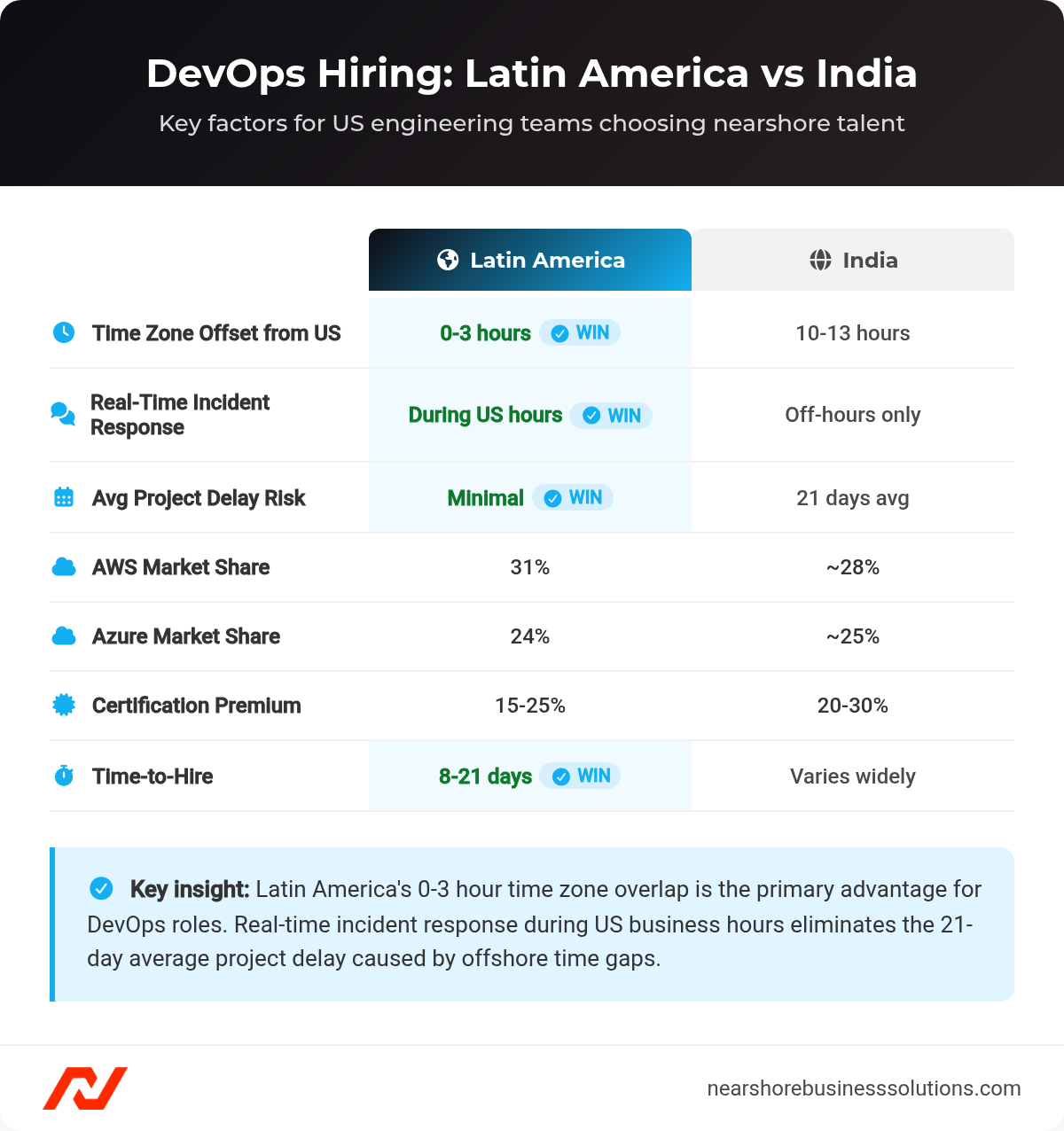
Key DevOps hiring factors compared between Latin America and India for US engineering teams.
India operates 10-13 hours apart from US time zones. This leads to late-night standups and project delays for initiatives requiring real-time collaboration. Latin American engineers join incident calls during normal US business hours.
Certification density in Latin America is comparable to India with a high Professional-level focus. The primary advantage is timezone alignment for DevOps roles that require immediate response.
What Salary Ranges Should You Expect for DevOps and Cloud Engineers in Latin America?
DevOps and cloud engineering salaries are rising 12%-18% annually in Latin America. Budget for these increases when planning multi-year team costs.
| Experience Level | Annual Salary | US Comparison | Savings |
|---|---|---|---|
| Junior DevOps Engineers | $18,000-$30,000 | $85,000-$110,000 | 72%-79% |
| Mid-Level DevOps Engineers | $35,000-$54,000 | $120,000-$150,000 | 64%-71% |
| Senior DevOps Engineers | $55,000-$90,000 | $160,000-$190,000+ | 52%-66% |
| AI/ML Infrastructure Engineers | $69,600-$99,600 | N/A | N/A |
| DevSecOps Architects | $65,000-$95,000 | N/A | N/A |
Country-specific hourly rates for 2025:
- Chile: $55-$90/hour (highest in region)
- Mexico: $40-$70/hour
- Brazil: $40-$65/hour
- Colombia: $35-$60/hour
- Argentina: $35-$55/hour (most competitive)
Specialized roles see 12%-18% salary increases for 2025-2026. AI/ML Infrastructure Engineers are forecast to earn $92,000-$130,000 by 2027. DevSecOps Architects are projected at $85,000-$125,000 by 2027.
Is Remote Work Sustainable for DevOps Projects with Latin American Teams?
What Infrastructure Do You Need to Support Remote Engineers?
High-speed broadband is available in Medellín, Mexico City, Buenos Aires, and São Paulo. Hire engineers in major metro areas. Rural areas have latency issues that affect real-time DevOps monitoring. Provide backup internet solutions for critical team members.
How Do You Maintain Productivity and Engagement?
Annual retention runs 85%-98% versus 60%-77% in the US. Average tenure is 2.5 years versus 1.8 years in the US. Invest in career development and treat remote engineers as core team members, not isolated contractors.
Frequently Asked Questions About Hiring DevOps Engineers in Latin America
These are the most common questions US tech leaders ask about hiring DevOps and cloud engineers in Latin America.
How Long Does It Take to Hire a DevOps Engineer in Latin America?
Average time-to-hire is 8-21 days through a specialized recruitment agency. Agencies maintain pre-screened talent pools with verified AWS, Azure, or GCP certifications. Ramp-up time averages 2-4 weeks after hiring.
What If a DevOps Engineer Does Not Work Out?
Nearshore Business Solutions provides a 90-day replacement guarantee on all placements. Annual retention runs 85%-98% for well-managed Latin American teams. Lower turnover than US equivalents means you hire and retrain less frequently.
Do I Need to Provide Equipment for Latin American Engineers?
You can provide equipment or use a hardware stipend. Import taxes on electronics increase equipment costs by 50%-100% in Brazil and Argentina. A laptop that costs $1,500 in the US may cost $2,500-$3,000 locally. Most companies provide a stipend rather than shipping equipment.
How Do I Pay DevOps Engineers in Latin America?
Most US companies pay through an Employer of Record or direct contractor agreements. EOR fees add 10%-20% to base salary but handle all local tax, benefits, and compliance. Direct payments via platforms like Deel are common for PJ contractors in Brazil.
What Is the Difference Between Nearshore and Offshore DevOps Teams?
Nearshore teams in Latin America operate within 0-3 hours of US time zones. Offshore teams in India are 10-13 hours apart. DevOps roles require real-time incident response: nearshore engineers join calls during normal US business hours. Offshore engineers respond outside their normal hours, increasing burnout and response times.
Do I Need a Local Entity to Hire DevOps Engineers in Latin America?
No. An Employer of Record handles local employment, tax, and compliance without a legal entity. EORs operate in all major Latin American countries and onboard engineers within 1-2 weeks of contract signing.
What Security and Compliance Frameworks Do Latin American Engineers Know?
Brazilian engineers are familiar with LGPD. Colombian engineers work with Law 1581. Healthcare engineers hold HIPAA certifications. FinTech engineers have PCI DSS experience. Key cloud security certifications include AWS Certified Security Specialty, Azure Security Engineer Associate, and GCP Professional Cloud Security Engineer.
Ready to Build Your Latin American DevOps Team?
Nearshore Business Solutions sources and vets DevOps and cloud engineers from Mexico City, Guadalajara, Buenos Aires, Medellín, and São Paulo. We screen for technical skills, English fluency, and US work style fit. Our acceptance rate is 16%.
Every placement includes a 90-day replacement guarantee. You receive pre-vetted candidates with verified AWS, Azure, or GCP certifications in 2-4 weeks.
Get a free consultation to discuss your DevOps hiring needs and receive a custom quote.