
Remote team engagement with LATAM developers cuts annual attrition from 35-40% (US average) to 15-20%, and extends average tenure from 14 months to 24+ months.
LATAM developers in Mexico City, Bogotá, Buenos Aires, São Paulo, and Santiago work within 0-3 hours of US time zones. Senior engineers cost $60,000-$90,000 annually, compared to $150,000-$210,000 in the US. But cost savings evaporate fast when engagement breaks down and developers leave at 12-14 months.
This guide gives CTOs and engineering leaders the operational framework to keep LATAM developers motivated past two years. You’ll find country-specific engagement drivers, 90-day onboarding structure, communication practices, compensation requirements, and the KPIs that predict retention before attrition becomes visible.
Why Do LATAM Developers Disengage from Remote Teams?
Disengagement in LATAM engineering teams costs $38,500+ per mid-senior developer departure, and most departures are preventable. Three friction points drive the majority of exits: schedule violations, cultural invisibility, and missing career paths.
How Does Time Zone Overlap Affect Motivation?
The 0-3 hour overlap between LATAM and US time zones enables real-time collaboration, but 45% of remote developers report higher daily stress than on-site peers. The primary cause is “meeting creep”: syncs and Slack pings that extend into evening hours and destroy developer focus blocks.
Teams that enforce clear focus blocks and respect local end-of-day boundaries consistently outperform those that treat time zone proximity as permission for constant availability. Engineers in Bogotá, Mexico City, and Buenos Aires have some of the best US overlap in global nearshoring. Mismanaging that overlap is a self-inflicted retention problem.
What Role Does Cultural Disconnect Play in Developer Burnout?
Cultural disconnect cancels out your AI tooling ROI. While 68% of developers save 10+ hours per week using AI tools, 50% lose those same hours to organizational dysfunction: unclear direction, tool sprawl, and information silos.
The “ghost in the machine” effect is the most common disengagement trigger. Developers feel like a Slack handle, not a team member. This intensifies when architecture decisions happen in HQ-only meetings, and LATAM engineers receive only bug fixes while US counterparts own new feature development. The fix is structural ownership, not team-building sessions.
How Do Compensation and Growth Gaps Lead to Turnover?
US tech teams churn at 35-40% annually, with average developer tenure at 14 months. LATAM nearshore models cut that to 15-20% attrition and 24+ month tenures, but only when compensation and growth signals are right.
The departure trigger is rarely salary alone. Top LATAM talent in Mexico and Brazil actively evaluates whether a role offers a path to Staff Engineer or Architect. When that path is absent, you are not retaining talent. You are renting it. When remote workers are both engaged and socially thriving, the share actively job-hunting drops from 57% to 38%. That 19-point gap is recoverable with deliberate action.
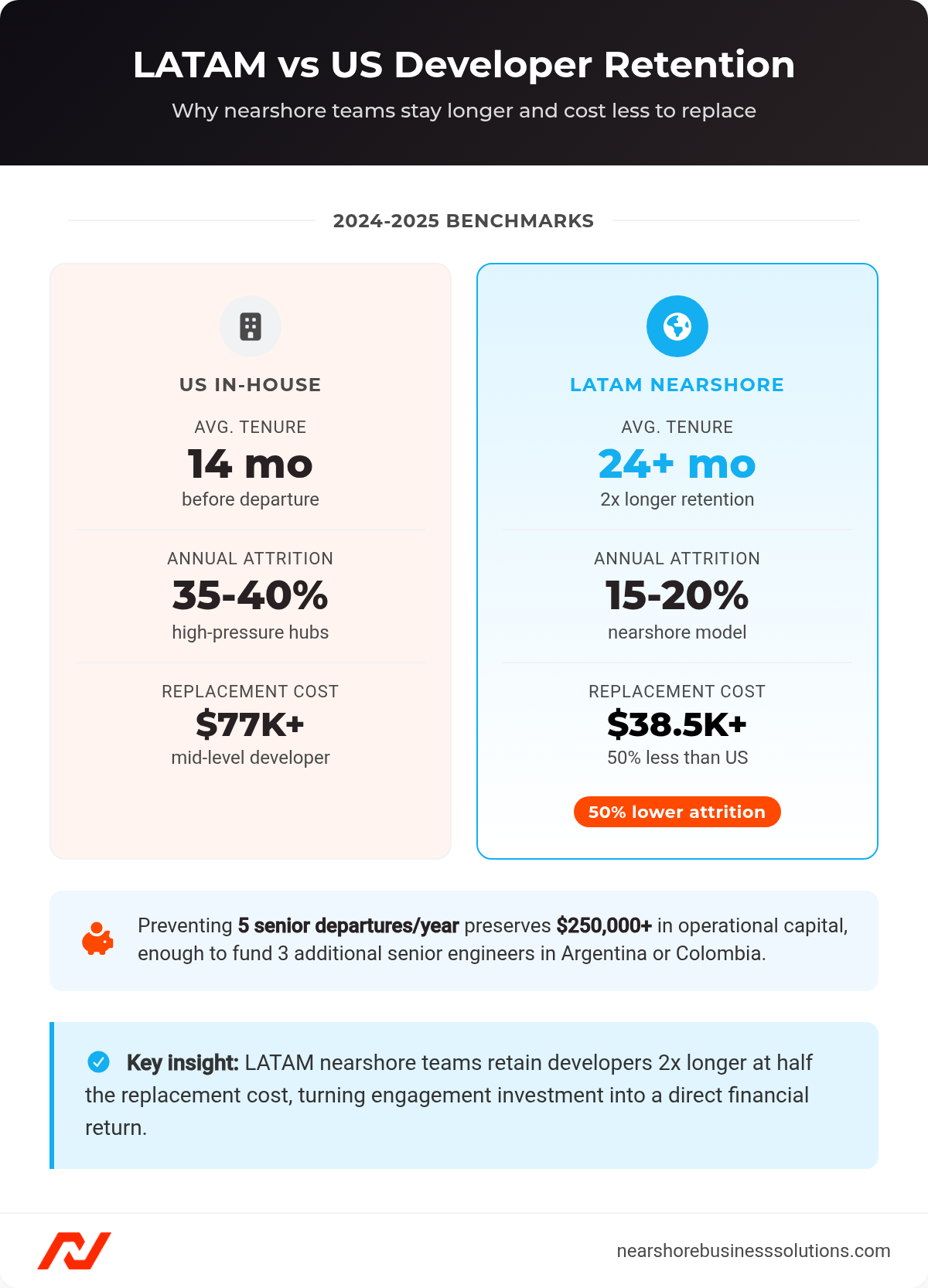
LATAM nearshore teams achieve 24+ month average tenure versus 14 months for US in-house developers.
What Makes Engaging LATAM Developers Different from Other Remote Talent?
LATAM is not a monolith. Treating it as one is the fastest way to mismanage your distributed team. Each country carries distinct labor laws, cultural hierarchy norms, and communication preferences that require adapted management, not a copy-paste of your US playbook.
How Do Work Culture Norms Differ Across LATAM Countries?
Each LATAM country presents distinct operational requirements for engagement:
| Country | Key Labor Nuance | Public Holidays/Year | Top Engagement Driver |
|---|---|---|---|
| Argentina | USD-linked pay essential due to inflation | 15-18 | USD salary stability (5/5) |
| Mexico | 20% min wage increase in 2024; USD-focused tech sector | 7-9 | Career growth + time zone sync (5/5) |
| Brazil | Complex CLT laws; EOR required for compliance | 11-13 | Social connection (5/5) |
| Colombia | Transitioning to 42-hr workweek by 2026 | ~18 | Career growth + work-life balance (4/5) |
| Chile | 40-hr workweek law; Data Science and Cybersecurity focus | ~16 | Work-life balance (5/5) |
Calendar planning alone, accounting for 7-18 public holidays per country, requires intentional sprint management that most US teams underestimate. For context on hiring in each market, see our guide to hiring software developers in Latin America.
What Communication Styles Are Common Among LATAM Developers?
Two patterns define LATAM communication in distributed settings, and both require active management.
First, hierarchy deference. Junior developers in many LATAM cultures are less likely to push back or volunteer dissenting opinions. If only senior engineers speak in retrospectives, you have a structural problem, not a talent problem. Explicitly soliciting input from junior team members is a management requirement, not a courtesy.
Second, sync preference. Pure async-only workflows underperform with LATAM teams. Unlike offshore models common in Asia, LATAM developers in cities like Medellín, Santiago, and Buenos Aires prioritize real-time pairing and social connection. Async tools work best as supplements to synchronous rituals, not replacements for them.
How Can You Build a Long-Term Motivation Strategy for LATAM Remote Teams?
Long-term motivation is an engineered system, not a cultural vibe. It requires defined pillars, measurable goals, and psychological safety baked into daily operations.
What Are the Core Pillars of Sustainable Remote Engagement?
The companies with the lowest LATAM attrition, including Walrus Health, Jeeves, and Twilio, share one shift: they abandoned the vendor-managed model and treated LATAM engineers as core team. Jeeves (a16z-backed) filled critical FinTech roles across Colombia, Brazil, and Mexico this way. The architecture decision that precedes everything else is whether these developers are central to your product or peripheral to your headcount.
How Do You Set Clear Goals That Keep LATAM Developers Invested?
Effective OKRs for the first 60 days should be calibrated to ramp-up, not compressed to full velocity. Three concrete targets work well:
- 90% code review approval rate by Day 30
- At least two documentation contributions by Day 45
- 3-4 story points per sprint by Day 90
By Day 61-90, developers should be in on-call rotations and cross-team design sprints. That integration is not ceremonial. It signals they are a full engineering stakeholder, not a contractor on trial.
Why Does Psychological Safety Matter for Long-Term Retention?
In workplaces with high psychological safety, retention for diverse groups increases by up to six times. For distributed LATAM teams, the DEI risk is geographic, not just demographic. A developer in Colombia who perceives their architecture input as less valued than a San Francisco peer’s will quietly disengage before they formally resign.
Standardized, metric-based performance reviews eliminate proximity bias. The EqualEngineers framework shows that inclusion-focused culture reduces stress and absenteeism while improving operational resilience. Psychological safety is a retention lever with a measurable six-times multiplier.
What Communication Practices Keep LATAM Developers Engaged?
Communication structure determines whether your distributed team operates as an integrated unit or a fragmented contractor pool. The tooling matters less than the discipline around it.
How Often Should Remote Teams Hold Syncs with LATAM Members?
1:1 cadence should split 50% on technical blockers and 50% on integration and wellbeing. The second half is where disengagement signals surface before they become attrition. Managers who only discuss tickets miss the early warnings.
At the team level, enforce “no-Slack zones” and Do Not Disturb blocks. Context switching is a top-three productivity killer. Every unstructured interrupt during deep work is a small tax on developer satisfaction that compounds over quarters.
Which Async Communication Tools Work Best Across Time Zones?
Two tools carry disproportionate weight in high-retention LATAM teams:
- Loom delivers asynchronous code reviews and architecture walkthroughs. It provides the context of a meeting without scheduling friction. Particularly effective for complex technical feedback that loses nuance in text.
- Notion or Confluence serves as the single source of truth. In distributed teams across Mexico City, São Paulo, and Buenos Aires, undocumented decisions functionally do not exist. Documentation quality directly determines how effectively LATAM developers operate during non-overlap hours.
How Do You Prevent LATAM Developers from Feeling Invisible on Global Teams?
Twilio’s integration of Colombian and Brazilian engineers into core QA and development, without Silicon Valley location requirements, is the operational model. Visibility is created through ownership, not presence.
Three concrete interventions prevent invisibility:
- Assign LATAM developers to high-impact features, not just maintenance queues
- Include engineers from Bogotá, Medellín, and São Paulo in architecture decision records (ADRs)
- Ensure equal access to mentorship relationships across all geographies
If your LATAM team only sees bug backlogs, you are building a churn pipeline. For strategies on building distributed teams that stick, see our guide to hiring in Colombia.
How Does Career Growth Drive Long-Term Motivation?
Career trajectory is the primary retention variable for senior LATAM talent. Compensation gets them in the door. Growth keeps them past 24 months.
What Learning and Upskilling Opportunities Do LATAM Developers Value Most?
GenAI enrollment in Latin America has surged 425%, the fastest growth rate globally. This is a workforce aggressively investing in AI-native skills. Companies that provide structured access to AI tooling, internal learning budgets, and exposure to modern stacks position themselves as career accelerators, not just employers.
Country-level signals reinforce this: Chile’s tech community in Santiago and Valparaíso centers on Data Science and Cybersecurity. Colombia’s developer community in Medellín and Bogotá has a strong JavaScript ecosystem. Aligning learning opportunities to local specializations, including programs through institutions like Tecnológico de Monterrey (ITESM) in Mexico and Universidad de los Andes in Colombia, accelerates both skill development and cultural fit.
How Can You Create Clear Promotion Paths for Remote LATAM Engineers?
For a senior developer in Mexico or Brazil, a US SaaS or FinTech engagement often represents the top of the local career market, placing them in the top earning percentile domestically. That context means your promotion architecture carries more weight than it does for a US-based hire with ten comparable options.
The shift LATAM talent is making is from cost-of-living arbitrage to professional parity. They are not accepting Staff Engineer titles as consolation. They are targeting them as the point of the engagement. Build visible, milestone-based promotion tracks or your competitors will.
What Mentorship Models Work Well for Distributed LATAM Teams?
Two structured models perform consistently for LATAM onboarding:
Buddy System (Day 1-14): Pair the incoming LATAM developer with a US-based peer. Purpose is informal knowledge transfer and cultural navigation, not performance evaluation.
Architecture Deep Dives (Day 15-30): Structured sessions covering microservices mapping and API documentation. This moves the developer from “running tasks” to “understanding the system,” the prerequisite for ownership and long tenure.
Both models signal investment in the developer’s context, not just their output.
How Do Recognition and Compensation Impact LATAM Developer Retention?
Compensation is the foundation. Recognition is the structure built on top. Both need to be calibrated to regional realities, not US assumptions.
What Forms of Recognition Resonate Most with LATAM Developers?
“Emotional compensation” is measurable and growing. Mexican and Brazilian developers weight flexible work arrangements and wellness benefits, including gym memberships and mental health stipends, comparably to their US counterparts. These are not perks in the LATAM market. They are increasingly baseline expectations.
Country-specific calibration:
- Chile: Work-life balance is rated 5/5 in criticality for retention
- Colombia: Work-life balance and social connection both rated 4/5
- Brazil: Social connection rated 5/5; team cohesion directly affects retention
How Should You Structure Competitive Pay for LATAM Remote Talent?
The total cost of ownership (TCO) for a LATAM senior developer runs 40-50% below US equivalents, but only when you budget for mandatory benefits from day one:
| Cost Component | LATAM Senior Dev ($70K base) | US Senior Dev ($175K base) |
|---|---|---|
| Base Salary | $70,000 | $175,000 |
| Mandatory Benefits + Social | ~$21,000 (30%) | ~$52,500 (30%) |
| Total Annual TCO | ~$95,000 | ~$227,500+ |
| Savings | 40-50% vs. US equivalent | N/A |
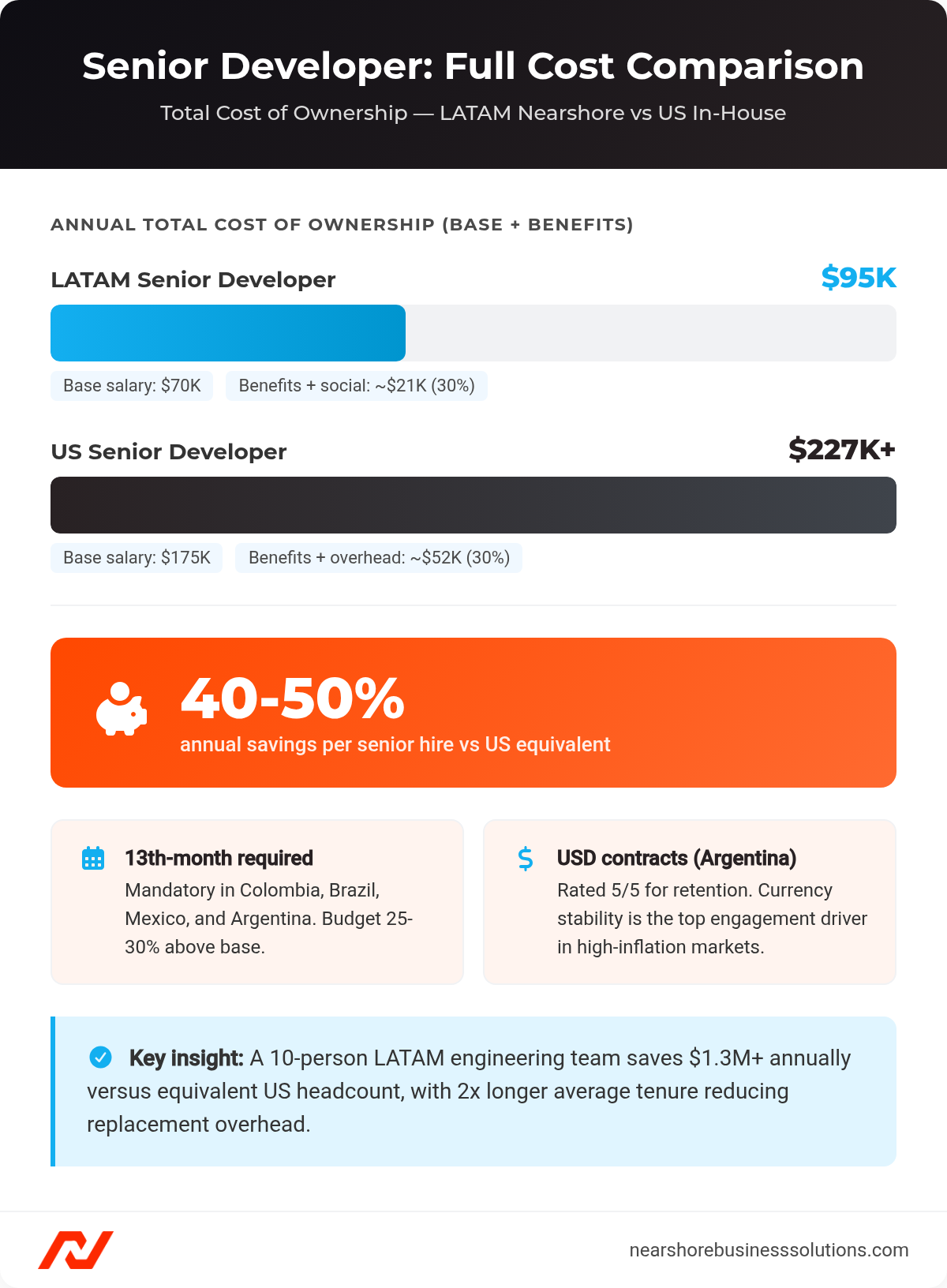
Senior developer total cost of ownership: LATAM nearshore at $95K annually versus $227K+ for US in-house.
Colombia’s social contributions alone can reach 30%. Argentina requires USD-linked contracts (rated 5/5 for retention) due to high inflation. Budget the fully-loaded cost from the start, not after your first renewal conversation.
Are Equity and Performance Bonuses Effective Motivators in LATAM Markets?
The 13th-month payment is a legal obligation in most of LATAM, not a bonus. Missing these payments damages professional trust in a way that compensation adjustments rarely repair:
- Colombia (Prima de Servicios): Two installments, June and December
- Brazil (13o Salario): Paid by November 30 and December 20
- Mexico (Aguinaldo): Mandatory by December 20
- Argentina (SAC): Two installments annually
Beyond compliance, USD-linked contracts in Argentina carry a retention criticality of 5/5. In high-inflation economies, currency stability is the most powerful retention instrument available. For compliance details on Mexico specifically, see our guide to hiring in Mexico.
How Can Team Culture Strengthen Remote Engagement?
Culture in distributed teams is not ambient. It is architected. The teams with the lowest LATAM attrition treat belonging as an engineering problem with measurable outputs.
How Do You Foster a Sense of Belonging Across Distributed LATAM Teams?
Walrus Health treats Brazilian developers in São Paulo as a substantial portion of the core team, not an external resource. The result: maintained innovation velocity in a regulated industry while mitigating US senior talent costs.
The geographic DEI risk is real. When a developer in Colombia perceives their input as less valued than a San Francisco peer’s, engagement scores drop and quiet quitting follows. The fix is structural: equal access to high-impact work, architecture decisions, and growth opportunities. Periodic team-building sessions do not close that gap.
What Virtual Team-Building Activities Work for LATAM Developer Groups?
Invest in cultural ambassadors: team members who bridge context between US and LATAM engineers in both directions. Regular sync rituals, including weekly team socials and async celebration of wins, create the social infrastructure that prevents isolation.
High-performing LATAM developers in Bogotá, Guadalajara, Buenos Aires, and Santiago adapt well to async-first workflows when documentation quality is high. The failure mode is not async itself. It is async without documentation, which leaves developers operating in an information vacuum during non-overlap hours.
How Do Local Holidays and Cultural Moments Factor Into Team Planning?
Holiday calendars vary significantly across LATAM and must be integrated into sprint planning:
| Country | Public Holidays/Year |
|---|---|
| Mexico | 7-9 |
| Brazil | 11-13 |
| Chile | ~16 |
| Argentina | 15-18 |
| Colombia | ~18 |
Ignoring these creates two compounding problems: missed sprint velocity and a signal to the developer that their local context is invisible to leadership. Neither is recoverable cheaply.
What Management Practices Best Support LATAM Developer Motivation?
Management quality is the single highest-leverage variable in LATAM retention. Tooling and compensation create the conditions. Management determines whether developers stay past 18 months.
How Should Remote Managers Adapt Their Leadership Style for LATAM Teams?
Micromanagement is the primary demotivator for senior LATAM talent. Jira and Monday Dev are velocity tools, not surveillance systems. Using them as the latter is a reliable path to losing your best engineers in Mexico City, São Paulo, and Buenos Aires.
Hierarchy norms require an active counter-strategy. LATAM developers, especially at junior and mid-levels, may self-censor dissent in retrospectives and design reviews. Managers must explicitly create space for pushback and treat that input as high-signal, not insubordination.
What Does Effective One-on-One Coaching Look Like for Remote LATAM Developers?
Replacing a LATAM mid-senior developer with a $60,000 salary costs $38,500+:
- Recruitment fees: $10,000
- Leadership time: $5,000
- Onboarding investment: $3,500
- Productivity loss during ramp-up: $20,000
Preventing five senior departures in a year preserves $250,000+ in operational capital. That is enough to fund three additional senior engineers in Argentina or Colombia. The math makes 1:1 investment non-optional.
How Do You Measure Engagement and Spot Early Warning Signs of Disengagement?
Two metrics provide early warning before attrition becomes visible:
Developer Experience Index (DXI): A composite friction score. High DXI correlates directly with retention and reduced burnout risk. Track it quarterly.
eNPS (Engineering Net Promoter Score): Measures whether developers would recommend your organization to peers. Target: above 60. Scores below 40 indicate a retention problem already in motion.
Both metrics belong on your executive engineering dashboard alongside DORA metrics, not in a quarterly HR report.
What Tools and Processes Help Sustain Remote Team Engagement?
The right tools reduce friction. The right processes convert that reduced friction into retention. Neither works without the other.
Which Project Management Platforms Support LATAM Developer Workflows?
High-functioning distributed teams hit these benchmarks:
| KPI | Target Benchmark | Business Impact |
|---|---|---|
| Cycle Time (Commit to Deploy) | Under 24 hours | Product velocity |
| Change Failure Rate | Under 15% | System stability |
| eNPS | Above 60 | Talent retention |
| AI Time Savings | 3.6-4.1 hrs/week | Resource ROI |
| Focus Time | 60% of workday | Developer burnout prevention |
Focus block duration, targeted at 2+ uninterrupted hours, is both a productivity metric and a leading indicator of team health. Track it.
How Can Onboarding Processes Set the Foundation for Long-Term Motivation?
Onboarding determines whether the first 90 days build momentum or create early churn. The high-retention playbook:
- Day -7 to Day 0: Ship hardware (minimum 16GB RAM). All credentials functional before start date. Eliminate Day 1 anxiety.
- Day 1-14: First Commit Rule. Every new hire pushes code to a non-production environment by Day 3. Immediate self-efficacy is the goal. Failure to feel productive in the first two weeks exponentially increases early-tenure turnover.
- Day 15-30: Architecture Deep Dives. System context before solo ownership.
- Day 31-60: First self-contained feature. OKRs calibrated to ramp-up, not full velocity.
- Day 61-90: On-call integration and cross-team design sprint participation. Full team membership signaled.
How Do Feedback Loops and Retrospectives Keep LATAM Teams Aligned?
LATAM nearshore teams that complete structured onboarding achieve 24+ month tenures and 15-20% annual attrition, compared to 35-40% in US tech hubs. That differential, sustained across a 10-person team, represents hundreds of thousands in preserved operational capital annually.
AI tooling benchmark: high-performing teams capture 3.6-4.1 hours per week in AI time savings. Tracking this as a KPI validates tooling ROI and identifies teams where organizational dysfunction is consuming the gains. If developers are saving 10 hours to AI and losing 10 hours to process chaos, the retrospective agenda is already written.
Frequently Asked Questions About Remote LATAM Developer Engagement
These are the most common questions engineering leaders ask about keeping LATAM developers motivated long-term.
How Long Does It Take to See Results from an Engagement Program?
Engagement improvements typically show in eNPS and DXI scores within 60-90 days of structural changes. Onboarding improvements produce measurable early-tenure retention within one hiring cycle, approximately 3-6 months after implementation.
What If a LATAM Developer Does Not Work Out?
With Nearshore Business Solutions, every placement includes a 90-day replacement guarantee. If a developer is not the right fit, we source and place a replacement at no additional cost. Most issues surface in the first 30 days if the First Commit Rule and buddy system are not followed.
Do I Need to Provide Hardware to LATAM Developers?
Yes. Ship hardware with a minimum 16GB RAM at least five to seven days before the start date. Developers in Buenos Aires, Bogotá, and Mexico City who receive hardware before Day 1 report significantly lower early-tenure friction. Equipment delays on Day 1 are a leading cause of early disengagement.
How Do I Pay LATAM Developers Compliantly?
Payment structure depends on country. Brazil requires an Employer of Record (EOR) due to complex CLT laws. Argentina works best with USD-linked contracts. Colombia and Mexico have more flexible engagement options. Most US companies use EOR services or professional employer organizations to handle mandatory contributions, 13th-month payments, and local compliance.
What Is the Difference Between Nearshore and Offshore Engagement?
Nearshore (LATAM) offers 0-3 hour time zone overlap with the US, enabling real-time collaboration. Offshore (Asia) typically involves 8-12 hour gaps that force async-only workflows. LATAM developers also show stronger preference for synchronous pairing and social connection, which drives higher retention when managed correctly.
Do I Need a Local Legal Entity to Hire in LATAM?
No. EOR providers handle local employment contracts, payroll, and benefits without requiring you to set up a legal entity. This is the standard model for US companies hiring in Brazil, Colombia, Argentina, Mexico, and Chile.
How Do I Know If My LATAM Team Is Disengaging Before They Resign?
Track eNPS quarterly. Scores below 40 indicate active retention risk. Monitor DXI for rising friction. Watch for reduced PR volume, decreased participation in retrospectives, and declining documentation contributions. These are leading indicators, not lagging ones.
What Does a Long-Term Remote Engagement Strategy for LATAM Developers Look Like?
A long-term LATAM engagement strategy is a financial infrastructure decision disguised as a people strategy.
The inputs are quantifiable: 24+ month tenures, 15-20% attrition, $95,000 TCO versus $227,500+ for a US equivalent. The outcomes are measurable: DXI scores, eNPS above 60, cycle times under 24 hours, focus blocks at 60% of the workday.
The execution framework collapses to five decisions:
- Treat LATAM as core team. Assign high-impact features and architecture decisions to engineers in Bogotá, Mexico City, Buenos Aires, São Paulo, and Santiago, not just maintenance queues.
- Comply with local law from day one. 13th-month payments, social contributions, and workweek laws are not negotiable. Missing them breaks professional trust that compensation adjustments will not rebuild.
- Fix the developer environment before adding tools. AI saves 10 hours per week. Organizational dysfunction spends them. DevEx investment precedes tooling investment.
- Build visible promotion tracks. LATAM engineers are targeting Staff Engineer and Architect trajectories. Career architecture is a retention instrument.
- Measure what matters. DXI, eNPS, focus block duration, and cycle time belong on your engineering dashboard. Engagement problems that appear in these metrics are recoverable. Engagement problems that appear as resignation letters are not.
The LATAM talent pool is scaling, upskilling at the fastest GenAI adoption rate globally (425% growth), and actively seeking US partnerships that treat them as professional equals. Companies that build the operational infrastructure to match that ambition will compound their engineering capacity efficiently. Those that do not will pay US replacement costs to find out why.
Ready to Build Your LATAM Engineering Team?
Nearshore Business Solutions sources and vets developers from tech hubs across Mexico, Colombia, Argentina, Brazil, and Chile. We screen for technical skills, English fluency, and US work style fit. Our acceptance rate is 16%.
Every placement includes a 90-day replacement guarantee. You receive pre-vetted candidates in 2-4 weeks.
Get a free consultation to discuss your engagement strategy and receive a custom quote.