
Hiring backend developers in Latin America saves 55-68% versus US rates while accessing a 2.6M+ developer pool trained in Python, Node.js, and Java.
LATAM backend developers cost $53,000-$63,000 gross annually versus $140,000-$180,000+ in the US. Time zones overlap 6-8 hours with US business hours. Brazil, Mexico, Argentina, and Colombia lead in senior talent for the most in-demand backend stacks.
We connect you with vetted backend developers from São Paulo’s FinTech district, Buenos Aires’ Python specialist hubs, Mexico City’s cloud engineering ecosystem, and Medellín’s Ruta N innovation complex. Below you’ll find stack-specific salary benchmarks, country-by-country talent maps, hiring models, legal compliance requirements, and a step-by-step hiring process.
Why Are Companies Hiring Backend Developers in Latin America?
LATAM is the default nearshore choice for US engineering teams. The region combines a 2.6M+ developer pool, 6-8 hours of daily US time zone overlap, and total cost savings of 55-68% below equivalent US hires.
What Makes Latin America a Growing Tech Talent Hub?
Latin America produces nearly 1 million technology graduates annually from a developer population exceeding 2.6 million. Per 2024-2025 GitHub Octoverse data, it is one of the fastest-growing regions globally for open-source contributions and new developer sign-ups.
Growth is concentrated in Brazil, Mexico, Colombia, Argentina, Chile, and Peru. Peru led 2024 with 27.5% year-over-year developer activity growth, the highest in the region. Structural drivers include government-backed programs: Argentina’s Programa 4.0 and Medellín’s Ruta N produce mid-level developers pre-trained in US-favored stacks. Universities including Universidad de Buenos Aires (UBA), ITBA, Tecnológico de Monterrey (ITESM), UNAM, Universidad de los Andes, and EAFIT supply the senior tier.
How Does Hiring in LATAM Compare to Other Outsourcing Regions?
LATAM outperforms offshore models on real-time collaboration. While offshore teams in India or Southeast Asia carry a 12-hour time lag, LATAM operates nearly identically to US hours. Nearshore teams respond to inquiries within 2 hours at a 95% rate, versus 15-25% for offshore teams. That responsiveness reduces revision cycles by 25% and accelerates product release cycles by 40%.
For a broader overview, see our complete guide to hiring software developers in Latin America.
What Backend Development Skills Are Most In-Demand in Latin America?
Python, Node.js, and Java dominate backend demand across LATAM. Each concentrates by country, driven by local industry, academic tradition, and corporate ecosystems.
What Python Backend Developers in Latin America Offer
Python is the most popular language on GitHub as of 2024. In LATAM, Mexico and Argentina are rated “Very High” availability for Python AI and data roles. Brazil, Peru, and Chile are rated “High.”
Mexico City benefits from a government push for AI and coding literacy. This has produced a surge in Python specialists focused on data science and generative AI. Argentina’s academic tradition at UBA and ITBA yields developers proficient in Python for complex backend architectures and mathematical modeling.
What Node.js Developers in Latin America Bring to the Table
Node.js is the framework of choice for LATAM’s SaaS and e-commerce sectors. Stack Overflow confirms React and Node.js remain the leading technologies globally. In LATAM, they are the most frequently filled roles.
Brazil and Colombia are rated “Very High” for Node.js availability. Mexico and Chile are “High.” Brazil’s iFood and Colombia’s Rappi have built the region’s deepest Node.js talent base by scaling high-concurrency backend systems internally.
What Java Specialists in Latin America Deliver
Java anchors FinTech and enterprise systems across the region. Brazil is rated “Very High” for Java and FinTech talent. Mexico, Colombia, and Chile are “High.”
Brazil’s Pix open banking initiative has cemented Java’s role in national financial infrastructure. The Itaim Bibi and Vila Olímpia districts of São Paulo house the continent’s largest concentration of Java and Spring Boot engineers.
What Are the Key Benefits of Hiring LATAM Backend Developers?
LATAM delivers 55-68% cost savings versus US equivalents, 6-8 hours of daily US overlap, improving English proficiency at the hub level, and cultural alignment that drives retention.
How Does Time Zone Alignment Benefit US-Based Teams?
LATAM developers overlap 6-8 hours daily with US business hours, enabling real-time standups, code reviews, and architectural sessions without asynchronous delays.
| City / Country | UTC Offset | Overlap with US Eastern | Overlap with US Pacific |
|---|---|---|---|
| Mexico City | UTC-6 | 7 hours | 8 hours |
| Bogotá / Lima | UTC-5 | 8 hours | 5 hours |
| São Paulo / Buenos Aires / Santiago | UTC-3 | 6 hours | 3 hours |
Chile observes seasonal DST changes that alter overlap throughout the year. For US Pacific teams, Mexico City is the tightest alignment in the region.
What Cost Savings Can You Expect Compared to US Hiring?
US senior backend developers cost $140,000-$180,000+ gross annually. LATAM senior equivalents range from $53,000-$63,000, saving 55-68% before accounting for EOR fees.
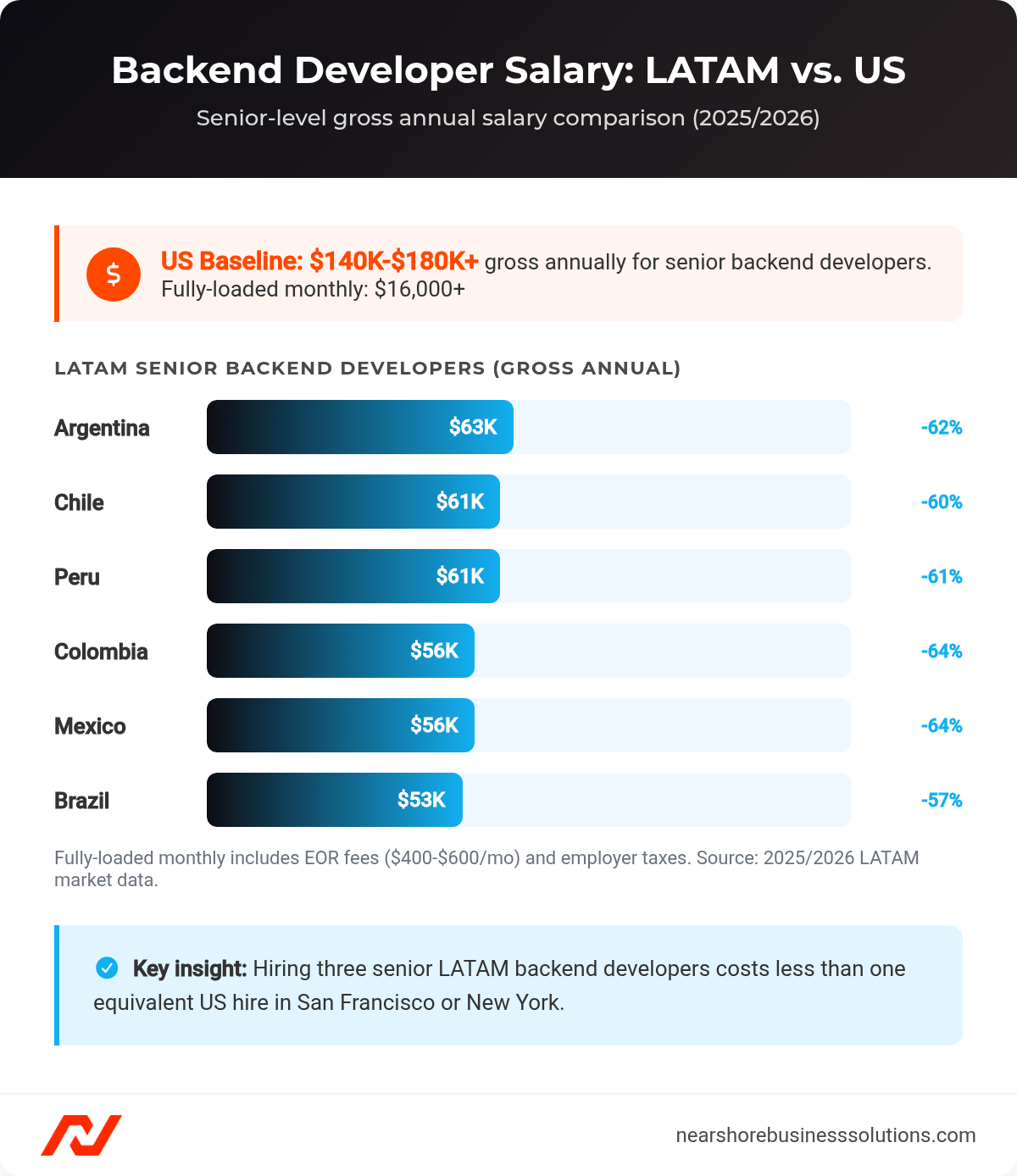
Senior backend developer gross annual salaries across six LATAM countries versus the US baseline.
| Country | Gross Annual | Fully-Loaded Monthly | Savings vs. US |
|---|---|---|---|
| Argentina | $63,163 | $6,950 | 60-65% |
| Chile | $61,266 | $6,700 | 58-62% |
| Peru | $61,265 | $6,550 | 58-64% |
| Colombia | $55,894 | $7,050 | 60-68% |
| Mexico | $55,894 | $6,350 | 60-68% |
| Brazil | $53,253 | $7,200 | 55-60% |
Fully-loaded monthly includes EOR fees ($400-$600/month) and applicable employer taxes.
How Strong Is English Proficiency Among LATAM Developers?
Argentina is the only major market where high English proficiency is widespread across the entire engineering population. It is the safest choice for roles requiring constant stakeholder communication.
Mexico and Brazil rank “Low” nationally on the EF EPI, but hub-level proficiency in Mexico City and São Paulo tech centers is significantly higher. Senior developers in these cities are typically bilingual from years working with international firms. Chile is “Moderate” nationally. Colombia is “Low (Moderate in Tech).”
Do not use national EF EPI scores to screen candidates. Proficiency in major tech hubs consistently outperforms national averages. Assess at the individual level.
What Cultural Compatibility Factors Matter for Remote Teams?
LATAM developers view US companies as access to the global tech vanguard, not just higher pay. That psychological alignment is a retention multiplier. Developers integrated into core US product teams show significantly higher loyalty and output versus those siloed in outsourced maintenance pods. 78% of LATAM engineers report openness to a new job within 12 months. Secondary retention drivers beyond salary include stability and flexible hours.
Where in Latin America Are the Best Backend Developers?
Brazil and Mexico dominate by volume. Argentina leads on seniority per capita. The right answer depends on your stack and how quickly you need to hire.
Which Countries Produce the Most Python and Node.js Talent?
Brazil leads with 5.4 million developers and 27% year-over-year growth. Mexico follows with 1.9 million developers and strong cloud and AI specialization.
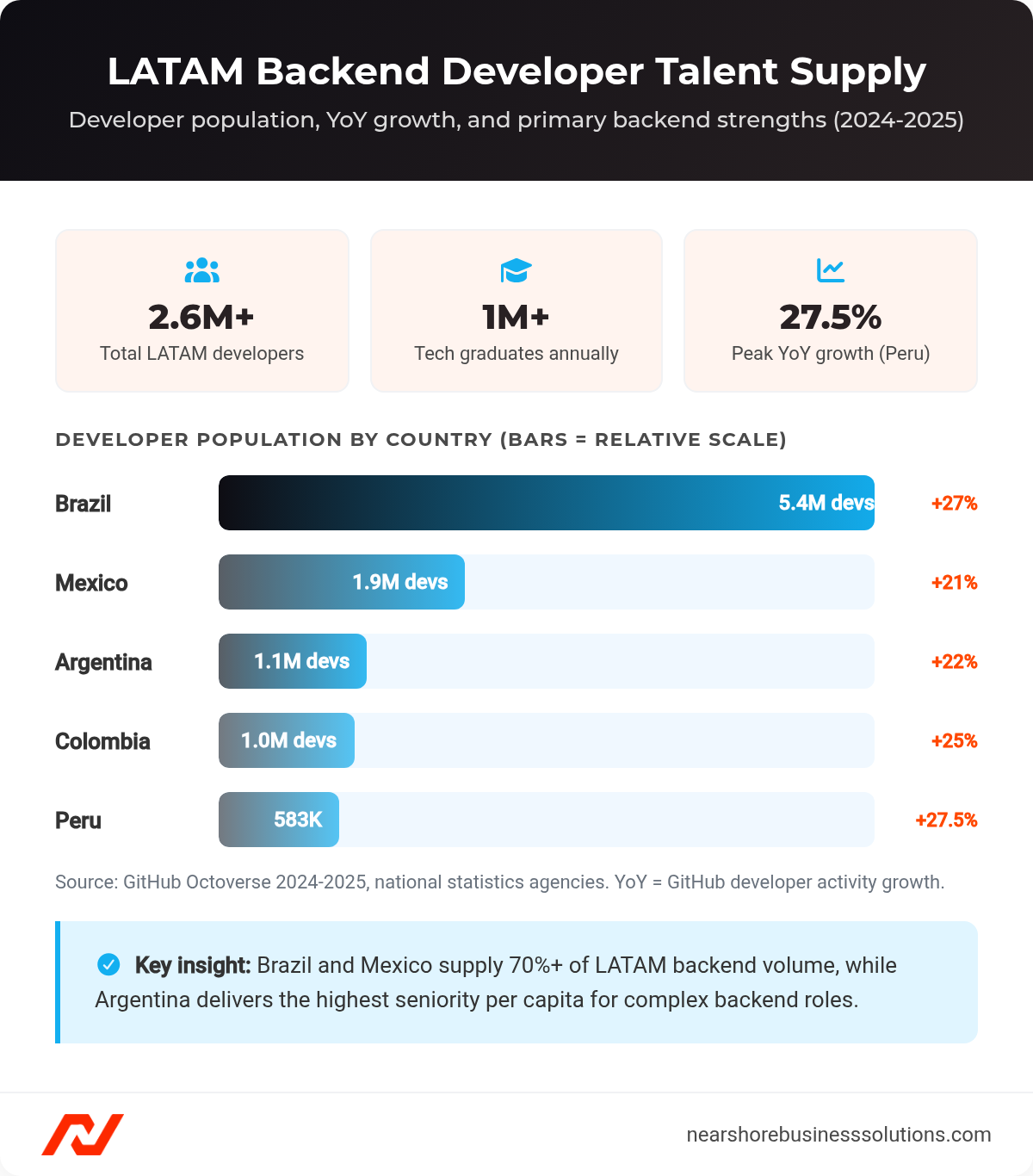
Developer population and year-over-year GitHub activity growth by country in Latin America (2024-2025).
| Country | Developer Population | YoY Growth | Annual Tech Grads | Primary Strengths |
|---|---|---|---|---|
| Brazil | 5.4M | 27% | 200,000+ | Java (Spring), Node.js, Python |
| Mexico | 1.9M | 21% | 130,000+ | Python (AI), JavaScript, Java |
| Argentina | 1.1M | 22% | 15,000+ | Python, Ruby, Node.js |
| Colombia | 1.0M | 25% | 13,000+ | Node.js, Java, PHP |
| Peru | 583,000 | 27.5% | 8,000+ | Node.js, Python |
Colombia has the fastest recent growth in software engineering graduates, concentrated in Medellín and Bogotá. Peru’s 27.5% growth rate is the highest in the region despite its smaller absolute pool.
What Are the Top Tech Hubs for Java Specialists in LATAM?
São Paulo is the continental center for Java and Spring Boot talent, anchored by Nubank, the world’s largest digital bank. Other top hubs follow for specific stack needs.
São Paulo, Brazil: FinTech powerhouse. Vila Olímpia and Itaim Bibi districts host the highest absolute concentration of Java and Spring Boot engineers in LATAM. Home to Nubank and Mercado Libre engineering centers.
Mexico City, Mexico: Developer population exceeding São Paulo’s. Roma Norte and Condesa have a bicultural engineering environment. Deep Python and cloud expertise. The strongest Python and AI hub outside Buenos Aires.
Buenos Aires, Argentina: Region’s leader in engineering seniority per capita. Palermo Soho hosts dozens of high-end coworking spaces. Ideal for “force multiplier” senior engineers requiring minimal ramp-up. Graduates from UBA and ITBA set the regional benchmark for backend architecture depth.
Medellín, Colombia: Ruta N innovation complex provides fiber infrastructure, coworking, and university connections to EAFIT and Universidad Nacional. Best cost-efficiency-to-technical-agility ratio for SaaS and HealthTech teams.
How Do You Hire Backend Developers in Latin America?
The process runs five steps: define stack requirements, select a hiring model, source and vet candidates, conduct technical interviews, and manage cross-border contracts. Total time-to-hire for senior backend roles is 2-6 weeks, versus 3-6 months for equivalent US hires.
How Do You Define Your Technical Requirements Before Hiring?
Align stack needs with regional strengths before sourcing to avoid misaligned candidate pipelines.
- Python / AI: Mexico City, Buenos Aires
- Node.js / SaaS: São Paulo, Medellín
- Java / FinTech: São Paulo, Mexico City
FinTech roles with PCI-DSS compliance, high-concurrency transaction processing, or blockchain experience command a 15-20% salary premium above the regional average. Define these requirements before posting.
What Are the Differences Between Freelance, Agency, and Dedicated Hiring Models?
EOR and contractor models each suit different timelines and risk tolerances. Choose based on expected retention length and IP exposure.
EOR (Employer of Record): A local entity handles all payroll, taxes, and statutory benefits. Best for long-term retention and IP protection. Onboarding: 2-4 weeks. Adds $400-$600/month per employee to total cost.
Independent Contractor: More flexibility, lower cost, faster onboarding (under 1 week). In Brazil, this is the “PJ” model. High misclassification risk if the developer is treated like a full-time employee. Significant legal penalties apply.
How Do You Source and Vet Backend Candidates?
Agencies specializing in LATAM deliver pre-vetted candidates within 48-72 hours. Top candidates in senior Node.js or Python roles often have multiple competing offers within days of entering the market. If you are running a direct search, plan for a 2-3 week sourcing window to surface high-quality passive candidates.
How Do You Conduct Technical Interviews for Backend Roles?
Structure interviews in two rounds: a live coding or take-home assessment calibrated to real role complexity, followed by a system design session. For Python and Node.js roles, include async patterns and API architecture. For Java and FinTech, test concurrency models and Spring Boot configuration.
Cloud architecture questions are increasingly relevant. 62% of large enterprises in Brazil and Mexico have implemented multi-cloud strategies. Senior candidates expect to demonstrate cloud competency alongside language depth. Senior developers in São Paulo and Mexico City commonly hold AWS Certified Developer or Azure Solutions Architect certifications.
How Do You Handle Contracts, Compliance, and Payments Across Borders?
Pay USD-denominated salaries, particularly in Argentina where hyperinflation is a material risk. This is also a top retention mechanism across the region. For EOR arrangements, budget the 15-20% fully-loaded premium over gross salary as a standard line item, plus the $400-$600/month EOR provider fee.
What Should You Look for When Evaluating LATAM Backend Developers?
Evaluate technical depth in the target stack, cloud architecture competency, and async communication discipline. Portfolio provenance from LATAM’s talent factory ecosystem is a meaningful quality signal.
What Technical Assessments Work Best for Python, Node.js, and Java Roles?
Cloud credentials are increasingly relevant. Cloud adoption in LATAM is growing at a CAGR of 17%+. 62% of large enterprises in Brazil and Mexico have implemented multi-cloud strategies. Assess cloud architecture competency alongside language-specific skills. Developers without cloud experience in 2025 are increasingly outliers in the senior candidate pool.
What Soft Skills Matter for Remote Backend Developers?
The highest-performing nearshore teams use strategic asynchronicity: Loom and Slack for routine updates, synchronous time reserved for architectural discussions and pair programming. This is especially valuable in HealthTech and FinTech, where documentation and regulatory review require focused, uninterrupted work. Screen for async communication discipline, not just language fluency. A developer who surfaces blockers proactively in writing is more valuable than one who waits for a standup.
How Do You Verify a Developer’s Portfolio and Past Work?
LATAM has produced globally recognized engineering benchmarks. Look for developers who have worked on or been trained at companies with real scale: Mercado Libre ($90B+ valuation), Nubank (world’s largest digital bank), Rappi (multi-vertical super app), and Kavak (Mexico’s data-driven unicorn in asset valuation). Proximity to these talent factories as an employee, contractor, or bootcamp graduate is a meaningful quality signal. Request GitHub contribution history and live code walkthroughs for senior roles.
What Are the Hiring Models Available for LATAM Backend Talent?
Three models apply: staff augmentation, dedicated team builds, and agency-sourced placements. Each suits a different company stage, risk profile, and speed requirement.
Is Staff Augmentation or a Dedicated Development Team a Better Fit?
For growth-stage companies ($5M-$100M ARR), the target is the team multiplier: three senior LATAM developers for the cost of one in San Francisco or New York. Dedicated, integrated teams show lower churn and higher technical output than siloed augmentation pods.
If the work is core to the product and not a time-boxed feature sprint, build a dedicated team. Augmentation is appropriate for filling skill gaps or covering parental and medical leave. See our guide on hiring backend developers for more on engagement model selection.
When Does Hiring Through a LATAM Tech Agency Make Sense?
Speed is the deciding factor. Agencies deliver pre-vetted senior candidates in 48-72 hours versus 3-6 months for equivalent US hires. If you are scaling before a funding round or backfilling a critical departure, an agency handles sourcing, vetting, and compliance. Your team focuses on technical evaluation only. The trade-off is a placement fee (typically 15-20% of first-year salary) versus the compounding opportunity cost of an unfilled role.
What Are the Pros and Cons of Direct Hiring vs. EOR Models?
Default to EOR for any developer you expect to retain beyond 6 months or who will have access to proprietary IP.
| Model | Cost | Onboarding | IP Protection | Legal Risk | Best For |
|---|---|---|---|---|---|
| EOR | Salary + 15-20% + $400-600/mo fee | 2-4 weeks | Maximum | Minimal (provider assumes) | Core long-term team members |
| Contractor | Lower gross | Under 1 week | Variable | High (misclassification) | Short-term / project roles |
What Are the Typical Rates for Backend Developers in Latin America?
Senior LATAM backend rates range from $53,000-$63,000 gross annually, saving 55-68% below US benchmarks. Stack-specific breakdowns follow.
How Much Do Python Developers in LATAM Charge?
Argentina commands the highest Python rates in LATAM, reflecting the densest concentration of senior talent and the USD-denominated premium required to offset currency volatility.
| Country | Availability | Gross Annual | Fully-Loaded Monthly |
|---|---|---|---|
| Argentina | Very High | $63,163 | $6,950 |
| Peru | High | $61,265 | $6,550 |
| Mexico | Very High | $55,894 | $6,350 |
What Are the Average Rates for Node.js Developers by Country?
Brazil’s fully-loaded monthly rate exceeds Colombia’s despite lower gross salary, due to higher employer-side labor costs under Brazilian law.
| Country | Availability | Gross Annual | Fully-Loaded Monthly |
|---|---|---|---|
| Chile | High | $61,266 | $6,700 |
| Colombia | Very High | $55,894 | $7,050 |
| Brazil | Very High | $53,253 | $7,200 |
How Do Java Specialist Rates in LATAM Compare to US Benchmarks?
US baseline is $150,000+ gross and $16,000+ fully-loaded monthly. LATAM Java specialists save 55-68% versus that baseline.
| Country | Availability | Gross Annual | Savings vs. US |
|---|---|---|---|
| Uruguay | High | $61,732 | 57-61% |
| Brazil | Very High | $53,253 | 55-60% |
| Mexico | High | $55,894 | 60-68% |
Java FinTech specialists with PCI-DSS, high-concurrency, or blockchain experience command 15-20% above the regional average in Brazil and Mexico. Budget accordingly for regulated financial infrastructure roles.
What Legal and Compliance Considerations Apply When Hiring in LATAM?
Employment law, IP protection, and misclassification risk vary significantly by country. Brazil and Argentina carry the highest legal complexity. Chile offers the most straightforward operating environment.
How Do Employment Laws Differ Across Key LATAM Countries?
Legal risk varies significantly. Brazil’s “PJ” contractor model is common but carries high misclassification risk if the relationship functions like full-time employment.
- Brazil: PJ contractor model common but carries high misclassification risk. Treat any full-time equivalent relationship as requiring EOR.
- Chile: Highest economic stability and lowest churn risk in the region. Straightforward operating environment for US companies.
- Colombia / Peru: Moderate stability and churn risk on both dimensions. Growing government support through ProColombia and INNpulsa Colombia programs.
- Argentina: Low economic stability, high churn risk. Mitigate with USD or stablecoin-denominated compensation contracts. Knowledge Economy Law provides 15% reduced income tax for tech companies through 2029.
What Is an Employer of Record (EOR) and When Do You Need One?
Use EOR for any core team member you expect to retain long-term. The provider assumes legal employer status, handles payroll, taxes, and statutory benefits, and provides IP protection under local labor law. Cost is $400-$600/month per employee above gross salary. This represents a 15-30% fully-loaded premium over gross depending on country-specific social security obligations. Onboarding: 2-4 weeks.
How Do You Handle IP Protection and NDAs With Remote Developers?
Mexico’s 2020 amendments to the Industrial Property Law (aligned with USMCA) offer the region’s strongest IP protections. Brazil and Chile have well-established patent and trade secret frameworks, though enforcement is slower than in the US. Brazil’s LGPD (GDPR-equivalent) has matured data privacy practices. This is a meaningful advantage for US HealthTech and FinTech companies building LATAM engineering pods. For any role with access to core IP, use EOR over contractor models: IP assignment under a contractor relationship is legally more fragile in most LATAM jurisdictions.
What Are Common Challenges When Hiring Backend Developers in LATAM?
The most common failure modes are infrastructure assumptions, salary inflation in maturing markets, and poor retention practices. Each is preventable.
How Do You Ensure Infrastructure Reliability for Remote LATAM Teams?
Connectivity quality varies significantly by country and neighborhood. Chile leads the region at 357 Mbps median fixed broadband. Brazil and Mexico follow at 180 Mbps and 120 Mbps respectively.
| Country | Median Fixed Speed |
|---|---|
| Chile | 357 Mbps |
| Brazil | 180 Mbps |
| Mexico | 120 Mbps |
| Argentina | 110 Mbps |
| Colombia | 100 Mbps |
| Peru | 90 Mbps |
AWS, GCP, and Azure adoption is growing at 17%+ CAGR across the region. Require UPS setups for developers in residential areas of Medellín or Buenos Aires where power consistency is less reliable than in commercial tech districts.
What Are the Biggest Hiring Mistakes Companies Make in LATAM?
Four mistakes consistently undermine LATAM hiring outcomes. Avoiding them protects both cost efficiency and retention.
- Relying on national EF EPI scores to assess English proficiency. Hub-level tech proficiency in Mexico City, São Paulo, and Buenos Aires significantly outperforms national averages.
- Underestimating market maturation inflation. Salaries in Mexico City and São Paulo rise faster than in secondary hubs like Medellín or Córdoba as more US companies compete for the same talent.
- Forgetting the retention budget. Small annual increments prevent senior talent from being poached. HealthTech investment in LATAM grew 37.6% in 2024, intensifying competition for privacy-compliant developers in Brazil and Colombia.
- Siloing LATAM developers in maintenance pods. Integration into core US product teams is the primary driver of retention and performance output. Developers in siloed outsourced maintenance structures show materially higher churn.
Frequently Asked Questions About Hiring Backend Developers in Latin America
These are the most common questions US CTOs and VPs of Engineering ask about hiring backend developers in LATAM.
How Long Does It Take to Hire a Backend Developer in LATAM?
Senior backend roles in Node.js or Python typically fill in 2-6 weeks. This is significantly faster than the 3-6 months required for equivalent US hires. Agencies specializing in LATAM deliver pre-vetted candidates within 48-72 hours for urgent roles.
What If a Developer Doesn’t Work Out After Hiring?
When hiring through a staffing agency or nearshore partner, replacement guarantees typically cover the first 60-90 days. EOR arrangements allow contract termination per local labor law with defined notice periods. Building a direct relationship with an agency that vets for US work style fit reduces replacement frequency.
Do I Need to Provide Equipment to Remote LATAM Developers?
Equipment provisioning depends on your hiring model. Contractors typically provide their own setups. For EOR arrangements, equipment policies vary by provider. Many US companies ship laptops or reimburse locally purchased equipment. Confirm with your EOR provider before onboarding.
How Do You Pay Backend Developers in Latin America?
Pay USD-denominated salaries across all LATAM markets. This is especially important in Argentina where peso inflation is a material risk. EOR providers handle local payroll conversion. Direct contractors typically invoice in USD via international wire, Wise, or Deel.
What Is the Difference Between Nearshore and Offshore Development?
Nearshore means hiring in countries with overlapping time zones, typically LATAM for US companies. Offshore means hiring in regions with large time differences, typically India or Southeast Asia. LATAM nearshore teams respond within 2 hours at a 95% rate versus 15-25% for offshore teams. That responsiveness reduces revision cycles by 25%.
Do I Need a Local Entity to Hire in LATAM?
No. EOR providers serve as the legal employer in each country, eliminating the need for a local entity. This is the recommended approach for companies hiring fewer than 10-15 developers per country. At scale, establishing a local subsidiary may become cost-effective.
Which LATAM Country Is Easiest to Hire In for the First Time?
Colombia and Mexico are the most accessible starting points for first-time LATAM hires. Both have strong English proficiency in tech hubs, established EOR infrastructure, and active agency ecosystems. Argentina offers the highest seniority but requires USD-denominated contracts to manage currency risk.
Is Hiring Backend Developers in Latin America Right for Your Team?
The answer depends on execution, not location. LATAM offers scale (2.6M+ developers), technical depth (Python, Node.js, Java), and economic alignment (55-68% savings) to solve persistent US talent scarcity. The condition is matching stack needs to regional strengths and integrating developers into real product work.
Routing by use case:
| Use Case | Target Hub |
|---|---|
| Complex backend architecture + high English proficiency | Buenos Aires, Mexico City |
| Large-scale SaaS: Node.js or Java | São Paulo, Medellín |
| Fastest-growing emerging talent pool | Lima, Bogotá |
| Java / FinTech at scale | São Paulo |
| Python / AI specialists | Buenos Aires, Mexico City |
Model guidance: core long-term team members belong on EOR. Short-term or project-based roles are appropriate for contractor arrangements.
Maximize the 6-8 hours of daily overlap. Integrate developers into daily US standups and architecture reviews from day one. The cost arbitrage is the headline. Retention and output quality are the actual ROI.
For country-specific guidance, see our guides on hiring in Brazil, hiring in Argentina, and hiring in Colombia.
Ready to Build Your Latin America Backend Engineering Team?
Nearshore Business Solutions sources and vets backend developers from São Paulo, Buenos Aires, Mexico City, Medellín, and Lima. We screen for technical skills, English fluency, and US work style fit. Our acceptance rate is 16%.
Every placement includes a 90-day replacement guarantee. You receive pre-vetted candidates in 2-4 weeks.
Get a free consultation to discuss your hiring needs and receive a custom quote.