Interviewing remote candidates in Latin America works best with a 5-stage structured process that fills senior roles in 14 business days. It cuts mis-hires and protects 40 to 60 percent in salary savings.
Latin America’s developer talent pool exceeds 1.2 million engineers. Senior LATAM engineers cost 40 to 60 percent less in fully loaded rates than US equivalents at the same skill level (developer-marketplace and Levels.fyi analysis, May 2024). Structured interviews predict job performance at 0.51 validity versus 0.38 for unstructured ones (Schmidt & Hunter, 1998).
Those savings disappear when a mis-hire costs you $65,000 to $80,000 in a nearshore context and forces a restart three months later (2024 global tech-talent and developer-marketplace salary reports; Levels.fyi 2024). This playbook covers every stage, from scorecard design through signed offer. It is calibrated for the cultural, linguistic, and logistical realities of hiring engineers across Latin America.
Why Does Your Current Process Fail When You Interview LATAM Developers Remotely?
Your process fails because it copies an onsite playbook into a Zoom link. Google’s hiring research, documented in Laszlo Bock’s Work Rules!, confirmed that unstructured “gut feeling” interviews barely predict job performance.
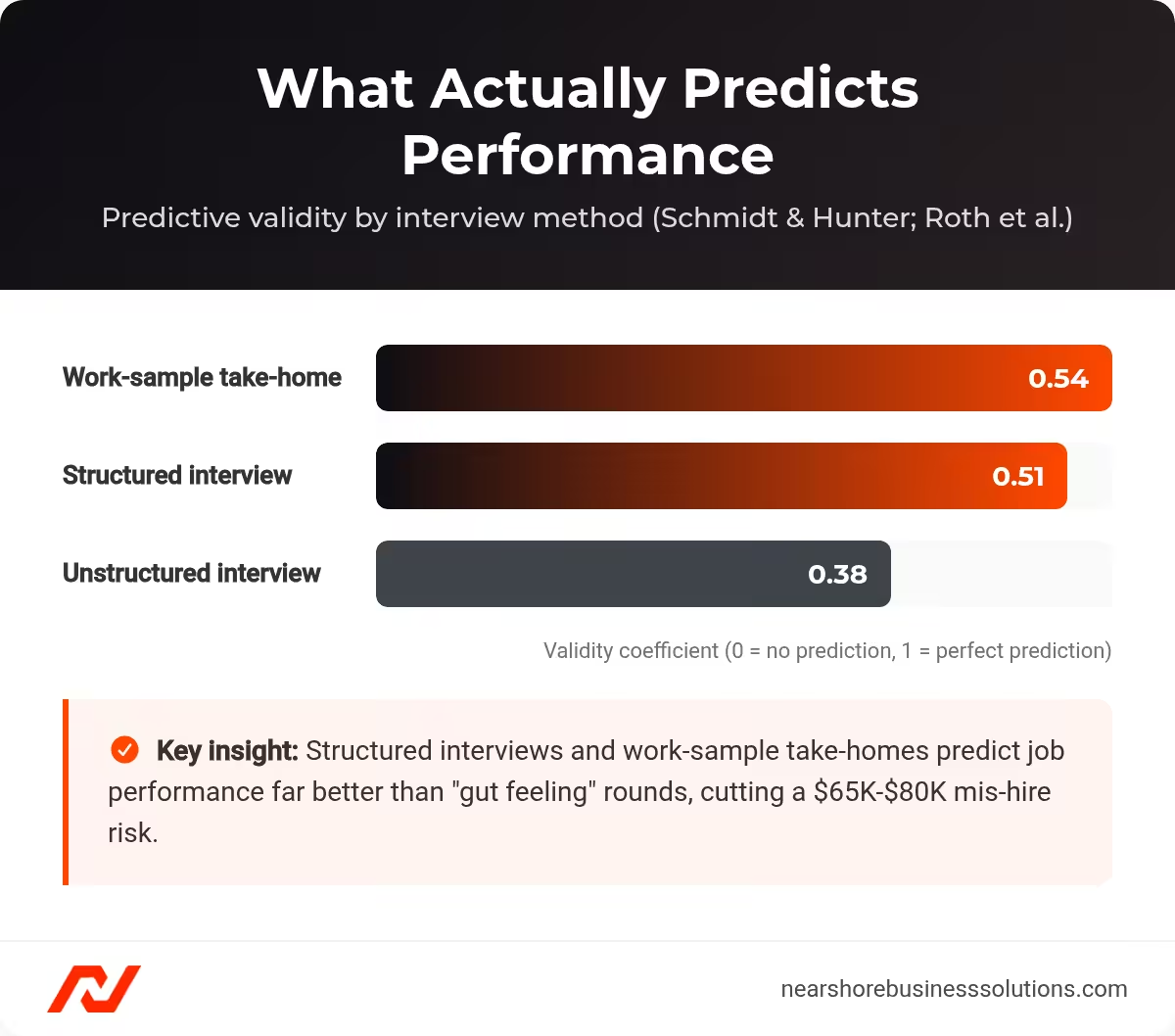
Predictive validity by interview method: structured and work-sample beat unstructured rounds.
Remote interviews remove the signals interviewers rely on. You lose body language, whiteboard energy, and office-tour rapport. Unstructured approaches get even less reliable. The failure points are specific. Poor scheduling signals disrespect to candidates fielding multiple global offers. Over-indexing on “perfect” English filters out strong technical communicators. US-centric behavioral questions collide with Latin American professional norms. One-way interrogation-style interviews lose senior engineers who have options across North America and Europe. Engineering leaders standardizing their own loop can adapt our structured interview framework for Latin American candidates.
For US companies hiring senior LATAM engineers through staff augmentation, a structured pipeline solves all four problems at once.
Where Do Onsite Interview Assumptions Break Down Across Borders?
Three assumptions break hardest, starting with English fluency. EF’s 2023 English Proficiency Index ranks Mexico (447) and Colombia (440) as “Very Low.” Those national averages hide the university-educated tech sector. Estimated B2-plus English proficiency among software engineers runs 30 to 40 percent in Argentina, Costa Rica, and Uruguay. It runs 15 to 25 percent in Brazil, Mexico, and Colombia, with large absolute numbers given pool size (vetted developer-marketplace talent pool data, 2023 to 2024).
Live coding penalizes candidates unfairly. Whiteboard-style algorithmic interviews poorly predict day-to-day engineering performance. Format variables like latency, unfamiliar IDE setups, and real-time screen sharing under observation add noise unrelated to ability (Roth et al., 2005).
Culture-fit rounds encode US norms. Hofstede’s 6-D Model quantifies the gap. The US scores 91 on Individualism versus Brazil (38), Mexico (30), and Colombia (13). On Power Distance, the US scores 40 versus Mexico (81), Brazil (69), and Colombia (67). LATAM engineers in high-power-distance cultures undersell expertise. They avoid challenging an interviewer’s framing. They credit the team rather than themselves. Standard “culture fit” rounds screen these candidates out.
What Does a Structured Interview Framework Change About Remote Technical Hiring?
A structured framework replaces gut feeling with six defined stages. The stages are: (1) Sourcing and Application Review, (2) Recruiter Screen (30 min), (3) Async Technical Assessment (60 to 90 min), (4) Live Technical Interview (60 min), (5) Behavioral and Values Interview (45 to 60 min), and (6) Final Interview With Offer Discussion (30 to 45 min).
Four to five stages after the recruiter screen is the ceiling. Ashby’s 2024 Recruiting Funnel Benchmarks Report found that each superfluous stage triggers a 15 to 20 percent drop-off among top candidates.
How Do You Design a Scorecard Before You Screen a Single Résumé?
Build the scorecard before the first résumé review, and it cuts inter-rater discrepancy by up to 50 percent versus unanchored global judgments (Macan, 2009). Without this artifact, your panel defaults to individual preference. One interviewer weights algorithmic speed. Another weights undefined “communication skills.”
Build the scorecard in three sessions under 90 minutes total. Force-rank competencies into must-have and nice-to-have. Assign each competency to exactly one interview stage. Write behavioral anchors for scores 1, 3, and 5.
How Do You Map Role Competencies to Interview Stages Instead of Interviewers’ Preferences?
Map each competency to one dedicated stage, the way GitLab’s documented hiring process does, with async communication skills evaluated throughout (GitLab Handbook, accessed May 2024). Start with the LATAM tech landscape in view. JavaScript and TypeScript dominate at roughly 70 percent of professional developers across the region. Python, SQL, Node.js, and React follow. AWS holds 55-plus percent cloud platform adoption (Stack Overflow 2023; HackerRank 2023). Mapping each competency to a stage is easier once you have defined the essential tech skills to look for when hiring in Latin America. For a language-specific version of this playbook, see our guide to interviewing and hiring top Python developers.
One mapping decision matters most for LATAM hiring. Test async written communication as a scored competency. Require candidates to submit a written README with their take-home assessment. When you recruit nearshore engineers from Latin America, this sidesteps accent bias. You evaluate communication in the medium your distributed team uses daily.
How Do You Build a 1-to-5 Rubric With Behavioral Anchors That Remove “Vibes” From Hiring Decisions?
A rubric removes vibes by defining observable actions at each level, not labels like “1 equals poor, 5 equals excellent.” Smith and Kendall showed that anchoring scale points to specific observable behaviors reduces idiosyncratic rater effects far more than trait-based scales (Journal of Applied Psychology, 1963).
| Competency | 1: No Evidence | 3: Meets Bar | 5: Exceeds Independently |
|---|---|---|---|
| System Design | Code works but shows no architectural reasoning | Coherent architecture addressing requirements; identifies at least one tradeoff | Anticipates unstated requirements; documents tradeoffs; addresses failure modes without prompting |
| Async Written Communication | No README or documentation | README explains the solution and key decisions; clear but requires follow-up | README reads as a self-contained design document a teammate could onboard from alone |
| Proactive Communication When Blocked | Cannot describe a specific blocking situation | Describes identifying a blocker, communicating it, and proposing a path forward | Describes identifying a blocker before it became critical, notifying affected parties with written context and multiple options |
Three enforcement rules make the rubric operational. First, every interviewer submits scores with written justification before any group discussion. This prevents the anchoring bias Tversky and Kahneman documented. Second, flag score splits of 3-plus points for calibration discussion, not resolution by seniority. Third, require the hiring manager to make a Hire or No-Hire decision using only scorecard data before reading unstructured commentary.
How Do Async Technical Assessments Accurately Vet Remote Candidates in Latin America?
Async assessments front-load objective skill evaluation before any engineer blocks a calendar hour. Send the async assessment after the recruiter screen. Review submissions in batch. Reserve live interviews for candidates whose written work already shows production-level thinking. This sequencing matters more in LATAM markets, where senior engineers field concurrent offers from US, Canadian, and European companies.
When Should You Use CodeSignal, HackerRank, or Custom Take-Home Projects?
Use platforms for volume and custom take-homes for depth, because work-sample tests hit a predictive validity of 0.54 for job performance (Roth et al., 2005), the highest of any single method. Timed platforms excel at high-volume filtering. Custom take-homes generate deeper signal. Deploy CodeSignal or HackerRank for roles with 40-plus applicants. Route the top 30 percent into a custom take-home scoped to your actual stack. For senior roles under 20 candidates, skip the platform and lead with the take-home.
How Do You Scope a Take-Home That Respects Candidates’ Time and Tests Production-Level Skills?
Scope the take-home to a maximum of three hours, because CodeSignal’s 2023 data shows assessments in the 75-to-105-minute range hit the highest completion rates near 70 percent, while assessments over three hours fall below 40 percent. State the expected time investment explicitly. Candidates in high-power-distance cultures rarely push back on unreasonable scope and may silently invest 10-plus hours.
Apply five rules to every take-home:
- Provide a starter repository.
- Define acceptance criteria explicitly.
- Scope to a single feature.
- Offer a 48-hour submission window.
- Pay candidates at senior levels ($100 to $200; Automattic pays $25 per hour for async trial projects).
Require a follow-up live review as the primary anti-cheating guardrail.
Which Code Quality Signals Matter More Than Passing Tests When Evaluating Submissions?
Five quality signals matter more than a passing test suite. Train reviewers to score each against your rubric:
- Error handling: Does the candidate handle failure modes or assume the happy path?
- Commit history: Atomic, well-messaged commits reveal the process discipline async teams need.
- README quality: The highest-leverage point. It doubles as an English writing assessment for the skill LeadDev ranks as the number-one communication competency for remote engineers.
- Test coverage intent: Three well-chosen tests beat 15 shallow ones.
- Code readability: In a nearshore context where code review happens asynchronously, readability directly inputs to team velocity. Your distributed engineering team lives or dies on how readable the code is.
How Do LATAM Teams Run the Live Remote Technical Interview With Pair Programming Over Whiteboarding?
Run the live round as pair programming, not whiteboarding, because pair programming produces code with significantly higher design quality and correctness than solo exercises (Cockburn & Williams, 2000). Open a shared IDE. Load a realistic problem. Build together. This format tests thinking aloud under ambiguity, asking clarifying questions, incorporating feedback, and iterating on working code. Those behaviors predict remote engineering effectiveness.
Why Does Pair Programming Surface Collaboration Skills That Whiteboarding Hides?
Pair programming surfaces four collaboration signals that whiteboarding hides. First, clarification-seeking. In high-power-distance cultures, engineers assume the interviewer’s framing is authoritative, and pair programming structurally invites challenge. Second, receptiveness to feedback, because the interviewer suggests alternatives and observes integration. Third, organic thinking aloud, which emerges naturally when two people build together. Fourth, adaptive problem-solving, because mid-session requirement changes mirror real distributed-team dynamics.
How Do You Handle Time Zone Scheduling and Tech Setup Without Losing Top LATAM Candidates?
Schedule across the 2-to-3-hour overlap LATAM hubs share with US Eastern Time. Major hubs span UTC-3 in Argentina and Brazil to UTC-6 in Mexico and Costa Rica. Offer 2 to 3 time slots across overlapping hours. Send a tech-check invite 24 hours ahead. Keep a backup communication channel, since WhatsApp is standard across LATAM. Poor scheduling is the number-one cited mistake when interviewing LATAM candidates (Nearshore Americas, 2023 to 2024). Set a 48-hour maximum response time between stages and communicate it upfront.
How Do You Calibrate Behavioral and Culture-Add Interviews for the Nearshore Hiring Process?
Calibrate behavioral rounds to the three competencies that predict remote success, and adjust technique, not the bar, for Latin American norms. Run the behavioral round after the live technical interview, before the final offer discussion.
Which Three Behavioral Competencies Predict Remote Success Across Borders?
Three competencies predict remote success. First, proactive communication when blocked: “Describe a time you identified a potential problem before it became a major issue. How did you communicate it?” Second, ownership of outcomes versus task completion. Third, comfort with ambiguity and async decision-making. Research on global virtual teams shows that low variance in English proficiency across the team matters even more than a high average for cohesion and performance (Klitmøller & Lauring, 2013, Journal of World Business).
How Do You Adjust for Latin American Professional Norms Without Lowering the Technical Bar?
Adjust your interview technique, not your standards, because Hofstede’s Uncertainty Avoidance scores show LATAM engineers seek more clarity: Argentina (86), Mexico (82), and Colombia (80) versus the US (46). Provide clear context rather than testing “comfort with ambiguity” through deliberately vague prompts. Avoid culturally biased idioms. Probe deeper on accomplishments, with prompts like “Tell me about a time you disagreed with a technical lead,” rather than penalizing a less self-promotional style. LATAM developers bring documented strengths: strong relationship orientation that drives loyalty, adaptability forged by economic volatility, and a cultural emphasis on dedication.
How Do You Use the Scorecard Debrief to Make a Data-Driven Hire or No-Hire Decision?
Bring all stage scores into a single debrief and require independent scoring before any group discussion. Define a decision rule. No hire if any must-have competency scores below 3. Strong hire if the average is 4 or higher across all must-haves. A well-managed process pushes the final-round-to-offer pass-through rate as high as 90 percent (Ashby, 2024). This kills the “loudest interviewer wins” dynamic that plagues remote panels, where hallway calibration is impossible.
What Is the Complete Checklist to Interview Remote Candidates in Latin America in 14 Business Days?
The complete checklist is a 5-stage pipeline that runs in 14 business days, plus a list of seven mistakes to avoid. Each stage tests a distinct scorecard competency and assigns a clear owner.
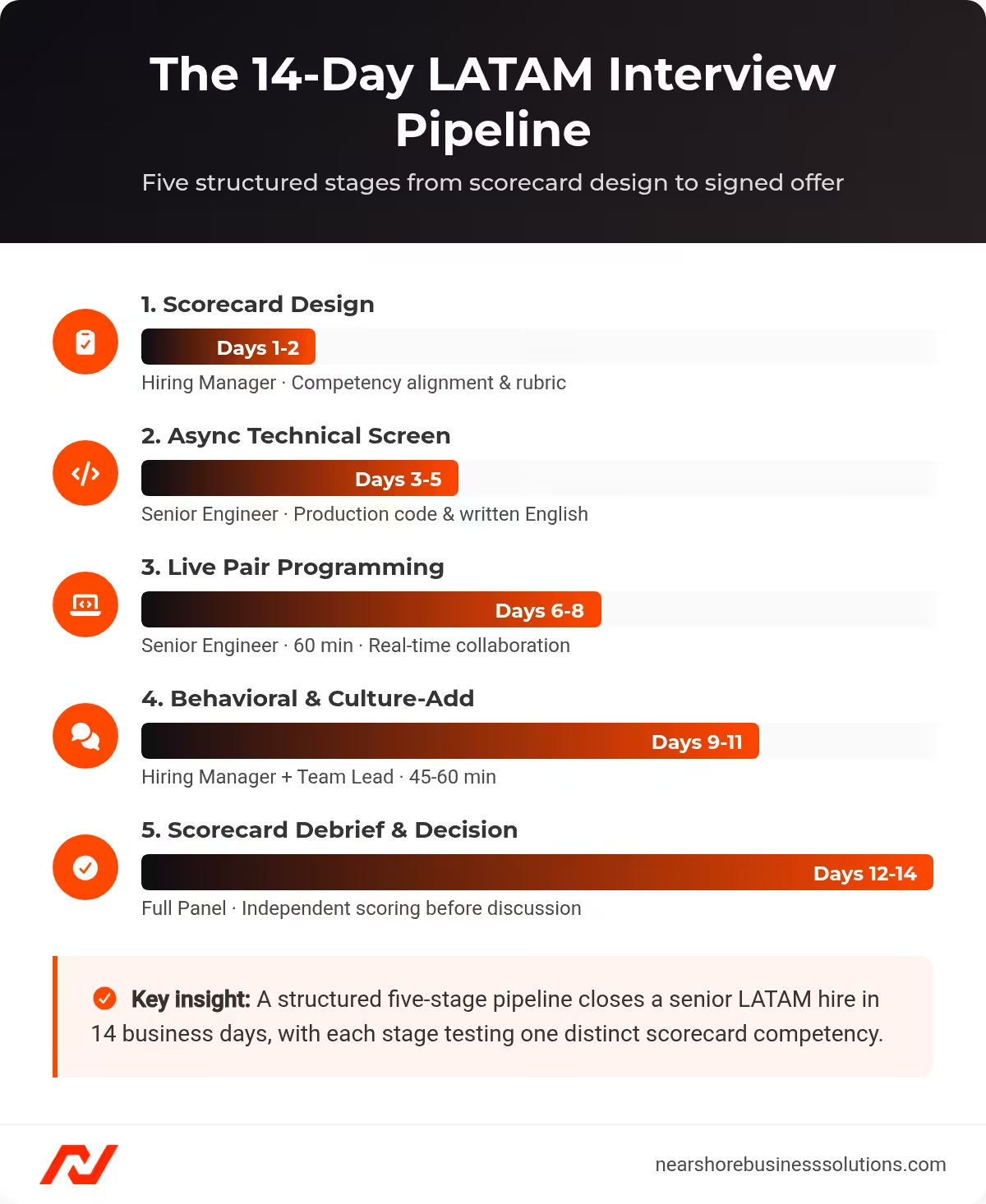
The 5-stage remote LATAM interview pipeline, from scorecard design to signed offer in 14 days.
What Are the 5 Stages From Scorecard Design to Signed Offer?
| Stage | Owner | Timeline | Tests | Tooling |
|---|---|---|---|---|
| 1. Scorecard Design | Hiring Manager | Days 1 to 2 | Competency alignment and rubric calibration | Internal rubric |
| 2. Async Technical Screen | Senior Engineer (review only) | Days 3 to 5 | Production code quality, written English | CodeSignal or HackerRank for volume, then custom take-home for shortlist |
| 3. Live Pair Programming | Senior Engineer | Days 6 to 8 (60 min) | Collaboration, real-time problem-solving | CoderPad or VS Code Live Share |
| 4. Behavioral and Culture-Add | Hiring Manager and Team Lead | Days 9 to 11 (45 to 60 min) | Proactive communication, ownership | Structured question bank |
| 5. Scorecard Debrief and Decision | Full Panel | Days 12 to 14 (30 to 45 min) | Data-driven hire or no-hire | Independent scoring before group discussion |
What Seven Mistakes Stall Nearshore Hiring, and How Do You Fix Each One?
Seven mistakes stall nearshore hiring, and each has a specific fix:
- Mistake: Adding unnecessary rounds past two weeks. Fix: Cap at five stages, each testing a distinct scorecard competency.
- Mistake: Failing to sell the role to candidates with multiple global offers. Fix: Allocate the final five minutes of every live stage for candidate questions.
- Mistake: Ghosting candidates between stages. Fix: Set a 48-hour max response SLA and communicate it upfront.
- Mistake: Testing algorithms instead of production skills. Fix: Use pair programming and evaluate code quality beyond passing tests.
- Mistake: Skipping the scorecard debrief. Fix: Require independent scoring before group discussion.
- Mistake: Evaluating English via accent rather than technical communication. Fix: Embed assessment into README quality, pair programming, and behavioral questions across all stages.
- Mistake: Applying US cultural norms to behavioral interviews. Fix: Adjust for power distance and uncertainty avoidance. Probe deeper, do not penalize formality.
Frequently Asked Questions About Interviewing Remote LATAM Candidates
These are the most common questions VPs of Engineering ask about interviewing remote candidates in Latin America.
How long does it take to hire a remote LATAM developer?
A well-run structured process closes a senior hire in 14 business days, from scorecard design through signed offer. Each stage tests a distinct competency and runs on a 48-hour response SLA between rounds. Adding stages past two weeks triggers a 15 to 20 percent drop-off among top candidates.
What if a remote developer does not work out?
A mis-hire in a nearshore context costs $65,000 to $80,000 in direct compensation, plus the lost time of a restarted search. A structured scorecard and pair-programming round cut that risk by predicting performance at 0.51 validity versus 0.38 for unstructured interviews.
How do you assess English proficiency without bias?
Assess written technical communication, not accent. Score README quality on the take-home assessment, then confirm in pair programming and behavioral rounds. This evaluates the exact medium your distributed team uses daily and avoids screening out strong technical communicators.
Should you use take-home assessments or live coding?
You should use both, in sequence. Work-sample take-homes hit 0.54 predictive validity, the highest of any single method, so use them to filter. Follow with a live pair-programming round to confirm the work and observe collaboration in real time.
How many interview stages should a remote pipeline have?
Use four to five stages after the recruiter screen, and no more. Ashby’s 2024 benchmarks show each superfluous stage drives a 15 to 20 percent drop-off among top candidates who hold competing offers.
Ready to Build Your LATAM Engineering Team?
Nearshore Business Solutions sources and vets software developers across Latin America. We screen for technical skills, English fluency, and US work-style fit, then run the structured interview pipeline this playbook describes. Every placement includes a 90-day replacement guarantee, and you receive your first pre-vetted candidates within 3 business days.
Book a free consultation to scope your roles and get a custom shortlist of vetted LATAM engineers.