
Structured interviews predict on-the-job performance with a 0.51 validity coefficient versus 0.38 for unstructured interviews, a 34% accuracy gap (Schmidt and Hunter, 1998). Applying U.S. domestic interview processes to LATAM candidates without adjustment produces systematic false negatives because of calibration gaps in cultural communication, English assessment, and time-zone constraints.
LATAM candidates cost $50,000-$100,000 annually for senior engineers versus $160,000-$220,000 in the U.S. Published developer-marketplace data reports over 80% of vetted LATAM developers hold B2+ English proficiency (CEFR upper-intermediate or higher). Colombia (UTC-5) delivers 8 full overlapping hours with U.S. Eastern time, compared to 0-1.5 hours for India.
Nearshore Business Solutions has run structured LATAM interview processes across hundreds of placements in Colombia, Mexico, Argentina, and Brazil. This guide covers the specific calibration changes that eliminate false negatives, the four-stage hiring loop that produces binary hire or no-hire decisions, and the scorecard weighting that accounts for async communication on distributed teams.
Why Does Your Domestic Interview Process Fail When You Interview LATAM Developers?
U.S. interview processes are calibrated for individualist communication styles. Applied to LATAM candidates, this calibration produces three systematic failure modes: cultural norms that mask ownership signals, English assessments that test the wrong dimension of fluency, and time-zone constraints that punish ambiguous rounds.
Why Do Cultural Communication Norms Cause U.S. Interviewers to Misread Ownership?
Colombia scores 67 on Hofstede’s Power Distance Index. The U.S. scores 40. Mexico ranks among the highest-collectivist cultures in Latin America, while the U.S. sits near the top of the individualism scale globally. These gaps produce a specific distortion: candidates who drove critical technical outcomes describe them with collaborative language that U.S. interviewers misinterpret as weak ownership.
A Colombian staff engineer who single-handedly architected a monolith-to-microservices migration will say “the team decided to migrate” rather than “I led the migration.” These are high-context communication norms, not signs of passive contribution. Erin Meyer’s Culture Map framework identifies relationship-oriented, indirect cultures as ones where individual credit-claiming signals poor team citizenship.
The fix is concrete: replace open-ended ownership prompts with structured probes. Ask “Walk me through the technical decision that shaped this project’s architecture. Who made the call, what tradeoffs did you weigh, and what did you personally contribute to the final direction?” Score on quality of technical reasoning and specificity of contribution, not on first-person pronoun usage. Research from Kang et al. in Administrative Science Quarterly confirms that standardized evaluation criteria reduce implicit cultural and accent bias at every stage of the hiring funnel.
Why Does English Assessment Miss the Gap That Matters for Distributed Teams?
B2 English (CEFR upper-intermediate) and C1 English (advanced) sound similar on a 45-minute Zoom call. They diverge sharply in async engineering output: PRs, Slack threads, incident postmortems, and RFCs that make up the majority of communication on a distributed team.
Hinds and Mortensen’s research on geographically distributed software teams found that “shared context” and “communication clarity” predicted project success far more than native-level fluency. B2 speakers with strong writing discipline outperform C1 speakers who rely on verbal communication and treat written artifacts as an afterthought.
Published developer-marketplace data reports over 80% of vetted LATAM developers hold B2+ English proficiency, and 75%+ of developers seeking international remote roles self-report as professionally proficient or fluent. For a country-level breakdown of proficiency scores and CEFR benchmarks, see our guide on LATAM tech English levels.
How Does Time-Zone Math Change What Your Interview Loop Must Accomplish?
Colombia (UTC-5) delivers 8 full overlapping hours with U.S. Eastern time. Argentina (UTC-3) gives a PST-based team only 3 hours. Compare these figures to offshore alternatives: Eastern Europe (Ukraine, UTC+3) provides 2-3 hours of overlap with ET. India (Bangalore, UTC+5:30) delivers 0-1.5 hours. LATAM gives U.S. East Coast teams 4 times more synchronous collaboration time than Eastern Europe and over 5 times more than India.
| LATAM Tech Hub | UTC Offset | Overlap with ET (9-5) | Overlap with CT (9-5) | Overlap with PT (9-5) |
|---|---|---|---|---|
| Mexico City, MX | UTC-6 | 7 hours | 8 hours (full) | 6 hours |
| Bogota / Medellin, CO | UTC-5 | 8 hours (full) | 7 hours | 5 hours |
| Sao Paulo, BR | UTC-3 | 6 hours | 5 hours | 3 hours |
| Buenos Aires, AR | UTC-3 | 6 hours | 5 hours | 3 hours |
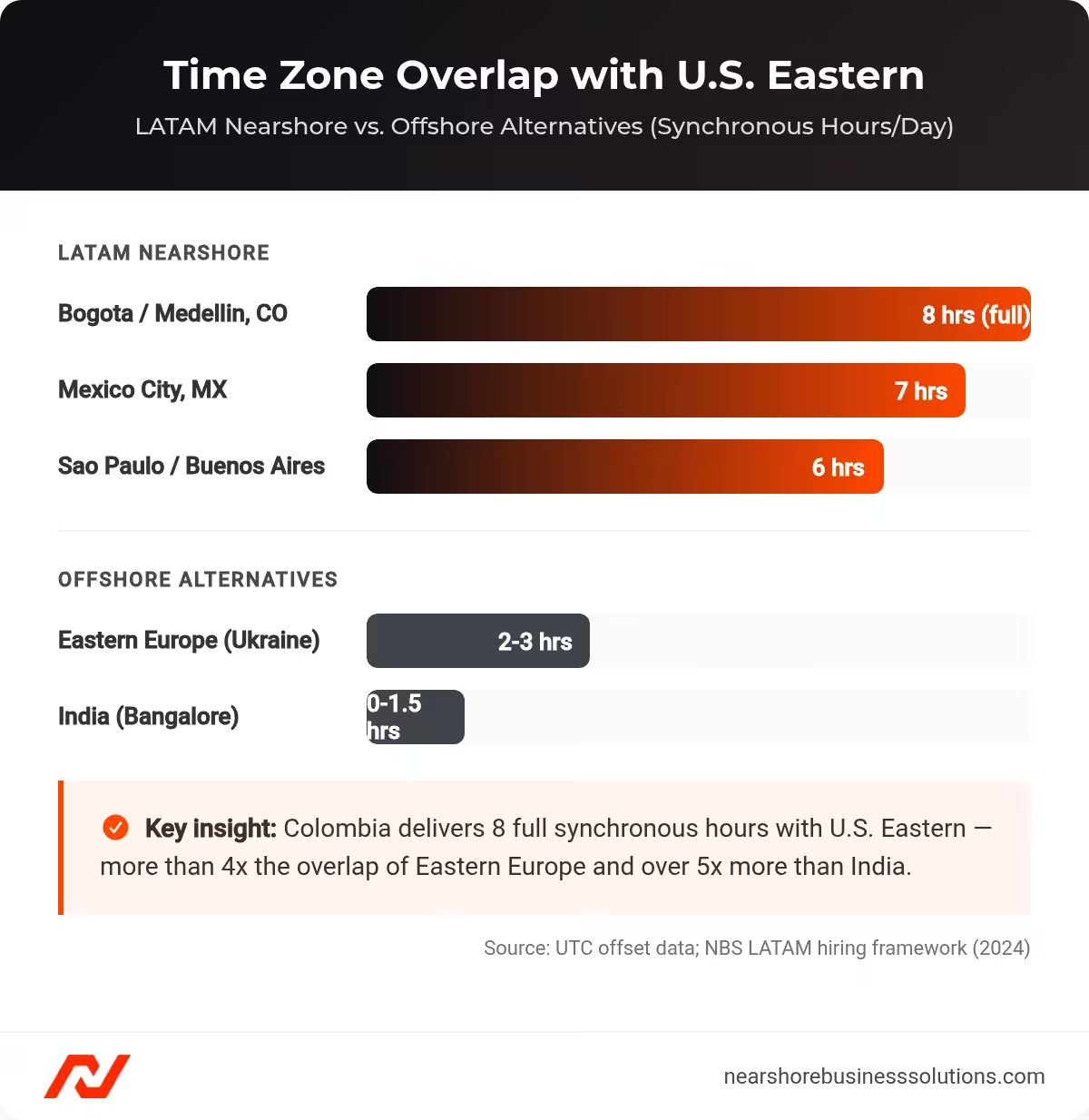
Time zone overlap comparison: LATAM nearshore delivers 4-8x more synchronous hours than offshore alternatives.
Compressed time zones demand higher signal per interview round. Consolidate from four rounds to three by combining system design and behavioral into a 75-minute session. Make every round produce a binary hire or no-hire signal. Front-load async evaluation before the first live interview. LATAM hiring via specialized nearshore platforms averages 3-5 weeks from screening to offer acceptance, versus 7-10 weeks for U.S. domestic hires (Hired, 2023). For the full remote interview process, see how to interview remote candidates from Latin America.
What Does a High-Signal Remote LATAM Interview Loop Actually Look Like?
Structured interviews predict on-the-job performance at a 0.51 validity coefficient versus 0.38 for unstructured interviews, a 34% accuracy gap (Schmidt and Hunter, 1998). Google’s internal research confirms that four interview rounds capture the vast majority of predictive signal, with diminishing returns beyond that number. The loop below compresses to three effective rounds without sacrificing signal.
| Stage | Format | Duration | Primary Signal | Interviewer Role |
|---|---|---|---|---|
| 1. Async Technical Screen | Async take-home | 90 min | Code quality, technical writing | Senior engineer (blind review) |
| 2. Structured STAR Behavioral | Sync (Zoom) | 45 min | Ownership signal, conflict navigation | Hiring manager |
| 3. System Design Live Session | Sync (Zoom + Miro) | 60 min | Trade-off reasoning, scalability | Staff or principal engineer |
| 4. Collaboration Simulation | Sync (Zoom + GitHub) | 30 min | Async communication, constructive pushback | Future teammate |
Why Should You Run an Async Technical Screen Before Any Live Interview?
Live coding over Zoom forces LATAM candidates to simultaneously manage algorithmic problem-solving, real-time English production, and screen-sharing latency. Each factor independently degrades performance. LeadDev (2023) confirmed that timed algorithmic tests under these conditions systematically disadvantage non-native English speakers.
A 90-minute async take-home eliminates all three variables. Evaluate four artifacts: code structure and modularity, commit history (require a Git repository because commit messages are a direct English writing signal), test coverage decisions, and the README’s trade-off analysis.
Sample prompt: Build a simplified rate-limiter service supporting fixed-window and sliding-window counters. Include a README explaining your data store choice, strategy trade-offs, and what you would change at 10,000 requests per second. This prompt works across dominant LATAM stacks: Node.js (65%), Python (52%), Java (48%), without biasing toward a specific framework (2024 LATAM developer survey data).
Assign a blind reviewer using a four-point rubric. Only candidates scoring 3 or above advance, eliminating 40-50% of the pipeline before anyone books a Zoom slot.
How Do You Run the STAR Behavioral Round with LATAM Candidates?
Companies using structured STAR behavioral interviews report a 20-30% improvement in 90-day retention (SHRM, 2023). For LATAM candidates from high-power-distance, collectivist cultures, STAR provides explicit scaffolding that overrides default collaborative framing, but only if you activate it with a coaching preamble:
“I am going to ask you behavioral questions. I would love for you to use the STAR format: Situation, Task, Action, Result. Focus especially on what you specifically did, your individual decisions, actions, and contributions. I want to understand the impact of your personal work.”
That last sentence grants explicit permission to claim individual credit. For engineers from cultures where self-promotion signals arrogance, this permission is the highest-leverage sentence in the entire interview loop.
Three calibrated prompts: (1) “Tell me about a time you disagreed with a technical decision made by someone more senior.” (2) “Describe a production incident where you led the response.” (3) “Give me an example of when you pushed back on a product requirement for technical reasons.” Follow each with: “What was the specific decision you personally made that changed the trajectory?”
Add remote-readiness probes adapted from GitLab’s public interviewing handbook: “Tell me about a time you were blocked and your manager was in a different time zone. How did you unblock yourself?” A candidate who scores 3 after one coaching follow-up is demonstrating ownership through a collectivist communication frame, not hedging.
How Do You Run the System Design and Collaboration Simulation Rounds?
Run the system design session over 60 minutes via Zoom with a shared whiteboard. Share the prompt 10 minutes before the call to remove a language-processing penalty without reducing difficulty. Calibrate prompts to LATAM experience: LATAM’s senior talent pool skews heavily toward AWS (71% proficiency), and alumni from Mercado Libre, Rappi, VTEX, and Globant carry direct experience designing high-throughput e-commerce and multi-tenant SaaS systems (2024 LATAM talent-pool data). Score on pre-anchored scorecard dimensions: trade-off reasoning, constraint identification, scalability thinking, and communication clarity.
Replace the vague “culture fit” round with a 30-minute collaboration simulation. Give the candidate a partially completed PR with three intentional issues: one clear bug, one readability concern, one architectural question. Ask them to review it live, leaving inline comments in GitHub. Score on clarity of written feedback, severity calibration, and constructive tone. For a deeper look at how nearshore firms structure technical screening, see how nearshore firms vet developers.
What Should the Interview Scorecard Look Like for LATAM Hires?
Structured scorecards improved hiring quality by 25% at Google, measured by 12-month performance ratings (Bock, Work Rules!, 2015). Fewer than 20% of engineering interactions on a fully distributed team occur synchronously (GitLab Remote Work Report, 2023). The weighting below inverts the legacy bias of onsite whiteboard culture. Written communication and async collaboration carry a combined 35%.
| Competency | Weight | Strong Signal (4) | Meets Bar (3) | Notes |
|---|---|---|---|---|
| Technical Problem-Solving | 25% | Clean decomposition, edge-case tests, README with rejected alternatives | Functional solution, reasonable structure, addresses prompt | Do not penalize language or framework choice |
| Async Written Communication | 25% | Descriptive atomic commits, self-contained PR descriptions, actionable feedback | Clear but occasionally lacks context | Score clarity, not grammatical perfection |
| STAR Behavioral Depth | 20% | Names individual decisions unprompted, quantifies results | Provides specifics after one coaching follow-up | A 3 after coaching means ownership through collectivist framing |
| System Design | 15% | 3 or more non-obvious trade-offs unprompted, concrete scaling path | Addresses trade-offs when prompted | Share prompt 10 minutes early |
| Collaboration Simulation | 10% | Correct severity calibration, questions before directives | Identifies key issues, one comment needs follow-up | Score working style, not polish |
| Verbal Communication | 5% | Continuous narration of thought process | Explains reasoning when asked | Score information transfer, not accent |
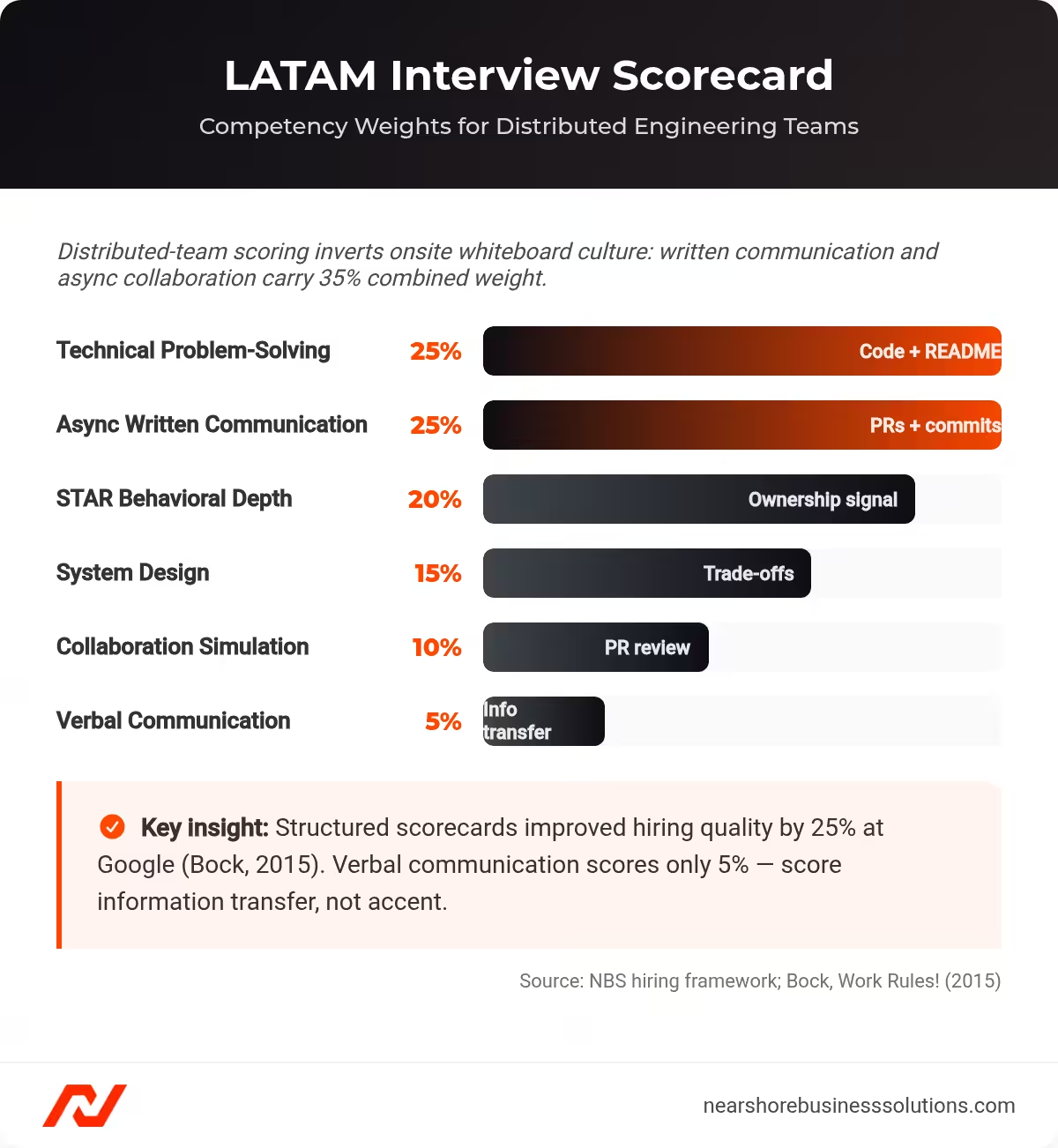
LATAM interview scorecard weighting: async written communication and technical skills carry 50% combined.
How Do You Run a Calibration Session Before Your First LATAM Interview Loop?
Calibration takes 30 minutes and eliminates debrief disagreements that kill offer velocity. Run it before the first loop starts, not after the first candidate completes.
- Walk through the scorecard together. Discuss what “Meets Bar” looks like when the candidate pool is LATAM engineers from Bogota, Medellin, Mexico City, and Buenos Aires.
- Coach on accent bias. Share this scoring principle: score communication on whether the information was transmitted clearly, not on how the candidate sounds. Biased feedback example: “Hard to understand” or “thick accent.” Legitimate feedback: “Could not explain the trade-off between consistency models after two re-phrasings and a follow-up prompt.” Add an explicit bias-check question to the debrief form.
- Align on the STAR coaching script. Every interviewer reads the same preamble before behavioral questions.
- Confirm competency ownership. Each interviewer knows which scorecard rows they score.
- Record and distribute. Make the calibration session required viewing for any new interviewer joining the loop.
Where Does LATAM Hiring Stall and How Do You Close Top Engineers in 48 Hours?
Top LATAM developers in high-demand stacks receive 3-4 competing offers from U.S. and European companies within days of a final round. LATAM developer retention consistently runs well above both U.S. domestic hires and offshore hires. A fast structured close compounds those retention returns.
What Salary Benchmarks Should You Use for LATAM Engineering Offers?
LATAM engineers cost 50-60% less than U.S. equivalents at every seniority level. Total cost comparison: a U.S. full-time senior engineer at $180,000 costs $225,000-$234,000 with loaded benefits at 25-30%. A LATAM senior engineer at $90,000 via an EOR costs $103,000-$112,000 including compliance, payroll, and benefits administration.
| Role and Seniority | LATAM Range (USD/year) | U.S. Average (USD/year) | Savings |
|---|---|---|---|
| Mid-Level Engineer | $50,000-$75,000 | $125,000-$160,000 | 50-55% |
| Senior Engineer | $75,000-$100,000 | $160,000-$220,000 | 50-55% |
| Staff or Principal | $100,000-$130,000 | $220,000-$300,000+ | 55-60% |
Salary figures reflect 2024-2025 market data across Colombia, Mexico, Argentina, and Brazil from a 2024 LATAM tech-salary report. Rates vary by country and specialization. DevOps and AI specialists command a 12-15% premium above these ranges.
What Employment Structure Should You Use for Your First LATAM Hires?
For your first 5-10 LATAM hires, use an Employer of Record (EOR). EORs handle compliance, payroll, and benefits across Colombia, Mexico, Argentina, and Brazil without requiring a local entity. This removes the single biggest friction point from the offer conversation. EOR setup averages 3-7 business days versus 30-90 days to establish a local entity. Transition to a local entity only when headcount in a single country exceeds 15-20 and the operational overhead of entity management becomes cheaper than EOR fees.
Why Is a 48-Hour Offer SLA Your Biggest Competitive Advantage?
A 48-hour offer SLA means: final interview Monday, structured debrief Tuesday morning, offer letter Tuesday afternoon. When the hiring decision is scorecard-driven rather than consensus-seeking, speed is a natural byproduct. Offers delivered within 48 hours of the final round see meaningfully higher acceptance rates than offers delayed 5 or more business days.
Frequently Asked Questions About Interviewing Latin American Candidates
These are the most common questions VPs of Engineering ask when building their first LATAM interview loop.
How long does it take to hire a LATAM developer end-to-end?
LATAM hiring via specialized nearshore platforms averages 3-5 weeks from screening to offer acceptance (Hired, 2023). This is 50-60% faster than the 7-10 week average for U.S. domestic hires. NBS delivers pre-vetted candidates for first interviews within 3 business days.
What if a LATAM developer does not work out after hire?
NBS includes a 90-day replacement guarantee on every placement. If a developer does not meet performance expectations within the first 90 days, we replace them at no additional placement fee. For EOR-contracted developers, the EOR handles local labor law compliance for any separations.
Do LATAM developers need specific equipment for remote work?
Most senior LATAM developers in Bogota, Medellin, Buenos Aires, Mexico City, and Sao Paulo already have professional home office setups. Ask explicitly during screening: “Describe your home office setup and internet connection.” Candidates who pass NBS vetting meet a minimum threshold: 50 Mbps dedicated connection, backup power or a UPS, and dedicated workspace. Equipment stipends of $500-$1,500 are standard for companies with distributed team policies.
How do you pay LATAM developers?
The two common structures are EOR payroll (the EOR employs the developer locally and invoices you in USD) and independent contractor (you pay via wire transfer, Wise, or Deel). EOR is the default for compliance in Colombia (Law 1581 data protection), Brazil (LGPD), and Mexico (IMSS registration). Contractor arrangements work for short-term engagements under 6 months but carry reclassification risk in Colombia and Brazil.
What is the difference between nearshore and offshore for LATAM hiring?
Nearshore means your developers work in time zones with 4-8 hours of overlap with U.S. business hours, enabling real-time standups, PR reviews, and incident response. Offshore (India, Eastern Europe) delivers 0-3 hours of overlap. The difference shows up in sprint velocity on async-heavy teams: Teams switching from offshore to nearshore typically see far fewer delayed pull request reviews and escalation lag.
Do I need a local entity to hire in Colombia or Mexico?
No. An Employer of Record handles all local employment, payroll, and compliance without a local entity. For Colombia, the EOR registers as the employer under Colombian labor code. For Mexico, they handle IMSS and INFONAVIT contributions. NBS partners with EOR providers in Colombia, Mexico, Argentina, Brazil, Chile, and Uruguay.
Should I use a nearshore firm or hire directly from job boards?
Nearshore firms provide pre-screened candidates with verified technical assessments, English proficiency testing, and reference checks. Direct sourcing via LinkedIn or Computrabajo in Colombia or OCC Mundial in Mexico takes 2-3 months and requires in-house LATAM HR capability. NBS delivers candidates in 3 business days.
Ready to Build Your LATAM Engineering Team?
Nearshore Business Solutions sources and vets developers from Bogota, Medellin, Mexico City, Guadalajara, Buenos Aires, and Sao Paulo. We screen for technical skills, English fluency, and U.S. work style fit.
Every placement includes a 90-day replacement guarantee. You receive the first pre-vetted candidates within 3 business days.
Get a free consultation to discuss your hiring needs and receive a custom LATAM salary benchmark for your target role and country.