
An EOR costs 25% less than a direct-hire entity for teams under 10 engineers in Latin America. Through providers like Deel or Remote.com, a software engineer in Mexico City goes on payroll for a flat $599 to $799 monthly fee, while misclassifying that same hire as a contractor risks penalties up to 4,481,000 MXN (about $250,000 USD) under Mexico’s 2021 Labor Subcontracting Reform.
EOR onboarding takes 5 to 10 business days. Setting up a direct-hire entity in Mexico takes 8 to 12 weeks, and the real break-even headcount lands between 10 and 20 employees per country.
This guide compares EOR and direct hiring across Mexico, Colombia, Brazil, and Argentina, with employer-burden benchmarks extended to Costa Rica, Chile, and Uruguay: the real dollar cost at 5, 10, 20, and 50 engineers, the break-even headcount, and the misclassification and permanent establishment risks that make the contractor shortcut dangerous. Use the cost tables and decision points below to build the model your CFO or board will ask for.
What Actually Changes When You Choose an EOR vs Direct Hire?
Two variables define the split between EOR and direct hire: who holds the employment contract, and who absorbs compliance liability. Every downstream difference (payroll mechanics, IP ownership, equity grants, termination exposure) flows from those two choices. The EOR market grew to $4.98 billion in 2023 and is projected to reach $12.7 billion by 2030, according to Grand View Research, as more US companies choose the model over building a local entity from scratch.
An EOR holds the contract. Your company directs the work but never becomes the legal employer in the foreign jurisdiction. A direct hire through your own local entity means you hold the contract and run payroll. You file taxes and own every obligation that comes with being an employer under that country’s labor code.
Most US tech companies initially encounter a third option: hiring a “contractor” on a services agreement and skipping the employment question entirely. That shortcut explains why this decision is urgent. LATAM labor regulators in Mexico, Brazil, Colombia, and Argentina have all sharpened enforcement against misclassification in the last three years. The penalties now routinely exceed any savings the contractor model generated. Not sure whether you need a full legal entity at all? See our breakdown of EOR vs Local Entity for the entity-specific version of this decision.
How Does the EOR Model Work Day to Day?
Deel, Remote.com, and Oyster HR charge $599 to $799 a month per employee to become the legal employer in your target country. The EOR is the legal employer; your company directs the day-to-day work. The worker is a full employee, not a contractor, which eliminates misclassification risk from the outset. These providers maintain legal entities in each country and place your hire on their local payroll, handling statutory benefits (paid vacations, 13th-month salary or aguinaldo, severance accruals, social security contributions) as the employer of record.
| Provider | Monthly Fee | Annual Plan Fee |
|---|---|---|
| Deel | $599/mo | N/A |
| Remote.com | $699/mo | $599/mo |
| Oyster HR | $699/mo | $599/mo |
| Multiplier | $400/mo | N/A |
| Papaya Global | $650/mo | $770/mo for Brazil |
Source: provider pricing pages for Deel, Remote.com, Oyster HR, Multiplier, and Papaya Global, accessed March 2024.
Month-to-month contracts are now standard across Deel, Remote, and Oyster, with no long-term lock-in. Offboarding typically requires 30 days’ notice to the EOR, independent of the statutory notice period owed to the employee. Your company pays 100% of any statutory severance the local jurisdiction mandates, plus an administrative processing fee.
IP ownership is the EOR model’s most underexamined risk. The employee’s legal employer is the EOR, not your company. Two contracts must work in lockstep. The EOR-to-employee agreement must assign IP in favor of your company, and your master services agreement with the EOR must contain a clear pass-through IP assignment clause. In jurisdictions like Brazil and Argentina, where moral rights cannot be waived, this three-party chain of title can be challenged. Have your own IP counsel review both layers before onboarding anyone.
How Does Direct Hiring Work When You Own the Local Entity?
Incorporating your own entity costs $7,000 to $25,000 and takes 6 to 20 weeks, depending on the country, before that entity can legally employ anyone. Your company incorporates a legal entity in the target country (a S. de R.L. in Mexico, a LTDA in Brazil, a S.A.S. in Colombia) and that entity becomes the legal employer. You control compensation structure, benefits design, and termination procedures directly. You also absorb 100% of compliance liability.
IP assignment is cleaner: employment contracts contain standard work-for-hire clauses assigning all created IP to the employing entity, which your US parent owns through the corporate structure. There is no three-party chain of title.
Equity grants become viable with a direct entity. Granting stock options through an EOR ranges from significantly more complex to functionally impossible, depending on provider and jurisdiction. If equity is a core part of your compensation philosophy, this single factor may force the direct-hire path.
One critical risk: if you attempt to “direct hire” without incorporating an entity, tax authorities can assert permanent establishment. That means retroactive corporate income tax liability on revenue attributed to that country, plus penalties. Brazil and Argentina apply particularly aggressive permanent establishment doctrines, according to Baker McKenzie’s 2023 BEPS tax guide, often weighing the economic substance of a relationship over its legal form. An EOR exists precisely to prevent this trigger. Littler Mendelson’s 2023 analysis notes an EOR reduces, rather than eliminates, permanent establishment exposure once a hire acts as a de facto company representative.
Why Does Misclassification Risk Make This Decision Urgent?
In NBS’s experience, roughly 40 to 60% of US companies entering LATAM start by hiring “contractors” on services agreements. Four countries have made that shortcut increasingly dangerous.
Mexico: The 2021 Labor Subcontracting Reform tightened the legal definition of an employee. Penalties reach up to 4,481,000 MXN (approximately $250,000 USD). Companies also owe retroactive payment of all back taxes and statutory benefits for the entire misclassified relationship.
Brazil: The CLT defines employment through four tests: personality, subordination, non-eventuality, and onerosity. Most full-time software engineers meet all four. Labor courts rule overwhelmingly in favor of employees.
Colombia: Labor law presumes an employment relationship exists when a worker provides personal services under conditions of subordination and dependency. Reclassification forces payment of all statutory benefits and social security contributions for the full duration of the contractor arrangement.
Argentina: Courts have additionally applied penalty multipliers under employment regularization statutes for unregistered workers.
Some companies try contractor management platforms (Deel at $489/mo, Remofirst at $199/mo), but these handle invoicing logistics without eliminating the underlying legal risk. The savings over an EOR look negligible against fines that routinely reach tens of thousands of dollars per worker. Not sure whether your current contractors would survive a reclassification audit? Compare the legal tests in Contractor vs Employee LATAM.
How Much Does EOR vs Direct Employment Cost in LATAM in 2026?
A senior software engineer earning $6,000 a month base in Mexico costs $7,049 to $7,249 a month through an EOR. That same engineer on your own Mexican entity’s payroll costs approximately $8,700 a month fully loaded, though your share per head drops as you spread fixed entity overhead across more hires. The contractor model looks cheapest at $6,324 a month, right up until a labor court reclassifies the relationship.
The table below uses a $70,000 USD annual base salary, the median for a mid-senior full-stack engineer in Mexico City as of Q1 2025, per Glassdoor and Terminal compensation data.
| EOR Model | Direct Hire (Own Entity) | Contractor Model | |
|---|---|---|---|
| 5 Engineers | $391,940 | $521,250 | $379,340 |
| 10 Engineers | $783,880 | $1,019,000 | $758,680 |
| 20 Engineers | $1,567,760 | $2,015,500 | $1,517,360 |
| 50 Engineers | $3,919,400 | $5,001,250 | $3,793,400 |
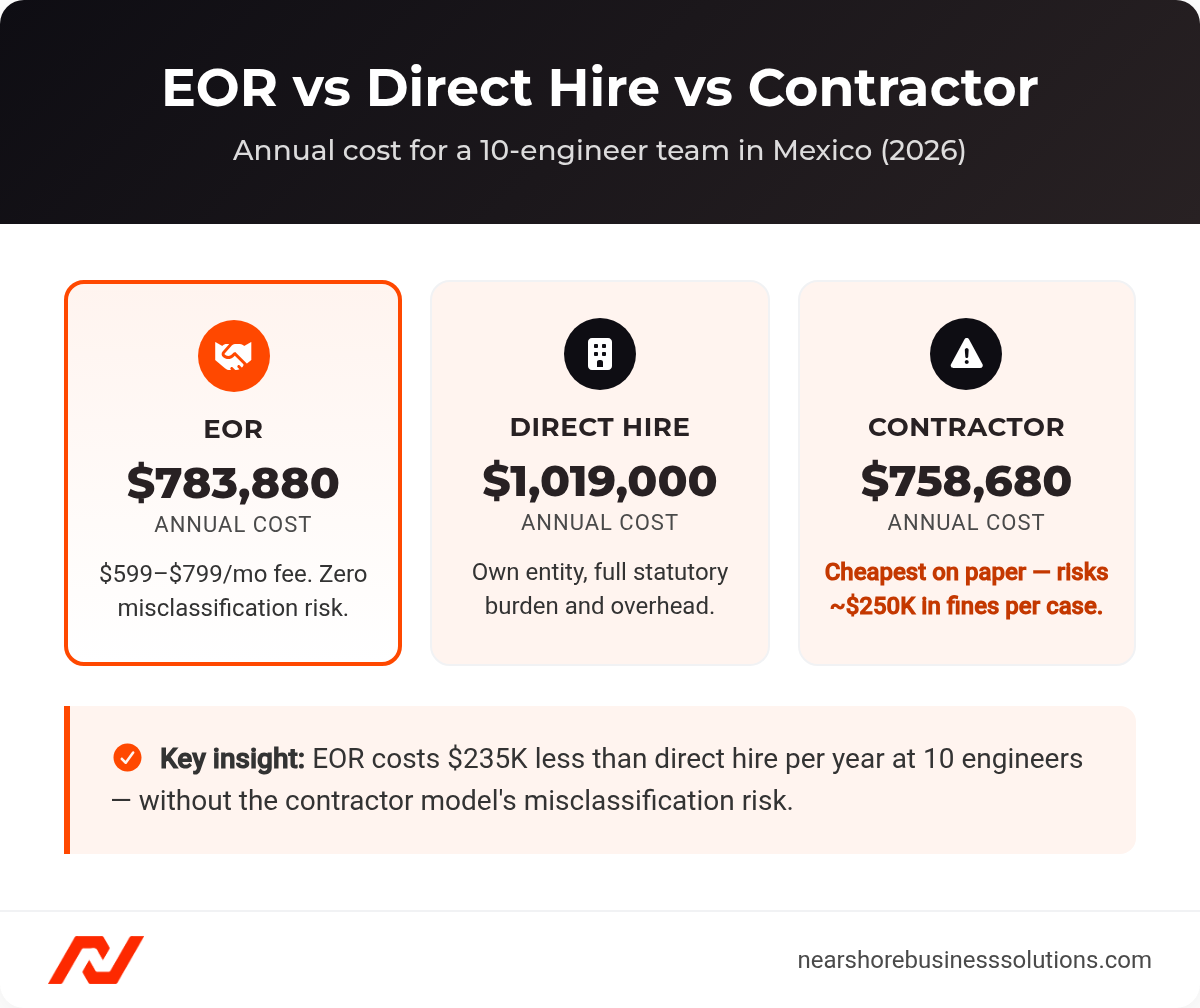
Annual cost for a 10-engineer team in Mexico: EOR vs direct hire vs contractor.
Methodology: NBS model using a $70,000 USD base salary, the EOR platform fee for the EOR column, and each country’s statutory employer burden detailed above for the direct-hire column. Figures are computed illustrations, not third-party statistics.
The direct-hire column looks 30 to 35% more expensive because it honestly bundles the employer-side statutory burden. That burden (IMSS, Infonavit, payroll tax) runs roughly 30 to 35% on top of gross salary in Mexico, plus entity maintenance costs. The EOR column includes the identical statutory burden but wraps it into a single line item. The contractor column excludes employer burden entirely, which is why it appears cheapest and carries the highest legal risk.
How Does Per-Employee Monthly Cost Compare: EOR Fee vs Fully-Loaded Payroll?
The EOR formula is simple: base salary, plus statutory employer burden passed through inside the invoice, plus a flat platform fee of $599 to $799 a month. The direct-hire formula replaces the platform fee with prorated entity overhead. At 5 engineers in Mexico, that overhead adds roughly $375 a month per head; at 20 engineers, it drops to $94 a month per head.
Entity formation demands capital and calendar time before you hire anyone:
| Country | Incorporation Cost | Timeline to First Hire | Annual Compliance |
|---|---|---|---|
| Mexico | $8,000–$15,000 | 8–12 weeks | $15,000–$30,000 |
| Colombia | $7,000–$12,000 | 6–10 weeks | $12,000–$25,000 |
| Brazil | $15,000–$25,000 | 12–20 weeks | $25,000–$50,000 |
| Argentina | $10,000–$20,000 | 10–16 weeks | $20,000–$40,000 |
Sources: Healy Consultants, “Company Formation Guides” (2024); World Bank, “Doing Business” (2020, with costs updated from consultancy data).
For the payroll mechanics behind each line item, from wire transfers to statutory withholding, see our guide to paying international employees compliantly.
Where Does the Break-Even Headcount Fall?
Raw arithmetic, dividing annual entity maintenance by annual EOR fee per employee, suggests a break-even at 3 to 5 employees depending on country. That simple math ignores three cost categories.
First, incorporation costs of $7,000 to $25,000 must amortize across 24 to 36 months. Second, internal management overhead (board resolutions, transfer pricing documentation, statutory audits, monthly social security filings) consumes 10 to 20 hours of senior staff time per month per entity. At a $150 an hour blended cost, that adds $18,000 to $36,000 a year in invisible overhead, according to G-P’s 2023 “CFO’s Guide to Global Expansion.” Third, entity wind-down costs add up: dissolving a Brazilian LTDA takes 6 to 12 months and $10,000 to $20,000 in legal fees.
Adjusting for these factors, the realistic break-even lands between 10 and 20 employees in a single country. Below 10, the EOR model almost always wins on total cost of ownership. Above 20, the entity model’s per-head economics justify the complexity. CFOs cite four reasons for making that switch once headcount clears the threshold: lower cost per head at scale, cleaner financial visibility into payroll and tax line items, a stronger signal of long-term commitment to the market, and the ability to grant equity directly, according to Velocity Global’s 2023 “Scaling Global Teams” report.
What Hidden Costs Do Most Comparisons Miss?
Five cost categories rarely show up on a vendor’s pricing page.
- FX markups. EOR providers convert USD to local currency for payroll disbursement, typically capturing a 1 to 3% spread (G2 and Capterra user reviews, 2023-2024). On a $6,000 a month salary, a 2% spread costs $1,440 a year per employee. It is invisible unless you request a conversion breakdown.
- Benefits administration premiums. EORs procure group health insurance then invoice at 10 to 25% above actual premium cost (Capterra user reviews, 2024), translating to $50–$150 a month per employee.
- Statutory benefit padding. Some providers apply conservative estimates for variable employer contributions and retain excess as float, reconciling annually with 60 to 90 day refund delays.
- Invoice opacity. Finance teams frequently encounter single-line invoices with no itemized breakdown. Request per-employee cost decomposition in writing before signing.
- Severance reserves (direct-hire side). In Brazil, FGTS requires 8% monthly deposits. Upon unjustified termination, the employer owes a 40% fine on the total accumulated balance. For an engineer employed at $7,000 a month for three years, the FGTS balance reaches approximately $20,160, triggering an $8,064 termination fine on top of other severance components.
Why Does EOR Win on Speed-to-Hire and Operational Flexibility?
EOR wins on speed because it puts an engineer on payroll in 5 to 10 business days versus the 8 to 12 weeks a new Mexican entity needs, closing 10 to 22 weeks of hiring lag. A vacant senior engineering seat costs $15,000 to $40,000 a month in delayed feature releases and redistributed workload, based on the U.S. Department of Labor’s benchmark that a bad or delayed hire costs 30% of annual salary. Oxford Economics research separately puts total productivity loss per vacant knowledge-worker role at 28 weeks of equivalent salary.
How Long From Offer Letter to First Payroll?
EOR onboarding takes 5 to 10 business days from offer letter to first payroll, roughly a tenth of the time a new entity requires.
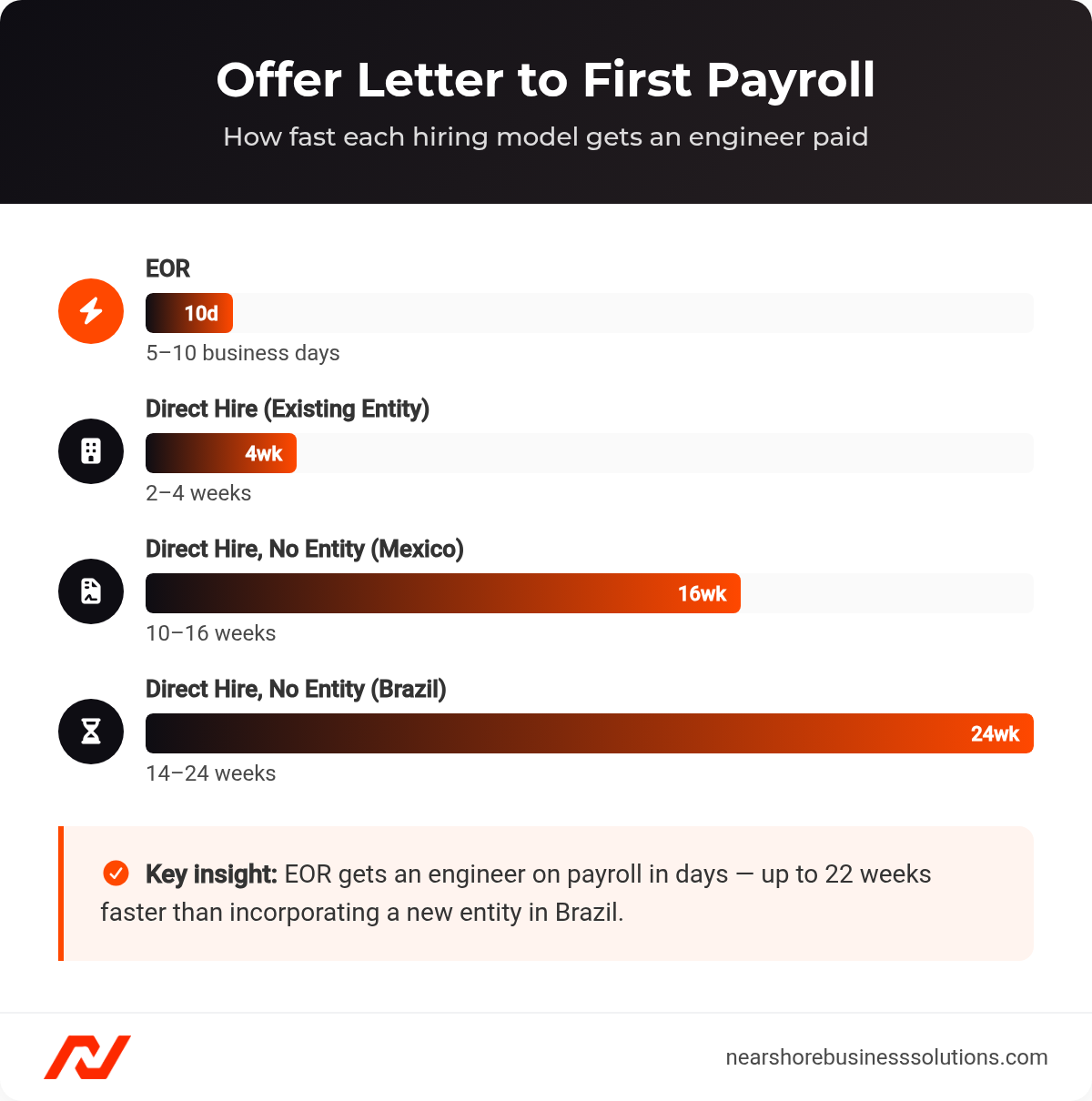
Time from offer letter to first payroll: EOR versus direct hire, with and without an existing entity.
| Employment Model | Total Timeline |
|---|---|
| EOR | 5–10 business days |
| Direct hire with existing entity | 2–4 weeks |
| Direct hire without entity (Mexico) | 10–16 weeks |
| Direct hire without entity (Brazil) | 14–24 weeks |
Should You Test a New Market via EOR Before Committing?
Hiring 3 engineers through an EOR costs $2,097 a month, fully reversible with 30 days’ notice. That makes it a low-risk test of a new market before you commit to an entity. The sequence that works best for Series B and C clients:
- Select the target market based on talent density and time-zone alignment. Mexico and Colombia overlap US Eastern by 6 to 8 working hours.
- Hire 2 to 5 engineers through an EOR to validate talent quality and operational workflow. Total platform cost for 3 engineers at $699 a month: $2,097 a month, fully reversible with 30 days’ notice.
- Run for 6 to 12 months. Track retention, sprint velocity, manager satisfaction, and total EOR spend.
- If headcount plan exceeds 10 engineers, begin entity incorporation in parallel while existing hires continue on the EOR.
- Transition employees from EOR to your own entity once incorporation completes. That means terminating the EOR relationship, then re-hiring onto your entity’s payroll.
How Do You Scale Back Without Severance Surprises?
Terminating an employee without cause in Brazil costs a 40% fine on the full FGTS balance, on top of notice pay. Every LATAM country mandates similar severance, because “at-will” employment does not exist in the region.
| Country | Severance Formula |
|---|---|
| Mexico | 3 months’ salary + 20 days’ salary per year of service + accrued benefits |
| Colombia | 30 days’ salary for year one + 20 days for each additional year |
| Brazil | Notice pay + 40% fine on total FGTS balance + accrued benefits |
| Argentina | 1 month’s salary per year of service (minimum 1 month); courts have applied doubled severance under emergency decrees |
Under the EOR model, the provider’s legal team calculates severance, prepares documentation, and manages the exit process. Your involvement: one email and a wire transfer. Under direct hire, your in-country labor attorney, local HR representative, and accountant manage every step. Your entity remains the named respondent if the terminated engineer files a labor claim.
Compliance and Legal Risk: Who Actually Bears the Liability?
In the EOR model, the provider’s local entity is the named employer on every government filing. When a Brazilian labor inspector audits INSS contributions or a Mexican IMSS audit flags an underpayment, the EOR’s entity receives the notice and responds. Your company never appears in government records as an employer.
Direct hire inverts this entirely. Your entity’s tax ID appears on every filing, and a single miscalculated IMSS contribution in Mexico triggers surcharges of 1.47% a month plus fines of 40 to 100% of omitted contributions.
The employer burden rates below show why compliance errors are costly across the seven markets benchmarked here:
| Country | Mandatory Statutory Costs (% of base) | Total Employer Burden |
|---|---|---|
| Mexico | 30–35% | 35–50% |
| Colombia | 45–55% | 50–65% |
| Brazil | 60–70% | 70–90% |
| Argentina | 55–65% | 60–80% |
| Costa Rica | 26–28% | 36–48% |
| Chile | 20–25% | 30–40% |
| Uruguay | 20–25% | 30–40% |
Sources: NAPS Group, “Labor Costs in Mexico 2024” (2024); Biz Latin Hub, “Employer of Record in Colombia” (2024); Deloitte, “Doing Business in Brazil” (2023); Harris Bricken, “Hiring Employees in Argentina” (2023); Auxadi, “Country Payroll Guides” (2024).
The EOR model does not create zero liability. Your company retains responsibility for actual working conditions (workload, schedule expectations), data protection governance (how employees handle customer PII), and ensuring the three-party IP chain of title is legally sound. But the EOR absorbs the procedural compliance burden that generates the majority of fines and labor court exposure. That is the real difference between directing work and administering employment.
Frequently Asked Questions About EOR vs Direct Hiring
Do I need a local entity to hire engineers in Latin America? No. An EOR lets you hire without incorporating anywhere, and 5 to 10 business days gets a new engineer onto payroll. You only need your own entity once headcount clears the realistic break-even point of 10 to 20 employees in a single country, or if you plan to grant equity.
How long does it take to hire through an EOR versus a direct entity? EOR onboarding takes 5 to 10 business days. Direct hire with an existing entity takes 2 to 4 weeks. Without an entity, expect 10 to 16 weeks in Mexico and 14 to 24 weeks in Brazil before incorporation and first payroll are both done.
What happens if a labor court reclassifies a contractor as an employee? You owe retroactive statutory benefits, back taxes, and social security contributions for the full duration of the relationship. In Mexico, penalties under the 2021 Labor Subcontracting Reform reach 4,481,000 MXN, approximately $250,000 USD, per case.
Can I grant equity to employees hired through an EOR? Rarely without significant complexity. Granting stock options through an EOR ranges from difficult to functionally impossible depending on provider and jurisdiction. A direct entity gives you a clean legal framework for issuing equity.
What’s the difference between an EOR and a contractor management platform? A contractor management platform, like Deel at $489 a month or Remofirst at $199 a month, only handles invoicing for contractors. It does not convert them into employees, so misclassification risk stays with you. An EOR makes the worker a full employee from day one.
Who is liable if a labor inspector audits my hire? Under an EOR, the provider’s local entity is the named employer and responds to the audit. Under direct hire, your entity’s tax ID is on the filing, and you are responsible for any resulting surcharges or fines, such as Mexico’s 1.47% monthly surcharge on miscalculated IMSS contributions.
Ready to Build Your EOR vs Direct Hire Cost Model?
Nearshore Business Solutions runs employer-of-record payroll and compliance for US tech companies hiring across Mexico, Colombia, Brazil, and Argentina. We handle statutory benefits, severance calculations, and government filings so your company never appears on a local labor claim.
Every EOR engagement comes with itemized, per-employee invoicing, not a single-line “management fee,” so your finance team can audit the real cost against the direct-hire model above.
See how our Employer of Record service works and get a custom cost model for your headcount plan.