
Hiring tech talent in Latin America cuts senior engineer costs 52-69% versus US rates while giving you 4-8 hours of daily time zone overlap.
Latin America holds 1.2 to 1.5 million software developers (Evans Data Corporation, 2023). The pool grows 7-9% a year, well ahead of the US at 3-4% (IDC, 2023). A 2024 global hiring report found that 64% of LATAM tech workers hired internationally work for US companies, and that US hiring in the region jumped 160% in 2023.
This guide covers where to find Latin America tech talent, what it costs, how to vet and retain engineers, and which engagement model fits your scaling plan. We pull salary data from Levels.fyi and published LATAM salary benchmarks, and ground every benchmark in cited sources so your CFO can approve the number.
Why Has Latin America Tech Talent Become the Strategic Default for US Engineering Leaders?
Latin America tech talent has shifted from a cost-arbitrage play to a structural hiring advantage. Argentina ranks #1 in Latin America for technology skills (Coursera Global Skills Report, 2023). Mexico outranks India in developer quality at 19th versus 27th globally (2023 developer-skill assessment data). LATAM candidates pass rigorous technical interviews at rates only 10% below US candidates, well above the global average (Karat, 2023). Three compounding advantages explain why engineering leaders now treat the region as their default talent strategy.
How Much Time Zone Overlap Do You Get With Latin America?
LATAM delivers 4-8 hours of working-hour overlap with every US time zone, which removes the async tax that offshore creates. Microsoft Research (2022) found that teams with at least 4 hours of overlap achieved 21% higher code commit velocity and resolved pull requests 18% faster than teams with minimal overlap. The Agile Alliance (2023) measured the inverse: every 12-hour async cycle on a complex issue costs 3-5 hours of lost productivity versus a real-time discussion.
| US Time Zone | Mexico City (CST) | Bogotá (EST) | São Paulo (BRT) | Buenos Aires (ART) |
|---|---|---|---|---|
| Pacific (PT) | 6 hours | 5 hours | 4 hours | 4 hours |
| Central (CT) | 8 hours (Full) | 7 hours | 6 hours | 6 hours |
| Eastern (ET) | 7 hours | 8 hours (Full) | 7 hours | 7 hours |
Central and Eastern US teams get full-day overlap with Mexico City and Bogotá. Even the widest gap, Pacific to Buenos Aires, still provides 4 hours of synchronous work. That covers standup, planning, and at least one collaborative session a day.
Is English Proficiency a Problem When Hiring LATAM Engineers?
No. English proficiency is a hiring advantage in the vetted tech cohort, not a filtering problem. National EPI scores mislead hiring decisions because they aggregate retail workers, students, and retirees. Published 2023 marketplace data shows that over 85% of vetted LATAM developer pools hold business-level or fluent English. Karat (2023) is more precise: LATAM candidates scored 4.1 out of 5.0 on communication assessments, nearly matching US candidates at 4.3 and far exceeding South Asian candidates at 3.2. Eastern European hubs post slightly higher general EPI scores. The vetted LATAM tech cohort performs comparably and consistently outperforms India and Southeast Asia in verbal fluency and accent neutrality.
How Does Cultural Alignment Speed Up Engineering Ramp-Up?
Cultural and methodological alignment cuts ramp-up time by weeks because LATAM runs on the same stack US teams use. The region’s developers default to JavaScript, TypeScript, Python, React, Node.js, PostgreSQL, and AWS (Stack Overflow Developer Survey, 2023). Nearshore tech talent from LATAM does not need retraining on toolchains. They already commit to GitHub, track work in Jira, and communicate in Slack daily. The deeper advantage is behavioral. Shared Western business norms and direct communication styles reduce misunderstandings. Offshore hires often need 4-6 weeks of context-building before contributing autonomously. LATAM engineers typically integrate into Agile ceremonies and ship meaningful work within the first two sprints.
Which Tech Roles Can You Realistically Hire in Latin America?
You can hire across at least seven role categories in Latin America, from full-stack and backend to DevOps, data, and technical product management. The real sourcing question is not whether LATAM has the talent. It is where specific skill concentrations run deepest and at what seniority band supply matches demand. Vertical teams follow the same logic; our guide to building remote ecommerce teams in Latin America maps the platform-specific roles and hubs for online retail.
Where Are the Five LATAM Tech Hubs Every VP Engineering Should Know in 2026?
The five hubs are Mexico, Colombia, Argentina, Brazil, and the Uruguay-Costa Rica pair, holding a combined pool of more than 1 million developers. Each leads on a different axis: scale, overlap, raw technical caliber, or senior concentration. For a city-level view of where these ecosystems concentrate, see our guide to the top tech hubs in Latin America.
| Mexico | Colombia | Argentina | Brazil | Uruguay / Costa Rica | |
|---|---|---|---|---|---|
| Top Cities | Guadalajara, Mexico City, Monterrey | Bogotá, Medellín | Buenos Aires, Córdoba | São Paulo, Florianópolis | Montevideo, San José |
| Est. Developers | ~225,000 | ~100,000 | ~135,000 | ~500,000+ | ~25,000 / ~20,000 |
| Specializations | Mobile, cloud, full-stack | SaaS, fintech, back-end | Algorithms, AI/ML | Fintech, enterprise software | Fintech, IT services |
| Key Advantage | Full-day CST overlap, ~130K annual grads, USMCA alignment | EST overlap, government programs, Medellín’s startup ecosystem | Highest technical caliber; EPI 562 (High Proficiency) | Sheer scale, 3x largest pool; USP Top 50 CS globally | High stability, concentrated senior quality |
| Key Risk | English proficiency varies wide outside the top 20% | Senior talent competition from Rappi, Globant, US firms | Economic instability, mitigate with USD pay via EOR | Portuguese-first; English speakers command a 15-25% premium | Small pools constrain scaling past 10-15 engineers |
| Senior IC Depth (5-10 yr) | Deep; Oracle, IBM, HP built a thick bench | Strong and accelerating | Exceptionally deep | Deepest absolute numbers | Small but high-quality |
| Staff/Principal (15+ yr) | Shallow; expect longer fill times | Thin; most moved to management | Available but expensive with competing offers | Deepest in LATAM at this tier | Very limited |
Mexico’s talent pipeline is anchored by Tecnológico de Monterrey (ITESM), ranked among the top engineering schools in Latin America, plus UNAM, the region’s largest university. Guadalajara, often called “Mexico’s Silicon Valley,” hosts the Ciudad Creativa Digital district with Intel, IBM, Oracle, and HP. Mexico’s position under the USMCA adds digital-trade and IP protections aligned to US practice. Colombia draws on Universidad de los Andes and EAFIT in Medellín, where the Ruta N innovation district anchors the startup scene and ProColombia supports foreign employers. Argentina pairs Universidad de Buenos Aires (UBA) and ITBA with the Knowledge Economy Law (Ley de Economía del Conocimiento), which cuts employer payroll contributions and lowers total employment cost. Buenos Aires birthed Mercado Libre, Globant, and Auth0, so engineers there often bring product-oriented startup experience.
Composite nearshoring ranking: Mexico leads on balance of scale, overlap, and alignment. Colombia is best for EST teams and rising quality. Argentina offers the best raw technical talent if currency risk is managed. Brazil wins on scale and enterprise depth; see our guide to hiring developers in Brazil. Uruguay and Costa Rica suit boutique senior teams. Costa Rica in particular backs that senior density with 25+ years of enterprise engineering, which is why we profile Costa Rica as a tech outsourcing hub.
For team composition, note that Staff and Principal salaries in LATAM ($105,000-$130,000) show the narrowest savings gap versus US equivalents ($280,000), at 54-63%. The pragmatic approach: hire your 5-10 year senior ICs from LATAM where density runs deep. Keep Staff and Principal roles US-based or budget for LATAM-premium pay.
How Do You Source DevOps, Data Engineers, and Product Managers Beyond Full-Stack?
You source specialized roles by targeting the right country for each skill, since the assumption that LATAM equals React developers understates the region by at least five role categories. Brazil and Argentina lead Python, data, and ML. Teams zeroing in on that market can compare Brazilian talent hubs and CLT costs in our guide to hiring Brazilian software engineers. Argentina and Brazil hold the emerging Go and Rust talent. AWS certifications across the region grew 38% year over year (Stack Overflow Developer Survey, 2023).
| Skill Category | Availability | Strongest Markets | Salary Premium vs. Full-Stack |
|---|---|---|---|
| React / Node.js / TypeScript | Excellent | All major hubs | None, baseline rate |
| Python / Data / AI / ML | Strong, growing fast | Brazil, Argentina | 10-15% for specialized ML |
| Java / Kotlin | Excellent | Brazil, Colombia | None |
| Go / Rust | Emerging | Argentina, Brazil | 20-30%; expect 4-6 week sourcing |
| Cloud / DevOps (AWS, K8s, Terraform) | Strong | All hubs | 5-10% for multi-cloud architects |
| QA Automation | Strong | Costa Rica, Colombia, Brazil | 15-20% below IC rates |
| Technical Product Management | Emerging | Mexico, Argentina | 10-20% premium, thinnest supply |
What Does It Actually Cost to Hire Technology Talent in LATAM?
Senior LATAM engineers cost $50,000 to $130,000 a year versus $160,000 to $280,000 in the US, a 52-69% saving by role. Base salary captures only 65-75% of the real number your CFO approves. This section builds the complete cost model, from headline benchmarks to statutory loading and EOR fees.
What Are the 2026 Salary Benchmarks by Role, Seniority, and Country?
Senior full-stack engineers run $65,000-$80,000 across LATAM versus $195,000 in the US, a 60-65% saving. All figures below reflect annual USD for senior-level ICs with 5-8+ years, benchmarked against SF and NYC pay.
| Role | US Median | Mexico | Colombia | Argentina | Brazil | Avg. Savings |
|---|---|---|---|---|---|---|
| Senior Full-Stack | $195,000 | $75,000 | $70,000 | $65,000 | $80,000 | 60-65% |
| Senior Backend | $200,000 | $80,000 | $75,000 | $70,000 | $85,000 | 58-65% |
| DevOps / Platform | $210,000 | $85,000 | $80,000 | $75,000 | $90,000 | 57-64% |
| Engineering Manager | $250,000 | $110,000 | $100,000 | $95,000 | $120,000 | 52-62% |
| Data Engineer | $205,000 | $82,000 | $78,000 | $72,000 | $88,000 | 58-65% |
| QA / SDET | $160,000 | $60,000 | $55,000 | $50,000 | $65,000 | 62-69% |
| Staff / Principal | $280,000 | $120,000 | $110,000 | $105,000 | $130,000 | 54-63% |
| ML Engineer | $220,000 | $95,000 | $90,000 | $85,000 | $105,000 | 52-61% |
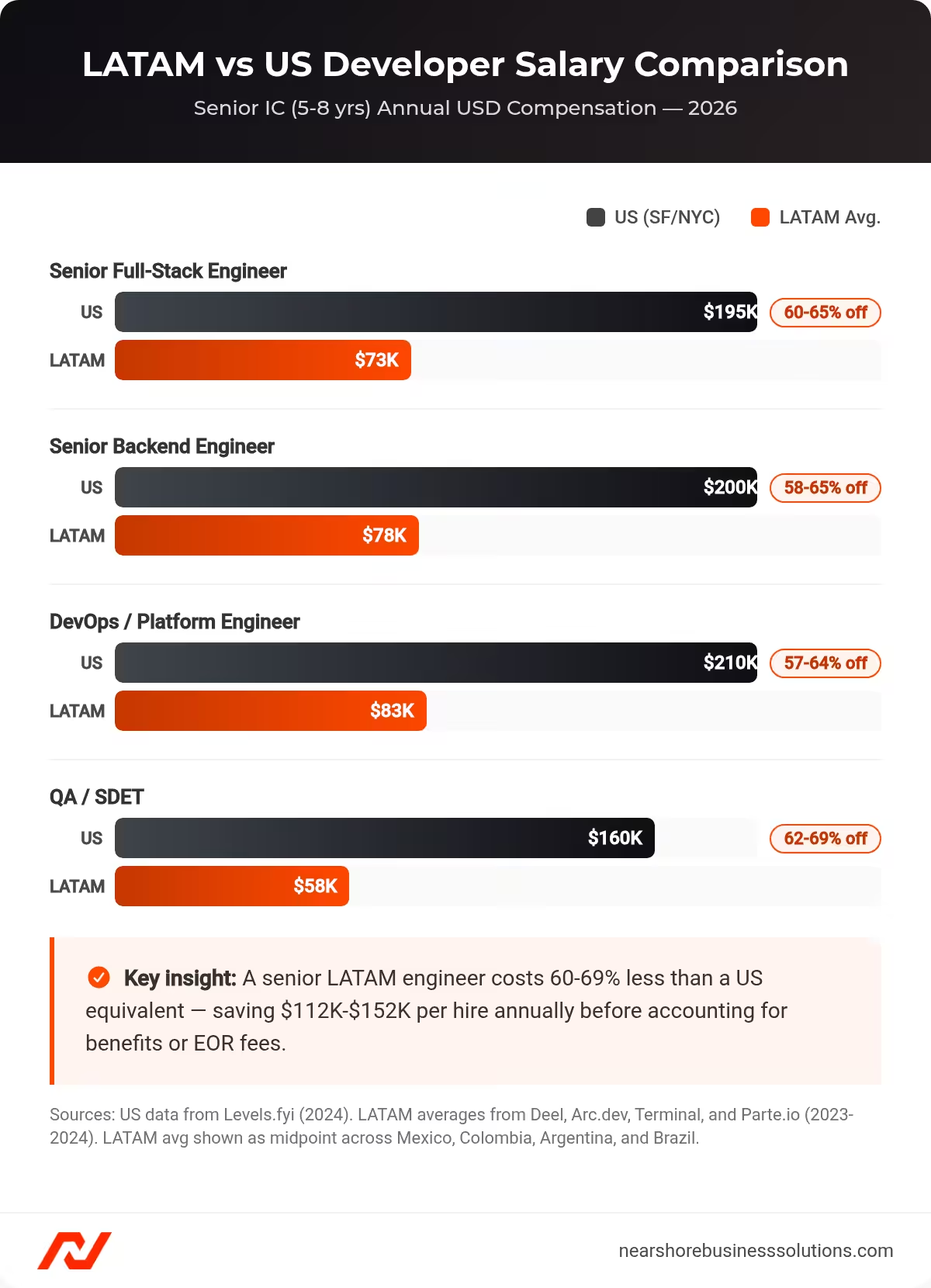
Senior engineer annual salaries across four LATAM countries compared to US SF/NYC rates, 2026.
Sources: US data from Levels.fyi (2024). LATAM data from published global hiring and developer-marketplace benchmarks and Parte.io (2023-2024). Argentina figures reflect USD-denominated expectations.
What Hidden Costs Erode Your Savings?
Three hidden costs erode savings: statutory benefits loading of 30-60%, EOR fees, and currency volatility. Statutory loading is the largest. Colombia mandates 13th-month pay, health, pension, and severance, totaling about 35-40% (published 2024 employer-cost data). Brazil’s CLT framework pushes costs 40-60% above base. Mexico’s aguinaldo and IMSS land around 30-35%.
EOR fees add $599-$799 per employee per month. Deel and Remote both price in this range (Deel, 2024). Some EORs charge 8-15% of gross salary instead, so compare structures, because percentage models cost more above an $80,000 base.
Currency volatility hits Argentina hardest. The peso swung more than 50% against the dollar in 2023-2024 (2024 LATAM market data). USD-denominated contracts through an EOR neutralize this for both parties, which is why Argentina figures above reflect USD expectations.
Contractor rates run 15-25% above equivalent full-time salaries because the contractor absorbs taxes and benefits (published 2024 contractor-rate data). You assume misclassification risk in exchange, a growing enforcement priority in Colombia and Brazil.
Here is a worked example for a Colombian senior full-stack engineer.
| Cost Component | Amount |
|---|---|
| Base salary | $70,000 |
| Statutory benefits (~35%) | $24,500 |
| EOR fee ($650/mo x 12) | $7,800 |
| Total Cost of Engagement | $102,300 |
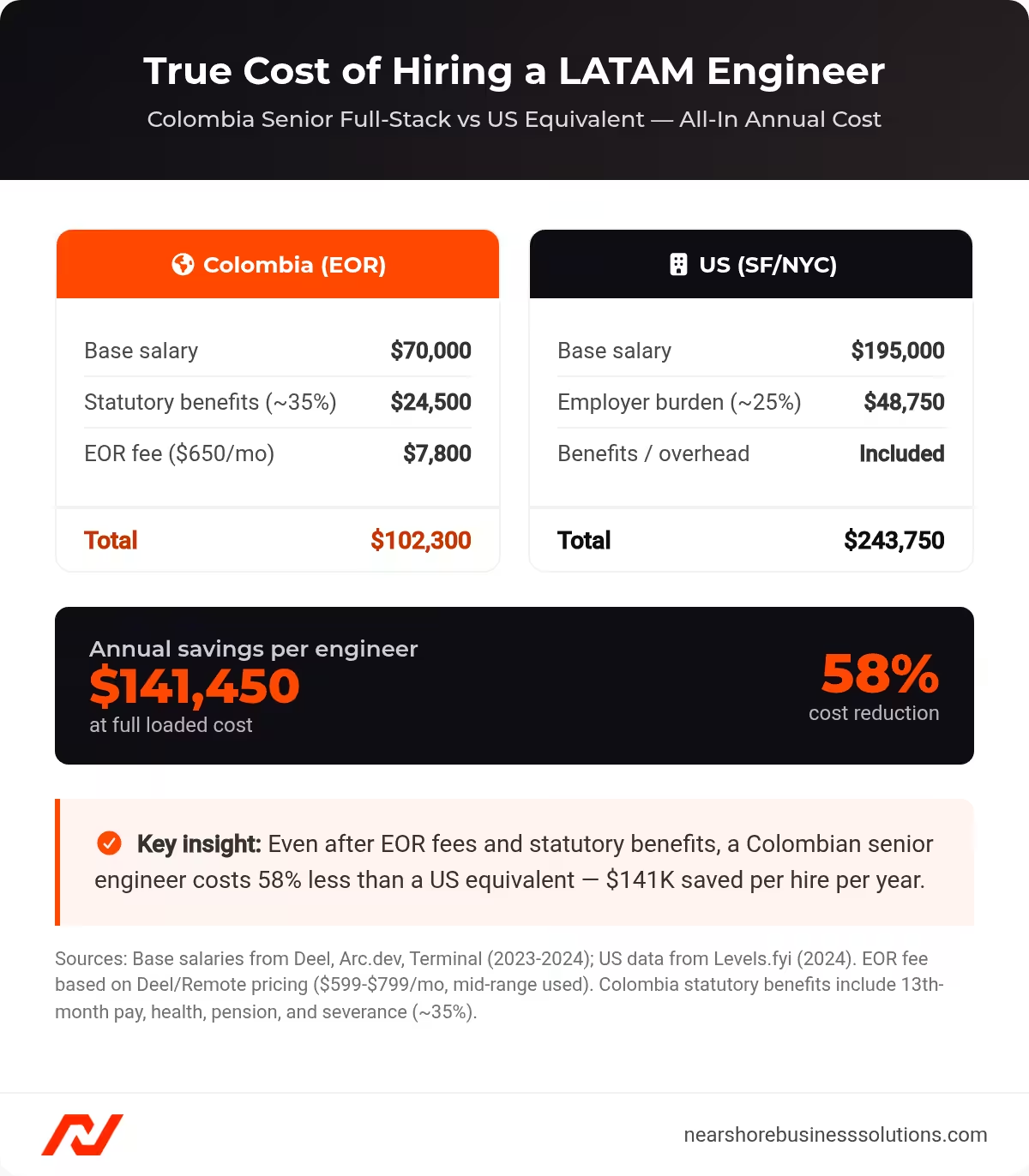
All-in annual cost for a Colombian senior engineer via EOR versus a US-based equivalent, including benefits and fees.
The US equivalent is $195,000 plus a 25% employer burden, or $243,750. Net savings reach $141,450 per engineer per year, a 58% reduction in total cost. The biggest hidden cost is not fees or currency. It is a mis-hire. A $75,000 senior who ships autonomously generates compound value. A $55,000 mid-level who churns at month four costs 3-4 months of ramp time, a second sourcing cycle, and every slipped feature.
How Do You Vet Latin America Tech Talent to Avoid Costly Mis-Hires?
You vet LATAM talent through a four-layer framework that filters 100 sourced candidates down to 1-2 hires. Glassdoor (2023) estimated the average cost of a bad hire at 30% of first-year earnings. For remote engineers with less passive oversight, problems surface later and compound faster. What separates a high-performing pipeline from one producing regrettable attrition is the rigor of your evaluation stages.
What Are the Layers of an Effective Vetting Framework?
The framework runs five evaluation layers, each with a published pass rate that compounds into a 1-2% final yield.
- Resume and Profile Screen. Verify stack experience, project complexity signals, and career trajectory coherence. Pass rate: about 30%.
- English Communication Assessment. A 20-30 minute live conversational interview tests the ability to explain technical decisions, ask clarifying questions, and handle ambiguity. Communication breakdowns account for 39% of failed remote engineering engagements (HackerRank, 2023). Pass rate: about 50% of Stage 1 passers.
- Online Technical Assessment. Role-specific assessments predict 90-day performance 2.4 times more accurately than generic algorithm puzzles (CodeSignal, 2024). Set a top-20% threshold. Pass rate: about 40% of Stage 2 passers.
- Live System Design and Pair Programming. A 60-90 minute session evaluates requirement decomposition, trade-off articulation, and real-time collaboration. Structured work-sample interviews predict job performance with r=0.54 correlation, the highest of any single method (Google re:Work, 2023). Pass rate: about 30% of Stage 3 passers.
- Paid Async Trial Project, 48-72 Hours. A scoped deliverable against your codebase tests code quality, commit hygiene, documentation, and async communication of blockers. Trial projects cut first-year attrition 32% versus interview-only processes (Automattic, 2023). Pay $500-$1,500. Pass rate: binary hire or no-hire.
The cumulative funnel runs 100 sourced, 30 pass resume, 15 pass English, 6 pass technical, 2 pass system design, 1-2 hired. That 1-2% yield tracks the published sub-1% acceptance rates of large developer marketplaces (2023). Any process promising significantly higher yield is cutting corners.
Should You Vet In-House or Partner With a Nearshore Staffing Firm?
You should vet in-house at 1-3 hires per quarter and outsource the funnel’s top at 4 or more concurrent hires. Running the full framework costs 12-18 hours of internal engineering and recruiting time per hire. At five concurrent openings, your senior engineers spend 60-90 hours a month interviewing instead of shipping.
Firms like NBS IT staffing absorb Stages 1-3 and deliver pre-qualified candidates. That compresses your time from 15-plus hours per hire to 3-4 hours. Nearshore staffing firms report median time-to-present figures around 14 days, with some claiming 72-hour first-candidate delivery for React and Node.js roles.
The staff augmentation markup of 30-60% on base covers sourcing, vetting, compliance, payroll, and 60-90 day replacement guarantees. That guarantee transfers the $35,000-$50,000 mis-hire cost from your balance sheet to the firm’s operating model.
Which Engagement Model Fits: Staff Augmentation, EOR, Direct Hire, or Contractor?
The right model depends on team stage and growth speed: contractors for short projects, staff augmentation for fast scaling, EOR for long-term integrated teams, and direct entity at 50-plus engineers. The vetting framework delivers qualified candidates. The engagement model determines how they appear on your org chart, balance sheet, and legal exposure.
How Do You Match an Engagement Model to Team Stage and Growth Speed?
You match the model to your speed and headcount horizon. The table below maps cost, IP, speed, and compliance risk across the five common models.
| Factor | Contractor | Staff Augmentation | EOR | Managed Team | Direct Entity |
|---|---|---|---|---|---|
| Cost | Hourly; zero overhead | Monthly; 30-60% markup | Base + statutory + $599+/mo fee | Fixed monthly; highest markup | Full TCOE + $20K-$100K+ setup |
| IP Ownership | Contract-defined; airtight MSA required | Transfers via MSA | Assigned via EOR contract; very secure | Defined in SOW/MSA | Direct; most secure |
| Speed to Hire | 1-3 weeks | 2-6 weeks | 4-8 weeks | 4-8 weeks | 6-12+ months |
| Compliance Risk | High; misclassification exposure | Low; provider holds employment | Very low; gold standard | Low | Lowest |
| Best Fit | 2-8 week projects; trial engagements | Scaling 3-15 engineers fast | Long-term integrated team members | Outsourced non-core modules | 50+ engineers; multi-year |
If you need 4 or more hires within 60 days, staff augmentation compresses sourcing and compliance into one vendor, and the markup pays for speed you cannot replicate internally. If you build steadily over 6-12 months, EOR gives direct management control at lower per-head cost. Any role expected to last beyond 6 months should route through EOR or staff augmentation. Retention improves with employment-grade benefits, and misclassification risk escalates with duration. A 2023 survey found that 72% of US companies hiring internationally for the first time prefer the EOR model for its balance of compliance, speed, and employee experience (published 2024 global hiring research).
How Do You Retain Nearshore Tech Talent When Every US Company Competes for the Same Engineers?
You retain LATAM engineers with a retention stack that goes beyond pay: career paths, learning budgets, equity, belonging rituals, and USD stability. LATAM tech salaries are inflating 8-15% a year in hot markets (2024 LATAM salary benchmarks), and every strong engineer in your pipeline has competing offers. Hiring is the beginning. Retention determines ROI.
What Goes Into a Retention Stack for LATAM Engineers?
The retention stack combines five levers, because compensation alone does not hold engineers when offers are everywhere. LATAM engineers cite career growth and meaningful work above salary in satisfaction surveys.
| Retention Lever | Tactical Implementation | Why It Matters for LATAM |
|---|---|---|
| Career Growth Path | Defined IC and management ladders with transparent promotion criteria | LATAM engineers rank career growth and meaningful work above salary |
| Learning and Development | $1,500-$3,000 annual stipend for conferences, courses, certifications | Signals investment in the individual, not just extraction of output |
| Equity or Phantom Equity | Include LATAM members in equity programs or phantom equivalents | Reduces the contractor-mindset gap that drives attrition |
| Team Belonging Rituals | Same Slack channels, sprint ceremonies, all-hands; rotate meeting times fairly | The fastest way to lose LATAM engineers is treating them as second-class |
| USD Stability and Flexibility | USD-denominated pay via EOR; schedule autonomy over rigid hours | For Argentina especially, USD pay stabilizes income and lifts retention |
How Often Should You Re-Benchmark LATAM Salaries?
Re-benchmark compensation twice a year, and quarterly in Argentina given currency volatility. Use published global salary insights, LATAM developer-marketplace salary guides, and Parte.io for current data. A 10% annual adjustment in competitive markets costs far less than a replacement cycle. Every senior engineer who leaves resets your team’s velocity by 8-12 weeks.
Frequently Asked Questions About Hiring Tech Talent in Latin America
These are the most common questions US engineering leaders ask about hiring in Latin America.
How long does it take to hire a developer in Latin America?
It takes 2-6 weeks through staff augmentation and 4-8 weeks through an EOR. Contractor engagements can close in 1-3 weeks. Nearshore staffing firms report median time-to-present figures around 14 days, with some claiming 72-hour first-candidate delivery for React and Node.js roles.
What if a developer does not work out?
Most staff augmentation firms include a 60-90 day replacement guarantee. That guarantee transfers the $35,000-$50,000 cost of a mis-hire from your balance sheet to the firm. A paid async trial project before the offer also cuts first-year attrition by 32% (Automattic, 2023).
How do you pay developers in Latin America?
You pay through an Employer of Record, a staff augmentation firm, or a direct contractor agreement. EOR fees run $599-$799 per employee per month and cover payroll, benefits, and compliance. USD-denominated pay via an EOR protects against currency swings, which matter most in Argentina.
What is the difference between nearshore and offshore?
Nearshore means hiring in nearby time zones, like Latin America for US teams, with 4-8 hours of daily overlap. Offshore means distant time zones, like India, where a 12-hour async cycle costs 3-5 hours of lost productivity per complex issue (Agile Alliance, 2023).
Do I need a local entity to hire in Latin America?
No. An Employer of Record legally employs the talent on your behalf, so you avoid a $20,000-$100,000+ entity setup that takes 6-12 months. Direct entity setup only makes sense at 50-plus engineers in one country.
Is the IP my company creates secure?
Yes, when structured correctly. Staff augmentation transfers IP through a Master Service Agreement, and an EOR assigns it through the employment contract. Contractor engagements need an airtight agreement, since misclassification and weak IP terms are the main risks.
Ready to Build Your Latin America Engineering Team?
Nearshore Business Solutions sources and vets developers across Mexico, Colombia, Argentina, and Brazil.
Every placement includes a 90-day replacement guarantee, and you receive your first pre-vetted candidates within 3 business days.
Get a free consultation to discuss your hiring needs and receive a custom quote.