Building remote ecommerce teams in Latin America cuts developer costs 53-61% while accessing 1.25 million skilled developers across Colombia, Mexico, Argentina, and Brazil, with time-to-hire dropping to under 30 days.
LATAM developers cost $45,000-$100,000 annually for senior ecommerce roles, versus $110,000-$210,000 in the US, per Glassdoor and Gartner. Time-to-hire drops to under 30 days through a staff augmentation partner, with first vetted candidates within 3 business days, compared to 8-12 weeks for US senior roles. Colombia, Mexico, and Argentina offer 6-8 hours of daily overlap with US Eastern time.
We source vetted ecommerce developers from tech hubs in Bogota, Medellin, Mexico City, Buenos Aires, and Mendoza. Each candidate is screened for platform-specific skills, English fluency, and US work style fit. Below you will find salary benchmarks, role definitions, the embedded team model, and a four-step hiring playbook.
Why Are Engineering Leaders Building Remote Ecommerce Teams Instead of Hiring Locally?
Four forces are pushing US engineering leaders toward LATAM: salary inflation, time-to-fill, platform complexity, and the maturing of Latin America’s developer ecosystem.
The average time-to-fill for a US technology role is 43 days, per the SHRM 2023 Talent Acquisition Benchmarking Report. For specialized ecommerce positions like a Headless Commerce Engineer fluent in Next.js and Shopify’s Storefront API, or a Senior Magento Developer who can architect multi-store Adobe Commerce deployments, that window stretches to 60-90 days. Every week a critical role stays open, sprint velocity drops and platform migration timelines slip.
Hiring through a LATAM nearshore partner cuts time-to-engage to under 30 days, with first vetted candidates within 3 business days. Deloitte’s 2022 Global Outsourcing Survey documents the strategic shift: companies nearshore primarily to “improve speed to market” and “access intellectual capital,” with cost savings as a significant but secondary driver. Gartner’s 2023 Market Guide confirms LATAM nearshore teams deliver 30-50% cost savings over onshore resources while providing better collaboration than traditional offshore options. Average voluntary turnover for US engineering roles runs 13.2% annually, per the Radford Global Technology Survey, versus 5-8% for well-managed nearshore engagements.
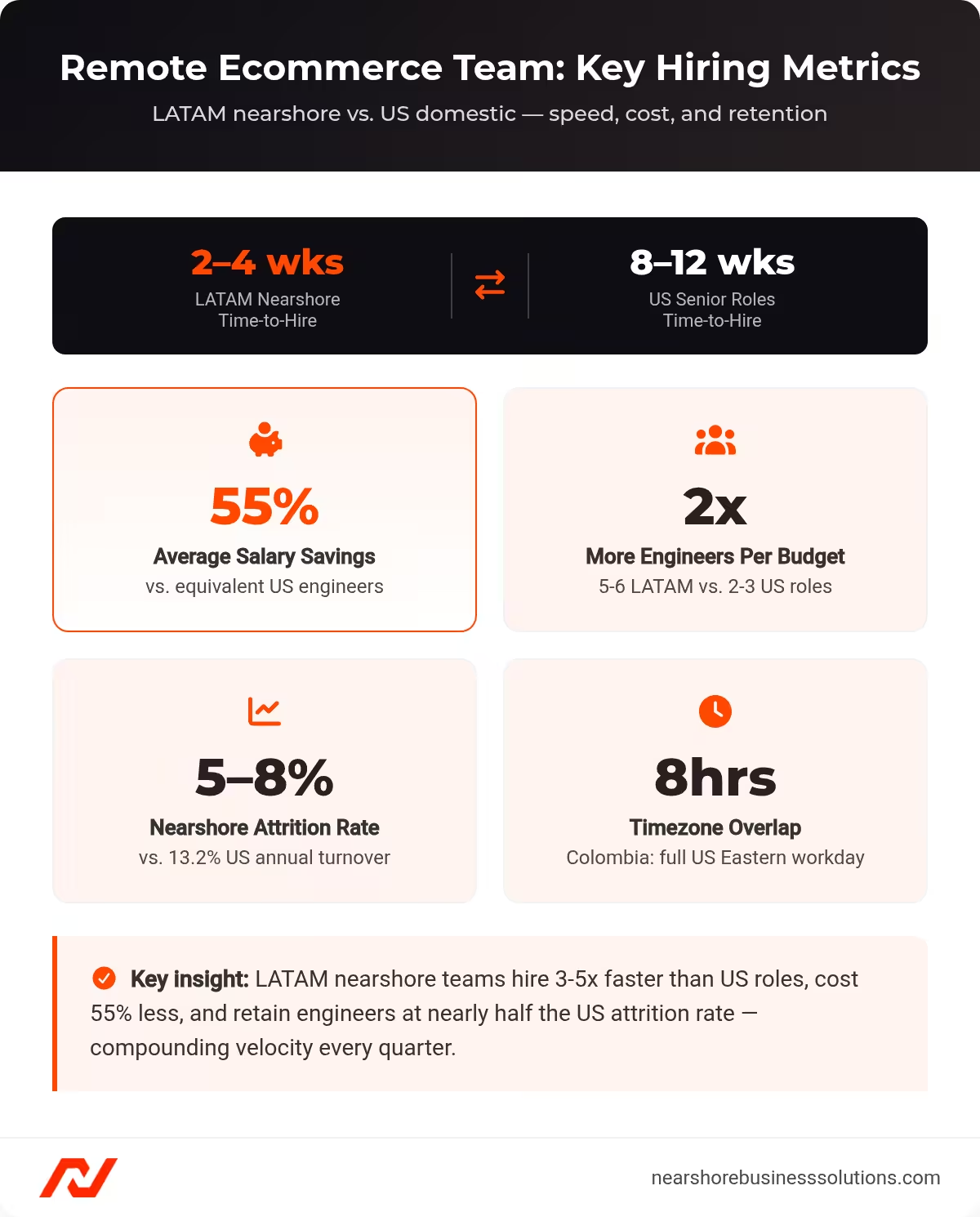
Time-to-hire, cost savings, attrition rate, and timezone overlap for LATAM nearshore ecommerce teams.
What Is the Talent Gap in Ecommerce Platform Engineering for Shopify, Magento, and WooCommerce?
Over 28,000 ecommerce engineering positions sit open across the United States at any given time, per LinkedIn Jobs data from October 2023. That includes 4,500+ open “Shopify Developer” roles and 2,000+ open “Magento Developer” roles. The gap is structural: WooCommerce holds roughly 23% global market share, Shopify 20%, and Adobe Commerce/Magento 7%, per BuiltWith’s 2023 global ecommerce usage statistics. Few engineers invest deeply across more than one platform. The rapid shift toward headless and composable (MACH) architectures has created demand for engineers combining JavaScript/React frontend capability with API integration and platform-specific backend knowledge.
At US rates, a $10M ARR ecommerce company can afford two or three senior platform engineers. At LATAM rates, the same budget fields a five- or six-person squad. The table below compares current salary ranges, sourced from Glassdoor, GetonBoard, and 2023 developer-marketplace salary reports.
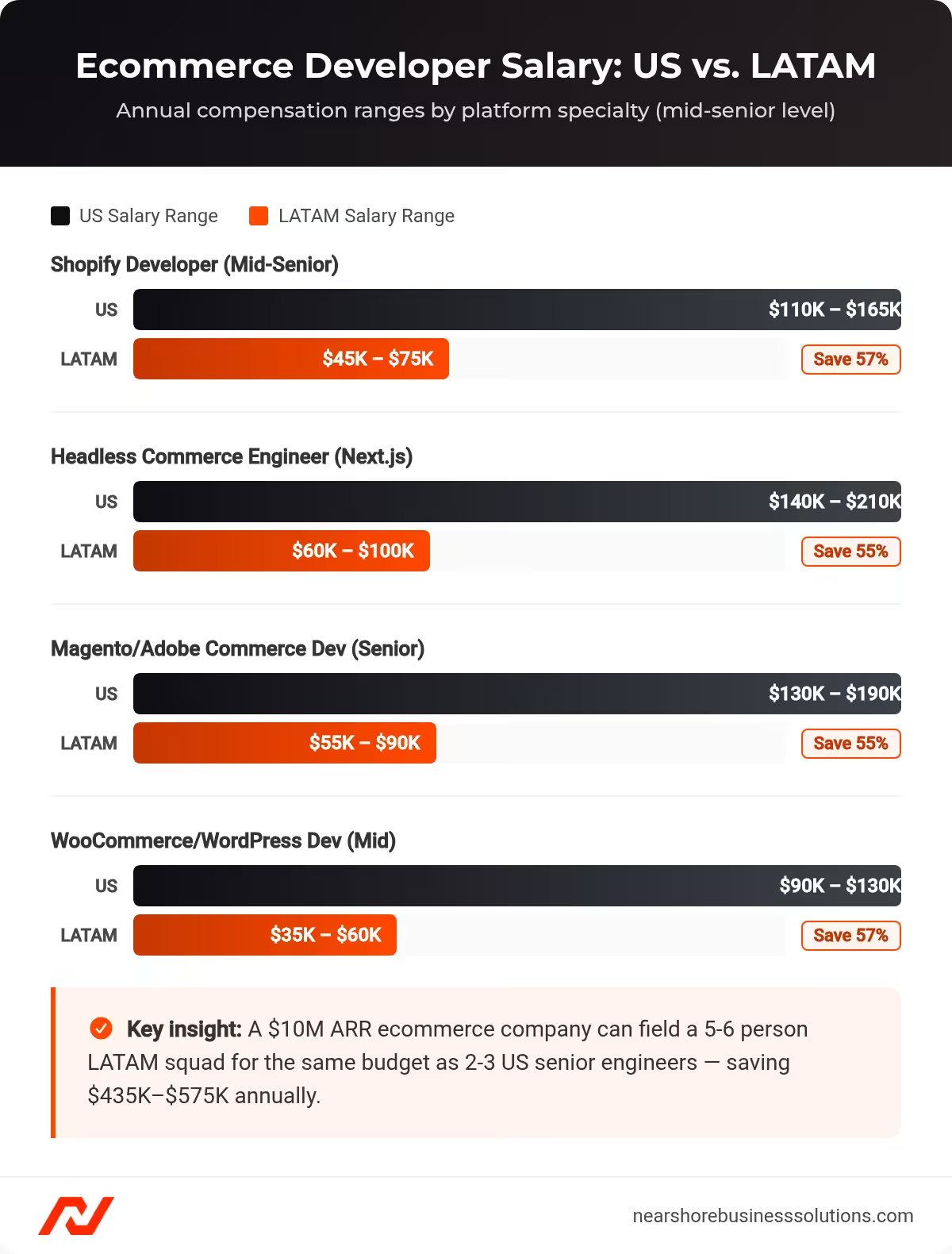
Annual salary ranges for four ecommerce developer roles, US vs. LATAM, showing 55–57% cost savings.
| Role | US Salary Range | LATAM Salary Range | % Savings |
|---|---|---|---|
| Shopify Developer (Mid-Senior) | $110,000-$165,000 | $45,000-$75,000 | 55%-59% |
| Magento/Adobe Commerce Dev (Senior) | $130,000-$190,000 | $55,000-$90,000 | 53%-58% |
| WooCommerce/WordPress Dev (Mid) | $90,000-$130,000 | $35,000-$60,000 | 54%-61% |
| Headless Commerce Engineer (Next.js) | $140,000-$210,000 | $60,000-$100,000 | 53%-57% |
Why Does Time Zone Overlap with LATAM Outperform the Cheapest-Talent Offshore Model?
GitLab’s 2023 Remote Work Report identifies 4-5 hours of synchronous overlap as the minimum threshold for high-velocity collaborative teams. LATAM cities clear that bar decisively, while India (0-1 hours overlap with US Eastern), Ukraine/Poland (1-2 hours), and the Philippines (0 hours) do not.
| City | UTC Offset | Overlap with US Eastern | Overlap with US Pacific |
|---|---|---|---|
| Bogota/Medellin, Colombia | UTC-5 | 8 of 8 hours | 5 of 8 hours |
| Mexico City, Mexico | UTC-6 | 7 of 8 hours | 6 of 8 hours |
| Buenos Aires, Argentina | UTC-3 | 6 of 8 hours | 3 of 8 hours |
| San Jose, Costa Rica | UTC-6 | 7 of 8 hours | 5 of 8 hours |
The cost advantage of India or the Philippines disappears when you factor in communication latency. Every standup becomes someone’s midnight meeting. Every urgent production bug waits until the next business day. The cheapest engineer per hour becomes the most expensive engineer per shipped feature when that latency compounds across a quarter.
For ecommerce teams specifically, real-time overlap is not a preference. It is a requirement. A payment gateway outage at 2 PM ET needs an immediate all-hands response. A Black Friday launch needs engineers monitoring performance and pushing fixes during the US peak window. A/B test results need same-day decisions, not 24-hour handoffs.
What Does a High-Performing Nearshore Ecommerce Team Look Like Inside a US Engineering Org?
22% of LATAM developers on a leading nearshore hiring platform list ecommerce as a primary skill, per a 2023 state-of-LATAM-tech-talent report. But the difference between a high-performing nearshore ecommerce team and an underperforming one is not the individual talent. It is how those individuals are integrated into the US engineering org.
What Core Roles Does a Nearshore Ecommerce Pod Need?
Six specialized roles make up a complete ecommerce engineering pod. A checkout flow touches payment tokenization, fraud scoring, tax calculation, inventory reservation, and shipping rate APIs. Often all within a single user action that must complete in under two seconds. Generic full-stack developers cannot staff these positions effectively.
The table below shows the six core roles, their primary stack, and their key responsibility in a modern ecommerce org.
| Role Title | Primary Stack | Key Responsibility |
|---|---|---|
| Frontend CRO Engineer | Next.js, React, Liquid, LaunchDarkly | Storefront performance, A/B tests, checkout UX |
| Payments Integration Engineer | Stripe, Adyen, PCI-DSS tooling | Payment gateways, subscription billing, fraud rules |
| Fulfillment/Logistics Systems Engineer | ShipStation, EasyPost, ERP connectors | 3PL integrations, inventory sync, return workflows |
| Ecommerce DevOps/Platform Engineer | AWS, Terraform, Docker, Datadog | CI/CD pipelines, CDN config, auto-scaling |
| Ecommerce QA/Automation Engineer | Cypress, Playwright, k6 | End-to-end checkout tests, load testing |
| Ecommerce Data Analyst/Engineer | dbt, BigQuery, Segment, GA4 | Order analytics, LTV modeling, attribution |
The full six-role pod costs $740,000-$1,095,000 annually at US rates. At LATAM rates: $305,000-$520,000. The difference funds three to four additional engineers or an entire second pod covering a different product line.
LATAM’s developer ecosystem supports the full ecommerce stack. Over 65% of developers in the region use JavaScript professionally, per the Stack Overflow Developer Survey 2023. Approximately 40-50% of those have professional React experience. PHP developers, covering Magento and WooCommerce, make up around 25% of the LATAM pool. Python and Node.js each see 40-45% adoption, supporting composable commerce backends. AWS penetration runs 50-60% among LATAM developers.
On the education side, Latin America produces over 350,000 STEM graduates annually. Brazil leads with roughly 120,000, Mexico follows at 115,000, Colombia at 40,000, and Argentina at 30,000, per UNESCO Institute for Statistics and World Bank data. Training platforms like Platzi in Colombia (3 million students), Digital House in Argentina and Brazil (acquired by Globant), Henry in Buenos Aires (ISA-based, placing graduates in US companies), and Laboratoria in Peru, Chile, and Mexico add a growing layer of career-switcher talent. For staff augmentation at scale, these pipelines matter.
Why Does the Embedded Model Outperform the Siloed Offshore Pod for Conversion Rate Gains?
Eventbrite established its core engineering hub in Mendoza, Argentina, not as a satellite cost center but as a fully integrated part of its global organization contributing to key platform features. Zapier built a fully remote team hiring extensively across Colombia, Brazil, and Argentina, distributing engineering responsibility as equal participants. Both companies used the embedded model.
The embedded model places LATAM engineers directly into existing squads. Same Slack channels, same Jira board, same standups, same on-call rotations. The siloed model assigns requirements documents and receives deliverables days later. The performance gap shows up in every sprint cycle.
Consider a Stripe webhook failure at 2 PM ET. A siloed offshore team receives the notification at midnight local time. By morning, your store has lost eight hours of revenue. A LATAM-embedded payments engineer is already in Slack when the alert fires.
Consider A/B testing. A Frontend CRO Engineer deploys a checkout experiment at 9 AM ET. By 1 PM, the test shows statistical significance. The engineer reviews data with the product manager and ships the winning variant before the afternoon traffic peak. With asynchronous offshore handoffs, that same loop takes two to three days. Compounded across 30-40 CRO experiments per quarter, the embedded model produces materially higher cumulative conversion gains.
| Practice | Embedded Model | Siloed Failure Mode |
|---|---|---|
| Shared tooling | Same Jira, GitHub, Slack, Datadog | Separate “offshore Jira” creates context gaps |
| Sprint ceremonies | LATAM engineers participate as full members | Team receives summary documents post-ceremony |
| Reporting lines | Same engineering manager as US counterparts | Offshore PM intermediary adds latency, strips context |
| On-call rotations | Shared schedule extends coverage to 10-14 hrs/day | US engineers cover all shifts alone, driving burnout |
Wunderman Thompson Commerce (formerly Gorilla Group) documented a case with a US-based B2B manufacturer using Adobe Commerce. Their Bogota-based Magento team delivered a 35% reduction in development costs and a 50% increase in deployment frequency. The key: real-time support during US business hours, which was the client’s hard requirement. That outcome is not achievable with a siloed offshore pod.
How Do You Hire Ecommerce Developers in LATAM? A Four-Step Playbook from Role Brief to Signed Offer
Four steps take you from vague requirement to a signed offer with a pre-vetted LATAM ecommerce developer. Each step has a specific failure mode; knowing them saves weeks.
How Do You Define Platform-Specific Skill Requirements Before Sourcing a Single Candidate?
Specificity in your role brief cuts screening volume by roughly 50%. “Full-stack developer with ecommerce experience” is not a role brief. A Senior Magento 2 Developer who can extend the EAV data model to support configurable product bundles with tiered pricing across multiple store views is a role brief. The difference is accountability: vague briefs produce mismatched candidates, platform-specific briefs produce a shortlist of three to five qualified developers in two to four weeks.
Five elements every ecommerce developer role brief must include:
- Platform-Specific Experience. Name the exact platform version and subsystems. “Shopify Plus with Checkout Extensibility and Shopify Functions” is actionable. “Shopify experience” is not.
- Headless/Composable Proficiency. Specify the integration surface: which headless CMS, search provider, commerce API layer, and frontend framework. Include GraphQL as a hard requirement for headless builds.
- Performance and Optimization Mindset. Require demonstrated Core Web Vitals improvements. A candidate who can cite specific Largest Contentful Paint or Total Blocking Time gains has the optimization instinct ecommerce demands.
- API Integration Expertise. List every third-party system: payment gateways, tax engines, 3PL/WMS systems, marketing automation platforms. A typical mid-market stack involves 15-25 API connections.
- Security Awareness. Require familiarity with PCI-DSS compliance: SAQ levels, tokenization workflows, and OWASP Top 10 vulnerabilities as applied to commerce.
How Do You Source Ecommerce Developers Through LATAM Staff Augmentation Partners?
A single LinkedIn posting attracts 150-300 applicants within 72 hours, per hiring platform data. Of those, 80-85% will lack the platform-specific depth your brief demands. Three sourcing models exist, each with different time, cost, and compliance tradeoffs.
| Model | Time to Engage | Compliance Risk | Best Use Case |
|---|---|---|---|
| Direct Contractor | Days | High: misclassification liability | Short-term scoped sprints |
| Employer of Record (EOR) | 1-2 weeks | Eliminated: EOR handles local employment | Long-term hires you manage directly |
| Staff Augmentation Partner | Under 30 days | Low: partner manages compliance | Scaling pods with pre-vetted talent |
The staff augmentation model through a nearshore IT staffing partner is the standard choice for ecommerce pods of three or more engineers. The partner handles sourcing, vetting, payroll compliance, and replacement if a hire does not work out. You manage the engineers directly inside your sprint cadence.
Latin America produces over 350,000 STEM graduates annually, per UNESCO and World Bank data. Brazil and Mexico together account for 235,000 of those. The education pipeline is deepening across Bogota, Medellin, Buenos Aires, and Mexico City. Universities including Universidad de los Andes and EAFIT in Colombia, Tecnologico de Monterrey (ITESM) and UNAM in Mexico, and the Universidad de Buenos Aires (UBA) and ITBA in Argentina produce the core of the senior talent pool. The staff augmentation model taps this pipeline pre-vetted, cutting your screening load to a shortlist.
How Do You Run Technical Assessments for Ecommerce Developer Roles?
LeetCode-style algorithm interviews do not screen for ecommerce engineering skills. A Shopify developer who can implement an efficient sorting algorithm may not know how to extend Checkout Extensibility without breaking an active cart session. The assessment must mirror real ecommerce scenarios.
Three assessment formats that work for platform-specific screening:
- Checkout flow build. Give the candidate a Figma spec and API docs. Ask them to implement a multi-step checkout with address validation, order summary recalculation, and error handling for a failed payment. Review the code for edge cases (race conditions on inventory, idempotency on Stripe charge).
- Payment gateway webhook debug. Provide a broken webhook handler with three seeded bugs: a missing idempotency key, an unhandled refund event type, and a missing HMAC signature check. Measure how quickly the candidate identifies all three and explain their reasoning.
- Storefront performance audit. Give the candidate a Lighthouse report with a Core Web Vitals score in the red. Ask them to diagnose the top three contributors and describe their remediation approach, with specific code patterns.
Wunderman Thompson Commerce evaluated their Bogota-based Magento developers on platform-specific skills, including debugging Adobe Commerce module conflicts rather than abstract algorithm puzzles. The result: 35% cost reduction and 50% increase in deployment frequency on the client account.
How Do You Structure Onboarding for Ecommerce Developers Around Your Commerce Stack and Seasonal Revenue Cycles?
Ecommerce onboarding must include business context, not just codebase orientation. A developer who does not understand your peak revenue windows will schedule a schema migration for Black Friday weekend. Three phases cover the required ground.
- Days 1-30. Access provisioning, codebase orientation, first bug fix or small PR. Grant access to Datadog or New Relic dashboards from day one so new hires absorb live system behavior rather than reading documentation.
- Days 31-60. Domain immersion: catalog structure, payment processors, fulfillment partners. Paired feature work with a US-based engineer who provides commerce domain context on every task.
- Days 61-90. Independent feature ownership, business context depth (AOV targets, conversion benchmarks, seasonal traffic patterns), and first architectural contribution.
English proficiency varies by country. Argentina ranks 28th globally with High Proficiency (EF EPI score: 562). Costa Rica ranks 37th. Brazil and Mexico rank lower nationally, but tech-sector professionals working with US companies show significantly higher proficiency than those national averages suggest. Set communication expectations explicitly during onboarding. Power Distance scores are higher in Mexico and Colombia than in the US (Hofstede Insights, 2023), but developers adapting to US engineering orgs adjust to direct communication styles quickly within flat, agile team structures.
Frequently Asked Questions About Building Remote Ecommerce Teams
Engineering leaders ask these questions most often before launching a LATAM nearshore ecommerce team.
How Long Does It Take to Hire an Ecommerce Developer in LATAM?
Expect under 30 days from role brief to signed offer when working through a staff augmentation partner with pre-vetted ecommerce talent, with first vetted candidates within 3 business days. Direct LinkedIn sourcing typically adds 4-6 weeks of screening time. That timeline assumes a clear platform-specific role brief. Vague requirements extend it to 6-8 weeks as the partner rescreens broader candidates.
What Happens If a Developer Does Not Work Out?
Reputable staff augmentation partners include a 90-day replacement guarantee as a standard contract term. If the placed developer is not meeting expectations within the first three months, the partner replaces them at no additional recruiting fee. This makes the risk profile of a LATAM hire comparable to a US hire, without the six-month notice periods common in some LATAM labor codes.
Do I Need to Set Up a Local Entity to Hire in Latin America?
No. The Employer of Record (EOR) model eliminates that requirement. An EOR becomes the legal employer of record in the developer’s home country. They handle local payroll, mandatory social contributions, benefits, and HR compliance. You manage the developer’s work directly. This covers Colombia’s social security obligations, Mexico’s IMSS contributions, and Argentina’s mandatory bonus (aguinaldo) requirements without you establishing a legal presence.
How Do I Pay LATAM Developers and Handle Currency Risk?
When using a staff augmentation partner or EOR, you pay the partner in USD at a fixed rate. The partner handles local currency conversion and payment to the developer. Your costs are predictable in dollar terms. If you hire direct contractors, you will need a cross-border payment platform like Deel or Remote to handle peso, real, and peso-argentino conversions.
What Is the Difference Between a Nearshore and Offshore Ecommerce Team?
Nearshore means the team is in your time zone or within three hours of it, enabling same-day collaboration. Offshore typically means India, Eastern Europe, or the Philippines, where the time difference reaches 8-14 hours. For ecommerce teams that need to respond to production incidents, launch promotional events, and iterate on A/B tests in real time, that 8-14 hour gap eliminates the collaboration model that drives conversion rate gains. Nearshore costs more per hour than offshore, but delivers better outcomes per sprint.
What Security and Compliance Standards Should a LATAM Ecommerce Developer Know?
Require PCI-DSS awareness for any developer touching payments. SAQ levels determine compliance scope: an engineer working on a Stripe integration needs to understand SAQ A-EP at minimum. For data handling, Colombia’s Law 1581 and Brazil’s LGPD (Lei Geral de Protecao de Dados) govern personal data, which is relevant if your ecommerce platform stores customer records for local markets. Argentina’s PDPA aligns closely with GDPR standards. SOC 2 Type II certified partners add a layer of documented security controls for enterprise clients.
Ready to Build Your Nearshore Ecommerce Engineering Team?
Nearshore Business Solutions sources and vets ecommerce developers across Latin America. We screen for platform-specific skills, English fluency, and US work style fit.
Every placement includes a 90-day replacement guarantee. You receive the first pre-vetted candidates within 3 business days. We support Shopify, Magento, WooCommerce, and headless commerce stack requirements across Colombia, Mexico, Argentina, and Brazil.
Get a free consultation to discuss your ecommerce hiring needs and receive a custom candidate shortlist.