Cultural competency training cuts miscommunication-driven project delays by 25% and lifts international employee retention 15% over two years, yet only 42% of mid-sized US companies run any formal program.
The global cross-cultural training market nearly doubled in five years, from $4.6 billion to $8.9 billion (Grand View Research, 2024). That growth tracks the distributed workforce expansion that put 1.5 million LATAM software engineers (Evans Data Corporation, 2024) within reach of US hiring managers. Companies in the top quartile for ethnic diversity outperform peers by 39% in profitability (McKinsey, 2024).
This guide breaks down why most programs fail, what effective training looks like in 2026, six proven cultural competency training examples with measurable outcomes, and a phased roadmap HR leads can deploy for LATAM expansion. We help US companies build vetted nearshore engineering teams across Latin America, so the frameworks below are anchored in real US-LATAM collaboration data.
Why Do Most Cultural Competency Training Programs Fail Global and Remote Teams?
Only 35% of US tech HR leaders with nearshore operations run a dedicated cultural integration program for their LATAM teams (per a 2024 nearshore operations survey). Another 45% rely on informal onboarding conversations. That means no structure, no measurement, and no accountability. The result is cultural debt: accumulated misunderstandings and eroded trust that compound sprint over sprint.
Legacy cultural awareness training was architected for co-located, monocultural headquarters. When companies bolt these programs onto nearshore operations unchanged, they create a false sense of readiness while the real friction goes underground. Three failure patterns explain why.
Why Do One-Size-Fits-All Modules Ignore Regional Power Distance Norms?
Generic modules fail because hierarchy means different things across cultures. Mexico scores 81 on Hofstede’s Power Distance Index. The US scores 40. Colombia lands at 67, Brazil at 69.
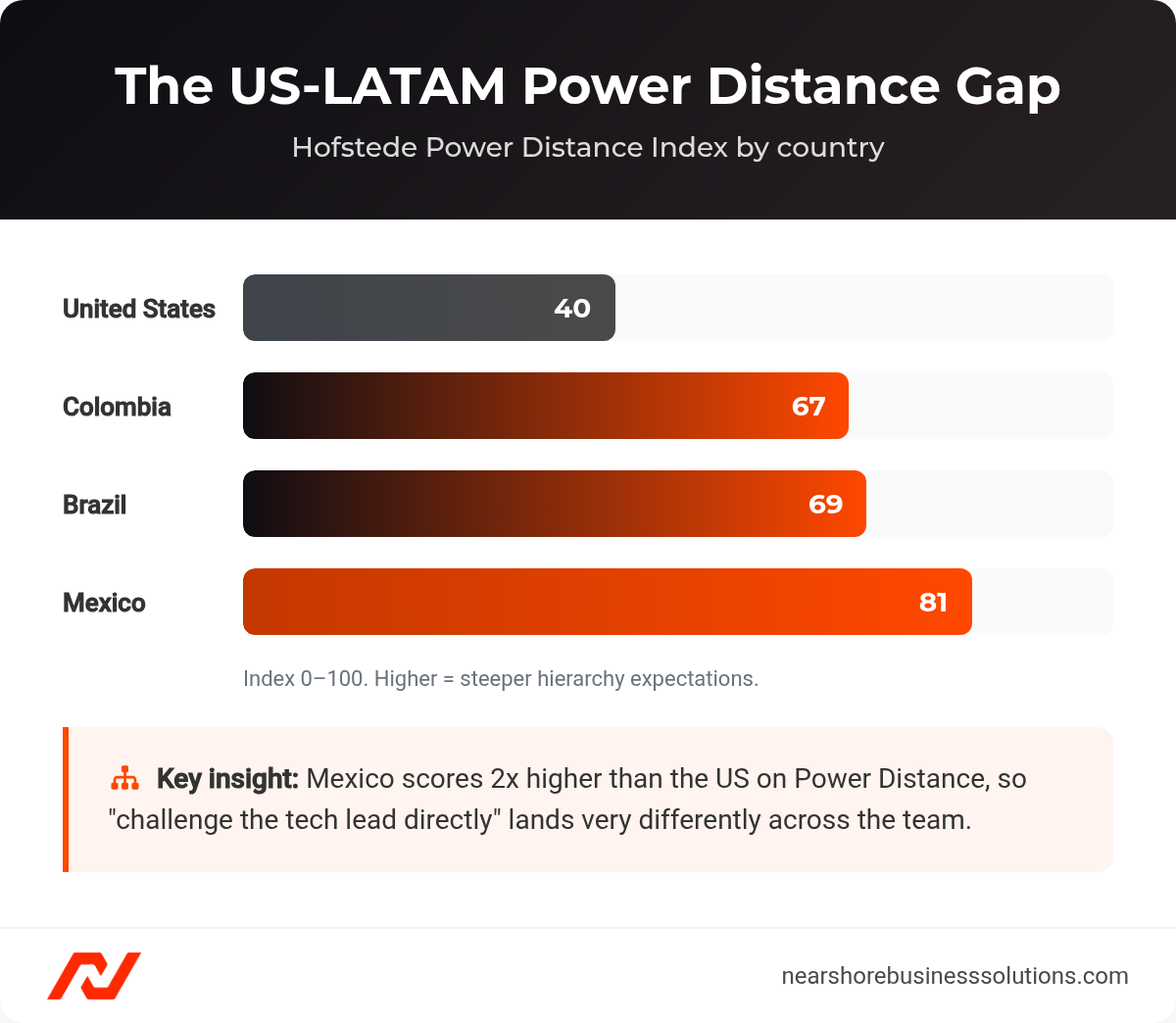
Hofstede Power Distance Index for the US versus four LATAM nearshore markets.
A training module built around flat-hierarchy norms collides with these differences. “Speak up in standups” and “challenge the tech lead directly” assume a low-power-distance frame. A US engineering manager asks “Any questions or concerns?” and hears silence. They log consensus. The LATAM team, reading the prompt as rhetorical within a high-power-distance frame, surfaces concerns privately. That creates hidden blockers that delay delivery. Closing that gap is a core aim of effective cross-cultural business communication, which adapts tone and directness to each culture.
Does Unconscious Bias Training Build Cross-Cultural Communication Skills?
No. Unconscious bias training builds awareness, not behavior change. 58% of tech companies now include global collaboration modules in their unconscious bias training (Gartner, 2024). Yet awareness and competency are different capabilities.
Knowing that proximity bias exists does not teach a manager in Denver how to run an inclusive sprint retrospective across three time zones. The gap between “I understand bias” and “I adapt my behavior in cross-cultural standups” remains the core failure mode.
Why Do Compliance-Driven Programs Miss the Retention Outcomes HR Leads Need?
Compliance checkboxes miss retention because retention runs through psychological safety, not policy.
> **Companies with effective cross-cultural management training retain international employees at a 15% higher rate over two years.** Deloitte, 2023Employees on culturally competent teams report 30% higher psychological safety scores and 22% higher eNPS (Korn Ferry). Teams with high levels of perceived bias have 45% lower psychological safety scores, which reduces innovation and raises silent quitting among international members (McKinsey, 2023). Remote international employees are 30% less likely to feel they have an equal shot at promotion compared to domestic peers. No compliance checkbox resolves that perception. These dynamics sit at the heart of managing global teams well, where leaders have to engineer inclusion rather than assume it.
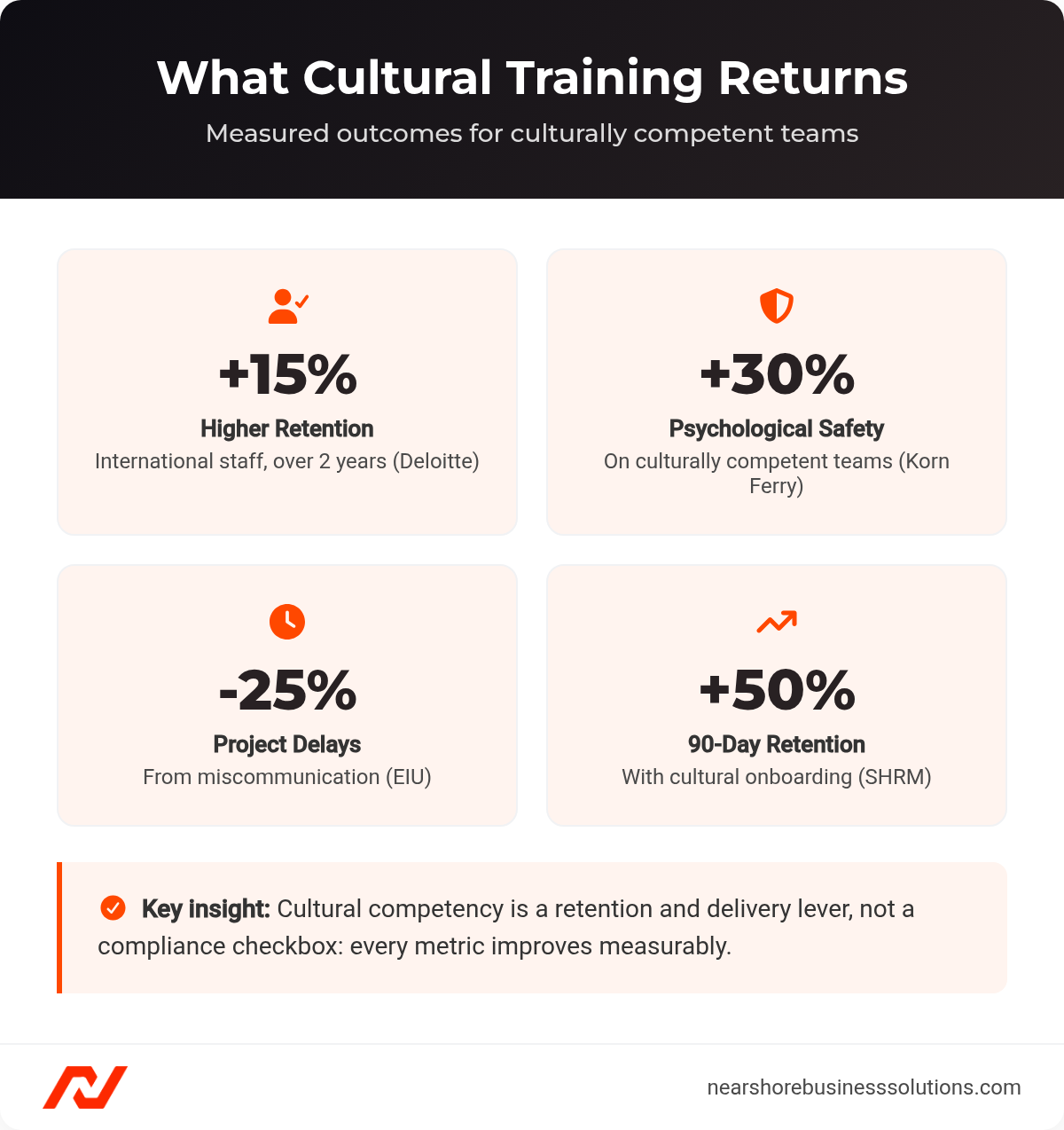
Measured outcomes of cultural competency training on retention, safety, and delivery.
What Does Effective Cross-Cultural Training Actually Look Like in 2026?
Effective training in 2026 sequences learning across three pillars rather than stalling at completion metrics. While 68% of multinational corporations provide some form of cross-cultural training (RW3 CultureWizard, 2023), most programs measure attendance instead of behavior. The framework that bridges that gap is the Cognitive-Affective-Behavioral (CAB) model:
- Cognitive: structured knowledge about cultural dimensions.
- Affective: attitudinal shifts driven by empathy and perspective-taking.
- Behavioral: practiced skills applied in real work situations.
An estimated 70 to 75% of cross-cultural programs reference Hofstede’s framework (SHRM, 2023). Roughly 40% of new programs now add Erin Meyer’s Culture Map scales. Teams with high cross-cultural understanding report 25% fewer project delays due to miscommunication (Economist Intelligence Unit, 2022), a reduction that traces directly to the behavioral pillar. To baseline and track progress, the Intercultural Development Inventory (IDI) gives a validated pre- and post-assessment instrument. It is used by over 2,500 organizations globally and 15 to 20% of Fortune 500 companies (IDI, 2024).
How Do You Shift From Event-Based Workshops to Ongoing Learning Loops?
You replace annual workshops with micro-touchpoints woven into existing team rituals. Annual cultural training decays without reinforcement. US-LATAM teams hold a structural advantage here: GitLab found that teams with 4 to 6 hours of synchronous overlap were 40 to 60% more effective at collaborative problem-solving than teams with fewer overlap hours (GitLab, 2023).
Five touchpoints convert event-based training into a learning loop:
- Onboarding Week 1: Cultural immersion module paired with Hofstede team profile review and IDI assessment.
- 1:1 Templates: Standing prompt: “What’s one cultural difference that affected your work this sprint?”
- Sprint Retrospectives: Dedicated column for cultural misalignments alongside standard retro categories.
- Async Documentation: Living collaboration playbook specifying feedback style, escalation paths, and response-time expectations.
- Quarterly Team Rituals: Culture showcase sessions where team members present work norms from their region.
What Should You Measure Beyond Completion Rates?
Measure leading indicators of integration, not course completion. Companies with structured, culturally aware onboarding for nearshore engineers report 50% higher 90-day retention and 25% higher 6-month retention (SHRM Foundation, 2023). LATAM nearshore attrition rates run 8 to 12% on well-integrated teams. That sits below the 13.2% US domestic tech voluntary turnover rate and well below the 15 to 20% typical of India offshore engagements. Cultural integration quality separates the 8% floor from the 12% ceiling.
| Metric | What It Measures | Collection Method | Target Benchmark |
|---|---|---|---|
| Inclusion sentiment score | Whether international members feel culturally valued | Quarterly pulse survey | ≥80% favorable |
| Cross-cultural collaboration frequency | Substantive cross-border interactions | Jira, GitHub PR co-authorship analytics | ≥3 per week per pair |
| Manager feedback quality score | Feedback adapted to cultural context | 360 review rubric | ≥4.0 / 5.0 |
| 90-day retention (international hires) | Early cultural integration failure signal | HRIS data, segmented by region | ≥90% |
| eNPS by region | Regional engagement gaps | Anonymous quarterly survey | Within 10 points of HQ |
| Escalated cross-cultural conflicts | Friction requiring HR intervention | Incident tracking | ≤1 per quarter per team |
Segment every metric by region and by manager. Cultural integration failures cluster under specific managers far more often than under specific countries.
What Are the Best Cultural Competency Training Examples for Distributed Teams?
The best cultural competency training examples share one trait: each produces a measured outcome, not just a completion certificate. The six formats below span workshops, onboarding, e-learning, coaching, peer learning, and showcases. Each maps to a documented result from a named company.
1. Hofstede-Based Team Mapping Workshops for New Cross-Border Squads
A facilitator leads the new squad through a structured comparison of each member’s country-level Hofstede dimensions. The session zeroes in on the gaps most likely to generate sprint-level friction.
| Dimension | US Norm | Colombia Norm | Common Friction | Recommended Fix |
|---|---|---|---|---|
| Individualism (IDV) | 91 (individual credit expected) | 13 (collective credit preferred) | US lead asks “Who was responsible?” Colombian team says “Everyone.” US reads lack of accountability. | Frame recognition around team goals; use “we” language |
| Power Distance (PDI) | 40 (flat, challenge-up culture) | 67 (hierarchy respected) | Junior Colombian engineer agrees to impossible task rather than questioning senior US architect | Managers explicitly invite dissent: “Poking holes in my plan is part of your job” |
Slalom Consulting operationalizes this through its Global Teaming Framework. Before US-Argentina kickoffs, team members complete GlobeSmart profiles and attend a facilitated norm-setting session. Slalom reports a 95% on-time delivery rate versus 80% for projects that skipped it, plus 5-point higher engagement scores (Slalom, 2023). For more on building cultural fit when hiring software developers in Latin America, start with country-level dimension mapping.
2. Cultural Buddy Onboarding Programs for International New Hires
Nearshore LATAM engineers reach 80% productivity in 4 to 6 weeks. That beats offshore engineers at 8 to 12 weeks and approaches domestic US hires at 3 to 5 weeks (Everest Group, 2023). The variable that compresses that window is whether the new hire has a dedicated cultural translator during onboarding, separate from their technical mentor.
Week 1 Cultural Immersion:
- Pair the new hire with a designated cultural buddy, selected for communication patience rather than seniority.
- Schedule structured 1:1s with 3 to 5 US team members focused on working style preferences.
- Facilitate a 60-minute workshop on communication norms using The Culture Map framework.
- Walk through the team’s collaboration playbook covering feedback style, escalation paths, and meeting etiquette.
- Have the cultural buddy check in daily for Week 1, then twice weekly through Day 90.
The buddy creates a low-stakes channel for questions new hires won’t ask their manager. Is it okay to decline a meeting? Was that PR feedback a big deal or routine? For the full operational playbook, see how to manage a remote team.
3. Scenario-Based E-Learning Modules Focused on Communication Breakdowns
Branching-scenario e-learning forces learners into decision points that passive video skips. The learner watches a simulated sprint planning meeting where a developer stays silent when asked for estimates, then chooses how to respond. Each branch triggers consequences and explains the cultural logic.
| Challenge | % Reporting | US Perception | LATAM Perception |
|---|---|---|---|
| Directness of feedback | 65% | LATAM feedback is too “soft” | US feedback is “blunt” or “rude” |
| Attitude towards deadlines | 52% | Deadlines are rigid commitments | Relationships may take priority |
| English idioms/slang | 48% | Assumes shared understanding | Confusion and exclusion |
| Meeting participation | 40% | Brainstorming = rapid-fire | Hierarchical, turn-based speaking |
(Source: Nearshore Communication Report, 2023)
Digital scenario platforms run $50 to $200 per employee annually (Training Industry Magazine, 2024). That is a fraction of the cost of one mis-hired engineer churning at 90 days.
4. Manager Coaching Sprints on Leading Across High- and Low-Context Cultures
Four weeks. Four coaching sessions. One output: managers rewrite their feedback scripts to function across Edward Hall’s high-context and low-context divide. A US manager who writes “This PR needs significant rework” intends clarity. A Colombian engineer reads harshness. The coaching sprint teaches managers to layer explicit intent onto direct feedback, preserving clarity while adding relational context.
| Bias Type | How It Manifests | Structural Fix |
|---|---|---|
| Competence bias | Assuming lower proficiency from LATAM colleagues | Standardized rubrics: increase promotion rates for remote staff by 15 to 25% (HBR, 2024) |
| Communication bias | Mistaking indirect communication for lack of confidence | Perspective-taking workshops: reduce biased decisions by up to 20% (HBR, 2024) |
| Affinity bias | Bonding more with US-based reports through shared cultural context | Structured cross-regional 1:1s; reverse mentoring pairings |
| Time zone bias | Favoring same-timezone members for high-visibility work | Rotating meeting times; async-first decision documentation |
Comprehensive coaching programs run $1,500 to $5,000 per leader (Training Industry Magazine, 2024). That is cheap relative to the cost of a manager whose unexamined biases drive 15 to 20% attrition on a 12-person nearshore team.
5. Peer Learning Formats: Reverse Mentoring, Book Clubs, and Regional Circles
HubSpot deployed Culture Map-based workshops across its global offices, including Bogotá, and reported a 12-point increase on its Inclusion Index within 18 months. Attrition on teams spanning three or more countries dropped 8% below the company average (HBR, 2022).
Three peer-learning formats deliver similar results without enterprise budgets:
Reverse mentoring. A junior engineer in São Paulo mentors a VP in Chicago on Brazilian communication norms. The senior leader gains cultural fluency. The junior engineer gains visibility and agency.
Culture Map book clubs. Over 70% of LATAM software engineers seeking US remote roles hold B2 or C1 English proficiency (EF EPI 2023; 2024 nearshore platform data), which makes English-language book clubs feasible. The key is to facilitate discussion tied to real sprint interactions, not passive reading.
Structured cross-regional 1:1s. Monthly 30-minute conversations guided by prompts: “What assumption about how we work have you had to unlearn? What norm from your region would improve this team?”
6. Quarterly Culture Showcase Sessions Led by Regional Team Members
Mercado Libre’s internal “MELI Culture Code” training showed a 20% reduction in cross-team communication friction and 15% faster resolution of cross-border engineering blockers (Mercado Libre, 2023 to 2024).
The primary scenario for 2026 is the Uncertainty Avoidance gap. The US scores 46 on Hofstede’s UAI. Argentina scores 86, Mexico 82. Engineers in high-UAI cultures need detailed plans and clear acceptance criteria before building. The US startup norm of ambiguous user stories and MVP-scoping on the fly generates anxiety, not velocity. A culture showcase surfaces this pattern explicitly, and the team co-authors a fix: more documentation, unambiguous definitions of done, and predictable sprint cadences.
How Should HR Leads Build a Cultural Competency Training Roadmap for LATAM Expansion?
HR leads should sequence the rollout across three phases over 12 months, starting with an audit before any training launches. The phased structure prevents the most common failure: deploying training without a baseline to measure it against.
| Phase | Timeline | Key Actions | Success Metric |
|---|---|---|---|
| Phase 1: Audit | Months 1–2 | Cultural gap assessment, Hofstede team mapping, baseline sentiment survey | Gap report completed; baselines established |
| Phase 2: Deploy | Months 3–6 | Launch cultural buddies, manager coaching, e-learning modules | Manager completion ≥90%; 90-day retention ≥90% |
| Phase 3: Embed | Months 6–12+ | Integrate into performance frameworks and promotion criteria | Inclusion sentiment ≥80%; escalated conflicts ≤1/quarter/team |
How Do You Audit Current Training Gaps in Phase 1?
Start by capturing baselines before launching any training. Five steps complete a Phase 1 audit:
- Deploy the measurement framework from “What Should You Measure” as your audit baseline. Capture inclusion sentiment, eNPS by region, and collaboration frequency before launching any training.
- Map team Hofstede profiles for each specific city-pair in your org. Treat Mexico City and Guadalajara as distinct from national averages.
- Run a targeted pulse survey of 5 to 7 questions focused on feedback directness, escalation comfort, and perceived equity in stretch assignments. Segment by country and by manager.
- Assess manager readiness through the IDI. Prioritize managers leading cross-border squads of four or more.
- Compile findings into a gap report. Map each friction point to a specific training format and the metric that will track resolution.
How Do You Prioritize and Deploy Training in Phase 2?
Lead with manager coaching, then layer in buddies and e-learning. Four actions structure Phase 2 deployment:
- Launch manager coaching sprints first for every manager leading a cross-border squad flagged in the audit. Target 90% completion by end of month 4.
- Activate cultural buddy pairings for all new LATAM hires starting in month 3. Track buddy check-in completion and new-hire sentiment at Day 30 and Day 90.
- Deploy scenario-based e-learning covering the top two communication friction patterns from your pulse survey.
- Establish the 90-day retention benchmark by segmenting HRIS data for all international hires onboarded during Phase 2. Target ≥90%.
Many companies pair this rollout with an employer of record in Latin America so the compliance and payroll layer is handled while HR focuses on cultural integration.
Frequently Asked Questions About Cultural Competency Training
How Long Does Cultural Competency Training Take to Show Results?
Leading indicators move within one to two sprints, while retention effects appear over 90 days to two years. Onboarding-stage interventions show up first in 90-day retention, which structured cultural onboarding lifts 50% (SHRM Foundation, 2023). Deeper retention gains of 15% compound over two years (Deloitte, 2023).
What Does Cultural Competency Training Cost Per Employee?
Costs range from $50 to $200 per employee annually for digital scenario platforms (Training Industry Magazine, 2024). Manager-specific coaching programs run $1,500 to $5,000 per leader. Both are small relative to the cost of one nearshore engineer churning at 90 days due to cultural misalignment.
Which Framework Should We Use: Hofstede, Culture Map, or IDI?
Use them together. Roughly 70 to 75% of programs reference Hofstede for country-level dimensions (SHRM, 2023). The Culture Map adds practical communication scales, and the IDI provides a validated pre- and post-assessment to measure progress. Hofstede maps the gaps, the Culture Map translates them into behavior, and the IDI tracks the change.
Do We Need Training If Our LATAM Team Already Speaks English?
Yes. Over 70% of LATAM engineers hold B2 or C1 English proficiency (EF EPI 2023; 2024 nearshore platform data), yet 65% of US-LATAM teams still report friction over feedback directness (Nearshore Communication Report, 2023). Language fluency does not resolve differences in power distance, uncertainty avoidance, or high- versus low-context communication.
How Do We Measure ROI on Cultural Competency Training?
Track retention, project-delay reduction, and engagement against pre-training baselines. Effective programs cut miscommunication-driven delays 25% (Economist Intelligence Unit, 2022), lift psychological safety 30% (Korn Ferry), and raise two-year retention 15% (Deloitte, 2023). Segment every metric by region and by manager to find where integration actually breaks down.
Ready to Build a Culturally Integrated Nearshore Team?
Nearshore Business Solutions sources and vets software engineers across Mexico, Colombia, Argentina, and Brazil. We screen for technical skills, English fluency, and US work-style fit.
Every placement includes a 90-day replacement guarantee, and you receive your first pre-vetted candidates within 3 business days. We also support the cultural onboarding frameworks above, so your new hires reach productivity faster.
Get a free consultation to discuss your nearshore hiring and cultural integration plan.