
Dev marketplaces like Toptal and Turing place a vetted Latin American developer in 7 to 21 days. Job boards and cold LinkedIn postings take 60 to 120 days for the same role, and first-year cost for a senior hire swings by nearly $70,000 across channels.
Four channels compete for the region’s developer talent: marketplaces, staff augmentation firms, recruiting agencies, and direct job boards. Each trades speed against cost, vetting depth, and retention, which ranges from about 75% to more than 90% at 12 months.
This guide compares all four hiring channels head to head on cost, speed, and long-term retention, then closes with a vetting framework that applies no matter which one you pick. The harder question for most engineering leaders is not whether enough Latin American developer talent exists. It is which hiring mechanism gets you the right person, at the right cost, without a surprise departure six months later.
Why Does the Hiring Channel Matter More Than the Country You Pick?
Time-to-hire ranges from 7 days through a marketplace to 120-plus days through a cold job-board search, a gap wide enough to blow past an entire sprint cycle before one candidate starts. The hiring channel, not the country you pick, creates that spread.
Latin America’s software developer workforce has grown to an estimated 1.25 million professionals and is projected to climb past 1.5 million through 2026, per Atlantico’s 2023 Latin America Digital Transformation Report and the Stack Overflow Developer Survey. That supply is large enough that geography rarely becomes the constraint. The channel you use to reach it does.
First-year cost for a senior full-stack developer swings by nearly $70,000 depending on channel. It runs about $97,200 through an employer of record (EOR) paired with direct sourcing, versus roughly $166,400 through a marketplace billing $80 an hour, per 2024 pricing from Deel, Remote.com, and Toptal. Retention diverges just as sharply. Staff augmentation firms post 75% to 85% twelve-month retention, partly because bench-rotation models can reassign a top performer to a higher-margin client. Developers hired directly through an EOR or job board hold 90%-plus retention over the same period, because they work for your company, not a vendor’s bench.
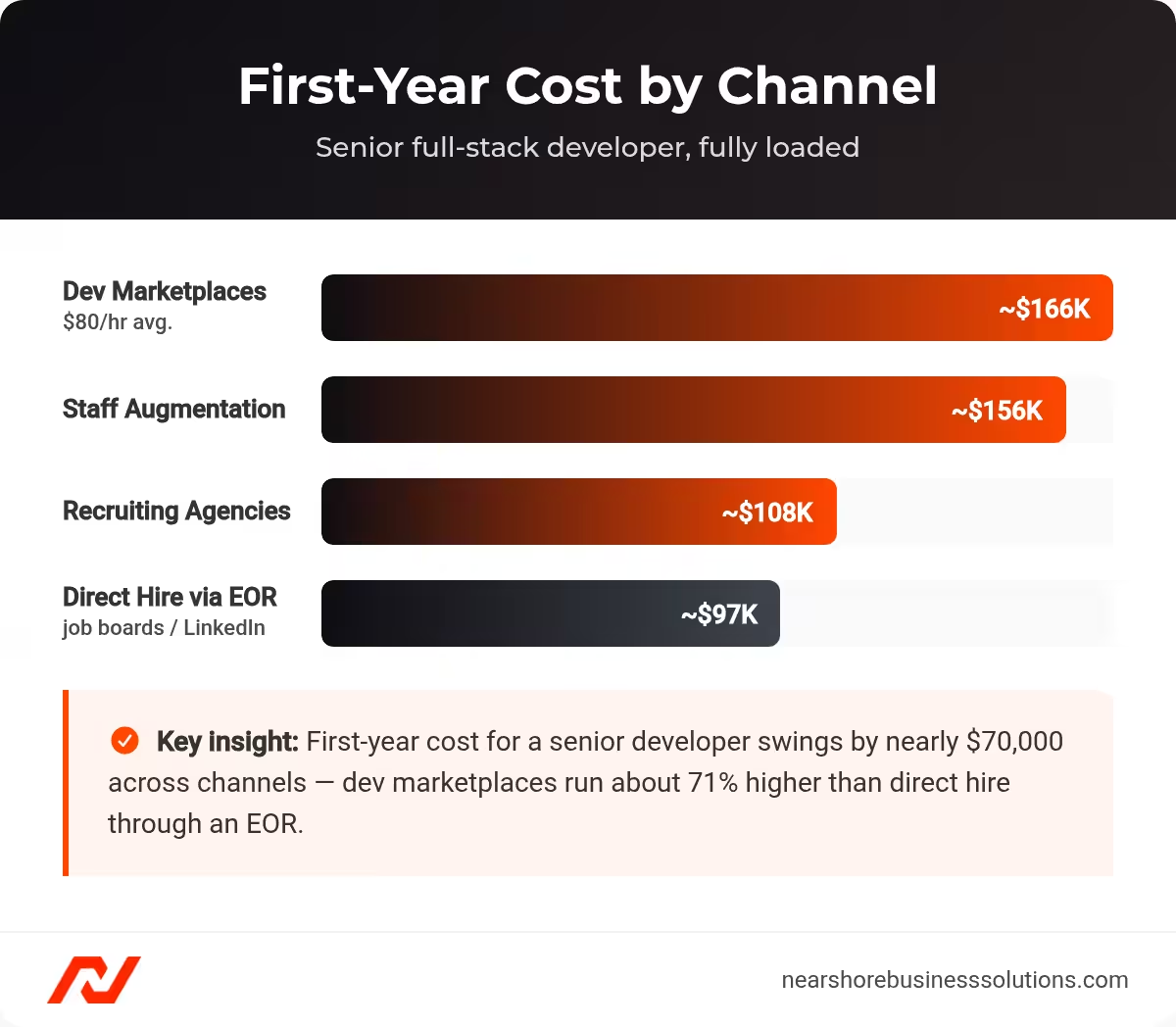
First-year cost for a senior LATAM developer hire, compared across four hiring channels.
This guide focuses on the four hiring mechanisms, not on comparing individual countries. For a city-by-city breakdown of where senior LATAM talent concentrates, see our guide to tech hubs across Latin America. For the vetting checklist every channel still requires, skip to the framework later in this guide.
How Much Does the Wrong Channel Cost You in Wasted Time?
A single senior-developer LinkedIn posting aimed at Latin America typically draws 200 to 500-plus applicants, with fewer than 10% qualified for a first-round interview, based on job-board response benchmarks. Screening that volume costs an estimated 40 to 80 hours of internal recruiter time plus 10 to 20 hours of engineering-manager interview time per hire. That is the real price of the slowest channel. The job posting itself is nearly free. The hours your engineering team spends sorting signal from noise are not.
How Does Time-to-Hire Compare Across All Four Channels?
Time-to-hire spans from about one week through a marketplace or a staff augmentation bench to nearly four months through a cold job-board search, with recruiting agencies landing in between at 30 to 60 days. The comparison table later in this guide breaks down cost, vetting depth, and retention alongside these timelines, so you can weigh the full trade-off, not just speed.
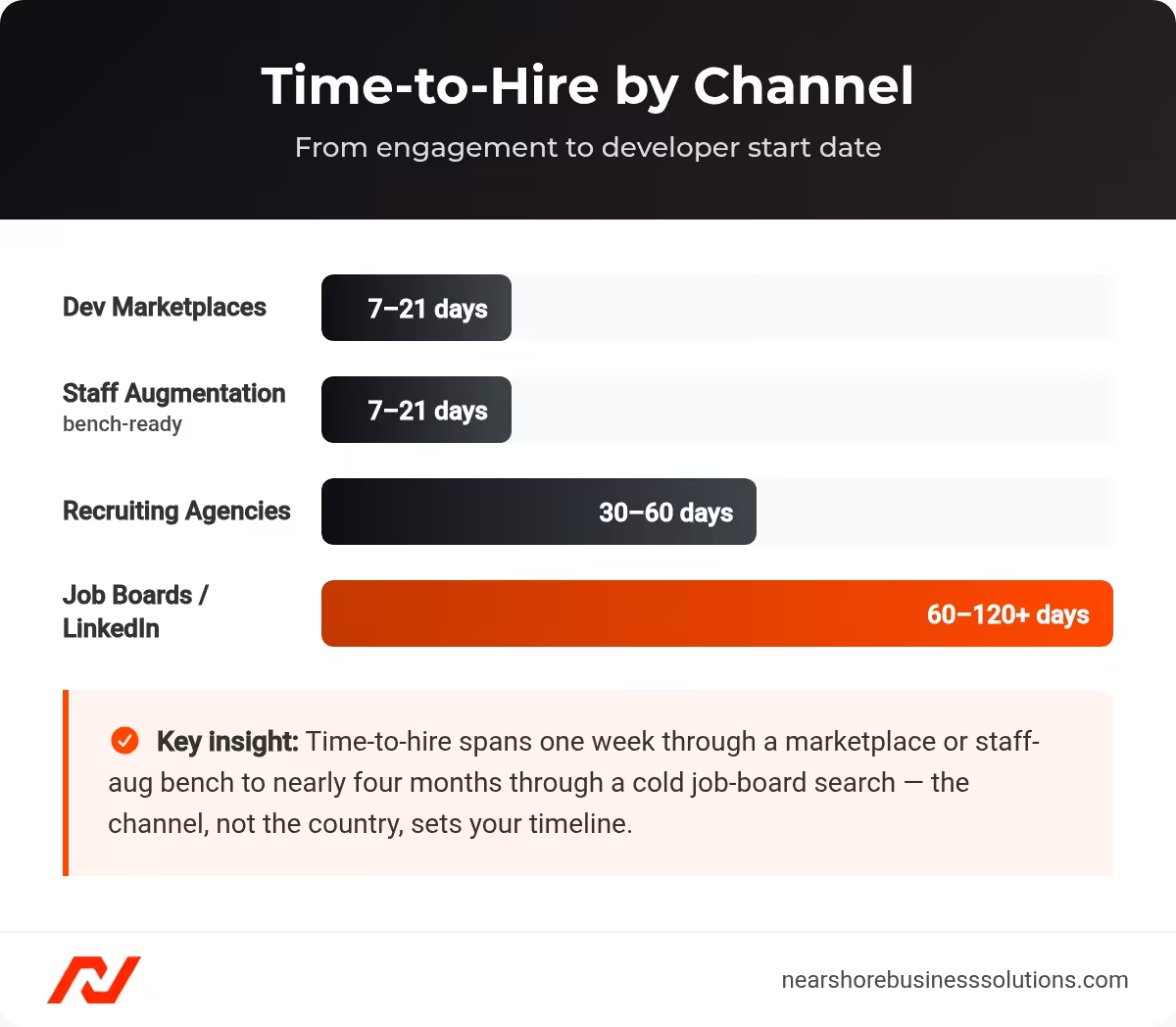
Time-to-hire in days across four LATAM developer hiring channels, from marketplaces to job boards.
How Do Dev Marketplaces Like Toptal and Turing Compare on Speed, Vetting, and Price?
Toptal accepts roughly 3% of applicants, Turing about 1%, and Arc.dev 2.3%, then delivers a matched developer in as little as 48 hours and typically within 7 to 21 days, per each platform’s published acceptance-rate claims. Curated marketplaces absorb the sourcing and screening cost upfront, then recoup it through hourly markups of 30% to 100% over the developer’s direct pay. LATAM supply on these platforms has scaled quickly: Andela reported in 2022 that 30% of its talent pool was based in Latin America following a regional expansion (Andela, August 2022). Buyer satisfaction is high across the category, with G2 rating Toptal and Turing 4.7 out of 5 and Arc.dev 4.6 out of 5 as of October 2023.
What Does Marketplace Vetting Actually Test, and What Still Needs Your Own Check?
Toptal runs a five-stage pipeline that includes live screening and a paid test project. Turing relies on AI-scored tests and coding challenges through its Talent Cloud. Arc.dev runs four stages that end in a live pair-programming session, the most signal-rich collaboration test of the three. None of them evaluates fit against context they cannot see: your system design constraints, your team culture, or your domain knowledge. All three platforms rate only “Medium” for cultural-fit screening, so internal validation stays necessary no matter which one you use.
When Are Marketplaces the Right Call, and What Do They Cost?
Marketplaces earn their premium in three scenarios: urgent skill gaps, short-term augmentation under six months, and contract-to-hire evaluations where a no-bill trial lets you test a developer before committing.
| Toptal | Turing | Arc.dev | Direct Hire via EOR | |
|---|---|---|---|---|
| Hourly Range (Sr. LATAM Dev) | $70–$120+ | $65–$110+ | $60–$100+ | N/A (salaried) |
| Typical Markup Over Direct Comp | 50–100% | 40–80% | 30–60% | None (EOR fee only) |
| Trial Period | 1–2 weeks, no-bill | 1–2 weeks, no-bill | 1–2 weeks, no-bill | N/A |
| Est. First-Year Cost (Sr. Full-Stack) | ~$145,600–$249,600 | ~$135,200–$228,800 | ~$124,800–$208,000 | ~$97,200 |
They turn into a costly choice for permanent pods. A 10-person team at $80 an hour costs about $1,664,000 a year through a marketplace, versus roughly $972,000 through direct hires with EOR support. Three levers reduce marketplace spend:
- Volume discounts. Typical marketplace volume discounts of 5% to 15% apply for three or more concurrent developers.
- Contract-to-hire conversion fees negotiated upfront, typically one to three months of hourly billing.
- Rate locks that protect against the mid-single to low-double-digit annual rate increases common on major platforms.
How Does Staff Augmentation Let You Scale a LATAM Team Without a Local Entity?
Staff augmentation firms employ the developer directly, handle payroll, statutory benefits, and termination, and let you scale from two developers to twelve within 30 to 60 days without posting a single job listing. Revenue at the largest firms shows the scale of the model: Globant reported $1.78 billion for fiscal year 2022, BairesDev reported over $800 million, and Softtek’s revenue is estimated above $1 billion, per company disclosures. Staff augmentation is the dominant channel for US companies scaling five to twenty or more LATAM developers at once.
The developer works for the firm, not your company. You direct daily work, assign tickets, and review pull requests, while the firm handles HR administration. IP ownership is contractually assigned to you, and your compliance burden is zero. See how a staff augmentation engagement is structured before you sign a bench agreement.
How Do You Evaluate an Augmentation Partner Before You Sign?
Five questions separate a firm that can deliver from one that cannot. Vetting rigor across the sector rates “Medium-High,” with real variance between firms.
- Bench depth for your stack. Ask for current bench count by technology, seniority, and country. A firm that cannot produce numbers within 24 hours has weaker bench management than its sales pitch implies.
- Annual attrition, company-wide and client-specific. These are different numbers, and client-specific attrition matters more for your planning.
- Benefits beyond statutory minimums. Firms that add private health insurance, learning stipends (commonly $1,000 to $3,000 a year), and equipment budgets keep senior developers longer.
- Geographic presence in target tech hubs. Local offices mean local community relationships and accurate salary benchmarking.
- Vetting process specifics. Ask what the firm tests and how often candidates fail each stage.
2024 blended monthly rates run Junior $5,000 to $7,000, Mid-Level $7,000 to $9,500, Senior $9,500 to $13,000, and Architect or Lead $12,000 to $16,000-plus. A senior developer at $13,000 a month produces a first-year cost of about $156,000, between the marketplace ceiling and the EOR direct-hire floor.
What Makes Retention a Make-or-Break Factor in Staff Augmentation?
Client-specific developer turnover on staff augmentation engagements runs 15% to 25% annually, above direct-hire benchmarks, largely because firms can reassign a high-performing developer to a higher-margin client while your billing stays flat, per Accelerance’s industry turnover analysis. Three firm-side practices separate 85% retention from 75%: dual-track career ladders tied to client-engagement tenure, benefits packages that exceed local market norms, and dedicated engagement managers who handle cultural integration beyond a Slack invite. Before you sign, negotiate a clause requiring 30 days’ written notice before any developer reassignment and your right to approve a replacement before they join your team.
How Do Recruiting Agencies Compare to Marketplaces and Staff Augmentation?
Recruiting agencies place a developer directly onto your payroll in 30 to 60 days for a one-time fee of 15% to 25% of first-year salary, about $13,500 to $22,500 on a $90,000 role. They back the placement with a three- to six-month replacement guarantee, per industry recruiting-fee benchmarks. Fee structures vary by model: contingency search charges only on a successful placement and suits a single role, while retained search charges an upfront fee for dedicated sourcing and suits a senior or hard-to-fill position.
Vetting typically covers CV and portfolio review, HR screening, a formal English evaluation, a technical assessment, and reference checks. Agency vetting rates “High” for cultural fit, above marketplaces’ “Medium” rating, because agencies screen explicitly for long-term team fit rather than a standardized skills test. Named firms illustrate the range: Terminal pairs agency sourcing with an EOR-style platform, Revelo draws on a large native database concentrated in Brazil, and Near emphasizes cultural alignment for US startups. For a broader view of engagement models across Latin America, see our overview of hiring software developers in Latin America.
When Do Agencies Beat Marketplaces or Staff Augmentation?
Agencies fit the one or two strategic hires most teams make a year, roles that need deep domain expertise, or a senior leadership seat where a bad match is expensive to unwind. Twelve-month retention for agency placements runs an estimated 85% to 90%, the second-highest of the four channels behind direct hiring, because agencies are compensated for long-term fit rather than placement volume.
Are Job Boards and LinkedIn the Cheapest Way to Hire LATAM Developers Directly?
Yes, but only on a per-posting basis: a LinkedIn job post runs about $15 to $25 a day, per LinkedIn’s published ad pricing, far below any channel’s markup or fee. Job boards still carry the longest time-to-hire of any channel, though, at 60 to 120-plus days once you count sourcing, screening, and legal setup.
More than 1.5 million LinkedIn profiles list “Software Developer” or “Software Engineer” across Brazil, Mexico, Argentina, Colombia, and Chile combined. A Recruiter Lite seat runs about $170 a month, and a full Recruiter Corporate seat runs roughly $9,000 a year, per LinkedIn’s published seat pricing.
What Works Differently When You Recruit LATAM Developers on LinkedIn?
InMail response rates from LATAM developers run an estimated 1.5x to 2x higher than from US developers, based on recruiter-reported data across LATAM sourcing teams, reflecting stronger openness to international remote roles. Outreach in Spanish or Portuguese, transparent USD-pegged compensation ranges, and a clear “remote-friendly US company” signal on your company page consistently outperform generic postings.
Which Regional Job Boards Surface Senior Talent Before Global Platforms Do?
Four regional platforms reach senior LATAM developers before they surface on global boards.
| Platform | Region Focus | Typical Seniority | Cost Model |
|---|---|---|---|
| GetonBoard | Chile, Mexico, Colombia | Mid to senior | Free plus premium tiers |
| Torre | Colombia and broader LATAM | Mid-level | Freemium, AI matching |
| Workana | Argentina, Brazil, LATAM-wide | Junior to mid | Commission-based |
| We Work Remotely | Global, strong LATAM pool | Mid to senior | Flat posting fee |
Job boards also carry the recruiter-hours cost described earlier in this guide, plus EOR compliance costs of $499 to $699 a month per developer, per Oyster HR’s published pricing, if you lack a local entity.
Which Channel Should You Use for Your Team Size, Budget, and Timeline?
The right channel depends on your headcount and timeline: marketplaces and staff augmentation deliver in 7 to 21 days, agencies in 30 to 60, and job boards in 60-plus.
| Criteria | Dev Marketplaces | Staff Augmentation | Recruiting Agencies | Job Boards / LinkedIn |
|---|---|---|---|---|
| Time-to-Hire | 7–21 days (as fast as 48 hrs) | 7–21 days (bench-ready) | 30–60 days | 60–120+ days |
| First-Year Cost (Sr.) | ~$166,400 | ~$156,000 | ~$108,000 | ~$97,200–$102,200 |
| Vetting Depth | Very High (platform-led) | Medium-High | High (technical + cultural) | None / DIY |
| Scalability | High (1–3 at a time) | Very High (5–20+ concurrent) | Moderate (1–5) | Low |
| Retention (12-mo) | ~80–85% | ~75–85% | ~85–90% (with guarantees) | ~90%+ |
| Compliance Burden | None | None | Low (client needs EOR) | Very High |
| Cultural Fit Screening | Medium | Medium | High | High (internal) |
| Best For | Urgent gaps, contract-to-hire | Scaling pods of 5–20+ devs | Strategic hires, niche senior roles | Budget-conscious with internal recruiting |
How Should You Match Your Channel to Your Company’s Growth Stage?
Seed-stage companies hiring one to two developers do best with marketplaces or direct hiring through LinkedIn. Deel reported a 161% increase in companies hiring LATAM workers between the second half of 2021 and the second half of 2022, and many were early-stage teams pairing EOR infrastructure (see EOR pricing above) with direct sourcing.
Growth-stage companies scaling five to fifteen developers do best with staff augmentation. Firms like Globant, Encora, and Wizeline maintain benches across multiple LATAM hubs, and minimum engagements typically run three to six months for two to three developers.
Enterprise teams filling niche senior roles do best with agencies. Firms like Terminal, Revelo, or Near deliver high cultural-fit screening with three- to six-month replacement guarantees.
Why Do Sophisticated Engineering Teams Use More Than One Channel at Once?
Sophisticated engineering orgs typically run two or three channels at once, not one. The most common pattern pairs staff augmentation for the core pod, a marketplace for specialized short-term needs, and direct hiring for senior leadership. No single channel covers every hiring need alone.
How Do You Vet LATAM Developers No Matter Which Channel You Choose?
Even marketplace vetting, the most standardized of the four channels, rates only “Medium” for cultural fit, so every channel needs the same internal quality layer before an offer goes out. Our guide to how nearshore firms vet developers covers the full methodology behind this framework.
What Does a Four-Step Vetting Framework Look Like?
Four steps catch what channel-level vetting misses.
- Role-specific take-home challenge (2 to 3 hours). Scope it to your actual stack and domain.
- 45-minute live system design session with a senior engineer on your team.
- Async written communication sample, such as a mock pull request review or incident write-up. Only 35% of LATAM developers self-report “Advanced” or “Fluent” English, per Terminal’s 2023 State of Remote Engineering survey, and async writing surfaces gaps that verbal interviews miss.
- Structured reference check focused on autonomy, communication cadence, and reliability. Agencies include this step as standard. Marketplaces and staff augmentation firms typically do not.
What Red Flags Only Surface After the First 30 Days?
Staff augmentation carries the highest post-hire risk: bench rotation can mean the developer you evaluated is not the one who stays past the first 30 days. Marketplace trial periods, typically 1 to 2 weeks and no-bill, give you a built-in window to catch issues early if you use them deliberately. For direct hires, embed a trial task with intentionally ambiguous requirements during the interview process. It tests independent judgment before the offer goes out.
What Is the Fastest Way to Hire LATAM Developers Without Sacrificing Quality?
Marketplaces and staff augmentation deliver the fastest hires, in 7 to 21 days, but at a premium of $150,000-plus a year for a senior hire. The highest-retention channels, direct hire and agencies, take 30 to 120-plus days instead. The fastest path without sacrificing quality combines more than one channel.
Most scaling teams do best with staff augmentation for immediate capacity, marketplace trials for specialist gaps, and direct hiring for the roles where twelve-month retention compounds into a real advantage. Treat the channel decision as infrastructure, not a one-time transaction. The mix you choose today shapes how fast you can staff the next sprint, and the one after that.
What Questions Do VPs of Engineering Ask Before Hiring LATAM Developers?
These are the questions that come up most often once a team has picked a channel and is ready to move.
How Long Does It Take to Hire a LATAM Developer?
It takes 7 to 21 days through a marketplace or staff augmentation bench, 30 to 60 days through a recruiting agency, and 60 to 120-plus days through a direct job-board search. The channel you pick, not the country, sets your timeline.
What Happens if a Developer Doesn’t Work Out?
Marketplaces offer a 1- to 2-week no-bill trial and a free replacement. Agencies typically back a placement with a three- to six-month replacement guarantee. Staff augmentation firms will swap a developer, but you should negotiate a right to approve the replacement first.
Do You Need a Local Entity to Hire in Latin America?
No. An employer of record (EOR) like Deel, Remote.com, or Oyster HR lets you hire a developer directly without setting up a local entity. Oyster HR’s published pricing runs about $499 to $699 a month per employee, depending on the country; Deel and Remote.com start around $599 a month.
How Do You Pay LATAM Developers?
Through a marketplace, agency, or staff augmentation firm, you pay the firm and it pays the developer. Through direct hiring, you pay local payroll and statutory benefits yourself or through an EOR.
What’s the Difference Between Staff Augmentation and Outsourcing?
Staff augmentation adds headcount you direct day to day. Outsourcing hands off a deliverable the vendor owns end to end, including how the work gets done.
Which Channel Has the Highest 12-Month Retention?
Direct hire through an EOR or job board holds the highest retention, at 90%-plus, because the developer works for your company rather than a vendor’s bench.
Ready to Build Your LATAM Engineering Pipeline?
Nearshore Business Solutions runs the sourcing, vetting, and placement process for teams that want marketplace speed with staff-augmentation retention. Every candidate is screened for technical skill, English fluency, and US work-style fit before you see a resume, and every placement carries a 90-day replacement guarantee.
See how Nearshore Business Solutions runs remote talent acquisition to build a hiring pipeline that works across every channel, not just one.