
Why US Companies Hiring in Mexico Has Doubled Since 2023: What That Means for Your Hiring Model
700,000 to 850,000 professional software developers now work in Mexico, the second-largest developer community in Latin America. That pool grows at a 5–7% CAGR, fed by over 130,000 engineering and technical graduates per year, roughly a third of whom specialize in IT disciplines (Source: Stack Overflow 2023 Developer Survey extrapolations and Everest Group; growth rate per Kearney 2023 Global Services Location Index).
Three forces converged simultaneously. First, USMCA gave cross-border tech employment a regulatory backbone that offshoring to APAC never had. Second, post-COVID remote-work normalization eliminated the cultural objection: distributed teams stopped being an experiment and became infrastructure. Third, US developer compensation kept climbing while Mexico’s talent pipeline kept widening, creating a unit-economics gap too large for growth-stage CTOs to ignore.
50–65% effective cost savings on a senior software engineer (depending on the US comparison city), after total loaded cost, gets finance teams’ attention (Source: modeling based on Papaya Global country guides and Deel cost calculators). But if you build an internal business case on cost alone, you will underestimate the complexity and oversell the simplicity. Compliance with Mexican labor law, payroll infrastructure (EOR vs. entity), and cultural integration each carry their own failure modes. Cost opens the conversation. Execution determines the outcome.
If you are weighing whether to source talent through a dedicated Mexico hiring partner, the structural decisions below will shape your compliance exposure more than your salary line ever will.
USMCA and the Regulatory Tailwind Making Cross-Border Hiring Viable
Chapter 19 of USMCA (Digital Trade) prohibits customs duties on digital products, guarantees unrestricted cross-border data transfers, and, critically for CTOs, protects proprietary source code from forced government disclosure (Source: USTR, USMCA Agreement Text, 2020). No equivalent protections exist in most APAC offshoring jurisdictions. If your engineering org ships SaaS and stores customer data in US cloud infrastructure, Chapter 19 means your Mexican developers operate under the same digital-trade framework as your Austin headquarters, without data-localization risk.
Chapter 23 (Labor) commits Mexico to internationally recognized labor standards, including freedom of association and collective bargaining enforcement (Source: USTR, USMCA Agreement Text, 2020). USMCA’s enforcement mechanisms, including a Rapid Response Labor Mechanism the US has already invoked multiple times, create a compliance floor that reduces due-diligence burden compared to jurisdictions with weaker or less transparent labor protections.
The Cost Snapshot: Why Mexico Nearshore Hiring Changes the Unit Economics
| Cost Component | United States (San Francisco) | Mexico (Mexico City, via EOR) |
|---|---|---|
| Base Salary (Median) | $190,000 | $90,000 |
| Employer Taxes (FICA, FUTA, SUTA) | ~$14,500 | N/A (Handled by EOR) |
| Benefits (Health, Dental, 401k) | ~$28,500 | N/A (Handled by EOR) |
| Mexican Mandatory Contributions (IMSS, INFONAVIT, Aguinaldo, etc.) | N/A | ~$31,500 (~35% of salary) |
| EOR Fee | N/A | ~$10,800 ($900/mo) |
| Total Loaded Cost | ~$233,000 | ~$132,300 |
| Effective Cost Savings | ~43% vs. SF / ~55% vs. US national avg. |
Source: Internal modeling based on Papaya Global Mexico Hiring Guide 2024 and Deel cost calculators. The ~35% loaded-cost factor is a standard estimate used by EOR providers (Papaya Global, 2024).
$100,700 per senior hire, per year. Multiply across a five-person squad and the savings fund an entire additional team, or flow straight to runway extension.
Time-Zone Overlap: The Collaboration Advantage Over APAC Offshoring
| Mexican Tech Hub | Time Zone | Overlap with SF (PST) | Overlap with Austin (CST) | Overlap with NYC (EST) |
|---|---|---|---|---|
| Guadalajara / Mexico City | Central (CST) | 6 hours | 8 hours (full overlap) | 7 hours |
| Hermosillo | Mountain (MST) | 7 hours | 7 hours | 6 hours |
| Tijuana | Pacific (PST) | 8 hours (full overlap) | 6 hours | 5 hours |
A 12-hour time difference, standard with India or the Philippines, introduces a full 24-hour delay for a single question-and-answer cycle. Mexico eliminates it. Your nearshore engineers attend standup, join design sessions live, and respond to production issues in real time.
What Does It Actually Cost to Hire Employees in Mexico as a US Company?
Mandatory Employer Contributions: IMSS, INFONAVIT, and the Payroll Tax Stack
Mexico calculates employer obligations against the “integrated salary” (salario diario integrado, or SDI), not the gross annual pay figure US finance teams default to. The SDI folds base salary together with aguinaldo, vacation premium, and other mandatory benefits into a single daily rate. Mismodeling this is the single most common budgeting error US companies make.
Every payroll transaction must generate a CFDI (Comprobante Fiscal Digital por Internet), Mexico’s mandatory digital tax receipt. No CFDI, no legally valid payroll.
- IMSS, ~25–35% of integrated salary. Covers five insurance branches: illness and maternity, occupational risk, disability and life, retirement and old age, and daycare/social benefits. Software companies classify as Class I (lowest risk), reducing the occupational risk component (Source: Deloitte, Doing Business in Mexico: A Tax and Legal Guide, 2024).
- INFONAVIT, 5% of integrated salary. A mandatory housing fund contribution. Every IMSS-registered employee triggers this obligation automatically, with no opt-out and no exemption for foreign-owned employers or EOR structures (Source: Ley del INFONAVIT).
- State Payroll Tax, 2–3%, varies by state. Mexico City charges 3%, Jalisco (Guadalajara) charges 2%, Nuevo León (Monterrey) charges 3% (Source: respective state treasury schedules, 2024).
- SAR (Retirement Savings), 2% of integrated salary. Employer-funded contribution to the employee’s individual retirement account.
- Total estimated employer burden: 34–45% of integrated salary. For mid-to-senior engineering hires in Mexico City or Guadalajara, use 35–40% as the working assumption.
Compliance penalties: Failure to register an employee with IMSS triggers back-payment of all missed contributions, adjusted for inflation with interest, plus fines of up to 150% of the omitted contributions (Source: Deloitte, 2024).
Aguinaldo, Vacation Premium, and PTU: The Benefits US Employers Overlook
These are constitutional and statutory requirements, not perks.
Aguinaldo: Minimum 15 days of base daily salary, paid by December 20th (Source: Ley Federal del Trabajo, Article 87). Competitive tech employers routinely offer 30 days to compete with Mercado Libre, Kavak, Clip, and other well-funded regional employers.
Vacation Premium: Mexico’s 2023 reform doubled minimum vacation entitlement to 12 days in the first year. Employers must pay a premium of at least 25% of salary for each vacation day taken (Source: Ley Federal del Trabajo, 2023 vacation reform).
PTU (Profit Sharing): 10% of pre-tax profits distributed to employees annually (Source: Ley Federal del Trabajo). Under an EOR structure, PTU applies to the EOR entity’s profits, not the US parent’s, which typically reduces effective exposure significantly.
Worked example, $50,000 base salary, first year, 30-day aguinaldo:
| Mandatory Benefit | Annual Cost |
|---|---|
| Aguinaldo (30 days) | $4,110 |
| Vacation Premium (12 days at 25%) | $411 |
| PTU (estimated, via EOR) | ~$1,000 |
| Total mandatory benefits add-on | ~$5,521 (11% of base) |
Source: NBS modeling on statutory minimums from the Ley Federal del Trabajo, applied to a $50,000 base.
The statutory contributions (34–45%) apply to the integrated salary, which already includes aguinaldo and vacation premium. This compounding effect pushes total employer cost to 45–60% above base salary.
Salary Benchmarks by Role and Seniority: Mexico vs. United States (2024–2025)
Base salaries before mandatory contributions, benefits, or EOR fees. Apply the 35–40% loaded-cost multiplier to arrive at total deployed cost.
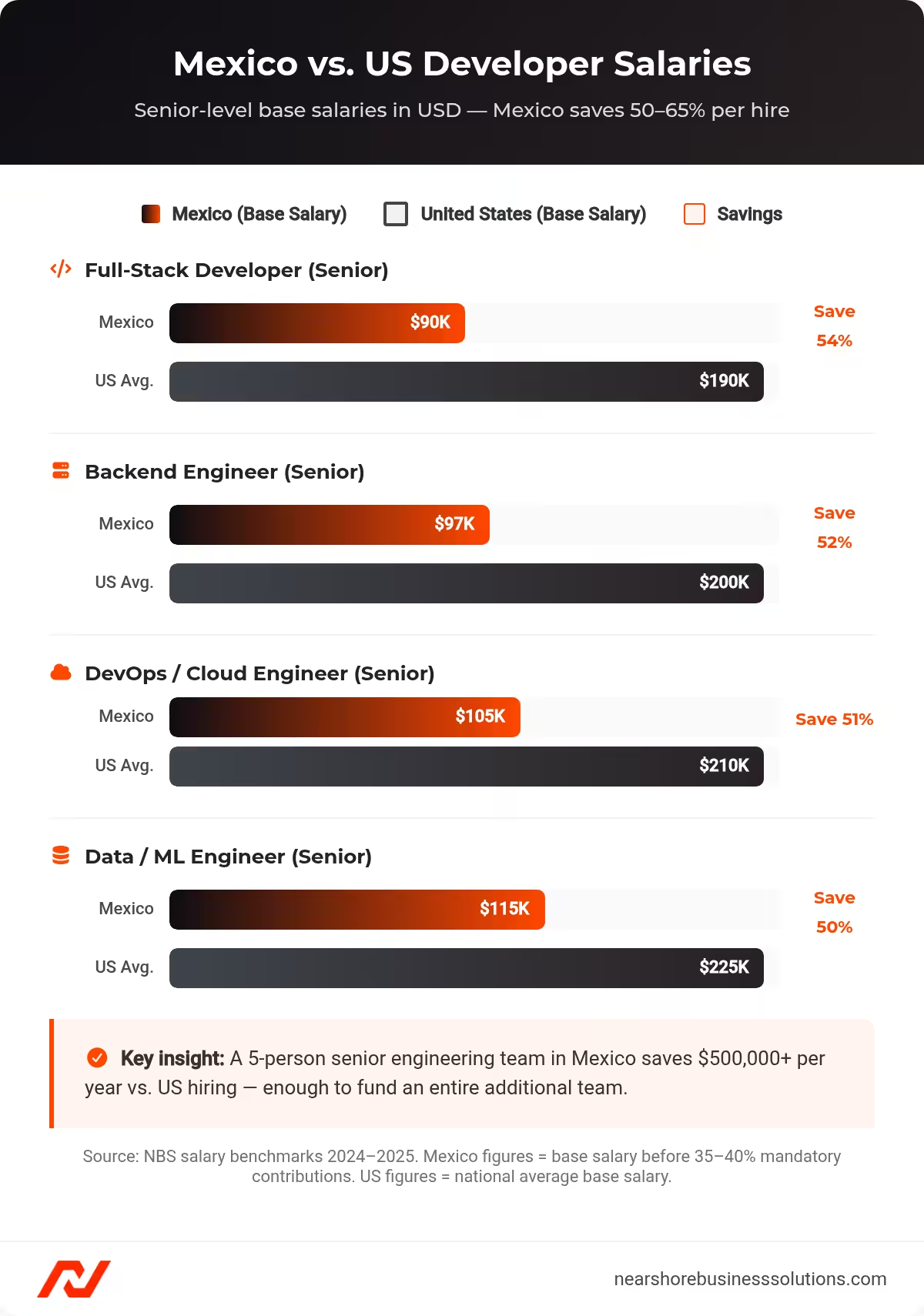
Mexico vs. US senior developer salaries by role — 50–54% savings before mandatory contributions.
| Role | Seniority | Mexico Base (USD) | United States Base (USD) |
|---|---|---|---|
| Full-Stack Developer | Junior | $30,000–$45,000 | $90,000–$120,000 |
| Mid-Level | $45,000–$70,000 | $120,000–$160,000 | |
| Senior | $70,000–$110,000 | $160,000–$220,000+ | |
| Backend Engineer | Mid-Level | $50,000–$75,000 | $125,000–$170,000 |
| Senior | $75,000–$120,000 | $170,000–$230,000+ | |
| DevOps / Cloud Engineer | Mid-Level | $55,000–$80,000 | $130,000–$180,000 |
| Senior | $80,000–$130,000 | $180,000–$240,000+ | |
| Data / ML Engineer | Mid-Level | $60,000–$90,000 | $140,000–$190,000 |
| Senior | $90,000–$140,000 | $190,000–$260,000+ | |
| Engineering Manager | Senior | $120,000–$160,000 | $250,000–$320,000+ |
Source: Mercer 2023/2024 Total Remuneration Survey and global talent-firm analysis.
Note: tech salaries in Mexico increased 15–25% in USD terms from 2022 to 2024, driven by nearshoring demand, with projected wage inflation of 8–12% annually for skilled tech roles (Source: Mercer Total Remuneration Survey analysis, 2024). The widest absolute savings occur in the mid-level band, where Mexico’s deep bench of 3–7 year experience engineers creates the most liquid hiring market.
Severance Exposure: How Mexican Labor Law Protects Employees at Termination
At-will employment does not exist in Mexico. Performance issues, role elimination, and “not a good fit” do not qualify as justified cause for dismissal. Unjustified dismissal triggers the following statutory components (Source: Ley Federal del Trabajo, severance provisions):
| Severance Component | Formula |
|---|---|
| Constitutional Indemnity | 3 months of integrated daily salary |
| 20 Days per Year | 20 days of integrated salary × years of service |
| Seniority Premium | 12 days of salary per year of service (capped at 2× daily minimum wage) |
| Accrued Benefits | Proportional aguinaldo + unused vacation + vacation premium |
Worked example, $60,000 base, 3 years tenure, unjustified dismissal: ~$30,612, roughly 51% of annual base salary, payable as a lump sum. For a five-person squad, model aggregate severance reserves at $125,000–$175,000 (Source: NBS modeling on Ley Federal del Trabajo formulas). Under an EOR structure, the EOR executes terminations in compliance with Mexican procedural requirements, but standard agreements pass severance costs through to the client.
How Should US Companies Structure Hiring in Mexico: Entity, EOR, or Contractor?
Opening a Mexican Subsidiary: When It Makes Sense to Set Up a Local Entity
Setup runs through eight sequential steps: choose entity type (S. de R.L. de C.V. for most US tech companies), appoint legal representative, RFC registration with SAT, IMSS employer registration, INFONAVIT registration, state payroll tax registration, open Mexican bank account, and REPSE registration if applicable.
Total timeline: 3–6 months. Setup cost: $20,000+. Ongoing admin: $3,000–$8,000/month. At 5 employees, that’s $600–$1,600 per person per month in overhead alone. At 25 employees, it drops to $120–$320 (Source: NBS modeling on standard Mexican incorporation and administration costs).
Contractor Agreements in Mexico: When Independent Contractor Status Is Legally Viable
A legitimate contractor must operate as a persona física con actividad empresarial, issue their own CFDI for each payment, and maintain genuine independence. Mexican labor courts apply a substance-over-form subordination test: if the company controls the worker’s hours, provides tools, directs work methods, and integrates them into the team, they are legally an employee regardless of contract language (Source: April 23, 2021 reform to the Ley Federal del Trabajo).
Penalties for misclassification: Fines up to $250,000 USD per misclassified worker (2,000 to 50,000 times the UMA daily reference value), back-payment of all IMSS and INFONAVIT contributions, payments retroactively deemed non-deductible for tax purposes, and potential criminal liability for tax fraud (Source: Ley Federal del Trabajo, 2021 outsourcing reform).
Contractor status is viable for defined-scope projects with fixed deliverables and no ongoing operational integration. For any role functioning as ongoing full-time employment, it is a compliance violation with penalties that dwarf the savings.
Employer of Record (EOR): The Fastest Compliant Path for US Companies Hiring in Mexico
An EOR serves as the legal employer, registered with IMSS, INFONAVIT, SAT, and state payroll authorities, while your company directs daily work. Time-to-hire: days, not months. This is the model most US companies use to start hiring through an employer of record in Latin America without standing up a local entity first.
The 2021 outsourcing reform banned subcontratación de personal but created a regulated pathway for servicios especializados. A compliant EOR operates within this framework: its specialized service is payroll administration and employment compliance, not the client’s core business. Verify that any EOR provider holds active REPSE registration.
EOR fees typically run $500–$1,500 per employee per month (Source: EOR provider pricing data, 2024). At five employees, that’s $2,500–$7,500 monthly, a fraction of entity overhead, with zero setup cost or delay. Standard agreements include assignment-of-work-product clauses routing all IP to the client company.
When EOR reaches its limits: past 30–50 employees, direct entity ownership typically becomes more cost-effective and provides local brand presence, direct IMSS relationship management, and the ability to structure local equity compensation.
Hiring Structure Comparison
| Attribute | Entity | EOR | Contractor |
|---|---|---|---|
| Time-to-hire | 3–6 months | 1–2 weeks | Immediate |
| Setup cost | $20,000+ | $0 | $0 |
| Compliance risk | Low (if administered) | Low (EOR manages) | High (misclassification) |
| Best-fit headcount | 20+ employees | 1–50 employees | Project-based |
| Severance handling | Company manages directly | EOR executes; cost passed through | N/A |
| Scalability break-even | Favorable above 20–25 | Most cost-effective at 1–50 | Does not scale for FT roles |
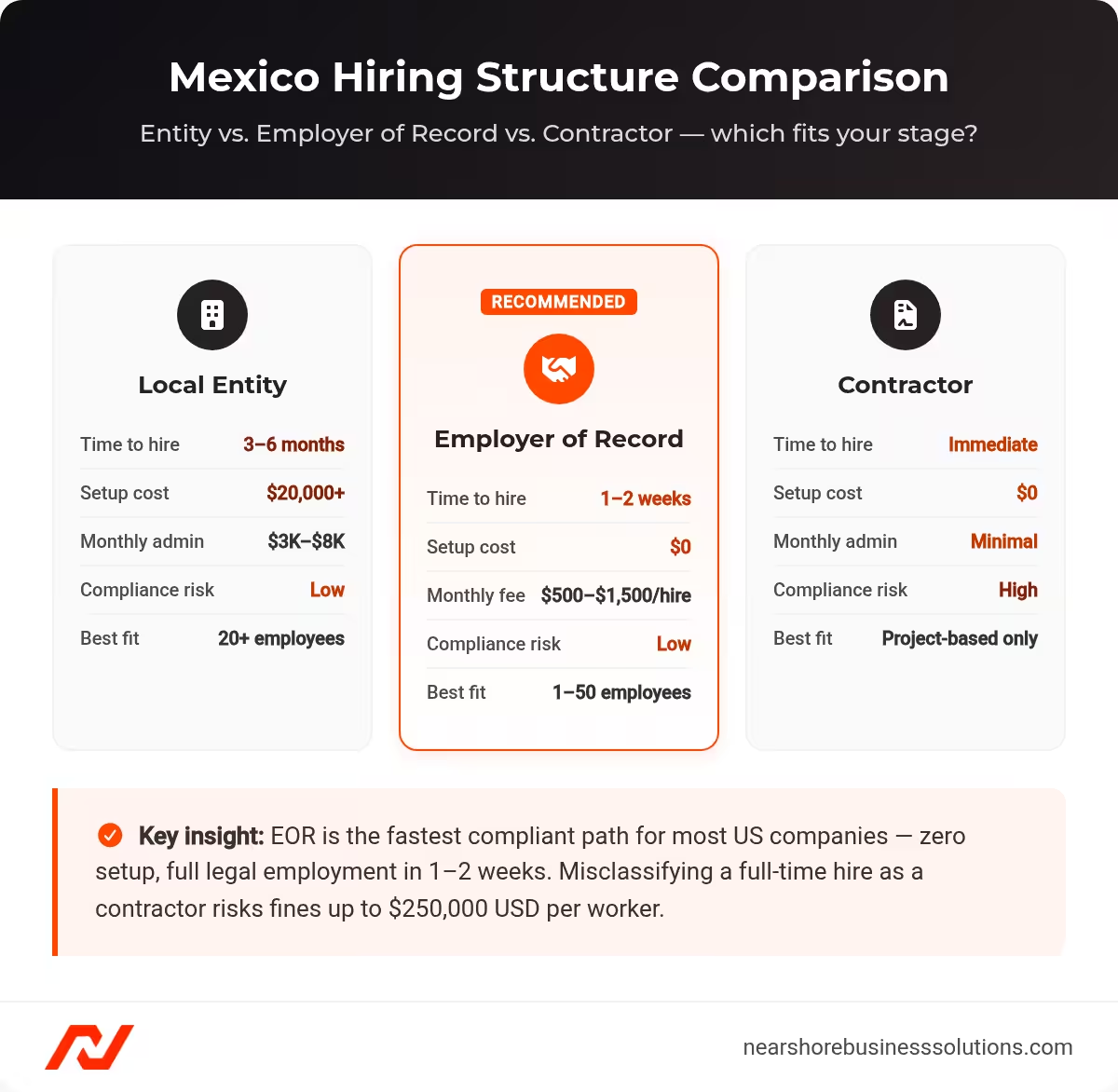
Mexico hiring structure comparison — EOR delivers full legal employment in 1–2 weeks with zero setup cost.
Ready to Build Your Mexico Engineering Team?
Nearshore Business Solutions sources and vets software engineers across Mexico City, Guadalajara, and Monterrey, then handles IMSS registration, CFDI-compliant payroll, and severance provisioning through a compliant EOR. We screen for technical skills, English fluency, and US work-style fit. Every placement includes a 90-day replacement guarantee.
Get a free consultation to receive a custom cost breakdown for your first Mexico hire.