LATAM nearshore teams cut developer costs 60-65% versus US rates while achieving turnover below 12%, compared to 37% attrition in the US tech sector.
Latin America offers 2.6 million engineers across Mexico, Brazil, Colombia, and Argentina. Senior developers cost $55,000-$100,000 annually versus $160,000-$185,000 fully loaded in the US. Nearshore teams deliver 40% faster release cycles than traditional offshore models due to 4-8 hours of daily time zone overlap.
We connect US tech leaders with vetted engineers from Guadalajara, Bogotá’s Ruta N innovation district, Buenos Aires, and São Paulo. This guide covers hiring, onboarding, performance management, legal compliance, and retention for distributed engineering teams in 2026.
What Is Talent Management for Distributed Engineering Teams?
Talent management for distributed engineering teams means hiring, developing, and retaining technical staff across multiple locations while maintaining output quality. It covers hiring processes, onboarding, performance measurement, and retention strategies adapted for remote work.
The practice differs from traditional HR. Engineering teams need technical evaluation frameworks, asynchronous coordination, and performance metrics tied to delivery milestones rather than activity tracking.
Why Is Talent Management Different for Distributed Teams Than Colocated Teams?
76% of executives report difficulty filling critical technical roles. Hiring cycles for senior engineers stretch 3-6 months. Expanding geographic reach into Latin America directly addresses these constraints, while eliminating informal knowledge transfer risks through deliberate documentation processes.
Far-offshore models cost 15-25% more due to communication lags and documentation overhead with 12-hour time differences. Nearshore models add only 15-20% management overhead. You maintain 4-6 hours of daily real-time collaboration with teams in Mexico City, Bogotá, or Buenos Aires.
What Are the Core Components of Distributed Engineering Team Management?
Four disciplines drive distributed team success: hiring, onboarding, performance, and retention.
Structured hiring frameworks eliminate intuition-based evaluation. Use standardized technical assessments and clear rubrics that work without in-person interviews. Onboarding velocity determines time-to-productivity. Best-in-class nearshore teams reach 50% productivity in 25 days versus 50+ days for ad-hoc approaches. Performance measurement tracks outcomes: pull request velocity, code review quality, incident response time, and feature delivery. Teams using purpose-built dev tools show 25-30% faster PR review cycles. Retention engineering keeps attrition below 12% for LATAM teams versus 37% in the US tech sector.
How Do You Hire the Best Engineers for Distributed Teams?
Start with geographic strategy before writing job descriptions. Latin America’s 2.6 million engineers include 800,000 developers in Mexico and 760,000 in Brazil. Mexico mid-level engineers cost $45,000-$65,000 versus $115,000 for US equivalents. Senior developers run $70,000-$100,000 against $160,000+ domestic rates.
For a full breakdown of LATAM hiring options, see our guide to hiring software developers in Latin America.
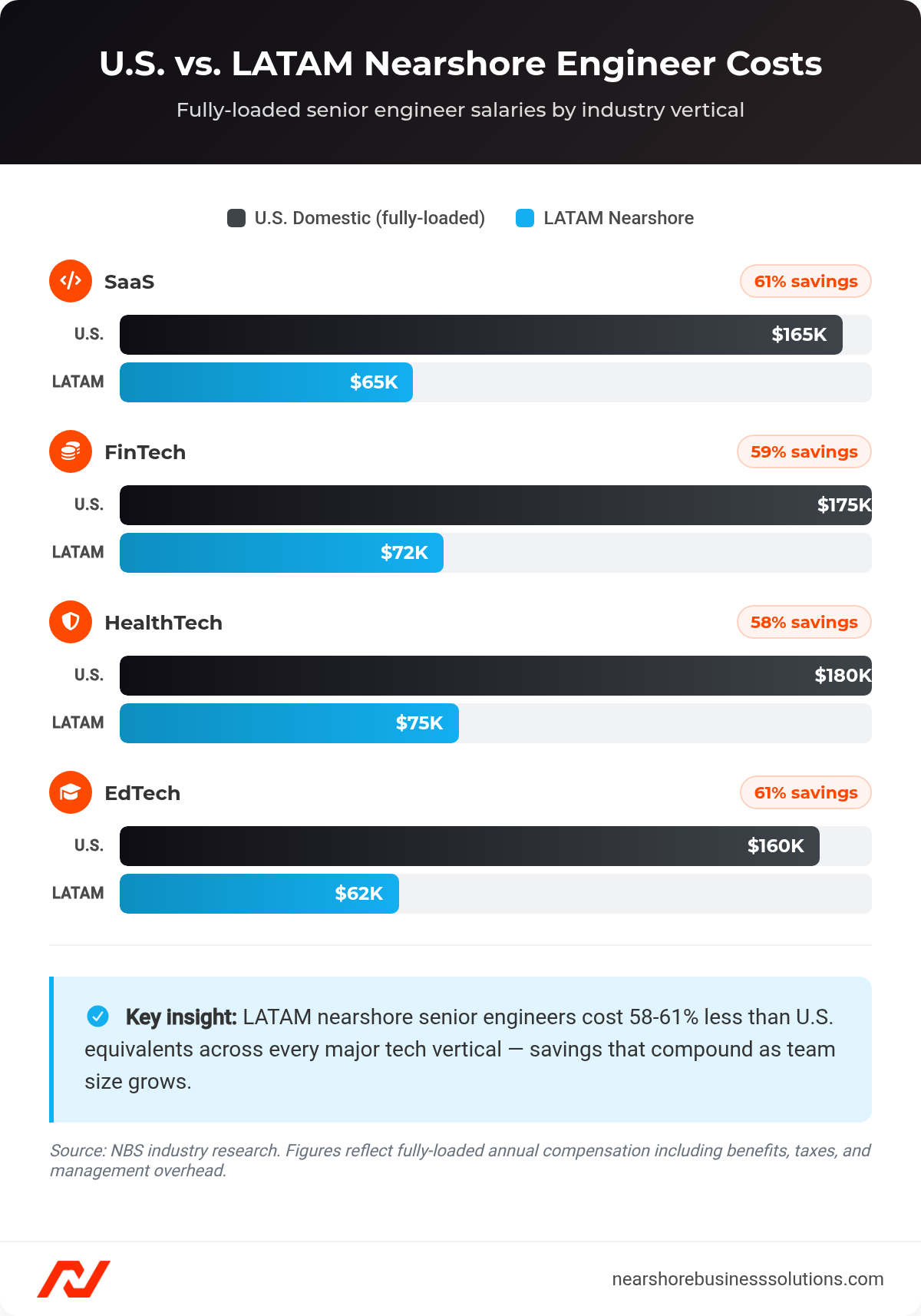
Senior engineer fully-loaded costs by industry: LATAM nearshore delivers 58-61% savings versus U.S. domestic rates.
What Technical Skills Should You Prioritize When Hiring Remote Engineers?
Match specialization to regional strengths. Guadalajara, anchored by the Guadalajara Creative Digital City initiative and graduates from Tecnológico de Monterrey (ITESM) and UNAM, concentrates Python and full-stack enterprise talent. São Paulo dominates FinTech and AI/ML with 81 software firms and 60% of Brazil’s startup investment. Buenos Aires leads blockchain and data science. Bogotá and Medellín, home to graduates from Universidad de los Andes and Universidad EAFIT, offer strong English proficiency and EST alignment.
Technical fundamentals matter more than specific frameworks in remote contexts. Prioritize engineers who write clear documentation, communicate architectural decisions explicitly, and debug independently. Async collaboration skills separate effective remote engineers from those who struggle.
Should You Hire from Specific Geographic Regions or Time Zones?
Time zone overlap trumps cost savings. Four hours of daily overlap enables real-time debugging and same-day code reviews. Below three hours, you add 18-24 hour delays to critical decisions.
| Region | Time Zone vs EST | Engineer Pool | Cost Range (Senior) | Key Advantages |
|---|---|---|---|---|
| Mexico | -1 to -3 hours | 800,000 developers | $70,000-$100,000 | Proximity, 50-60% savings, 8-hour overlap |
| Colombia | 0 hours (100% aligned) | Strong talent base | $65,000-$85,000 | Perfect EST alignment, English proficiency |
| Argentina | +2 hours | Specialized talent | $55,000-$70,000 | Blockchain/data science, USD payment accepted |
| Brazil (São Paulo) | +1 to +2 hours | 760,000 engineers | $70,000-$90,000 | FinTech/AI/ML, 60% of startup investment |
Mexico cost by experience level: Junior (1-2 years) $30,000-$40,000; Mid-level (3-5 years) $45,000-$65,000; Senior (6+ years) $70,000-$100,000 annually. Start with one region and scale proven processes before expanding.
What Interview Techniques Work Best for Distributed Engineering Candidates?
Use recorded technical interviews for async evaluation. Have candidates complete live coding sessions you review later with multiple team members. This eliminates scheduling complexity across time zones.
Test written communication explicitly. Require candidates to explain technical decisions via documentation. Remote engineers spend 60% of collaboration time writing, not talking. Assign a take-home project requiring written architectural explanations, not just code.
Conduct at least one interview during proposed working hours to confirm availability alignment with your team’s core collaboration window.
How Do You Onboard Remote Engineers Effectively?
Best-in-class nearshore teams reach 50% productivity in 25 days and 100% within 90 days. Ad-hoc approaches take 50+ days to hit 50% productivity. The 90-day framework splits into three phases: Learn (days 1-30), Build (days 31-60), and Integrate (days 61-90).
What Should Happen Before a Remote Engineer’s First Day?
Provision access before day one. Repository access, dev environment templates, VPN credentials, and communication tools must be ready. Remote engineers cannot walk to IT.
Pre-start checklist: ship hardware 5-7 days early to account for international customs; schedule the entire first week with team intros and architecture walkthroughs; assign a starter bug or documentation update for days 2-3; block calendar with overlap window meetings.
How Long Should the Onboarding Process Be for Distributed Engineers?
90 days delivers full productivity with measurable milestones. Shorter timelines skip integration into architecture decisions and team dynamics.
Days 1-30 (Learn Phase): Setup dev environment, fix first minor bug, complete required training. Outcome: Familiarity with repo and documentation.
Days 31-60 (Build Phase): Own a small feature end-to-end, handle support tickets. Outcome: Active contribution to sprint velocity.
Days 61-90 (Integrate Phase): Participate in architecture design, mentor newer hires, lead sprint rituals. Outcome: Full proficiency and cultural alignment.
Pair each LATAM engineer with a US counterpart during onboarding. Set explicit mentor expectations: 30-minute weekly syncs, same-day response to blockers, and code review priority for the first 60 days.
What Documentation Do Remote Engineers Need Access to Immediately?
Six types of documentation enable self-service within 48 hours: architecture decision records (ADRs) explaining why systems exist as designed; runbook documentation for deployments and rollbacks; coding standards and PR guidelines to prevent rework; system diagrams of service dependencies and data flows; troubleshooting guides for known issues; and customer context documentation explaining who uses the product.
Keep documentation close to code. Store ADRs in the repository. Engineers will not context-switch to update disconnected tools.
What Tools Are Essential for Distributed Engineering Team Management?
The 2025 distributed stack emphasizes written transparency and automated workflows. Tool selection determines communication overhead and integration velocity.
| Category | Recommended Tools | Purpose |
|---|---|---|
| Project Mgmt | Monday.com, Jira, Linear | Sprint management and backlog refinement |
| Documentation | Notion, Confluence | Living documentation and ADRs |
| Code/CI/CD | GitHub, GitLab | Pull requests as primary alignment mechanism |
| Communication | Slack, Microsoft Teams | Real-time troubleshooting and relationship building |
| Scheduling | World Time Buddy | Managing meeting coordination across 4-5 zones |
Default to async for status updates and reserve sync for unblocking. A 5-minute Loom recording often replaces a 30-minute meeting. Mandatory code reviews within the same business day, enabled by time zone overlap, prevent overnight wait cycles that add 18-24 hours to every decision.
How Do You Manage Performance in Distributed Engineering Teams?
Output-based metrics outperform activity tracking. One SaaS firm achieved a 50% reduction in critical bugs and product roadmap realignment in 3 weeks after transitioning to a Mexican nearshore team. Track what ships and how fast it ships.
What Performance Metrics Should You Track for Remote Engineers?
DORA metrics provide objective baselines:
- Lead Time: Duration from commit to production (nearshore teams average 40% faster than offshore)
- Cycle Time: Time from work start to completion (track per engineer to identify bottlenecks)
- Deployment Frequency: High performers deploy multiple times daily; low performers deploy weekly or less
- Change Failure Rate: Distributed teams with strong code review hit below 15%; weak review processes exceed 30%
Avoid vanity metrics like lines of code, commits per day, or Slack activity.
How Do You Set Clear Expectations for Distributed Team Members?
Definition of Done (DoD) creates a shared, explicit checklist for every ticket. Standard DoD components: unit tests written, integration tests pass, documentation updated, code reviewed and approved, deployed to staging and verified, product owner acceptance confirmed.
Set response time SLAs: code review (4 hours), PR approval (same business day), blocker escalation (immediate). Document ownership boundaries clearly. Remote engineers need explicit scope definition.
Should Performance Reviews Differ for Distributed Versus Colocated Engineers?
No different standards, different evidence sources. Use 360-degree feedback incorporating input from both US and LATAM peers.
Review cadence that works remotely: monthly check-ins for project goals and trajectory; quarterly reviews for OKRs and career development; annual evaluations for compensation. Evaluate collaboration explicitly: async communication skills, documentation quality, and proactive problem-surfacing.
How Do You Balance Synchronous and Asynchronous Communication in Distributed Teams?
The same-day feedback loop drives 40% velocity increases in nearshore teams. Prime time overlap windows (10 AM to 2 PM EST) enable high-bandwidth collaboration. For context on how nearshore compares to traditional models, see our hire in Colombia guide.
Reserve synchronous time for: daily stand-ups (15 minutes max), sprint planning and retrospectives, architecture decisions (async for proposals, sync for final decisions), incident response, and pair programming on complex problems. Everything else defaults to async.
Meeting reduction tactics: use async status updates in Slack or Notion; replace recurring syncs with documented updates; protect 3-4 hour “no meeting” windows daily; record all meetings for async consumption; audit recurring meetings quarterly.
What Strategies Retain Top Engineering Talent in Distributed Teams?
US tech sector attrition runs 37%. LATAM nearshore teams achieve turnover below 12%. Replacing a senior US developer costs over $150,000 in recruitment fees, training lag, and lost institutional knowledge.
| Employment Model | In-House Retention | Nearshore Standard | Best-in-Class |
|---|---|---|---|
| Integrated Culture | 72% | 92% | 99% |
| Managed Teams (EOR) | 68% | 88% | 98% |
| Ad-hoc Contracting | 55% | 65% | 75% |
Best-in-class nearshore providers maintain 96-98% retention by offering full-time employment status, comprehensive benefits, and direct integration into the US company’s mission.
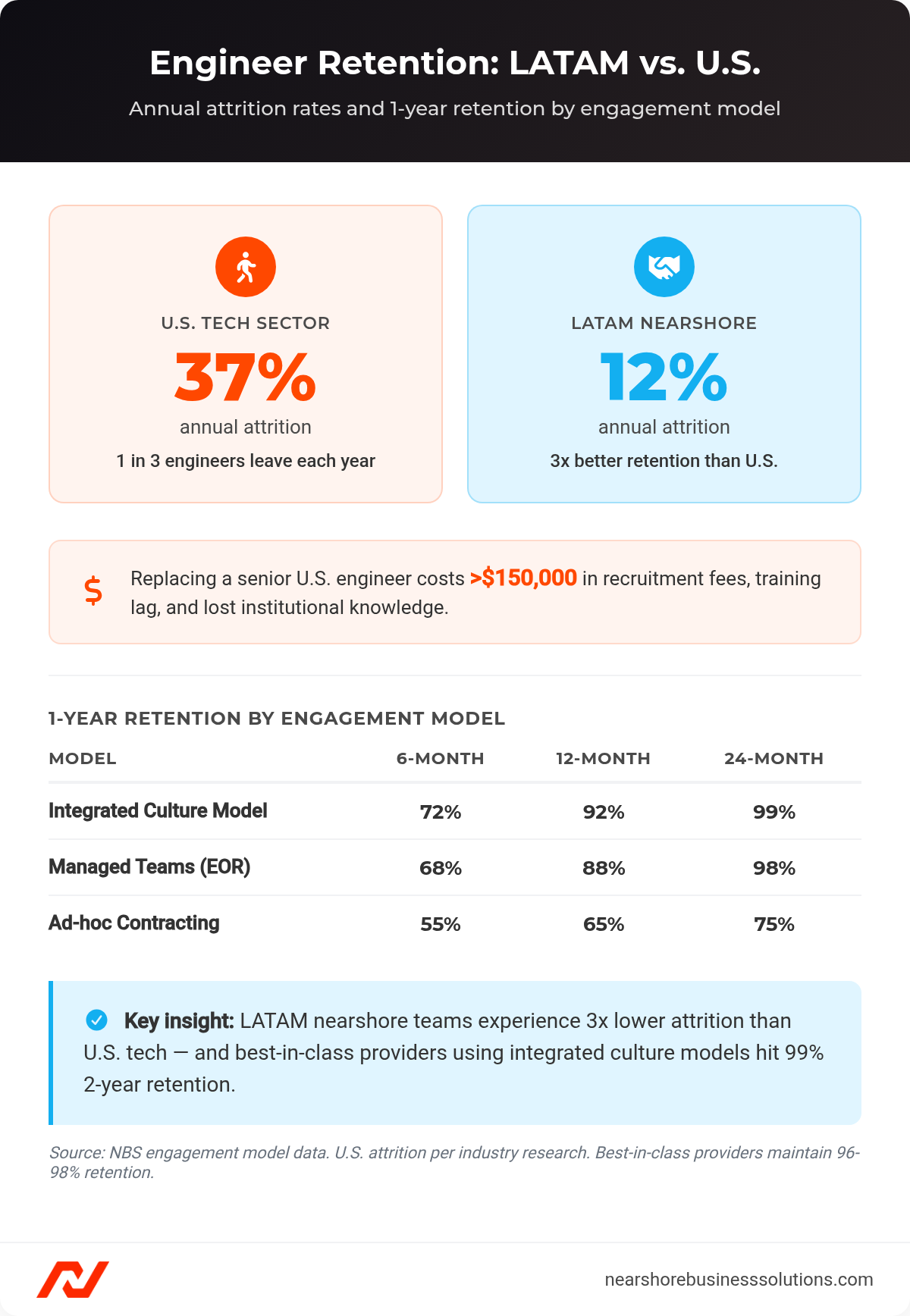
LATAM nearshore attrition runs at 12% versus 37% in U.S. tech, with integrated culture models achieving 99% 2-year retention.
How Do You Create Career Development Paths for Distributed Engineers?
Define explicit career ladders with transparent promotion criteria. Remote engineers need written frameworks showing progression from mid-level to senior to staff. Generic “we’ll know it when we see it” standards drive attrition.
Rotate ownership of high-impact projects. Do not reserve architectural work for onshore teams. Distributed engineers need portfolio-building opportunities. Provide $2,000-$3,000 annually for courses, conferences, and certifications. Create technical leadership tracks: not everyone wants management.
Should Compensation Differ Based on Engineer Location?
Yes, with transparency. US fully loaded costs for senior engineers run $160,000-$185,000. LATAM nearshore provides 60-65% total cost reduction.
| Industry | US Onshore (Fully Loaded) | LATAM Nearshore (Fully Loaded) | Effective Savings |
|---|---|---|---|
| SaaS | $165,000 | $65,000 | 60.6% |
| FinTech | $175,000 | $72,000 | 58.8% |
| HealthTech | $180,000 | $75,000 | 58.3% |
| EdTech | $160,000 | $62,000 | 61.2% |
Regional benchmarks: Mexico $78,000; Brazil $74,000; Argentina $68,000; Colombia $65,000 average. Consider USD-denominated compensation for Argentina and Brazil to hedge currency volatility.
What Benefits Matter Most to Remote Engineers?
Critical benefits for retention: full-time employment status (contractors feel disposable); healthcare coverage; $2,000-$3,000 annual learning budget; equipment stipend ($2,000-$3,000 for laptop, monitor, desk, chair); USD compensation or inflation protection for Argentina and Brazil; and company equity to create ownership mindset.
How Do You Handle Time Zone Differences in Distributed Engineering Teams?
Time zone overlap directly determines collaboration velocity. Nearshore teams with 0-3 hour differences achieve 40% faster release cycles. Far-offshore models with 12-hour differences add 15-25% hidden costs from communication lags.
| Location | US EST Offset | US PST Offset | Effective Overlap |
|---|---|---|---|
| Mexico City | -1 hour | +2 hours | 8 hours |
| Bogotá | 0 hours | +3 hours | 8 hours |
| Buenos Aires | +2 hours | +5 hours | 5-6 hours |
| São Paulo | +2 hours | +5 hours | 5-6 hours |
Minimum 4 hours daily overlap is required. Below this threshold, you lose same-day feedback loops. Protect 10 AM to 2 PM EST as prime time. Use World Time Buddy to visualize overlaps before scheduling. Cluster meetings on specific days to preserve focused work time.
Zero overlap forces 24-48 hour feedback cycles that kill velocity. Far-offshore models with 12-hour differences create: questions asked at 5 PM answered next morning, code reviews waiting overnight, and critical bugs requiring emergency late-night calls.
What Are the Most Common Mistakes in Managing Distributed Engineering Teams?
Treating distributed engineers as contractors rather than team members guarantees failure. Four failure patterns repeat across organizations that struggle with distributed work.
| Factor | Pitfall (What Fails) | Success (What Works) |
|---|---|---|
| Ownership | Task-based tickets with no context | Engineers owning delivery of outcomes |
| Onboarding | Ad-hoc Slack messages and “wait and see” | Structured 90-day plan with clear stage gates |
| Communication | Async only with 12-hour lags | Real-time stand-ups during overlapping hours |
| Legal | Misclassifying full-timers as contractors | EOR models with IP transfer chains |
Give engineers outcome ownership, not task lists. Assign “Improve checkout conversion by reducing payment errors” instead of “Update payment validation logic.” Focus on output-based metrics rather than hours logged. The Productivity Paradox: headcount increases without proper systems cause individual productivity to decrease due to coordination complexity. With 5 engineers, you manage 10 pairwise relationships. With 10 engineers, that jumps to 45.
How Do You Scale Distributed Engineering Teams Successfully?
Foreign Direct Investment in Latin America reached $184.3 billion. Microsoft, Amazon, and Google established cloud regions and research centers in Chile, Mexico, and Colombia. Successful scaling requires defining ownership and quality gates before adding capacity.
Major regional hubs to build around:
Guadalajara, “Mexico’s Silicon Valley”: Triple Helix model with government, ITESM/Universidad de Guadalajara academia, and industry collaboration. Eight-hour overlap with US costs 50-60% less than domestic rates.
São Paulo, Financial and Tech Epicenter: 81 software development firms, 60% of Brazil’s startup investment. FinTech, e-commerce, and AI/ML specializations.
Buenos Aires, High Senior Talent Density: Strong blockchain and data science capabilities. Engineers commonly accept USD compensation, reducing currency risk. Five to six hours EST overlap.
Medellín, Innovation Hub: Ruta N initiative and graduates from Pontificia Universidad Javeriana and Universidad Nacional de Colombia. Strong English proficiency and 100% EST overlap. INNpulsa Colombia and ProColombia support foreign companies establishing tech teams here.
Companies achieve 35% cost savings with nearshore teams. Reinvest into innovation, product development, and team-building. Create cross-functional squads that mix locations within teams to prevent “us versus them” dynamics.
Legal and Compliance Considerations for Distributed Teams
Misclassification and IP ownership failures reduce valuations or kill transactions during acquisition or investment rounds. For details on compliant hiring in Mexico, see our hire in Mexico guide.
What Employment Models Work Best for Distributed Engineering Teams?
| Model | Setup Time | Compliance | Best For | Key Risks |
|---|---|---|---|---|
| Direct Entity | 3.5 months | Full control, highest burden | 50+ engineers in single country | Requires local legal/HR expertise |
| EOR (Employer of Record) | Weeks | Compliant, handles local benefits/taxes | 5-50 engineers across countries | Vendor dependency |
| Contractor | Fast | Massive legal risk | True project-based work (under 3 months) | Presumption of employment, IP ownership unclear |
The EOR model mitigates classification risk and handles mandatory benefits automatically. Argentina requires labor risk insurance (ART). Mexico mandates IMSS social contributions. True TCO adds 15-20% to base employment cost. It is still 60-65% cheaper than US equivalents.
How Do You Protect Intellectual Property With Distributed Teams?
US-standard IP clauses are often unenforceable in LATAM jurisdictions. Use a two-step transfer process: employee assigns rights to EOR in a locally compliant contract; EOR assigns rights to the US company. Without clear chain of custody, the EOR or worker may legally own IP, which can kill transactions during acquisition.
Country-specific requirements: Argentina requires explicit assignment language (retroactive assignments may not hold); Brazil moral rights persist after economic rights transfer; Mexico IP assignment must be explicit and compensated. Audit IP assignment completeness quarterly.
What Tax Implications Exist for Distributed Engineering Teams?
Non-US entities must submit the W-8BEN-E form before the first payment to avoid mandatory 30% withholding. Permanent Establishment (PE) risk: a US company may create taxable presence in a foreign country if a remote worker has contract-signing authority or performs key revenue-generating roles.
PE mitigation: restrict strategic decision-making to US headquarters; limit contract execution authority to US employees; document that foreign employees support but do not drive revenue.
Contractor classification represents a business threat. Labor courts in Latin America presume employment relationships when workers demonstrate exclusivity, set hours, detailed supervision, or a long-term ongoing relationship. One labor court case can trigger reclassification across your entire team.
Frequently Asked Questions About Managing Distributed Engineering Teams
These are the most common questions US tech leaders ask when building distributed engineering teams in Latin America.
How Long Does It Take to Hire a Remote Engineer in LATAM?
It takes 2-4 weeks through a nearshore staffing firm with an existing talent network. Direct hiring takes 3-6 months for senior roles. Plan for 4-6 weeks total from decision to first day, including EOR legal onboarding.
What If a Developer Does Not Work Out?
Use a staffing firm with a replacement guarantee. Nearshore Business Solutions provides a 90-day replacement guarantee. Document performance issues in writing during the first 30 days to support any separation decisions under local labor law.
Do I Need to Provide Equipment to LATAM Engineers?
Yes. Ship hardware 5-7 days before start date to account for international customs. Budget $2,000-$3,000 per engineer for laptop, monitor, desk, and chair. Define equipment ownership and return policy in the employment agreement before onboarding.
How Do I Pay Remote Engineers in Latin America?
Through an Employer of Record who handles local payroll, taxes, and compliance. The EOR pays engineers in local currency while you pay the EOR in USD. For Argentina and Brazil, consider USD-denominated compensation to hedge against currency volatility. Collect W-8BEN-E before the first payment.
What Is the Difference Between Nearshore and Offshore Development?
Nearshore refers to teams in the same or close time zones (Latin America for US companies). Offshore refers to teams with 8-12 hour differences. Nearshore delivers 40% faster release cycles due to same-day feedback loops. Offshore adds 15-25% hidden costs from communication lags and rework.
Do I Need to Set Up a Local Legal Entity?
No, not initially. An EOR serves as the legal employer without requiring you to establish a local entity. Setting up a direct entity takes 3.5 months. Use an EOR until you have 50+ engineers in a single country to justify the overhead.
How Do I Protect My IP With a Distributed Team?
Use an EOR with a documented two-step IP transfer process: employee assigns rights to EOR, EOR assigns rights to your company. Verify this chain of custody before the first line of code is written. US-standard work-for-hire clauses are often unenforceable in LATAM jurisdictions.
Ready to Build Your Distributed Engineering Team?
Nearshore Business Solutions sources and vets developers from Guadalajara, Bogotá, Medellín, Buenos Aires, and São Paulo. We screen for technical skills, English fluency, and US work style fit. Our acceptance rate is 16%.
Every placement includes a 90-day replacement guarantee. You receive pre-vetted candidates in 2-4 weeks.
Get a free consultation to discuss your hiring needs and receive a custom quote.