
Remote work productivity tips matter most when they’re designed for distributed engineering teams, not individual contributors. Stanford researcher Nick Bloom’s 2024 data shows well-managed remote teams erase a fully-remote productivity deficit entirely, while Microsoft’s Work Trend Index found 153% more weekly meetings since 2020 are the real barrier.
Remote teams work best with three layers: async-first defaults, protected deep work windows, and intentional team rituals. Stack Overflow’s 2023 Developer Survey shows 80% of professional developers work hybrid or fully remote. The challenge isn’t remote work itself. It’s that most VPs of Engineering still run distributed teams with co-located playbooks.
Nearshore Business Solutions places senior engineers from Mexico, Colombia, Argentina, and Brazil with US tech teams. We screen for async fluency, written communication skill, and US work style fit. Below you’ll find evidence-backed systems for distributed engineering teams, including how nearshore talent amplifies these systems rather than adding friction.
Why Does Most Remote Productivity Advice Fail Engineering Leaders?
Most remote productivity advice targets individual contributors, not engineering organizations. It tells a VP of Engineering to buy a standing desk or silence notifications. That doesn’t help you build focus-first culture for 40 engineers across three time zones.
The problem is structural, not motivational. Microsoft research named this “productivity paranoia”: 87% of employees say they’re productive, yet only 12% of their leaders believe it. The gap exists because leaders lack the right instrumentation and compensate with surveillance or gut-feel instead of systems.
What Is the Productivity Theater Problem?
Productivity theater costs more than most VPs realize. A one-hour meeting with five mid-level engineers costs roughly $500 in loaded salary (assuming $200K fully loaded annual cost per engineer). Employees consider 33% of their meetings unproductive (Steven Rogelberg, University of North Carolina). For a 40-person team, that works out to over $400,000 annually in loaded time subsidizing theater, derived from Clockwise’s 10.3-hour weekly meeting data and industry average loaded costs.
The root cause: organizations default to synchronous communication, then wonder why deep work disappears. RescueTime data shows the average knowledge worker checks Slack every 6 minutes, and each interruption triggers a 15-25 minute context-switching penalty (University of California, Irvine). Clockwise’s 2023 study found the average software engineer loses 10.3 hours per week to meetings, leaving only 13.7 hours of true focus time.
Hybrid work structures, not individual habits, drove a 33% increase in employee retention with zero negative impact on performance reviews or promotions (Stanford/WFH Research, Bloom et al.). Remote work productivity is a design problem. So is nearly everything else on the distributed-team agenda, from communication breakdown to isolation, which we break down in our guide to remote work challenges for distributed teams.
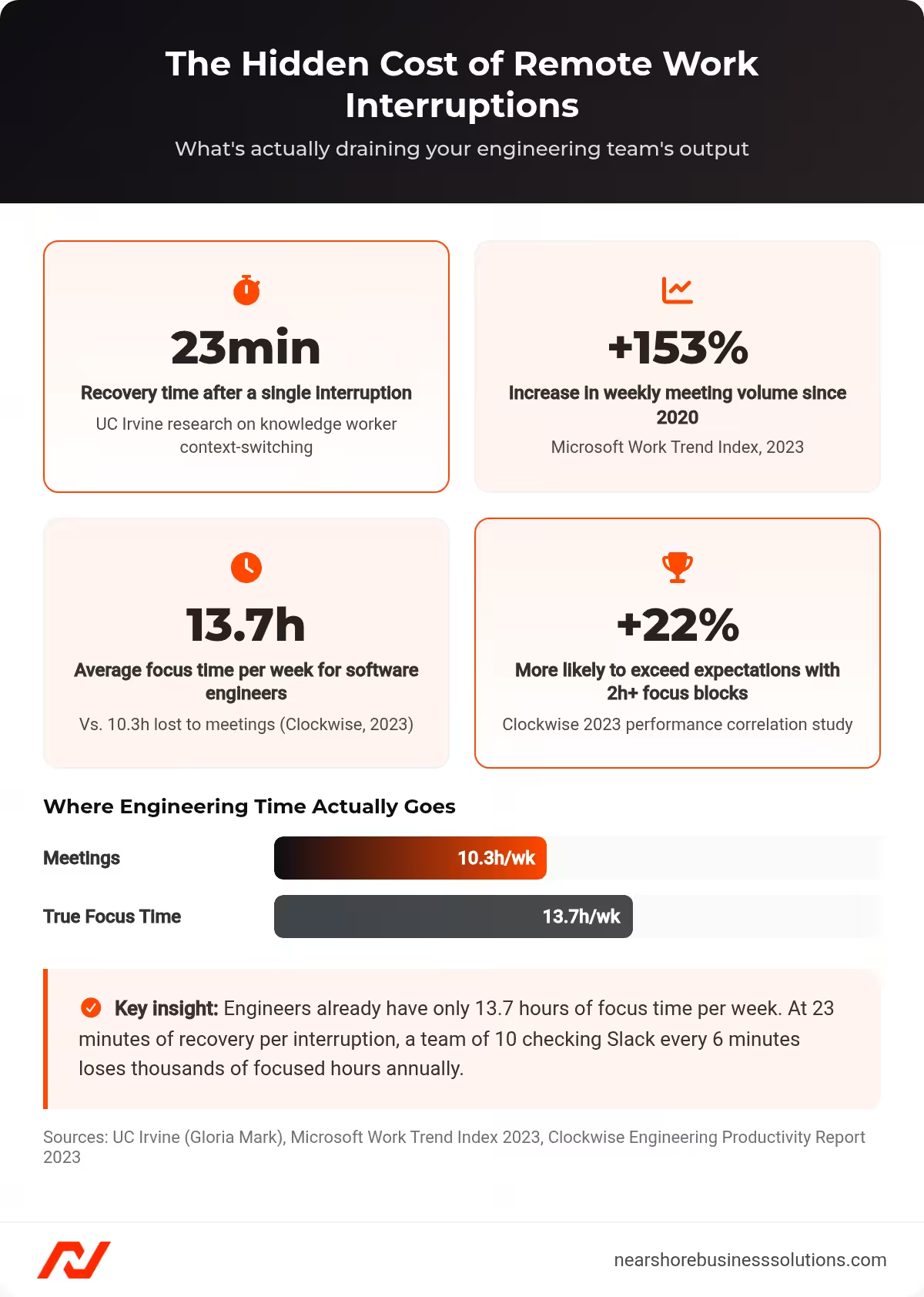
Key data on how interruptions drain remote engineering output, from UC Irvine and Microsoft research.
Which Focus Metrics Matter More Than Hours Logged?
Engineers with the most focus time, defined as blocks of 2+ uninterrupted hours, are 22% more likely to receive “exceeds expectations” ratings (Clockwise, 2023). Five metrics reveal whether your distributed team is actually engineered for output:
| Metric | Target / Benchmark | Why It Matters |
|---|---|---|
| Focus Time Ratio | 50%+ of week in 2+ hour blocks | Directly predicts performance ratings and delivery speed |
| PR Cycle Time | Under 48 hours | Rising cycle time signals collaboration friction, not code complexity |
| Meeting Load Index | 5 hours/week maximum | Developers exceeding 5 hours see significant drops in sprint goal completion (Atlassian) |
| DORA Metrics | Varies by tier | Gold standard for DevOps performance; measures whether focus converts to shipped product |
| SPACE Composite Score | Quarterly health check | Catches blind spots single metrics miss (Microsoft, GitHub, University of Victoria) |
Tools like LinearB, Jellyfish, and Clockwise surface these metrics passively, without requiring engineers to self-report. If tracking productivity creates more overhead than it eliminates, you’ve replaced one form of theater with another.
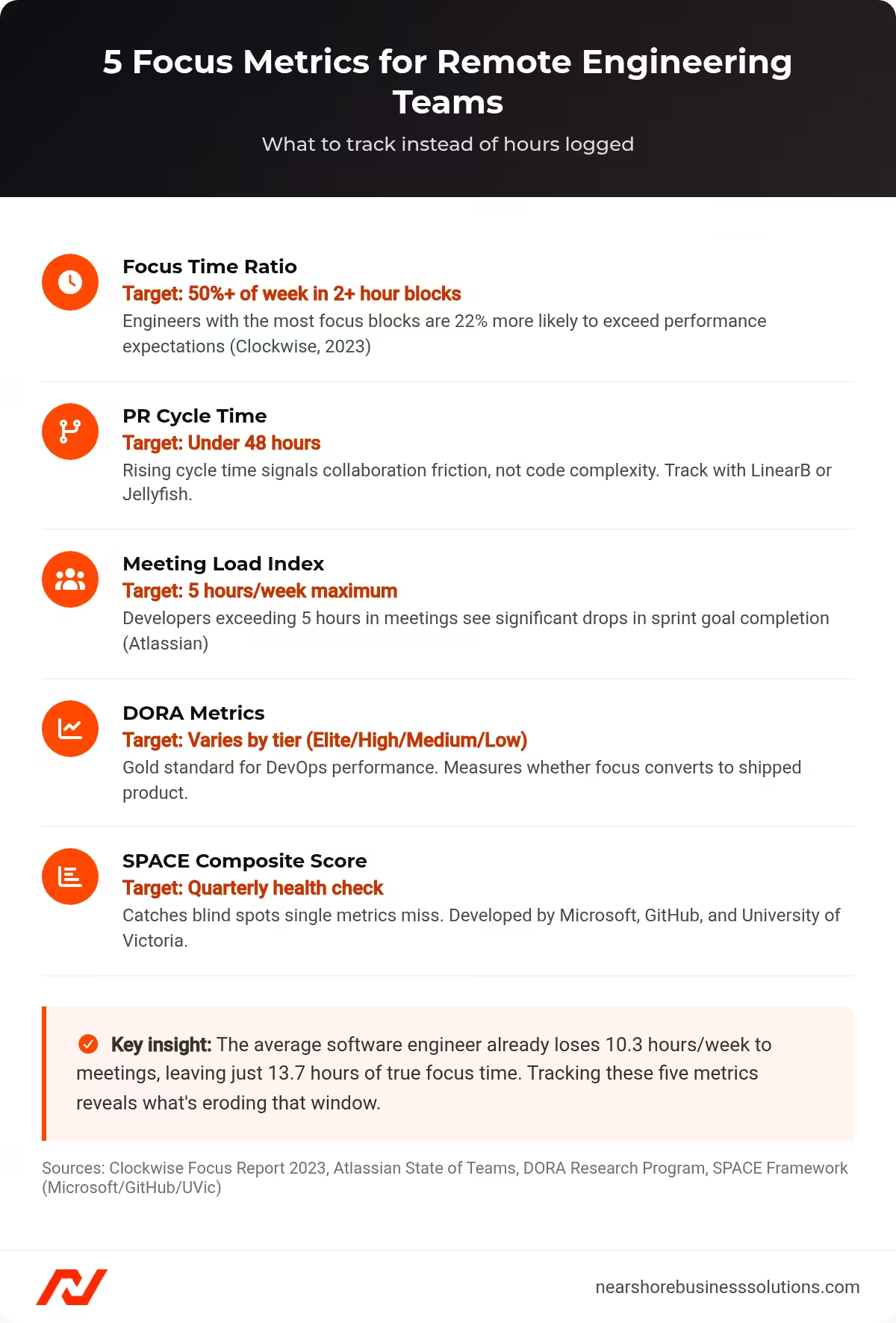
Five focus metrics that predict remote engineering team performance better than hours logged.
How Do You Build a Remote Work Productivity System That Scales Across Time Zones?
Distributed teams need three layers in this order: async-first defaults create space, deep work windows defend it, and rituals ensure no one drifts. The average knowledge worker toggles between apps 1,200 times per day and burns four hours weekly just reorienting (Qatalog & Cornell University, 2023). Building the async layer first reduces that switching cost at scale.
How Do You Default to Async Work Without Losing Alignment?
GitLab ships product across 65+ countries with zero offices and reports 80% faster project cycle times since adopting a documentation-first async model (GitLab Remote Playbook, 2024). Doist self-reports 90%+ employee retention and an estimated 40% reduction in communication overhead from the same approach (Doist internal data, published via their blog). Automattic operationalizes async through “P2,” an internal blogging platform where every decision lives in permanent written record.
Async-first doesn’t mean async-only. It means every communication begins as async unless it qualifies for a synchronous upgrade. Before scheduling any meeting, ask: Does this require real-time back-and-forth? Is it too ambiguous for written resolution? Will the meeting produce a decision that can’t be reached in a document? If all three answers are no, the meeting doesn’t happen.
| Communication Type | Urgency | Recommended Format | Example |
|---|---|---|---|
| Status update | Low | Async: Slack or Geekbot prompt | Daily standup replacement |
| Scoped question | Low-Medium | Async: threaded Slack post | “Which auth library for the new microservice?” |
| Code review | Medium | Async: Loom video + PR comments | 2-min Loom showing a refactored module |
| Design decision | Medium | Async: written RFC with 48-hour comment window | Architecture proposal |
| Ambiguous problem | High | Synchronous: meeting with pre-read | Incident post-mortem requiring cross-team analysis |
| Production incident | Critical | Synchronous: immediate war room | Pager alert triggers live Zoom |
For more on building async-first team structures, see our guide on how to manage a remote team effectively across time zones.
How Do You Schedule Deep Work Windows That Survive a Multi-Time-Zone Calendar?
23 minutes and 15 seconds is how long it takes to fully return to a task after a single interruption (University of California, Irvine). A 2023 meta-analysis in the Journal of Applied Psychology found that time-blocking produced a medium-to-large effect on performance (d = 0.46), stronger evidence than most management practices leaders already treat as standard.
For distributed teams spanning US and Latin American time zones, the architecture follows three steps. First, define core collaboration hours as a 3-4 hour overlap window, typically 10 AM to 2 PM ET. Second, compress every synchronous interaction into this window. Third, protect everything outside it as deep work by default, enforced by Clockwise or Reclaim.ai as calendar policy, not a suggestion.
Both US and LATAM engineers get 4+ hours of uninterrupted focus daily. Neither sacrifices collaboration quality.
What Three Rituals Replace Surveillance With Transparency?
Surveillance tools like keystroke loggers and screenshot capture generate ambient anxiety that drives engineers to optimize for looking busy rather than shipping product. Three rituals create transparency through structure instead:
| Ritual | Format | Duration / Frequency | Purpose |
|---|---|---|---|
| Weekly Team Sync | Synchronous | 45 minutes / weekly | Align priorities, surface blockers, make decisions. Pre-distributed agenda required: no agenda means cancelled. |
| Async Daily Check-In | Asynchronous | 5 minutes per engineer / daily | Written prompt (shipped, blocked, next) via Geekbot. Entire team status scannable in two minutes. |
| Biweekly Retrospective | Synchronous | 60 minutes / every two weeks | Inspect the operating system itself. Which deep work blocks got invaded, and why? |
Total synchronous load: roughly 1.5 hours per week, well under the Atlassian benchmark of 4-5 hours maximum for individual contributor engineers.
What Tools Actually Improve Remote Productivity, and Which Ones Create Noise?
Tool sprawl is a productivity killer at scale. Okta’s 2023 report found companies with fewer than 2,000 employees deploy an average of 89 apps. For a VP evaluating tool number 90, the bar should be explicit: does this tool eliminate at least one existing workflow, meeting, or manual process? If it only adds a new surface to monitor, it creates noise.
Communication layer. Slack’s Workforce Index (2023) found that 50% of knowledge workers never adjust notification settings from defaults, converting an async tool into a synchronous interruption machine. Three fixes work consistently: archive any channel that hasn’t produced a decision in 30 days, silence notifications by default except for a single escalation channel, and redirect recurring status updates to structured async tools. Establish a channel-specific SLA of 4 business hours for responses, not 4 minutes.
Visibility layer. Every status meeting exists because someone lacks visibility. Geekbot and Range replace daily syncs with searchable artifacts. LinearB surfaces PR cycle time and pickup time from Git data. When median pickup time drifts from 4 to 18 hours, the leader sees it before it becomes a missed release. Notion and Confluence store reasoning through Architecture Decision Records and public-by-default RFCs. Well-written Linear or Jira tickets, with problem statements, acceptance criteria, and linked ADRs, replace mid-sprint clarification pings.
For a full comparison of async tools across categories, see our remote collaboration tools guide.
How Does Remote Team Productivity Start With Who You Hire?
Structured onboarding makes remote employees 58% more likely to stay for three years or more, according to Deel Labs (2023). Process doesn’t rescue a bad hire, and a great hire doesn’t survive a chaotic first month.
A 2022 meta-analysis in the Journal of Occupational and Organizational Psychology identified conscientiousness and autonomy orientation as the strongest predictors of remote work performance. Screen for four traits specifically, using the same structured approach outlined in our talent management best practices guide for distributed teams:
- Written communication skill. In async environments, writing is the work interface. Candidates who communicate imprecisely in async formats will create coordination overhead at every handoff.
- Self-direction. The interval between task assignment and next check-in may span 24-48 hours across time zones. Engineers who need frequent check-ins to stay unblocked are costly in distributed settings.
- Proactive over-communication. Engineers who communicate only when asked create information vacuums. Look for candidates who default to sharing status, blockers, and decisions without prompting.
- Async collaboration fluency. Candidates who default to “let’s hop on a call” generate coordination overhead from day one. Assess this directly in the interview process.
Why Do Nearshore Teams Accelerate Remote Productivity?
Nearshore Latin American engineers deliver 3-5 hours of real-time overlap with US Eastern teams, compared to 0-1 hours for India-based teams. An IEEE Software study found that teams with significant time zone overlap had higher code integration frequency and lower defect rates. A 12-hour time difference can add 24 hours of delay to a single query-response cycle, the opposite of the fast feedback loops that focus metrics demand.
Companies like Zapier (engineers across Colombia and Argentina), Gusto (50+ engineers in Mexico City), and Eventbrite (100+ engineers in Mendoza and Buenos Aires) have validated this model at scale. LATAM attrition rates run 10-15%, compared to 20-25%+ for India-based teams, reducing the hidden costs of recruiting, onboarding, and knowledge loss. Senior engineer salaries average 60-68% below US equivalents, while delivering real-time collaboration that opposite-hemisphere time zones cannot.
NBS sources engineers from Mexico City, Guadalajara, Bogota, Medellin, Buenos Aires, and Sao Paulo. Each candidate goes through a technical screen, live coding assessment, English fluency evaluation, and reference verification. We deliver a pre-vetted shortlist in 3 business days with a 90-day replacement guarantee.
To explore hiring models that support distributed teams, see our staff augmentation and employer of record services.
What Do VPs of Engineering Most Often Ask About Remote Work Productivity?
These are the most common questions engineering leaders ask about building productivity systems for distributed teams.
How Many Hours of Meetings Per Week Is Too Many for Remote Engineers?
More than 5 hours per week of meetings significantly reduces sprint goal completion rates, according to Atlassian research. The current industry average is 10.3 hours per week (Clockwise, 2023). Reducing to the 4-5 hour threshold through async substitution and meeting cancellation policies typically frees 5-6 hours of focus time per engineer per week.
What Is the Fastest Way to Improve Focus Time for a Distributed Team?
Define core collaboration hours and compress all synchronous meetings into that window. This single structural change creates automatic focus blocks for the hours outside the window. Teams using Clockwise or Reclaim.ai to enforce this as calendar policy report recovering 4+ hours of weekly focus time within the first two weeks of implementation.
Do Remote Engineers Need to Be in the Same Time Zone?
No, but significant overlap matters. US-LATAM teams typically share 3-5 hours of overlap per day, which is enough for standups, code reviews, and unblocked design decisions. US-India teams share 0-1 hours, which forces asynchronous handling of decisions that benefit from real-time discussion, adding a full day of delay to each cycle.
What Is the Difference Between Monitoring Remote Engineers and Managing Them?
Monitoring tools (keystroke loggers, screenshot capture) measure activity, not output. Management systems measure output directly: PR cycle time, sprint velocity, DORA metrics, and focus time ratios. The research is consistent: activity monitoring increases anxiety and optimizing-for-appearance behaviors. Output measurement with clear targets improves both productivity and retention.
How Long Does It Take to Onboard a Remote Engineer?
Remote onboarding to full productivity takes 30-60 days with a structured program, versus 60-90 days without one. Key accelerators include a pre-built onboarding checklist, a documentation-first culture (so new hires can unblock themselves async), a dedicated onboarding buddy, and clear sprint-level goals for weeks 1, 2, 4, and 8.
What Is the Best Async Tool for Daily Engineering Standups?
Geekbot and Range are the most widely adopted standup replacement tools for engineering teams. Both integrate with Slack, collect structured prompts (what did you ship, what are you blocked on, what’s next), and make the entire team’s status scannable in two minutes. Both tools reduce standup ceremony from 15-30 minutes daily to 5 minutes per engineer.
Does the Pomodoro Technique Work for Software Engineers?
Time-blocking methods including the Pomodoro Technique show a medium-to-large effect on performance for knowledge workers (Journal of Applied Psychology, 2023, d = 0.46). For software engineers specifically, the benefit comes from protecting uninterrupted blocks, not from the specific 25-minute interval. Most engineers working on complex systems benefit from 90-120 minute focus blocks rather than the standard 25-minute Pomodoro cycle.
Is a Remote-First System Right for Your Engineering Team?
Remote work productivity tips only work when embedded in a deliberate operating system: async defaults, protected deep work windows, intentional rituals, the right tools, and the right people. Skip one layer and the system degrades.
One action this week: Audit your team’s meeting load against focus time for the past two weeks. If your engineers average fewer than 13.7 hours of focus time, which is the current industry average, block four hours of protected focus time next sprint and measure what changes. Engineers with 2+ hour focus blocks are 22% more likely to exceed expectations (Clockwise, 2023). Every 23-minute recovery from an interruption you prevent compounds into shipped product.
How Do You Scale Your Engineering Team With Nearshore Talent?
Nearshore Business Solutions connects US tech teams with vetted engineers from Mexico, Colombia, Argentina, and Brazil. We handle sourcing, technical screening, and placement. You focus on building your product.
Our engineers are pre-screened for technical skills, English fluency, and async collaboration fit. Every placement includes a 90-day replacement guarantee. You receive a pre-vetted shortlist in 3 business days.
Book a free consultation to discuss your nearshore team structure and receive a custom talent plan.