
Agile nearshore development delivers 20-30% faster sprint velocity than offshore teams while cutting costs 40-65% versus US hiring.
Latin America’s 2.6 million developers work in US time zones with 5-8 hours of daily overlap. Teams in Bogotá, Mexico City, and Buenos Aires integrate into Scrum workflows within days. Retention rates run 2x higher than offshore alternatives.
This guide covers how to build high-performance distributed teams across Colombia, Mexico, Argentina, and Brazil. You’ll find cost benchmarks, framework recommendations, and vetting criteria for nearshore partnerships.
What Is Agile Nearshore Development?
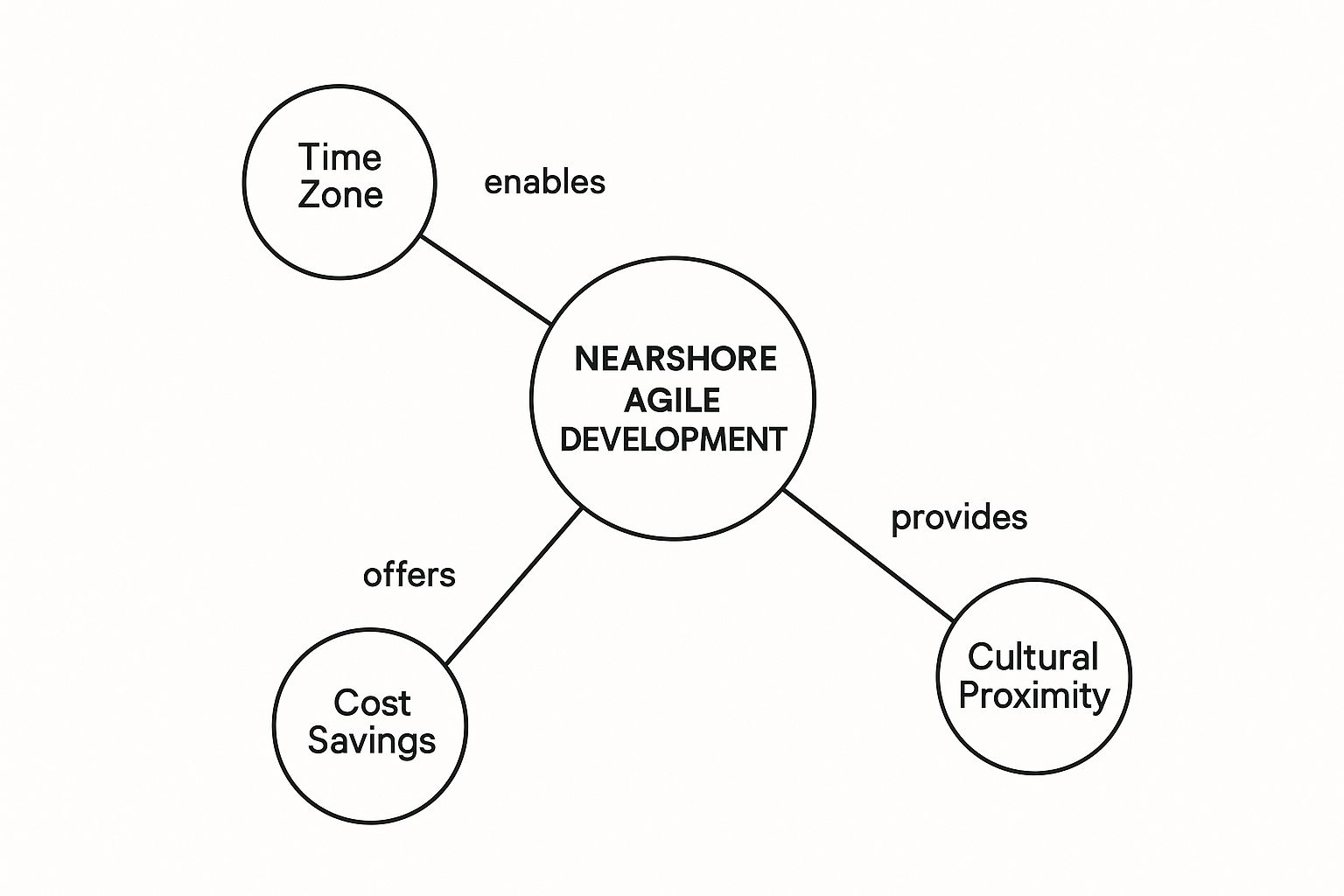
Agile nearshore development combines iterative Agile methodology with geographically proximate outsourcing. You get skilled developers in countries like Colombia, Mexico, or Argentina. They share your time zone and integrate into your sprint cycles.
The “nearshore” distinction matters. Offshore teams in Asia face 10-12 hour time gaps. Nearshore teams in Latin America share 5-8 hours of real-time overlap with US business hours. This enables same-day code reviews and immediate incident response.
Three components define the model:
Geographic proximity. Nearshore partners operate in neighboring regions. Travel time is 3-5 hours for in-person sessions when needed.
Cultural alignment. Latin American developers work within similar communication styles as US counterparts. This reduces onboarding time.
Agile integration. Nearshore teams embed into existing sprint cycles. They use the same tools—Jira, GitHub, Slack—and attend ceremonies as full team members.
How Does Nearshore Differ from Offshore and Onshore Outsourcing?
The three models serve different priorities. Onshore maximizes control but limits talent pools. Offshore minimizes cost but creates operational friction. Nearshore balances both.
Offshore targets the lowest labor costs in distant regions like India or Eastern Europe. A one-hour time difference reduces real-time collaboration by 37%. With 10-12 hour gaps, synchronous work becomes nearly impossible. Code reviews wait overnight. Blockers sit unresolved for 24 hours.
Nearshore prioritizes time zone alignment and cultural fit. Latin America delivers 5-8 hours of daily overlap with US business hours. Teams using overlapping workflows deliver projects 22% faster than co-located teams.
Onshore eliminates time zone barriers entirely. But with a predicted shortage of 4 million developers by 2025, onshore-only strategies face structural limits.
For Agile teams requiring daily collaboration, nearshore consistently outperforms offshore on velocity metrics.
For a detailed breakdown of regional options, see our complete guide to hiring developers in Latin America.
What Makes a Distributed Team High-Performance?
High performance in distributed teams comes from systems, communication patterns, and cultural integration—not geography. The DORA metrics separate elite performers from the rest.
Elite teams deploy code multiple times per day. They have lead times under one hour. Change failure rates stay under 15%. Recovery from failures takes less than an hour.
What Characteristics Define High-Performing Remote Teams?
High-performing distributed teams use a hybrid communication approach. Synchronous time handles complex problem-solving. Asynchronous channels handle status updates and documentation.
Teams must use centralized platforms—Jira, Azure DevOps, Linear—for transparent workflow management. Development pipelines should enforce quality gates with required test coverage and automated code review triggers.
Teams with daily check-ins experience a 45% increase in alignment on project goals. Daily standups stay under 15 minutes. Sprint ceremonies happen during overlap hours.
How Do Trust and Transparency Affect Distributed Team Success?
Written transparency is a core element of high-performing distributed teams. Companies like GitLab report that 90% of their team communicates asynchronously. This approach drives productivity gains.
All critical decisions and architectural choices must be documented on centralized platforms. When a developer in Bogotá needs context on a design decision, the answer exists in Confluence—not in someone’s memory.
Teams using asynchronous methods experience a 25% improvement in satisfaction. Documentation isn’t overhead. It’s infrastructure.
Why Does Cultural Alignment Matter for Performance?
Cultural alignment reduces invisible friction. LatAm regions share cultural values aligned with North American business practices. Direct communication styles and similar meeting expectations reduce onboarding time.
English proficiency varies across the region. Argentina leads with an EF EPI score of 575 (High Proficiency). Costa Rica scores 516 (Moderate). Mexico, Colombia, and Brazil fall into the Low Proficiency band.
The hiring implication: source from established tech hubs in Medellín, Guadalajara, or Buenos Aires. Then validate communication skills during technical interviews conducted entirely in English.
What Are the Benefits of Agile Nearshore Development?
The benefits fall into four categories: time zone overlap, cost efficiency, feedback speed, and communication clarity. Each delivers measurable impact on sprint velocity.
How Does Time Zone Overlap Improve Agile Collaboration?
Nearshore alignment guarantees 5-8 hours of daily synchronous overlap with US business hubs. This enables real-time standups, pair programming, and same-day code reviews.
Colombia (UTC-5): 8 hours overlap with EST. Ideal for teams in New York, Boston, or Miami.
Mexico (UTC-6): 8 hours overlap with CST. Maximum overlap for teams in Austin, Chicago, or Dallas.
Brazil/Argentina (UTC-3): 6 hours overlap with EST. Works best with East Coast companies.
Many LatAm countries—Colombia, Peru, Costa Rica—don’t observe Daylight Saving Time. This provides essential consistency for sprint planning.
What Cost Advantages Does Nearshore Offer Over Onshore?
US companies realize 40-65% reductions in labor expenses compared to domestic hiring. The savings scale with team size while maintaining collaboration advantages.
| Role | US Average | Argentina | Mexico | Colombia |
|---|---|---|---|---|
| Senior Full-stack Developer | $146,900-$150,000 | $72,588 | $28,271 | $26,040 |
| Senior Back-end Developer | $120,000-$140,000 | $77,664 | $28,606 | $27,864 |
Cost of living in major LatAm cities runs 70-80% lower than US tech hubs. This enables competitive local salaries at reduced absolute cost.
How Does Geographic Proximity Enable Faster Feedback Loops?
Nearshore teams achieve 20-30% faster sprint velocity than offshore teams. The gains come from eliminating async delays in daily workflows.
Real-time collaboration enables engineers to resolve blockers immediately. No overnight waits for code reviews. A 4-hour flight from Miami to Bogotá makes quarterly on-sites feasible.
Why Does Language Compatibility Reduce Project Risk?
High English proficiency reduces friction in complex discussions. Nuanced FinTech compliance requirements and rapid UX iteration feedback require precise communication.
Technical vocabulary tends to be stronger than conversational English. Developers read documentation and Stack Overflow in English daily. But conduct technical interviews entirely in English to validate communication clarity.
Which Nearshore Regions Are Best for Agile Software Development?
Latin America dominates nearshore development for US companies. The region combines talent density, cost efficiency, and time zone alignment that other options cannot match.
Why Is Latin America a Leading Nearshore Destination?
Latin America’s tech ecosystem grows at 20% annually. The region has over 2.6 million skilled engineers. Approximately 739,000 new tech graduates enter the workforce each year from 437 universities.
Ninety percent of enterprise leaders currently operate in LatAm or plan to within three years. US companies increased LatAm hiring by 50% in 2023.
What Makes Mexico a Top Choice for Nearshore Development?
Mexico has the largest talent pool in LatAm, exceeding 800,000 developers. Mexico City, Monterrey, and Guadalajara serve as primary tech hubs. Guadalajara—often called “Mexico’s Silicon Valley”—concentrates enterprise software talent.
Time zone alignment with Central and Mountain Time makes Mexico ideal for companies in Texas, Colorado, or the Midwest.
Learn more about hiring developers in Mexico and the local tech ecosystem.
Why Are Brazil and Colombia Growing as Tech Hubs?
Brazil is home to over 1.2 million engineers specializing in AI, Data Science, and Cloud Computing. São Paulo hosts 13 unicorns including Nubank and iFood. Brazilian learners rank #1 globally in data visualization.
Colombia is a top destination for cloud infrastructure and enterprise scaling. Medellín’s Ruta N innovation district and Bogotá’s tech clusters concentrate talent. The government offers tax incentives for IT companies through programs like INNpulsa Colombia.
How Do Argentina and Costa Rica Compare for Specialized Talent?
Argentina delivers the region’s highest English proficiency and deepest software engineering talent. Buenos Aires and Córdoba are major tech hubs. Universities like Universidad de Buenos Aires and ITBA produce skilled graduates. Argentina commands premium LatAm rates—justified by fluency and technical depth.
Costa Rica offers political stability and moderate English proficiency. Its smaller talent pool limits scale. Best for specialized teams of 5-15 engineers.
How Do You Build a High-Performance Agile Nearshore Team?
Building a high-performance nearshore team requires structured planning across five phases: requirements, partner selection, talent vetting, onboarding, and integration.
How Do You Define Project Requirements Before Hiring?
Evaluate sourcing using Total Cost of Ownership (TCO) and Time-to-Market (TTM) metrics—not just hourly rates. A $50/hour developer who ships in six months delivers more value than a $30/hour developer who ships in twelve.
Define requirements across four dimensions:
Technical scope. Stack requirements, architecture constraints, and security standards.
Communication requirements. Daily standup attendance, English proficiency thresholds.
Scale trajectory. Starting team size and 12-month growth plan.
Compliance needs. HIPAA, SOC 2, PCI-DSS requirements.
What Should You Look for When Selecting a Nearshore Partner?
Look for partners with ISO 27001 and SOC 2 certifications. These indicate mature security practices. Top-tier providers can launch a functional team in less than two weeks.
Evaluate partners on five criteria:
Talent depth. Does the partner have bench strength in your required stack?
Retention rates. Ask for 12-month retention metrics on existing engagements.
Reference clients. Request introductions to current clients with similar team sizes.
Engagement flexibility. Can you start small and scale to twenty engineers?
Government alignment. Colombia offers Ruta N incentives. Brazil provides MoVer fiscal benefits.
How Do You Vet and Recruit Nearshore Talent Effectively?
Nearshore teams leverage pre-vetted talent pools. Companies add sprint-ready capacity within days. Traditional offshore requires 8-12 weeks of recruitment.
Vet for three areas:
Technical competence. Live coding exercises and system design discussions.
Communication clarity. Conduct interviews entirely in English.
Agile fluency. Probe experience with sprint ceremonies and estimation practices.
What Does Effective Onboarding Look Like for Distributed Teams?
Engineers from Medellín, Guadalajara, and Buenos Aires arrive familiar with Scrum and CI/CD practices. Agile adoption is pervasive across LatAm tech hubs. This reduces onboarding friction.
Cover four areas in the first two weeks:
Tooling setup. Access to GitHub, Jira, Slack, and cloud environments.
Codebase orientation. Architecture walkthroughs and pairing sessions.
Process alignment. Sprint cadence, definition of done, deployment procedures.
Team introductions. One-on-ones with key collaborators and product managers.
How Do You Integrate Nearshore Developers with In-House Staff?
Partnering with LatAm teams creates a true extension of the domestic team. The Dedicated Team model establishes a fully integrated squad that shares sprint KPIs.
Integration practices that work:
Unified channels. No separate Slack workspaces. Everyone operates in the same channels.
Shared ownership. Nearshore developers own features end-to-end.
Rotation opportunities. Pair domestic and nearshore engineers on complex features.
In-person sessions. Quarterly on-sites for planning and team building.
Which Agile Frameworks Work Best for Distributed Nearshore Teams?
Framework selection depends on team size and project complexity. Scrum, Kanban, and hybrid approaches each serve different configurations.
How Do You Adapt Scrum for Teams Across Multiple Locations?
Scrum dominates LatAm at 66-87% adoption rate. Nearshore developers arrive with existing Scrum fluency. Sprint planning and retrospectives are familiar ceremonies.
Adapt Scrum for distributed execution:
Standup timing. Schedule during overlap hours. A 10 AM EST standup works for New York to Bogotá.
Sprint boundaries. Align with shared working days. Avoid Monday starts when holidays don’t align.
Ceremony participation. All team members attend planning, review, and retrospective sessions.
Definition of done. Document explicit completion criteria. Distributed teams can’t rely on hallway clarification.
Can Kanban Improve Workflow Visibility in Nearshore Settings?
Kanban is used by 56-61% of LatAm teams, often combined with Scrum. Kanban’s visual workflow provides transparency that distributed teams need.
Async visibility. Board state communicates progress without meetings.
WIP limits. Work-in-progress constraints prevent overloading team members.
Flow metrics. Cycle time tracking exposes bottlenecks regardless of location.
When Should Distributed Teams Consider SAFe or Hybrid Approaches?
Hybrid sourcing models are projected for 50% of companies by 2026. SAFe applies when multiple squads work on interdependent features or enterprise integration requires PI planning cycles.
SAFe adds overhead. For single-squad engagements, Scrum or Kanban delivers better velocity-to-process ratio.
How Do You Run Agile Ceremonies with Nearshore Teams?
Agile ceremonies require adaptation for distributed execution. Protect synchronous time for high-value interactions. Push everything else to async channels.
What Are Best Practices for Remote Daily Standups?
Reserve the 2-3 hours of daily overlap for high-leverage activities. Standups stay under 15 minutes. Team members post written updates before the call. The meeting addresses blockers only.
Video on. Rotate facilitation. Capture blockers in a shared location.
How Do You Conduct Sprint Planning Across Time Zones?
Reserve synchronous overlap for backlog refinement and architecture discussions. Sprint planning requires real-time negotiation. Async planning creates misalignment.
Product owner shares prioritized backlog 48 hours before planning. Estimation happens live. Post-planning documentation becomes the source of truth.
What Makes Remote Retrospectives Effective?
Use async input collection followed by synchronous discussion. Team members add items to Miro or FigJam before the meeting. This gives non-native speakers time to formulate thoughts.
Review themes, vote on priorities, and commit to action items live. Every improvement action needs an owner and deadline.
What Tools Enable Agile Nearshore Team Success?
Tooling creates connective tissue between distributed team members. The right stack enables transparency and enforces process consistency.
Which Project Management Tools Support Distributed Agile Workflows?
Teams must use centralized platforms—Jira, Azure DevOps, Linear—for transparent workflow management. The platform becomes the single source of truth.
Board visibility. Every team member sees the same board state.
Workflow enforcement. Configured workflows prevent tickets from moving without required fields.
Reporting automation. Burndown charts and velocity trends generate automatically.
Why Is Jira Integration Critical for Nearshore Development?
Integration between Jira and development tools creates automated accountability. Every commit references a ticket. Build status surfaces directly in Jira. PRs can’t merge without linked tickets.
What Security Tools Protect Distributed Development Environments?
Development pipelines should enforce check-in policies with required tests. Security happens through tooling, not trust.
Access management. Role-based access control. Immediate revocation on offboarding.
Secrets management. HashiCorp Vault or AWS Secrets Manager. No credentials in code.
Code scanning. SonarQube and Snyk run on every PR. Vulnerabilities block merges.
Partners should have ISO 27001 and SOC 2 certifications. Seventy percent of businesses plan to prioritize cybersecurity in nearshore strategies.
What Are the Biggest Challenges of Agile Nearshore Development?
Nearshore development reduces many distributed team challenges but doesn’t eliminate them. Communication, knowledge silos, and retention require active management.
How Do You Overcome Communication Barriers in Distributed Teams?
Avoid constant synchronous meetings. They lead to fatigue and reduce deep work time. Async-first workflows allow LatAm teams to address blockers before the US workday begins.
Post written standup updates in Slack. Record Loom walkthroughs for complex features. Document every technical decision in Confluence. Define response-time expectations for each channel.
What Causes Knowledge Silos and How Do You Prevent Them?
Knowledge silos form when information lives in individuals’ heads. Distributed teams can’t rely on casual knowledge transfer.
Rotate pairing partners across locations. Assign code reviews across the full team. Document Architecture Decision Records (ADRs) for every significant choice. Write operational runbooks for deployments and incident response.
How Do You Reduce Turnover in Nearshore Teams?
Nearshore yields up to 2x higher retention than offshore. The retention advantage stems from economic symmetry. US companies save 40-65%. LatAm professionals earn premium local compensation. This creates a stable “win-win” dynamic.
Pay at or above local market rates. Provide training budgets and certification support. Include nearshore developers in team events and recognition programs. Assign meaningful features, not just bug fixes.
How Do You Measure Performance in Agile Nearshore Teams?
Performance measurement requires metrics that capture value delivery, not activity. Hours logged tells you nothing. Story points delivered and features shipped tell you everything.
What KPIs Should You Track for Distributed Development?
DORA identifies four key metrics: Deployment Frequency, Lead Time for Changes, Change Failure Rate, and Mean Time to Recovery.
Deployment frequency. Elite teams deploy multiple times per day.
Lead time for changes. Elite teams have lead time under one hour.
Change failure rate. Top teams stay under 15%.
Mean time to recovery. Leading teams recover in under one hour.
How Do Velocity and Cycle Time Apply to Nearshore Teams?
Nearshore teams experience 20-30% velocity improvement over offshore counterparts. Track velocity for 3-4 sprints before drawing conclusions. Compare across distributed pods. Declining velocity signals problems.
Track cycle time alongside velocity. High velocity with long cycle times suggests batching rather than continuous flow.
What Does Agile Nearshore Development Cost?
Cost analysis must extend beyond hourly rates. Total Cost of Ownership captures the full picture—labor, management overhead, quality costs, and velocity impact.
How Do Nearshore Developer Rates Compare by Country?
Market rates vary across LatAm, reflecting talent supply and English proficiency.
Argentina commands premium LatAm rates. High English proficiency and mature startup ecosystem justify the premium.
Brazil occupies the middle tier. Data science and AI specialization command higher rates.
Mexico and Colombia offer maximum cost efficiency. These markets capture significant savings while maintaining collaboration advantages.
LatAm developer salaries are increasing 8-12% annually as demand grows.
What Hidden Costs Should You Budget for in Nearshore Partnerships?
Headline rates understate true engagement costs.
Turnover costs. Each replacement costs 50-200% of annual salary including productivity ramp-up.
Management overhead. Budget for coordination time and tooling costs.
Travel costs. Quarterly on-sites at $2,000-4,000 per trip.
Legal and compliance. Employer of Record services add 15-25% to base compensation.
How Do You Calculate Total Cost of Ownership for Distributed Teams?
Nearshore partnerships deliver verified cost savings of 30-50%. Some reports show 60-65% versus US domestic hiring. Offshore achieves 70%+ raw savings but hidden delay costs often negate the advantage.
TCO includes: direct labor, partner fees, infrastructure costs, coordination costs, quality costs, and opportunity costs from delayed delivery.
Frequently Asked Questions About Agile Nearshore Teams
Is Nearshore Development Better Than Offshore for Agile Projects?
For Agile projects requiring daily collaboration, nearshore consistently outperforms offshore. Nearshore delivers 20-30% faster velocity, 2x higher retention, and 5-8 hours daily overlap. Offshore remains viable for documentation-heavy projects with stable requirements.
How Long Does It Take to Build a High-Performance Nearshore Team?
Sprint-ready capacity takes days to weeks with nearshore partners. Traditional offshore requires 8-12 weeks. Top providers launch functional teams in under two weeks. Peak performance requires 3-6 months regardless of sourcing model.
Can Startups Benefit from Agile Nearshore Development?
Startups benefit disproportionately. Limited runway demands cost efficiency and execution speed. A seed-stage startup can field a 5-person team for the cost of 2-3 US developers. Companies scale from small squads to 35+ developers quickly.
What Is the Difference Between Staff Augmentation and Dedicated Teams?
Staff Augmentation: Fills specific skill gaps quickly. Dynamic, individual contributor focus. Ideal for short-term capacity spikes.
Dedicated Teams: Long-term roadmap execution. Fully integrated, high cohesion. Ideal for continuous product development.
Dedicated team model is recommended for high-performance product engineering.
How Do You Protect Intellectual Property with Nearshore Partners?
Enterprise-grade partners offer ISO 27001 and SOC 2 certifications. Major enterprises including McKesson have partnered with nearshore providers for mission-critical work.
Ensure contracts include IP assignment clauses, NDAs, and audit rights. Implement role-based access control and endpoint security requirements.
Is Agile Nearshore Development Right for Your Organization?
Agile nearshore fits organizations where collaboration speed matters as much as cost efficiency. The model transforms distributed engineering from a cost center into a competitive accelerator.
Recommended when:
Agility, cultural alignment, and team stability are non-negotiable. Daily synchronous collaboration enables faster iteration. Product roadmaps demand continuous delivery.
Best for:
SaaS platforms requiring rapid feature iteration. FinTech products where compliance demands tight communication. HealthTech and EdTech products iterating on user feedback.
Decision framework:
If velocity matters more than absolute cost, nearshore outperforms offshore. If team stability reduces risk, nearshore retention rates justify any premium. If real-time collaboration enables product quality, nearshore overlap hours deliver.
Ready to Scale Your Engineering Team?
Nearshore Business Solutions connects you with vetted developers across Latin America. We handle sourcing, vetting, and placement—you focus on building your product. Our developers are pre-screened for technical skills and English proficiency, with a 90-day replacement guarantee.
Get a free consultation to discuss your hiring needs and receive a custom quote.