
Hiring AI and ML engineers in Latin America saves 60-70% versus U.S. salaries, with access to 2 million+ tech professionals growing at 15-20% annually.
LATAM AI engineers cost $65-$100/hour for senior talent, compared to $150-$250+ in the U.S. Mexico (560K+ engineers), Brazil (500K+), Argentina, and Colombia deliver real-time time zone overlap with U.S. teams. Placement demand grew 250% year-over-year in 2025.
Our network includes vetted developers from Buenos Aires’ Distrito Tecnológico, Medellín’s Ruta N, and Guadalajara’s tech cluster. Each candidate is screened for technical depth, English fluency, and U.S. work style fit. Below you’ll find salary benchmarks, country profiles, hiring models, and compliance requirements for the LATAM AI market.
Why Should You Hire AI and ML Engineers in Latin America?
LATAM delivers 60-70% cost savings versus U.S. salaries with real-time time zone overlap, not overnight handoffs. Regional AI investment hit $4.1 billion in 2025, up 14% year-over-year, fueling both talent supply and ecosystem maturity.
What ROI Can You Expect from LATAM AI Hiring?
One AI-first project generated $1.2M in annual revenue on $35,000 in LATAM engineering investment, a first-year ROI exceeding 3,500%. The simple one-year formula: ($180K U.S. cost minus $90K LATAM cost) divided by $90K equals 100% ROI. The real multiplier is team size: the same budget that buys 2 U.S. engineers buys 5 LATAM engineers.
How Fast Is the AI/ML Talent Pool Growing?
LATAM AI/ML specialization is growing at 25-30% year-over-year, outpacing traditional software roles. Developer population is expanding at 15-20% region-wide, with Argentina (41%), Brazil (39%), and Colombia (33%) leading growth. Brazil added 924,000 new GitHub developers in 2022 alone, and region-wide Git pushes scaled from 2,900 per quarter in 2020 to 20,000+ by late 2024.
Why Does Time Zone Matter More Than Cost?
Companies hiring in LATAM report 40-50% faster response times compared to EMEA-based teams. Colombia and Peru align with U.S. Eastern Time. Mexico City aligns with Central Time. That alignment means daily standups, pair programming, and emergency production response happen during standard business hours, not overnight shifts.
Which Countries Are Best for Hiring AI and ML Engineers?
Mexico (560K+ engineers) and Brazil (500K+) are the only two LATAM markets with the scale needed for large team buildouts. Argentina leads in senior talent density and English proficiency. Colombia is the fastest-rising AI hub in the region.
For a broader overview of hiring software developers in Latin America, see our regional guide.
What Does Each Country Offer AI/ML Teams?
| Country | Est. Tech Talent Pool | Annual Graduates | Primary AI/ML Hubs |
|---|---|---|---|
| Brazil | 500,000+ | 70,000+ | Sao Paulo, Florianópolis, Belo Horizonte |
| Mexico | 560,000+ | 110,000+ | Mexico City, Guadalajara, Monterrey |
| Argentina | 115,000+ | 15,000+ | Buenos Aires, Córdoba, Rosario |
| Colombia | 65,000+ | 12,000+ | Bogotá, Medellín, Cali |
| Chile | 35,000+ | 8,000+ | Santiago |
| Peru | 25,000+ | 5,000+ | Lima |
Brazil: Largest developer community in the Southern Hemisphere. Ranks second in LATAM for AI readiness. High compliance complexity means an Employer of Record (EOR) is strongly recommended.
Mexico: 110K+ engineering graduates per year, the deepest junior-to-mid pipeline in the region. Tecnológico de Monterrey (ITESM) and UNAM are the top feeder institutions for AI talent. Guadalajara’s Creative Digital City hosts Intel, IBM, Oracle, and HP. USMCA provisions protect IP to U.S. standards.
Argentina: Highest tech unicorn density in LATAM, 5 per capita. Mercado Libre, Globant, Auth0, and Tiendanube all originated here. Universidad de Buenos Aires (UBA) and ITBA produce elite engineering talent. The Knowledge Economy Law (Ley de Economía del Conocimiento) delivers a 70% reduction in employer payroll contributions for qualifying tech companies. EF EPI score: 575, the highest in the region.
Colombia: “ColombIA Inteligente 2025” and Orange Economy laws are building a fast-growing applied AI cluster. Ruta N in Medellín hosts HP, Hewlett Packard Enterprise, and dozens of startups. Universidad de los Andes (ranked #1 in Colombia) and EAFIT are the primary engineering feeders. ProColombia actively supports foreign company entry.
How Does LATAM Time Zone Overlap Compare by City?
| Hub City | US Eastern (ET) | US Central (CT) | US Pacific (PT) |
|---|---|---|---|
| Mexico City | 7-8 hrs | 8 hrs | 6-7 hrs |
| Bogotá / Medellín | 8 hrs | 7-8 hrs | 5-6 hrs |
| Lima | 8 hrs | 7-8 hrs | 5-6 hrs |
| Santiago | 7-8 hrs | 6-7 hrs | 4-5 hrs |
| Sao Paulo | 6-7 hrs | 5-6 hrs | 3-4 hrs |
| Buenos Aires | 6-7 hrs | 5-6 hrs | 3-4 hrs |
For ET and CT teams, Colombia, Peru, and Mexico offer the most overlap. For PT teams, Mexico City (6-7 hrs) and Bogotá (5-6 hrs) are the lower-friction options. Sao Paulo and Buenos Aires offer only 3-4 hours of PT overlap. Build deliberate async rituals if your core team is West Coast.
What Skills Should You Look for in LATAM AI and ML Engineers?
LATAM engineers regularly compete at ICPC global finals alongside teams from the U.S., China, and Russia. The technical ceiling is high. The evaluation challenge is filtering for depth, not just credentials.
What Are the Core Technical Requirements for AI/ML Roles?
Four core capability areas define a production-ready AI/ML hire:
- ML frameworks: PyTorch, TensorFlow, JAX
- MLOps: Kubeflow, MLflow, Vertex AI, SageMaker
- Data engineering: Spark, dbt, Airflow, SQL at scale
- Cloud: AWS, GCP, or Azure with production deployment experience
- LLM fine-tuning, RAG pipelines, and prompt engineering for 2025+ stacks
Which Universities Produce the Best AI/ML Talent in LATAM?
| Institution | Country | Research Focus |
|---|---|---|
| University of Sao Paulo (USP) | Brazil | Neural Networks, Robotics, Data Mining |
| Unicamp | Brazil | Signal Processing, ML, Deep Learning |
| Federal University of Rio de Janeiro | Brazil | Big Data Analytics, Cloud Computing |
| Tecnológico de Monterrey (ITESM) | Mexico | Applied ML, Financial Engineering |
| UNAM | Mexico | Theoretical CS, AI Governance, Data Ethics |
| University of Chile | Chile | NLP, Algorithm Design |
| Pontificia Universidad Católica | Chile | Computer Vision, Mining AI |
| Universidad de los Andes | Colombia | Health Informatics, E-commerce Data |
Beyond degrees, the Latin America Data Skills for All (DS4A) program, backed by SoftBank, delivers 11-week training cycles on practical AI use cases. Brazilian and Argentinian engineers appear regularly in the global Kaggle top 100, particularly in computer vision and neural networks.
How Does English Proficiency Affect AI/ML Hiring in LATAM?
| Country | EF EPI Score | Band | Implication |
|---|---|---|---|
| Argentina | 575 | High | Near-native fluency in tech hubs |
| Uruguay | 542 | Moderate | Strong business communication |
| Chile | 517 | Moderate | Reliable for technical documentation |
| Brazil | 482 | Low | Concentrated in major tech centers |
| Colombia | 480 | Low | Improving with bilingual initiatives |
| Mexico | 440 | Very Low | Variable; top hub talent is proficient |
National EF EPI scores understate hub-level proficiency. Engineering leaders consistently report that AI hires in Sao Paulo, Buenos Aires, and Bogotá communicate well in technical contexts. For high-stakeholder-interaction roles, prioritize Argentina.
What Do AI and ML Engineers Cost in Latin America?
A senior AI engineer in Mexico earns $69,600-$99,600 per year. The U.S. equivalent: $160,800-$211,000. That gap funds two additional hires, and in a constrained headcount environment, additional hires mean additional product lines.
What Are AI/ML Salary Benchmarks by Country and Level?
| Level | US Avg (Monthly) | Brazil | Mexico | Argentina |
|---|---|---|---|---|
| Junior (0-1 yr) | $7,500-$11,500 | $2,640-$3,800 | $2,500-$3,600 | $2,100-$3,150 |
| Mid-Level (1-3 yr) | $10,000-$16,000 | $3,630-$6,800 | $2,780-$5,040 | $2,940-$5,400 |
| Senior (4-6+ yr) | $13,333-$23,333+ | $5,775-$9,500 | $3,400-$8,200 | $4,000-$7,500 |
Senior LATAM hourly rates: $65-$100. U.S. domestic: $150-$250+. For roles requiring specialized skills like reinforcement learning or LLM infrastructure, expect to pay toward the top of the LATAM senior range.
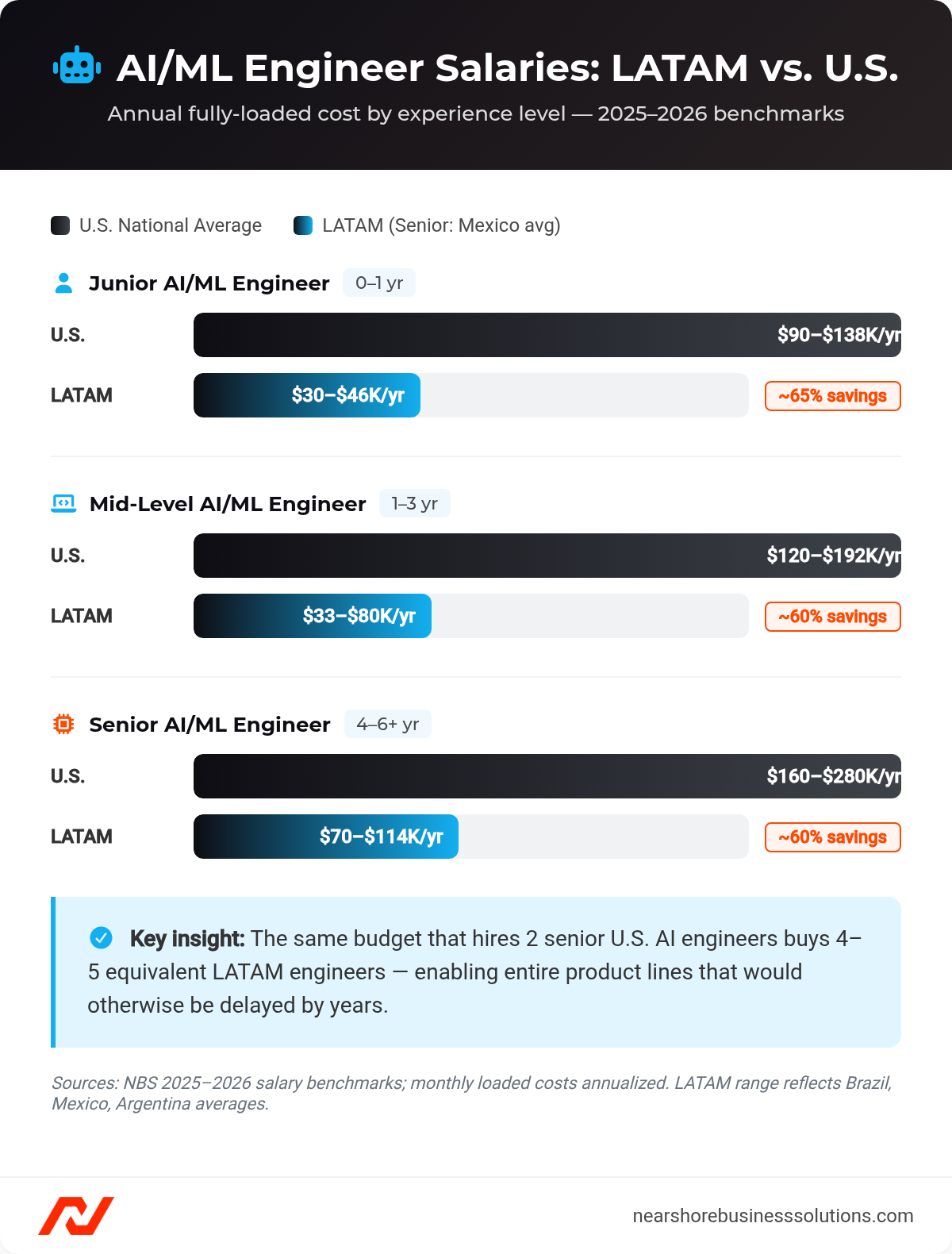
AI/ML engineer salary comparison by seniority level: U.S. versus LATAM fully-loaded annual costs.
What Employer Burden Should You Expect per Country?
| Country | Multiplier | Key Components |
|---|---|---|
| Brazil | 1.65-1.80x | 20% INSS, 8% FGTS, 13th month, 1/3 vacation bonus |
| Mexico | 1.36-1.44x | 20-28% Social Security, 5% Infonavit, 15-day Aguinaldo, 10% profit sharing |
| Colombia | 1.35-1.40x | 12% pension, 8.5% health, 9% parafiscal |
| Argentina | 1.40-1.50x | 24-27% Social Security, 13th month (two installments) |
| Peru | 1.25-1.35x | 9% EsSalud, 13th and 14th month salaries |
| Chile | 1.05-1.09x | 5-8.5% social security, unemployment insurance |
Chile is the most employer-friendly regulatory environment in the region. Brazil is the most complex: documentation-heavy labor law makes EOR nearly mandatory for U.S. companies entering the market.
Which Hiring Model Is Right for Your AI Team?
The right model depends on your timeline, team size, and compliance appetite. Most growth-stage firms start with EOR and migrate to dedicated teams as headcount scales.
How Do the Main Hiring Models Compare?
| Model | Best For | Speed | Cost | Compliance Risk |
|---|---|---|---|---|
| Freelance / Contractor | Short-term, defined scope | Fastest | $45-$80/hr senior | High: REPSE cert required in Mexico |
| Staff Augmentation | Skill gaps, project surge | 24-48 hrs (via platforms) | Mid-range | Managed by vendor |
| EOR | Stable long-term team, IP protection | 7-28 days | $450-$800/head/mo. fee | Fully managed |
| Owned Entity | 20-25+ headcount in one country | Slowest (months) | ~$9K/mo. loaded (senior) | Fully owned |
When Should You Use a Nearshore Agency vs. Hire Directly?
Platforms like Turing and Howdy deliver matched candidate profiles in 24-48 hours at a 3:1 interview-to-hire ratio. Time-to-hire drops from the U.S. benchmark of 3-6 months to 7-28 days. Engineering leaders have used these timelines to scale departments from zero to 100 engineers in under a year.
Direct hiring makes sense at Series B+ when you have internal recruiting infrastructure and are building a permanent team in a single country. Below that threshold, the compliance and operational overhead usually exceeds the savings on agency fees.
How Do You Hire AI and ML Engineers in Latin America?
Six steps cover the full process from requirements to retention. Skipping any step, especially step 3 and step 7, is the documented failure mode.
Step 1: How Do You Define Requirements Before Sourcing?
Define the stack, seniority, and collaboration model in writing before sourcing. Vague job descriptions attract unvetted candidates and extend hiring cycles. For AI/ML roles: name the frameworks, deployment environment (cloud or on-prem), and whether the role is research-adjacent or production-engineering-heavy.
Step 2: How Do You Choose the Right Hiring Channel?
Three channels dominate LATAM AI/ML hiring:
- Nearshore platforms (Turing, Howdy): fastest time-to-hire, pre-vetted, 24-48 hr profile delivery
- EOR providers (Deel, Remote, Rippling): full compliance management, $450-$800/head/mo.
- Direct LinkedIn/job boards: lowest cost, highest internal lift, 6-12 week cycles
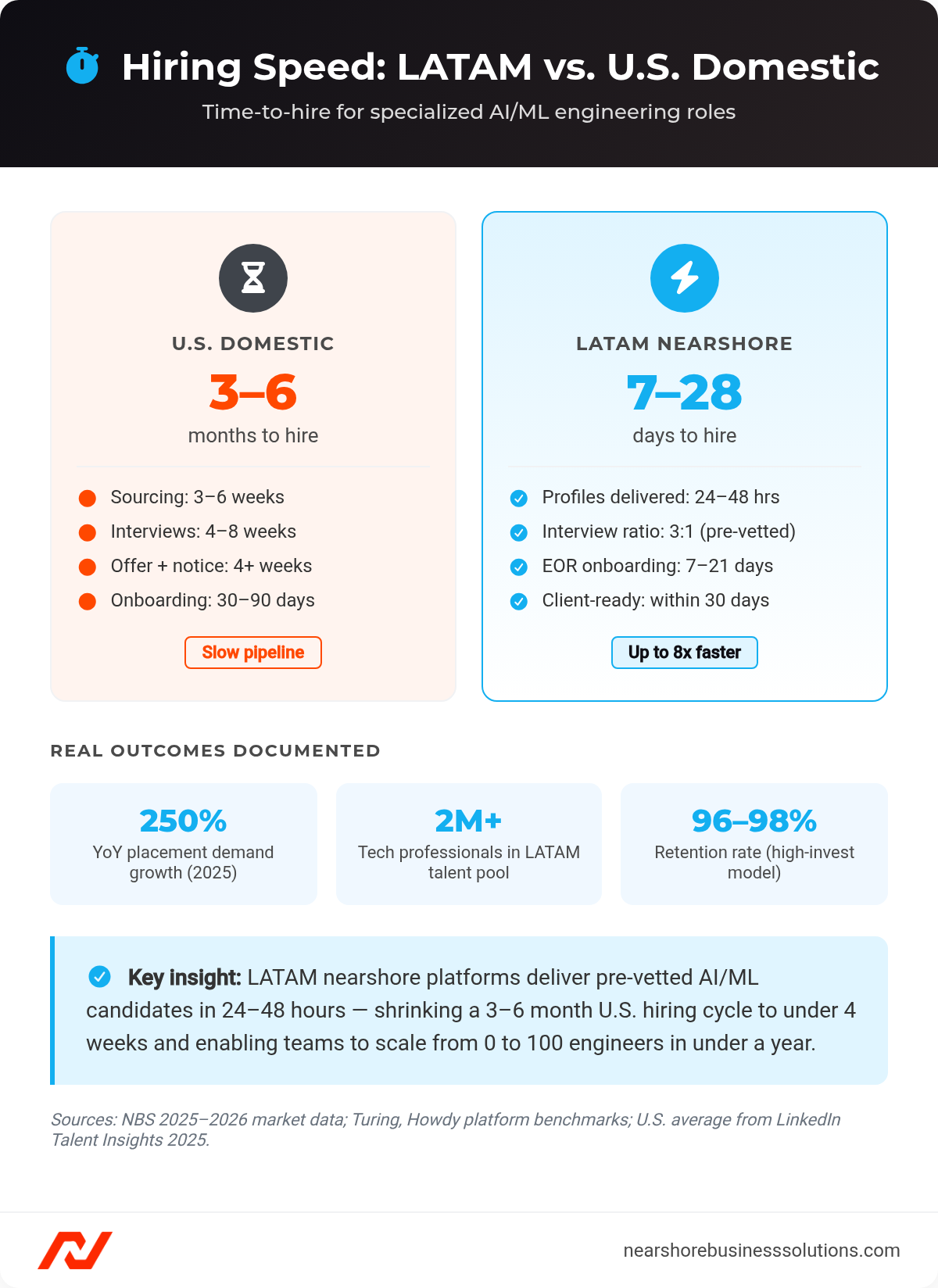
Time-to-hire comparison: U.S. domestic AI/ML recruiting versus LATAM nearshore platform pipelines.
Step 3: How Do You Source and Screen LATAM AI Candidates?
Brazilian and Argentinian engineers appear regularly in the global Kaggle top 100. Kaggle rankings are a high-signal filter for data science depth. USP, Unicamp, and Tecnológico de Monterrey are strong target alma maters. The DS4A program (11-week SoftBank-supported AI training) produces battle-tested candidates across Bogotá, Sao Paulo, and Buenos Aires.
Step 4: What Is the Right Technical Assessment for AI/ML Roles?
Use take-home assessments that mirror real work: data pipeline design, model evaluation, and system design for ML infrastructure. Avoid generic LeetCode-only screens. They filter out applied ML engineers who are production-focused. Follow with a live pair-programming session to evaluate communication under pressure.
Step 5: How Do You Evaluate Remote Collaboration Readiness?
Ask for evidence of async documentation habits, previous remote team experience, and English fluency in a live technical discussion. The goal is real-time collaboration: daily standups, emergency response, pair programming, during your core business hours. Engineers who already operate this way are low-onboarding-risk.
Step 6: How Do You Handle Contracts, IP, and Legal Compliance?
IP contracts must include: present and future assignment of inventions and work product, moral rights waivers where applicable, and strict confidentiality obligations.
- Argentina: Denominate salaries in USD, pay in local currency via EOR to hedge currency volatility
- Mexico: Verify REPSE certification for contractors to avoid hidden-employee misclassification
- All LATAM countries: Register patents and trademarks first-to-file with DNDA (Argentina) or IMPI (Mexico), even if Berne Convention auto-protection applies
Step 7: How Do You Onboard and Retain LATAM AI Engineers?
New hires can handle client interactions within 30 days and reach full productivity by 90 days, but only if onboarding is structured. High-retention teams (96-98%) invest in physical offices and local performance coaches. Average developer tenure without those investments: approximately 2.5 years in high-demand hubs. The documented failure mode: hiring too fast under timeline pressure and skipping technical validation. Teams built this way backfire within 2-3 months.
What Are the Legal and Compliance Requirements for LATAM AI Hiring?
Every LATAM country has distinct labor law. Non-compliance creates retroactive liability. Misclassified contractors can claim full employment benefits. EOR eliminates this risk entirely.
For country-specific compliance, see our guides to hiring in Mexico and hiring in Argentina.
What Are the Key Compliance Rules per Country?
Brazil: Most documentation-heavy in the region. Employer burden 1.65-1.80x. EOR is the practical standard for U.S. companies. Brazil’s LGPD data protection law applies to all personal data processed locally.
Mexico: REPSE certification required for independent contractors providing specialized services. Without it, the contractor relationship is presumed employment. Under USMCA, Mexican IP is protected to U.S. standards.
Argentina: Knowledge Economy Law provides a 70% reduction in employer payroll contributions for qualifying tech companies. Currency volatility requires USD-denominated salary agreements with local currency disbursement via EOR.
Colombia: “Orange Economy” and “ColombIA Inteligente 2025” programs create AI hiring incentives. Law 1581 (Colombia’s Habeas Data Law) governs personal data protection at GDPR-comparable standards.
Peru: 13th and 14th month salaries paid in July and December. Employer burden 1.25-1.35x.
Chile: Lowest employer burden (1.05-1.09x). Easiest compliance environment for entity setup or direct hiring.
How Does IP Protection Work Across LATAM?
LATAM follows the Berne Convention: copyright is automatic from creation. But registration with national offices (DNDA in Argentina, IMPI in Mexico) is recommended for enforcement. Under USMCA, Mexican IP protection meets U.S. standards. For all markets: formal registration and explicit contract language remain essential regardless of treaty coverage.
What Platforms Find AI and ML Engineers in Latin America?
| Platform Type | Examples | Time-to-Hire | Best For |
|---|---|---|---|
| Nearshore staffing | Turing, Howdy | 24-48 hrs (profile), 7-28 days (hire) | Fast team buildout, vetted talent |
| EOR providers | Deel, Remote, Rippling | 7-21 days | Compliance-first, long-term hires |
| Job boards | LinkedIn, GetOnBrd, Workana | 6-12 weeks | Direct hire, cost-sensitive |
| Community sourcing | GitHub, Kaggle, Laboratorio | Variable | Specialized roles, diversity hiring |
Laboratorio, a LATAM social enterprise, has placed 3,500+ women in tech roles across 1,100+ companies. A strong pipeline for AI and HealthTech specializations. GitHub’s Innovation Graph identifies Brazil, Mexico, and Argentina as top hubs for open-source AI activity.
What Challenges Should You Expect When Hiring LATAM AI Engineers?
Three structural challenges apply to LATAM AI hiring. None are blockers, but ignoring them creates preventable failures.
How Do You Handle Senior AI Talent Scarcity?
AI/ML supply is growing at 25-30% year-over-year, but senior demand still outpaces it, especially in reinforcement learning, computer vision at scale, and LLM infrastructure. Expand searches to Argentina (strong senior density) and Chile (growing AI research output at Pontificia Universidad Católica and University of Chile). Consider upskilling mid-level engineers already on your team.
How Do You Manage Time Zone Edge Cases for PT Teams?
Sao Paulo and Buenos Aires offer only 3-4 hours of overlap with U.S. Pacific Time. If your core team is PT-based, build deliberate async rituals: structured documentation, recorded standups, and written decision logs. For PT teams, Mexico City (6-7 hr PT overlap) or Bogotá (5-6 hr PT overlap) are the lower-friction options.
How Do You Manage Retention and Currency Risk in LATAM?
Average tenure in high-demand hubs is approximately 2.5 years without retention investment. Argentina’s chronic inflation accelerates attrition when salaries are not proactively adjusted. Mitigate with USD-denominated contracts, clear growth paths, and local office access if budget allows. High-retention models achieve 96-98% retention with physical offices and local performance coaches.
How Does LATAM Compare to Eastern Europe and Southeast Asia for AI Hiring?
LATAM’s primary structural advantage over every other nearshore region is time zone alignment. That single factor changes how teams operate.
How Does LATAM Compare to Eastern Europe for AI Talent?
| Factor | LATAM | Eastern Europe |
|---|---|---|
| Time zone overlap with US ET | 6-8 hours | 1-4 hours |
| Real-time collaboration | Standard workday | Early morning/late evening shifts |
| Response time improvement | Baseline | 40-50% slower (EMEA avg) |
| AI talent depth | High (growing) | High (mature) |
| Cost | Comparable | Comparable |
Eastern Europe has a mature AI talent base, but the time zone gap forces asynchronous handoffs. LATAM enables the same delivery model as a domestic team.
How Does LATAM Infrastructure Compare to Southeast Asia?
LATAM urban connectivity is on par with major U.S. cities:
- Chile ranks #1 in South America for 5G adoption
- Colombia has LATAM’s 3rd-largest fiber-optic network
- Brazil hosts IX.br, one of the world’s largest internet exchange points by traffic volume
- 70% of Mexico’s nearshoring hubs are in Guadalajara and Monterrey smart city infrastructure
South and Southeast Asia requires overnight handoffs, a structurally different delivery model. LATAM allows real-time problem-solving during standard U.S. business hours.
What Do Real Case Studies Show About LATAM AI ROI?
A Series B FinTech processing $2B+ in annual transactions deployed 2 LATAM engineers and 1 DevOps specialist. Result: 40x reduction in Cold Start Time, 67% drop in monthly infrastructure costs, delivered in 4 weeks against a 4-6 month traditional estimate. A separate SaaS company scaled its customer success team from 3 to 17 managers in 11 months, achieving 40-60% TCOE reduction and $450K-$825K in annual savings.
Frequently Asked Questions About Hiring AI Engineers in Latin America
These are the most common questions U.S. engineering leaders ask about LATAM AI/ML hiring.
How Long Does It Take to Hire an AI Engineer in Latin America?
It takes 7-28 days for vetted candidates through nearshore platforms like Turing and Howdy. Platforms deliver matched profiles in 24-48 hours with a 3:1 interview-to-hire ratio. Direct LinkedIn sourcing takes 6-12 weeks.
What If the AI Engineer Doesn’t Work Out?
Most nearshore platforms include a replacement guarantee. Nearshore Business Solutions offers a 90-day replacement guarantee on every placement. Structure your onboarding so that new hires reach client interaction readiness by day 30 and full productivity by day 90.
Do I Need to Set Up a Local Entity to Hire in LATAM?
No, not for fewer than 20-25 people in a single country. EOR providers like Deel, Remote, or Rippling handle all local compliance, payroll, and benefits for $450-$800 per head per month. Entity setup only makes sense at scale because monthly loaded costs for a single senior engineer can reach $9,000.
How Do I Pay LATAM AI Engineers?
Pay through an EOR provider in local currency, but denominate salaries in USD for Argentina and other volatile-currency markets. EOR handles all currency conversion, payroll processing, and statutory benefits. Contractor arrangements are possible but carry misclassification risk, especially in Mexico without REPSE certification.
What Is the Difference Between Nearshore and Offshore AI Hiring?
Nearshore means same-timezone or minimal-timezone-gap hiring, typically LATAM for U.S. companies. Offshore means significant timezone gaps (India, Southeast Asia, Eastern Europe), which forces asynchronous handoffs. LATAM nearshoring delivers the same real-time collaboration model as domestic hiring at 60-70% lower cost.
Do LATAM AI Engineers Own the Code They Write?
Not if your contracts are structured correctly. IP contracts must include present and future assignment of inventions, moral rights waivers, and strict confidentiality obligations. Under Berne Convention, copyright is automatic from creation, but registration with national offices (DNDA in Argentina, IMPI in Mexico) is recommended for enforcement.
What Stack Do LATAM AI Engineers Typically Know?
Most senior LATAM AI engineers work with PyTorch or TensorFlow, MLflow or Vertex AI for MLOps, and AWS, GCP, or Azure for cloud deployment. Production LLM experience (fine-tuning, RAG pipelines) is increasingly common in the 2025-2026 cohort, particularly from graduates of USP, Unicamp, and ITESM.
Is Latin America the Right Place to Build Your AI Engineering Team?
For growth-stage companies ($5M-$100M ARR), yes. The talent is there, the time zones work, and the infrastructure is mature.
| Factor | LATAM Position |
|---|---|
| Cost savings vs. U.S. | 60-70% on equivalent salaries |
| Time-to-hire (via platform) | 7-28 days vs. 3-6 months U.S. |
| Time zone overlap | 6-8 hrs with US ET/CT; 5-7 hrs with PT |
| Compliance entry point | EOR at $450-$800/head/mo. |
| Total cost of employment reduction | 40-60% TCOE reduction documented |
| AI/ML talent growth rate | 25-30% year-over-year in specialization |
First steps: define your stack and seniority requirements before sourcing. Choose EOR as your compliance vehicle for first hires. Engage a nearshore platform for pre-vetted profiles within 24-48 hours. Prioritize Mexico City, Buenos Aires, or Bogotá for ET/CT teams. Budget for onboarding: 30 days to client-ready, 90 days to full productivity.
Companies treating LATAM as a core engineering strategy, not a peripheral outsourcing option, are building faster, spending less, and retaining better.
Ready to Build Your LATAM AI Engineering Team?
Nearshore Business Solutions sources and vets AI and ML engineers from Buenos Aires, Bogotá, Mexico City, Guadalajara, and Sao Paulo. We screen for technical skills, English fluency, and U.S. work style fit. Our acceptance rate is 16%.
Every placement includes a 90-day replacement guarantee. You receive pre-vetted candidates in 2-4 weeks.
Get a free consultation to discuss your hiring needs and receive a custom quote.