
Nearshore FinTech development cuts costs 50-65% while delivering real-time collaboration that offshore models cannot match.
LATAM developers cost $57,500-$72,000 annually for senior engineers, versus $138,500-$229,900 in the US. The region holds 2.2 million professional developers in synchronized time zones. Argentina and Uruguay hold EU Adequacy Status. Brazil’s LGPD and Colombia’s Law 1581 meet GDPR-equivalent standards.
We connect FinTech teams with vetted engineers from Guadalajara, Buenos Aires, São Paulo, Bogotá, and Medellín. Each developer is screened for technical skills, English fluency, and US work style fit. Below, you’ll find salary benchmarks, compliance frameworks, market comparisons, and a step-by-step hiring process.
What Is Nearshore Development for FinTech and Why Does It Matter?
Nearshore FinTech development gives US companies access to 2.2 million LATAM developers at 50-65% lower cost, with 0-2 hour timezone overlap. The Inter-American Development Bank estimates nearshoring will boost Latin American exports by $78 billion, with Mexico capturing $35 billion alone. Traditional onshore hiring takes 3-6 months per senior engineer at $160,000 total annual cost. LATAM nearshore cuts this to 2-4 weeks at $65,000, a 60% reduction.
What Makes Nearshore Development Different from Offshore and Onshore Models?
Nearshore provides 6-8 hours of overlap with US business hours, eliminating the 24-hour question cycle. Companies using nearshore teams report 30-40% productivity gains versus offshore models. Your LATAM engineers join real-time standups, sprint reviews, and live pair programming sessions.
Offshore models (Asia, Eastern Europe) force asynchronous workflows with 7-12 hour gaps. Onshore provides real-time collaboration at 2-3x the cost. Nearshore delivers both: instant feedback loops at offshore-level pricing.
Why Is Nearshore Development Particularly Suited for FinTech Companies?
LATAM’s regulatory environment aligns with GDPR, PCI-DSS, and SOC 2 Type II. Argentina and Uruguay hold EU Adequacy Status, the European Commission’s highest data protection recognition. Brazil’s LGPD mirrors GDPR with enforcement authority to levy fines up to 2% of local revenue.
The region’s real-time payment infrastructure processed 63 billion transactions in Brazil alone during 2024 through Pix. SPEI in Mexico reaches 71% of adults. Your nearshore team builds on infrastructure that outpaces many US payment systems.
What Are the Key Benefits of Nearshore FinTech Development in Latin America?
LATAM nearshore combines cost savings, speed, and compliance in one package. The table below shows how key metrics compare across hiring models:
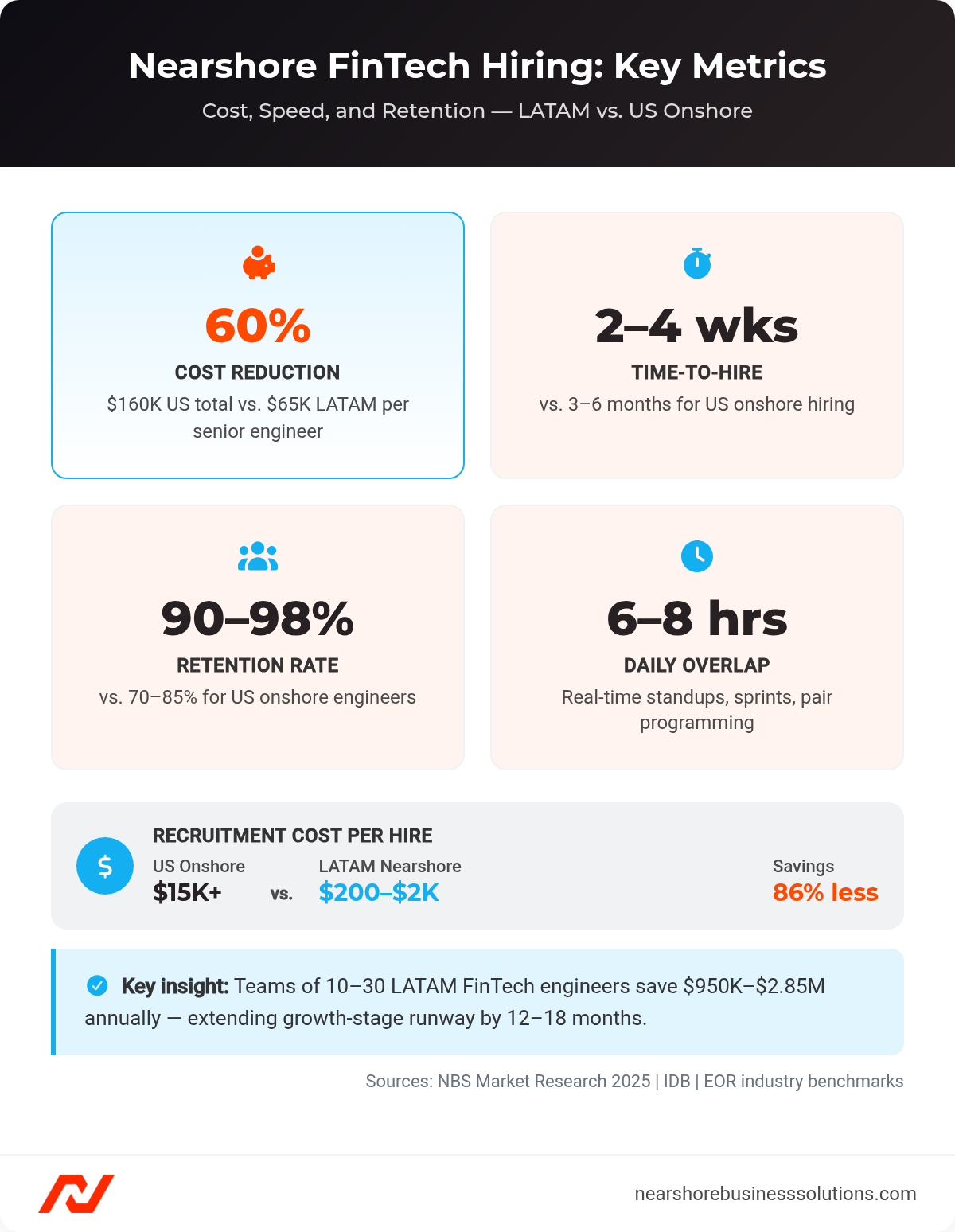
Key hiring metrics for LATAM nearshore FinTech teams compared to US onshore: cost, speed, retention, and timezone overlap.
| Metric | Onshore | Nearshore | Impact |
|---|---|---|---|
| Time-to-Hire (Senior Dev) | 3-6 Months | 2-4 Weeks | Faster roadmaps |
| Developer Retention | 70-85% | 90-98% | Preserves knowledge |
| Time-to-Market | Baseline | 45% faster | Accelerated revenue |
| Cost Reduction | Baseline | 50-65% | Extended runway |
| Feedback Latency | Instant | 0-2h overlap | Eliminates async cycle |
What Security Requirements Must Nearshore FinTech Development Teams Meet?
ISO 27001 certifications nearly doubled in 2024, reaching 96,709 valid certificates globally. LATAM service providers led regional adoption, making systematic information security management the baseline standard. Top firms maintain ISO 27001, SOC 2 Type II, and PCI-DSS as a starting point, not an add-on.
What Are the Essential Security Standards for FinTech Software Development?
Five certifications define the security baseline for FinTech nearshore partnerships. Verify each before signing a contract:
| Standard | Focus Area | LATAM Adoption | US Relevance |
|---|---|---|---|
| ISO/IEC 27001 | Information Security Management | High, doubled in 2024 | Baseline for trust |
| SOC 2 Type II | Trust Service Criteria | High (top-tier firms) | Vendor risk management |
| PCI-DSS | Payment Card Security | Mandatory | Transactional integrity |
| ISAE 3402/SOC 1 | Financial Reporting Controls | High in BPO centers | Audit trail compliance |
| ISO/IEC 27701 | Privacy Management | Emerging (2025) | Privacy law alignment |
SOC 2 Type II verifies controls over security, availability, processing integrity, confidentiality, and privacy. This is the documentation your compliance team needs from any nearshore vendor.
How Do LATAM Nearshore Teams Handle Data Protection and Encryption?
Zero Trust IAM and MFA are foundational controls for all LATAM FinTech teams. LATAM teams also deploy AI-driven threat detection for real-time anomaly monitoring. Data residency compliance requires local availability zones: AWS and Azure maintain dedicated Brazilian and Mexican regions for financial data that cannot cross borders.
How Is Secure Code Development Practiced in LATAM Nearshore Teams?
Secure Development Lifecycle (SDLC) integration begins at architecture design, not after launch. Leading LATAM teams embed privacy controls into their Information Security Management System from initial sprint planning. Privacy Impact Assessments run proactively for every feature touching sensitive financial data, before release, not on request.
What Compliance Challenges Exist in Nearshore FinTech Development?
LATAM compliance frameworks have matured rapidly since 2018. Four major compliance areas require attention: financial regulations, data privacy laws, PCI-DSS, and KYC/AML implementation. Each differs by country, but GDPR-equivalent frameworks reduce overall legal friction compared to other offshore regions.
What Financial Regulations Must Nearshore Development Teams Understand?
Mexico’s progressive Fintech Law provides explicit frameworks for institutional integration. The 2025 modernization introduced immediate breach notification requirements with criminal sanctions for non-compliance. Colombia offers 30% R&D tax credits through the Superintendencia de Industria y Comercio (SIC), the highest in the region. This tax credit structure makes Colombia particularly cost-effective for FinTech R&D work.
How Do LATAM Countries Handle GDPR and International Data Privacy Laws?
Latin America went through a GDPR-inspired legislative pivot starting in 2018. Most LATAM frameworks now recognize Standard Contractual Clauses (SCCs) and Binding Corporate Rules (BCRs) for cross-border transfers. The table below shows the current state by country:
| Country | Principal Law | GDPR Alignment | Enforcement |
|---|---|---|---|
| Argentina | PDPA (Law 25.326) | EU Adequacy | DNPDP, Moderate |
| Brazil | LGPD (Law 13.709) | GDPR Equivalent | ANPD, Strong |
| Colombia | Law 1581 of 2012 | High, Requires DPO | SIC, Proactive |
| Mexico | Federal Law | Moderate (2025) | INAI, Moderate |
| Chile | PDPL (2024) | High | New DPA |
| Uruguay | Law 18.331 | EU Adequacy | URCDP, Strong |
Brazil’s ANPD wields enforcement power matching EU regulators. Fines reach 2% of local revenue or 50 million BRL per violation.
What Are the PCI-DSS Compliance Requirements for FinTech Development?
PCI-DSS compliance is mandatory for any entity handling payment card data. No exceptions exist for nearshore arrangements. LATAM FinTech hubs maintain high PCI-DSS adoption rates. Verify your partner’s current certification and annual audit schedule before engagement.
How Does KYC and AML Implementation Work with Nearshore Teams?
Brazil’s 2025 biometric data reforms prohibit commercial monetization and require explicit consent for fingerprints, facial recognition, and iris scans. If your FinTech uses biometric authentication for digital onboarding, your nearshore team must architect consent management into the user flow from sprint one. Mexico’s modernized framework introduces similar restrictions requiring jurisdiction-specific consent logic.
Which Latin American Markets Lead in FinTech Development Expertise?
Four markets dominate LATAM FinTech development: Mexico, Argentina, Brazil, and Colombia. Each offers distinct advantages in cost, talent depth, timezone alignment, and regulatory environment. Chile, Uruguay, and Costa Rica round out the secondary tier for specialized roles.
What Makes Mexico a Top Nearshore Destination for FinTech Development?
Mexico offers 245,000-800,000 tech professionals with 110,000 annual STEM graduates from Tecnologico de Monterrey (ITESM), UNAM, and IPN. Mexico City runs one hour behind EST, providing full overlap for Eastern, Central, and Pacific teams. Guadalajara, known as Mexico’s Silicon Valley, hosts Intel, IBM, Oracle, and HP in the Guadalajara Creative Digital City district. Senior developer rates: AI/ML $61K, Cloud $68.5K, DevOps $72K, Full-Stack $62.5K annually.
Why Is Argentina a Strong FinTech Development Hub in LATAM?
Argentina leads LATAM in English proficiency at 575 EF EPI score and delivers up to 65% total cost savings. The country specializes in AI/ML, TensorFlow, Python, and NLP. Universidad de Buenos Aires (UBA), Instituto Tecnologico de Buenos Aires (ITBA), and Universidad Austral anchor the technical talent pipeline. Companies like Mercado Libre, Globant, and Auth0 (acquired by Okta for $6.5B) originated here. Argentina’s Knowledge Economy Law reduces employer payroll contributions by 70% for qualifying tech companies. EU Adequacy Status enables seamless European data flows. USD-based contracts are essential due to currency volatility. Senior developer rates: AI/ML $57.5K (lowest in region), Cloud $68.5K, DevOps $63.5K annually.
How Does Brazil’s FinTech Ecosystem Support Nearshore Development?
Brazil hosts 550,000-750,000 tech professionals with 100,000 annual STEM graduates. Sao Paulo contains 81+ FinTech and AI firms. Pix has 165 million users and processed 63 billion transactions in 2024. ITU GCI score: 96.5, the highest in the region. LGPD establishes GDPR-equivalent standards with strong ANPD enforcement. Nubank and C6 Bank validate institutional-grade platform development. Senior developer rates: AI/ML $59.5K, Cloud $66K, DevOps $68K annually.
What FinTech Development Capabilities Does Colombia Offer?
Colombia’s tech workforce is expanding from 150,000 to 260,000+ by 2026, fueled by a government initiative training 112,000 developers by 2025. Bogota and Medellin run on EST, providing zero-hour difference for Eastern US teams. Medellin’s Ruta N technology district has attracted HP, Hewlett Packard Enterprise, and dozens of startups. Universities including Universidad de los Andes (ranked #1 in Colombia) and EAFIT in Medellin produce internationally recognized engineering graduates. Colombia earned the designation “JavaScript wizards” for mobile development expertise. Colombia offers 30% R&D tax credits through the SIC, the highest in the region. ProColombia supports foreign companies establishing operations. Senior developer rates: Cloud $54K (lowest in region), DevOps $70K, Full-Stack $62K annually.
Which Other LATAM Markets Are Growing in FinTech Development Expertise?
Three secondary markets offer specialized depth for specific FinTech needs:
Chile (61K-100K professionals): Ranked #1 in Latin America for digital skills and AI adoption. Specializes in Java, Node.js, and data analytics. Chile’s 2024 PDPL provides high GDPR alignment. Santiago is the primary tech hub. One consideration: high ransomware targeting requires robust endpoint security.
Uruguay (24K-33K professionals): Elite specialization in Go, Rust, AI, and QA. EU Adequacy Status. English proficiency #2 in the region at 542 EF EPI score. Montevideo’s small pool limits scalability but offers exceptional technical depth for specialized roles.
Costa Rica (50K professionals): Strong US corporate presence and high BPO experience. Focuses on .NET, Java, Angular, and React. English proficiency #3 in the region at 534 EF EPI score. San Jose is the primary hub.
How Much Does Nearshore FinTech Development Cost in Latin America?
Senior LATAM FinTech developers cost $57,500-$72,000 annually versus $138,500-$229,900 in the US, a 54-65% total employment cost reduction. The full cost picture includes taxes, benefits, and recruitment:
| Cost Component | US Engineer | LATAM Engineer | Difference |
|---|---|---|---|
| Gross Salary | $132,720 | $57,200 | -57% |
| Taxes and Benefits | $27,280 | $7,800 | -71% |
| Total Annual Cost | $160,000 | $65,000 | -60% |
| Recruitment | $15,000+ | $200-$2,000 | -86% |
Employer of Record (EOR) services charge $299-$650 monthly per employee for teams under 15. Direct hiring via local entity becomes cost-effective once teams exceed 15 members. Hiring 10-30 senior engineers saves $950K-$2.85M annually, extending runway 12-18 months.
What Are the Average Rates for FinTech Developers in Top LATAM Markets?
Senior developer salaries vary by role and country. The table below shows annual USD rates for 2025:
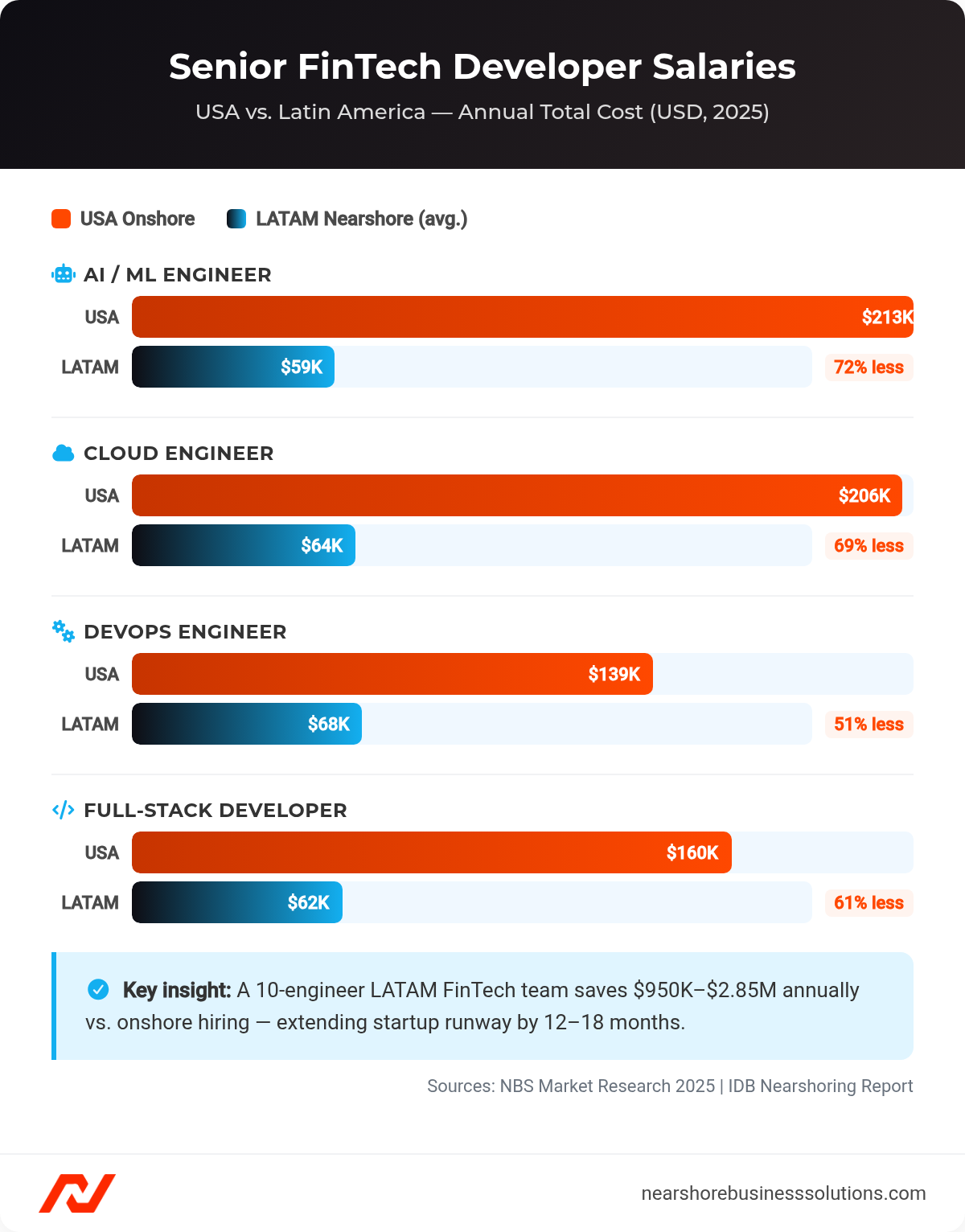
Senior FinTech developer annual salaries across four roles: USA onshore vs. LATAM nearshore (2025).
| Position | USA | Mexico | Brazil | Argentina | Colombia |
|---|---|---|---|---|---|
| AI/ML Engineer | $212,740 | $61,000 | $59,500 | $57,500 | $60,000 |
| Cloud Engineer | $205,720 | $68,500 | $66,000 | $68,500 | $54,000 |
| DevOps Engineer | $138,500 | $72,000 | $68,000 | $63,500 | $70,000 |
| Full-Stack | $160,000 | $62,500 | $60,000 | $62,000 | $62,000 |
| Mobile Developer | $229,900 | $62,500 | $62,000 | $62,000 | $62,000 |
| QA Automation | $160,480 | $58,000 | $56,000 | $55,500 | $54,000 |
What Is the Step-by-Step Process to Build a Nearshore FinTech Development Team?
Building a LATAM FinTech team takes 5-9 weeks from requirements definition to onboarding. Start with compliance requirements before any vendor conversations.
How Do You Define Your FinTech Product Requirements and Compliance Needs?
Start by documenting required certifications (SOC 2 Type II, PCI-DSS, ISO 27001) before any vendor conversations. Identify data residency requirements: Brazil and Mexico mandate local storage for certain financial data. Map your technology stack to LATAM specializations:
- JavaScript and mobile products: Colombia
- AI/ML and NLP: Argentina
- Data science and core banking: Brazil
- Large-scale teams and SPEI integration: Mexico
How Do You Identify the Right LATAM Market Based on Expertise and Regulations?
Match market selection to team size and product type. For scalability (30+ engineers), choose Brazil (750K+ pool) or Mexico (800K pool). For AI/ML depth, Argentina offers elite talent with 65% savings. For timezone fit, Mexico gives -1 hour for Pacific teams and Colombia gives 0-hour for Eastern teams. For mobile-first FinTech, Colombia’s JavaScript expertise makes it the strongest choice. For help hiring software developers in Latin America, see our LATAM overview guide.
How Do You Vet Nearshore Partners for Security and Compliance Capabilities?
Require evidence of current certifications dated within 12 months. Verify ISO 27001 validity through official registries. Review incident response procedures and breach notification protocols meeting Mexico’s immediate notification standard. Ask for documented PCI-DSS audit history and SOC 2 Type II reports from the past 12 months. Vendor evaluation requires 3-4 weeks for thorough due diligence.
How Do You Establish Security Protocols and Compliance Frameworks?
Contracts must specify US law governance with explicit IP ownership clauses. Work-for-hire provisions must explicitly transfer all intellectual property rights. Implement Zero Trust IAM and MFA from day one across distributed teams. Configure local availability zones (AWS or Azure in Brazil and Mexico) for data residency compliance. For Argentina teams specifically, USD-based contracts prevent retention risk from currency volatility.
How Do You Onboard and Integrate Your Nearshore FinTech Development Team?
Time-to-hire runs 2-4 weeks once requirements are specified. Provide architecture documentation, API contracts, and security requirements on day one. Schedule daily standups during the 6-8 hour overlap window. Use the first sprint for knowledge transfer and access provisioning. Retention rates reach 90-98% when teams understand product context from the start.
What FinTech Technologies and Specializations Are Available in LATAM Nearshore Teams?
LATAM nearshore teams cover the full FinTech stack: payment processing, core banking, blockchain, mobile wallets, and API integration. Digital wallets and A2A transfers represent 46% of total e-commerce turnover in the region. LATAM developers build on payment rails that outpace many US systems. For hiring in Colombia for mobile and JavaScript development, see our country-specific guide.
What Payment Processing and Gateway Development Expertise Exists in LATAM?
LATAM leads global payment innovation, with four major real-time rail systems in production:
- Pix (Brazil): 165M users, 63B transactions annually, 24/7 settlement
- SPEI (Mexico): 71% adult usage, digital payout backbone
- Transferencias 3.0 (Argentina): 62.6M transactions, QR interoperability
- Bre-B (Colombia): Launched October 2025, universal interoperability
Unified API solutions like Bitso and Cobre handle Pix, SPEI, and PSE with embedded FX from a single integration. Integration cycles drop from 6-9 months to 3-4 weeks. Real-time reconciliation reduces manual treasury work by 20 hours weekly.
How Do LATAM Developers Handle Blockchain and Cryptocurrency Development?
Argentina leads regional blockchain development, driven by cryptocurrency adoption during economic instability. Argentine developers built production-grade crypto wallets and exchange platforms under real market pressure. Brazil integrates blockchain with traditional banking rails, giving Brazilian developers unique experience combining DeFi concepts with regulated financial infrastructure.
What Banking and Lending Platform Development Capabilities Are Available?
A Latin American FinTech partnered with FICO for 100% digital lending achieved a 40% cost reduction per credit assessment and complete digital onboarding. Brazil’s Nubank and C6 Bank built institutional-grade digital banking infrastructure serving millions of customers. LATAM nearshore teams bring direct experience building regulated financial products from greenfield, not just augmenting legacy systems.
What Mobile FinTech and Digital Wallet Development Skills Do LATAM Teams Offer?
Colombia specializes in React Native and cross-platform mobile development. Mobile developer rates run $62K annually in LATAM versus $229,900 in the US, a 73% savings. This makes mobile-first architectures viable for growth-stage FinTechs. For hiring in Argentina for AI/ML and blockchain roles, see our Argentina hiring guide.
How Do Time Zones and Communication Benefit Nearshore FinTech Development?
LATAM’s 0-2 hour time gap delivers 30-40% productivity gains over offshore models by enabling real-time collaboration. The 6-8 hour overlap eliminates asynchronous workflow drag across all major US time zones. Real-time standups, sprint reviews, and live pair programming operate identically to co-located teams.
What Are the Time Zone Advantages for US FinTech Companies?
Every major LATAM tech hub operates within 2 hours of US Eastern time:
| LATAM Tech Hub | Time vs EST | Optimal For |
|---|---|---|
| Mexico City | -1 Hour | Pacific, Mountain, Central |
| Bogota and Medellin | 0 Hours | Eastern, Central |
| Buenos Aires and Sao Paulo | +2 Hours | Eastern, European overlap |
| San Jose (Costa Rica) | -1 Hour | Central, Mountain |
Time-to-market improves 45% with nearshore teams versus offshore. Sprint velocity increases 30-40% when product managers, designers, and engineers operate synchronously.
How Does English Proficiency Impact FinTech Development in LATAM Markets?
National English proficiency scores underrepresent tech talent fluency. Mexico’s score of 440 and Brazil’s 482 reflect general populations, not engineering communities. Software engineering training, documentation, codebases, Stack Overflow, and certifications are English-native. Argentina leads at 575 EF EPI, followed by Uruguay at 542 and Costa Rica at 534. Brazil and Mexico provide high tech-specific English proficiency because engineering education is conducted in English.
What Legal and Contractual Considerations Apply to Nearshore FinTech Development?
Three legal areas require explicit documentation before nearshore FinTech work begins: IP ownership, data residency, and contract currency. Skipping any creates costly problems during scaling.
What Intellectual Property Protections Exist for FinTech Software in LATAM?
Contracts governed by US law with explicit IP ownership clauses protect proprietary algorithms. Work-for-hire provisions must explicitly transfer all IP rights. Define security certification requirements (SOC 2 Type II, ISO 27001) with annual renewal obligations in the contract.
What Are the Data Residency and Cross-Border Transfer Regulations?
Brazil and Mexico mandate local storage for certain financial data. Configure AWS or Azure local availability zones to meet these requirements. Standard Contractual Clauses (SCCs) and Binding Corporate Rules (BCRs) are recognized across LATAM. Argentina and Uruguay’s EU Adequacy Status simplifies European data flows without additional legal instruments.
How Do You Manage Risk Across Distributed Nearshore FinTech Teams?
Five risk areas require documented mitigation before work begins:
| Risk | Impact | Mitigation |
|---|---|---|
| IP Protection | Loss of algorithms | US law contracts, explicit IP ownership |
| Data Residency | Non-compliance | Local AWS or Azure zones |
| Security Breach | Financial fraud | Zero Trust IAM, MFA |
| Talent Turnover | Lost knowledge | USD contracts, retention coaching |
| Infrastructure | Downtime | Multi-region replication |
Run Privacy Impact Assessments for every feature touching financial data. Document incident response procedures meeting Mexico’s immediate notification requirement and test quarterly.
How Do You Ensure Quality and Performance in Nearshore FinTech Development?
LATAM teams implement Jenkins and GitLab for CI/CD, Terraform for infrastructure-as-code, and Kubernetes for orchestration. DevOps engineer rates run $63.5K-$72K annually in LATAM versus $138.5K in the US, enabling full CI/CD pipelines at 50% cost reduction. Developer retention at 90-98% preserves institutional knowledge across sprints.
What Are Common Challenges in Nearshore FinTech Development and How Do You Solve Them?
Three challenges arise consistently: regulatory differences, distributed security, and talent retention. Each has a clear solution.
How Do You Address Regulatory Differences Between US and LATAM Markets?
GDPR-equivalent frameworks in LATAM reduce legal friction compared to most offshore regions. Argentina and Uruguay’s EU Adequacy Status provides the highest external validation available. Mexico’s 2025 Federal Law and Brazil’s biometric reforms often exceed US state requirements, which means LATAM compliance maturity is a competitive advantage.
How Do You Maintain Security Standards Across Distributed Teams?
Uruguay and Chile show high cybercrime scores because of high internet penetration, not weak security. Deploy identical security controls across all distributed teams: same MFA, VPN, endpoint protection, and access logging. Consistency eliminates the gaps that emerge from treating remote teams differently.
What Strategies Help Retain Top FinTech Talent in Competitive LATAM Markets?
USD-based contracts and retention coaching address currency volatility in Argentina. Active retention requires three elements: clear career paths, technical challenges matching skill level, and USD-indexed compensation. These cost far less than replacement at $150K+ per senior engineer. Nearshore retention rates of 90-98% outperform onshore rates of 70-85% when these conditions are in place.
Frequently Asked Questions About Nearshore FinTech Development
These are the most common questions US FinTech leaders ask about building engineering teams in Latin America.
How Long Does It Take to Hire a Nearshore FinTech Developer?
It takes 2-4 weeks from requirements specification to start date for nearshore FinTech roles. Vendor evaluation requires an additional 3-4 weeks for thorough due diligence. Plan for 5-9 weeks total from kickoff to a fully onboarded engineer.
What Happens If a Nearshore Developer Does Not Work Out?
Most reputable nearshore partners offer a 90-day replacement guarantee at no additional cost. Nearshore Business Solutions includes this on every placement. Retention rates of 90-98% make replacements rare, but the guarantee eliminates financial risk for the first 90 days.
Do I Need a Local Entity to Hire in Latin America?
You do not need a local entity for teams under 15 engineers. Employer of Record (EOR) services handle legal employment, payroll, and compliance for $299-$650 per employee monthly. A local entity becomes cost-effective above 15 members when the overhead of legal setup is offset by savings on EOR fees.
How Do I Pay LATAM Developers in Compliance with Local Laws?
EOR services handle payroll compliance automatically across all LATAM jurisdictions. For direct hiring above 15 team members, a local entity with in-country payroll processing is standard. All Argentina contracts must be USD-denominated to protect against currency volatility and retain top talent.
What Is the Difference Between Nearshore and Offshore Development for FinTech?
Nearshore provides 0-2 hour timezone overlap, versus 7-12 hour gaps for offshore. For FinTech, nearshore’s compliance maturity (GDPR-equivalent laws, EU Adequacy Status in Argentina and Uruguay) closes the regulatory gap that offshore models historically could not address. Productivity gains of 30-40% over offshore come from synchronous collaboration.
What Security Certifications Should I Require from a Nearshore FinTech Partner?
Require ISO 27001, SOC 2 Type II, and PCI-DSS as a baseline. Verify all certificates are dated within 12 months through official registries. Ask for incident response procedures meeting Mexico’s immediate notification standard. Any partner unable to provide current certifications should not handle payment or identity data.
Do I Need Separate Infrastructure for Data Residency Compliance?
You do not need separate infrastructure. AWS and Azure maintain dedicated availability zones in Brazil and Mexico for financial data residency. Configure your existing cloud provider for the appropriate regional zones. Argentina and Uruguay’s EU Adequacy Status means no additional data transfer instruments are needed for European flows.
Ready to Build Your LATAM FinTech Engineering Team?
Nearshore Business Solutions sources and vets FinTech developers from Buenos Aires, Bogota, Medellin, Mexico City, Guadalajara, and Sao Paulo. We screen for technical skills, English fluency, and US work style fit. Our acceptance rate is 16%.
Every placement includes a 90-day replacement guarantee. You receive pre-vetted candidates in 2-4 weeks.
Get a free consultation to discuss your hiring needs and receive a custom quote.