
EOR services in Mexico let US tech companies hire engineers in 7 to 15 business days, with all-in costs 50 to 70% below US rates and zero entity setup.
An employer of record (EOR) in Mexico holds the legal employment contract, runs payroll, and files real-time CFDI tax documents with SAT. Costs add 35 to 50% over gross salary for mandatory benefits. A senior full-stack developer runs about $93,000 to $101,000 all-in, versus $180,000 to $225,000 in the US.
This guide covers salary benchmarks by role, the legal structure behind REPSE-registered EORs, a line-item cost breakdown, the onboarding timeline to first payroll, and the provider fees you should expect. We pull figures from Deel’s Global Hiring Report, Terminal.io’s salary data, and Mexico’s Federal Labor Law.
Why Is Mexico the Top Nearshore EOR Market in 2026?
Mexico ranks as the 4th most popular country globally for US companies hiring internationally, per Deel’s Global Hiring Report, which recorded 161% growth in Latin American hiring during the first half of 2023. Time-zone alignment, a deep developer pool, and USMCA-backed IP protections drive that demand. The catch is compliance: the 35 to 50% mandatory employer burden, real-time CFDI tax reporting, and the 2021 outsourcing reform make compliant hiring more complex than most CTOs expect.
Mexico’s position under the USMCA (United States-Mexico-Canada Agreement) provides digital trade rules, cross-border data flow provisions, and IP protection aligned to US business practices. Cities like Guadalajara, Monterrey, Mexico City, and Querétaro anchor the talent base. Below, we break down salaries, the compliance gap, and the entity-versus-EOR decision.
What Do Software Engineers Cost in Mexico by Role?
Mexican software engineers cost $58,000 to $130,000 per year depending on role and city, which is 55 to 72% below US equivalents. Salaries have grown 10 to 15% annually in USD terms, per Terminal.io’s 2024 Tech Salary Guide for Latin America, driven by US demand and a strengthening Peso. Mexico City commands a 5 to 10% premium over Guadalajara and Monterrey, while secondary cities run 10 to 15% lower.
| Role | Mexico City (USD/yr) | GDL / MTY (USD/yr) | Secondary Cities (USD/yr) | US Equivalent (USD/yr) | Savings % |
|---|---|---|---|---|---|
| Full-Stack Developer (React/Node) | $70K–$90K | $65K–$85K | $58K–$78K | $180K–$280K | 55–70% |
| Backend Engineer (Java/Python) | $72K–$95K | $68K–$90K | $61K–$82K | $180K–$280K | 55–70% |
| DevOps / SRE Engineer | $80K–$105K | $75K–$100K | $68K–$92K | $190K–$300K | 58–72% |
| iOS/Android Mobile Developer | $74K–$98K | $70K–$93K | $63K–$85K | $175K–$270K | 56–70% |
| Engineering Manager | $95K–$130K | $90K–$125K | $82K–$115K | $220K–$350K | 57–68% |
| Data Engineer | $76K–$100K | $72K–$95K | $65K–$87K | $180K–$280K | 56–70% |
| QA / SDET Engineer | $58K–$75K | $55K–$72K | $49K–$66K | $140K–$200K | 58–70% |
Sources: Coderslink Mexico Tech Salaries 2024, Terminal.io 2024 LatAm Tech Salary Guide, Levels.fyi US data (2024). Ranges reflect total cash compensation for mid-to-senior talent (3 to 8 years of experience).
This talent base is anchored by strong universities. Tecnológico de Monterrey (ITESM) ranks among the top engineering schools in Latin America. Universidad Nacional Autónoma de México (UNAM) is the region’s largest university, with over 350,000 students. Instituto Politécnico Nacional (IPN) and Universidad de Guadalajara add thousands of STEM graduates each year.
Most EOR contracts for tech roles now denominate in USD. This shifts exchange-rate risk away from the employer but locks in the current, narrower arbitrage window. CTOs who delay hiring by 12 to 18 months should budget 15 to 25% higher than these benchmarks.
What Compliance Costs Do CTOs Underestimate in Mexico?
Mexico’s mandatory employment costs add 35 to 50% on top of gross salary, per Mexico’s Federal Labor Law (Ley Federal del Trabajo). These include aguinaldo, vacation premium, profit sharing (PTU), IMSS social security, and INFONAVIT housing contributions. The 2021 outsourcing reform made contractor misclassification subject to severe penalties. Those penalties include joint liability for the foreign client company.
Every payroll payment generates a CFDI. This is an auditable tax document filed in real-time with SAT, Mexico’s tax authority. Compliance failures surface fast because SAT receives the data the moment it is stamped. These obligations are why “just hiring a contractor” breaks down in Mexico. They are also why purpose-built EOR infrastructure exists.
Should You Set Up an Entity or Use an EOR in Mexico?
You should use an EOR if you plan to hire fewer than 20 engineers, because it cuts time-to-first-hire from 3 to 6 months down to 7 to 15 business days. An EOR also eliminates the $17,000 to $40,000 entity setup cost. The decision hinges on headcount and time horizon.
| Dimension | Own Entity (S. de R.L. de C.V.) | Employer of Record |
|---|---|---|
| Time to First Hire | 3–6 months | 7–15 business days |
| Setup Cost (Year 1) | $17,000–$40,000+ | $0 (no setup fee from most providers) |
| Ongoing Admin Burden | $1,000–$2,500+/month | Included in per-employee fee |
| Year 1 Total (1 engineer) | ~$159,000 (incl. ~$30K setup) | ~$112,200 |
| Risk Exposure | Full: you are the employer | Transferred: EOR assumes employer liability |
| Best For | 20+ employees, long-term commitment | 1–20 employees, market-testing, speed priority |
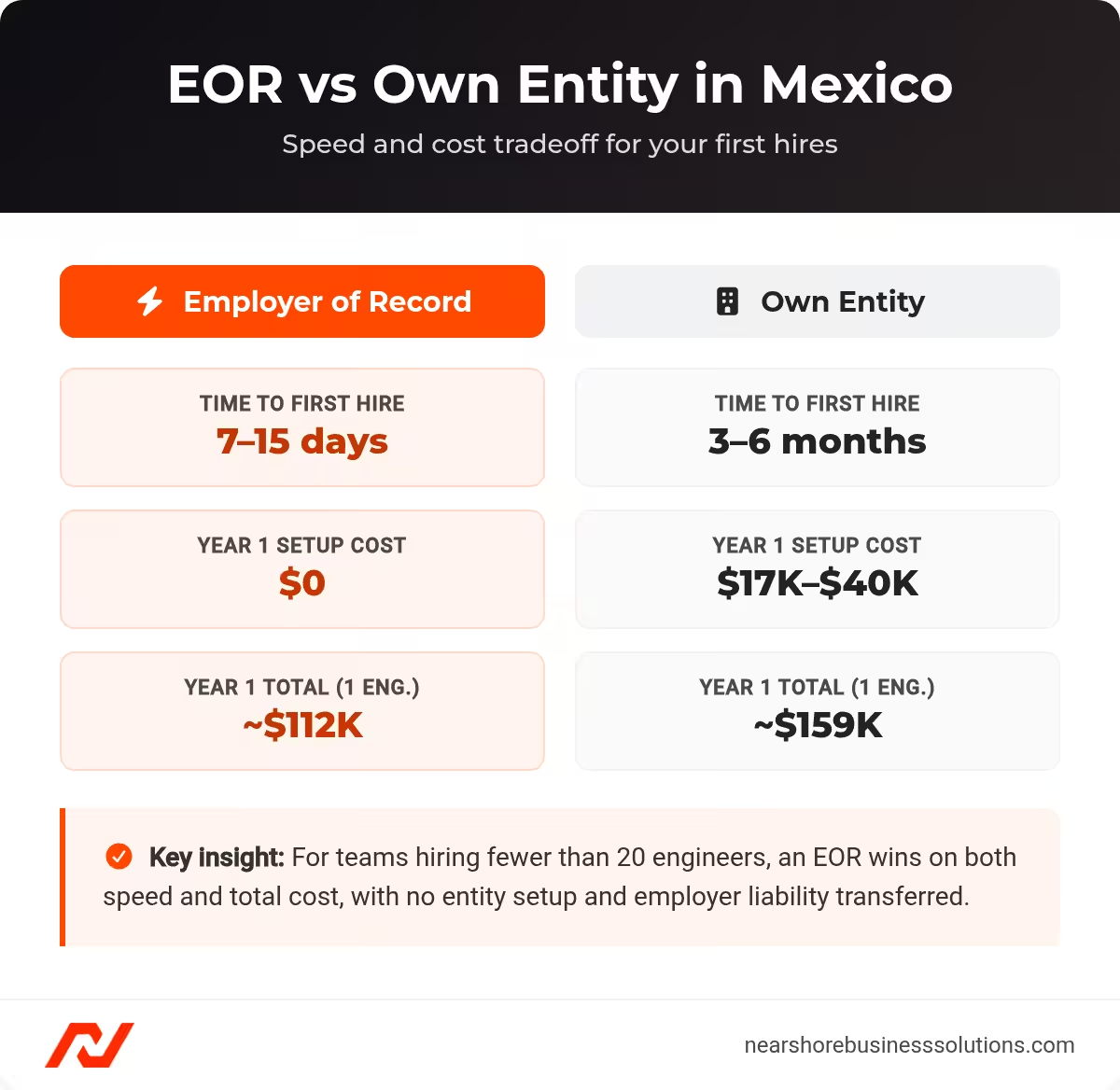
Speed and cost comparison of using an EOR versus setting up a Mexican entity.
For most US engineering teams exploring hiring in Mexico for the first time, EOR removes the 3 to 6 month ramp. It also lets you validate the talent market before committing to permanent infrastructure. Companies weighing several countries at once can compare options through our employer of record in Latin America service.
How Does an Employer of Record in Mexico Actually Work?
An employer of record in Mexico is a REPSE-registered company that becomes the legal employer of your engineer. It signs the labor contract, runs payroll, files CFDIs, and pays IMSS, INFONAVIT, and SAR. Your US company contracts with the EOR through a B2B service agreement and directs the engineer’s daily work. Three pieces make the model function: the legal structure, the onboarding process, and a clear split of responsibilities.
Why Is EOR Legal in Mexico When Outsourcing Is Not?
EOR is legal because Mexico’s 2021 outsourcing reform banned supplying workers for a client’s core business, but it kept a legal path for specialized services. The reform took effect September 1, 2021. It killed the staffing-agency model. It also codified subcontracting of “specialized services or the execution of specialized works” outside the client’s core business purpose.
A US SaaS company’s core business is building software, not administering Mexican payroll or managing IMSS contributions. Those functions count as specialized HR administration services. A REPSE-registered provider delivers them legally. Every EOR must hold active enrollment in the REPSE (Registro de Prestadoras de Servicios Especializados), administered by STPS. The registration must be renewed every three years.
The EOR holds a Mexican legal entity. It serves as the employer of record before SAT, IMSS, and INFONAVIT at the same time. The employee’s labor contract sits with the EOR’s Mexican entity, not your US company. Your US company contracts with the EOR under a separate B2B service agreement.
| Outsourcing (Illegal) | EOR Arrangement (Legal, with REPSE) | |
|---|---|---|
| Who is the employer? | Staffing agency nominally employs; client controls workers performing client’s core activities | EOR is the sole legal employer; client receives specialized HR services |
| REPSE registration | Irrelevant: practice is prohibited | Required and must remain current |
| Penalty exposure for client | Joint and several liability: fines of 2,000–50,000 UMAs ($220K–$5.5M USD) | Insulated via service agreement, provided EOR maintains compliance |
Enforcement has intensified. STPS conducted over 7,000 labor inspections in 2023, per STPS enforcement reporting. SAT cross-references CFDI payroll data against REPSE registrations algorithmically. Using an unregistered provider, or one whose REPSE lapses, exposes both the provider and the US client to the full penalty framework for illegal outsourcing.
How Long Does EOR Onboarding to First Payroll Take?
EOR onboarding to first payroll takes 7 to 15 business days across seven steps. The most common bottleneck is employee documentation, which adds 3 to 7 days when a candidate lacks a current RFC or has IMSS discrepancies. The timeline below maps each step.
- Scoping call and role definition (Day 1). The EOR confirms role details, compensation, benefits, and sets the integrated daily salary (SDI) for statutory calculations.
- Offer letter issuance (Day 1 to 2). The EOR generates a compliant offer letter in the agreed currency.
- Employment contract drafting (Day 2 to 5). The contract must be in Spanish, specify work location per NOM-037 teletrabajo rules, and include CFDI-compliant compensation terms.
- Employee documentation collection (Day 3 to 7). The employee provides RFC, CURP, IMSS number, and bank details. This is the most common bottleneck. Missing documents add 3 to 7 days.
- IMSS and INFONAVIT registration (Day 5 to 10). This must occur on or before the first day of work. Failure to enroll carries fines of 20 to 350 UMAs per employee. It also creates unlimited liability for 100% of medical costs for any work-related accident.
- Bank account setup and payroll validation (Day 5 to 10, concurrent). The EOR validates CLABE compatibility with its payroll processor.
- First payroll run with CFDI timbrado (Day 10 to 15). The EOR processes payroll, generates a digitally signed CFDI payroll receipt, and files it with SAT in real-time through an authorized PAC.
What Do You Control and What Does the EOR Manage?
You control the work; the EOR controls the employment. Mexican labor courts apply a “reality over form” doctrine, where the actual working relationship, not the contract language, determines employer status. That doctrine makes the boundary below worth protecting.
Your company controls: daily task assignment and project direction, performance management (1:1s, OKRs, reviews), tools and systems access (GitHub, Slack, Jira, AWS), IP assignment and confidentiality requirements, and team integration into standups and architecture reviews.
The EOR manages: payroll processing and ISR withholding, IMSS/INFONAVIT/SAR contributions, statutory benefits administration (aguinaldo, vacation, vacation premium), CFDI issuance every pay period, PTU calculation and distribution by May 30 annually, compliant termination including the constitutionally mandated three-month severance for unjustified dismissal, and labor dispute representation before the Federal Center for Labor Conciliation.
Three practices protect the boundary:
- Route all compensation through the EOR’s Mexican payroll. Direct payments from your US entity create a parallel employment relationship.
- Route all employment-status decisions through the EOR. You request termination; they execute it legally.
- Keep the service agreement as the sole contractual link between your company and the EOR.
What Does It Really Cost to Hire Through EOR Services Mexico?
Hiring a senior full-stack developer through EOR services in Mexico costs about $93,000 to $101,000 per year, all-in. That figure includes a $60,000 gross salary, $25,600 to $31,700 in mandatory employer burden, a $6,000 platform fee, and supplemental health insurance. The same hire runs $180,000 to $225,000 in the US. Two pieces drive the math: the total cost of employment and the platform fee.
What Is the Total Cost of Employment in Mexico?
Mexico’s all-in employer burden lands between 35 and 50% above gross salary, per Mexico’s Federal Labor Law and Social Security Law. The worked example below models a senior full-stack developer earning $60,000 USD gross in Guadalajara, the most common profile US teams hire through EOR.
| Line Item | Annual (USD) | Notes |
|---|---|---|
| Gross Base Salary | $60,000 | Senior developer, Guadalajara, 5+ years of experience |
| IMSS Employer Share | $12,000–$15,000 | Seven sub-contributions; capped at 25× UMA (~$4,960 USD/mo at 2025 UMA). Cesantía y Vejez rate: 5.150% in 2025, legislated to reach 11.875% by 2030 |
| INFONAVIT | $2,976 | 5% of SDI, capped at 25× UMA |
| SAR (Retirement) | $1,190 | 2% of SDI, capped at 25× UMA |
| State Payroll Tax | $1,200–$1,800 | Jalisco: 2%; CDMX: 3%; Nuevo León: 3% |
| Aguinaldo | $5,000 | Tech market norm: 30 days (8.33% of annual gross); paid by Dec. 20 |
| Vacation Premium | $750 | 25% of vacation days’ salary; 12 days Year 1 post-“Vacaciones Dignas” reform |
| PTU (Profit Sharing) | $2,500–$5,000 | 10% of taxable profit; EOR handling varies materially |
| Subtotal: Employer Burden | $25,616–$31,716 | ~35–42% above gross |
| EOR Platform Fee | $6,000 | Market midpoint ($400–$699/mo) |
| Supplemental Health Insurance | $1,800–$3,600 | Increasingly table stakes; omitting narrows candidate pool 30–40% (NBS internal placement data, Q1 2025) |
| Total Cost to Client | $93,416–$101,316 | |
| US Equivalent | $180,000–$225,000 | Base + benefits + equity |
| Implied Annual Savings | $78,684–$131,584 | Per hire, per year |
Sources: Ley Federal del Trabajo (Articles 76 to 81, 87, 117 to 131), Ley del Seguro Social, INFONAVIT Law (Article 29), 2025 UMA published by INEGI ($113.14 MXN/day), Jalisco state payroll tax law. Insurance cost ranges from NBS internal placement data and broker quotes (MetLife, GNP, AXA México), Q1 2025.
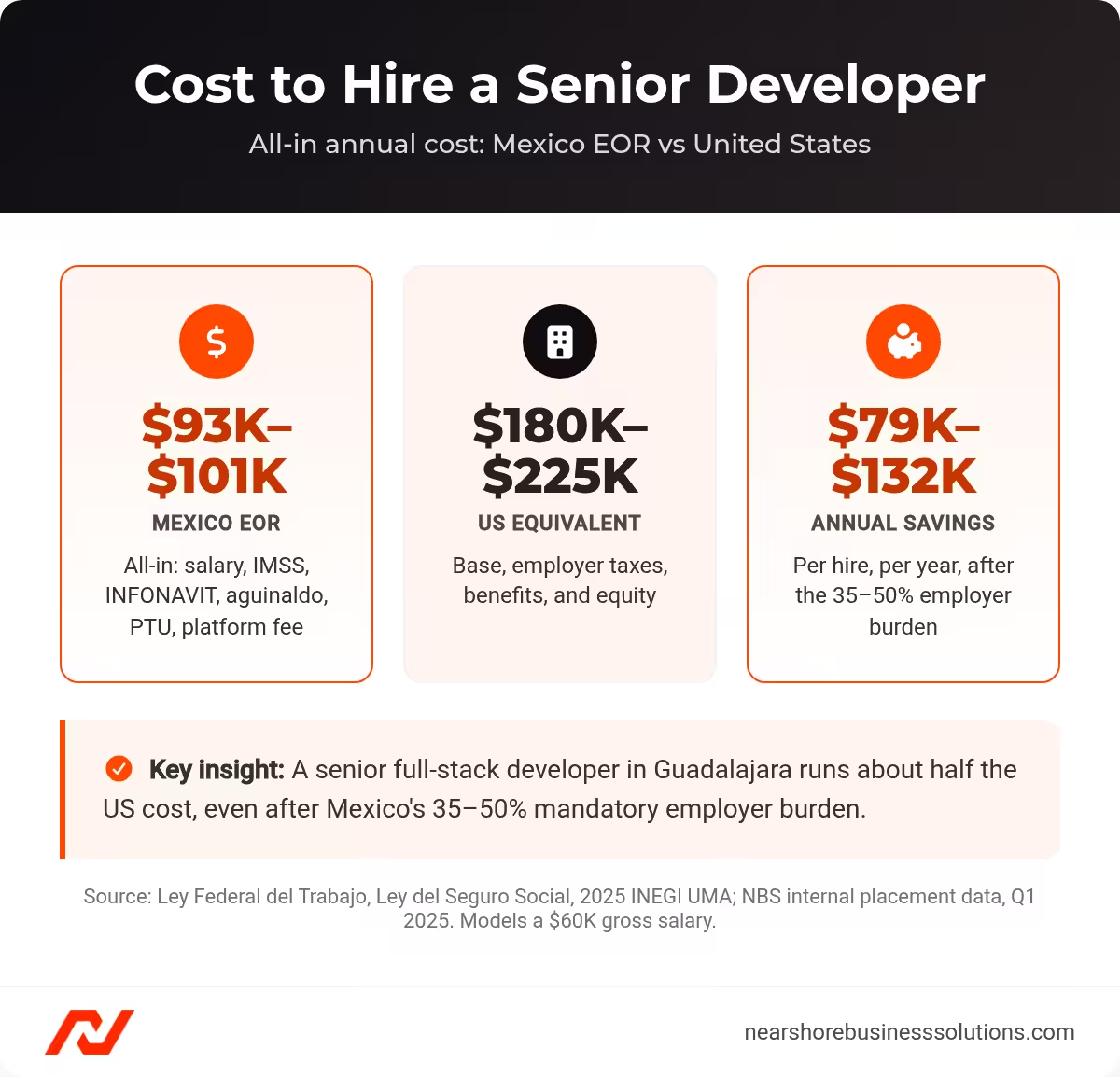
All-in annual cost to hire a senior developer through a Mexico EOR versus the US.
Two patterns deserve attention. First, the IMSS cap creates a counterintuitive dynamic. Higher-paid engineers trigger roughly the same IMSS dollar contribution as mid-level developers, because both exceed the 25× UMA ceiling. So the employer burden percentage decreases for senior hires. Second, PTU is the single largest cost ambiguity. Ask any prospective EOR three questions: How do you structure PTU? What was the actual PTU payout per employee for the last two fiscal years? Is PTU exposure capped in the service agreement?
The Cesantía y Vejez employer rate is legislated to rise from 5.150% in 2025 to 11.875% by 2030, per the decree reforming Article 168 of the Social Security Law. That adds roughly 1 to 1.5 percentage points annually to your all-in cost, independent of salary raises.
What Do EOR Platform Fees Include in Mexico?
EOR platform fees in Mexico run $400 to $699 per employee per month under flat-fee models, and 10 to 18% of gross salary under percentage-of-salary models, per provider pricing data. Flat fees favor higher-salaried roles. Percentage models, more common among regional Latin American providers, become expensive fast for senior engineers. At $5,000 per month gross, a $599 flat fee equals 12% of salary, while a 15% model charges $750.
| Provider | Monthly Fee | Own Mexican Entity? | Key Inclusions | Notable Add-On Costs |
|---|---|---|---|---|
| Deel | $599 | Yes | Payroll, CFDI, IMSS/INFONAVIT, statutory benefits, Deel Card | Health insurance, equity admin, immigration |
| Remote.com | $599 ($699 no commitment) | Yes | Payroll, tax, social security, IP protection clauses | Health/dental/vision (~$200–$400/mo), equity admin |
| Oyster HR | $599 | Yes | Payroll, compliance, benefits guidance, onboarding portal | Health insurance, global mobility, dedicated CSM |
| Papaya Global | From $650 | Yes | Payroll with real-time gross-to-net, automated CFDI, analytics | Custom benefits, equity, dedicated specialist |
| Multiplier | $400 | Partner model | Payroll, compliance, contracts, multi-currency invoicing | Supplemental insurance, legal advisory |
Several items fall outside the base fee. Supplemental private health insurance administration adds a $25 to $75 per month management fee on top of premiums, per provider pricing data. Equity compensation structuring runs $100 to $250 per month. Complex termination legal advisory runs $200 to $500 per event. Visa and immigration support runs $1,500 to $4,000 per case. Enterprise clients with 10 or more employees can often negotiate lower base rates.
For teams deciding whether a worker should be an employee or a contractor, our guide to EOR compliance in Latin America walks through the misclassification rules that make EOR the safer path in Mexico.
Frequently Asked Questions About EOR Services in Mexico
These are the most common questions CTOs and finance leads ask about hiring through an EOR in Mexico.
How long does it take to hire an employee through an EOR in Mexico?
It takes 7 to 15 business days from the scoping call to the first payroll run. The most common delay is employee documentation, which adds 3 to 7 days when a candidate lacks a current RFC or has IMSS discrepancies. Entity setup, by contrast, takes 3 to 6 months.
Is using an EOR legal in Mexico after the 2021 outsourcing reform?
Yes, using a REPSE-registered EOR is legal. The 2021 reform banned supplying workers for a client’s core business but kept a legal path for specialized HR services. Always verify the provider’s REPSE registration number on the official STPS public portal before signing.
What is the total employer cost on top of salary in Mexico?
The all-in employer burden runs 35 to 50% above gross salary. This covers IMSS, INFONAVIT, SAR, state payroll tax, aguinaldo, vacation premium, and PTU. A $60,000 developer costs about $25,600 to $31,700 in mandatory burden before the EOR platform fee.
What is a CFDI and why does it matter for payroll?
A CFDI is a government-mandated XML tax document that the EOR files with SAT in real-time for every payroll payment. It records the employee’s earnings, deductions, and ISR withholding. Incorrect or missing CFDIs make the entire payroll expense non-deductible for Mexican corporate income tax.
Do I need a local entity to hire developers in Mexico?
No, you do not need a local entity when you use an EOR. The EOR holds its own Mexican entity and acts as the legal employer. This is the main reason teams hiring fewer than 20 engineers choose EOR over entity setup.
What happens if a developer doesn’t work out?
The EOR executes a compliant termination, including the constitutionally mandated three-month severance for unjustified dismissal. You request the termination, and the EOR handles the legal process before the Federal Center for Labor Conciliation. Route all employment-status decisions through the EOR to protect the boundary.
Ready to Build Your Mexico Engineering Team?
Nearshore Business Solutions sources and vets developers across Guadalajara, Monterrey, Mexico City, and Querétaro. We screen for technical skills, English fluency, and US work style fit. Our acceptance rate is 16%.
Every placement includes a 90-day replacement guarantee. You receive pre-vetted candidates in 2 to 4 weeks.
Get a free consultation to discuss your hiring needs and receive a custom EOR cost projection for Mexico.