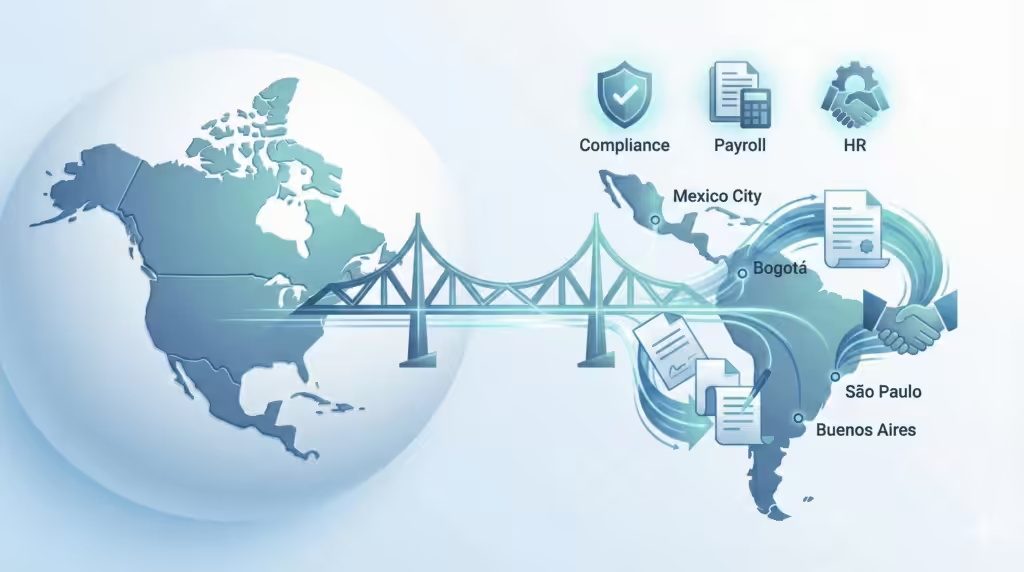
An EOR lets you hire developers in Brazil, Mexico, Colombia, and Argentina in weeks instead of the 3.5 months entity setup requires.
LATAM developers cost $65-$100/hour. That’s 30-50% below US rates. EORs handle payroll, taxes, and compliance so you avoid Permanent Establishment risk. Employer burdens range from 30% to 47% depending on country.
Below you’ll find country-by-country breakdowns of labor laws, mandatory benefits, and social security contributions. We cover misclassification risks, payroll compliance, termination rules, and how to choose the right EOR provider.
What Is an Employer of Record in Latin America?
An EOR is a third-party organization that becomes the legal employer of your workers in a foreign country. The EOR handles payroll, taxes, benefits, and compliance. You manage day-to-day work.
For country-specific guidance, see our complete guide to hiring developers in Colombia or learn more about hiring software developers across Latin America.
How Does an EOR Legally Employ Workers on Your Behalf?
The EOR registers as the official local employer in the target country. It files payroll taxes, administers mandatory benefits, and holds the employment contract. Legal employer liability transfers from your US entity to the EOR.
What Employment Responsibilities Does an EOR Manage?
EORs handle the operational burden of cross-border employment:
- Multi-currency payroll processing
- Local tax filing and statutory contributions
- Off-cycle payments like bonuses and commissions
- HR data, benefits administration, and device provisioning
- Stock options and equity compensation for tech hires
What Is the Difference Between an EOR and a PEO?
An EOR assumes full legal employer status and compliance responsibility. A PEO shares employment duties with your company, which requires you to have a local entity. For international hiring without a local presence, EOR is the only compliant option.
What Is the Difference Between Using an EOR and Setting Up a Legal Entity?
Entity setup in LATAM takes up to 3.5 months and carries significant administrative costs. An EOR reduces that timeline to weeks. Choose entity formation when you plan 50+ hires in a single country. Below that threshold, EOR delivers faster ROI.
Why Do Companies Use an Employer of Record to Expand into Latin America?
Three factors drive EOR adoption: speed to market, cost savings, and compliance risk reduction.
How Does an EOR Accelerate Market Entry Without Entity Setup?
Weeks, not months. An EOR lets you onboard engineers immediately while entity formation drags past the 3.5-month mark. You hire full-stack, AI, and DevOps talent from tech hubs like Guadalajara, Medellín’s Ruta N district, and Buenos Aires’ Distrito Tecnológico. Nearshoring delivers 15% faster time-to-market. Overlapping time zones enable real-time collaboration that offshore locations cannot match.
What Are the Cost Advantages of Using an EOR Over Incorporation?
Senior LATAM developers cost $65–$100 per hour. That’s 30%–50% below US and European rates for equivalent skill levels. Quality holds. Nearshoring achieves 92% client satisfaction on work quality versus 84% for offshore alternatives. The savings come without the performance tradeoff.
How Does an EOR Reduce Legal and Compliance Risk?
EORs absorb Permanent Establishment (PE) risk. Without one, your company could trigger tax obligations and regulatory exposure in each country where you hire. Growth-stage companies benefit most. The EOR carries that burden.
PE triggers include three key factors:
- Physical Presence: Fixed office, bank account, or dedicated home office
- Revenue Generation: Employees conducting sales or revenue activity in-country
- Command and Control: Parent company exerting excessive direction over workers
Demand a written PE indemnity clause in your EOR contract.
What Are the Labor Law Challenges in Major Latin American Countries?
Each LATAM country presents unique employment law complexities. The table below summarizes key challenges by country:
| Country | Talent Pool / Rates | Employer Burden | Key Compliance Challenges |
|---|---|---|---|
| Brazil | 630,000+ developers (USP, UNICAMP graduates); $53K avg salary | 31.95%–46.35% | LGPD data protection; no at-will termination; complex burden rates |
| Mexico | Guadalajara tech hub; Tecnológico de Monterrey talent | 39.69%–46.72% | July 2025 digital platform reforms; IMMEX program for export operations |
| Argentina | UBA and ITBA graduates; Knowledge Economy Law benefits | 17% employee SST + employer costs | 13th-month salary mandatory; 21% VAT on digital services |
| Colombia | Ruta N innovation district (Medellín); EAFIT and Universidad de los Andes talent | 30%–35% | Law 1581 data protection; 35% CIT; ProColombia support available |
| Chile | Stable market | Similar to Colombia | Cause-based termination required; statutory severance; no at-will termination |
What Mandatory Benefits Must Employers Provide in Latin America?
LATAM countries mandate various employee benefits. Below is a summary of key requirements:
| Benefit | Requirements by Country |
|---|---|
| 13th-Month Salary | Brazil and Argentina: Mandatory. Budget one additional month of pay annually. Brazil adds 1/3 vacation bonus. |
| Profit Sharing | Mexico: Employers must distribute 10% of pre-tax profits to employees annually. |
| Vacation Entitlements | Most LATAM nations mandate 10–30 days annually; increases with tenure. EOR tracks accruals. |
| Healthcare & Pension | LATAM average: 12.68%–13.10% employer contributions (nearly double North American average of 7.44%–7.62%). |
| Parental Leave | Brazil: 120 days maternity. Mexico: 84 days maternity. Statutory across LATAM with varying durations. |
How Do Social Security Contributions Work Across Latin America?
Social security systems vary significantly across LATAM. The following table details employer obligations by country:
| Country | Key Contributions | Rates |
|---|---|---|
| Brazil | INSS (Social Security), FGTS (Severance Fund), RAT (Work Accident Insurance) | INSS: 20%–22.5% (no cap); FGTS: 8%; RAT: 1%–3% (tech: 2%). Total: 30%+ |
| Mexico | IMSS (Social Security), INFONAVIT (Housing), SAR (Retirement), State/Federal payroll taxes | IMSS: 24.95%–33.58%; INFONAVIT: 5%; SAR: 5.15%. Combined: 39.69%–46.72% |
| Argentina | Pension, healthcare, social services; mandatory severance accruals; 13th-month provisions | Employee: 17% social security. Additional employer contributions apply. |
| Colombia | Health, pension, workplace risk insurance | 30%–35% employer burden |
| Chile | Mandatory health and pension contributions; severance provisions | Similar structure to Colombia; EOR calculates exact rates |
What Are the Risks of Employee Misclassification in Latin America?
Misclassification exposes you to back-taxes, penalties, and co-employer liability that can extend to your US entity.
How Do Latin American Countries Define Employees Versus Independent Contractors?
The distinction centers on control and exclusivity. If a worker follows set hours, uses company tools, and works exclusively for you, LATAM courts classify them as employees. Contract language does not override functional reality. Some companies use hybrid models. The key is matching contract type to actual work arrangement.
What Penalties Can Employers Face for Misclassifying Workers?
Misclassification triggers back-payment of unpaid benefits, taxes, and severance. Penalties compound with interest. Authorities may freeze accounts and block future hiring. Co-employer liability can extend to your US entity.
What Are the Warning Signs of Misclassification?
Red flags include contractors who work fixed schedules, report to managers, or use company email. Working exclusively for one client over extended periods also creates exposure.
How Can an EOR Prevent Misclassification Liability?
EORs assess each role before engagement. They advise on the compliant structure based on local law and actual work arrangement. This upfront legal guidance eliminates guesswork. The EOR assumes classification risk for workers on its payroll.
How Does Payroll Compliance Work When Hiring Through an EOR?
The EOR calculates withholdings, files returns, and remits payments to local tax authorities each pay period.
What Payroll Cycles Are Standard in Latin America?
Most LATAM countries mandate monthly payroll. Brazil and Mexico allow biweekly cycles for certain industries. Your EOR configures pay schedules to match local requirements and handles timing for 13th-month salary disbursements.
How Are Income Tax Withholdings Calculated and Remitted?
Tax rates vary by country and income level. Brazil applies progressive rates up to 27.5% for high earners. Mexico and Colombia use similar tiered structures. The EOR calculates withholdings each pay period. Your finance team receives net-cost reporting without managing foreign tax codes.
What Reporting and Filing Deadlines Must Employers Meet?
Filing deadlines differ by jurisdiction and tax type. Missing them triggers penalties and interest. Evaluate EOR platforms on reporting depth. Require audit-ready exports with visibility into headcount costs and compliance status. Data should segment by country, department, or role.
How Do Currency Fluctuations Affect Payroll in Argentina?
Argentina’s currency volatility creates budgeting risk. The peso has experienced double-digit monthly swings. EORs manage multi-currency processing and can structure contracts in USD with local conversion at payroll. This stabilizes your cost basis.
What Are the Termination and Severance Requirements in Latin America?
Termination rules and severance calculations vary significantly by country. The table below summarizes key requirements:
| Country | Notice Period | Severance Formula | Cause-Based Rules |
|---|---|---|---|
| Brazil | 30 days min + 3 days per year of service | FGTS (8%/month accrual) + 40% penalty on termination without cause | Reduces/eliminates severance with documentation |
| Mexico | None for cause-based | 3 months salary + 20 days/year + 12 days/year seniority premium (capped at 2x min wage) | Proof required; reduces obligations |
| Argentina | 15–90 days based on tenure | 1 month salary per year of service | Documentation required |
| Colombia | 15–90 days based on tenure | 30 days (year 1) + 20 days per additional year | Documentation required |
| Chile | 30 days standard | 30 days per year of service (capped at 11 years) | Cause required; documentation essential |
What Happens When an Employee Is Terminated for Cause?
Cause-based termination reduces or eliminates severance in most LATAM countries. However, burden of proof sits with the employer. Documentation must meet local legal standards. EORs manage termination procedures and prepare required paperwork.
How Do Remote Work Laws in Latin America Affect Employers?
Remote work regulations have expanded across LATAM. The table below outlines key obligations by country:
| Country | Key Requirements | Employer Obligations |
|---|---|---|
| Brazil | Written telework agreements required; work-hour tracking unless exempt | Define equipment, infrastructure, and expense reimbursement responsibility in contract |
| Mexico | 2021 remote work reforms; disconnect rights outside working hours | Cover internet, electricity, equipment costs; ensure ergonomic conditions |
| Argentina | Voluntary agreements; reversibility rights; disconnect rights | Provide employer tools; respect disconnect outside scheduled hours |
| Colombia | Remote work registration with Ministry of Labor required | Equal treatment for remote/on-site workers including training and promotions |
What Equipment and Expense Reimbursements Are Required?
All four major LATAM markets require employers to provide or reimburse work equipment. Monthly stipends for internet and electricity are mandatory or strongly recommended. EOR platforms handle device provisioning, tracking, and retrieval. Factor $100-$200 monthly per employee for home office allowances.
How Do You Choose the Right EOR Provider in Latin America?
Five factors separate reliable EOR providers from risky ones: entity ownership, regional expertise, pricing model, technology platform, and customer support.
| Risk Category | What to Verify | Gold Standard |
|---|---|---|
| PE Risk | Explicit mitigation strategy | Written PE indemnity clause in SLA |
| IP Protection | Contractual IP assignment | Audited two-step assignment process |
| Cost Transparency | Predictable pricing | Flat-fee model with FX transparency |
| Integration | Tech stack compatibility | API integration with HRIS/ERP |
| Local Expertise | In-country specialists | Own-entity model, no resellers |
Should You Choose an EOR with Owned Entities or Partner Networks?
Own-entity EORs maintain direct legal presence in each country. This model delivers tighter compliance control and stronger IP protection. Partner-network EORs rely on third-party providers. This dilutes oversight. For sensitive technical roles, own-entity providers reduce risk.
What Regional Expertise Should an EOR Demonstrate?
Require in-country labor and tax specialists, not generalized international counsel. Regulations change frequently. Your EOR must track updates in real time. Verify licensing status. Many LATAM countries require specific government registration for EOR operations.
How Should You Evaluate EOR Pricing and Fee Structures?
Two models dominate: Flat fee ($300-$500 per employee per month) and Percentage (8-12% of gross payroll). Flat-fee wins for senior engineers and tech leads. A $100,000 salary at 10% costs $10,000 annually versus $6,000 flat. Demand full fee transparency. Confirm FX markup policies and setup charges before signing.
What Technology and Platform Capabilities Matter?
The platform should centralize HR data, payroll, and benefits in one system. Require API integration with your HRIS, ERP, and accounting stack. Request sample payslips during evaluation. This validates accuracy and confirms statutory compliance coverage.
What Level of Customer Support Should You Expect?
SLAs must define onboarding timelines, response guarantees, and escalation paths. Payroll errors need same-day resolution. In-country HR advisors matter for retention. Employees should access support in their local language.
What Sector-Specific Compliance Should Tech Companies Consider?
FinTech, HealthTech, and SaaS companies face additional regulatory layers beyond standard labor law.
What FinTech Compliance Requirements Apply in LATAM?
LATAM payments will exceed $300 billion by 2027. Brazil’s PIX system has 165 million users and sets regional payment standards. FinTech CTOs must ensure EOR partners can handle compliant cross-border payroll. Look for compliance alert features that notify you of regulatory changes.
What HealthTech Data Requirements Exist?
HealthTech teams handle sensitive patient data under local EHR regulations. Medellín has emerged as a HealthTech hub. Choose an EOR with sector experience in health data compliance.
How Does Digital Service Taxation Affect SaaS Companies?
Argentina charges 21% VAT on digital services from non-residents. Your EOR must structure compensation to comply with cross-border digital taxation rules.
What Is the Process for Onboarding Employees Through an EOR?
Most EORs complete onboarding in 1-2 weeks. Compare this to 3.5 months for entity establishment.
What Documentation Is Required to Hire an Employee?
Standard requirements include government ID, tax identification number, proof of address, and banking details. Country-specific requirements:
| Country | Required Tax/ID Numbers |
|---|---|
| Brazil | CPF registration |
| Mexico | CURP and RFC numbers |
| Argentina | CUIL |
How Long Does EOR Onboarding Take in Latin America?
Most EORs complete onboarding in 1-2 weeks. Compare this to 3.5 months for entity establishment. Timeline depends on document readiness. Brazil’s eSocial system adds processing time. Mexico and Colombia typically move faster.
How Are Employment Contracts Drafted to Meet Local Requirements?
EORs generate contracts compliant with local labor codes. Brazil and Mexico prohibit at-will employment. They require cause-based termination provisions. IP assignment language must satisfy local jurisdiction requirements and comply with data protection laws like Brazil’s LGPD and Colombia’s Law 1581. Your EOR drafts enforceable IP terms that protect your codebase.
The EOR handles employee PII compliance. You retain responsibility for customer data your developers access. For HealthTech and FinTech, verify data residency requirements and Transfer Impact Assessment needs.
How Do Probationary Periods Work in Different Countries?
Probation allows reduced severance obligations during initial employment:
| Country | Probationary Period |
|---|---|
| Brazil | Up to 90 days |
| Mexico | 30–180 days depending on role seniority |
| Argentina | Typically 3 months |
| Colombia | Typically 3 months |
Termination during probation requires less documentation but still demands compliance with notice provisions. Your EOR tracks probation expiration.
When Should a Company Transition from an EOR to a Local Entity?
The breakeven point typically sits at 50+ employees in a single country.
What Headcount or Revenue Levels Justify Entity Setup?
Below that threshold, EOR fees cost less than entity maintenance, local accounting, legal counsel, and HR staffing. Other triggers include significant local revenue requiring tax presence or government contracts mandating local incorporation.
Run the math: entity setup runs $20,000–$50,000 plus $3,000–$10,000 monthly in ongoing costs. Compare against your per-employee EOR fees at projected headcount over 3 years.
How Can Companies Plan a Smooth Transition from EOR to Entity?
Start planning 6 months before target transition. Entity registration takes 2–4 months. Employee transfer requires new contracts and benefits enrollment.
Your EOR should support the transition. Key steps:
- Transfer employment contracts without triggering severance obligations
- Migrate payroll history and benefits accruals
- Ensure no gaps in social security contributions
- Coordinate final EOR invoicing with entity payroll start date
Negotiate transition terms upfront. Some EORs charge buyout fees. Others offer transition support as a retention incentive. Clarify costs before signing.
Frequently Asked Questions About Employer of Record in Latin America
These are the most common questions US tech leaders ask about hiring through an EOR in LATAM.
Can an EOR Hire Both Full-Time Employees and Contractors?
Yes. Many companies run hybrid models with full-time engineers through the EOR and contractors for project work. The EOR should assess each role and recommend the compliant structure.
How Does an EOR Protect Intellectual Property Rights?
IP ownership laws vary by jurisdiction. Generic confidentiality clauses do not transfer invention rights from locally employed developers. Require contracts with explicit, locally compliant IP assignment language. The gold standard includes a two-step audited assignment process. Verify your EOR’s IP protection methodology before signing.
What Happens If Employment Laws Change After Hiring?
LATAM regulatory environments evolve. Mexico’s 2025 platform worker rules demonstrate how quickly obligations shift. Your EOR must staff local specialists who track real-time changes. Look for proactive compliance alert features.
How Are Employee Disputes Handled Through an EOR?
The EOR manages disputes under local labor law. They handle documentation, legal response, and settlement negotiation. Secure contractual indemnification covering Permanent Establishment risk and misclassification liability. A written PE indemnity clause in your SLA is the gold standard.
What Is the Cost Comparison Between LATAM and US Engineering Talent?
LATAM developers cost 40-55% less than US equivalents when you factor in employer burden rates.
| Country | Base Salary (USD) | Employer Burden | Total Cost | Savings vs. US |
|---|---|---|---|---|
| Brazil | $50,000–$53,000 | 32%–46% | $66,000–$78,000 | ~55% |
| Mexico | $52,000–$90,000 | 40%–47% | $73,000–$132,000 | ~40% |
| Colombia | $55,000–$66,000 | 30%–35% | $72,000–$89,000 | ~50% |
| US | $141,000 | 7.6% | $152,000–$207,000 | — |
Ready to Scale Your Engineering Team?
Nearshore Business Solutions connects you with vetted developers across Latin America. We handle sourcing, vetting, and placement. You focus on building your product. Our developers are pre-screened for technical skills and English proficiency, with a 90-day replacement guarantee.
Learn more about our Employer of Record services in Latin America, or get a free consultation to discuss your hiring needs.