
Nearshore development in Latin America cuts engineering costs 40-65% while giving US SaaS startups access to 2.2 million developers in overlapping time zones.
LATAM developers cost $35-90/hour for senior roles. You can hire a senior full-stack engineer in Mexico for $88,500 fully loaded versus $185,000+ in the US. Teams in Bogotá, Mexico City, and Buenos Aires share 6-8 hours of business overlap with US time zones. Sourcing to offer takes 16-28 days versus 52-62 days domestically.
Our network covers engineers from Guadalajara’s Ciudad Creativa Digital, Medellín’s Ruta N, and São Paulo. Each is screened for technical skills, English fluency, and US work style fit. Below, you’ll find cost benchmarks, hiring timelines, compliance frameworks, and a stage-by-stage scaling playbook.
How Does Nearshore Development Differ from Offshore and Onshore Models?
Three models exist for staffing a distributed engineering team: onshore (US-based), nearshore (LATAM), and offshore (India, Eastern Europe). Each has a distinct cost and velocity profile that changes as your startup scales.
What Are the Key Differences Between Nearshore and Offshore Development?
Timezone gap is the decisive factor between nearshore and offshore. Offshore teams in India or Eastern Europe operate 8-13 hours apart from US time zones, which turns routine collaboration into multi-day cycles.
Measured outcomes from nearshore vs. offshore comparisons:
- LATAM nearshore teams respond to Slack and Jira queries within 2 hours at a 95% rate. Offshore teams hit 15-25%.
- Bug resolution: same-day nearshore vs. 2-3 days offshore.
- Attrition: LATAM holds below 10%. India offshore exceeds 20-25% in high-demand roles.
What Are the Key Differences Between Nearshore and Onshore Development?
Cost is the primary driver separating nearshore from onshore. A US senior engineer’s fully loaded Total Cost of Employment (TCOE) exceeds $180,000 annually. Nearshoring yields a 40-65% reduction. At that ratio, a startup can hire 3-4 senior LATAM engineers for the cost of one Silicon Valley hire.
Which Model Is Right for an Early-Stage SaaS Startup?
Nearshore is the dominant choice for US SaaS startups once they have product-market fit and need to scale engineering headcount quickly. The LATAM nearshore market has grown from $11.6 billion in 2023 to a projected $18.8 billion by 2027, driven by cloud adoption, digital transformation, and AI/ML integration. That growth reflects a maturing ecosystem, not a niche tactic.
What Are the Advantages of Nearshore Development for SaaS Startups?
LATAM nearshore combines four advantages that US SaaS startups at the $5M-$100M ARR stage need most: time zone alignment, cultural fit, cost savings, and faster iteration cycles.
How Does Time Zone Alignment Improve Development Velocity?
LATAM provides 6-8 hours of shared business overlap with US teams. Nearshore projects run 40-60% faster than asynchronous setups with a 10-hour timezone gap.
| US City | Mexico City (UTC-6) | Bogotá (UTC-5) | Buenos Aires (UTC-3) | São Paulo (UTC-3) |
|---|---|---|---|---|
| New York (EST) | 7-8 hours | 8 hours | 6 hours | 6 hours |
| Chicago (CST) | 8 hours | 7 hours | 5 hours | 5 hours |
| Denver (MST) | 7 hours | 6 hours | 4 hours | 4 hours |
| San Francisco (PST) | 7 hours | 5 hours | 3 hours | 3 hours |
A product manager in New York and a developer in Bogotá share 8 full working hours. A PM in San Francisco and a developer in Mexico City share 7. This overlap enables a PM to screen-share with a developer at 2:00 PM EST and close the ticket before day’s end.
How Does Cultural Compatibility Affect Team Collaboration?
US SaaS employment carries high professional status in Latin America, which drives tenure well above market norms. Average engineer tenure in US tech hubs has dropped to approximately 14 months. Top nearshore agencies in Costa Rica and Colombia report 24 months or more, a 70%+ improvement over US tech hub norms.
That stability reduces the compounding costs of recruitment, onboarding, and knowledge transfer that erode ROI in high-churn environments. Developers at firms like Rappi and those coming from Medellín’s Ruta N and Bogotá’s enterprise sector are accustomed to US work cadences.
What Cost Savings Can SaaS Startups Realistically Expect?
LATAM nearshoring yields a 40-65% reduction in fully loaded TCOE versus US equivalents. Here are 2025-2026 benchmarks (taxes, benefits, and overhead included):
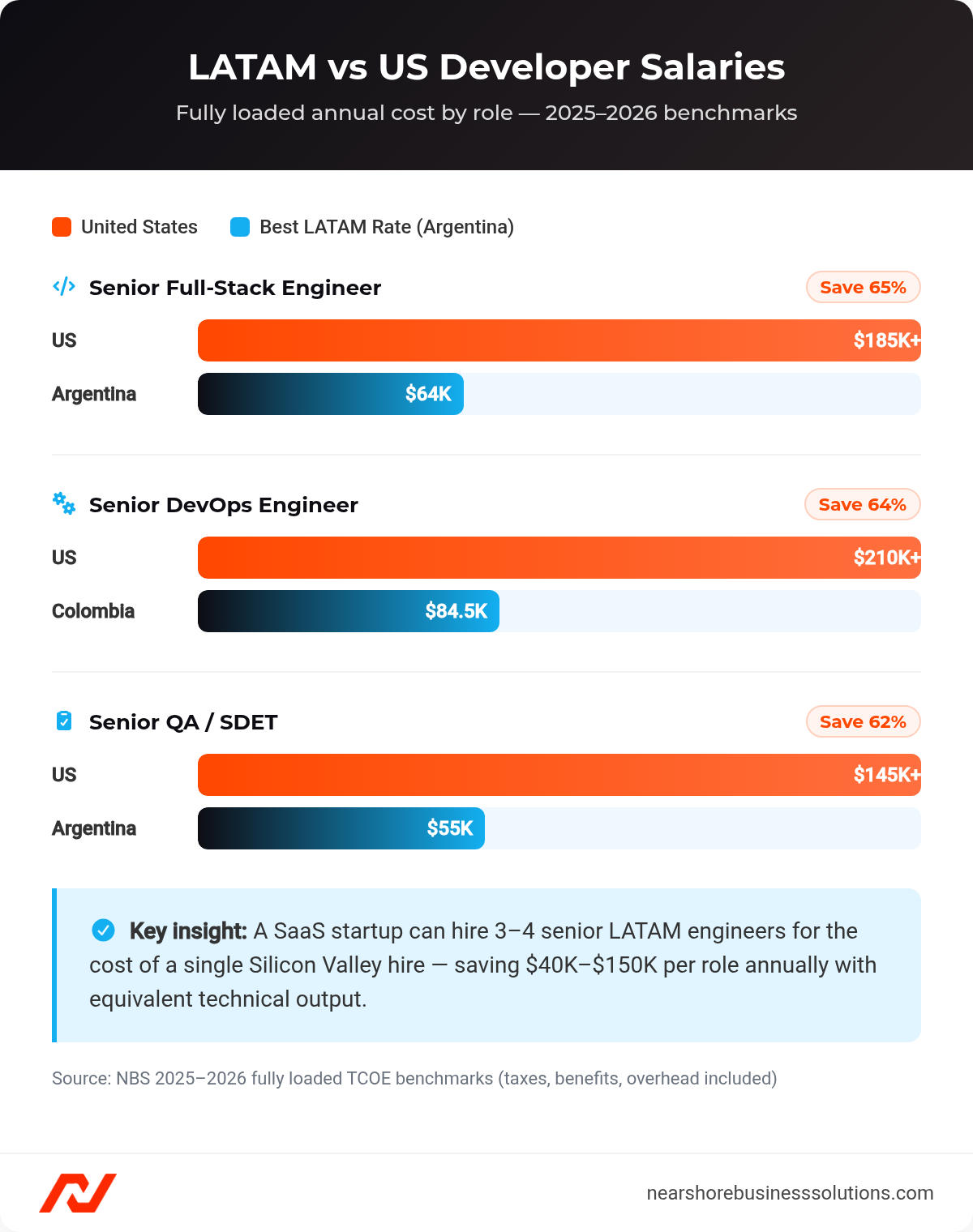
Fully loaded annual developer salaries by role: US vs. top LATAM nearshore countries.
| Role | United States | Mexico | Brazil | Argentina | Colombia | Chile |
|---|---|---|---|---|---|---|
| Senior Full-Stack | $185,000+ | $88,500 | $90,045 | $64,000 | $75,000 | $78,000 |
| Senior DevOps | $210,000+ | $95,000 | $102,000 | $75,000 | $84,500 | $90,000 |
| Senior QA/SDET | $145,000+ | $72,000 | $65,000 | $55,000 | $60,000 | $68,000 |
| Tech Lead/Architect | $250,000+ | $115,000 | $120,000 | $110,000 | $95,000 | $115,000 |
Senior LATAM hourly rates range from $35-90/hour depending on specialization. Note: Brazil imposes approximately 73% in employer payroll burden, including a mandatory 13th-month salary and vacation bonus. Chile’s employer burden is just 5-8.5%, though this is partially offset by higher base salaries.
How Does Nearshore Development Support Faster Iteration Cycles?
Nearshore teams produce 25% fewer revision cycles and achieve a 40% faster product release cycle compared to offshore equivalents. In Agile environments, this translates to more sprints closed per quarter and faster time-to-market. The combination of timezone overlap and cultural alignment drives these gains.
What Are the Disadvantages of Nearshore Development for SaaS Startups?
Three real risks exist in nearshore engagements: language variation, IP complexity, and quality control gaps. Each is manageable with structured hiring and contracting.
What Communication and Language Risks Should Startups Anticipate?
English proficiency varies significantly by country. Argentina leads the LATAM region on the EF English Proficiency Index with a “High” ranking, making it the top choice for roles requiring high-touch stakeholder communication. Mexico and Brazil rank lower on the general index, but senior engineers in US-client-focused roles command a 20-30% English proficiency premium, reflecting demonstrated fluency built through years of US-market exposure.
The risk is manageable with structured hiring: require spoken English as a non-negotiable screening criterion for any role interfacing with US product teams.
How Do Intellectual Property and Legal Considerations Vary by Region?
Mexico offers the strongest IP framework for US companies via the USMCA, which provides enhanced IP protections and streamlines cross-border investment. Chile has established Latin America’s first National Cybersecurity Agency and holds the most efficient patent examination timelines in the region.
Data privacy compliance is well-developed across the region. Brazil’s LGPD and Colombia’s Ley 1581 are comprehensively aligned with the EU’s GDPR. All three grant data subjects rights to access, rectify, and delete personal data. Key fine structures:
- LGPD (Brazil): Up to 2% of revenue, capped at approximately $11M
- Ley 1581 (Colombia): Up to 2,000 minimum wages
- GDPR (EU): Up to 4% of global revenue
Mexico remains on a priority watch list for enforcement consistency. This is relevant for startups handling sensitive IP at scale.
What Quality Control Challenges Are Common in Nearshore Engagements?
The quality baseline is high. HackerRank and Stack Overflow data show LATAM developers outperform many global competitors in mathematics and algorithmic problem-solving. The primary quality control challenges are documentation gaps and unclear acceptance criteria. These issues degrade any distributed team, not just LATAM-specific ones. Rigorous Definition of Done standards and structured code review processes mitigate this risk effectively.
Which Nearshore Regions Are Best Suited for SaaS Startup Development?
The total active LATAM developer pool is 2.2 million. Mexico and Brazil each host 500,000+ engineers, sufficient depth to staff multiple concurrent teams. The right country depends on your cost tolerance, communication needs, and legal risk appetite.
Why Do US SaaS Startups Frequently Choose Latin America?
Combined timezone alignment, cost efficiency, and talent volume make LATAM the default choice for US SaaS firms. Here is a country-level risk and reward breakdown:
| Country | Talent Density | Cost Efficiency | Stability/Risk | Overall Grade |
|---|---|---|---|---|
| Mexico | High | Moderate | Low (USMCA) | A |
| Brazil | Very High | Moderate | Moderate (Tax Complexity) | A- |
| Colombia | High | High | Moderate (Scaling) | A |
| Argentina | High | Very High | High (Currency Volatility) | B+ |
| Chile | Moderate | Moderate | Very High (Legal Stability) | A- |
For a detailed overview of hiring across the region, see our guide to hiring software developers in Latin America.
What Factors Should You Weigh When Selecting a Nearshore Region?
Developer population, STEM graduate pipeline, and risk tolerance drive the selection. Here is the developer supply data by country:
| Country | Developer Population | Annual STEM Graduates | Top University |
|---|---|---|---|
| Brazil | 630,000+ | 50,000+ | Univ. of São Paulo (USP) #1 in region |
| Mexico | 700,000+ | 110,000+ | Tecnológico de Monterrey (ITESM) #4 in region |
| Colombia | 350,000+ | 11,000+ | Universidad de los Andes |
| Argentina | 115,000+ | 15,000+ | Universidad de Buenos Aires (UBA) |
| Chile | 61,000+ | 2,600+ | Pontifical Catholic Univ. (UC) |
Mexico’s Tecnológico de Monterrey (ITESM) and Brazil’s USP anchor top-tier pipelines. Colombia’s Universidad de los Andes and Argentina’s UBA produce engineers with curriculum standards aligned to Silicon Valley expectations.
When Should a SaaS Startup Transition to a Nearshore Development Model?
Active US tech job postings are projected to reach 600,000+ by 2026. Annual CS graduates will produce only 85,000. The structural shortfall reaches 1.2 million engineers that year. For growth-stage SaaS companies, the window to act is now.
What Are the Signs Your In-House Team Can No Longer Scale Fast Enough?
Three signals indicate domestic hiring has stopped working: senior job posts stay open 8+ weeks, you are competing on comp with FAANG companies, or sprint velocity is stalling due to headcount gaps. When any of these apply, nearshore is the viable path forward.
Is Nearshore the Right Move at Pre-Seed, Seed, or Series A?
For pre-seed companies, nearshore is typically premature: the team is too small and the product too undefined. At seed stage, selective staff augmentation of 1-2 senior engineers can accelerate MVP development. Series A is the primary inflection point: ARR is tracking toward $5M+, the product requires broader engineering coverage, and the cost difference compounds rapidly.
For companies in the $5M-$100M ARR range, Employer of Record (EOR) services enable compliant LATAM hiring in days rather than months. EOR is the most operationally agile entry path into the market.
How Do You Know if You’re Ready to Manage a Distributed Engineering Team?
Three readiness indicators apply. First, your engineering processes are documented and repeatable, not tribal knowledge. Second, you have a US-side engineering leader with 4+ hours per week to devote to the nearshore team. Third, you have shipped at least one full product cycle with your current team. If any of these are absent, address them before hiring distributed engineers.
How Do You Build and Structure a Nearshore Development Team for a SaaS Product?
Building a nearshore team requires a deliberate sequencing strategy. The recommended order: backend nucleus first to establish data architecture, then DevOps to build CI/CD pipelines, then frontend and mobile to iterate on the user interface.
What Roles Should You Hire Nearshore vs. Keep In-House?
Keep in-house: CTO, VP of Engineering, product leadership, and any roles requiring frequent C-suite or investor interaction. Nearshore-appropriate roles: backend engineers, DevOps, QA/SDET, frontend engineers, and mobile developers. This split ensures strategic context stays close while execution capacity scales.
How Do You Decide Between a Nearshore Agency and Independent Contractors?
Three engagement models exist for nearshore expansion:
- Staff Augmentation: US company retains full management control. Best for filling specific skill gaps, such as adding two React developers to an existing squad.
- Dedicated Teams: Third-party manages the full squad (developer, QA, PM). Reduces VP of Engineering management burden by 20-25%.
- Build-Operate-Transfer (BOT): Partner builds and runs the team, then transfers ownership. Ideal for 100+ employee regional operations.
Independent contractors offer flexibility but create compliance risk in LATAM countries with strict labor classification laws. For most Series A companies, a reputable agency or EOR is lower-risk than direct contractor arrangements.
What Does a Healthy Nearshore Team Structure Look Like at Each Growth Stage?
Team structure requirements change as headcount grows. Three distinct phases apply.
Founding Stage (1-10 Engineers): Use staff augmentation to fill 1-3 specific senior roles alongside the in-house team. Keep the engagement model simple. Management overhead must stay under 20% of a senior engineer or tech lead’s time.
Growth Stage (10-50 Engineers): Adopt managed squad ratios: 1 Tech Lead per 5-7 developers, 1 DevOps engineer per 10 developers, 1 QA engineer per 4-5 developers. Vouch (insurtech) scaled to 50+ engineers in a single year using this model, doubling team size while maintaining feature deployment velocity.
Scale Stage (50+ Engineers): At this headcount, transition to a dedicated team or BOT structure. The management leverage of having a local tech lead managing 5-7 engineers reduces cross-border coordination overhead. Consider establishing a local legal entity to improve retention and career pathing for senior LATAM engineers.
How Do You Vet and Select a Nearshore Development Partner?
Vetting LATAM partners requires the same rigor as domestic hiring, plus additional checks on tenure data, legal compliance, and English proficiency.
What Technical Screening Methods Work Best for Nearshore Candidates?
Use a two-stage technical screen: async coding challenge, then live systems design with a senior US engineer. LATAM engineers in Brazil, Mexico, and Colombia score competitively on HackerRank in mathematics and algorithmic problem-solving. Evaluate architecture thinking, not just syntax.
What Red Flags Should You Watch for During the Vetting Process?
Four red flags disqualify a nearshore partner: no tenure data for placed engineers; all mid-level candidates with no senior mentorship structure; no transparency on employer burden; and rates below regional minimums, which signal talent quality issues. The 75th percentile of LATAM talent commands significant premiums. Budgeting at the low end will not produce senior hires.
How Do You Evaluate Cultural and Communication Fit Before Signing?
Argentina leads the region on the EF English Proficiency Index. Prioritize Argentine engineers for high-touch PM-adjacent roles. For execution-focused engineering roles, run a 30-minute live problem-solving session in English. Communication gaps surface quickly under technical pressure.
What Contract Terms and SLAs Should a SaaS Startup Require?
Five terms are non-negotiable: IP assignment to the US entity; LGPD/Ley 1581/CCPA data handling addendum; 2-hour Slack SLA during overlap hours; 30-day replacement guarantee; and offboarding knowledge transfer obligations.
For Colombian labor law specifics, see our complete guide to hiring developers in Colombia.
How Do You Integrate a Nearshore Team Into Your Existing SaaS Development Workflow?
Integration is where most nearshore engagements fail. Consistent tooling, clear SLAs, and shared ceremonies during overlap hours are the three levers that determine success.
How Should You Align Nearshore Teams Around Agile and Scrum Processes?
Run all ceremonies during shared overlap hours. Daily standups should anchor to the latest US timezone, typically 9:00 AM PST / 12:00 PM EST. This keeps LATAM engineers within business hours and enables a PM in New York to resolve a critical bug with a Bogotá developer before day’s end.
What Tools and Infrastructure Enable Effective Nearshore Collaboration?
Nearshore teams hit a 95% query response rate within 2 hours on Slack and Jira. Offshore teams hit 15-25%. Use the same Jira instance, Confluence, and GitHub organization for all engineers. Separate tools create friction and signal second-class status.
How Do You Onboard Nearshore Engineers Into a SaaS Product Context Quickly?
LATAM onboarding runs at roughly half the time of domestic hires. The table below shows the full hiring and ramp comparison:
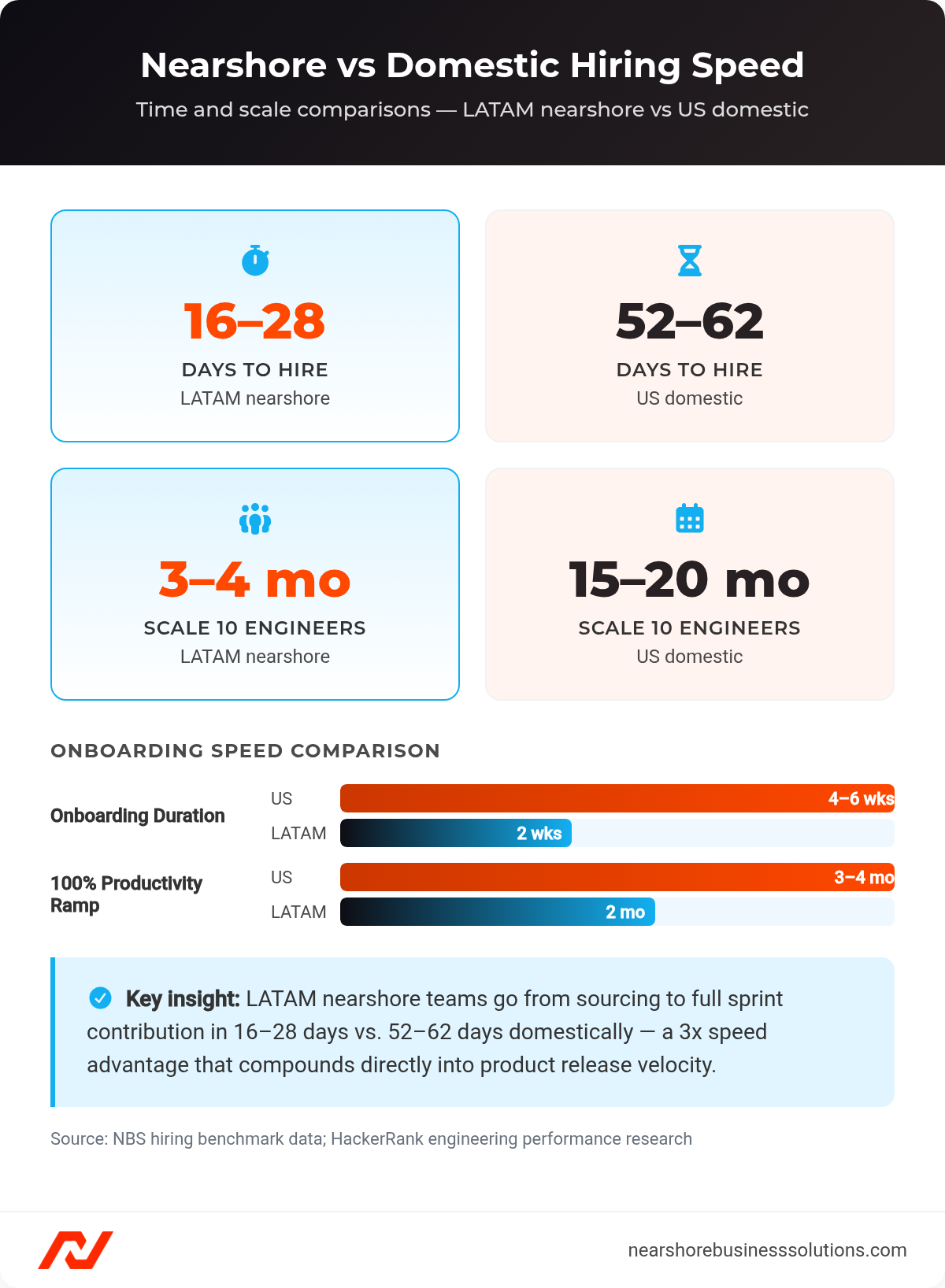
Nearshore vs. domestic hiring speed: sourcing-to-offer, onboarding, and team scaling benchmarks.
| Metric | US Domestic | LATAM Nearshore |
|---|---|---|
| Onboarding Duration | 4-6 weeks | 2 weeks |
| Productivity Ramp to 100% | 3-4 months | 2 months |
| Sourcing to Offer | 52-62 days | 16-28 days |
| Time to Scale 10 Engineers | 15-20 months | 3-4 months |
How Do You Manage and Retain a High-Performing Nearshore Development Team?
LATAM attrition sits below 10% versus 20-25% in India offshore markets. That advantage is not automatic. It requires intentional management across metrics, culture, and compensation.
What Performance Metrics Should You Track for Nearshore Engineers?
Use the same KPIs as in-house engineers: sprint velocity, PR merge rate, bug escape rate, and ticket cycle time. Nearshore teams producing 25% fewer revision cycles than offshore equivalents is the baseline benchmark. If your team is above that ratio, investigate process clarity, not engineering capability.
How Do You Build Team Culture and Engagement Across Time Zones?
US tech hub tenure averages 14 months. Top LATAM nearshore agencies report 24+ months. To sustain that gap, include nearshore engineers in company all-hands, product demos, and public recognition. Exclusion from company culture is the leading driver of voluntary attrition in distributed teams.
What Compensation and Career Growth Structures Reduce Nearshore Churn?
Four practices maintain LATAM’s attrition advantage: build explicit career ladders with LATAM-benchmarked comp bands; offer USD-denominated contracts in Argentina; provide access to certifications and conference attendance; and review comp annually, as market rates are rising 8-12% per year in senior LATAM roles.
For Mexico-specific compensation data and labor law details, see our guide to hiring developers in Mexico.
What Are the Most Common Nearshore Development Mistakes SaaS Startups Make?
Three mistakes account for most nearshore failures: poor documentation, underestimated management overhead, and misaligned vendor incentives.
How Does Poor Requirement Documentation Derail Nearshore Projects?
Asynchronous communication turns 5-minute questions into 24-hour delays. Before hiring a single LATAM engineer, establish a written Definition of Ready for tickets, a Definition of Done for PRs, and recorded video walkthroughs for complex feature specs. Nearshoring makes the cost of skipping documentation visible faster.
Why Do Startups Underestimate Nearshore Management Overhead?
Dedicated team models reduce VP of Engineering management burden by 20-25%, but only when the engagement is properly scoped. Startups that skip structured onboarding and regular 1:1s typically see the first engineer churn within 90 days. Budget at least 5 hours per week of senior US engineering leadership time during the first 90 days.
How Can Misaligned Incentives Between Vendor and Startup Slow Scaling?
Scaling 10 LATAM engineers takes 3-4 months versus 15-20 months for US engineers. Vendor misalignment erodes this advantage. Agencies may optimize for placement fees over engineer quality. Align incentives contractually: 90-day replacement guarantees, retention bonuses at 12-month milestones, and SLA penalties for sub-threshold performance.
What Does a Nearshore Scaling Playbook Look Like in Practice?
The playbook is already in production. Multiple SaaS companies across fintech, healthtech, and cybersecurity have documented the pattern across a 12-month build arc.
What Case Studies Show How SaaS Startups Have Scaled Using Nearshore Teams?
Three documented cases show the pattern across verticals:
Vouch (insurtech): Scaled to 50+ engineers in a single year using culturally aligned LATAM talent. Doubled team size while maintaining high-velocity feature deployment.
US healthcare provider (Mexico nearshore): Reduced operational costs by 40% and achieved a 15% boost in operational efficiency by nearshoring IT and medical coding support under compatible timezones and legal frameworks.
Conjur (CyberArk): Built Golang and Ruby-based security tooling with nearshore engineers. Shared timezone was cited as the enabling factor for maintaining DevOps pipeline integrity in a security-critical product.
What Milestones Should Anchor Each Phase of Nearshore Expansion?
Five milestones define a successful 12-month nearshore build. Months 1-2: finalize the engagement model and execute contracts with IP and data compliance clauses. Months 2-3: onboard the first 2-3 engineers and validate communication cadence. Months 3-6: reach full sprint contribution and establish a 1:5-7 tech lead ratio. Months 6-12: scale to target headcount and run the first compensation review. Month 12+: evaluate BOT transition if headcount exceeds 25 and assess attrition against the 10% benchmark.
How Do You Know When to Shift Nearshore Talent to Full-Time Employees?
Three FTE transition signals: an engineer has been with the team 18+ months and carries institutional knowledge; a role has shifted from project-based to core product ownership; or regional headcount is approaching 100. At that scale, the BOT model converts contractors to direct employees with proper local benefits.
Frequently Asked Questions About Nearshore Development for SaaS Startups
These are the most common questions CTOs and VPs of Engineering ask before committing to a LATAM nearshore model.
How Long Does It Take to Hire a LATAM Engineer?
Sourcing to offer takes 16-28 days through a specialized nearshore agency. That compares to 52-62 days for a US domestic senior hire. Onboarding duration runs approximately 2 weeks, versus 4-6 weeks domestically.
What If a Placed Engineer Doesn’t Work Out?
Require a 30-day replacement guarantee in your agency contract at a minimum. Most reputable LATAM agencies offer 60-90 day guarantees. Budget at least 5 hours per week of US engineering leadership time during the first 90 days to catch fit issues before they compound.
How Do I Pay LATAM Developers Legally?
Employer of Record (EOR) services handle compliant payroll, benefits, and local labor law compliance in days rather than months. For Argentina, use USD-denominated contracts due to currency volatility. Brazil and Colombia require local entity or EOR setup to comply with LGPD and Ley 1581.
What Is the Difference Between Nearshore and Offshore Development?
Nearshore means 6-8 hours of business overlap and cultural alignment with US work cadences. Offshore means 8-13 hour timezone gaps that convert routine collaboration into multi-day cycles. Nearshore teams respond to queries within 2 hours at a 95% rate. Offshore teams hit 15-25%.
Do I Need a Local Legal Entity to Hire in LATAM?
No. EOR services cover payroll, benefits, local tax compliance, and termination procedures without requiring a local entity. This is the recommended path for companies hiring fewer than 25 engineers in a single country. Above that threshold, evaluate the BOT model.
Which LATAM Country Is Best for My SaaS Startup?
Mexico and Colombia are the top choices for high-velocity Agile roles requiring strong timezone overlap. Mexico provides USMCA IP protections and the largest developer pool at 700,000+ engineers, including graduates from Tecnológico de Monterrey (ITESM) and Universidad Nacional Autónoma de México (UNAM). Colombia offers Medellín’s Ruta N ecosystem and Universidad de los Andes graduates at competitive cost efficiency. Argentina provides the highest English proficiency in the region but carries currency volatility risk.
Is Nearshore Development the Right Scaling Strategy for Your SaaS Startup?
For US SaaS companies between $5M and $100M ARR, nearshore development in Latin America is a structural growth lever. The US faces a 1.2 million engineer shortage by 2026. LATAM taps an expanding surplus in a $15 billion-plus market with improving quality, legal alignment, and timezone overlap.
Three priorities for CTOs executing this strategy:
- Timezone Parity: Prioritize Colombia and Mexico for high-velocity Agile roles. Do not accept offshore-style async workflows.
- Retention over Arbitrage: Target partners with documented 24+ month tenures. Low-cost placements that churn in 90 days cost more than premium hires who stay.
- Compliance Integration: Use EOR services to ensure LGPD and Ley 1581 compliance from day one. Retroactive compliance is expensive.
Ready to Scale Your SaaS Engineering Team?
Nearshore Business Solutions sources and vets developers from Bogotá, Medellín, Mexico City, Guadalajara, Buenos Aires, and São Paulo. We screen for technical skills, English fluency, and US work style fit. Our acceptance rate is 16%.
Every placement includes a 90-day replacement guarantee. You receive pre-vetted candidates in 2-4 weeks.
Get a free consultation to discuss your hiring needs and receive a custom quote.