
Hiring remote sales and marketing teams saves 55-75% versus US fully loaded rates, cuts time-to-fill from 45-60 days to 21-40 days, and taps a verified pool of 6 million sales and marketing professionals across LATAM and key offshore markets.
LATAM SDRs cost $20,000-$32,000 per year in Colombia versus $65,000-$85,000 in the US. Nearshore agencies fill roles in 21-40 days versus 45-60 days domestically. A 2023 industry survey found 92% of LATAM sales and marketing professionals experienced with Salesforce or equivalent CRM.
Nearshore Business Solutions sources vetted sales and marketing talent from Bogota, Medellin, Mexico City, Guadalajara, Buenos Aires, and Sao Paulo. Below, you will find cost comparisons by role and country, time zone overlap data, English proficiency benchmarks, and a role-to-country matching matrix for 2026.
Why Are Sales Leaders Choosing to Hire Remote Sales Marketing Teams in 2026?
Three economic forces have made remote hiring for revenue teams a competitive necessity. US talent costs have crossed a threshold where unfilled seats bleed pipeline value. Nearshore time zone strategies have matured beyond simple alignment. English-proficient talent pools in LATAM and offshore markets have reached a scale that removes quality trade-offs.
How Much Do You Save by Hiring a Remote SDR or BDR?
A US-based SDR in a Tier 2 city costs $87,500 fully loaded (1.25x multiplier on $70,000 base). The same role in Colombia costs $38,000 fully loaded (1.52x on $25,000 base). That is a 56.6% reduction netting $49,500 per head annually. Scale to five hires and you recover $247,500 per year.
The savings compound further at the team level. Three Colombia-based SDRs cost the same as one US-based SDR. If each SDR generates 10 qualified meetings monthly at a 20% close rate on a $25K ACV, three remote seats produce $150K in monthly pipeline for the same budget as one domestic hire producing $50K. That is a 2.3x cost-to-pipeline efficiency gain.
Recruitment costs compress too. US placement runs $15,000-$25,000 with 45-60 day time-to-fill. LATAM via nearshore agencies runs $5,000-$12,000 with 21-40 day fills. Every month an SDR seat stays empty costs roughly $4,167 in forfeited pipeline value. US companies that hire SDRs from Colombia, Mexico, or Chile through NBS fill those seats in 14-21 days.
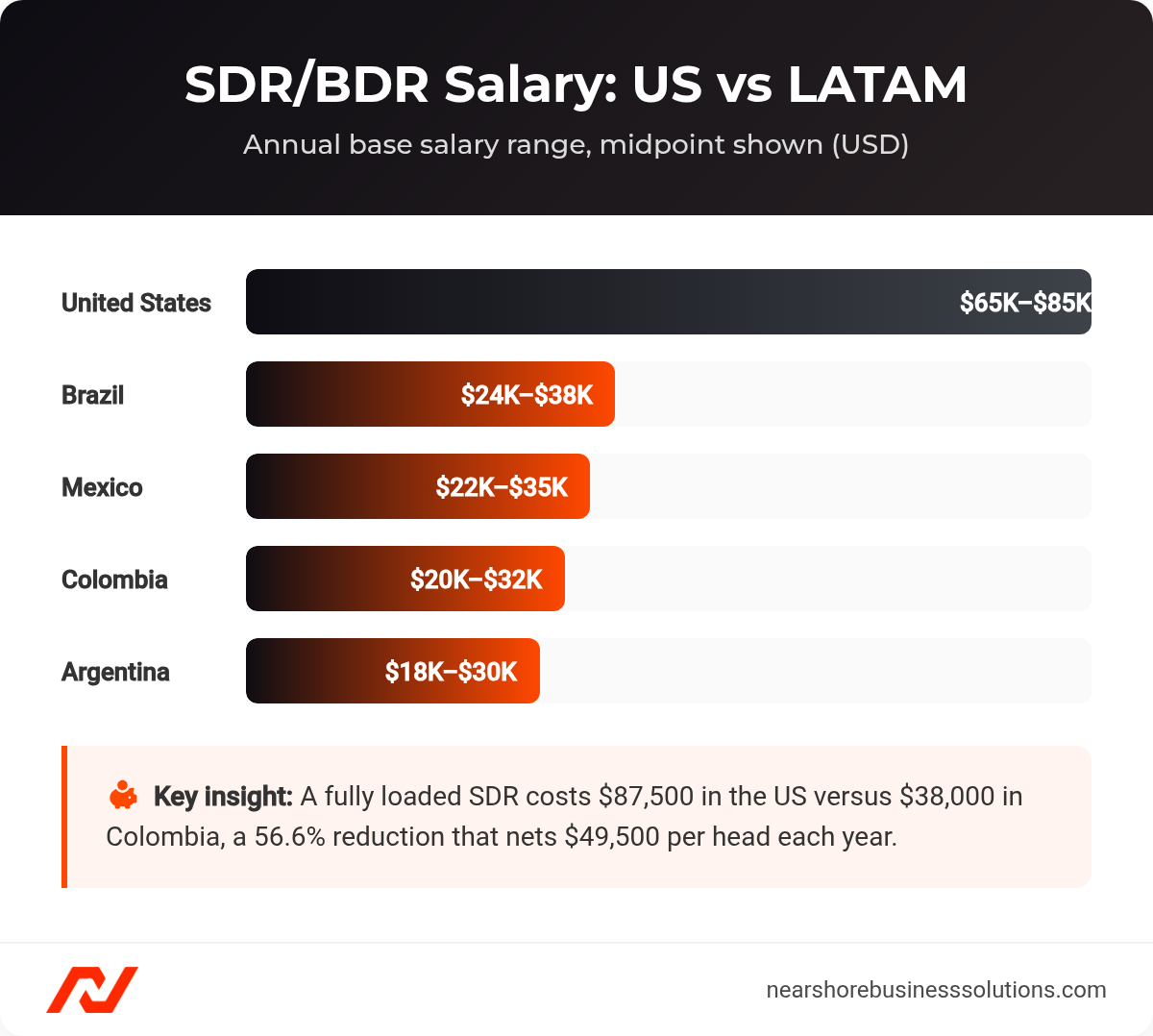
SDR/BDR base salary ranges across the US and four LATAM markets.
Annual Base Salary Ranges by Role and Country (USD)
| Role | United States | Mexico | Colombia | Argentina | Brazil | India | Poland | Philippines |
|---|---|---|---|---|---|---|---|---|
| SDR/BDR | $65,000-$85,000 | $22,000-$35,000 | $20,000-$32,000 | $18,000-$30,000 | $24,000-$38,000 | $10,000-$18,000 | $25,000-$40,000 | $9,000-$16,000 |
| Demand Gen Manager | $110,000-$140,000 | $40,000-$60,000 | $38,000-$55,000 | $45,000-$65,000 | $45,000-$65,000 | $20,000-$35,000 | $50,000-$75,000 | $18,000-$30,000 |
| Content Marketing Manager | $90,000-$120,000 | $35,000-$50,000 | $30,000-$48,000 | $28,000-$45,000 | $40,000-$55,000 | $18,000-$30,000 | $45,000-$65,000 | $15,000-$25,000 |
| SEO/SEM Specialist | $75,000-$95,000 | $25,000-$40,000 | $22,000-$38,000 | $20,000-$35,000 | $28,000-$45,000 | $12,000-$22,000 | $35,000-$55,000 | $10,000-$20,000 |
| Paid Media Specialist | $80,000-$105,000 | $28,000-$42,000 | $25,000-$40,000 | $24,000-$38,000 | $30,000-$48,000 | $14,000-$25,000 | $40,000-$60,000 | $12,000-$22,000 |
Total Cost of Employment (TCE) multipliers vary by country and determine budgeting accuracy. Key multipliers: USA (1.18x-1.25x), Mexico (1.35x-1.50x), Colombia (1.45x-1.52x), Argentina (1.60x-1.75x), Brazil (1.65x-1.80x). Ignoring them leads to budget overruns of 20-40%.
Why Does Time Zone Overlap Matter More Than Time Zone Match for Sales Teams?
4-6 hours of real-time overlap sets the operational floor for a functional remote sales team. That window covers morning standups, live deal-desk escalations, and prospect calls during US business hours. Requiring a perfect 8-hour time zone match eliminates 80% of the global talent pool and solves a problem that does not exist.
LATAM delivers the strongest overlap economics for US companies. Mexico and Colombia share 7-9 hours of real-time coverage with US Eastern and Central time zones. Argentina and Brazil provide 5-7 hours with US Eastern, covering the full core selling window. India offers 0-1.5 hours. The Philippines offers effectively zero.
Mexico eliminated daylight saving time for most of the country in late 2022. Brazil does not observe DST. Neither country requires schedule adjustments twice per year.
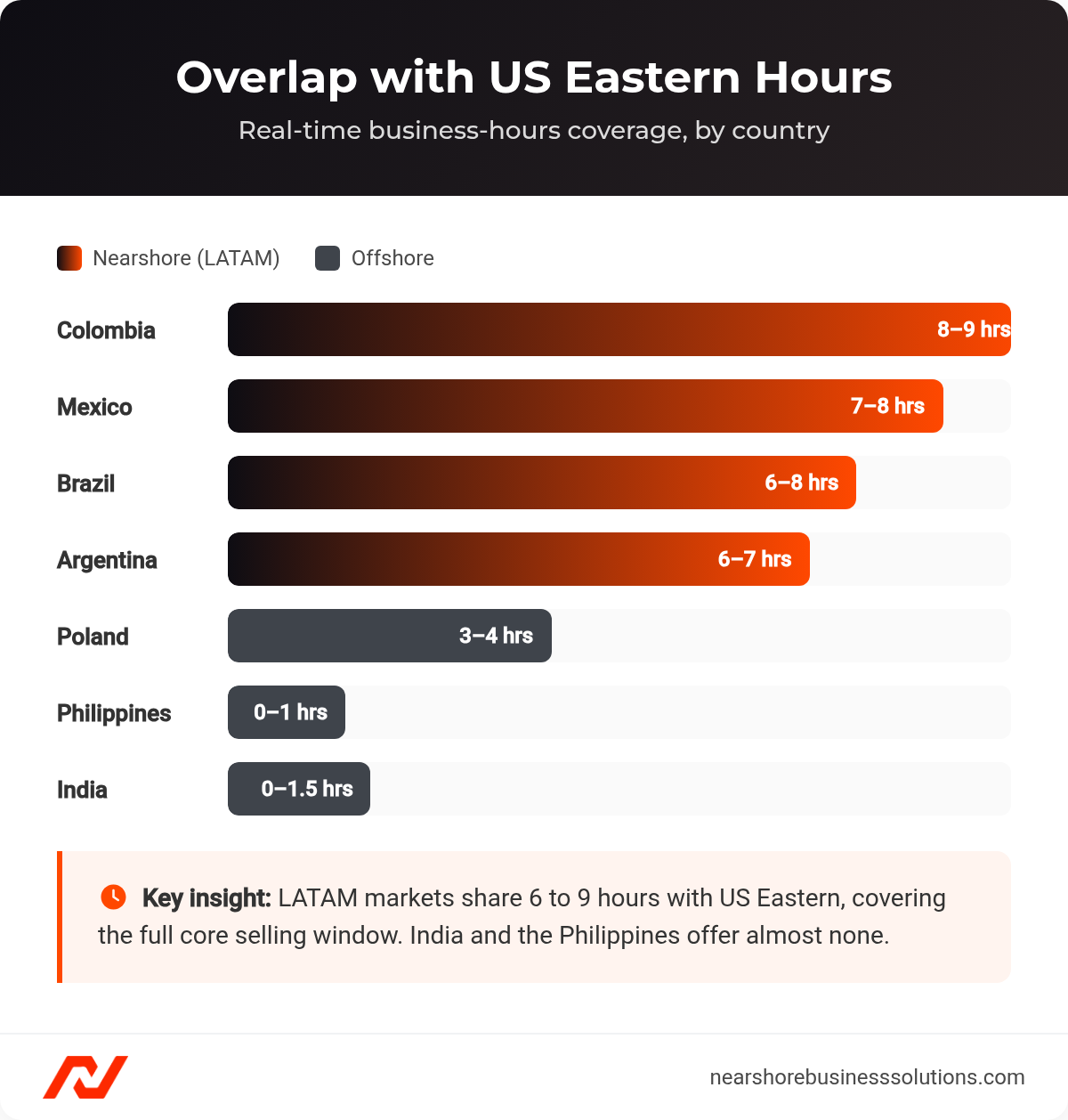
Business-hours overlap with US Eastern time by country, nearshore versus offshore.
Business-Hours Overlap with US Time Zones
| Country | Overlap with US Eastern | Overlap with US Central | Overlap with US Pacific |
|---|---|---|---|
| Mexico | 7-8 hours | 8-9 hours | 6-7 hours |
| Colombia | 8-9 hours | 7-8 hours | 5-6 hours |
| Argentina | 6-7 hours | 5-6 hours | 3-4 hours |
| Brazil | 6-8 hours | 5-7 hours | 3-5 hours |
| South Africa | 3-4 hours | 2-3 hours | 0-1 hours |
| Poland | 3-4 hours | 2-3 hours | 0-1 hours |
| Philippines | 0-1 hours | 0 hours | 0 hours |
| India | 0-1.5 hours | 0 hours | 0 hours |
What English Proficiency Level Do Revenue-Facing Roles Actually Require?
EF EPI rankings place Argentina at #28 (High), Brazil at #70, Colombia at #75, and Mexico at #89 globally. These national averages measure the general population and should be largely ignored for hiring decisions. Among university-educated professionals in tech and business seeking US-facing remote roles, industry estimates place business-fluent English at 70-80%. The English-speaking sales and marketing talent pool across key LATAM markets exceeds 1.2 million professionals (NBS market estimate, derived from EF EPI country data, LinkedIn Talent Insights, and Coursera Global Skills Report enrollment data).
Role requirements should drive the proficiency rubric. Outbound SDRs need C1-level spoken fluency for real-time objection handling. Content marketers need C1-level written proficiency for editorial-quality prose. SEO specialists and marketing ops analysts need only B2 professional working proficiency for clear written communication. A blanket “must be fully fluent” standard unnecessarily shrinks the candidate pool for roles where technical execution outweighs verbal polish.
For BDR and SDR hiring in Latin America, we assess spoken fluency separately from written proficiency and match candidates to role requirements rather than applying a single standard across all revenue positions.
Which LATAM Countries Are Best for Nearshore Sales Team Hiring?
LinkedIn Talent Insights counts 6.05 million sales and marketing professionals across the four primary LATAM markets. Universities across the region graduate approximately 760,000 business, marketing, and communications students annually (NBS market estimate, based on national education ministry data for Mexico, Colombia, Argentina, and Brazil). A 2023 industry survey found 92% experienced with Salesforce or an equivalent CRM, 85% proficient in HubSpot, and 78% skilled in Outreach or Salesloft. Over 200,000 hold Google Ads certifications, 150,000 carry HubSpot certifications, and 50,000 maintain Salesforce credentials. The nearshore staffing industry serving US companies in LATAM is growing at a CAGR of 25-30% (2023-2025), per NBS market estimate aligned with Everest Group and Staffing Industry Analysts nearshore segment reporting.
Our nearshore talent solutions cover all six LATAM markets below with sourcing, vetting, and placement under a 90-day replacement guarantee.
Why Is Colombia the Top Choice for Nearshore Outbound SDR and BDR Teams?
Colombia delivers the best combination of time zone overlap, English proficiency, cost savings, and BPO infrastructure for US SaaS companies building outbound sales engines. Bogota offers a large candidate pool with mature BPO infrastructure. Medellin’s startup scene, concentrated around the Ruta N innovation district, produces SDRs with direct SaaS exposure. COT (UTC-5) delivers 8-9 hours of overlap with US Eastern time.
Within curated talent pools built through agencies like Nearshore Business Solutions, business fluency rates reach 70-80%. Colombian SDRs frequently display a neutral accent that US prospects cannot place geographically. Talent sourced through Universidad de los Andes, EAFIT, and Universidad Nacional feeds both the BPO and SaaS sales pipelines across Bogota and Medellin. Companies that hire SDRs in Latin America through NBS draw candidates from these same universities.
The TCE multiplier of 1.45x-1.52x delivers SDR cost savings of 65-75% versus US equivalents. WTW projects 9.9% year-over-year salary increases, so budget for 10% annual escalation from day one.
Cloudflare hired 4+ BDRs in Colombia achieving 110% of quota in their first quarter with ramp time under 60 days. ServiceTitan scaled to 10+ BDRs booking 12-15 qualified demos per BDR per month, contributing to a 30% pipeline increase within the first year.
Why Does Argentina Offer High-Caliber Remote Marketing Talent With Cost Advantages?
Argentina pairs the highest English proficiency in LATAM (EF EPI #28) with economic conditions that make senior marketing talent accessible at mid-market budgets. Buenos Aires concentrates the majority of English-fluent content marketers and demand generation professionals. Universities like UBA (Universidad de Buenos Aires) and ITBA produce marketing and analytics graduates who enter the professional market with strong written English. ART (UTC-3) delivers 6-7 hours of overlap with US Eastern.
The TCE multiplier of 1.60x-1.75x is the highest among primary LATAM markets, but marketing role savings still reach 65-75% versus US equivalents. Triple-digit inflation makes USD-pegged salaries a retention advantage that domestic employers cannot match. Budget for compensation reviews every 6 months. Companies like Mercado Libre, Globant, and Auth0 have built large marketing teams in Buenos Aires, validating the depth of the talent market. Whether you hire locally or nearshore, our guide to making a successful marketing hire covers the cost factors and vetting steps to get the decision right.
An anonymized FinTech SaaS company hired a Content Marketing Manager and SEO Specialist in Buenos Aires. Within 6 months, organic traffic increased 40%, MQLs from content doubled, and annual cost savings totaled $130,000 versus New York hires.
What Makes Mexico the Largest Nearshore Talent Pool for Bilingual Sales Roles?
Mexico’s talent pool is double Colombia’s count, making it the largest absolute nearshore market in LATAM. Mexico City delivers the deepest enterprise SaaS sales bench. Monterrey produces bilingual professionals shaped by proximity to the Texas border and graduates from Tecnologico de Monterrey (ITESM). Guadalajara, often called Mexico’s Silicon Valley, generates startup-native sales fluency and houses a growing martech cluster. The TCE multiplier of 1.35x-1.50x is the lowest among primary LATAM markets.
WTW projects only 5.2% salary increases in Mexico for 2025, the most predictable budget trajectory among primary LATAM markets. The IMMEX manufacturing program has historically positioned Mexico as a cross-border business hub, deepening the bilingual professional talent base.
Gong hired 5 SDRs in Mexico booking 150 qualified meetings in six months, influencing $2M in pipeline at 60% cost savings. Anaplan hired 8 SDRs achieving 105% quota attainment with cost per meeting 45% lower than US counterparts. GoSite hired 6 SDRs booking 400 meetings in their first quarter, sourced and onboarded in 35 days.
Why Is Brazil a Strong Market for Demand Generation and Marketing Operations Hiring?
Brazil’s talent market is the largest in LATAM and the most underused by US companies. The primary reason is Portuguese as the first language. However, Brazil’s absolute volume of English-proficient professionals (approximately 450,000, per NBS market estimate based on EF EPI data and Brazilian Ministry of Education enrollment figures) exceeds Argentina’s entire professional base. Sao Paulo concentrates multinational corporate experience. Curitiba produces marketing operations talent with deep HubSpot, Google Analytics, and Tableau expertise. Brazil leads LATAM alongside Mexico in professional certifications across Google, HubSpot, and Salesforce platforms.
BRT (UTC-3) delivers 6-8 hours of overlap with US Eastern. The TCE multiplier of 1.65x-1.80x is the highest in the region. Fully loaded costs for marketing ops roles land 55-70% below US equivalents. WTW projects 6.5% salary increases, moderate and predictable. Brazil’s LGPD (data protection framework) provides a compliance structure familiar to EU-experienced marketing ops professionals.
Nextbite built a 15-person sales and marketing team in Brazil contributing to $5 million in pipeline within the first year at 65% cost savings.
Are Costa Rica and Chile Worth Considering for Nearshore Sales Hiring?
Yes, both are strong supplemental markets for targeted roles, not large-scale team builds. Costa Rica operates on CST with 7-8 hours of US Eastern overlap, ranks #40 on EF EPI, and excels at customer success and account management roles. Mature BPO infrastructure anchored by Amazon, HP, and Intel provides a trained talent pipeline. Its TCE multiplier of 1.40x-1.55x sits mid-range for LATAM. San Jose produces professionals familiar with US enterprise buying cycles through decades of BPO and tech support work.
Chile offers the lowest TCE multiplier in South America (1.30x-1.40x). Santiago’s fintech cluster produces strong marketing analytics and RevOps talent. RevOps and marketing operations professionals in Santiago frequently hold HubSpot and Salesforce certifications and have experience supporting US-headquartered companies operating across Latin America. Both countries are best deployed for 1-5 targeted hires in specialized roles rather than scaled SDR or BDR team builds.
Which Offshore Countries Have the Best Cost Per Hire for Marketing Roles?
Offshore markets deliver deeper cost savings than nearshore options but reduce time zone overlap significantly. They perform best for marketing functions where asynchronous workflows are viable: content creation, demand generation execution, paid media, and analytics.
The Philippines is the most established offshore destination for English-proficient content marketing, email marketing, and social media management. Costs run 70-80% below US benchmarks. The 12-13 hour offset from US Eastern works for async workflows.
South Africa (UTC+2, 3-4 hours morning overlap with US Eastern) combines near-native English, Western cultural alignment, and competitive costs. It is the offshore market that behaves most like a nearshore one, particularly strong for BDR and customer success roles.
Poland (CET, 3-4 hours morning overlap with US Eastern) offers strong demand generation, marketing ops, and martech talent. EU membership provides built-in GDPR compliance for companies with European customer data obligations.
India (UTC+5:30, 0-1.5 hours overlap) delivers scale and cost efficiency for marketing analytics, SEO, and paid media. It is not suited for live phone-based SDR roles but excels at async execution.
How Do You Match the Right Country to Each Sales or Marketing Role?
The best model blends nearshore markets for real-time pipeline roles and offshore markets for async content and execution. Use the matrix below to match role requirements to regions.
| Role Type | Sync/Async | Min. Overlap | English Level | Best-Fit Countries |
|---|---|---|---|---|
| SDR Cold Calling | Sync | 6-8 hrs | Near-native spoken | Colombia, Mexico |
| SDR Email/LinkedIn | Async | 3-4 hrs | Business fluent (written) | Colombia, Argentina, South Africa |
| BDR Discovery Calls | Sync | 6-8 hrs | Near-native spoken | Colombia, Mexico, Argentina |
| Content Marketing Manager | Async | 2-4 hrs | Business fluent (written) | Argentina, Poland, Philippines |
| SEO/SEM Specialist | Async | 2-3 hrs | Moderate technical | India, Poland, Philippines |
| Paid Media Specialist | Async | 2-3 hrs | Moderate technical | India, Poland, Brazil |
| Demand Gen Manager | Mixed | 4-6 hrs | Business fluent | Colombia, Mexico, Poland |
| Marketing Ops / RevOps | Async | 2-4 hrs | Moderate technical | India, Poland, Brazil |
| Customer Success | Sync | 5-7 hrs | Near-native | Costa Rica, Colombia, South Africa |
The key decision variables are three: required overlap hours, English fluency level, and whether the role requires live synchronous interaction or can operate async. Cold-calling SDRs and discovery BDRs require near-native spoken English and 6-8 hours of overlap. Content and SEO roles need strong written proficiency and can tolerate 2-4 hours of overlap or full async.
For a detailed cost and coverage breakdown by role, see our staff augmentation hiring guide for both nearshore and offshore engagement models.
What Are the Most Frequently Asked Questions About Hiring Remote Sales and Marketing Teams?
These are the most common questions US sales and marketing leaders ask about building remote revenue teams.
How Long Does It Take to Hire a Remote SDR or BDR Through a Nearshore Agency?
Nearshore agencies fill SDR and BDR roles in 21-40 days from kickoff to start date. This includes candidate sourcing, vetting for spoken English and tool proficiency, and final interviews with your team. US-based hiring for the same roles typically runs 45-60 days with $15,000-$25,000 in placement costs.
What If a Remote Sales Hire Does Not Work Out?
Reputable nearshore agencies include a 90-day replacement guarantee. If a hire exits within the first 90 days for any reason, the agency sources and places a replacement at no additional placement fee. This is standard at Nearshore Business Solutions across all SDR, BDR, and marketing placements.
Do I Need to Set Up a Legal Entity to Hire Remote Sales Staff in LATAM?
No. An Employer of Record (EOR) structure handles legal employment in Colombia, Mexico, Argentina, Brazil, or Costa Rica without requiring a local entity. The EOR employs the worker locally, handles payroll and tax compliance, and your company manages the day-to-day work. Learn more about employer of record options in Latin America.
How Do I Pay Remote LATAM Sales and Marketing Employees?
Most US companies pay through the nearshore agency or EOR in USD. The agency converts to local currency and handles payroll tax obligations in each country. USD-pegged compensation is a strong retention lever in markets like Argentina where local inflation is high.
What Is the Difference Between Nearshore and Offshore for Sales Roles?
Nearshore means hiring in countries with significant time zone overlap with the US, typically 5-9 hours for LATAM. Offshore means hiring in countries with minimal overlap, typically 0-4 hours for Asia and parts of Europe. For live, phone-based sales roles requiring real-time interaction, nearshore is required. For async marketing execution roles like content writing, SEO, or paid media, offshore can deliver deeper cost savings.
What Tool Proficiency Can I Expect From LATAM Sales and Marketing Hires?
High. A 2023 industry survey found 92% of LATAM sales and marketing professionals experienced with Salesforce or equivalent CRM. 85% proficient in HubSpot. 78% skilled in Outreach or Salesloft. Over 200,000 hold Google Ads certifications and 150,000 carry HubSpot certifications. Expect platform-ready candidates who need minimal tool onboarding.
How Do I Handle SDR Ramp Time for a Remote Hire?
Remote SDR ramp times in Colombia and Mexico run 45-60 days through experienced nearshore agencies. Cloudflare achieved full quota attainment within the first quarter for Colombia-based BDRs. Structured onboarding with daily standups, recorded call reviews, and a shared playbook during the first 30 days compresses ramp time regardless of location.
How Do You Get Started Building a Remote Sales and Marketing Team?
Nearshore Business Solutions sources and vets SDRs, BDRs, demand generation managers, and content marketers from Bogota, Medellin, Mexico City, Guadalajara, Buenos Aires, and Sao Paulo. We screen for spoken English fluency, tool proficiency, and US work style fit.
Every placement includes a 90-day replacement guarantee. You receive pre-vetted candidates in 21-40 days.
Get a free consultation to discuss your sales and marketing hiring needs and receive a custom quote.