
LATAM developers deliver 8-12 hours of daily overlap with US teams, versus zero natural overlap from Manila, making nearshore LATAM the default choice for real-time engineering collaboration.
LATAM’s developer pool exceeds 1.25 million engineers, more than 5x the Philippines’ 210,000-230,000 (A.T. Kearney 2023; PSIA 2023). Senior engineers in Colombia cost $70,000-$100,000 fully loaded, versus $50,000-$75,000 base in Manila, but all-in BPO seat costs in the Philippines reach $99,000-$121,000, erasing the headline savings (Emapta; Booth & Partners, 2024).
We place engineers across Colombia, Mexico, Argentina, and Brazil through direct EOR contracts. Below, you’ll find a five-axis comparison covering time zone overlap, English proficiency, IP protection, fully loaded cost, and tech stack depth, plus a decision framework for choosing the right region for each role type.
Why Does the LATAM vs Philippines Decision Affect Your Engineering Velocity?
Teams with fewer than four daily overlap hours ship code measurably slower. Harvard Business Review found that asynchronous handoffs break down for collaborative problem-solving (“The Overlooked Importance of Time Zones,” 2021). Stripe quantified the cost: developers lose over 11 hours per week to collaboration inefficiencies, and the ideal colleague response time is under one hour (Stripe Developer Coefficient Report, 2022). An 8-plus-hour time zone gap makes sub-one-hour response cycles impossible.
Why Are CTOs Reversing Pure-Offshore Decisions in 2024-2026?
Companies that moved engineering to Southeast Asia between 2019 and 2022 are unwinding those decisions. The failure pattern repeats: async-only standups miss blockers. Pull requests sit 12-16 hours for review. Philippines tech attrition runs 20-30% annually in the BPO sector (Willis Towers Watson, 2023). One mid-market SaaS CTO described the effect: “The 24-hour feedback loop for code reviews was killing our velocity. A simple bug fix could take 3 days.” After migrating to Colombia, sprint velocity doubled within three months (published nearshore engineering case study, 2022).
The core issue is structural. Philippines engineers operating at a Hofstede power distance score of 94, versus the US at 40, default to agreement rather than surfacing risks (Hofstede Insights). Sprint retrospectives produce engineers who report the sprint went well when it did not. LATAM countries cluster between 35 and 81 on the same scale, closer to US norms.
How Does Time Zone Overlap Compare When You Hire LATAM vs Philippines?
LATAM delivers 8-12 hours of daily overlap with US teams. Manila delivers zero natural overlap with any US time zone.
| US Time Zone | Mexico City | Bogota | Sao Paulo | Buenos Aires | Manila |
|---|---|---|---|---|---|
| Pacific | 2 hr ahead | 3 hr ahead | 5 hr ahead | 5 hr ahead | 15 hr, 0 overlap |
| Central | Same zone | 1 hr ahead | 3 hr ahead | 3 hr ahead | 13 hr, 0 overlap |
| Eastern | 1 hr behind | 0 hr diff | 2 hr ahead | 2 hr ahead | 12 hr, 0 overlap |
| Factor | LATAM (0-3 hr offset) | Philippines (12-15 hr offset) |
|---|---|---|
| Agile ceremonies | Full real-time attendance | Degrades to recorded Loom updates |
| Pair programming | Seamless multi-hour sessions | Requires midnight-6 AM shifts |
| Code review turnaround | Minutes to hours | Minimum 12-24 hours per cycle |
| Spontaneous collaboration | Works anytime | Every interaction needs day-ahead scheduling |
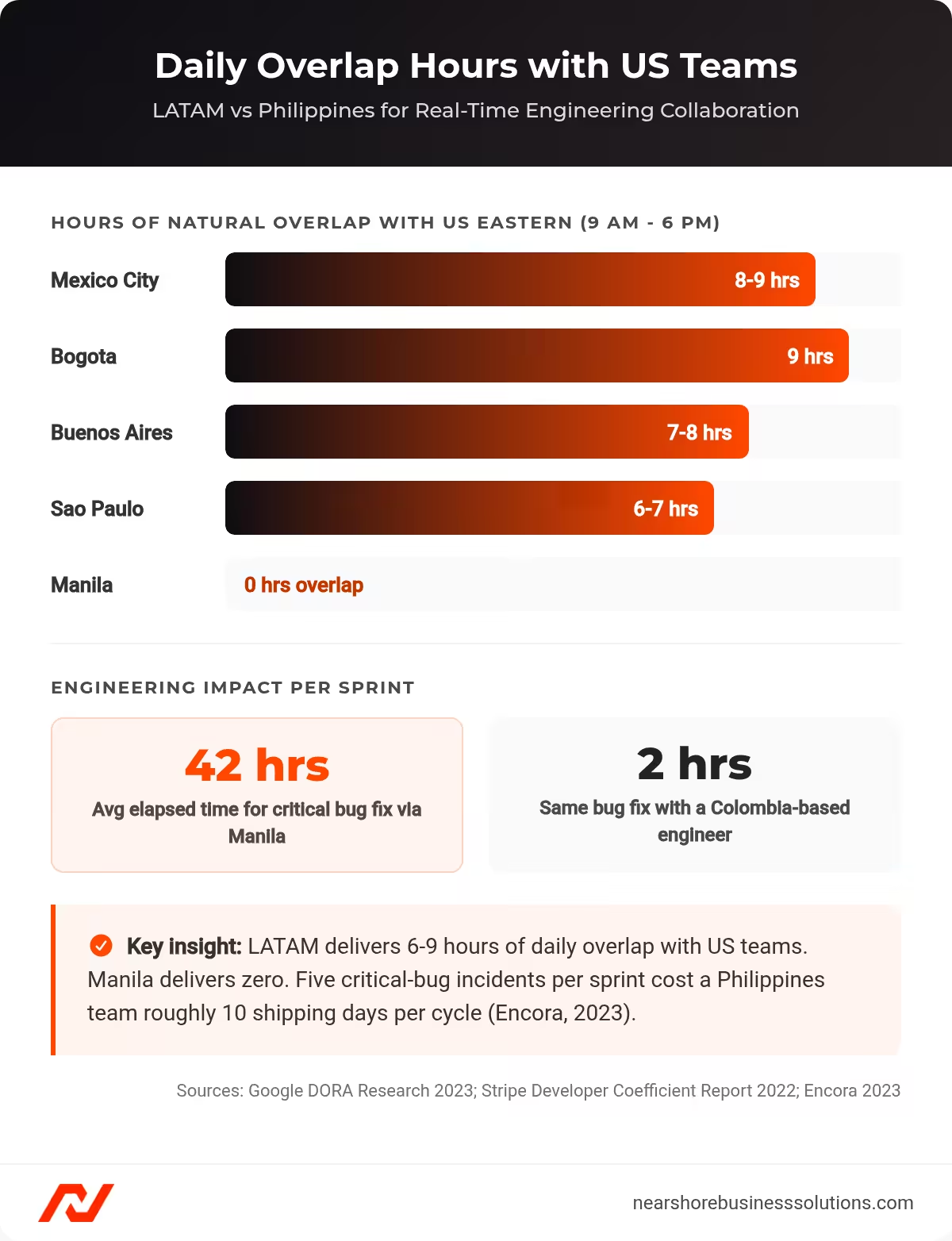
Daily overlap hours with US Eastern: LATAM delivers 6-9 hours, Manila delivers zero.
How Does the Async Tax Compound Over a Sprint?
A six-person team (three US, three nearshore) generates 60 synchronous touchpoints in a two-week sprint. With a LATAM team, roughly 55-58 resolve within the same session. With a Philippines team, close to zero resolve during natural hours (Google DORA Research, 2023).
The compounding effect is concrete. A senior US engineer finds a critical bug at 3 PM Eastern. A Colombian colleague at 1 PM in Bogota joins immediately. Fix committed by 5 PM. Elapsed time: two hours. The same bug reaches Manila at 3 AM. After two rounds of queued clarifying questions, the fix lands Thursday morning Eastern. Elapsed time: approximately 42 hours. Five such incidents per sprint cost roughly ten shipping days per cycle. A US FinTech client reduced time-to-market by 40% after consolidating into a LATAM nearshore team, citing time zone alignment as the primary driver (Encora, 2023).
GitLab’s Team Handbook (2024) specifies that teams should organize into regional clusters sharing at least four hours of overlap. Both Job van der Voort (CEO, Remote.com) and David Heinemeier Hansson (CTO, 37signals) independently identified two to four hours of daily overlap as the minimum for unblocking teammates.
When Does Philippines Time Zone Actually Work?
The Philippines time zone becomes an asset for coverage-based roles, not product engineering. A Manila engineer’s 9 AM-5 PM maps to 9 PM-5 AM Eastern, covering the US overnight window at standard daytime rates with no night-shift premium. Philippines DevOps/SRE salaries run $45,000-$80,000 fully loaded versus LATAM equivalents at $65,000-$130,000 (published 2024 global salary data). For 24/7 NOC/SOC operations, follow-the-sun DevOps rotation, and Tier 1-2 support following established runbooks, the Philippines delivers strong ROI.
How Do English Proficiency and Communication Culture Compare?
English fluency rates differ dramatically: roughly 80-90% of Filipino developers reach business-level English. Only 15-20% of LATAM’s total developer pool reaches equivalent fluency. The Philippines ranks 20th globally on the EF English Proficiency Index (2023), above every Latin American country except Argentina at 28th.
That headline misleads. CTOs hire from the subset vetted for US-facing work on established developer marketplaces. Within that filtered pool, LATAM’s absolute number of English-fluent developers exceeds the Philippines’ because the underlying base is 5x larger. Brazil alone graduates more software engineers annually than the Philippines (OECD, 2023). Vetted LATAM developers routinely test at C1/C2 levels, the same tier where Filipino developers operate.
| Country | EF EPI Rank | Power Distance | Communication Style |
|---|---|---|---|
| United States | Baseline | 40 | Direct, debate-oriented |
| Argentina | 28 | 49 | Most direct in LATAM. Comfortable debating tradeoffs |
| Philippines | 20 | 94 | Deferential. Excels at following established processes |
| Colombia | 75 | 67 | Relationship-first, increasingly direct in tech |
| Mexico | 89 | 81 | Adapting rapidly. US proximity drives cultural convergence |
Source: EF English Proficiency Index 2023; Hofstede Insights 2024.
The real gap is cultural. The Philippines’ power distance score of 94, a 54-point gap against the US, predisposes professionals to defer to seniority and avoid contradicting authority. In sprint retrospectives, this manifests as engineers who approve a PR without flagging the edge case they noticed. The cultural norm of Pakikisama (group harmony) clashes with the “disagree and commit” culture US tech companies expect.
Argentina and Costa Rica (power distance: 35) sit within single digits of the US baseline. LATAM engineers from those markets find architectural pushback and proactive risk-flagging natural rather than transgressive.
For senior roles requiring design debate and proactive risk escalation, LATAM software engineers deliver the communication culture US tech teams need.
Is Hiring in the Philippines Actually Cheaper? A Fully Loaded 2026 Cost Breakdown
A senior engineer in Manila costs $50,000-$75,000 in base compensation. Bogota runs $70,000-$100,000. That 30% gap is real and is the wrong number to optimize against.
| Mexico | Colombia | Argentina | Brazil | Philippines | |
|---|---|---|---|---|---|
| Senior SW Eng | $75k-$110k | $70k-$100k | $65k-$95k | $80k-$120k | $50k-$75k |
| Staff/Principal | $115k-$150k+ | $105k-$140k+ | $100k-$130k+ | $125k-$160k+ | $80k-$110k+ |
| DevOps/SRE | $70k-$120k | $65k-$110k | $65k-$100k | $75k-$130k | $45k-$80k |
| TCE Multiplier | 1.30x-1.40x | 1.45x-1.55x | 1.25x-1.35x | 1.50x-1.70x | 1.25x-1.35x |
| EOR/Partner Cost | $500-$800/mo | $500-$800/mo | $500-$800/mo | $500-$800/mo | 1.8x-2.2x base (BPO) |
| Attrition Rate | 15-25% | 15-25% | 15-25% | 15-25% | 20-30% |
Sources: published 2024 global salary data; Emapta; Booth & Partners 2024.
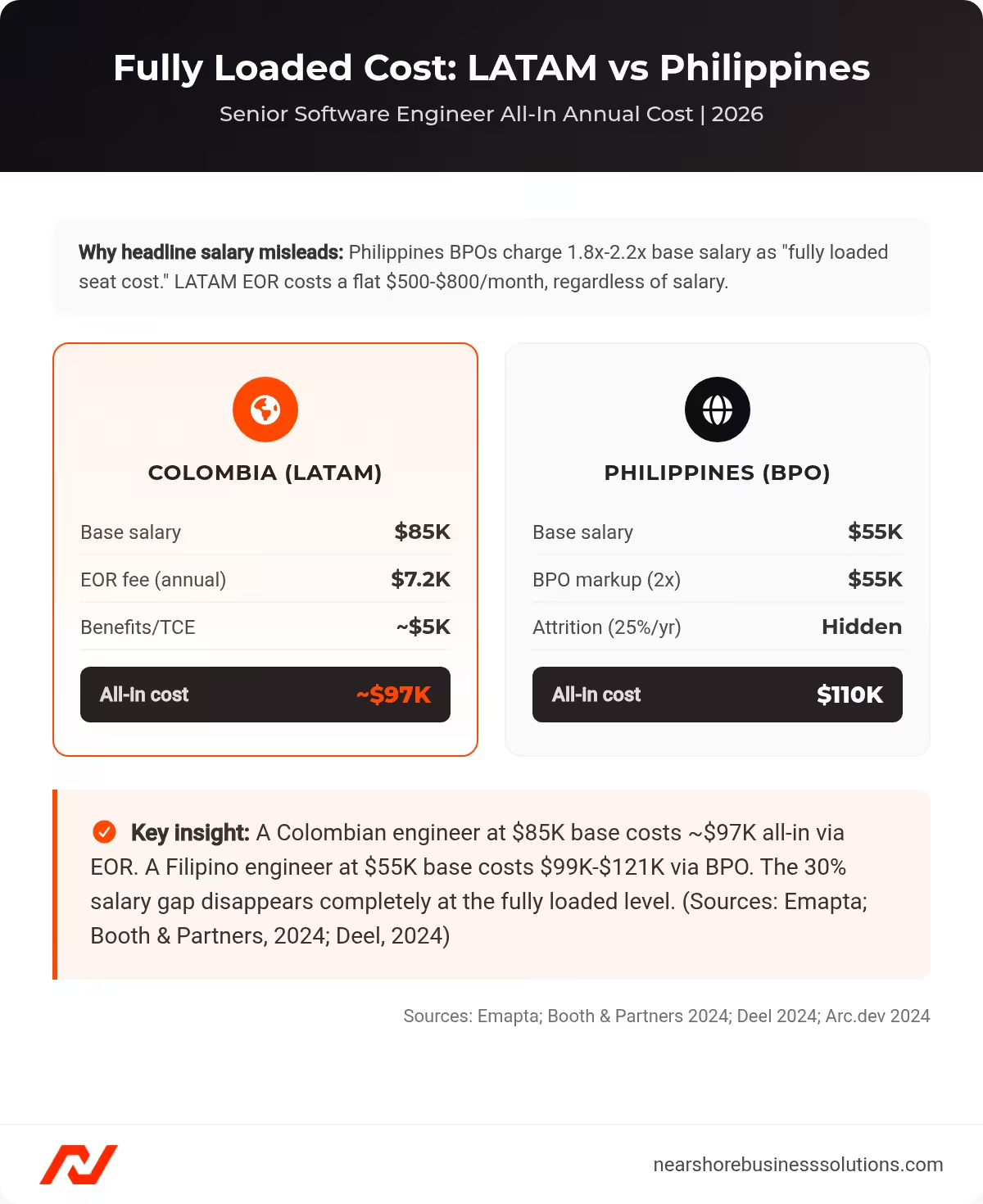
Fully loaded cost comparison: Colombia EOR at $97K vs Philippines BPO at $110K for a senior engineer.
Three patterns emerge from the fully loaded comparison.
First, the senior-level gap compresses to noise. A staff engineer in Manila costs $80,000-$110,000 versus $100,000-$130,000 in Argentina. The difference is roughly $1,600/month. One multi-day async delay on a critical feature costs more in blocked engineering time.
Second, the BPO markup restructures the Philippines’ equation. LATAM’s EOR model charges a transparent $500-$800/month. Philippines BPOs quote “fully loaded seat costs” at 1.8x-2.2x base salary (Emapta; Booth & Partners, 2024). A Filipino senior engineer earning $55,000 generates a seat cost of $99,000-$121,000. A Colombian earning $85,000 plus $7,200 annual EOR fee totals $92,200, lower all-in despite the higher engineer salary.
Third, attrition compounds hidden costs. Every departure costs 3-6 months of productive capacity. Philippines’ 20-30% annual attrition versus LATAM’s 15-25% means more frequent replacement cycles. One nearshore hiring platform documented this contrast: a Hims & Hers engagement achieved 95% retention over two years with a 40-plus-engineer LATAM team (published platform case study, 2023).
For a comparison between nearshore and offshore hiring models, including how EOR structures affect IP ownership and total cost, see our dedicated guide.
How Do IP Protection and Legal Compliance Compare?
Both regions signed WIPO, the Berne Convention, and TRIPS. The U.S. Chamber International IP Index (2024) reveals meaningful differences: Mexico ranks 26th, Brazil 31st, Colombia 34th, Philippines 39th, and Argentina 47th. Mexico’s participation in USMCA includes a comprehensive IP chapter aligning its laws with US standards. No equivalent bilateral agreement exists with the Philippines.
LATAM’s dominant hiring model, direct hire via EOR, creates an employer-employee relationship with clear IP assignment. The Philippines’ BPO model creates a vendor relationship with IP flowing through an intermediary. Both regions have modern data privacy frameworks: Brazil’s LGPD mirrors GDPR and the Philippines’ Data Privacy Act of 2012 provides comparable protections. LATAM’s EOR structure gives CTOs more direct control over IP ownership and data handling.
Which Tech Stack Does Each Region Support Best?
LATAM’s engineer pool is strongest in the stacks that power modern US SaaS companies. The Philippines’ pool is deeper in enterprise systems and BPO-adjacent automation.
| Attribute | LATAM | Philippines |
|---|---|---|
| Core Strengths | React, Node.js, Python, Java (Spring), AWS/GCP cloud-native | Java, .NET, C#, PHP, Angular. Enterprise systems |
| Emerging Areas | AI/ML, cloud-native architecture, open-source | Automation/RPA, enterprise integration, QA at scale |
| Seniority Distribution | Senior 35%, Mid 45%, Junior 20% | Senior 20%, Mid 40%, Junior 40% |
| HackerRank Rankings | Argentina #36, Brazil #38, Mexico #41 (HackerRank Developer Skills Report 2023) | #46 |
| Developer Pool | 1.25 million+ | 210,000-230,000 |
| Annual STEM Graduates | 750,000+ | 130,000-150,000 |
| Ecosystem Alumni | MercadoLibre, Nubank, Rappi, Globant | Primarily BPO/enterprise service providers |
LATAM’s 35% senior concentration versus the Philippines’ 20% reflects ecosystem maturity. Engineers from MercadoLibre, Nubank, and Rappi bring scale-up experience directly relevant to US product companies. HubSpot built a major engineering hub in Bogota citing talent quality and cultural alignment (HubSpot Careers Blog, 2022). Zapier chose Colombia and Mexico because time zone alignment was their top factor (Zapier Blog, 2023).
For cloud-native, React/Node/Python, or AI/ML work, LATAM delivers the seniority depth and ecosystem experience the Philippines cannot match at scale.
How Should You Choose Between LATAM and the Philippines?
Your role type drives the decision. Core product engineering needs overlap and debate. Coverage roles need hours without night-shift premiums.
- Real-time collaboration and sprint velocity: LATAM
- Engineers who push back in design reviews: LATAM (power distance 35-81 versus Philippines 94)
- Cost savings on junior/mid roles with defined async tasks: Philippines
- IP protection with US-aligned legal frameworks: LATAM, especially Mexico (USMCA)
- 24/7 coverage or follow-the-sun DevOps: Philippines
- Cloud-native, React/Node/Python, or AI/ML stack: LATAM
- Enterprise Java, .NET, or QA at scale: Philippines
What Does the Hybrid Model Look Like in Practice?
The sophisticated play is not binary. Hire core product engineers in LATAM via EOR for real-time collaboration and IP protection. Hire support, QA, and overnight operations in the Philippines for cost efficiency and follow-the-sun coverage. Define clear handoff protocols between the two layers. Measure cost-per-feature for LATAM teams and SLA adherence for Philippines ops teams separately.
The deciding question is simple: does this role need to overlap with your team, or extend it? Overlap roles go LATAM. Extension roles can go Philippines.
To explore remote talent acquisition models including EOR, staff augmentation, and hybrid team structures, see our full guide.
Frequently Asked Questions About LATAM vs Philippines Hiring
These are the most common questions CTOs ask when evaluating LATAM versus Philippines for remote engineering teams.
How Long Does It Take to Hire LATAM Engineers?
Specialist LATAM roles close in under 2 weeks through a qualified nearshore partner, with standard roles within 30 days, with a pre-vetted shortlist delivered within 3 business days.
What If a Developer Does Not Work Out?
NBS includes a 90-day replacement guarantee on all placements. If a developer leaves or underperforms within the first 90 days, we replace them at no additional cost. This is standard across our LATAM placements.
How Do You Pay Remote LATAM Engineers?
LATAM engineers hired via EOR are paid through the EOR provider in their local currency. You pay a single invoice in USD. EOR costs run $500-$800/month per engineer on top of salary, covering payroll, benefits, and compliance.
Do I Need a Local Legal Entity to Hire in LATAM?
No. EOR structures eliminate the need for a local entity in Colombia, Mexico, Argentina, or Brazil. The EOR is the legal employer. You retain full control over work assignments, tech stack, and performance management.
What Is the Difference Between Nearshore and Offshore?
Nearshore means hiring in countries that share or nearly share your time zone, typically LATAM for US companies. Offshore means hiring across a large time zone gap, such as the Philippines or India. Nearshore preserves real-time collaboration. Offshore trades overlap for lower sticker costs that often disappear in fully loaded calculations.
Which LATAM Countries Produce the Best Software Engineers?
Argentina ranks 36th globally on HackerRank’s Developer Skills Report (2023), Brazil 38th, and Mexico 41st. Colombia and Costa Rica produce strong engineers for cloud-native and SaaS work. Argentina and Costa Rica have the lowest power distance scores in LATAM, making their engineers the most culturally aligned with US debate-oriented tech culture.
Is the Philippines Better for QA and Support Roles?
Yes. For roles with defined processes, established runbooks, and async-compatible workflows such as Tier 1-2 support, QA testing, and overnight DevOps monitoring, the Philippines delivers strong value. Filipino engineers operating on Manila dayshift cover US overnight hours at standard rates with no shift premiums. For product engineering requiring real-time collaboration, LATAM is the stronger choice.
Ready to Build Your LATAM Engineering Team?
Nearshore Business Solutions sources and vets developers across Colombia, Mexico, Argentina, and Brazil. We screen for technical skills, English fluency, and US work style fit.
Every placement includes a 90-day replacement guarantee. You receive the first pre-vetted candidates within 3 business days.
Get a free consultation to discuss your hiring needs and receive a custom quote.