
The biggest remote work challenges for engineering teams are communication breakdown, time-zone review delays, isolation-driven attrition, and accountability gaps. Buffer’s 2024 State of Remote Work report found 38% of distributed professionals cite collaboration as their single greatest struggle, and Microsoft Research measured a 25% drop in cross-group communication ties after firms went remote. Every one of these problems is structurally solvable.
The teams that treat time-zone strategy, async discipline, and geographic hiring as one integrated system, rather than isolated patches, turn distribution into a 24-hour development cycle that co-located teams cannot match. This article breaks down exactly where distributed engineering orgs break, why they break, and the sequenced playbook for how to manage a remote team at scale without sacrificing velocity, quality, or retention.
Why Do Remote Work Challenges Intensify as Engineering Teams Scale Beyond 50 People?
Communication paths between engineers grow at n × (n−1) / 2. At 10 engineers, that is 45 connections. At 50, it is 1,225, a 27× increase from a 5× headcount change. Microsoft Research confirmed the structural consequence. Analyzing 60,000 employees, they found firm-wide remote work caused a 25% decrease in cross-group communication ties, making collaboration networks more static and siloed. You are not facing five separate problems. You are facing one systemic failure with five pressure points, and each one amplifies the others.
The Communication Overhead Multiplier Most Engineering Leaders Underestimate
The n × (n−1) / 2 scaling law means coordination costs grow exponentially while headcount grows linearly. Asana’s 2024 Anatomy of Work Index quantifies the baseline damage: the average knowledge worker loses 5.3 hours per week to “work about work,” communicating about tasks, searching for information, and switching between apps. That totals 265+ hours per year per person before a single line of code ships. For distributed engineering teams, these averages understate reality. Context-switching costs, meeting bloat, and lost deep-work hours interact multiplicatively.
From 10 Engineers to 50: Where Distributed Team Problems Break Every Existing Process
Pull request turnaround time increases 50% for every six hours of time zone difference between author and reviewer, per GitHub’s 2023 State of the Octoverse. At 10 engineers in two time zones, that delay is a minor inconvenience. At 50 engineers across four time zones, it becomes a pipeline bottleneck that stalls feature branches for 24 to 48 hours.
Ad hoc standups break first. Tribal knowledge breaks next. The NBER’s 2023 analysis confirms the structural paradox. While individual focus time increased 7.4% in remote settings, collaborative task time grew 5% and the overall workday expanded by 48.5 minutes per day. Individual productivity gains get consumed by coordination costs that compound with every engineer you add.
The Hidden Cost of “We’ll Figure It Out”: Turnover, Burnout, and Missed Deadlines
Engineers who feel isolated are 2.5× more likely to consider leaving within the next year (GitLab, 2023). SHRM’s 2022 analysis puts the replacement cost of a highly skilled employee at up to 200% of annual salary, which is $360,000 for a senior engineer earning $180,000. A 2023 global hiring report estimates $150,000 to $250,000 in direct and indirect costs per senior developer replacement, with a 6 to 9 month ramp to full productivity. Lose three senior engineers in a quarter and you have burned $450K to $750K while creating knowledge gaps that cascade through your roadmap for two quarters. Every quarter you treat this as a set of one-off problems instead of a structural challenge, the compounding cost accelerates.
What Are the 7 Most Damaging Challenges of Remote Work for Engineering Teams?
CodeSignal’s 2023 State of Engineering Management survey ranked the obstacles distributed engineering leaders face most:
- Team cohesion and culture erosion. 45% of engineering leaders rank this their top challenge. Weakened cohesion reduces voluntary knowledge sharing and increases siloed decision-making.
- Communication and collaboration breakdown. 41% cite this directly. Misaligned communication drives duplicate work, stale PRs, and rework cycles.
- Performance and productivity visibility gaps. 38% struggle to track output accurately. Poor visibility forces managers into either micromanagement or neglect.
- Burnout and isolation. 35% flag prevention as a top concern. Isolated engineers disengage from code reviews and design discussions.
- Onboarding failure at scale. 31% report ineffective remote onboarding. New hires take longer to reach first meaningful commit.
- Cross-functional collaboration delays. 29% experience friction between engineering, product, and design.
- Talent pipeline bottlenecks and pod-level inconsistency. Compounding the first six, US-market hiring timelines and divergent tooling across distributed pods create structural drag.
Time-Zone-Driven Review Delays That Inflate Change Lead Time
Microsoft Research’s foundational study found teams with zero overlap hours took 2.5× longer to complete tasks than co-located teams. Google Cloud’s 2023 Accelerate State of DevOps Report quantifies the downstream cost. A 12-hour time zone gap introduces a minimum 12-hour delay on any code review, inflating change lead time by 200% to 500% on complex tasks.
Meeting bloat fills the void that async discipline should occupy. Microsoft’s 2023 Work Trend Index shows time spent in Teams meetings has surged 252% since the remote shift. Otter.ai estimates inefficient meetings cost US businesses $399 billion annually. That time comes directly from deep work. GitHub’s Good Day Project found the average developer reaches flow state for only 12.5 hours per week, while Atlassian’s research shows developers toggle between applications up to 300 times per day, each switch costing up to 23 minutes to regain full focus.
Isolation and Accountability Gaps That Erode Code Quality and Team Cohesion
54% of leaders find gauging team productivity and workload more challenging in remote environments (Owl Labs, 2023). That visibility gap creates a destructive fork. Managers either over-monitor, demanding constant status updates that fragment deep work, or under-monitor, missing blockers that stall individual engineers for days. Isolated engineers stop requesting early design feedback, skip discretionary code review comments, and default to expedient solutions over architecturally sound ones. Accountability without trust produces compliance, not ownership.
Talent Pipeline Bottlenecks and Inconsistent Developer Experience Across Distributed Pods
The average time-to-hire for a senior software engineer in the United States is 60 to 90 days (CodeSignal, 2023). Latin American senior engineers close in 21 to 45 days (per 2024 developer-marketplace data), cutting hiring velocity by 40% to 65%. But speed without structural consistency creates a different problem. When distributed pods onboard with different tooling, different rituals, and different definitions of “done,” you get divergent engineering cultures sharing a single codebase. The fix is not hiring faster in the same constrained market. It is expanding your geographic aperture strategically, and a staff augmentation partner can standardize tooling and onboarding across pods from day one.
How Async-First Systems Eliminate 60% of Remote Team Challenges
IEEE Software’s 2022 study found teams with strong async-first cultures completed projects 33% faster and reported 25% higher job satisfaction than synchronous-dependent counterparts. Zapier’s implementation cut unnecessary meetings by 40% while sustaining annual retention above 90%. Async is not a communication preference. It is an operating system. The sections below break down exactly which synchronous rituals to eliminate, which accountability metrics replace surveillance, and which social structures prevent isolation. Async-first does not mean async-only. It means synchronous time becomes scarce, protected, and high-value, which directly accelerates talent management best practices by turning meeting-elimination documentation into onboarding infrastructure.
Replacing Real-Time Meetings with Decision-Grade Documentation That Ships Faster
Async-first teams hold up to 40% fewer meetings, and the structural question is which decisions require real-time voice and which ship faster as written artifacts.
| Meeting Type | Current Format | Recommended Format | Async Artifact |
|---|---|---|---|
| Daily standup | 15-min live sync | Async | Slack bot post with 2-hr response SLA |
| Sprint planning | 60-min live session | Hybrid | Pre-written RFC; 30-min sync for unresolved trade-offs |
| Architecture review | 60-min live debate | Sync | ADR circulated 48 hrs before session |
| Incident response | Live war room | Sync | Written retrospective post-incident |
| 1:1s | 30-min weekly video | Sync | Pre-filled agenda; stays synchronous for trust-building |
| Cross-team sync | 30-min weekly call | Async | Shared status doc; sync escalation only for blockers |
The principle: default to async, escalate to sync.
Building Accountability Without Surveillance: Output Metrics That Actually Work
Google Cloud’s 2023 Accelerate State of DevOps Report defines four metrics that separate elite performers: Change Lead Time (under one hour), Deployment Frequency (multiple deploys per day), Change Failure Rate (under 5%), and Mean Time to Recovery (under one hour). None require knowing when an engineer opened their laptop. Surveillance tools like keystroke loggers and screenshot intervals symptomize a missing measurement system, not a solution. Engineers who know their screen is monitored minimize exploratory research and optimize for visible activity over architectural quality.
Combating Isolation Through Structured Social Rituals That Reduce Attrition Risk
ClickUp’s 2023 restructuring around intentional collaboration rituals lifted their employee Net Promoter Score by 15 points and cut cross-functional feature delivery time by 20%. Rituals that work include virtual coffee roulettes (automated weekly random pairings creating cross-pod relationships), async “show and tell” channels (3 to 5 minute Loom recordings of problems solved), quarterly in-person offsites (3 to 4 days focused on relationship-building, not sprint work), and pair programming rotations (90-minute sessions pairing engineers from different pods biweekly).
How Top Engineering Orgs Turn Distributed Team Problems Into a 24-Hour Development Cycle
Teams with 4+ hours of overlap resolve integration issues 60% faster and report 45% fewer communication-related bugs than teams with under 2 hours of overlap (Communications of the ACM, 2022). A Series C FinTech shifted 60% of its offshore team from India to Bogotá. Sprint velocity increased 35% within six months, attrition dropped from 40%+ to under 15%, and ROI turned positive within the first year (per a published nearshore platform case study, 2023). The difference was not talent quality. It was temporal architecture.
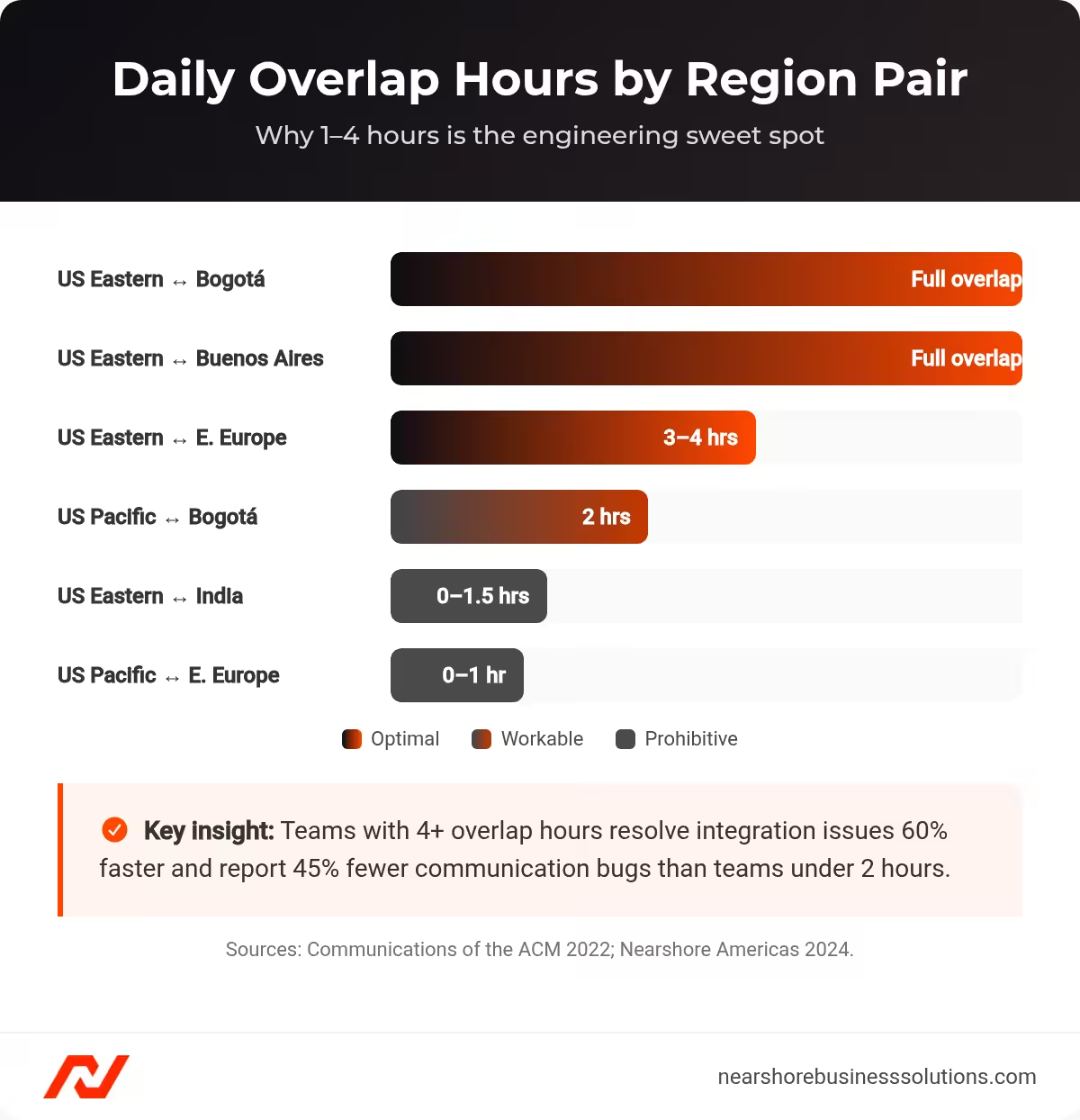
Daily US time-zone overlap by region pair, with LATAM offering full overlap.
Why 1–4 Hours of Overlap Is the Sweet Spot for Engineering Velocity and Deep Work
Full overlap recreates meeting sprawl. Zero overlap makes real-time debugging impossible. The 1 to 4 hour model concentrates synchronous touchpoints into a defined window, leaving 5 to 6 hours of unbroken deep work on both sides. Time zones in South America align with US business hours by default, and 85% of US tech leaders who chose LATAM cite time zone alignment as the primary driver (Nearshore Americas, 2024).
| Region Pair | Overlap Hours | Verdict |
|---|---|---|
| US Eastern ↔ India | 0–1.5 hrs | Prohibitive |
| US Pacific ↔ Eastern Europe | 0–1 hr | Prohibitive |
| US Eastern ↔ Eastern Europe | 3–4 hrs | Optimal |
| US Pacific ↔ Bogotá | 2 hrs | Workable |
| US Eastern ↔ Bogotá | Full | Optimal |
| US Eastern ↔ Buenos Aires | Full | Optimal |
Latin America’s Time-Zone Alignment: The Underrated Edge for US Engineering Organizations
Over 1.2 million professional software developers work across Latin America’s four largest tech markets, growing at 8% annually (Evans Data Corporation, 2023). Brazil ranks in the top 20 on HackerRank global challenges, and Argentina 21st on TopCoder. An estimated 40% of senior developers in major LATAM hubs have direct experience working for US or European companies (Endeavor, 2023), and demand for DevOps roles has surged 300% in three years (LinkedIn Talent Insights, 2024).
Fully loaded senior engineer costs range from $70K to $140K across the region versus roughly $252,000 in the US, a 50% to 65% reduction (salary plus benefits, overhead, and management load). LATAM nearshore attrition runs 15% to 20% annually versus 25% to 40% at major Indian IT services firms (Everest Group, 2023). 78% of US tech managers rated LATAM team communication as “good” or “excellent,” compared to 55% for South Asian teams (G2, 2023). Cultural affinity, cited by 68% of nearshore adopters, reduces the communication friction that drives rework. Many teams formalize this hiring shift through an employer of record in Latin America so they can onboard engineers in weeks without opening a local entity.
A 90-Day Action Plan for VP-Level Leaders to Build a Remote-Resilient Engineering Org
Every framework above collapses without sequenced execution. Each sprint builds on the prior one. Skip the audit and your async protocols target the wrong bottlenecks. Skip async protocols and your new LATAM hires inherit the same dysfunction.
Days 1–30: Audit Your Communication Debt
- Catalog every recurring meeting. Export calendar data and flag any meeting with more than 5 attendees and no written agenda.
- Measure response-time gaps. Pull median Slack response times segmented by time zone to expose the handoff seams stalling PRs.
- Map cross-time-zone dependency chains. Identify the three teams with highest cross-zone handoff frequency.
- Survey engineers anonymously. Five questions, forced-rank: top three pain points and estimated hours lost weekly.
- Calculate your overhead cost. A five-engineer team saving four hours each per week recovers 20 hours weekly. At a representative fully loaded rate of $121/hour, that is roughly $121,000 in annual capacity recovered, enough to fund one LATAM senior engineer.
Days 31–60: Deploy Async Protocols and Retrain Managers
Replace live standups with written async standups. Establish four-hour PR review SLAs. Introduce RFC-based decision-making for architecture changes. Retrain managers on DORA metrics, replacing activity dashboards with change lead time, deployment frequency, change failure rate, and mean time to recovery.
Prepare for LATAM integration by coaching managers on cultural dynamics. LATAM cultures score 20 to 30 on Hofstede’s individualism scale versus 91 for the US, so expect stronger team loyalty. Uncertainty avoidance scores of 80 to 90 mean LATAM engineers ask more detailed clarifying questions upfront, reducing rework. Power distance scores of 60 to 70 require managers to actively invite dissent.
Days 61–90: Expand Your Talent Strategy
Your async infrastructure is live. Your managers lead by output. Now hire into the time-zone architecture that makes both compound.
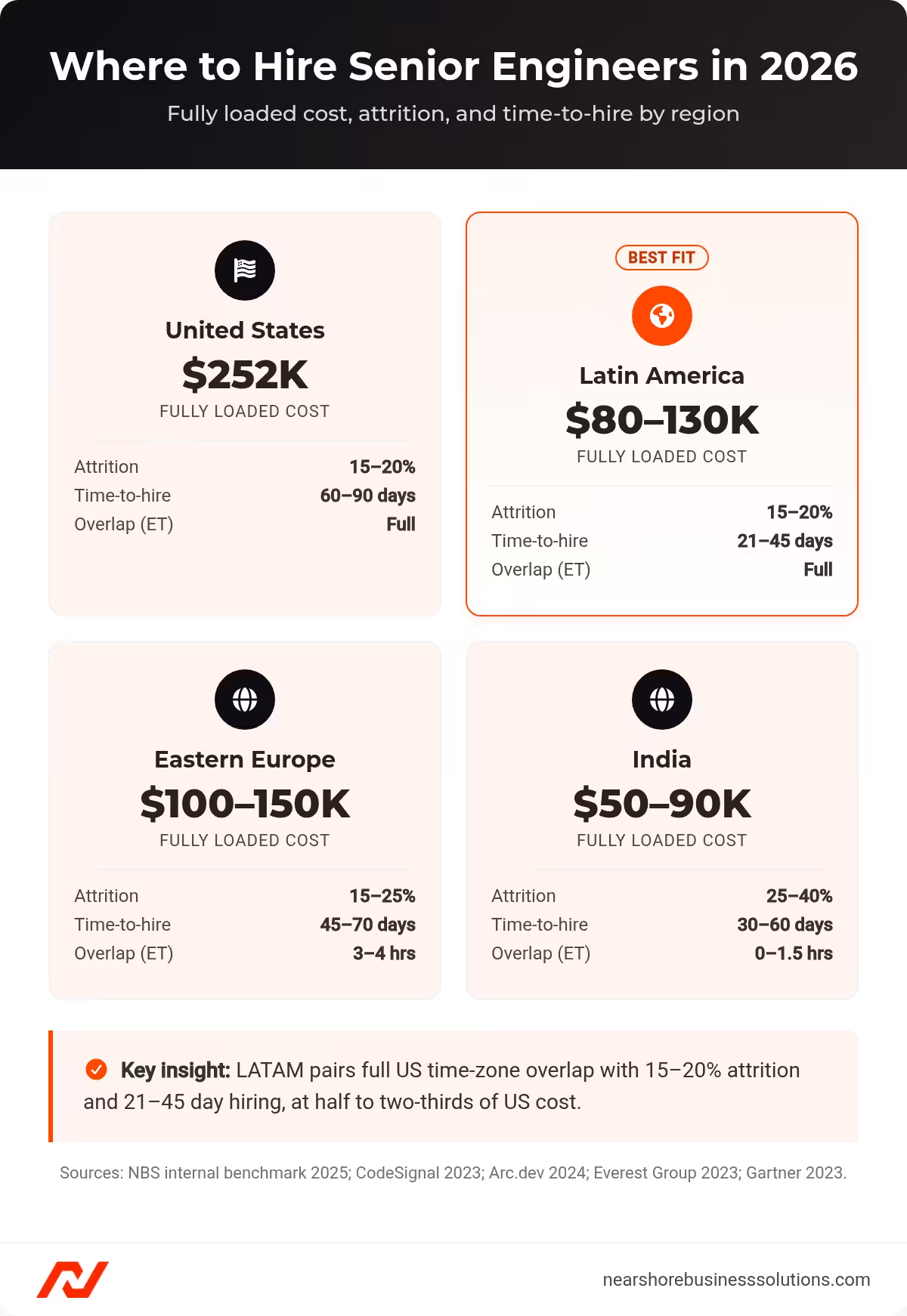
Fully loaded engineer cost, attrition, and time-to-hire across four global regions.
| Attribute | United States | Latin America | Eastern Europe | India |
|---|---|---|---|---|
| Fully Loaded Sr. Engineer Cost | $252,000 | $80K–$130K | $100K–$150K | $50K–$90K |
| Annual Attrition Rate | 15–20% | 15–20% | 15–25% (rising) | 25–40% |
| Time-to-Hire | 60–90 days | 21–45 days | 45–70 days | 30–60 days |
| US Eastern Overlap | Full | Full | 3–4 hrs | 0–1.5 hrs |
| Salary Trend (YoY) | 3–5% | 5–8% | 15–20% | 10–15% |
Eastern Europe’s post-Ukraine-invasion talent disruption removed an estimated 300,000 developers from the global market, driving 15% to 20% annual salary growth in Poland and Romania (Gartner, 2023; Mercer, 2023). India’s 10% to 15% annual salary increases and 25% to 40% attrition rates erode the cost advantage that justified offshore models. LATAM’s combination of full time-zone overlap, competitive cost, low attrition, and deep technical talent makes it the structurally superior choice for US engineering organizations scaling beyond 50 engineers. You can browse vetted candidates through hire software developers in Latin America to see real profiles and rates before you commit.
Frequently Asked Questions About Remote Work Challenges
What is the single biggest remote work challenge for engineering teams?
Communication and collaboration breakdown. 38% of distributed professionals name it their greatest struggle (Buffer, 2024), and 41% of engineering leaders cite it directly (CodeSignal, 2023). It compounds because communication paths scale at n × (n−1) / 2 while headcount scales linearly.
How does time zone difference affect code review speed?
Pull request turnaround increases 50% for every six hours of time zone gap (GitHub, 2023). A 12-hour gap adds a minimum 12-hour delay per review and inflates change lead time by 200% to 500% on complex tasks (Google Cloud, 2023).
Does async-first work actually improve delivery?
Yes. Teams with strong async-first cultures complete projects 33% faster and report 25% higher job satisfaction (IEEE Software, 2022). Zapier cut unnecessary meetings by 40% while keeping annual retention above 90%.
How much overlap do distributed engineering teams need?
One to four hours. Teams with 4+ hours of overlap resolve integration issues 60% faster and report 45% fewer communication-related bugs than teams with under 2 hours (Communications of the ACM, 2022), while still preserving 5 to 6 hours of deep work per side.
Why do US engineering teams choose Latin America over offshore regions?
Full time-zone overlap, 50% to 65% lower fully loaded cost than the US, 15% to 20% attrition versus 25% to 40% in India, and stronger communication ratings (78% “good” or “excellent” versus 55% for South Asian teams, G2 2023).
How long does it take to hire a senior engineer in Latin America?
21 to 45 days, compared to 60 to 90 days in the US (2024 developer-marketplace data; CodeSignal, 2023). That cuts hiring velocity by 40% to 65% while keeping full time-zone alignment.
Ready to Build a Remote-Resilient Engineering Team?
Nearshore Business Solutions sources and vets senior developers across Latin America for US engineering organizations. We screen for technical skills, English fluency, and US work-style fit, then place them into your existing async workflows with full time-zone overlap. Every placement includes a 90-day replacement guarantee, and you receive your first pre-vetted candidates within 3 business days.
Book a free consultation to map your time-zone architecture and get a custom hiring plan for your distributed engineering org.