Frontend vs backend hiring comes down to one diagnosis: is your product bottlenecked on interface or infrastructure? Backend engineers receive 59% more interview requests than frontend engineers (Hired, State of Software Engineers 2024), and LinkedIn data showed roughly 45,000 open backend roles versus 32,000 frontend roles across US tech in Q1 2024. Only 5.5% of developers call themselves “truly” full-stack (Stack Overflow). This framework gives CTOs three questions to move from diagnosis to a defensible headcount plan.
Every scaling CTO faces the same inflection point. The team that built your MVP cannot carry your product to its next stage, and the choice between frontend and backend hiring shapes engineering velocity for the next four quarters. The real challenge isn’t finding talented engineers. It’s diagnosing whether your product is bottlenecked on interface or infrastructure, then building the right team composition to resolve that constraint, whether you hire domestically or tap nearshore engineering talent across Latin America.
What Is Your Product Actually Bottlenecked On, Interface or Infrastructure?
Misdiagnosing your core bottleneck is the single most expensive hiring mistake a scaling CTO can make. A FinTech company that hires two React developers while its payment processing API buckles under load doesn’t just waste two salaries. It produces throwaway frontend work that must be rebuilt once the backend stabilizes. And with US time-to-hire for software engineering roles averaging 48 days, extending to 60+ days for specialized backend roles (Greenhouse, 2024 Engineering Hiring Kit), a wrong-track hire wastes months of recruitment time before the role even starts.
Two patterns dominate. Performance bottlenecks and scalability limits trigger backend hiring: databases and APIs that handled 1,000 users collapse at 100,000 (First Round Capital, “State of Startups 2022”). User activation, conversion, and retention problems trigger frontend hiring: the leap from functional MVP to polished UI becomes the difference between winning and losing competitive deals.
Churn surveys that mention “clunky,” “confusing,” or “slow to load” point to frontend debt. Incident logs full of timeout errors, 500-status responses, and queue backlogs point to backend debt. Martin Fowler’s work on Conway’s Law reinforces why this matters structurally: team composition mirrors system architecture. A team heavy on frontend engineers but starved of backend capacity creates architectural friction. The frontend team builds complex client-side workarounds for APIs that don’t exist yet, embedding technical debt into the product’s DNA.
How to Audit Your Backlog for Frontend vs Backend Hiring Signals
Your Jira board, support queue, and sprint retro notes already contain the answer. Run this five-step audit:
- Export 30 days of Jira tickets, support escalations, and sprint retro notes into a single spreadsheet.
- Tag each item as “UI/UX” or “Systems/Data.” UI/UX includes design bugs, conversion drop-offs, responsive breakages. Systems/Data includes API failures, timeout errors, database bottlenecks.
- Calculate the percentage split. A 55/45 split means a balanced problem. A 75/25 split means a clear priority.
- Cross-reference with revenue-impacting incidents. Ten cosmetic UI bugs matter less than one API outage that dropped a $200K enterprise renewal.
- Apply the 70/30 rule: if either category exceeds 70%, that track is your clear first hire.
One supply-side factor: the 2023 Stack Overflow Developer Survey found that 51.9% of professional developers identify as backend and only 22.9% as purely frontend. Frontend-specialist hiring pools are shallower, so factor this asymmetry into your timeline.
How SaaS and FinTech Product Architecture Shapes Your Front End vs Back End Developers Mix
Product architecture is the single strongest predictor of the frontend-to-backend ratio your team needs. The definitive baseline: a 1:2 frontend-to-backend ratio anchors most high-performing SaaS engineering organizations (Will Larson, An Elegant Puzzle, drawing on leadership at Stripe, Uber, and Carta). FinTech teams skew harder, to 1:3 or 1:4, driven by the density of ledger logic, transaction processing, and regulatory compliance code that never touches a user interface.
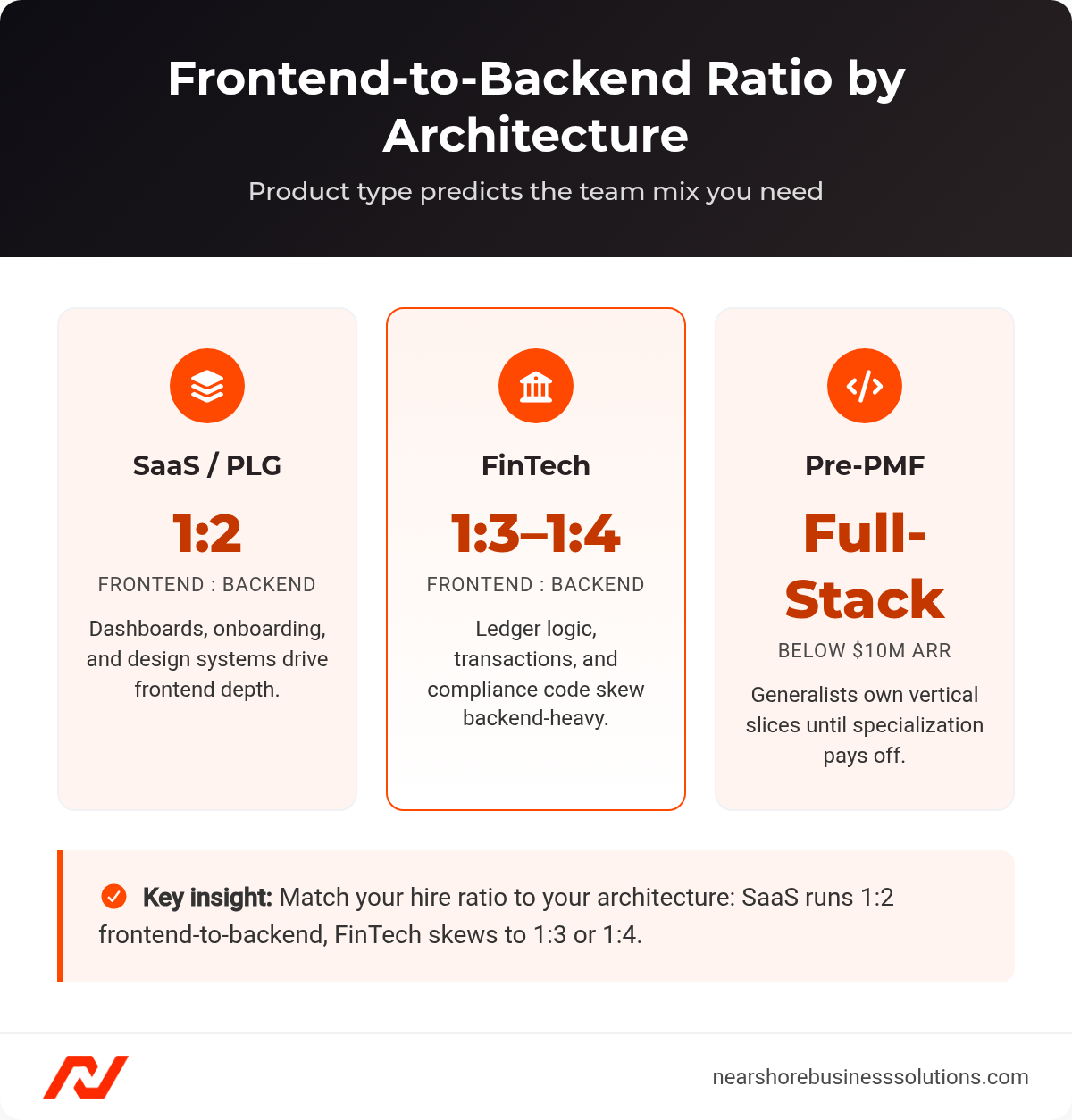
Frontend-to-backend hiring ratio by product architecture: SaaS, FinTech, and pre-PMF.
SaaS Products: Why Frontend-Heavy Teams Win on Retention
SaaS products competing on product-led growth live or die on frontend-intensive capabilities. Complex dashboards require data visualization with D3.js, advanced state management, and aggressive performance optimization. User onboarding flows, multi-step and conditional, directly determine activation rates, the strongest predictor of long-term retention in PLG models. Design system maintenance becomes a full-time frontend function as the product scales, and real-time collaboration features require deep expertise in WebSockets and CRDTs.
For engineering leaders building SaaS frontend capacity, Latin American talent markets offer the specialization depth these roles demand. Hire Frontend Developers through nearshore channels where timezone overlap enables real-time design-engineering collaboration.
FinTech and Data-Intensive Platforms: The Case for Backend-First Hiring
FinTech architecture inverts the SaaS calculus. Payment processing requires deep knowledge of transaction atomicity and ACID compliance: a single atomicity failure produces a balance discrepancy that triggers regulatory scrutiny. Compliance and reporting layers for PCI DSS, AML, and KYC consume thousands of hours of backend engineering. Real-time transaction handling demands low-latency system design with Kafka or RabbitMQ. Security, including fraud protection, encryption, and OAuth2/OIDC, requires backend specialists, not generalists.
Uber’s engineering blog documented their migration from monolith to microservices, a transformation requiring backend and infrastructure engineers at a 4:1 ratio or higher during the migration phase. Hire Backend Developers LATAM to address the infrastructure layer that determines whether your product can scale.
The Full-Stack Compromise: When It Works and When It Backfires
Hire full-stack when the company is pre-product-market-fit or below $10M ARR. A full-stack generalist delivering entire features end-to-end eliminates handoff latency. Basecamp’s Shape Up methodology operationalizes this: small teams of one designer and two full-stack programmers working in six-week cycles.
Hire specialists when the company crosses $10M ARR. The complexity of React’s concurrent rendering model and backend systems at scale demands engineers whose entire cognitive bandwidth goes to one domain.
| Stage / ARR Range | Recommended Hire Type | Role of Full-Stack Engineers |
|---|---|---|
| Pre-PMF to $10M ARR | Full-stack generalists | Primary builders, own complete vertical slices |
| $10M–$30M ARR | Begin introducing specialists on your primary bottleneck track | Bridge roles connecting specialist pods |
| $30M+ ARR | Specialist-dominant teams in product squads | Internal tooling, prototyping, or cross-squad integration |
Hire Full-Stack Developers LATAM for bridge roles, or recruit directly into specialist tracks as your architecture demands.
When Should You Hire Frontend and Backend Developers, Together or Sequenced?
Timing a hire correctly delivers more leverage than selecting the right candidate. A backend engineer hired three months before the frontend team needs stable APIs creates a foundation that multiplies every subsequent hire’s output. The same engineer hired three months too late arrives to find frontend developers have built brittle client-side workarounds.
Three Timing Models Compared: Backend-First, Frontend-First, and Parallel Hiring
| Backend-First Sequence | Frontend-First Sequence | Parallel Hiring | |
|---|---|---|---|
| Ideal Scenario | Monolith-to-microservices migration, replacing third-party APIs, or preparing for 10x scale | Launching a new customer-facing product where speed-to-market determines competitive outcome | Mature product with both infrastructure and feature demands running simultaneously |
| Prerequisite Conditions | Existing frontend retains current users during rebuild; 3–6 month infrastructure phase planned | Backend adequate, with stable CRUD APIs or viable BaaS (Firebase, Supabase) buying 6–12 months of runway | 10+ engineers with established leads on both tracks; clear API contracts defined |
| Risk Profile | User-facing velocity drops to near zero; UX gaps widen competitively | Backend debt accrues silently; 20–40% rework on early frontend features common once backend resources arrive | Highest coordination overhead; without shared contracts and synchronized sprints, tracks diverge |
| Best Product Type | FinTech, compliance-heavy platforms, systems where infrastructure failure carries regulatory liability | PLG SaaS, consumer apps, marketplace MVPs competing on user experience | Mid-stage SaaS ($15M–$50M ARR) adopting squad-based models |
Backend-first is the high-leverage play when infrastructure determines survival. Using a specialized LATAM recruitment partner, average time-to-hire runs 21–35 days, meaning a backend-first sequence can have engineers productive within the first month of a 90-day infrastructure phase.
Frontend-first makes sense when the backend is stable and the competitive battle is at the interface layer. This also sidesteps the tightest talent segment: Go developers receive 2.1x more interview requests than average (Hired, 2024).
Parallel hiring delivers the highest throughput when the organization has sufficient management capacity. The Spotify Squad Model, with cross-functional teams of five to eight, demonstrates the ideal end state. Stripe and Shopify operationalize a variant: centralized Platform teams build infrastructure while Product teams build features. Prerequisites are shared API contracts, a design-system-first approach, and synchronized sprint cadences.
How AI Tools Are Shifting the Frontend vs Backend Timing Calculus
GitHub Copilot’s 55% faster task completion rate obscures a critical asymmetry: the acceleration concentrates on work that dominates frontend development.
| Dimension | Frontend Impact | Backend Impact |
|---|---|---|
| Tasks Accelerated | Boilerplate UI components, CSS, form handling, design-to-code translation (e.g., Vercel’s v0) | Limited. Complex system design, distributed transactions, and schema design resist pattern-matched generation |
| Productivity Gain | An estimated 40–60% of typical sprint tickets scaffolded in minutes (NBS internal estimate based on GitHub’s 2023 Copilot research); effective 1.5x–2x output multiplier | Marginal gains on boilerplate; near-zero on query optimization, security, or architecture decisions |
| Net Hiring Implication | A smaller frontend team produces the output of a larger one | Backend team size cannot be compressed; reinforces hiring backend earlier |
The net implication: a CTO can plan with greater confidence that a deferred frontend phase will move faster once it begins. The backend phase cannot be similarly compressed.
Why CTOs Are Sourcing Front End vs Back End Developers from LATAM in 2026
The LATAM talent market has matured from a cost-arbitrage play into a structural hiring advantage. With roughly one million professional software developers across the region (Stack Overflow regional respondent data, 2023), an estimated 45–50% specialize in backend engineering and 30–35% in frontend (NBS analysis of regional Stack Overflow and HackerRank specialization data, 2023–2024). That split mirrors the 1:2 and 1:3 ratios SaaS and FinTech architectures demand.
The technology stacks overlap almost completely with US production environments. React dominates frontend work, consistent with its 42.8% global usage among developers (Stack Overflow Developer Survey 2023), with TypeScript as a near-universal standard among senior engineers. On the backend, Node.js and Python dominate modern SaaS, while Go gains rapid traction for high-performance systems. AWS is the dominant cloud provider across all four major LATAM markets (HackerRank 2022).
The legal infrastructure reinforces the technical fit. Brazil’s LGPD and Mexico’s LFPDPPP are modern data protection frameworks modeled on GDPR principles, supporting the compliance requirements FinTech and data-intensive SaaS companies operate under.
Timezone-Aligned Collaboration: The Underrated Advantage for Frontend-Backend Coordination
Frontend-backend coordination breaks down without synchronous overlap. API contract negotiations and cross-stack debugging require both sides in the same conversation.
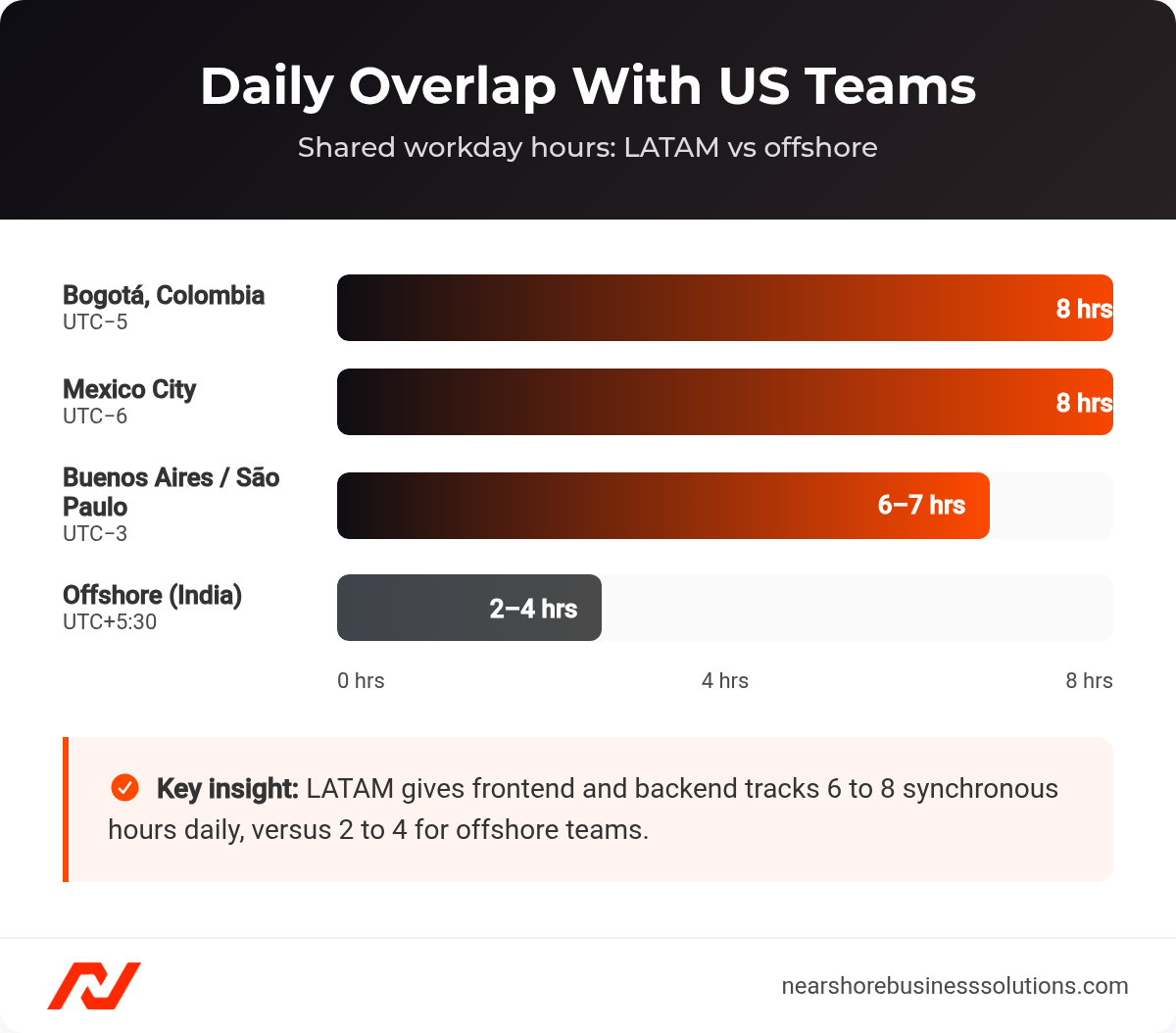
Daily workday overlap with US teams: LATAM cities versus offshore.
| City | Timezone | Overlap with US Eastern |
|---|---|---|
| Bogotá, Colombia | UTC−5 | Full overlap, 8 hours, zero scheduling friction |
| Mexico City, Mexico | UTC−6 | Full overlap with US Central, 8 hours |
| Buenos Aires, Argentina | UTC−3 | 6–7 hours of shared workday |
| São Paulo, Brazil | UTC−3 | 6–7 hours of shared workday |
Compare this to offshore teams in India sharing two to four overlap hours at workday edges. For the parallel hiring model, where synchronized sprints determine whether two tracks converge or diverge, the difference between six to eight hours and two to three is structural, not incremental. Hire Software Developers LATAM on the timeline your sequencing strategy actually requires.
Frequently Asked Questions About Frontend vs Backend Hiring
Should I hire frontend or backend developers first?
Hire for your bottleneck. Audit 30 days of tickets, tag each as UI/UX or Systems/Data, and if either exceeds 70%, that track is your first hire. When infrastructure determines survival, backend-first is the higher-leverage sequence.
What is the ideal frontend-to-backend ratio?
Most high-performing SaaS organizations run a 1:2 frontend-to-backend ratio (Will Larson, An Elegant Puzzle). FinTech and data-intensive platforms skew to 1:3 or 1:4 because of ledger, compliance, and transaction code that never touches the UI.
When should I hire full-stack instead of specialists?
Hire full-stack generalists pre-product-market-fit or below $10M ARR, when handoff latency hurts more than depth. Move to specialists past $10M ARR, when React’s concurrency model and backend-at-scale demand focused cognitive bandwidth.
How does AI change frontend vs backend hiring?
AI coding tools scaffold an estimated 40–60% of frontend sprint tickets but deliver near-zero gains on query optimization, security, and architecture. A smaller frontend team can match a larger one’s output, while backend headcount cannot be similarly compressed.
Why hire frontend and backend developers from LATAM?
The region offers roughly one million developers with US-aligned React, Node.js, Python, and AWS stacks, GDPR-style data laws (LGPD, LFPDPPP), and 6 to 8 hours of timezone overlap with US teams, versus 2 to 4 for offshore options. Time-to-hire runs 21 to 35 days with a specialized partner.
Ready to Build Your LATAM Engineering Team?
Nearshore Business Solutions sources and vets frontend, backend, and full-stack developers from Bogotá, Mexico City, Buenos Aires, and São Paulo. We screen for technical skills, English fluency, and US work style fit, with timezone overlap that keeps frontend and backend tracks synchronized.
Every placement is backed by our vetting process, and you receive your first pre-vetted candidates within 3 business days. Whether you sequence backend-first, frontend-first, or hire in parallel, we staff on the timeline your architecture requires.
Get a free consultation to discuss your hiring needs and receive a custom quote.