
Nearshore staff for software development can be sourced and onboarded in under 2 weeks, with first vetted candidates within 3 business days, and reduces total-cost-of-employment by 40-60% versus US rates (published nearshore industry and global hiring research, 2023-2024). Latin America’s 1.2-1.5 million developers work in your time zone, with 90%+ overlap to US business hours.
LATAM nearshore staffing firms source senior engineers from Guadalajara, Bogota, Buenos Aires, and Sao Paulo. Top-tier agencies screen 100 applicants to present 3-5 candidates. Blended rates run $60-$95/hour for mid-to-senior talent, versus $130-$200/hour for equivalent US hires.
This guide covers which staffing model fits your project phase, how to vet developers who merge production code in week one, what the real costs look like when every line item is surfaced, and how to retain high-performing engineers for years. If you are evaluating nearshore IT staffing for the first time or scaling an existing operation, the frameworks below are built for engineering leaders who need to justify the decision with data.
Why Are Engineering Leaders Shifting to Nearshore Staffing for Software Development?
Nearshore staffing for software development has moved from cost-cutting tactic to core talent strategy because the US hiring market cannot supply enough senior engineers at sustainable cost. The US tech labor market is short roughly 1.4 million software engineers against open requisitions (IADB, 2023). A senior full-stack engineer in the Bay Area commands $220,000-$280,000 in total compensation. The national average sits at $160,000-$200,000 (Levels.fyi, 2024).
Latin America’s developer population reached 1.2-1.5 million in 2024 and is growing at 8-11% annually across Brazil, Mexico, Colombia, and Argentina (Endeavor, 2023; Stack Overflow Developer Survey, 2023). The LATAM IT outsourcing market reached $22.5 billion in 2024 and is projected to grow to $35.8 billion by 2029, a 9.71% CAGR (Mordor Intelligence, 2024). An estimated 70% of Fortune 500 firms use IT outsourcing, with companies like Walmart, JPMorgan Chase, and Citibank operating significant tech hubs in Mexico and Brazil (Deloitte, “2023 Global Outsourcing Survey”; KPMG, 2023).
How Does Time Zone Overlap Multiply Sprint Velocity?
Time zone overlap is the variable that separates nearshore from offshore productivity. LATAM engineers share 4-6 synchronous working hours with US teams daily (Nearshore Executive Alliance, 2023). Offshore teams in India share 0-2 hours. When a LATAM engineer opens a pull request at 2:00 PM EST, the US tech lead reviews it the same afternoon. That PR sits unreviewed for 12-16 hours in an offshore model. Published nearshore benchmarks put staff augmentation at 10-15 business days from contract signing to first merged PR (2023 industry data). The direct cause is real-time overlap: onboarding sessions, pair programming, and code review happen during shared working hours instead of the next calendar day.
What Communication and Cultural Advantages Reduce Management Overhead?
LATAM developers screened for nearshore roles score B2/C1 on English proficiency assessments, with Argentina ranking 28th globally and Chile 45th on the EF English Proficiency Index (2023). Tech-sector talent in Brazil and Mexico scores significantly above national averages. Beyond language, LATAM engineers trained at universities like Tecnologico de Monterrey (ITESM) in Guadalajara, Universidad de los Andes in Bogota, and Universidad de Buenos Aires (UBA) bring Agile-native workflows and direct communication styles consistent with US engineering teams. That alignment reduces the meeting overhead and misalignment cycles that inflate management cost in offshore engagements. Agency-managed nearshore engineers show 10-15% annual attrition, lower than the 15-20% US tech industry average (Nearshore Executive Alliance, 2023).
How Do Nearshore, Offshore, and Onshore Compare Across Five Dimensions?
Nearshore delivers the cost reduction of offshore with the time zone alignment of onshore.
| Dimension | Onshore (US) | Nearshore (LATAM) | Offshore (India/Poland) |
|---|---|---|---|
| Blended Hourly Rate | $95-$145/hr | $60-$95/hr (mid-to-senior) | $25-$50/hr India; $45-$70/hr Poland |
| Time Zone Overlap with US | 100% | 90%+ (4-6 hr window) | 10-15% India; 30-40% Poland |
| English Proficiency (Tech Sector) | Native | B2/C1 (screened) | B1-B2 India; B2 Poland |
| Annual Attrition Rate | 15-20% | 10-15% (agency-managed) | 20-30% India; 12-18% Poland |
| Ramp-Up to 80% Productivity | 3-6 months | 4-6 weeks | 6-10 weeks India; 5-8 weeks Poland |
Sources: Levels.fyi 2024; 2024 nearshore industry benchmarks; 2023 global hiring research; Nearshore Executive Alliance 2023; EF EPI 2023.
What Are the Nearshore Software Staff Models?
Three engagement models dominate nearshore staffing for software development. Selecting the wrong one costs more than the rate difference. Nearshore agencies mark up 40-60% over the developer’s gross salary to cover recruiting, HR, benefits, payroll, and legal compliance (2024 nearshore industry benchmarks). For an engineer earning $80,000 gross, the client’s all-in cost lands between $112,000 and $128,000 per year.
When Do Nearshore Staff Augmentation Software Teams Outperform Dedicated Pods?
Nearshore staff augmentation places individual contributors directly into your existing squads under your management. Billing is time-and-materials, engagements run 6-18 months, and you can add or remove engineers with 30-day notice. Nextdoor reduced time-to-hire from 90 days to 21 days using nearshore staff augmentation from Mexico, with sprint velocity for augmented teams increasing 15% within two quarters (Wizeline, 2023). Three scenarios make augmentation the clear choice: mid-sprint capacity shortfalls requiring one or two surgically matched engineers, specialized tech stack needs, and proof-of-concept phases demanding fast iteration.
For detailed staff augmentation costs at the individual-contributor level, the hourly rate model ensures you pay only for the specialization you need. The constraint: augmentation scales linearly with your management capacity. Every embedded engineer requires 1:1s and code review bandwidth from your leads.
When Does a Dedicated Nearshore Development Team Make More Sense?
A dedicated team fits 12+ month product roadmaps with self-contained domain ownership. A typical dedicated pod includes a tech lead, two to four developers, one QA engineer, and an optional project manager, all provided and administratively managed by the nearshore partner. Billing shifts to a monthly retainer. Eventbrite scaled its Argentina engineering hub to over 100 engineers owning core platform features, reducing engineering costs by approximately 50% versus US staffing costs (Eventbrite, 2023). A cybersecurity SaaS company at $20M ARR deployed an 8-person SOC in Colombia in three months, achieving 24/7 coverage at 60% cost savings with mean-time-to-respond 25% faster than industry average (published nearshore-platform data, 2024).
How Do You Choose the Right Model Based on Project Phase?
Staff augmentation, dedicated teams, and hybrid combinations each fit different project phases.
- Choose staff augmentation if: your engineering managers have available capacity, you need fewer than five engineers, work requires deep integration with your proprietary systems, or you need to ramp up or down within 30 days.
- Choose a dedicated team if: you are building a new, self-contained product, internal managers cannot absorb more direct reports, the project runs 12+ months, or you need a full squad with developer, QA, and design roles starting simultaneously.
- Choose a hybrid if: concurrent workstreams require different structures, for example a feature team under augmentation while a new product platform runs as a dedicated pod.
How Do You Vet and Select Nearshore Staff for Software Development?
A 3-5% applicant-to-presentation rate separates elite nearshore agencies from resume-forwarding services (published nearshore vendor and developer-marketplace data; internal agency benchmarks). A credible agency runs candidates through six sequential gates: application screening (50% pass rate), behavioral interview (60%), English proficiency testing (70%), platform-based technical assessment on HackerRank or Codility (40%), live system design interview (50%), and final client presentation. Your client-side vetting adds four stages on top of that pre-filtering.
Stage 1: Portfolio and Contribution Review. Review two to three pull requests for decision quality. Are trade-offs articulated? Are alternatives dismissed with reasoning? Pass if the candidate demonstrates meaningful architectural decisions with written rationale. Fail if PR descriptions are blank or contributions are exclusively tutorial clones.
Stage 2: Live System-Design Interview Calibrated to Your Stack. A 60-minute session where the candidate designs a feature adjacent to your product domain. Score on requirements clarification, component decomposition, data modeling, and failure-mode awareness. Pass if they identify non-obvious trade-offs without prompting and communicate reasoning in clear, structured English.
Stage 3: Async Take-Home Mirroring a Real Backlog Ticket. Pull a mid-complexity ticket from your actual backlog, provide a reference repository, and give a 48-hour window. Include one intentional ambiguity. Pass if the PR is mergeable with minor comments, tests pass, and the ambiguity was resolved with documented reasoning or flagged as a clarifying question.
Stage 4: Paid Trial Sprint (2-5 Days). Embed the developer in your actual team for a full iteration. Track hours from repo access to first committed code, hours from PR submission to merge-ready, and communication patterns. A paid trial costing $400-$1,200 is the cheapest insurance against a bad hire that drains $15,000-$30,000 in lost velocity over a quarter.
What Questions Should You Ask Every Nearshore Staffing Partner Before Signing?
Seven questions separate strategic partners from resume vendors:
- What is your applicant-to-presentation ratio? Numbers below 5% indicate genuine selectivity. Ask for documented pass rates by stage.
- What is your 12-month retention rate for placed engineers? Anything below 85% warrants scrutiny. Ask how retention is tracked after placement.
- What is your replacement SLA? 30 days is standard; 60 days is unacceptable.
- Do you own your recruiting pipeline or use third-party sourcing? Agencies that outsource screening have less quality control.
- Can you provide client references in a similar tech stack? Ask for contacts at current clients, not testimonials.
- How do you handle underperformers? A partner with no documented underperformer process will leave you managing the problem alone.
- What IP and NDA infrastructure covers each placement? You need individual NDAs, IP assignment agreements, and clarity on which entity employs the developer.
What Does Nearshore Staff Augmentation for Software Development Actually Cost?
What Are the Blended Rate Benchmarks for LATAM Nearshore Software Staff?
LATAM nearshore rates run 40-55% below equivalent US costs at every seniority level (2024 nearshore industry rate benchmarks), with all-in hourly rates fully loaded via agency.
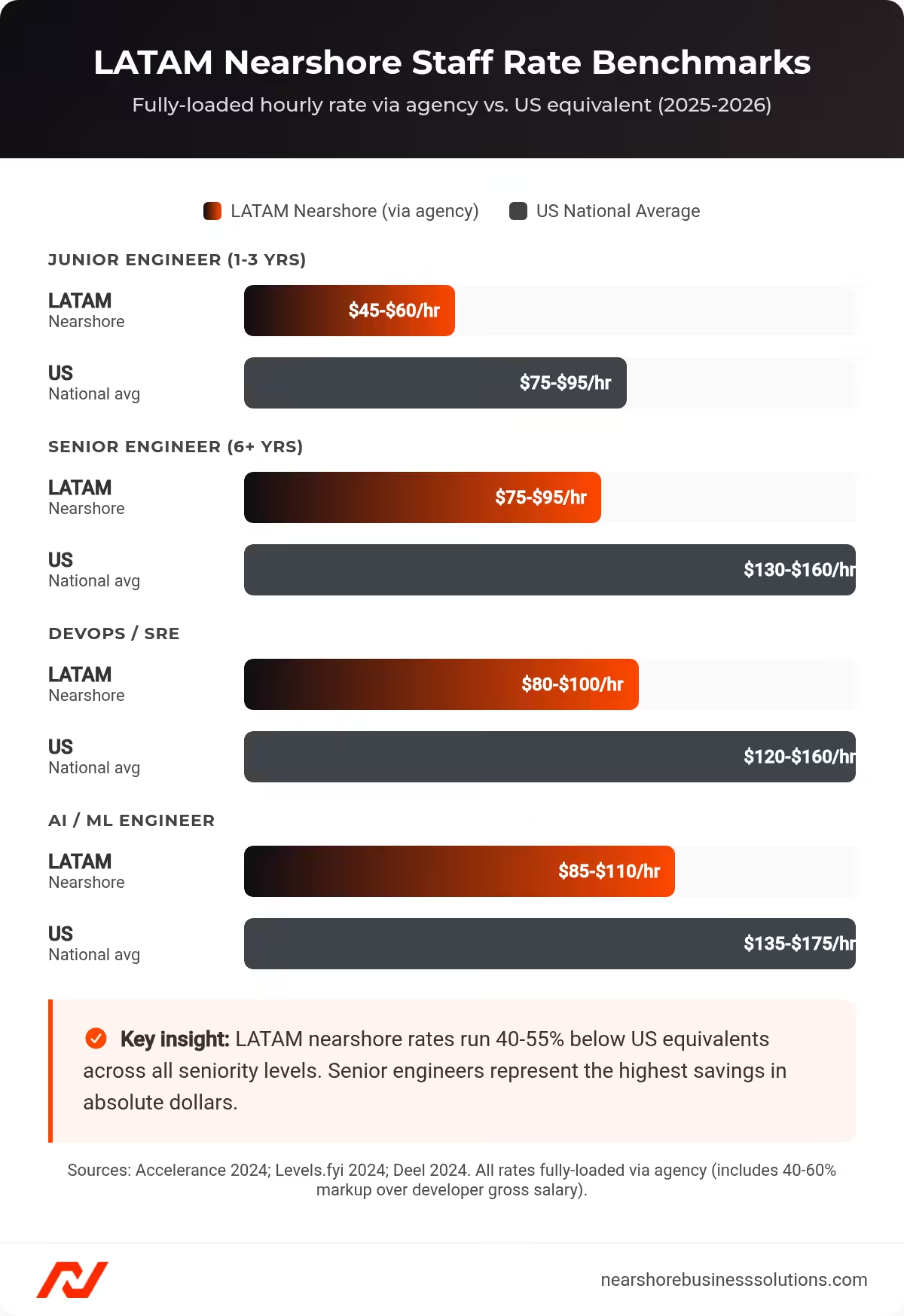
LATAM nearshore rate benchmarks by role: fully-loaded agency rates run 40-55% below US equivalents.
| Role/Seniority | Mexico | Colombia | Argentina | Brazil | Fully-Loaded via Agency |
|---|---|---|---|---|---|
| Junior Engineer (1-3 yrs) | $35k-$50k/yr | $30k-$45k/yr | $28k-$42k/yr | $38k-$55k/yr | $45-$60/hr |
| Mid-Level Engineer (3-6 yrs) | $50k-$70k/yr | $45k-$65k/yr | $40k-$60k/yr | $55k-$75k/yr | $60-$80/hr |
| Senior Engineer (6+ yrs) | $70k-$95k/yr | $65k-$85k/yr | $60k-$80k/yr | $75k-$95k/yr | $75-$95/hr |
| Staff/Principal (10+ yrs) | $95k-$120k/yr | $85k-$110k/yr | $80k-$100k/yr | $95k-$125k/yr | $90-$120+/hr |
| DevOps/SRE | $75k-$100k/yr | $70k-$90k/yr | $65k-$85k/yr | $80k-$105k/yr | $80-$100/hr |
| AI/ML Engineer | $80k-$110k/yr | $75k-$100k/yr | $70k-$95k/yr | $85k-$115k/yr | $85-$110/hr |
Country figures are gross annual salary (USD). Hourly rates include the 40-60% agency markup covering HR, benefits, payroll, and legal compliance. Sources: 2024 nearshore industry benchmarks; Levels.fyi 2024; published 2024 global salary data.
Rates are rising at 8-12% annually in top-tier LATAM markets, reflecting the 9.71% CAGR of the LATAM IT outsourcing sector (Mordor Intelligence, 2024).
What Does the Total Cost of Engagement Look Like Versus a US Hire?
Year-one fully loaded cost for a senior engineer in the Bay Area runs approximately $402,000 versus $176,800 for an equivalent nearshore engagement.
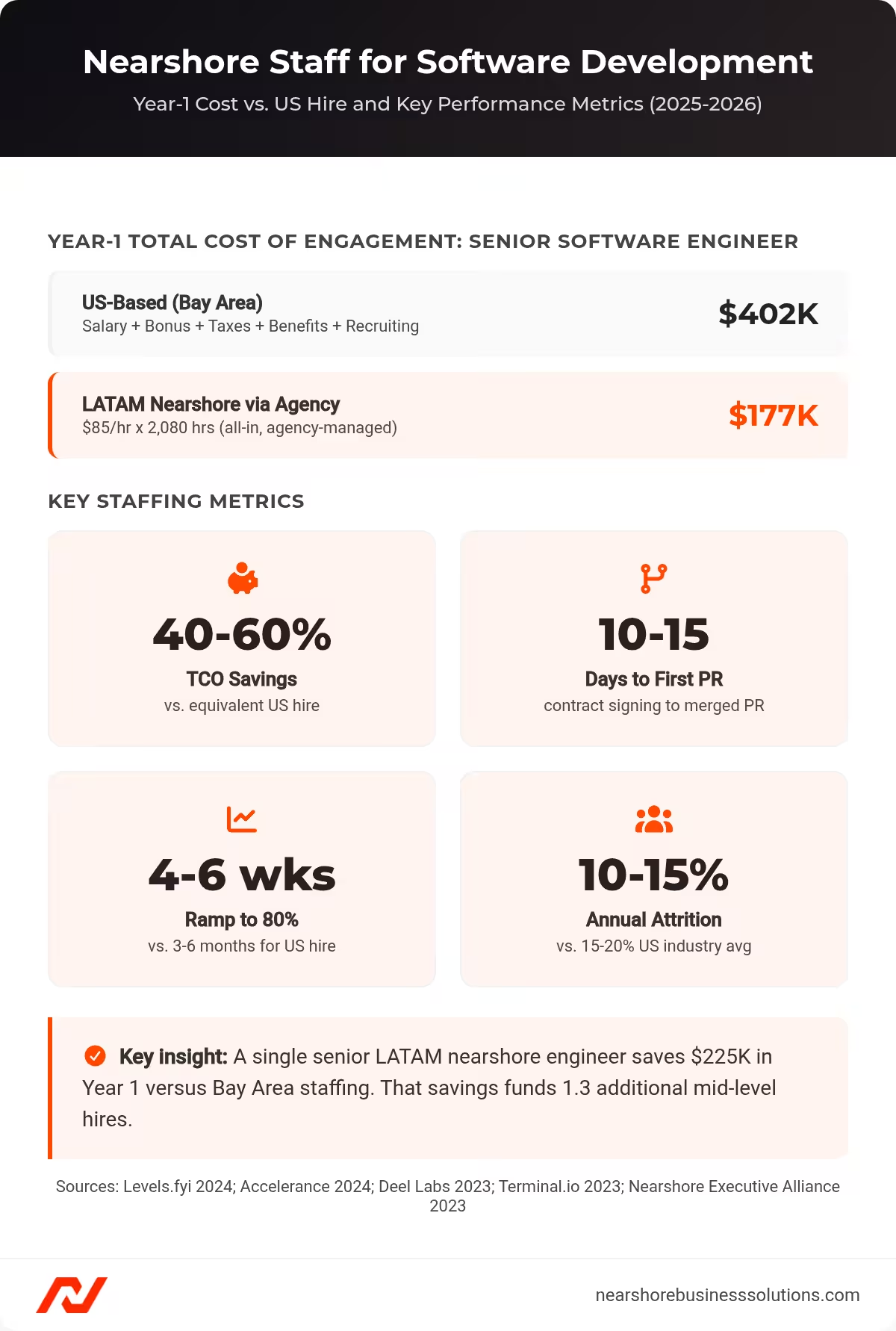
Nearshore staff total cost dashboard: Year-1 savings vs. US hire and four key performance metrics.
| Cost Component | US-Based (Bay Area Senior SWE) | LATAM Nearshore via Agency |
|---|---|---|
| Base Salary / Hourly | $250,000 | $85/hr x 2,080 hrs = $176,800 |
| Bonus/Equity | $50,000 | $0 (baked into rate) |
| Payroll Taxes | $25,000 | $0 (handled by agency) |
| Benefits (Health, 401k) | $22,000 | $0 (handled by agency) |
| Recruiting Fee (20%, Year 1) | $50,000 | $0 (baked into rate) |
| Overhead (Tools, Equipment) | $5,000 | $0 (handled by agency) |
| Total Year 1 Fully Loaded | $402,000 | $176,800 |
Sources: Levels.fyi 2024; 2023 global hiring research; 2024 nearshore industry benchmarks.
Hidden costs to budget: weeks 1-4 represent reduced output during the 4-6 week ramp to 80% productivity (2023 global hiring research), and staff augmentation carries direct management overhead because your leads manage each engineer directly. Payback period on the initial vendor-selection and onboarding investment is typically 2-4 months.
ROI formula: ROI = [(Annual US TCO – Annual Nearshore Cost) + Value of Faster Time-to-Market] / Annual Nearshore Cost
Worked example (1 senior engineer): Annual US TCO $350,000 minus annual nearshore cost $176,800 equals $173,200 in savings. Add $150,000 in value from shipping a feature three months earlier. ROI = ($173,200 + $150,000) / $176,800 = 183% in Year 1.
Zapier built a distributed team of over 200 engineers with a significant LATAM portion, accelerating its product roadmap by an estimated 30% (CEO Wade Foster, public statements). Nextdoor saw sprint velocity for augmented teams increase by 15% within two quarters of integrating senior nearshore engineers from Mexico (Wizeline, 2023).
How Do You Onboard Nearshore Developers for Time-to-First-PR Under 5 Business Days?
The industry benchmark from contract signing to first merged PR is 10-15 business days (2023 industry data). The 5-day target below covers the onboarding-only window after the engineer is selected and contracted. Fast onboarding is the hiring team’s responsibility, not the new developer’s.
What Does the 72-Hour Onboarding Sprint Look Like?
Day-by-day onboarding defines whether a nearshore engineer ships code in week one or week three:
Day 1: Access and Environment. Provision all system access (code repositories, Jira, Slack, CI/CD dashboards). Run a 90-minute architecture walkthrough covering system topology, deployment pipeline, and key services. Done when the developer can clone, build, and run the application locally.
Day 2: Domain Context and Pairing. A dedicated onboarding buddy runs a 60-minute codebase tour of the two or three subsystems the developer will touch first, followed by 2-3 hours of pair programming on a real, low-risk task. 360-degree introductions with team members and key stakeholders. Done when the developer can articulate the bounded context they own and has committed at least one change to a feature branch.
Day 3: First Ticket. Assign a small, well-scoped, production-path ticket. Not a documentation task, but a real change that ships. The buddy remains available for questions but does not drive. Done when the developer opens their first pull request for review.
How Do You Measure Onboarding Success Beyond “They Seem Fine”?
Four KPIs give early warning signals if a nearshore hire is not meeting the productivity ramp you need:
| KPI | Definition | Target Benchmark | Timeframe |
|---|---|---|---|
| Time-to-First-PR | First merged pull request after onboarding begins | 5 business days | Week 1 |
| Time-to-First-Unassisted-PR | First PR opened without buddy pairing | 10 business days | Week 2 |
| Code Review Pass Rate | % of PRs approved without major revision requests | 70% | First 30 days |
| Sprint Velocity Ramp | Story points as % of team median | 80% of full velocity | Week 4-6 |
After six months, teams with integrated nearshore staff showed 5-10% increases in deployment frequency with bug rates statistically identical to all-domestic counterparts (Nearshore Executive Alliance, 2023).
How Do You Retain High-Performing Nearshore Staff Long Term?
Agency-managed nearshore engineers show 10-15% annual attrition, lower than the 15-20% US tech industry average and significantly below India’s 20-30% contract attrition rates (Nearshore Executive Alliance, 2023). That baseline requires deliberate retention architecture across three areas.
Compensation that competes locally. Peg base salary to the 75th percentile of the developer’s local market using published global salary benchmarks or Levels.fyi data. Layer performance bonuses tied to sprint delivery and code quality metrics. The Knowledge Economy Law in Argentina and Free Trade Zone incentives in Colombia give nearshore developers favorable tax treatment that makes market-rate local salaries competitive without requiring US-equivalent compensation (Government of Argentina, Ley de Economia del Conocimiento, 2020; ProColombia, 2023).
Cultural integration as a retention lever. Developers who attend synchronous standups, backlog grooming, and retrospectives at normal working hours build peer relationships identical to domestic remote hires. Kueski grew its engineering team by 40% in one year by sourcing from Colombia and Argentina and integrating those engineers fully into its Agile ceremonies, enabling the launch of two new financial products (Forbes, 2023).
Career development pathways. Assign nearshore engineers to architecture reviews. Give them ownership of technical design documents. Include them in promotion-calibration conversations even if the formal title change flows through the agency. Engineers who see a growth trajectory stay; engineers who feel parked on maintenance work leave.
For teams ready to transition from nearshore staff augmentation to full embedded hiring, employer-of-record models in Latin America make direct conversion operationally straightforward. The Nearshore Team Implementation Guide covers the full transition playbook.
What Do Engineering Leaders Most Often Ask About Nearshore Staff for Software Development?
How long does it take to hire a nearshore developer?
Most nearshore agencies deliver your first pre-vetted candidates within 3 business days. Contract signing to first merged PR typically runs 10-15 business days (2023 industry benchmarks). A 72-hour structured onboarding sprint can compress the time-to-productivity window to under 5 business days after the engineer starts.
What happens if a nearshore developer does not work out?
Top-tier nearshore staffing partners include a 30-day replacement SLA in the contract. Ask for this in writing before signing. A paid 2-5 day trial sprint before commitment is the best way to avoid triggering the replacement clause.
Do I need to provide equipment to a nearshore developer?
Most nearshore agencies handle equipment provisioning as part of the service. Confirm in your contract whether the agency provides hardware or whether you need to ship or reimburse for equipment. Security requirements (encrypted drives, MDM enrollment) should be specified in the SOW.
How are nearshore developers paid?
The agency handles all payroll, benefits, and local tax compliance. You receive a single invoice, typically monthly or bi-weekly, at the agreed hourly or monthly retainer rate. Individual developers are employed by the agency or a local entity in their country.
What is the difference between nearshore and offshore software staffing?
Nearshore refers to Latin American developers sharing 4-6 hours of real-time overlap with US teams. Offshore typically means India or Eastern Europe, with 0-2 hours of overlap for US Eastern time. The overlap difference directly affects PR review cycle time, onboarding speed, and sprint predictability.
Do I need a local legal entity to hire nearshore developers?
No. When working with a nearshore staffing agency, the agency’s local entity employs the developer. You contract with the agency. For companies that want to convert long-term augmentation placements to direct hires, an employer-of-record service handles the local employment relationship without requiring you to establish a local subsidiary.
Ready to Scale Your Engineering Team With Nearshore Talent?
Nearshore Business Solutions sources and vets senior software engineers from tech hubs across Mexico, Colombia, Argentina, and Brazil. We screen for technical skills, English proficiency, and US work style fit. Every placement includes a 90-day replacement guarantee.
Start building your nearshore engineering team and receive your first pre-vetted candidates within 3 business days.