
Nearshore software development companies in Latin America cut fully loaded developer costs by 40-60% versus US rates while delivering 4-8 hours of real-time daily collaboration.
Top nearshore providers in Mexico, Colombia, Argentina, and Brazil maintain annual voluntary attrition below 10% and accept fewer than 3% of developer applicants. Senior engineers cost $55-85/hour versus $120-180/hour in the US. You can onboard a vetted, dedicated team in 4-6 weeks.
NBS sources developers from tech hubs in Guadalajara, Bogota, Buenos Aires, and Sao Paulo. Each engineer is screened across six vetting stages, including live system design and code review simulations. Below you will find the seven criteria that separate the best nearshore software development companies from resume factories.
Why Does Choosing the Wrong Nearshore Software Company Cost More Than Building In-House?
A failed nearshore engagement costs more than the invoice total. It compounds through rework, attrition, missed roadmaps, and the productivity tax on your remaining engineers.
What Is the Real Price Tag of a Failed Nearshore Engagement?
Replacing a nearshore developer costs 1.5x annual salary, per SHRM benchmarks. A five-person team churning inside 12 months compounds into six-figure losses: rework costs, orphaned code, and context loss that no handoff document fully captures.
Indian outsourcing firms reported 25-30% annual attrition post-pandemic, per NASSCOM’s 2023 analysis. Each departure mid-sprint leaves unfinished features and a scramble to backfill institutional knowledge.
Poorly scoped contracts amplify the damage further. When a statement of work lacks precision, every ambiguity becomes a change order. You end up paying near the cost of an in-house team while receiving a fraction of the output. Your product roadmap slips by a quarter.
The cheapest nearshore bid almost always becomes the most expensive engagement.
How Does Nearshore Compare to Offshore and Onshore in 2026?
The global IT outsourcing market reached $587.4 billion in 2023, projected to hit $904.9 billion by 2028 at a 9.0% CAGR, per Mordor Intelligence. Latin American IT services represent $83.5 billion of that total, growing to $126.9 billion by 2028.
Nearshoring to Latin America saves 40-60% on fully loaded salaries, according to Deloitte’s 2023 Global Shared Services and Outsourcing Survey. For every $100 spent on a US developer, equivalent talent in Mexico costs approximately $55, Colombia approximately $50, and Argentina approximately $45, per Everest Group’s 2023 analysis.
The decisive differentiator is synchronous overlap. Latin American engineers share 4-8 hours of real-time collaboration with US teams. India (UTC+5:30) and Eastern Europe (UTC+2/+3) force 24-hour feedback loops or stretched hours bridging a 10-13 hour gap.
Latin America has an estimated 1.2-1.5 million professional software developers, per SlashData Q1 2023. Brazil leads with 500,000-600,000, followed by Mexico at 225,000-275,000, Argentina at 135,000-150,000, and Colombia at 100,000-120,000.
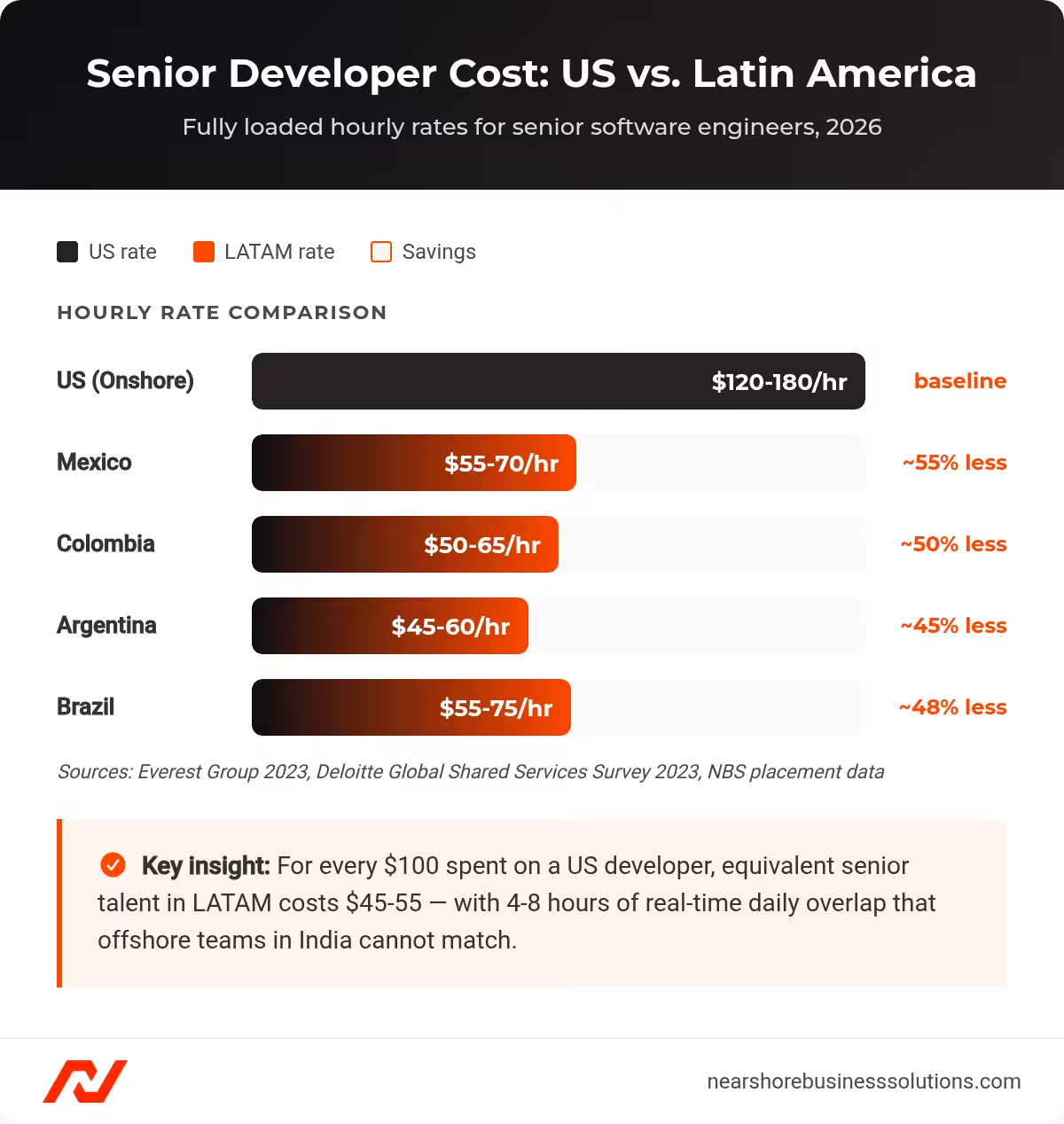
Senior developer hourly rates: US versus four Latin American markets, showing 40-60% cost savings.
For nearshore software development services that include engineering teams from these countries, NBS operates across all four major LATAM talent markets.
When Is Nearshore the Wrong Fit?
Nearshore fails in specific scenarios. Default to domestic hiring when work involves classified or government-regulated code (ITAR, FedRAMP, DFARS/CMMC). Do not nearshore hyper-niche work that is unavailable in LATAM, such as COBOL mainframe modernization or FDA-regulated embedded firmware.
Teams smaller than five engineers often see cultural integration overhead exceed benefit. Mandatory full-time in-office presence eliminates the model entirely.
Cultural dynamics also require honest assessment. On Hofstede’s Power Distance dimension, the US scores 40, Mexico scores 81, and Brazil scores 69. Junior developers from high-power-distance cultures may defer rather than push back on ambiguous requirements. Strong nearshore partners train teams to operate in low-power-distance US engineering cultures. Screen for this during vendor evaluation, not during Sprint 3.
What Are the 7 Criteria for Evaluating the Best Nearshore Software Development Company?
The seven criteria below come from patterns across hundreds of US-LATAM engineering engagements. Use them as a due diligence checklist before signing any contract.
How Do You Judge a Nearshore Company’s Technical Portfolio?
A credible nearshore vendor presents 10-15 detailed case studies if it has five or more years of operation, per Clutch’s 2024 B2B buyer research, which found 78% of buyers rate detailed case studies as “critical” or “very important.” Each case study must include: client identity and industry, the specific business problem, the tech stack and team composition, the engagement model, and measurable outcomes with hard metrics.
“Reduced cloud spend by 30%” and “decreased P95 page load time from 4.1s to 780ms” qualify. “We helped our client improve their platform” does not.
During technical due diligence, request a 30-minute architecture walkthrough with the senior engineer who led the engagement. Ask them to explain one trade-off: why PostgreSQL over DynamoDB, why event-driven architecture instead of synchronous API calls. The depth of that answer reveals more than any case study PDF.
Red flags include vague case studies substituting adjectives for metrics, portfolios dominated by brochure websites with no production scale, and blanket NDA claims covering every single client. A firm that cannot name any client after five-plus years likely has retention problems, not confidentiality obligations.
For guidance on developer vetting at nearshore firms, including what acceptance rates and interview stages to expect, see our dedicated guide.
What SOC 2 and Security Requirements Should You Demand?
SOC 2 Type II is the minimum security baseline for any nearshore vendor handling your code or user data. Demand Type II specifically. Type I certifies controls exist at one point in time. Type II certifies they operated effectively over 6-12 months.
65% of companies received a SOC 2 report request from a prospect in 2023, per Vanta. 61% of data breaches that year involved a third-party vendor or supply chain partner, per the Ponemon Institute’s Cost of a Data Breach Report published by IBM Security. The median breach cost reached $4.45 million globally.
Evaluate five specific controls: mandatory quarterly security awareness training, background checks for every developer accessing your systems, SAST integrated into CI/CD pipelines, AES-256 encryption at rest with TLS 1.2+ in transit, and company-provisioned hardware with enforced disk encryption and MDM enrollment.
Red flags include dismissing SOC 2 as unnecessary for “development-only” engagements, claiming compliance without a formal audit report from an AICPA-accredited CPA firm, and stating “We are working on SOC 2” without a named auditor or projected completion date.
How Do Reference Checks Reveal the Truth About a Nearshore Vendor?
Peer-to-peer references influence over 90% of technology purchase decisions, per Gartner 2023. Insist on speaking with 3-5 technical leaders: the VP of Engineering or CTO who reviewed pull requests and escalated production incidents, not project managers.
Seven questions extract maximum signal. How long before engineers contributed production-quality code? How did the team handle unexpected scope changes? Give a concrete example of proactive ownership beyond ticket completion. Rate written and verbal communication 1-10 with explanation. What was average developer tenure and how was turnover handled? Were there billing surprises? Would you hire them again for a mission-critical project?
Listen for the pause before that last answer.
A vendor’s first engagement in a new industry vertical typically incurs 30-50% longer ramp-up times compared to their fifth or tenth engagement, per a 2023 nearshore industry analysis. Ask directly: “How many clients in my industry and at my scale have you served in the last three years?” Fewer than three means you are funding their learning curve.
What Time Zone Overlap and Communication Standards Should You Require?
Teams maintaining at least four hours of synchronous daily collaboration report 30% higher productivity and 25% faster problem resolution, per MIT Sloan Management Review (June 2023). Latin America delivers 7-8 hours of overlap with US Eastern Time: roughly double the minimum threshold.
Require communication cadence in the contract: daily asynchronous standups, twice-weekly synchronous video check-ins, weekly sprint demos, and bi-weekly retrospectives with documented action items.
Top-tier nearshore firms screen developers to a minimum B2 (Upper Intermediate) CEFR level for English. Elite firms require C1 (Advanced) for senior roles.
Red flag: a “yes-man” communication pattern where every question receives agreement and none receives pushback. This transforms requirements ambiguity into delivered-but-wrong features.
Which Engagement Model Signals Nearshore Vendor Maturity?
Three models dominate nearshore engagements: staff augmentation, dedicated teams, and managed delivery. Staff augmentation means you manage developers directly. It works best for filling specific skill gaps. Dedicated teams deliver approximately 85% client satisfaction for scaling, per published nearshore industry research. The vendor manages HR and operations while you own the product roadmap. Managed delivery means the vendor owns outcomes: highest risk if scope is poorly defined.
The strongest nearshore partners propose models that evolve. They start with staff augmentation to build trust, transition to dedicated teams as scope expands, and eventually operate as managed delivery partners. A vendor pushing only one model regardless of your needs signals limited operational capability or misaligned sales incentives.
For a detailed comparison of nearshore pricing models and engagement structures, including how to structure contracts for each model, see our pricing guide.
How Do Talent Vetting and Retention Separate Top Nearshore Companies?
Retention is the single highest-leverage variable in nearshore success. A senior engineer who stays 30 months generates roughly three times the value of three engineers who each stay 10 months. Elite nearshore firms maintain annual voluntary attrition below 10% and average tenure above 2.5 years. The industry median hovers near 15-20%, per NASSCOM’s 2023 data.
The vetting process at elite firms follows six stages: resume screening filtering for tenure patterns and English-language content production; automated technical assessment at 80th-percentile difficulty; live 60-minute system design interview; code review simulation with a deliberately flawed pull request; behavioral and cultural fit interview; and English proficiency assessment scored against CEFR B2 minimum. Firms running this full pipeline typically accept fewer than 3% of applicants.
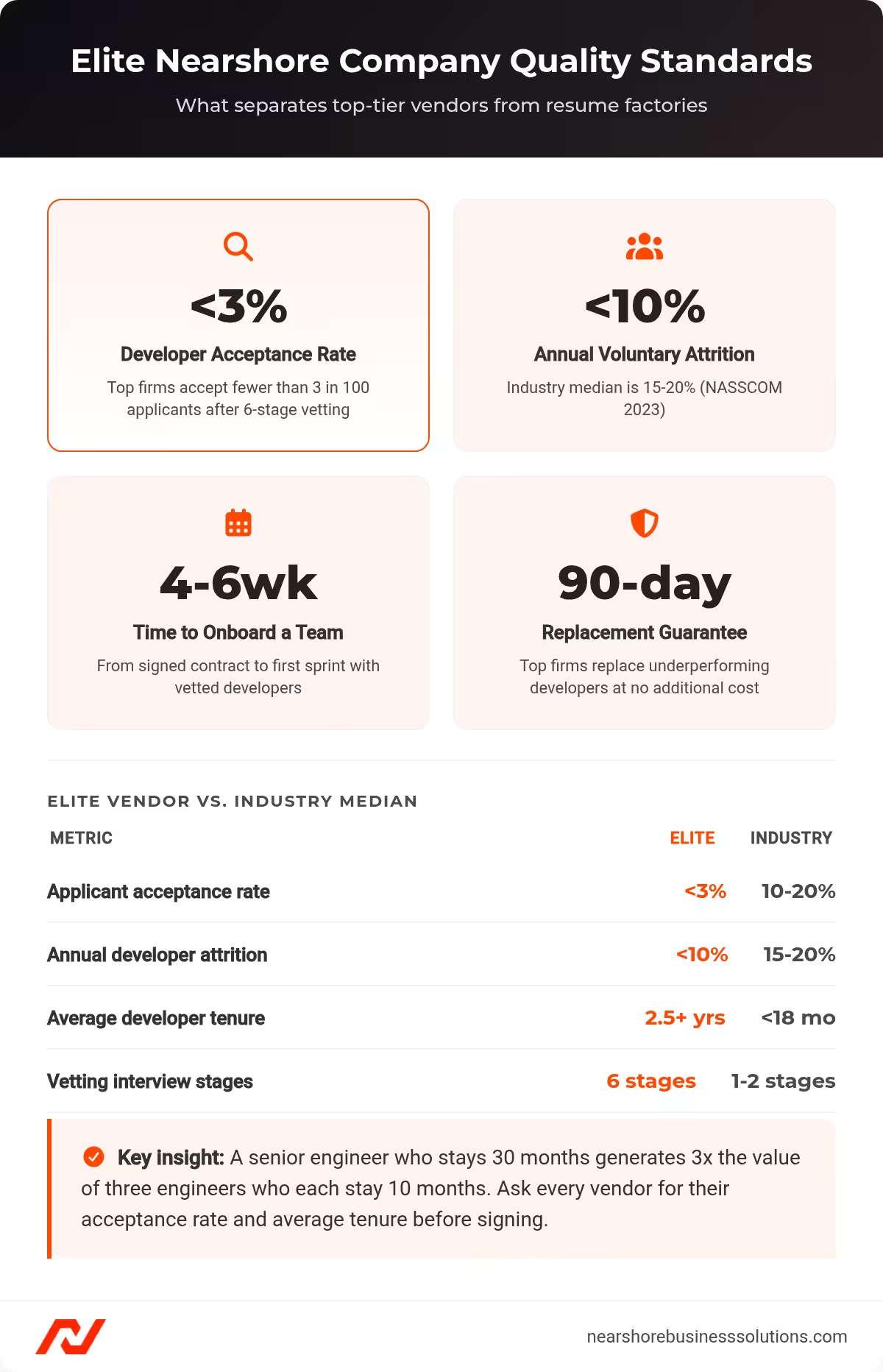
Quality benchmarks separating elite nearshore vendors from the industry median on vetting, attrition, and retention.
Retention mechanisms that matter include defined career progression frameworks from mid-level to staff engineer, internal rotation opportunities between client accounts, technical community investment of $1,000-$3,000 per engineer annually in conferences and certifications, and quarterly eNPS surveys with documented action plans.
Red flags include annual attrition exceeding 20%, no documented vetting process beyond resume review, compensation structures relying on contract lock-in, and any promise to deliver a developer in “24-48 hours.” That timeline suggests a bench of unassigned developers, not rigorous selection.
What Pricing Transparency Should You Expect from a Nearshore Company?
Senior developer hourly rates in LATAM range from $55-85/hour. Typical agency margins run 40-60% over base salary, covering recruiting, vetting, benefits, equipment, and support staff.
Three pricing models carry distinct risk profiles. Monthly retainers offer cost predictability for dedicated teams. Time-and-materials provides flexibility but requires rigorous hour tracking. Fixed-price transfers delivery risk to the vendor but incentivizes corner-cutting on quality.
A transparent vendor publishes rate ranges by role, itemizes overhead separately from developer compensation, and flags cost drivers before they appear on an invoice. The contract should state explicitly what is included: equipment, benefits, HR administration. It should state what is excluded: travel, specialized licenses, overtime premiums. Any vendor refusing to break down its blended rate into component costs is obscuring a margin structure it does not want you to scrutinize.
Red flags include complex pricing with unexplained line items, refusal to provide a clear hourly or monthly rate, and large upfront setup fees without itemized justification.
What Are the Most Common Questions About Choosing a Nearshore Software Development Company?
These are the questions US engineering leaders ask most often when evaluating nearshore vendors.
How Long Does It Take to Start Working with a Nearshore Team?
Most vetted nearshore firms deliver your first candidates within 3 business days. Onboarding and full productivity typically follow within 30-60 days. Firms promising delivery in 24-48 hours are drawing from unvetted bench talent, not running a rigorous selection process.
What If a Nearshore Developer Does Not Work Out?
Top-tier firms include a 90-day replacement guarantee in the contract. If a developer is not meeting expectations within the first three months, the vendor replaces them at no additional cost. Always confirm this guarantee is in writing before signing.
Do I Need a Local Entity to Hire Nearshore Developers?
No. Most nearshore firms handle local employment compliance through their own legal entity in each country. You contract with the vendor directly. This avoids the 4-6 month setup time and $15,000-$50,000 cost of establishing a local entity yourself. An employer of record in Latin America can also cover employment logistics if you want direct employment relationships.
What Is the Difference Between Nearshore and Offshore Software Development?
Nearshore refers to outsourcing to a country within a few time zones of your headquarters. For US companies, that means Latin America. Offshore typically refers to India, Eastern Europe, or Southeast Asia, with 8-13 hour time zone gaps. Nearshore enables real-time collaboration. Offshore forces async-only workflows and extends incident response by 24 hours or more.
How Do I Verify That a Nearshore Company’s Security Posture Is Real?
Request the SOC 2 Type II audit report directly. Confirm the issuing CPA firm is AICPA-accredited. Ask for the audit period (6-12 months minimum) and any exceptions noted in the report. Ask your security team to review the report before contract signature. A vendor that delays or avoids providing the report has not passed the audit.
What Should I Look for in a Nearshore Developer Vetting Process?
Ask for the acceptance rate (top firms report under 5%), the number of interview stages (minimum four), and whether they use structured technical assessments from platforms like HackerRank or Codility. Ask to see a sample test. Ask to interview the developer yourself before placement. Any vendor that skips technical assessment or pushes you to accept candidates without your own evaluation round is not running a rigorous process.
How Do I Handle IP Protection When Working with a Nearshore Company?
Require a written IP assignment agreement specifying that all code and work product produced during the engagement belongs to your company. Confirm the agreement is governed by US law or the law of a jurisdiction with strong IP enforcement. Mexico, Colombia, Argentina, and Brazil all have bilateral IP treaties with the United States. Require NDAs for every individual developer on your account, not just the vendor-level agreement.
Ready to Find the Best Nearshore Software Development Company for Your Team?
Nearshore Business Solutions connects US engineering teams with vetted developers from Guadalajara, Bogota, Buenos Aires, and Sao Paulo. We screen for technical skills, English fluency, and US work style fit.
Every placement includes a 90-day replacement guarantee. You receive the first pre-vetted candidates within 3 business days.
Book a free nearshore consultation to discuss your team requirements and receive a custom developer shortlist.