This Turing review is for US employers evaluating technical talent, managed engineering teams, or AI delivery. Developers and job candidates will find more relevant information on Turing’s talent review page. Employees can use Glassdoor or Indeed.
Disclosure and methodology
Nearshore Business Solutions (NBS) wrote this page. NBS competes with Turing for some Latin American recruitment and staffing engagements. NBS provides direct-hire recruitment, staff augmentation, in-country recruitment, and Recruitment as a Service.
We reviewed Turing’s current homepage, software-talent flow, AI services, custom-engineering services, customer testimonials, and developer reviews. We used Clutch for independent client evidence. We used Trustpilot and G2 to explain mixed review intent, and Glassdoor and Indeed only for employee-review intent. We kept company claims, client evidence, developer or candidate feedback, and employee feedback separate. Prices and ratings reflect sources available on August 27, 2026.
Turing verdict for employers
Turing is a credible option for employers that need global software talent, fully managed technical teams, or enterprise AI delivery. Its live software-developer hiring page publishes a four-day target for filling most roles. The same flow lets clients review pre-vetted candidates, conduct interviews, select a developer, and begin a three-week no-risk trial.
Turing also sells larger delivery outcomes. Its custom-engineering service offers fully managed teams for application development, modernization, and cloud work. Its AI service covers AI strategy, data engineering, ML operations, model development, talent as a service, and managed AI teams. The current corporate homepage leads with frontier AI data and environments, forward-deployed engineers, and an enterprise AI control plane.
This breadth is a strength and a procurement issue. An individual developer who reports to the client’s engineering manager represents a different purchase from a managed team or frontier AI program. Each offer can use Turing’s technical network, but management responsibility, pricing, acceptance criteria, and contract terms can differ.
Our verdict: Turing deserves consideration for technical talent and managed AI or engineering work. Buyers should identify the exact offer first, then compare its price and responsibilities with alternatives that sell the same outcome. A recruitment-led LATAM model may fit better when the employer wants a long-term hire, a public direct-hire fee, or broader business-role coverage.
Turing at a glance
| Area | Public evidence | What the buyer should verify |
|---|---|---|
| Current company focus | Turing’s homepage describes frontier AI and enterprise AI lines of business. | Which Turing offer, team, and contracting entity will deliver the work? |
| Individual technical talent | The software-developer page says Turing sends pre-vetted candidates, the client interviews and selects, and most roles can be filled in four days. | Does the target apply to the required role, location, seniority, and start date? |
| Managed delivery | Turing offers fully managed custom-engineering and AI teams and says it handles coordination and operation. | Who owns the backlog, architecture, QA, acceptance, and delivery risk? |
| Public pricing | Turing publishes no company-wide employer rate card on the pages reviewed. | What does the quote include, and what minimum or deposit applies? |
| Independent price estimate | Clutch lists $50 to $99 per hour and a $50,000 profile minimum. Its review-derived pricing chart says the most common historical project size is below $10,000 based on two reviews. | What current minimum and rate apply to the proposed offer and scope? |
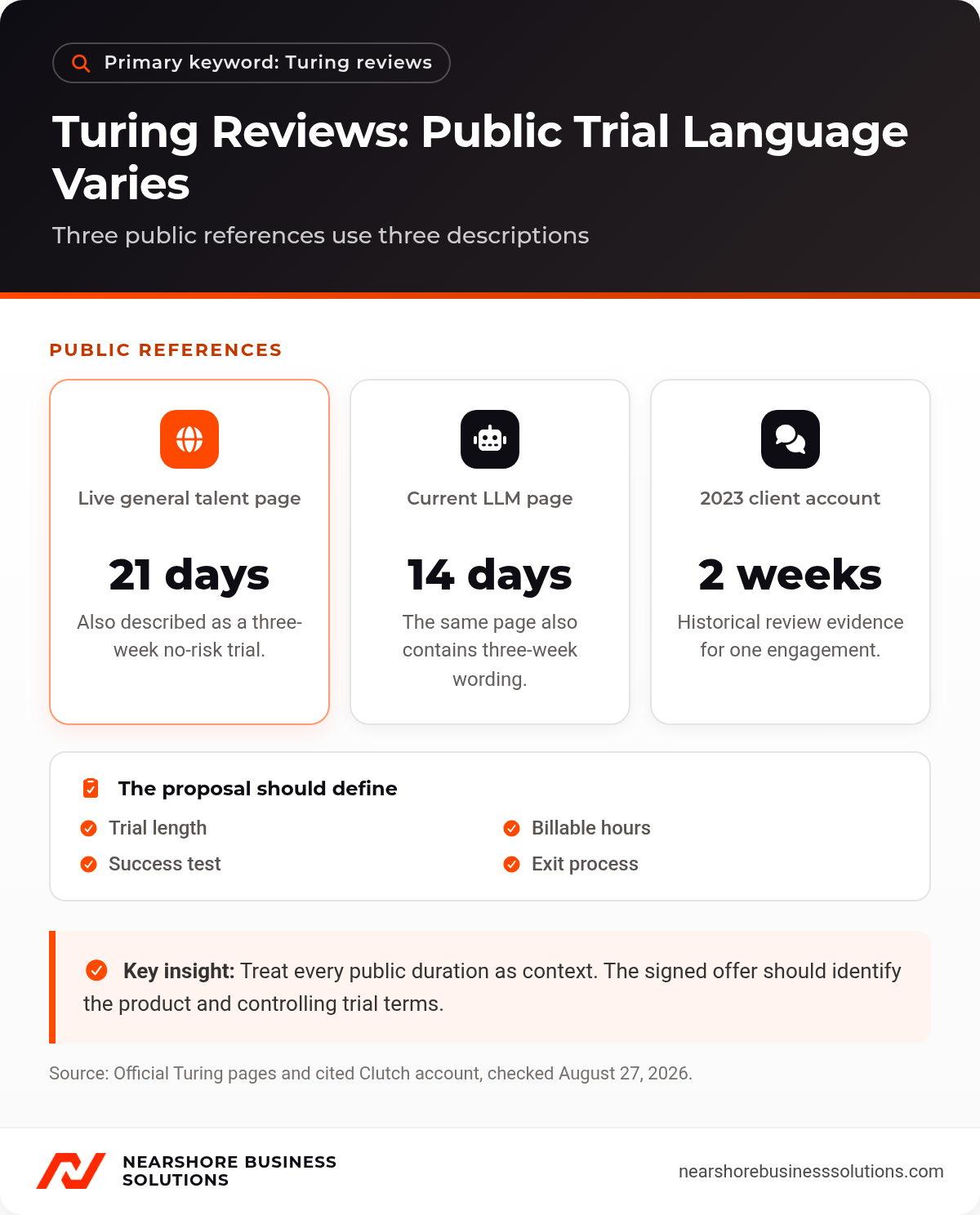
| Trial | The live general software-developer page publishes a 21-day or three-week no-risk trial. A current LLM page contains both three-week and 14-day wording, and a 2023 client review describes two weeks. | What trial length, billing treatment, success test, and exit process appear in the proposal? |
| Client reviews | Clutch shows 5.0/5 from four reviews, with a small sample and one review that gives limited buyer context. | Can Turing provide references for the same offer, scope, industry, and team size? |
| Review-site scores | Trustpilot shows 2.6/5 from 199 reviews, but visible reviews largely concern developer, candidate, or contractor experiences. | Which reviews describe an employer buying the same service? |
What services and talent models does Turing offer?
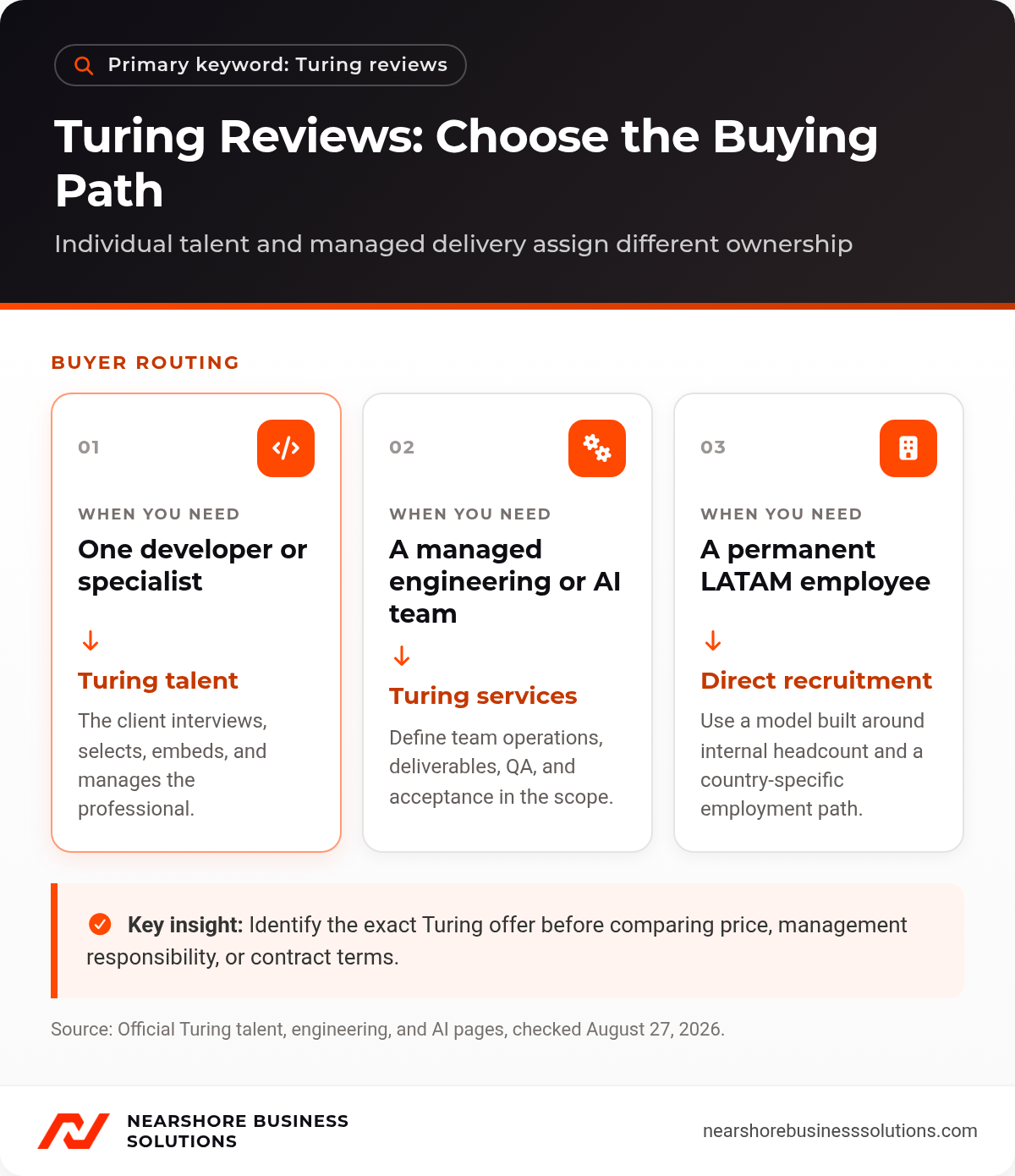
Turing’s public site supports four distinct buying paths. The proposal should name one of them clearly.
| Turing offer | What the buyer receives | Likely management structure | Best fit |
|---|---|---|---|
| Individual software talent | Pre-vetted developers or engineers matched to the client’s requirements. | The client interviews, selects, embeds, and manages the professional. | An engineering team with strong internal management that needs added capacity or a specialist. |
| AI talent as a service | Developers, data scientists, and other technical professionals on demand. | The structure depends on whether the proposal supplies individuals or a coordinated team. | A company that needs AI or data expertise while retaining internal delivery leadership. |
| Fully managed engineering or AI team | A team assembled from Turing’s network, with Turing handling coordination and operation. | Turing manages team operations. The client still owns business goals, governance, security approval, and acceptance. | A company that wants an external delivery layer for an application, modernization program, cloud work, or AI initiative. |
| Frontier or enterprise AI program | Datasets, reinforcement-learning environments, benchmarks, experts, forward-deployed engineers, or the Turing Intelligence Platform. | The structure depends on the program and statement of work. | A frontier lab or enterprise implementing and scaling advanced AI systems. |
The first three paths overlap with common talent and software-services searches. The fourth path represents Turing’s current corporate positioning and may involve a much larger or more specialized purchase. Buyers should request a scope that states deliverables, staffing, governance, dependencies, and acceptance criteria.
How does Turing match and vet software talent?
Turing’s live software-talent flow gives employers a clear selection sequence:
- The employer describes the skills and role requirements.
- Turing sends a list of pre-vetted candidates within days.
- The employer interviews and selects a developer.
- The engagement begins with the applicable trial period.
The software-developer page calls Turing an AI-powered deep-vetting platform. It says most roles fill in four days, sometimes on the same day. Turing also reports that its platform selects the top 1% from more than three million applicants, saves more than 50 engineering interview hours per developer, and has a 97% engagement success rate.
Those scale and performance figures are company-reported. We found no independent audit or public denominator for the engagement success rate. The claims still show how Turing positions its process, but buyers should inspect the evidence for each proposed person.
The same page says its tests cover programming languages, data structures, algorithms, system design, software specializations, and frameworks. It also describes a 57-question seniority assessment across project impact, engineering excellence, communication, people, and direction. These details help a buyer ask for the assessment record that applies to a proposed developer.
Ask which technical tests the candidate completed, how recently Turing assessed the candidate, who evaluated communication skills, and which reference or identity checks apply. The client interview should test the actual work: code review, architecture choices, debugging, data modeling, or another role-specific task.
Managed teams require additional diligence. Vetting individuals cannot establish whether a team has sound delivery management, quality controls, security practices, or domain knowledge. Ask for the proposed team structure, delivery lead, escalation path, reporting cadence, and definition of done.
How much does Turing cost?
Turing does not publish a company-wide rate card for employers on the homepage, software-talent page, AI-service page, or custom-engineering page that we reviewed. Exact pricing requires a proposal.
Clutch estimates Turing’s rate at $50 to $99 per hour and lists a $50,000 profile minimum as of August 27, 2026. Its review-derived pricing chart says the most common historical project size is below $10,000, based on two reviews. The fields describe different evidence. The profile minimum can reflect current requirements, while the review chart records past engagements that may cover other dates or services. Neither field establishes Turing’s terms for a new buyer. Ask Turing for an offer-specific quote.
The quote should separate these components:
- Each role, location, seniority level, allocation, and expected start date
- Project management, architecture, QA, DevOps, design, and customer-success support
- Platform, model, cloud, data, software, or third-party costs
- Payroll, benefits, equipment, security, and compliance responsibilities
- Minimum spend, deposit, billing cadence, and minimum engagement length
- Notice periods for reducing or ending the engagement
- Trial, replacement, refund, and service-credit terms
- Conversion, buyout, direct-hire, and non-solicitation terms
- Rate reviews and annual increases
Turing’s live general software-developer page uses equivalent 21-day and three-week wording in its title, headline, process, and FAQ. A current LLM-developer page uses the same 21-day and three-week language in several places, but its benefits list says 14 days. A verified 2023 TeamSnap review on Clutch describes a two-week risk-free trial. The proposal should state the period, which roles qualify, when billing begins, what happens after an unsuccessful trial, and how the buyer ends the engagement.
The current software-developer FAQ says a satisfied client pays the developer’s salary for the first three weeks and continues the engagement. It says an unsatisfied client pays nothing when the client exits during the trial. Buyers should confirm that treatment in their own proposal because public wording varies across Turing sources.
The service model changes the cost comparison. An individual-talent rate, a managed-team fee, and an AI program statement of work cover different responsibilities. Compare total cost after the shortlist uses the same scope and management structure.
What do Turing reviews show?
Clutch shows a 5.0/5 overall rating from four Turing reviews as of August 27, 2026. Three describe software engagements for TeamSnap, Meltwater, and an anonymous company. They praise developer quality, responsiveness, delivery speed, coordination, and account support. The fourth covers marketing work for a gaming app, which offers limited evidence for an engineering buyer. Four reviews remain too few for a broad satisfaction claim.
Turing’s customer testimonial page features similar themes from TeamSnap, Goldcast, Cleer, and Meltwater. These are company-selected accounts. Buyers should request recent references for the same role, service model, and scope.
Other review sites measure different relationships. Turing’s developer review page displays 4.65/5 based on developer reviews as of June 2024. Trustpilot displays 2.6/5 from 199 reviews as of August 27, 2026, with recent comments focused on assessments, project matching, pay, and work opportunities. G2 also mixes reviewer types, while Glassdoor and Indeed cover workers. Use those sources to investigate the talent experience. Client references, delivery evidence, and signed terms carry more weight for procurement.
Who is Turing best for?
Turing belongs on the shortlist for global software or AI talent, managed technical delivery, and substantial AI programs. Its individual-talent flow lets the client interview candidates, publishes a four-day fill target for most roles, and describes a three-week trial. Buyers should confirm timing and trial terms in the proposal.
A recruitment model fits a different outcome: building long-term internal headcount with a defined regional employment route. NBS works across 12 Latin American markets and hires across technical, commercial, operational, finance, HR, marketing, customer service, and leadership roles. Remote Talent Acquisition uses a one-time fee equal to two times the candidate’s first monthly salary. NBS publishes a three-business-day first-shortlist target for standard searches, a 90-day replacement, and 30, 60, and 90-day check-ins. It can also coordinate employment through EOR partners.
What are the best Turing alternatives by use case?
Choose the service model before comparing providers: individual talent, managed delivery, long-term hiring, or an enterprise AI program.
| Alternative | Best fit | Main distinction |
|---|---|---|
| NBS | Long-term LATAM hires, recurring recruitment, or staff augmentation | Direct hire has a public placement fee; RaaS and staff augmentation cover continuing hiring or workforce support. |
| BairesDev | LATAM software staffing or managed delivery | The offer ranges from buyer-managed capacity to outsourced software delivery. |
| Toptal | Flexible global specialist access | Hourly, part-time, and full-time freelance commitments are available. |
| Howdy | Full-time LATAM team members with workforce support | Howdy handles the selected employment structure while the client manages daily work. |
For enterprise AI work, compare specialist capability, data rights, security, evaluation methods, and delivery accountability.
Turing vs direct LATAM hiring
This table compares the structure of the purchase. The signed proposal and contract control the actual terms.
| Decision factor | Turing individual software talent | NBS direct-hire recruitment |
|---|---|---|
| Primary purchase | A pre-vetted technical professional through Turing’s talent flow | Recruitment for a long-term LATAM professional |
| Day-to-day management | The client interviews, selects, embeds, and manages the professional. | The employer selects and manages the professional after hire. |
| Employment structure | Confirm the employment or contracting arrangement for each country and offer. | The client hires directly or NBS coordinates employment through EOR partners. |
| Public price | No company-wide Turing rate card. Clutch estimates $50 to $99 per hour and lists a $50,000 profile minimum. Its historical review data includes smaller projects. | One-time fee equal to two times the candidate’s first monthly salary. |
| Published timing | Four days to fill most roles in the live software-talent flow, according to Turing. | First vetted candidates within three business days for standard direct-hire searches. Typical close time varies with role difficulty. |
| Trial or replacement | The live talent page publishes a three-week no-risk trial. Public wording varies, and universal replacement terms remain unclear. | Free replacement within 90 days, plus check-ins at 30, 60, and 90 days. |
| Role breadth | Strong software, data, cloud, AI, and technical leadership coverage. | Technical, commercial, operational, finance, HR, marketing, customer service, and leadership roles. |
| Geography | Global talent network. Confirm each proposed professional’s location and time-zone overlap. | 12 named Latin American markets. |
| Continuity | Confirm duration, conversion, non-solicitation, documentation, and exit terms. | The employment relationship establishes continuity after the search closes. |
What should buyers ask before signing a contract?
Use these questions for Turing and every alternative:
- Which offer appears in the proposal: individual talent, a managed team, or an AI program?
- Who employs each professional, and who owns daily management, delivery, and acceptance?
- Can our team interview and approve every proposed professional?
- What does each rate include, and what minimum spend or term applies?
- Which trial, billing, notice, replacement, refund, and conversion terms apply?
- Who owns IP, equipment, access, data protection, payroll, benefits, and compliance?
- Which rate increases, documentation, knowledge transfer, and exit requirements apply?
Buyers should ask the vendor to place every commercial answer in the proposal or contract. Marketing copy can describe a process or target, while the signed terms define legal responsibility and remedies.
Final verdict
Turing offers more than one type of technical service. Its live software-talent flow provides candidate matching, client interviews, a fast published fill target, and a trial. Its managed-service pages cover custom engineering and AI teams. Its current corporate positioning extends into enterprise agents and frontier AI data, evaluation, and research support.
Independent client evidence is favorable but limited. Clutch shows 5.0/5 from four reviews, with three useful software-client accounts. Trustpilot, Turing’s own developer reviews, G2, Glassdoor, and Indeed measure different or mixed audiences, so their aggregate scores fail to answer the employer’s delivery question.
The main diligence gap is commercial. Turing publishes no company-wide employer rate card, and public trial language varies. Buyers should secure the exact service model, price, employment structure, management responsibility, trial, replacement, conversion, security, and exit terms in writing.
NBS fits a different purchase when a company wants long-term Latin American hires, cross-functional recruiting, or a public direct-hire fee. Employers can review the NBS process for hiring software developers in Latin America or book a comparison call.
FAQ
Is Turing a legitimate company?
Turing has public service pages, named customer testimonials, and four Clutch project reviews, including TeamSnap and Meltwater. Buyers should still check references, scope, security, pricing, and contract terms.
How much does Turing cost for employers?
Turing publishes no company-wide employer rate card. Clutch estimates $50 to $99 per hour and lists a $50,000 profile minimum, although its review history includes smaller projects. Buyers need an offer-specific proposal.
How quickly can Turing provide a software developer?
Turing says most software roles fill within four days. Buyers should confirm the shortlist and start date for their role in the proposal.
Does Turing offer a risk-free trial?
Turing’s general page publishes a three-week trial, while its LLM page also uses 14-day wording. The proposal should confirm the period, billing, eligibility, success criteria, and exit procedure.
Can clients interview Turing developers?
Yes. Turing says clients interview and select developers. Confirm final approval rights when the proposal covers a managed team.
What is the difference between Turing talent and a managed Turing team?
Individual talent usually joins the client’s workflow. Turing coordinates its managed engineering and AI teams. The proposal should assign scope, delivery, quality assurance, acceptance, and escalation.
Are Trustpilot and G2 Turing reviews employer reviews?
Both sources contain mixed audiences. Visible Trustpilot reviews largely concern talent experiences, and G2 includes developer accounts. Clutch provides the clearest public client evidence reviewed here.
Which Turing alternatives fit long-term LATAM hiring?
NBS offers direct hire, a 90-day replacement, and four engagement models across 12 LATAM markets. Howdy focuses on full-time workforce support, while BairesDev offers engineering capacity and managed delivery.