Colombia observes 19 paid public holidays in 2026, more than any other major nearshore country in Latin America. Eleven of those festivos shift to Monday, ten of them under the Ley Emiliani itself and one under Ley 2578 de 2026, a new law that applies the same transfer mechanism. Every hour worked on a holiday carries a mandatory 90% surcharge under Article 179 of Colombia’s Código Sustantivo del Trabajo (CST), as amended by Article 14 of Ley 2466 de 2025.
| # | Holiday (Spanish) | Holiday (English) | Calendar Date | Day in 2026 | Observed Date 2026 | Type | Paid Status |
|---|---|---|---|---|---|---|---|
| 1 | Año Nuevo | New Year’s Day | Jan 1 | Thursday | Jan 1 | Fixed | Mandatory Paid |
| 2 | Día de los Reyes Magos | Epiphany | Jan 6 | Tuesday | Mon, Jan 12 | Transferred | Mandatory Paid |
| 3 | Día de San José | Saint Joseph’s Day | Mar 19 | Thursday | Mon, Mar 23 | Transferred | Mandatory Paid |
| 4 | Jueves Santo | Maundy Thursday | Moveable | Thu, Apr 2 | Apr 2 | Fixed | Mandatory Paid |
| 5 | Viernes Santo | Good Friday | Moveable | Fri, Apr 3 | Apr 3 | Fixed | Mandatory Paid |
| 6 | Día del Trabajo | Labor Day | May 1 | Friday | May 1 | Fixed | Mandatory Paid |
| 7 | Ascensión del Señor | Ascension of Jesus | Moveable | Thu, May 14 | Mon, May 18 | Transferred | Mandatory Paid |
| 8 | Corpus Christi | Corpus Christi | Moveable | Thu, Jun 4 | Mon, Jun 8 | Transferred | Mandatory Paid |
| 9 | Sagrado Corazón | Sacred Heart | Moveable | Fri, Jun 12 | Mon, Jun 15 | Transferred | Mandatory Paid |
| 10 | San Pedro y San Pablo | Saints Peter and Paul | Jun 29 | Monday | Mon, Jun 29 | Transferred | Mandatory Paid |
| 11 | Nuestra Señora del Rosario de Chiquinquirá | Our Lady of the Rosary of Chiquinquirá | Jul 9 | Thursday | Mon, Jul 13 | Transferred | Mandatory Paid |
| 12 | Grito de Independencia | Declaration of Independence | Jul 20 | Monday | Jul 20 | Fixed | Mandatory Paid |
| 13 | Batalla de Boyacá | Battle of Boyacá | Aug 7 | Friday | Aug 7 | Fixed | Mandatory Paid |
| 14 | Asunción de la Virgen | Assumption of Mary | Aug 15 | Saturday | Mon, Aug 17 | Transferred | Mandatory Paid |
| 15 | Día de la Raza | Columbus Day | Oct 12 | Monday | Mon, Oct 12 | Transferred | Mandatory Paid |
| 16 | Día de Todos los Santos | All Saints’ Day | Nov 1 | Sunday | Mon, Nov 2 | Transferred | Mandatory Paid |
| 17 | Independencia de Cartagena | Independence of Cartagena | Nov 11 | Wednesday | Mon, Nov 16 | Transferred | Mandatory Paid |
| 18 | Inmaculada Concepción | Immaculate Conception | Dec 8 | Tuesday | Dec 8 | Fixed | Mandatory Paid |
| 19 | Navidad | Christmas Day | Dec 25 | Friday | Dec 25 | Fixed | Mandatory Paid |
How Do Colombia’s 19 Holidays Break Down by Quarter in 2026?
Ley 51 de 1983, CST Articles 177 through 180, and Ley 2578 de 2026 fix 19 festivos for 2026, running from Año Nuevo on January 1 through Navidad on December 25. All 19 are mandatory paid rest days under CST Articles 177 through 180, with no opt-out provision.
What Happens to Colombia Holidays From January Through April 2026?
Expect softer attendance the Friday after New Year’s and treat the full week of March 30 through April 5 as a Semana Santa absence for planning purposes. Día de los Reyes Magos transfers from January 6, a Tuesday, to Monday, January 12, a six-day gap that trips up teams unfamiliar with the Ley Emiliani.
The January 13 to March 22 stretch has zero festivos, 69 calendar days, the longest uninterrupted run of the year. Teams that front-load Q1 deliverables into this window get the year’s best productivity block. Jueves Santo and Viernes Santo, April 2 and 3, anchor Semana Santa, and many Colombian engineers take the full week as PTO on top of the two fixed holidays.
What Happens to Colombia Holidays From May Through August 2026?
June is the heaviest month of the year. June 2026 has five Mondays, and three of them are non-working days, on June 8, 15, and 29, reducing the month to 19 effective workdays out of 22. Sagrado Corazón is a statutory festivo under Ley 51 de 1983 and it moves with Easter, so a calendar built from fixed dates alone misses it.
July carries two festivos: Nuestra Señora del Rosario de Chiquinquirá, added by Ley 2578 de 2026, transfers from Thursday, July 9 to Monday, July 13, and Grito de Independencia falls on Monday, July 20, one week later. Batalla de Boyacá falls on Friday, August 7. Combined with Asunción de la Virgen transferring to August 17, August holds two long weekends inside 10 days.
Why Is Q4 2026 Colombia’s Most Holiday-Heavy Quarter?
September delivers 22 uninterrupted workdays, the highest-capacity month of the year and the best window to recover velocity lost in June and August. November and December give that capacity back. November loses two Mondays, November 2 and 16, inside a 14-day span. December’s two fixed holidays, December 8 and 25, combine with a cultural pattern in which many Colombian professionals take December 21 through January 2 off entirely.
Why Colombia’s 19 Public Holidays Create Unique Challenges for Nearshore Employers
Nineteen paid holidays give Colombia the highest mandatory rest-day count of any major nearshore market in Latin America. US teams run on 11 federal holidays that carry zero added labor cost for salaried exempt staff. Colombia’s gap is bigger and it comes with a price tag, so it needs deliberate sprint planning.
The CST governs all 19 festivos as non-negotiable paid rest days. That rigidity is also the advantage. Eleven of the 19 holidays transfer to Monday, and a CTO can map those transfers onto sprint boundaries months ahead.
How Colombia Public Holidays Compare to Mexico, Brazil, Argentina, and Chile
Colombia’s 19 holidays top every major nearshore competitor’s public holidays in Latin America. The table below ranks the region by total count and guaranteed long weekends.
| Country | National Holidays | Guaranteed Long Weekends |
|---|---|---|
| Colombia | 19 | 12 in 2026, 11 of them fixed to Monday under the Ley Emiliani mechanism |
| Argentina | 16 | 8-10, set annually |
| Chile | 15 | 5-7 |
| Brazil | 12 | 3-5 |
| United States | 11 (Federal) | Varies |
| Mexico | 9 | 3-4 |
Mexico, the most common nearshore destination, mandates only 9 holidays with 3-4 guaranteed long weekends, less than half of Colombia’s count. Argentina comes closest at 16, and its bridge days sit outside the statute. The Jefatura de Gabinete fixed Argentina’s three días no laborables con fines turísticos for 2026 by Resolución 164/2025, published in the Boletín Oficial on December 26, 2025 under Ley 27.399, and it selects a fresh set each year. Colombia’s Ley Emiliani writes the transfer rule into the statute itself, so the original 10 dates do not depend on an annual administrative act. Congress used that same mechanism to add a permanent 19th holiday for 2026 via Ley 2578 de 2026, rather than a one-year discretionary decree.
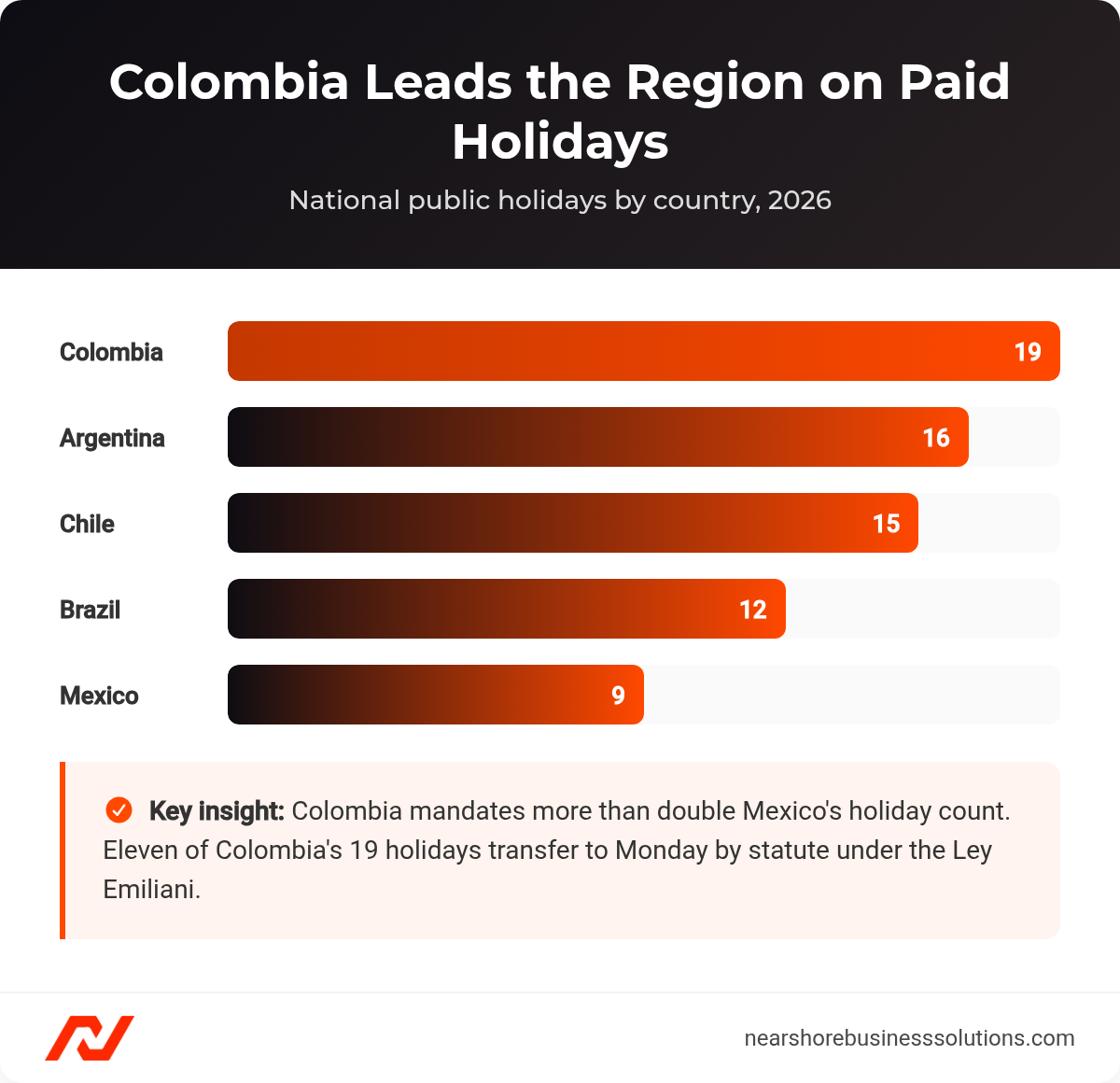
Colombia’s 19 national holidays outpace every major nearshore competitor in Latin America.
How the Código Sustantivo del Trabajo Mandates Paid Rest on All 19 Festivos
Articles 177 through 180 of the CST establish all 19 festivos as mandatory paid rest days with no opt-out provision. These entitlements apply the same way whether a company hires Colombian engineers directly or through an Employer of Record. Article 175 permits work on holidays for roles where interruption would cause operational harm, relevant to SRE on-call rotations and production incident response. The obligation to pay the holiday surcharge (CST Art. 179) is absolute either way.
What HR Leads Get Wrong About Colombia Holiday Dates Every Year
The Ley Emiliani itself transfers 10 of Colombia’s holidays to the following Monday. Payroll guides that stop at that figure now undercount the calendar: Ley 2578 de 2026, sanctioned June 1, 2026, added a 19th festivo, the Día de Nuestra Señora del Rosario de Chiquinquirá on July 9, and applies the Ley 51 de 1983 transfer mechanism to it directly. That brings the 2026 Monday-transfer total to 11. Independencia de Cartagena falls on November 11, a Wednesday in 2026, but the observed festivo lands on Monday, November 16, five calendar days later. A sprint plan built around November 11 protects the wrong day, and a sprint plan built on a pre-June-2026 source misses July 13 entirely.
A salaried, exempt US software engineer who works on July 4th costs the employer $0 in additional compensation. Colombian labor law imposes a mandatory 90% surcharge (CST Art. 179) for every hour worked on a festivo, regardless of seniority or salary level.
How Does Ley Emiliani (Ley 51 de 1983) Move Colombia Public Holidays to Mondays?
Article 1 of Ley 51 de 1983 sets a single rule. For 10 enumerated holidays, when the calendar date falls on any day other than Monday, the paid rest day shifts to the following Monday. No employer petition, no government decree, and no annual confirmation are required. The transfer is automatic and statutory, and the law has run without significant amendment for over 40 years.
The Colombian Congress designed the mechanism to solve a measurable productivity problem. Mid-week holidays fragmented workweeks into unproductive one- and two-day segments. Consolidating rest onto Mondays eliminated those fragments. It also created reliable three-day weekends, known as puentes festivos.
Which Colombia Holidays Transfer and Which Stay Fixed
Eight of Colombia’s 19 festivos hold a fixed calendar date every year, and the other 11 move to the nearest Monday under the Ley Emiliani mechanism.
| Fixed-Date Holidays (8) | Ley Emiliani Transferred Holidays (11) |
|---|---|
| Año Nuevo (Jan 1), Civic | Día de los Reyes Magos (Jan 6 to Monday) |
| Jueves Santo (liturgical Thursday) | Día de San José (Mar 19 to Monday) |
| Viernes Santo (liturgical Friday) | Ascensión del Señor (39 days post-Easter to Monday) |
| Día del Trabajo (May 1), Civic | Corpus Christi (60 days post-Easter to Monday) |
| Grito de Independencia (Jul 20), Civic | Sagrado Corazón (68 days post-Easter to Monday) |
| Batalla de Boyacá (Aug 7), Civic | San Pedro y San Pablo (Jun 29 to Monday) |
| Inmaculada Concepción (Dec 8) | Nuestra Señora del Rosario de Chiquinquirá (Jul 9 to Monday, Ley 2578 de 2026) |
| Navidad (Dec 25) | Asunción de la Virgen (Aug 15 to Monday) |
| Día de la Raza (Oct 12 to Monday) | |
| Día de Todos los Santos (Nov 1 to Monday) | |
| Independencia de Cartagena (Nov 11 to Monday) |
Jueves Santo and Viernes Santo cause the most frequent categorization error. Both move each year because Easter’s date shifts, but they always land on the Thursday and Friday of Holy Week. Neither ever transfers to Monday. Misclassifying them inflates the Monday-transfer count and produces incorrect observed dates.
How the Monday Transfer Works in Practice: 2026 Date Examples
The transfer rule shifts each holiday to the nearest following Monday, and the gap between the calendar date and the observed date can run from zero to six days.
| Holiday | Calendar Date | Day in 2026 | Observed Date | Transfer Action |
|---|---|---|---|---|
| Día de la Raza | Oct 12 | Monday | Mon, Oct 12 | No shift needed |
| Día de Todos los Santos | Nov 1 | Sunday | Mon, Nov 2 | Sunday to Monday (+1 day) |
| Asunción de la Virgen | Aug 15 | Saturday | Mon, Aug 17 | Saturday to Monday (+2 days) |
| Día de San José | Mar 19 | Thursday | Mon, Mar 23 | Thursday to Monday (+4 days) |
| Independencia de Cartagena | Nov 11 | Wednesday | Mon, Nov 16 | Wednesday to Monday (+5 days) |
| Día de los Reyes Magos | Jan 6 | Tuesday | Mon, Jan 12 | Tuesday to Monday (+6 days) |
The Asunción case trips up US managers most often. August 15 falls on a Saturday, already a non-working day, yet the Ley Emiliani transfer still creates a paid Monday absence on August 17.
Why Puente Festivo Culture Reduces Productive Work Days Beyond the Holiday Itself
Twelve puentes festivos land in 2026, and each one removes an entire Monday from team availability. Colombian engineers routinely add adjacent PTO days to stretch a puente into a four- or five-day break, so plan for full absence across the long weekend.
How Colombia’s 19 Festivos Become a Sprint-Planning Advantage
Eleven of the 19 holidays lock to Mondays by statute. The remaining moveable holidays derive from Easter and can be calculated decades ahead. A CTO can map every Colombian non-working day for 2026, 2027, and 2028 in a single planning session. No other major nearshore country offers this level of calendar certainty. Three planning rules apply:
- Run two-week sprints that end on Fridays. This keeps Monday ceremonies off a festivo.
- Model June conservatively. June 2026 has five Mondays and loses three of them to puentes, on June 8, 15, and 29, cutting the month from 22 working days to 19.
- Plan December conservatively too. Two fixed holidays fall in the month, and many Colombian professionals extend their break from December 21 through January 2.
What Is the 90% Holiday Surcharge and How Does It Affect Colombia Payroll?
Article 179 of the CST, as amended by Article 14 of Ley 2466 de 2025, sets the surcharge for work on a Sunday or festivo at 100% of ordinary pay. The statute reads: “El trabajo en día de descanso obligatorio, o días de fiesta se remunera con un recargo del ciento por ciento (100%) sobre el salario ordinario en proporción a las horas laboradas.” Its parágrafo transitorio lets an employer reach that rate in steps: 80% from July 1, 2025, 90% from July 1, 2026, and the full 100% from July 1, 2027. An employer may also apply the full 100% immediately. The floor for the rest of 2026 is therefore 90%, and hours worked on a festivo between January 1 and June 30, 2026 carried 80%. Article 180 gives a worker who works a mandatory rest day exceptionally the choice between paid compensatory rest and payment of the surcharge.
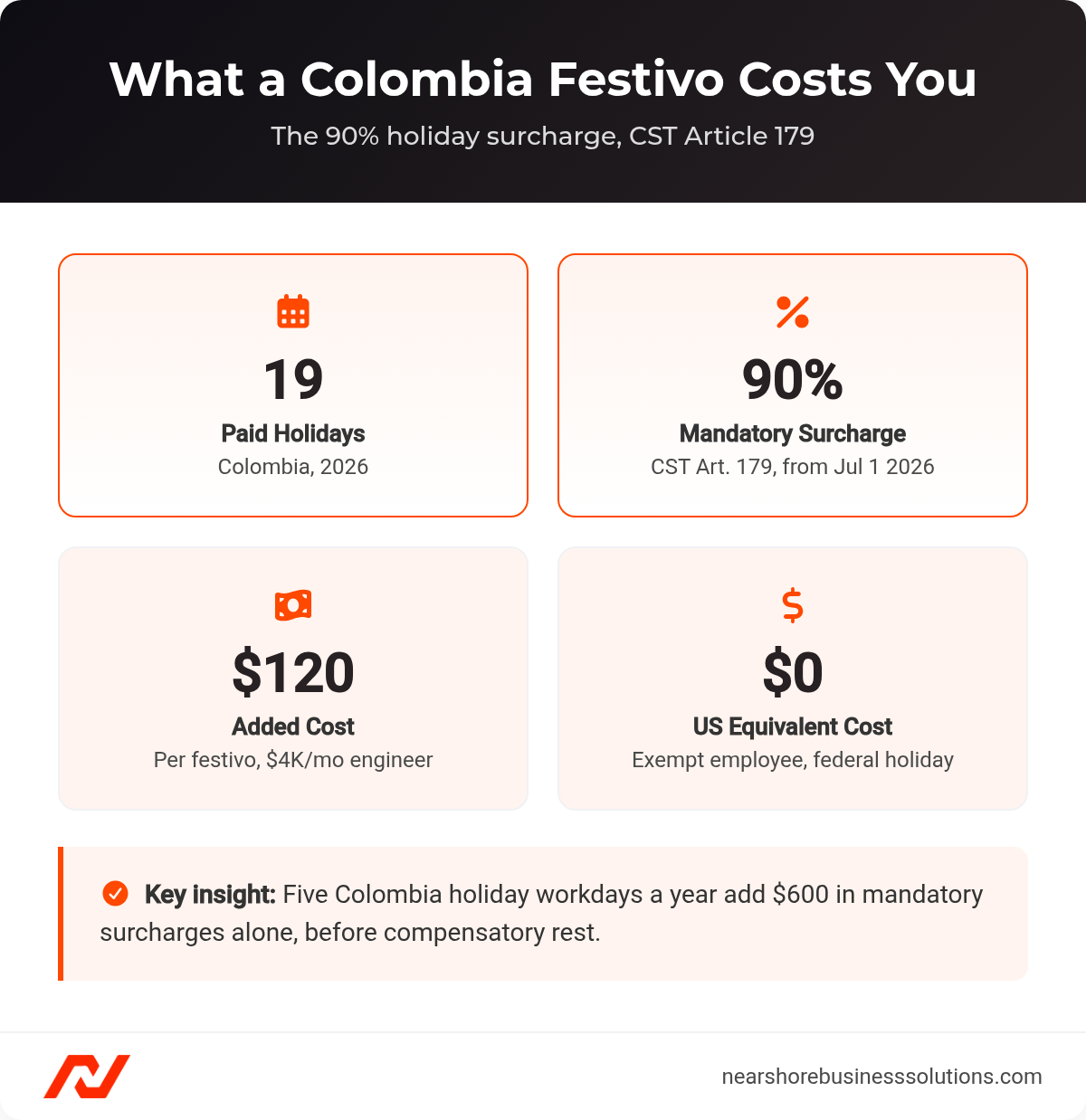
The 90% holiday surcharge adds real payroll cost that a US federal holiday does not.
How Do You Calculate the 90% Recargo Dominical y Festivo?
The calculation runs in four steps, and the base is always the daily wage.
- Determine the base daily wage. Divide monthly salary by 30.
- Calculate the 90% surcharge. Multiply the base daily wage by 0.90.
- Add the surcharge to the base daily wage for total holiday compensation.
- Stack overtime where it applies (CST Art. 168). Daytime overtime adds 25% of the ordinary rate. Nocturnal overtime adds 75%.
| Scenario | Base Daily Wage | Total Day Pay |
|---|---|---|
| Regular holiday work (daytime) | COP $58,364 | COP $110,892 (1.90x) |
| Daytime holiday overtime | COP $58,364 | COP $125,483 (2.15x) |
| Nocturnal holiday overtime | COP $58,364 | COP $154,665 (2.65x) |
The table uses the 2026 legal monthly minimum wage of COP $1,750,905, fixed by Decreto 1469 de 2025, issued on December 29, 2025. That is a 23% increase over the 2025 figure of COP $1,423,500.
For a senior software engineer earning $4,000 USD per month, the 90% surcharge (CST Art. 179) adds $120 to each holiday worked. The monthly salary divided by 30 gives a base daily wage of $133.33, and 90% of that is $120.00. A US exempt engineer working a federal holiday costs $0 extra. Across five holiday workdays a year, the Colombian surcharge adds $600, before compensatory rest obligations.
Frequently Asked Questions About Colombia’s Holiday Calendar
These are the questions HR leads and CTOs raise most often when they plan around Colombia’s holiday calendar.
Does the Ley Emiliani Apply to Contractors and Employer-of-Record Staff?
Yes, it applies regardless of engagement model. The CST treats festivos as a labor right tied to the work relationship, not the entity type. An Employer of Record has to honor the same 19-day calendar and the same 90% surcharge as a direct employer.
What Happens if a Project Deadline Lands on a Festivo?
The deadline should move. Article 175 of the CST allows work on a festivo only for roles where a stoppage would cause operational harm, and even then the 90% surcharge (Art. 179) applies. Building festivo dates into the sprint calendar up front is cheaper than paying the surcharge later.
Do Salaried Colombian Employees Get the 90% Surcharge Too?
Yes. Unlike US exempt employees, who receive $0 in extra pay for a federal holiday, Colombian law applies the 90% surcharge (CST Art. 179) to every hour worked on a festivo, regardless of salary level or seniority.
How Does Colombia’s Holiday Count Compare to Hiring in Mexico Instead?
Colombia has more than double Mexico’s holiday count. Colombia mandates 19 festivos against Mexico’s 9, so a Colombia-based team loses roughly ten more paid days per year than an equivalent Mexico-based team.
Do I Need a Local Entity to Comply With Festivo Law?
No. An Employer of Record can absorb festivo compliance, including the surcharge calculation (CST Art. 179) and the Ley Emiliani calendar, without your company standing up a Colombian legal entity.
How Far in Advance Can I Plan Around Colombia’s Holidays?
Multiple years out. Eleven of the 19 holidays lock to Monday by statute, and the remaining moveable dates derive from Easter, which is calculable decades ahead. A single planning session can map 2026, 2027, and 2028 for teams hired in Colombia.
Ready to Hire in Colombia Around Its Holiday Calendar?
Nearshore Business Solutions sources and vets developers across Colombia, including Bogotá and Medellín, and builds the Ley Emiliani calendar into every delivery plan we help you set. We hold a 94% client retention rate at 90 days and a replacement rate under 2%, with a free replacement guarantee inside that same 90-day window. You get first vetted candidates within 3 business days, and cut costs by 50% or more versus US-based hiring.
Start hiring in Colombia with a team that already plans around its 19-day holiday calendar.
Get a free consultation to build your 2026 delivery calendar around Colombia’s festivos before your next sprint planning cycle.