
Argentina observes 16 feriados nacionales in 2026 under Ley 27.399, plus 3 días no laborables con fines turísticos added through Resolución 164/2025, for 19 non-working dates in total. Every feriado nacional is a mandatory paid day off that carries a 100% wage surcharge if an employee works it, while the three tourism days are optional for the employer and carry no surcharge. Fifteen of the 16 feriados and all three tourism days fall on a weekday, so a US engineering leader managing an Argentine team plans around 18 non-working weekdays in 2026 against 11 on the US federal calendar.
| Date | Day of Week | Holiday | Paid / Mandatory Status |
|---|---|---|---|
| January 1 | Thursday | New Year’s Day | Mandatory paid holiday (100% surcharge if worked) |
| February 16 | Monday | Carnival Monday | Mandatory paid holiday (100% surcharge if worked) |
| February 17 | Tuesday | Carnival Tuesday | Mandatory paid holiday (100% surcharge if worked) |
| March 23 | Monday | Tourism Day (bridges to March 24) | Optional for employer, no surcharge |
| March 24 | Tuesday | Day of Remembrance for Truth and Justice | Mandatory paid holiday (100% surcharge if worked) |
| April 2 | Thursday | Veterans & Malvinas War Fallen Day | Mandatory paid holiday (100% surcharge if worked) |
| April 3 | Friday | Good Friday | Mandatory paid holiday (100% surcharge if worked) |
| May 1 | Friday | Labor Day | Mandatory paid holiday (100% surcharge if worked) |
| May 25 | Monday | May Revolution Day | Mandatory paid holiday (100% surcharge if worked) |
| June 15 | Monday | Güemes Memorial Day (moved from June 17) | Mandatory paid holiday (100% surcharge if worked) |
| June 20 | Saturday | General Belgrano Memorial Day | Mandatory paid holiday (falls on a weekend in 2026) |
| July 9 | Thursday | Independence Day | Mandatory paid holiday (100% surcharge if worked) |
| July 10 | Friday | Tourism Day (bridges from July 9) | Optional for employer, no surcharge |
| August 17 | Monday | San Martín Memorial Day | Mandatory paid holiday (100% surcharge if worked) |
| October 12 | Monday | Cultural Diversity Day | Mandatory paid holiday (100% surcharge if worked) |
| November 23 | Monday | National Sovereignty Day (moved from November 20) | Mandatory paid holiday (100% surcharge if worked) |
| December 7 | Monday | Tourism Day (bridges to December 8) | Optional for employer, no surcharge |
| December 8 | Tuesday | Immaculate Conception Day | Mandatory paid holiday (100% surcharge if worked) |
| December 25 | Friday | Christmas Day | Mandatory paid holiday (100% surcharge if worked) |
How Do Argentina’s Public Holidays Break Down by Category, and How Does 2026 Compare to the US and Mexico?
Ley 27.399 was sanctioned on September 27, 2017 and published in the Boletín Oficial on October 18, 2017. It governs the entire framework. Article 1 defines three categories: feriados nacionales inamovibles, feriados nacionales trasladables, and días no laborables. Article 7 lets the National Executive add up to three tourism days a year, which must fall on a Monday or a Friday. Each category carries different rules for sprint planning, on-call scheduling, and pay.
Argentina’s 16 feriados nacionales beat the US federal count of 11 by 45%, per Article 1 of Ley 27.399 and the US Office of Personnel Management’s published 2026 federal holiday calendar. They also beat Mexico’s 7 mandatory holidays under LFT Article 74 by more than double, a gap consistent with the broader pattern of public holidays across Latin America.
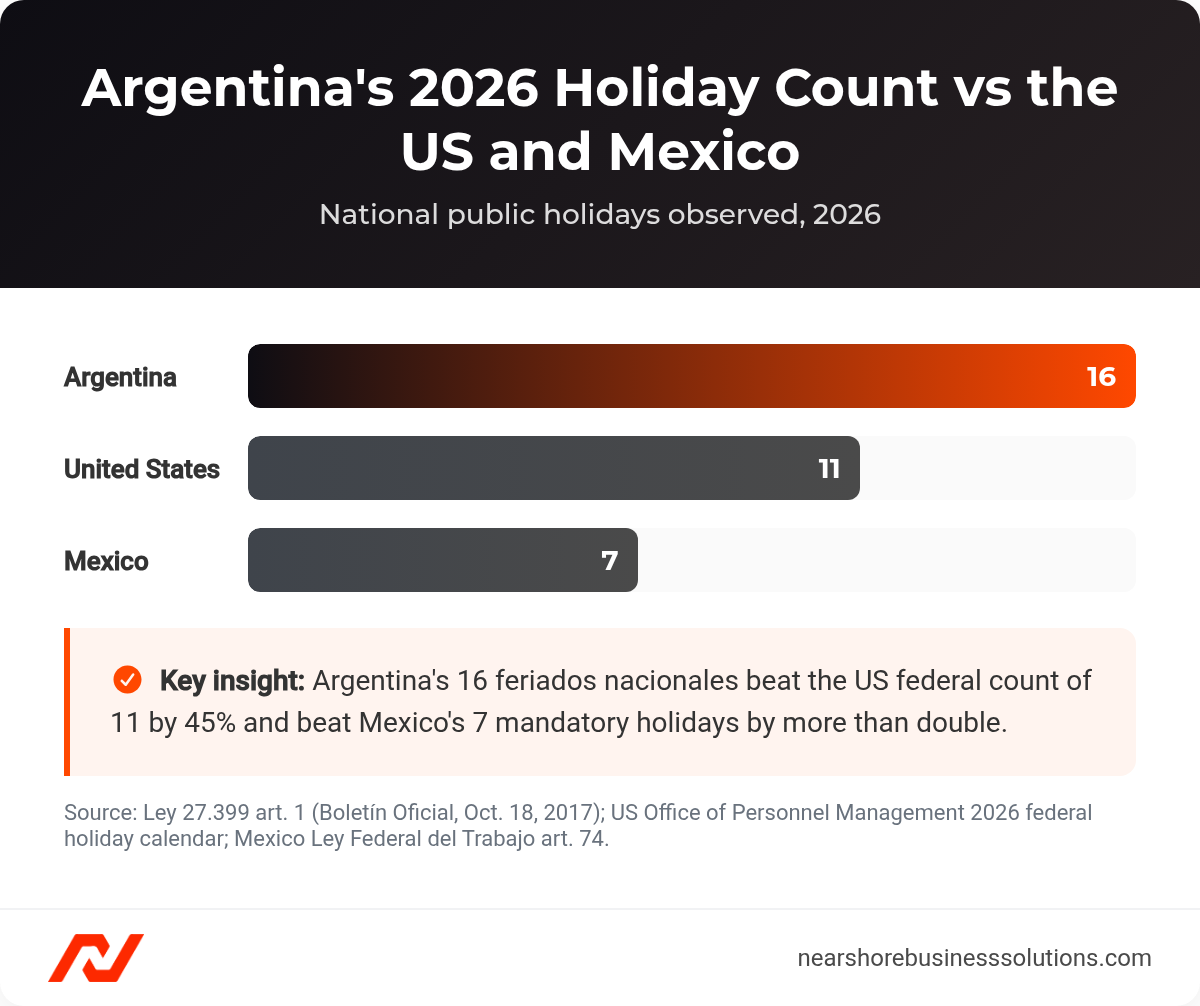
Argentina’s 16 feriados nacionales beat the US federal count of 11 by 45% and Mexico’s 7 by more than double.
Which Argentina Holidays Are Fixed (Feriados Inamovibles) and Never Move?
12 of the 16 feriados nacionales lock to specific calendar dates in 2026 regardless of the day of the week; no presidential decree can shift them. Carnival Monday and Tuesday sit back to back on February 16 and 17, because both are tied to Easter, which falls on April 5 in 2026. April carries the year’s tightest cluster: April 2 and April 3 are consecutive feriados inamovibles that run straight into the weekend, a four-day break from April 2 to April 5. June 20 falls on a Saturday, so it costs no weekday capacity. March holds one fixed holiday, and December holds two.
How Do Feriados Trasladables Shift in 2026?
4 national holidays move under the transfer rule in Article 6 of Ley 27.399: a holiday that falls on a Tuesday or Wednesday moves to the preceding Monday, and one that falls on a Thursday or Friday moves to the following Monday. All four of Argentina’s feriados trasladables land on a Monday in 2026, as shown in the calendar above.
One payroll nuance follows from Article 8 of Ley 27.399, which gives the transferred days the same remuneration rights as any other feriado nacional: the legal holiday is the moved date. An engineer who works Monday, November 23 triggers the holiday surcharge. Work on Friday, November 20 does not, since that date reverts to a normal working day once the holiday transfers. The same applies to June 15 against June 17.
Which Feriados Puente (Bridge Holidays) Did Argentina Declare for 2026?
Article 7 of Ley 27.399 grants the National Executive Power authority to declare up to 3 additional days a year to promote tourism, which must coincide with a Monday or a Friday. The same article directs the Executive to establish them 50 days before the end of the calendar year. For 2026 the Jefatura de Gabinete de Ministros used that power in Resolución 164/2025, signed December 23 and published in the Boletín Oficial on December 26, 2025, whose Article 1 names the three días no laborables con fines turísticos listed in the calendar above.
The category matters for payroll. Article 7 allows the Executive to declare either feriados or días no laborables, and Resolución 164/2025 chose días no laborables. Under LCT Article 167 an employee who works one of these three days collects salario simple, the normal wage with no surcharge, and the employer decides whether the office opens at all.
Counting weekends, feriados and tourism days together, the 2026 calendar produces 12 stretches of three or more consecutive non-working days. Five of them run four days: February 14 to 17, March 21 to 24, April 2 to 5, July 9 to 12, and December 5 to 8.
The 50-day window in Article 7 closes on November 11 for a year that ends December 31, and Resolución 164/2025 reached the Boletín Oficial on December 26, 2025, 5 days before the end of the year. Check each year’s resolution against the Boletín Oficial through late December, and do not treat the following year’s tourism days as fixed in mid-November.
What Is the Difference Between Feriados Nacionales and Días No Laborables in Argentina?
A feriado nacional is a mandatory paid rest day that carries a 100% pay surcharge if worked, while a día no laborable is optional for the employer and carries no surcharge at all. One word, optativo (optional), separates a 200% payroll obligation from a 100% one under the Ley de Contrato de Trabajo (LCT).
| Dimension | Feriado Nacional | Día No Laborable |
|---|---|---|
| Right to rest | Mandatory | Optional, employer decides |
| Pay if employee does NOT work | Full normal daily wage | Full normal daily wage |
| Pay if employee DOES work | Normal wage plus 100% surcharge (double pay) | Normal wage only, no surcharge |
| Count in 2026 | 16 days | Jueves Santo, 3 tourism days under Resolución 164/2025, plus religious observances |
The cost delta scales fast under LCT Article 166. A 10-person Argentine engineering squad working one feriado nacional costs 10 extra daily wages in surcharges. The same team working a día no laborable costs zero extra, since LCT Article 167 pays salario simple for those days.
Ley 27.399 Article 1 names one universal día no laborable: Jueves Santo. In 2026 it lands on April 2, the same date as the Día del Veterano y de los Caídos en la Guerra de Malvinas, which Article 1 lists as a feriado inamovible. The higher category governs, so April 2 is a full paid holiday and the surcharge attaches to it. Good Friday follows on April 3, also a feriado inamovible. A Q2 sprint plan should book April 2 and April 3 as two mandatory holidays running into the weekend.
Ley 27.399 Articles 2 and 3 add faith-specific días no laborables for employees who practise the Jewish and Islamic religions: Rosh Hashaná (two days), Iom Kipur (one day), the first two and the last two days of Pésaj, the Muslim New Year (Hégira), Id Al-Fitr, and Id Al-Adha. Article 4 states that employees who do not work on those days accrue their remuneration and the other rights arising from the employment relationship as if they had worked.
How Does Argentina’s 100% Holiday Surcharge Work Under the Ley de Contrato de Trabajo?
LCT Article 166 requires employers to pay double: employees who work a national holiday collect their normal working-day remuneration plus an equal amount, triggered automatically by any work performed on any of the 16 feriados nacionales. No contractual clause can waive or reduce the surcharge, since the LCT is orden público (public policy law) that employers cannot contract around.
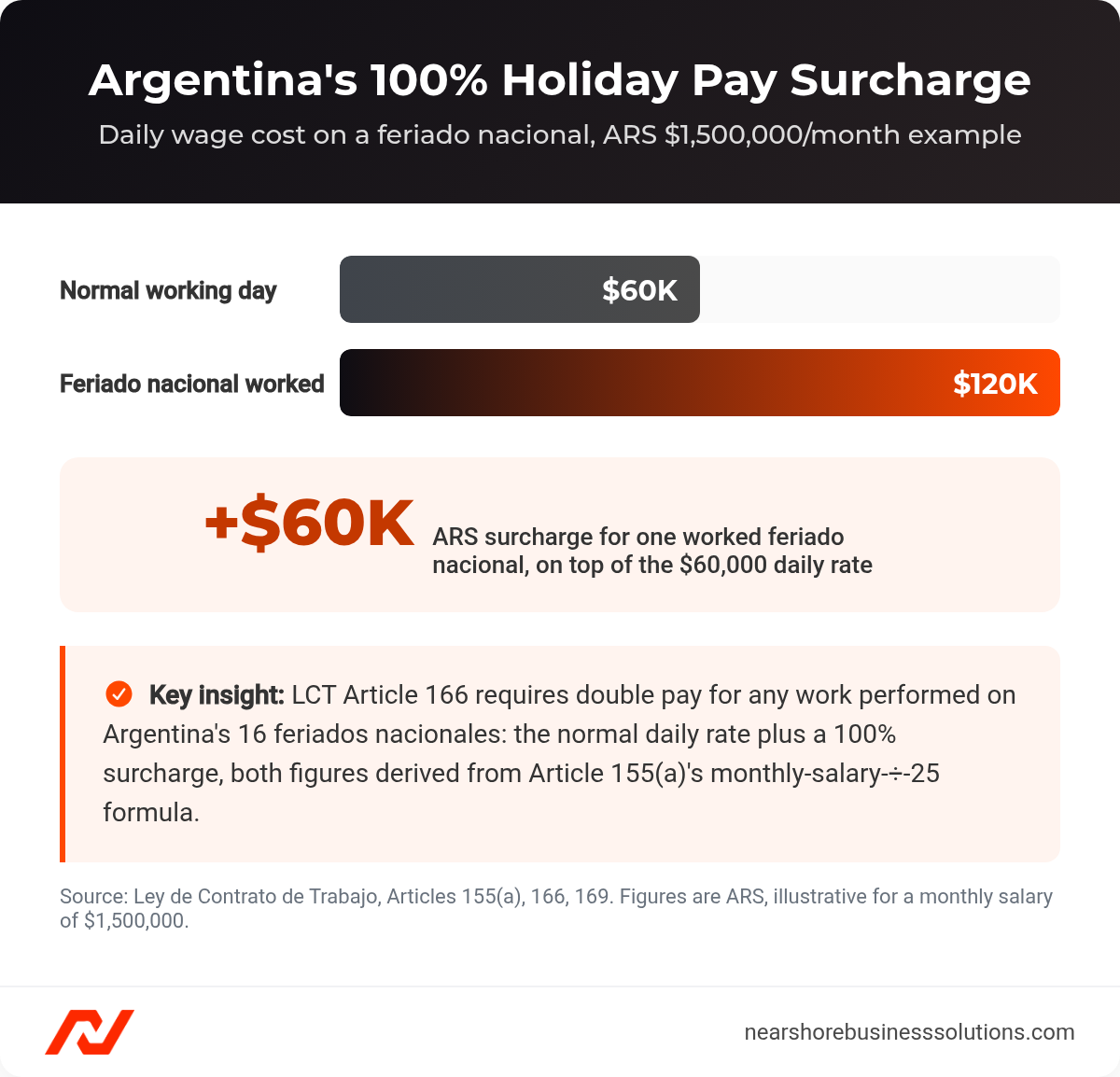
LCT Article 166 requires double pay for work on a feriado nacional: the $60,000 ARS daily rate plus a $60,000 ARS surcharge, on a $1,500,000/month salary example.
How Do You Calculate the Surcharge? Base Pay and Variable Components
LCT Article 169 sends holiday pay to Article 155 for its base calculation, and Article 155(a) fixes the daily figure for a monthly salaried employee by dividing the monthly salary by 25, reflecting the legal convention that a work month contains 25 payable days.
| Component | Calculation | Example (ARS $1,500,000/month) |
|---|---|---|
| Daily rate | Monthly salary ÷ 25 | ARS $60,000 |
| Surcharge for working the holiday | Daily rate × 100% | ARS $60,000 additional |
| Additional gross wage cost | ARS $60,000 |
Employer social security contributions apply to the surcharge as well as to base pay, so the total employer cost of the day lands above the gross wage figure in the table.
The surcharge base includes all regular, recurring compensation: base salary, habitual productivity bonuses, seniority supplements, and regular overtime averages. It excludes one-time bonuses, expense reimbursements, and aguinaldo, which is calculated separately.
A divisor of 30 understates the daily rate by 16.7%. ARS $1,500,000 divided by 30 gives ARS $50,000, against the ARS $60,000 that LCT Article 155(a) produces.
When Can Employees Refuse to Work on Argentina Holidays?
Employees can refuse in nearly every case, because LCT Article 166 treats feriados nacionales as mandatory rest days equivalent to Sundays. Employers may require work only in continuous-process industries, essential services defined by Ley 25.877, or force majeure situations, and software development is not on that list. An employer who disciplines an engineer for refusing a non-emergency holiday call risks exposure under LCT Article 242, which lets either party terminate the contract when the other’s breach amounts to injuria grave enough to make the relationship untenable.
How Does the Surcharge Apply to Remote Teams Across Time Zones?
The surcharge applies the moment work crosses into the Argentine calendar day of the holiday, regardless of what time it is in the requesting time zone. A deployment initiated at 11:00 PM ET on July 8 crosses into July 9, Argentine Independence Day, the moment midnight strikes in Buenos Aires (ART, UTC-3). Argentine labor law applies the law of the place where the work is performed, and Argentina does not observe daylight saving time.
The LCT makes the day the unit of obligation: one hour of incident response at 1:00 AM ART on July 9 triggers the same surcharge as a full 8-hour workday.
Three rules keep cross-timezone teams compliant: block pre-holiday deploys that could extend past the ART midnight boundary, configure on-call tools like PagerDuty or Opsgenie with location-aware holiday calendars, and mark async messages “non-urgent, respond after the holiday.”
Companies that engage Argentine talent through an Employer of Record shift this compliance burden to the EOR, which applies the correct holiday calendar and surcharge automatically. The client still budgets for the surcharge cost, but no longer tracks LCT Article 166 in-house.
How Do Public Holidays in Argentina Impact Sprint Planning and Release Cycles?
Argentina’s 2026 calendar yields 243 working days. Start from 365 days, subtract 104 weekend days, subtract the 15 feriados nacionales that fall on a weekday, and subtract the 3 tourism days, all three of which fall on weekdays. A US team on the 11-day federal calendar gets 250 working days in 2026, since every one of the 11 federal holidays is observed on a weekday. July 4 falls on a Saturday in 2026 and the federal observance moves to Friday, July 3. The gap is 7 days, or 2.8%, before accounting for PTO differences. The impact is not spread evenly across the year.
Which 2026 Months Have the Highest Holiday Density?
Six months carry two or more non-working weekdays. The percentage is the share of that month’s weekdays lost:
| Month | Non-Working Weekdays | Working Days Lost | Key Dates |
|---|---|---|---|
| December | 3 | 13.0% | December 7 tourism day, Immaculate Conception, Christmas |
| February | 2 | 10.0% | Carnival Monday and Tuesday |
| May | 2 | 9.5% | Labor Day, May Revolution Day |
| March | 2 | 9.1% | March 23 tourism day, Day of Remembrance |
| April | 2 | 9.1% | Veterans & Malvinas Day, Good Friday |
| July | 2 | 8.7% | Independence Day, July 10 tourism day |
September is the only month in 2026 with no non-working weekday at all.
On a two-week sprint cadence starting Monday, January 5, five sprints lose 2 days each, a 20% capacity hit: Feb 16 to Mar 1 (Carnival), Mar 16 to Mar 29 (tourism day and Day of Remembrance), Mar 30 to Apr 12 (Malvinas Day and Good Friday), Jul 6 to Jul 19 (Independence Day and the July 10 tourism day), and Dec 7 to Dec 20 (tourism day and Immaculate Conception). Seven more sprints lose 1 day each, a 10% capacity hit.
How Do You Build a Holiday-Aware Capacity Plan for Argentine Teams?
Build the plan in five steps, starting at the calendar year’s kickoff:
- Overlay every Argentine holiday from the Ley 27.399 calendar, plus the tourism days from that year’s resolution, on shared team calendars at the start of the year.
- Adjust sprint-level team capacity in Jira or an equivalent tool to reflect the lost days above, so sprint commitments stay realistic.
- For severely impacted periods like Carnival or the December 7 to December 8 pair, replace the fragmented 2-week sprint with a 1-week cleanup sprint or a 3-week sprint.
- Plan release freezes around the major holiday clusters, particularly the weeks of March 23, April 2, and December 7.
- Design staggered on-call rotations so US team members cover major Argentine holidays and vice versa.
Set sprint commitments against 243 days, and price any holiday work you deliberately schedule at the LCT Article 166 rate.
An Argentina hire placed through NBS carries savings of 40-70% by role, backed by 94% client retention, a replacement rate under 2%, and first vetted candidates in 3 business days.
Get a custom Argentina hiring quote to see the fully loaded cost for the specific role and seniority you need to fill.
Frequently Asked Questions About Argentina Public Holidays
Do Argentine employees get paid for holidays they do not work?
Yes. Under LCT Article 166, a feriado nacional is a paid day off. Employees receive their normal daily wage without working, the same treatment as a Sunday.
What happens when a holiday falls during an employee’s vacation leave?
LCT Article 150 counts annual leave in días corridos, running days that include weekends and holidays. A feriado nacional that falls inside the vacation period is already inside that count, so it does not add a day to the leave.
Do independent contractors (monotributistas) get paid holidays?
No, not by law. The LCT applies only to employees under a formal employment relationship (relación de dependencia). Contractor agreements can stipulate paid holidays as a contractual term, but nothing in Argentine law requires it.
Does the 100% surcharge apply to part-time and hourly workers?
Yes, on a proportional basis. Part-time employees receive holiday pay proportional to their normal scheduled hours, and hourly workers receive pay for the hours they would have normally worked that day.