
Hiring contractors in Latin America saves 30-70% on loaded labor costs, but misclassification penalties reach $224,000 per worker in Mexico and over 300,000 reclassification lawsuits hit Brazil in 2024 alone.
Contractors onboard in 48-72 hours versus 2-4 weeks for full-time employees through an EOR. Senior developers in Mexico City, Bogota, Buenos Aires, Sao Paulo, and Santiago cost $53,000-$100,000 annually, 50-65% less than US equivalents. The employment model you choose determines your legal liability, IP ownership, and total compensation costs.
This guide covers LATAM classification tests by country, cost multipliers for each model, misclassification penalties, IP risk, and a decision framework for seed-stage through enterprise companies.
What Is the Difference Between a Contractor and a Full-Time Employee in LATAM?
The difference is not just contractual. It is legal, fiscal, and operational. Latin America’s “Principle of Primacy of Reality” means courts classify a working relationship based on actual conditions, not what your contract says.
How Does LATAM’s “Primacy of Reality” Doctrine Work?
LATAM courts examine four conversion triggers to determine employment status: exclusivity (worker depends on you for 100% of income), integration (company email, Slack access, performance reviews), supervision (you dictate process vs. output), and duration (6-9+ months signals permanent need). If any of these indicators exist, courts will classify the relationship as employment, even if the contract says “independent contractor.”
Brazil saw 300,000 contractor-to-employee reclassification lawsuits in 2024. The “Pejotizacao” practice, where individuals use legal entities (PJ) to avoid employment taxes, is under review by the Brazilian Supreme Court for tech roles in 2025.
What Are the Core Legal Differences Between Contractors and Employees in LATAM?
Employees receive mandatory 13th-month salary (Aguinaldo or Prima), vacation premiums, severance accruals, and health and pension contributions. Total loaded compensation runs 1.05x-1.80x base salary depending on country. Contractors manage their own taxes, receive no statutory benefits, and retain autonomy. They also retain “moral rights” on intellectual property under civil law, creating ownership complications for US tech companies.
Contractors also onboard faster. A contractor can start work in 48 hours. An EOR employee requires 2-4 weeks for contract drafting and benefit enrollment. A direct hire through a local entity requires 3-6 months of entity setup first. Speed favors contractors; legal protection favors employees. The same tradeoff shapes the broader question of choosing between an EOR and direct hiring when you formalize a role.
The table below summarizes the four key legal dimensions:
| Dimension | Independent Contractor | Full-Time Employee |
|---|---|---|
| Benefits | None (except Chile) | 13th month, vacation, severance |
| IP Ownership | Contractor retains moral rights | Employer owns by default |
| Tax Responsibility | Contractor self-manages | Employer withholds and remits |
| Termination | Contract expiration | Statutory severance required |
What Are the Legal Requirements for Contractors Across LATAM?
Independent contractors must demonstrate genuine autonomy, issue proper tax invoices, and avoid integration into core operations. Each country applies a different classification test.
How Do the Five Major LATAM Countries Classify Contractors?
Mexico uses a “subordination” test: if you control when and how work occurs, the relationship is employment. The 2021 Labor Outsourcing Reform prohibits subcontracting for core corporate activities, so hiring a developer as a contractor on your primary product is high-risk. These classification rules are one reason US companies weigh EOR and entity options carefully, as our guide on how US companies hire in Mexico explains. Mexico’s SIQAL portal (launched September 2025) now lets workers report misclassification anonymously, marking a new enforcement era.
Brazil applies a four-pronged CLT test: personal service, habituality, payment, and subordination. PJ contractors must operate as registered legal entities. Labor courts are historically pro-worker.
Argentina evaluates technical, economic, and legal dependence under Ley 20.744. The Milei administration removed specific fines for defective registration in 2024-2025, but fundamental reclassification risk remains.
Colombia’s Law 2466 (2025) made indefinite-term contracts the mandatory default for ongoing roles, significantly narrowing contractor use. The workweek reduces to 42 hours by 2026, increasing overtime costs.
Chile applies subordination and dependency tests. Laws N 21.220 and 21.133 require even independent contractors to contribute to social security through the “Boleta de Honorarios” system. Chile is the only country where contractors have mandatory benefits.
What Contract Terms Are Required for Compliant Contractor Engagements?
Four practices maintain contractor compliance across LATAM:
- Deliverable focus: Contracts must reference project milestones and “Net-30” invoice terms, never “monthly salaries”
- Equipment autonomy: Contractors must provide their own laptops and home-office equipment. US-owned hardware signals employment status
- Fixed terms: Use 3-6 month contracts with clear project scope, not indefinite arrangements
- Proper invoicing: Brazil requires PJ registration and Nota Fiscal (NF-e). Mexico requires RFC tax ID and CFDI 4.0 invoices. Argentina uses Factura E. Chile uses Boleta de Honorarios
Non-resident withholding taxes are substantial: Mexico 10-25% ISR, Brazil 15-25% IRRF, Argentina 31.5%, Colombia 10-11% Retefuente, Chile 16-35%. US companies must collect Form W-8BEN from contractors to avoid 30% US withholding.
What Do Full-Time Employees in LATAM Cost?
Full-time employment adds 30-70% to base salary through mandatory benefits and payroll taxes. EOR services handle compliance but add $299-$1,000 per month per employee.
What Are the Payroll Tax Rates by Country?
Chile has the lowest employer burden in the region at 5-8.5%. Brazil carries the highest at 34-37%, including 20% INSS and 8% FGTS. Mexico’s IMSS and Infonavit contributions run 36-44%.
| Country | Employer Tax Rate | Key Components | Cost Multiplier |
|---|---|---|---|
| Brazil | 34-37% | INSS 20%, FGTS 8% | 1.65x-1.80x |
| Mexico | 36-44% | IMSS, Infonavit | 1.36x-1.44x |
| Colombia | 30-35% | Pension, Health | 1.35x-1.40x |
| Argentina | 23-27% | Social Security | 1.40x-1.50x |
| Chile | 5-8.5% | Pension, Unemployment | 1.05x-1.09x |
What Mandatory Benefits Apply to Full-Time Employees?
All five countries require 13th-month salary paid in two installments. Brazil adds a 1/3 vacation bonus and 8% FGTS severance fund. Mexico mandates a 25% vacation premium and 10% profit sharing (PTU). Colombia requires a mandatory $50/month Connectivity Allowance for remote workers earning under two minimum wages.
Remote work obligations add further costs. Argentina’s Law 27.555 requires providing all hardware, software, and internet and electricity reimbursement. Mexico requires proportional utility coverage for employees working over 40% remotely. These employer duties are worth factoring in when hiring remote developers in Mexico, which our practical guide walks through step by step. Chile mandates tools, maintenance, and internet and power allowances.
How Does Employee Termination Work in LATAM?
LATAM provides extensive job security versus US “at-will” principles. Termination costs run 1-3 months’ salary minimum plus accrued benefits. Colombia grants protected status to single mothers and ill workers, increasing complexity. Argentina’s severance calculations are complicated by inflation and currency controls. Brazil’s termination complexity ranks the highest in the region.
Unlike the US, LATAM employers cannot terminate without cause without paying statutory severance. Notice periods typically run 30 days minimum across the five major markets. Wrongful termination claims can add legal fees, reinstatement orders, and additional back-pay obligations.
Misclassified contractors become entitled to back-payment of all statutory severance from day one of the relationship upon reclassification.
How Do Contractor and Employee Costs Compare Across LATAM?
A $70,000 contractor costs exactly $70,000. The same role as a full-time employee costs $73,500-$126,000 annually depending on country, before EOR fees.
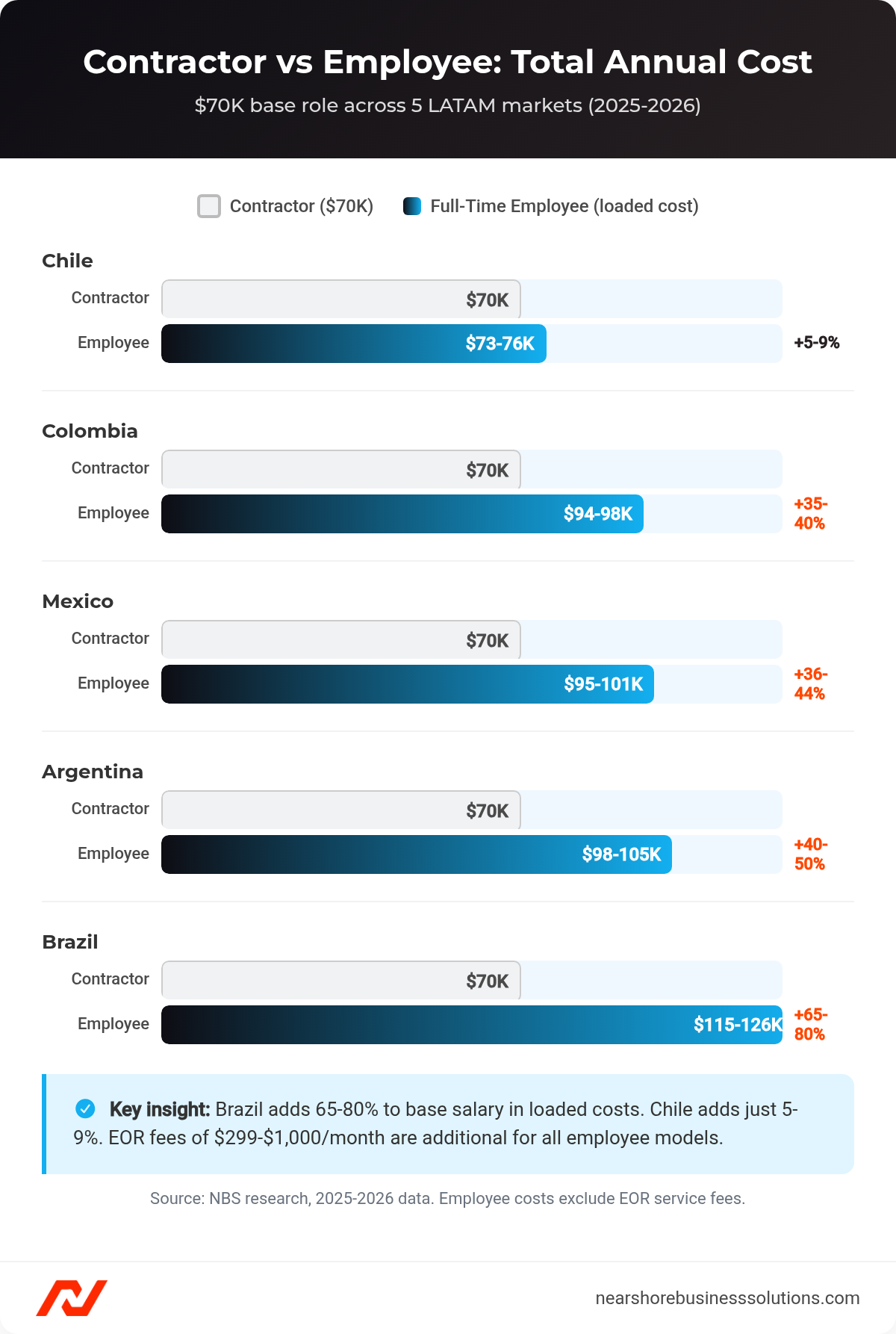
Total annual cost for a $70K LATAM role: contractor vs full-time employee by country.
What Are the Total Annual Costs by Country for a $70k Role?
Senior developers in LATAM cost 50-65% less than US equivalents ($155,000-$210,000 for a senior engineer). The table below shows 2025-2026 benchmarks plus loaded employment costs:
| Country | Senior Dev Salary | Employee Cost Multiplier | Total at $70k Base | EOR Fees Additional |
|---|---|---|---|---|
| Mexico | $66k-90k | 1.36x-1.44x | $95k-101k | $299-$1,000/mo |
| Brazil | $53k-75k | 1.65x-1.80x | $115.5k-126k | Highest in region |
| Argentina | $55k-72k | 1.40x-1.50x | $98k-105k | $299-$699/mo |
| Colombia | $54k-72k | 1.35x-1.40x | $94.5k-98k | $299-$699/mo |
| Chile | $61k-100k | 1.05x-1.09x | $73.5k-76.3k | $299-$699/mo |
FinTech and AI specialists command premiums: $80,000-$110,000 in Chile, $82,000-$95,000 in Mexico. SaaS and HealthTech roles show the highest year-over-year wage growth across the region. When the shortlist narrows to the region’s two largest markets, our Colombia vs Mexico nearshore development guide compares salaries, talent pools, and timezone fit.
For companies hiring in Colombia, see our guide to hiring software developers in Latin America for a full breakdown of engagement models and cost structures.
What EOR Fees Should You Budget?
EOR services run $299-$699/month flat rate or 10-15% of gross payroll. Premium firms charging $600-$1,000/month provide stronger IP protection and local legal support. Brazil’s fiscal complexity commands the highest EOR fees in the region. Variable costs include FX markups of 1-5%, setup fees over $500, and equipment procurement management.
What Are the Misclassification Risks When Hiring Contractors in LATAM?
Misclassification penalties range from $600 to $224,000 per worker. Brazil processes 4 million+ labor cases annually. The Primacy of Reality doctrine means your actual relationship determines classification, not your contract.
What Penalties Apply for Misclassification in Each Country?
| Country | Penalties | Statutory Back-Payments |
|---|---|---|
| Mexico | $9k-$224k + possible jail | 13th month, 10% PTU, vacations, IMSS taxes |
| Brazil | $600-$80k per worker | 8% FGTS, 13th month, 1/3 vacation bonus, INSS |
| Argentina | Back wages + severance | 13th month (Aguinaldo), severance, social security |
| Colombia | Up to 5,000 monthly salaries | Mandatory reclassification, health and pension |
| Chile | Inspection fines + arrears | Statutory severance, vacation pay, pension arrears |
Mexico also strips tax deductibility for non-compliant arrangements and imposes criminal liability for tax fraud. The Glovo precedent (79M euros in Spain, with similar enforcement in Colombia and Mexico) redefined “subordination” tests to include algorithmic control and sprint schedules. This is a direct warning for tech companies using standups and JIRA.
What Are the Five Most Common Misclassification Errors?
These five errors account for 80%+ of misclassification cases:
- Hiring contractors for core business functions (your primary product or service)
- Using indefinite-term contractor arrangements instead of fixed 3-6 month project scopes
- Providing company-owned hardware, software licenses, or home-office equipment
- Using “monthly salary” language in contractor agreements instead of “Net-30 invoice terms”
- Allowing contractor engagements to run beyond 6-9 months without conversion
Integration signals also trigger reclassification: providing company email, including contractors in performance reviews, or 1-on-1 career coaching. These are the same practices that build loyalty, and they also create legal liability.
How Does IP Ownership Differ Between Contractors and Employees?
US “work made for hire” doctrine does not apply in LATAM. Contractors retain “moral rights” under civil law, and those rights are inalienable. Only employees provide default employer IP ownership.
What IP Risk Do Contractors Create for US Tech Companies?
In Brazil and Chile, the creator is the first owner of inventions and software unless a written agreement specifically assigns rights with fair compensation. Without locally-compliant IP assignment clauses, US companies may find software ownership challenged in local courts.
This is the primary reason growth-stage companies formalize core engineering teams through EORs. IP risk outweighs cost savings for any role that creates proprietary software, algorithms, or data models. The moment a contractor builds something central to your product, you have an exposure that no contract override will solve under the Primacy of Reality doctrine.
A Series B company with 10 contractors in Brazil who haven’t signed locally-valid IP assignments could lose ownership claims on code built over the previous 18 months. Courts interpret IP rights broadly in favor of the creator.
Premium EOR providers ($600-$1,000/month) include local legal support for IP protection. Budget $3,000-$8,000 for annual legal review per country for IP clause drafting.
How Do Non-Compete and Data Protection Rules Work?
Non-compete clauses are generally enforceable if limited in scope, duration (6-12 months), and geography. Most jurisdictions require compensation during the restriction period. Argentina and Brazil view non-competes skeptically and require narrow drafting.
Data protection adds another compliance layer. Brazil’s LGPD, Argentina’s PDPA, Chile’s Law 19.628, and Mexico’s Federal Data Protection Law all require data processing agreements. Contractors create higher data protection risk due to reduced control. This is another factor favoring employment for roles handling sensitive data.
How Do You Choose Between a Contractor and Full-Time Employee in LATAM?
Match your engagement model to duration, project type, growth stage, headcount, and risk tolerance. The decision matrix has five variables.
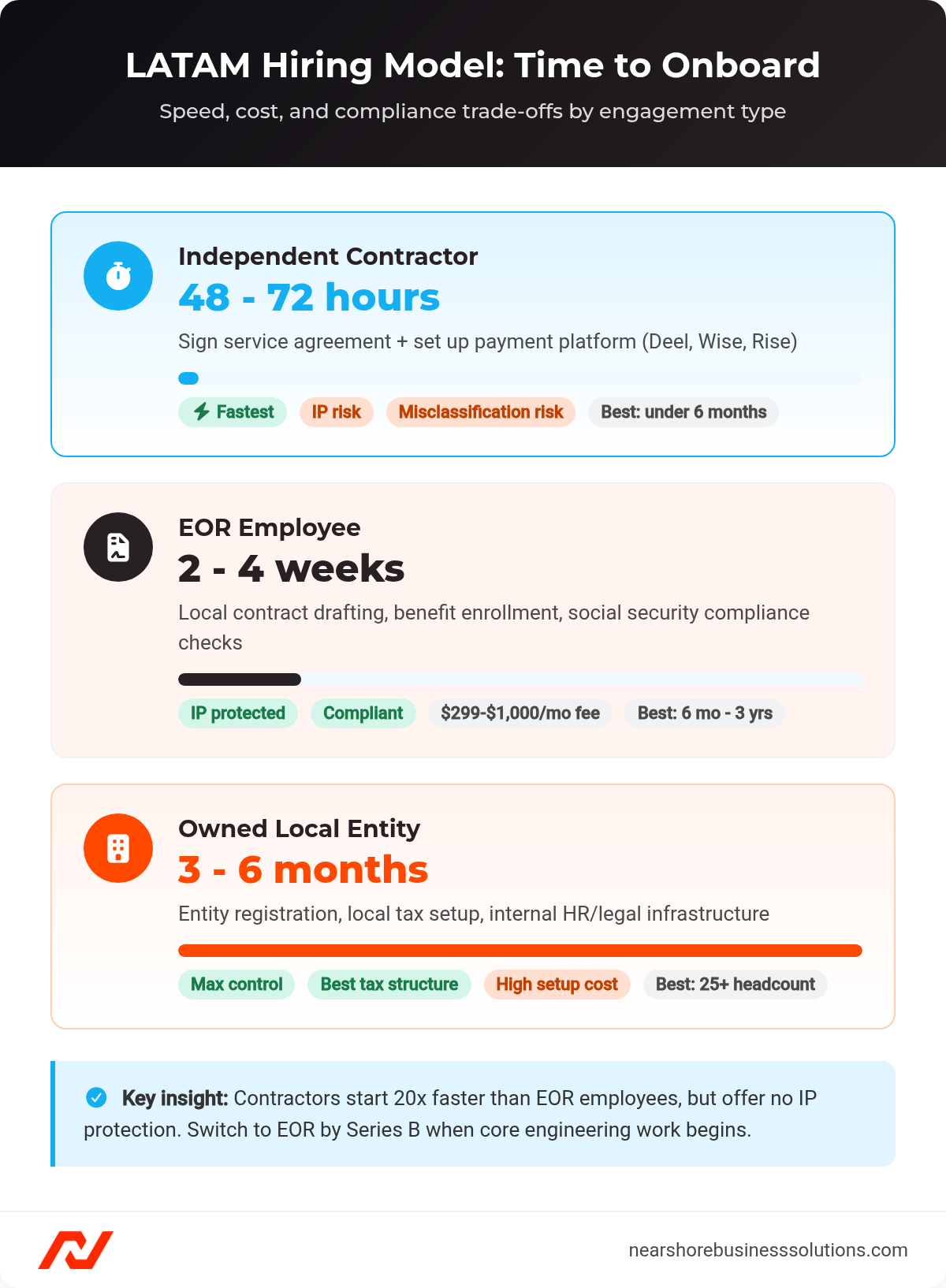
Onboarding speed and compliance trade-offs for contractor, EOR, and local entity models.
What Is the Contractor vs. Employee Decision Framework?
| Factor | Independent Contractor | EOR Employee | Owned Local Entity |
|---|---|---|---|
| Engagement Duration | Under 6 months | 6 months to 3 years | Permanent or strategic |
| Project Type | MVP, niche, or support | Core dev, team scaling | R&D center, regional HQ |
| Growth Stage | Seed or Series A | Series B or Series C | Public or mature enterprise |
| Headcount Target | 1-5 | 5-25 | 25+ |
| Risk Tolerance | High | Low | Minimal |
Seed and Series A startups should use contractors for MVPs and non-core features to prioritize speed. Series B and C companies should transition core engineering teams to EOR, because IP loss risk and misclassification exposure outweigh cost savings. Enterprises with 20-25+ headcount per country should establish local entities for optimal long-term tax structure.
How Do You Audit for Conversion Triggers?
Monitor quarterly for these four indicators:
- Exclusivity: Contractor relies on your firm for 100% of income with no other clients
- Integration: Contractor has company email, Slack access, or participates in performance reviews
- Supervision: Your managers dictate when and how work occurs, not just the output
- Duration: Engagement has exceeded 6-9 months
High-audit-risk countries (Brazil, Mexico, Colombia) require monthly reviews. Mexico’s STPS conducts granular workplace visits. Brazil’s litigation environment (4 million+ cases per year) makes compliance critical.
For companies scaling engineering teams in Mexico, see our Mexico hiring guide for REPSE registration requirements and subordination test specifics.
What Are the Key Differences Across the Five Major LATAM Markets?
Each country applies different tests, penalties, and administrative requirements. Mexico and Brazil present the highest enforcement risk. Chile presents the lowest loaded costs.
How Does Each Country’s Risk Profile Compare?
| Country | Litigation Level | Audit Risk | Termination Complexity | Primary Risk Driver |
|---|---|---|---|---|
| Brazil | Extreme (4M+/yr) | High | Very High | PJ reclassification, overtime |
| Mexico | Rising | High | High | Subordination, REPSE compliance |
| Argentina | High | Moderate | High | Severance, currency controls |
| Colombia | Moderate | High | High | Protected status workers, Law 2466 |
| Chile | Moderate | Moderate | Moderate | Workweek reduction, Boleta rules |
São Paulo has 630,000+ developers specializing in FinTech, Big Data, and Java. Mexico City has 800,000+ nationally across SaaS, Cloud, and DevOps, with USMCA protections for US companies. Buenos Aires developers show high AI and ML specialization with strong English proficiency. Bogota’s 165,000+ pool excels at full-stack and mobile at 0-hour EST overlap. Santiago’s 59,000+ developers focus on Cybersecurity and Data Engineering.
For Bogota and Medellin hiring specifics, see our Colombia hiring guide covering Law 1581 compliance, connectivity allowances, and talent hub breakdowns.
Frequently Asked Questions About Contractor vs. Employee Hiring in LATAM
These are the most common questions US tech leaders ask when evaluating contractor and employee models in Latin America.
How Long Does It Take to Onboard a Contractor vs. an Employee in LATAM?
Contractors can be onboarded in 48-72 hours. You sign a service agreement and set up a payment platform like Deel, Wise, or Rise. EOR employees take 2-4 weeks including local contract drafting, benefit enrollment, and social security compliance checks. Establishing a local entity takes 3-6 months.
Do I Need a Local Entity to Hire in LATAM?
No. EOR services act as the legal employer in each country without requiring you to establish a local entity. EOR is the standard compliance vehicle for US companies without a local footprint. You only need a local entity when headcount in a single country exceeds 20-25 employees and long-term tax optimization becomes a priority.
What Happens If I Misclassify a Contractor as an Employee?
Misclassification triggers back-payment of all statutory benefits from day one of the relationship. That includes 13th-month salary, vacation premiums, severance accruals, and social security contributions. In Mexico, you may also face criminal liability for tax fraud and lose tax deductibility for those payments. In Brazil, each worker can file individually. Over 300,000 did in 2024.
Who Owns the Software a LATAM Contractor Writes?
The contractor does, unless you have a locally-compliant IP assignment clause. LATAM civil law grants creators “moral rights” that cannot be waived by contract. In Brazil and Chile, written IP assignment with “fair compensation” is required for rights to transfer. Without locally-drafted IP clauses reviewed by local counsel, your software ownership is at risk.
How Do I Pay LATAM Contractors Compliantly?
Use Net-30 invoice terms, not monthly salary cycles. Collect Form W-8BEN from contractors to avoid 30% US withholding. Accept country-specific invoices: CFDI 4.0 in Mexico, Nota Fiscal in Brazil, Factura E in Argentina, Boleta de Honorarios in Chile, DIAN registration in Colombia. The US-Mexico income tax treaty can exempt software services from Mexican withholding, but requires precise documentation.
When Should I Convert a Contractor to Full-Time Employee?
Convert when the engagement shows any of the four triggers: exclusivity (100% income from your firm), integration (company systems access), supervision (process control vs. output), or duration (over 6-9 months). Most EOR providers facilitate contractor-to-employee transitions within 2-4 weeks. Proactive conversion costs less than defending a misclassification lawsuit.
Is Brazil’s Contractor Environment Still Viable for US Companies?
Yes, but only with proper PJ structure and legal support. PJ contractors must operate as registered legal entities and issue Nota Fiscal invoices. The Brazilian Supreme Court is reviewing PJ arrangements for tech roles in 2025. Budget for the highest EOR fees in the region and plan for 2-4x more legal support hours versus other LATAM countries.
Ready to Build Your LATAM Engineering Team?
Nearshore Business Solutions sources and vets developers from Bogota, Mexico City, Buenos Aires, Sao Paulo, and Santiago. We screen for technical skills, English fluency, and US work style fit.
Every placement includes a 90-day replacement guarantee. You receive the first pre-vetted candidates within 3 business days.
Get a free consultation to discuss your hiring needs and receive a custom quote.