
Hiring software developers in Brazil cuts senior engineering costs 65 to 82 percent versus the San Francisco Bay Area while keeping 5 to 6 hours of daily overlap with US East Coast teams.
Brazil has 500,000 to 580,000 developers (BRASSCOM), the largest pool in Latin America. A senior full-stack engineer costs about $99,000 fully loaded against roughly $195,000 in San Francisco. Tech stacks mirror US standards, and São Paulo stays at UTC-3 year-round.
This guide gives US engineering leaders the city-level salary data, the CLT compliance playbook, and the hiring-model comparison needed to make a first Brazil hire or scale the tenth. Below you will find talent-pool benchmarks, salaries by role, mandatory employer charges, and a clear EOR versus contractor versus entity decision.
Why Has Brazil Tech Talent Become the Top Nearshore Hiring Market for US Companies?
Brazil is the top nearshore market because it pairs the deepest talent pool in Latin America with strong time-zone overlap and US-aligned tech stacks. Its developer workforce of 500,000 to 580,000 professionals, per BRASSCOM and Evans Data Corporation, is the largest in the region by a wide margin. Stack Overflow’s 2023 Developer Survey ranked Brazil the 6th largest source of respondents globally, behind only the US, India, Germany, the UK, and Canada.
Three factors drive the advantage: workforce scale, time-zone fit, and stack alignment. US companies hiring at scale can also remove all local legal risk through an employer of record in Latin America.
How Does Brazil’s 500,000+ Developer Workforce Compare to Argentina, Mexico, and Colombia?
Brazil’s developer pool is two to five times larger than its nearest nearshore rivals, and its senior tier is deeper than all of them. The table below compares the four leading markets.
| Country | Est. Developer Population | Time Zone Overlap w/ US ET | Avg. English Proficiency (EF EPI 2023 Rank) | Key Differentiator |
|---|---|---|---|---|
| Brazil | 500,000 to 580,000 | 5 to 6 hours | #70 (Moderate) | Largest talent pool, strongest startup ecosystem, dominant senior engineer supply |
| Argentina | 115,000 to 140,000 | 5 to 6 hours (UTC-3) | #28 (High) | Best English in LATAM, but currency volatility and instability hurt retention |
| Mexico | 220,000 to 270,000 | 6 to 8 hours (varies by region) | #89 (Low) | Geographic proximity and USMCA alignment, but lower English fluency scores |
| Colombia | 100,000 to 130,000 | 8 hours (UTC-5 = ET) | #75 (Moderate) | Identical zone to US Eastern, growing ecosystem, but smallest senior pool of the four |
Sources: BRASSCOM 2023; Evans Data Corporation; LinkedIn Talent Insights 2024; EF EPI 2023.
Brazil’s senior talent pool, meaning engineers with 5 or more years of production experience, leads every other option. LinkedIn Talent Insights data from 2024 shows a 30 to 40 percent gap over Mexico at the senior level. That gap widens to 2 times or more over Colombia and Argentina.
Argentina’s stronger English comes with triple-digit inflation and capital controls that create retention problems. Colombia’s Eastern Time alignment is real, but its talent pool is about one-fifth the size of Brazil’s. That constraint bites when you need five senior backend engineers in the same quarter. Brazil also abolished daylight saving time in 2019 under Decree 9,772, so São Paulo stays at UTC-3 all year with no scheduling drift.
Which CS Programs at USP, UNICAMP, and ITA Fuel the Talent Pipeline?
Brazil’s universities graduate about 53,000 technology students per year, according to BRASSCOM’s 2023 talent demand study. Four institutions anchor the pipeline.
- USP (Universidade de São Paulo): ranks #1 in Latin America and inside the global top 100 for Computer Science in the 2024 QS World University Rankings.
- UNICAMP (Universidade Estadual de Campinas): holds #2 in Latin America, placing 101 to 150 globally.
- ITA (Instituto Tecnológico de Aeronáutica): Brazil’s MIT equivalent. It is hyper-selective and math-heavy, producing engineers who consistently outperform in algorithmic interviews.
- UFMG (Belo Horizonte): rounds out the top tier with strength in information retrieval, databases, and distributed systems.
Brazilian university teams regularly advance to the ICPC World Finals. HackerRank’s global skills study showed particular Brazilian strength in databases and data structures, the exact domains that matter for backend and data engineering hires.
How Much Time-Zone Overlap and Cultural Fit Does Nearshore Brazil Offer Agile Teams?
Nearshore Brazil delivers 5 to 6 hours of overlapping work time between São Paulo (UTC-3) and the US East Coast. That is enough for real-time standups, pairing, and incident response. Compare it to India at 0 to 1 hours of natural overlap or Poland at 2 to 3 hours concentrated in the US morning.
Brazilian developers also converge on the same tools US startups standardize around. Stack Overflow’s 2023 Developer Survey reports JavaScript usage at 63.3 percent, Python at 48.1 percent, TypeScript at 40.8 percent, React.js as the dominant web framework, and AWS at 51 percent cloud adoption. When a Brazilian engineer joins a US codebase, the tooling is familiar and no retraining is required.
English proficiency is stronger than the national ranking suggests. Brazil’s EF EPI rank of #70 reflects a population-wide average that includes non-tech professionals. Among software engineers with 3 or more years of international experience, functional English is standard. A 2023 industry survey of LATAM developers found that more than 40 percent of developers open to international positions rated their English as advanced or fluent. Senior engineers in São Paulo, Florianópolis, and Belo Horizonte routinely run technical discussions and sprint reviews in English.
Where Can You Find Software Developers in Brazil? A City-by-City Hiring Playbook
You can find Brazil’s software developers concentrated in six major hubs, led by São Paulo for senior supply and secondary cities for cost savings. São Paulo holds the densest engineering talent, while Florianópolis, Curitiba, Recife, Belo Horizonte, Porto Alegre, and Campinas offer 20 to 35 percent lower salaries with comparable skills.
Why Is São Paulo Latin America’s Densest Concentration of Senior Engineers?
São Paulo is the densest engineering market in Latin America, with 190,000-plus software developers and 6,000-plus tech startups. It concentrates more engineering talent than most Latin American countries hold nationwide. Nubank runs its 2,500-engineer headquarters here on Clojure, Kotlin, Python, TypeScript, React, and AWS. iFood, QuintoAndar, Loft, and Gympass draw from the same pool, while Google, Microsoft, and Amazon maintain substantial engineering offices.
The typical senior São Paulo engineer has shipped production systems handling millions of requests per day. English proficiency runs highest here among Brazilian cities. The tradeoff is cost, since São Paulo commands the country’s highest salary expectations. Even so, senior salaries represent 55 to 70 percent savings against equivalent US hires. A cost-of-living index of 28.5 (against NYC’s baseline of 100) and fixed broadband averaging 160 Mbps support reliable remote work.
Where Do Florianópolis, Curitiba, and Recife Offer 20 to 35% Lower Salaries?
Brazil’s secondary hubs offer 20 to 35 percent lower salaries than São Paulo with comparable skill levels. The table below breaks down developer population, specializations, senior salary ranges, and notable employers for each.
| City | Est. Developer Population | Key Specializations | Senior Salary Range (USD) | Notable Companies |
|---|---|---|---|---|
| Florianópolis | 20,000 to 25,000 | SaaS, marketing tech, product engineering | $32,000 to $50,000 | RD Station (TOTVS), Softplan, ArcTouch |
| Curitiba | 25,000 to 30,000 | Fintech, e-commerce, embedded systems | $34,000 to $52,000 | Ebanx, MadeiraMadeira, Contabilizei |
| Recife | 20,000 to 25,000 | AI/ML, IoT, fintech | $30,000 to $48,000 | Porto Digital tenants, CESAR, Tempest Security |
| Belo Horizonte | 35,000 to 45,000 | SaaS, mobile development, cloud infrastructure | $35,000 to $55,000 | Google (engineering center), Hotmart, Sympla |
| Porto Alegre | 25,000 to 30,000 | IT services, enterprise software, DevOps | $33,000 to $50,000 | Dell Technologies, SAP, ThoughtWorks |
| Campinas | 30,000 to 35,000 | R&D, hardware-software integration, telecom | $36,000 to $58,000 | Samsung R&D, Motorola, CI&T, CPqD |
Sources: Robert Half Brazil 2024; Porto Digital; municipal tech-sector reports.
Florianópolis earned the “Brazil’s Silicon Valley” label through density. It hosts 3,900-plus tech companies generating R$23.6 billion in annual revenue on an island of 500,000 people. Recife’s Porto Digital cluster, with 350-plus organizations across 40 hectares and state tax incentives, pushes senior salaries to $30,000 to $48,000, the strongest cost arbitrage among the six hubs. Belo Horizonte produced Hotmart, valued above $1 billion, and Google’s engineering center there validates talent quality at enterprise level.
Post-2020 remote work widened the funnel by 30 to 40 percent. Engineers who built careers at Nubank in São Paulo now live in secondary cities, keeping top-caliber skills at 15 to 25 percent lower salary expectations. For a broader regional view, see our guide to hiring software developers in Latin America.
What Does It Actually Cost to Hire Developers in Brazil? 2024 to 2025 Salary Benchmarks by Role
Hiring a developer in Brazil costs 55 to 82 percent less than an equivalent US hire, but every figure must reflect total employer cost, not base salary. Brazilian labor law under the CLT adds roughly 60 to 68 percent in mandatory charges on top of gross salary. Quoting base salary alone understates real cost by a third or more, so the figures below represent base salary plus all statutory charges.
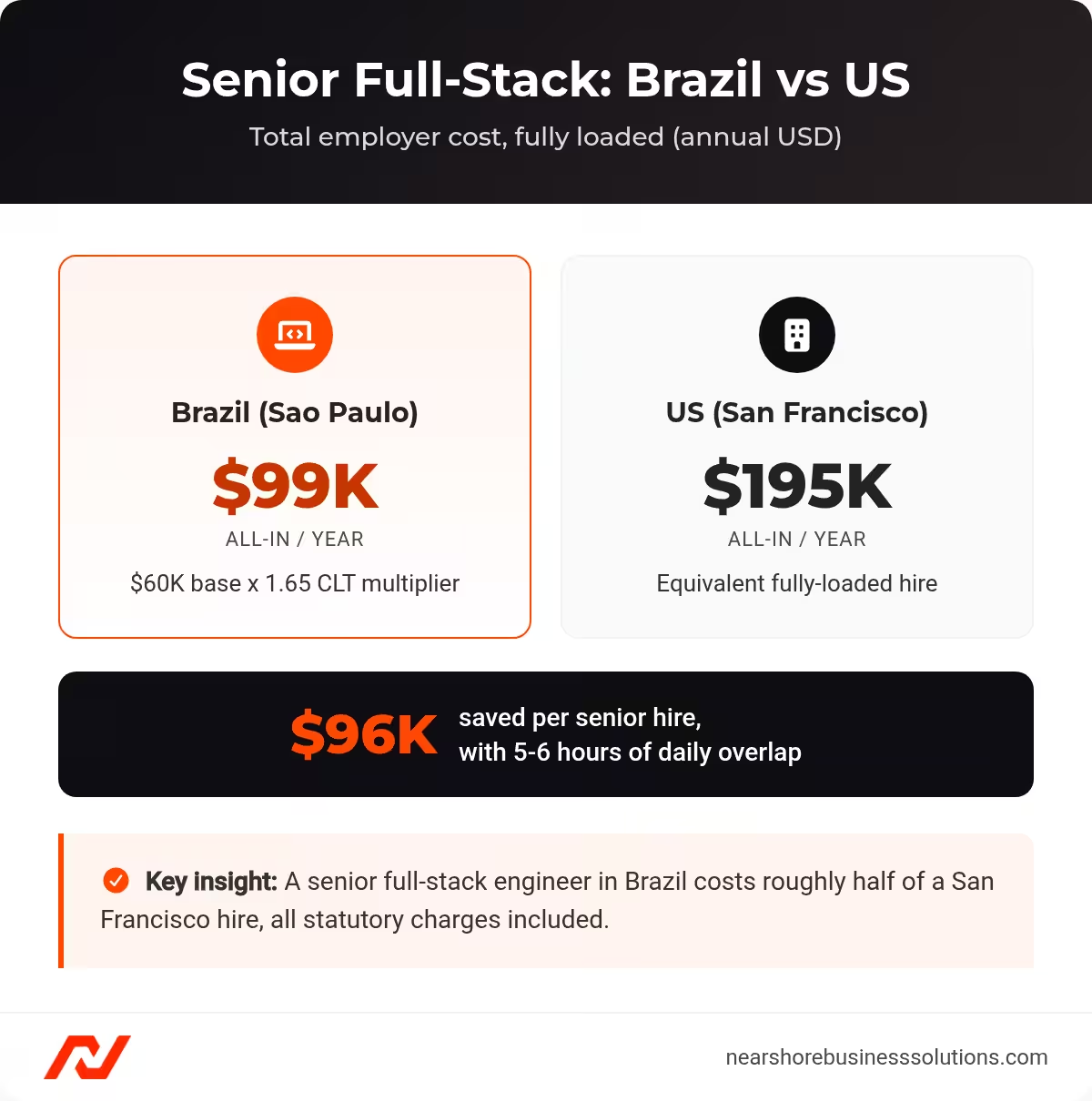
Senior full-stack developer cost in Brazil versus San Francisco, fully loaded.
What Are the Salary Ranges for Backend, Frontend, Full-Stack, and DevOps Roles?
Salary ranges run from about $18,000 for junior full-stack engineers to $140,000 for staff-level engineering managers, all as total employer cost. The table breaks down five core roles across four experience tiers.
| Role | Junior (0 to 2 yrs) | Mid-Level (3 to 5 yrs) | Senior (6 to 10 yrs) | Staff/Principal (10+ yrs) |
|---|---|---|---|---|
| Full-Stack (React + Node) | $18,000 to $30,000 | $30,000 to $48,000 | $48,000 to $70,000 | $70,000 to $95,000 |
| Mobile (iOS/Android) | $20,000 to $32,000 | $32,000 to $50,000 | $50,000 to $75,000 | $75,000 to $100,000 |
| DevOps/SRE | $22,000 to $35,000 | $35,000 to $55,000 | $55,000 to $80,000 | $80,000 to $110,000 |
| Data Engineer | $20,000 to $33,000 | $33,000 to $52,000 | $52,000 to $78,000 | $78,000 to $105,000 |
| ML Engineer | $25,000 to $40,000 | $40,000 to $65,000 | $65,000 to $90,000 | $90,000 to $120,000 |
| Engineering Manager | N/A | N/A | $70,000 to $100,000 | $100,000 to $140,000 |
Sources: Robert Half Brazil 2024; 2023-2024 global hiring and payroll platform data. All figures are total employer cost in USD, annualized.
ML Engineers command a 35 to 45 percent premium over full-stack roles at every tier, because Brazil’s AI/ML supply has not caught up with demand. DevOps and SRE salaries have climbed 18 to 22 percent since 2022. Engineering Managers form the thinnest layer of the talent pyramid, so budget 75 to 120 day search timelines for that role.
What Is the True Cost of CLT Employment, Including 13th Salary, FGTS, and INSS?
The true cost of CLT employment is your gross monthly salary multiplied by about 1.65. That multiplier covers social security, severance funding, the 13th salary, vacation pay, and standard benefits. The table breaks down each component.
| Component | % of Gross Salary | Notes |
|---|---|---|
| INSS (Employer Social Security) | ~20% (capped) | Employer-funded, separate from the employee’s own 7.5 to 14 percent deduction |
| FGTS (Severance Guarantee Fund) | 8% | Monthly deposits into a government-managed employee account |
| 13th Salary (Décimo Terceiro) | 8.33% | A constitutional right, not a bonus. Paid in two installments |
| Vacation + 1/3 Constitutional Bonus | ~11.11% | 30 days paid vacation plus a bonus equal to one-third of monthly salary |
| Meal Voucher (Vale Refeição) | ~2 to 4% | R$700 to R$1,200 per month. Not legally mandatory but functionally universal in tech |
| Health + Life Insurance | 2 to 5% | Coverage quality directly affects offer competitiveness |
| Total Estimated Employer Burden | ~60 to 68% | Varies by salary level, city, and benefits package |
A few obligations sit outside the multiplier. Maternity leave runs 120 days, extendable to 180 under the Empresa Cidadã program, with INSS reimbursing the salary. Paternity leave is 5 days standard, extendable to 20. Profit sharing, known as PLR, typically runs 1 to 3 months of salary per year. It is tax-advantaged and exempt from INSS and FGTS, which makes it more efficient than base-salary increases for delivering variable compensation.
How Do Brazil Developer Salaries Compare to the US and Other Nearshore Markets?
Brazil developer salaries land 65 to 82 percent below San Francisco rates while keeping more daily overlap than India or Eastern Europe. The table compares senior full-stack all-in cost across seven markets.
| Location | Senior Full-Stack All-In (USD) | Cost Savings vs. US (SF) | Time Zone Overlap w/ US ET |
|---|---|---|---|
| US (SF Bay Area) | $195,000 to $280,000 | Baseline | Same zone |
| Brazil (São Paulo) | $48,000 to $70,000 | 65 to 75% | 5 to 6 hours |
| Brazil (Secondary Cities) | $32,000 to $55,000 | 72 to 82% | 5 to 6 hours |
| Eastern Europe (Poland) | $55,000 to $85,000 | 57 to 70% | 2 to 3 hours |
| India | $25,000 to $50,000 | 75 to 87% | 0 to 1 hours |
| Colombia | $35,000 to $55,000 | 70 to 80% | 8 hours (identical to ET) |
| Argentina | $30,000 to $50,000 | 74 to 82% | 5 to 6 hours |
Sources: Robert Half 2024; 2023-2024 global hiring and payroll platform data.
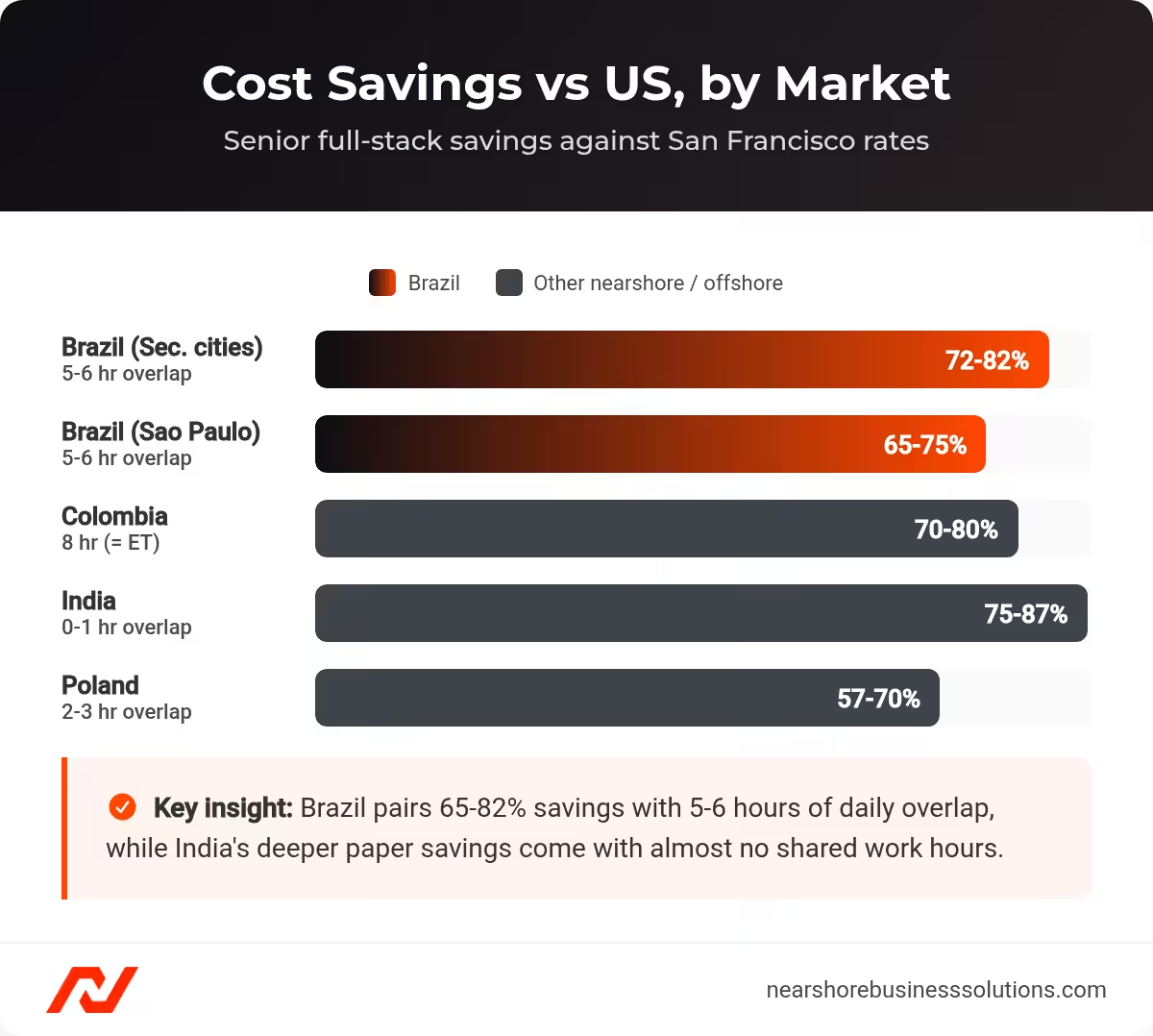
Developer cost savings versus US rates by nearshore and offshore market.
Brazil occupies the cost-efficiency sweet spot. It delivers 65 to 82 percent savings over Bay Area hires with enough daily overlap to sustain real-time standups, pairing sessions, and incident response. India shows deeper savings on paper, but it imposes operational overhead that erodes the advantage for teams that need more than two hours of daily collaboration.
What CLT Labor Law Must US Companies Understand Before Hiring in Brazil?
US companies must understand that Brazil’s CLT (Consolidação das Leis do Trabalho) is one of the most employee-protective labor frameworks in the world, and at-will employment does not exist. Contracts default to indefinite terms, terminations carry mandatory severance, and misclassification triggers retroactive liability. The two subsections below cover contract and termination rules first, then misclassification risk.
What Employment, Probation, and Termination Rules Eliminate At-Will Firing in Brazil?
Brazil eliminates at-will firing through indefinite-term contracts and mandatory severance on any termination without cause. Six rules define the framework.
- Indefinite-term contracts by default. CLT contracts have no end date unless explicitly structured as fixed-term, which is rare and restricted.
- 90-day probation period (45 plus 45). An initial 45-day trial, renewable once for another 45 days. Termination during probation avoids the 40 percent FGTS penalty but still requires payment of accrued rights.
- 44-hour standard work week. Overtime is paid at 150 percent of the normal hourly rate. Most tech companies use flexible schedules or hour-bank systems for senior roles.
- Notice period formula. 30 days plus 3 days per year of service, capped at 90 days. It is often paid in lieu of work.
- 40 percent FGTS penalty on termination without cause. The employer pays 40 percent of the total accumulated FGTS balance, a sum that grows with every month of employment.
- Total severance example. Terminating a developer earning R$20,000 per month after 2 years involves an FGTS balance of R$38,400, a 40 percent penalty of R$15,360, a notice period of about R$24,000, plus prorated 13th salary and unused vacation. Total severance easily exceeds 3 to 4 months of salary.
What Happens If You Misclassify a Contractor as an Employee in Brazil?
If you misclassify a contractor as an employee in Brazil, you owe all backdated CLT benefits for the entire engagement, plus fines and legal fees. A relationship that shows hallmarks of employment, such as fixed schedule, exclusivity, subordination, and integration into company structure, lets the worker file a claim with Brazil’s labor courts, the Justiça do Trabalho.
If the court recognizes the employment relationship, the company owes backdated FGTS, 13th salary, vacation, and INSS contributions for the whole period, plus penalties. This is the single biggest compliance risk for foreign companies hiring in Brazil, and it is actively enforced.
How Do You Choose Between EOR, Contractor, and Local Entity to Hire Developers in Brazil?
You should choose an employer of record for fast, low-risk hires of 1 to 15 developers, contractors only for genuine project-based work, and a local entity once headcount justifies the overhead. The right model depends on speed-to-hire, risk tolerance, and team size. The two subsections below cover the EOR path and the contractor path.
When Is an Employer of Record the Fastest, Lowest-Risk Path to Your First Brazil Hire?
An employer of record is the fastest, lowest-risk path when you need to hire in days, not months, with no Brazilian entity. An EOR legally employs the developer on your behalf and handles all CLT compliance, payroll, benefits, and tax filings. EOR fees typically run $599 to $799 per month per employee.
A senior developer at $6,000 per month base costs about $6,000 in salary, plus $3,900 in CLT burden, plus a $600 EOR fee, for roughly $10,500 per month all-in. This model fits teams of 1 to 15 developers where speed and zero local legal footprint matter most. NBS handles Brazil hires through an employer of record in Latin America so you skip entity setup entirely.
Why Do Independent Contractors (PJ) Carry Significant Misclassification Liability?
Independent contractors carry significant misclassification liability because the PJ relationship must be genuinely autonomous to stay legal. Contractors operating as PJ (Pessoa Jurídica) are common in Brazil and often preferred by developers for tax efficiency. The arrangement requires no fixed hours, no exclusivity, and a defined project scope.
For ongoing full-time roles where the developer attends daily standups, uses company tools, and reports to a manager, the PJ structure creates the misclassification exposure described above. Use contractors for defined-scope project work. Use CLT employment, directly or through an EOR, for integrated team members.
Frequently Asked Questions About Hiring Software Developers in Brazil
How Long Does It Take to Hire a Developer in Brazil?
It takes under 2 weeks to hire a vetted developer through a nearshore partner, with first pre-vetted candidates within 3 business days, versus 45-plus days for a typical US hire. Engineering Manager and other thin-supply roles can take 75 to 120 days because the senior pool is smaller.
What If a Developer Does Not Work Out?
A 90-day probation period, structured as 45 plus 45 days, lets you part ways before the 40 percent FGTS penalty applies. Working through an EOR or staffing partner, you can request a replacement without managing the termination process yourself.
Do I Need a Local Entity to Hire in Brazil?
No, you do not need a local entity. An employer of record legally employs developers on your behalf and handles CLT compliance, so you can hire in days without registering a Brazilian company. Most teams only open an entity once headcount makes the fixed overhead worthwhile.
How Do I Pay Developers in Brazil?
You pay developers through your EOR or staffing partner, which runs local payroll in Brazilian reais and remits INSS, FGTS, and the 13th salary on schedule. You receive a single monthly invoice in USD covering salary, statutory charges, and the service fee.
Should I Hire Contractors or Full-Time Employees in Brazil?
You should hire full-time employees, directly or via an EOR, for any integrated team member who works fixed hours under your direction. Reserve PJ contractors for genuinely autonomous, project-scoped work to avoid misclassification claims in the labor courts.
What Is the Difference Between Nearshore and Offshore for Brazil?
Nearshore means hiring in a similar time zone, and Brazil gives US teams 5 to 6 hours of daily overlap with the East Coast. Offshore options like India offer 0 to 1 hours of overlap, which slows real-time collaboration despite lower headline rates.
Ready to Build Your Brazil Engineering Team?
Nearshore Business Solutions sources and vets developers from São Paulo, Florianópolis, Belo Horizonte, and Brazil’s other major hubs. We screen for technical skills, English fluency, and US work-style fit.
Every placement includes a 90-day replacement guarantee, and you receive your first pre-vetted candidates within 3 business days. Start with our hire in Brazil service to get a city-level salary benchmark and a compliant hiring model for your roles.
Get a free consultation to discuss your hiring needs and receive a custom quote.